 Alternate History AI
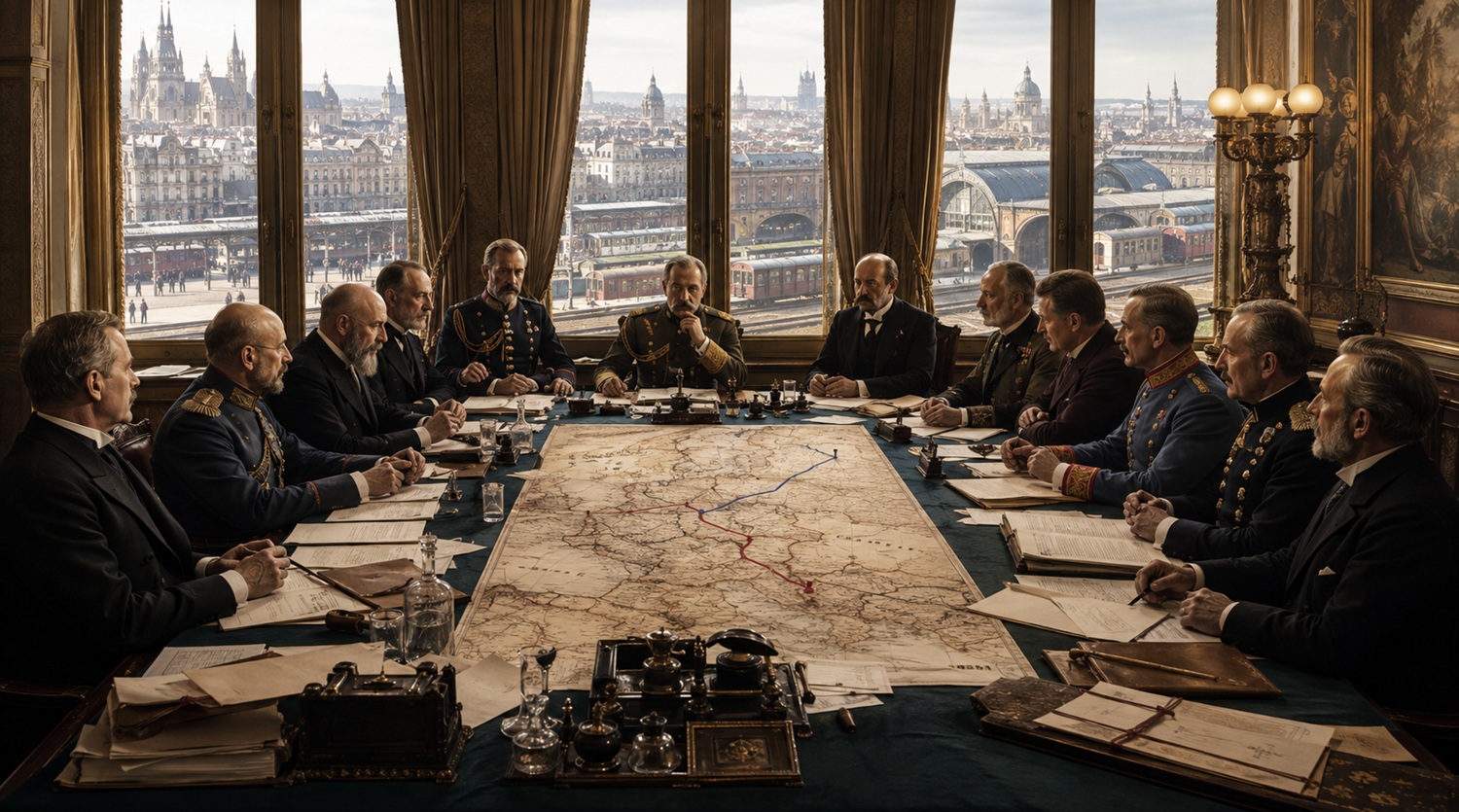
On June 28, 1914, Archduke Franz Ferdinand, heir to the Austro-Hungarian throne, and his wife Sophie were assassinated during a visit to Sarajevo.
Five weeks later, the major powers of Europe were at war.
It is tempting to draw a straight line between those events:
Franz Ferdinand is assassinated → World War I begins.
But history was not that automatic.
The Sarajevo assassination was the trigger for the crisis of 1914, not a sufficient explanation for why millions of Europeans soon found themselves fighting from Belgium to the Balkans. Europe entered the summer of 1914 carrying unresolved disputes over alliances, nationalism, imperial competition, military planning, the Balkans, the future of Austria-Hungary, German power, Russian ambitions, French security, and the declining ability of the great powers to resolve crises collectively. Historians continue to debate precisely how responsibility should be distributed, but the major decisions taken in Vienna, Berlin, St. Petersburg, Paris, and elsewhere during the July Crisis turned an Austro-Serbian confrontation into a European war.
That distinction opens one of the largest counterfactual questions in modern history:
What if the July Crisis had been contained?
Suppose Franz Ferdinand is still assassinated.
Suppose Austria-Hungary still confronts Serbia.
Suppose the alliances, armies, rivalries, nationalism, colonial empires, and domestic tensions of 1914 all remain.
But suppose the decisions made during the final week of July prevent a continental war.
There is no invasion of Belgium.
No four years of trench warfare on the Western Front.
No wartime collapse of the Russian, German, Austro-Hungarian, and Ottoman empires in 1917–1918.
No Treaty of Versailles in 1919.
No political aftermath identical to the one that helped make Adolf Hitler's rise possible.
No twentieth century as we know it.
That does not mean Europe lives happily ever after.
A world without World War I could be substantially less violent in the short term while remaining dangerously unstable in the long term.
The most realistic alternate history is therefore not a utopia.
It is a world in which Europe receives another chance to deal with the problems that it failed to solve in 1914.
Europe in 1914: Peaceful on the Surface, Dangerous Underneath
Europe had avoided a general great-power war for decades before 1914, but that did not mean the international system was tranquil.
The years before the First World War had seen repeated crises involving Morocco, the Balkans, Austria-Hungary, Russia, Germany, France, Britain, the Ottoman Empire, and the competition among European imperial powers. The Balkan Wars of 1912–1913 had transformed southeastern Europe only months before the Sarajevo assassination. Colonial warfare was also common even when Europe's major states were not fighting one another directly.
The continental powers increasingly operated within two broad diplomatic alignments.
Germany was closely allied with Austria-Hungary.
France was allied with Russia.
Britain had developed ententes with France and Russia without creating a simple automatic obligation to fight every war involving them. British Foreign Secretary Edward Grey continued to favor diplomatic negotiation during the July Crisis, and Britain had not entered July 1914 with an automatic commitment to go to war over Serbia.
The problem was that military planning made a localized crisis difficult to contain once mobilization began.
Germany's war planning anticipated that a conflict involving Russia could also require rapid action against France. German planning therefore created powerful pressure for early decisions rather than a slow diplomatic response.
Russia, meanwhile, viewed another humiliation in the Balkans as politically dangerous after previous setbacks.
Austria-Hungary increasingly regarded Serbian nationalism as a threat to the monarchy itself.
A crisis between Vienna and Belgrade therefore had the potential to pull Russia toward Serbia, Germany toward Austria-Hungary, France toward Russia, and eventually Britain into a wider conflict.
The assassination supplied that crisis.
It did not dictate its outcome.
Sarajevo: Trigger, Not Sole Cause
Gavrilo Princip, a Bosnian Serb nationalist, assassinated Franz Ferdinand and Sophie in Sarajevo on June 28, 1914. The assassination became the immediate catalyst for the July Crisis.
Austria-Hungary's leadership decided that Serbia had to be confronted.
Germany then gave Vienna the famous assurance commonly called the “blank cheque”—support for Austria-Hungary even if its action against Serbia led to wider complications. Historians disagree over exactly how German leaders understood the risks, but German support strengthened the position of those in Vienna who favored force.
Austria-Hungary delivered an extraordinarily severe ultimatum to Serbia on July 23.
The terms were designed in ways that made full Serbian acceptance difficult, and Austro-Hungarian representatives in Belgrade had instructions to break relations even if the Serbian response was conciliatory.
Serbia nevertheless accepted important parts of the demands while resisting provisions that would allow Austro-Hungarian authorities to participate directly in Serbian internal investigations in ways Belgrade considered incompatible with sovereignty. Serbia also indicated willingness to submit unresolved questions to international mediation.
Austria-Hungary declared war on Serbia on July 28.
The crisis then escalated through Russian mobilization, German decisions, military timetables, declarations of war, and Germany's invasion through Belgium.
Yet even on July 28, diplomatic alternatives had not completely disappeared.
That is where the alternate timeline begins.
The Point of Divergence: “Halt in Belgrade” Actually Happens
On July 28, Kaiser Wilhelm II formulated what became known as the Halt-in-Belgrade proposal.
The basic idea was that Austria-Hungary could obtain a limited military and political success—potentially occupying Belgrade—without launching an unrestricted conquest of Serbia. Military pressure would then stop while mediation produced a settlement.
Historically, German Chancellor Theobald von Bethmann Hollweg did not strongly translate the Kaiser's late turn toward restraint into effective pressure on Vienna. Scholarly accounts note that he undermined the proposal even as the crisis was becoming increasingly dangerous.
In our alternate timeline, he does the opposite.
July 28, 1914
Germany informs Vienna privately but unmistakably:
German support is conditional on localization.
Austria-Hungary may occupy Belgrade and demand concrete action against anti-Habsburg organizations.
But it must stop there.
Germany will not support a general Austro-Russian war if Vienna refuses mediation.
This matters because Austria-Hungary cannot confidently fight Russia without German backing.
Berlin simultaneously endorses British mediation proposals.
Edward Grey pushes for discussions among the uninvolved great powers.
Russia receives assurances that Serbia will not be annexed or destroyed.
Serbia agrees to additional international supervision of the assassination investigation without accepting unrestricted Austro-Hungarian police authority inside the country.
Austria-Hungary occupies a limited area around Belgrade, declares that Serbian compliance is being verified, and suspends further operations.
Russia delays general mobilization.
Germany does not mobilize against Russia.
The machinery of continental war stops before reaching the point where governments believe they must strike first or lose the ability to execute their military plans.
The Sarajevo crisis ends with humiliation, threats, military occupation, diplomatic bitterness—and no European war.
This outcome would not have been easy.
But it does not require an imaginary political leader or an impossible reversal.
It requires Germany to act decisively on a mediation concept the Kaiser actually proposed during the historical crisis.
The Immediate Settlement
Austria-Hungary needs something it can describe as victory.
Serbia needs to retain sovereignty.
Russia needs to demonstrate that it has not abandoned Serbia.
Germany needs Austria-Hungary to survive without provoking general war.
Britain wants mediation.
France does not want to abandon Russia but has little interest in beginning an unnecessary continental catastrophe if St. Petersburg accepts a negotiated solution.
The resulting settlement might therefore contain several provisions:
- Serbia publicly condemns revolutionary activity directed against Austria-Hungary.
- Serbia suppresses or investigates specific nationalist organizations where evidence supports action.
- Serbian officials credibly implicated in assassination-related networks face investigation.
- International observers participate in selected parts of the inquiry.
- Austro-Hungarian investigators receive evidence but do not gain unrestricted police powers inside Serbia.
- Austria-Hungary temporarily occupies Belgrade or a limited frontier zone.
- Serbia's territorial integrity is guaranteed.
- Russia accepts the agreement.
- Austria-Hungary withdraws after compliance benchmarks are met.
- Great-power talks begin on Balkan security.
Nobody is satisfied.
That is exactly why it could work.
Successful diplomatic settlements often preserve enough humiliation and ambiguity that every government can claim it prevented something worse.
Austria-Hungary: The Empire Gets a Reprieve, Not a Cure
Austria-Hungary would be one of the largest beneficiaries of avoiding the First World War.
Historically, the Habsburg monarchy entered a conflict that devastated its economy, killed enormous numbers of its soldiers and civilians, intensified nationality disputes, and ended with the empire's dissolution in 1918. The First World War marked the destruction of the Habsburg imperial political order.
Without general war, the monarchy survives 1914.
That does not make its problems disappear.
The empire still contains Germans, Hungarians, Czechs, Slovaks, Poles, Ruthenians/Ukrainians, Slovenes, Croats, Serbs, Romanians, Italians, and others living under a complicated constitutional arrangement dominated especially by Austrian and Hungarian political structures.
Nationalist movements continue.
Hungarian leaders resist reforms that could dilute their position.
Slavic political movements seek varying degrees of cultural autonomy, federalization, trialism, or independence.
The Balkans remain dangerous.
And the man who might have inherited the throne—Franz Ferdinand—is dead.
When Emperor Franz Joseph dies, the succession still passes to Karl if the dynastic sequence otherwise remains unchanged.
A surviving Habsburg state therefore enters the late 1910s facing an unavoidable question:
reform or continued paralysis?
Plausible future
The empire could gradually become more federal.
It could create stronger regional parliaments.
It could loosen Hungarian dominance over non-Magyar populations.
It could attempt to create a multinational imperial citizenship.
Or conservative elites could block reform until another crisis causes collapse.
The most defensible conclusion is:
No World War I probably postpones the breakup of Austria-Hungary. It does not guarantee that the empire survives indefinitely.
Serbia and the Balkans
Serbia survives the crisis but emerges politically constrained.
Its prestige among South Slavic nationalist circles might initially suffer because Austria-Hungary has demonstrated that it can impose consequences.
But the underlying South Slav question remains.
Serbian political ambitions do not disappear.
Bosnian Serb nationalism does not disappear.
Croatian and Slovenian dissatisfaction within Austria-Hungary does not disappear.
Bulgaria, Greece, Romania, Albania, and the Ottoman Empire continue pursuing competing Balkan interests.
The region had already experienced two Balkan Wars before 1914.
So a peaceful resolution to the July Crisis does not make southeastern Europe peaceful.
It merely prevents one Balkan conflict from immediately becoming a world war.
A later Austro-Serbian confrontation remains entirely possible.
Germany: The Kaiserreich Continues
Germany is transformed less dramatically in the short term because it is not defeated in war.
There is:
- no wartime collapse of the imperial government in 1918;
- no Kaiser's abdication under the historical circumstances;
- no November Revolution as it occurred;
- no Weimar Republic founded from military defeat;
- no Treaty of Versailles imposed upon Germany;
- no postwar “stab-in-the-back” mythology in its historical form.
Before 1914, however, Germany already faced substantial internal pressure for political reform.
The German Empire was a constitutional monarchy with an elected Reichstag, but parliamentary parties did not control the executive government or military in the way they would in a fully parliamentary system. Democratization was developing unevenly, and scholars describe the prewar political system as one experiencing significant pressure for reform rather than a static dictatorship.
The Social Democratic Party was becoming a major political force.
Conservative elites feared democratization, socialism, organized labor, and changes in the social hierarchy.
Without war, those conflicts continue inside the constitutional system.
One plausible Germany by the 1920s
The Reichstag gains greater authority.
Ministers become increasingly accountable to parliamentary majorities.
Prussia reforms its unequal voting arrangements.
The Kaiser remains head of state but exercises less direct political influence.
Germany slowly resembles a constitutional monarchy such as Britain—though with distinctly German institutions.
That is plausible.
But it is not inevitable.
A conservative backlash is also possible.
The important point is that Germany's domestic political struggle proceeds without the extraordinary destabilization caused by wartime defeat and revolution.
What Happens to Adolf Hitler?
Adolf Hitler still exists.
He was twenty-five years old in 1914.
His prewar worldview had already been influenced by nationalism and antisemitism. Antisemitism was not invented by World War I or by the Nazi Party; it had deep roots in European political and social life.
But the Hitler who became Führer was also a product of a very specific historical sequence.
World War I gave him military service and a powerful personal identification with Germany's war effort.
German defeat produced the political environment in which radical nationalists claimed that the country had been betrayed.
Postwar Munich became a center of revolutionary fear, ultranationalism, antisemitism, paramilitary politics, and violent anticommunism.
Hitler entered this political world and became leader of the Nazi Party in 1921.
Remove World War I and much of that pathway disappears.
There is no German defeat in November 1918.
There is no Versailles settlement.
There is no identical Weimar Republic for Hitler to attack.
There is no historical wave of demobilized German veterans returning from industrialized warfare.
There is no identical communist revolution in Germany.
There is no historical Nazi Party emerging from exactly that postwar Munich environment.
Does Hitler become politically important anyway?
Possible.
But highly uncertain.
He could remain in artistic, commercial, military, nationalist, or fringe political circles.
He might join another radical movement.
He could remain obscure.
Predicting his personal life decades ahead would be speculation.
The strongest conclusion is narrower:
The political pathway that turned Adolf Hitler from an obscure prewar figure into leader of Germany is broken.
Does Fascism Still Emerge?
Some form of authoritarian ultranationalism could certainly emerge without World War I.
European nationalism, racism, antisemitism, militarism, anti-socialism, and political violence all existed before 1914.
But historical fascism was deeply shaped by the war.
Scholarship on Italian Fascism emphasizes the importance of wartime mobilization, veterans, combat culture, postwar disappointment, paramilitary organization, and the political environment created after 1918. One Cambridge study describes the First World War as central to the origins of European fascism and Italian Fascism in particular.
Without the war, Benito Mussolini's own path changes radically.
Italy has no “mutilated victory” narrative.
Millions of veterans do not return from four years of mass warfare.
The same armed squadrist movements do not arise from the same circumstances.
There is no March on Rome in 1922 for the same reasons.
Authoritarian nationalism remains possible.
But fascism as a distinct post-World War I political phenomenon becomes much less likely to develop in its historical form.
European Antisemitism Does Not Disappear
This distinction is essential.
A world without World War I is not automatically a world without antisemitism.
Antisemitic political movements, conspiracy theories, discriminatory practices, religious prejudice, racial ideology, and nationalist hostility toward Jews already existed across Europe before 1914. The United States Holocaust Memorial Museum emphasizes that the antisemitism exploited by the Nazis had wider and older European roots.
So anti-Jewish discrimination could continue.
Pogroms could occur in eastern Europe.
Far-right political parties could organize around antisemitism.
Governments could enact discriminatory policies.
None of that requires World War I.
What changes is the path toward Nazi state power.
Would the Holocaust Still Happen?
The historically specific Holocaust becomes far less likely.
That statement needs careful wording.
The Holocaust was the systematic, state-sponsored persecution and murder of six million European Jews by Nazi Germany and its allies and collaborators. Nazi antisemitic policy radicalized after Hitler's accession to power in 1933 and ultimately became genocidal during the Second World War.
The rise of the Nazi regime was deeply connected to the unstable post-World War I European order.
The Versailles settlement, German defeat, political violence, economic instability, fear of communism, radical nationalism, and the weakness of the Weimar Republic all became part of the environment in which Nazism grew.
Remove the First World War and the entire causal chain changes.
That means there is no sound reason to assume:
Hitler becomes German chancellor in 1933;
the Nazi state develops;
Nuremberg racial laws are enacted;
Germany launches the historical Second World War;
the Nazi regime conquers much of Europe;
or the historical machinery of continental genocide is created.
The strongest counterfactual conclusion is therefore:
The Holocaust as it actually occurred probably does not happen.
That is not the same as claiming European Jews would live without persecution.
Antisemitism remains.
Violence remains possible.
Different authoritarian regimes remain possible.
But the specific Nazi genocidal project depended upon a political regime and a war that themselves emerged from a historical landscape profoundly shaped by 1914–1918.
Russia: The Revolution Is Delayed, Altered—or Prevented
Imperial Russia entered 1914 with serious problems long before the war.
The Revolution of 1905 had already exposed political and social unrest.
Land inequality, peasant grievances, labor militancy, demands for constitutional reform, nationality conflicts, and hostility toward autocracy remained unresolved.
Revolutionary parties, including the Bolsheviks, already existed.
So it would be incorrect to claim:
No World War I = no Russian revolutionary movement.
But World War I turned chronic problems into a state-breaking emergency.
Cambridge scholarship on the Russian Revolution specifically emphasizes how wartime pressures contributed to the collapse of the old regime in 1917. The war strained transportation, food supply, finance, military morale, government legitimacy, and the relationship between the monarchy and society.
Without that catastrophe, Nicholas II's regime receives more time.
That is not necessarily good news for Nicholas.
It simply means the monarchy is not forced through the exact crisis that destroyed it in February 1917.
Lenin Without the War
Vladimir Lenin remains a revolutionary Marxist.
The Bolshevik movement continues.
But its opportunity changes dramatically.
The historical Bolshevik seizure of power occurred after:
- the tsarist government collapsed during wartime;
- a Provisional Government continued fighting an increasingly unpopular war;
- economic disruption deepened;
- soldiers and workers became radicalized;
- Bolshevik slogans promising peace, land, and power to the soviets gained extraordinary resonance.
The war was therefore not incidental to the revolutionary sequence.
Without World War I, Lenin has no equivalent “peace” issue around which to build support in 1917.
There is no historical February Revolution.
There is no Provisional Government attempting to continue the war.
There is no October Revolution under the same circumstances.
Could Russia still have a revolution?
Absolutely.
The empire's problems remain substantial.
A later crisis could produce:
- constitutional monarchy;
- military dictatorship;
- liberal revolution;
- peasant revolution;
- socialist revolution;
- nationalist breakaways;
- or some combination.
But the Bolsheviks winning national power in October 1917 becomes extraordinarily unlikely because the political environment that allowed it does not exist.
No Soviet Union—At Least Not the Historical One
If the Bolsheviks do not seize power in 1917, the Soviet Union as established in 1922 does not emerge along the historical path.
That changes global politics almost immediately.
There is no Russian Civil War in its familiar form.
No historical Red Army victory establishing Bolshevik power across most of the former empire.
No Stalin rising within the same Soviet political system.
No forced collectivization under the same regime.
No identical international communist movement built around Moscow.
The Bolshevik Revolution historically became an enormous ideological event, shaping the global conflict between revolutionary communism and capitalism for much of the twentieth century.
Without it, socialism remains powerful internationally.
Marxism remains powerful.
Labor parties still grow.
Revolutionary movements still exist.
But there is no successful Soviet model exercising the same gravitational pull on global politics.
That also changes the politics of the European right.
Fear of Bolshevism became one of fascism's most powerful mobilizing tools.
Remove Bolshevik Russia and one important source of interwar political polarization is reduced.
France
France avoids one of the greatest demographic and physical shocks in its modern history.
There is no four-year Western Front across northeastern France.
No Verdun.
No Somme.
No devastated industrial regions.
No generation of casualties on the historical scale.
But France's strategic problem remains:
Germany is more populous and economically powerful, and France wants protection against German dominance.
Alsace-Lorraine also remains part of the German Empire because France does not recover it through victory in 1918.
That issue could continue poisoning Franco-German relations.
France therefore has powerful reasons to maintain its Russian alliance and cultivate Britain.
A no-war 1914 does not create Franco-German reconciliation automatically.
It may merely postpone the confrontation.
Britain
Britain remains outside a continental land war.
That has enormous consequences.
There is no mass British Expeditionary Force fighting for four years in France and Belgium.
No wartime casualty burden on the historical scale.
No comparable war debt.
No wartime economic mobilization.
No Gallipoli.
No British wartime seizure of Ottoman territories in the Middle East.
No identical postwar imperial settlement.
Britain remains the world's dominant imperial and naval power, though Germany and the United States continue challenging aspects of British economic and industrial primacy.
British foreign policy would probably return to the same fundamental question that existed before 1914:
How much German power can Britain tolerate before the European balance becomes threatening?
That issue does not disappear merely because one crisis is solved.
The Ottoman Empire: Survival Becomes Much More Plausible
Few political entities change more dramatically in this counterfactual than the Ottoman Empire.
Historically, the Ottomans entered the First World War on the side of the Central Powers in late 1914.
The war imposed catastrophic military, demographic, social, and economic costs and ultimately contributed directly to the destruction of the empire. The wartime transformation also produced the political conditions from which the Turkish Republic emerged.
Without a European war, the Ottoman Empire does not enter that conflict.
Therefore there is:
- no Gallipoli campaign;
- no British conquest of Mesopotamia in the same circumstances;
- no wartime conquest of Palestine;
- no Arab Revolt under the historical conditions;
- no Sykes-Picot wartime framework operating in the same way;
- no Ottoman defeat in 1918;
- no Allied partition plans arising from that defeat;
- no Turkish War of Independence under the same circumstances.
But the Ottoman Empire was already under pressure.
It had lost large territories in the nineteenth century.
The Balkan Wars had been disastrous.
Arab political movements were developing.
European powers exercised economic and strategic influence.
Constitutional and nationalist struggles were underway.
Recent scholarship stresses that the empire's late history contained multiple possible trajectories and should not simply be read backward from its eventual collapse.
So the Ottoman Empire probably survives longer.
Whether it survives permanently is another question.
The Middle East Without the First World War
The political map becomes radically uncertain.
Modern Middle Eastern borders were not created by one agreement or one event, but the First World War and the postwar dismantling of Ottoman territory were fundamental to the political restructuring of the region. Britain and France acquired mandates and influence across territories formerly under Ottoman sovereignty.
Without Ottoman defeat, there is no reason to expect Iraq, Syria, Lebanon, Jordan, Palestine, and Turkey to emerge with exactly their historical boundaries or political systems.
Instead, several possibilities develop.
Ottoman federalization
Arab provinces receive greater autonomy while remaining under the sultan's government.
Gradual decentralization
Provincial elites gain increasing political authority until the empire resembles a confederation.
National revolts
Arab nationalist or other regional movements eventually force independence.
European intervention
Britain, France, Russia, or Italy exploit a later Ottoman crisis and divide territory anyway.
The most defensible conclusion is therefore not that the Ottoman Empire lasts forever.
It is that the political map created after 1918 no longer follows its historical route.
The United States Remains Powerful—but Less Immediately Central to European Politics
The United States was already becoming a major world power before 1914.
The Spanish-American War of 1898 had demonstrated American military and imperial reach in the Caribbean and Pacific.
So avoiding World War I does not return the United States to nineteenth-century isolation.
American industrial production, finance, population, trade, naval development, Caribbean involvement, and Pacific interests continue expanding.
What disappears is the specific wartime leap into European affairs.
Historically, Germany's unrestricted submarine warfare helped bring the United States into the war in April 1917. American participation then gave President Woodrow Wilson an extraordinary role in shaping the peace settlement and advocating a new international system.
Without the war:
- there is no U.S. entry in 1917;
- no American Expeditionary Forces sent to France;
- no Fourteen Points in their historical context;
- no Wilsonian role at the Paris Peace Conference;
- no League of Nations created as a response to the First World War.
American influence grows more gradually through economic power rather than through intervention in Europe's catastrophe.
The twentieth century could therefore remain more European-centered for longer.
Colonial Empires Survive Longer
World War I was not merely a European conflict.
It mobilized colonial soldiers, laborers, resources, and economies across Africa and Asia. The postwar settlement then spread promises and arguments involving nationality and self-determination while simultaneously preserving much of European colonial rule. These contradictions energized anti-colonial politics in several regions.
India provides a particularly important example.
The war increased Indian participation in imperial military efforts and contributed to a political environment in which nationalism became more powerful afterward. Scholarship specifically describes the First World War as giving a significant boost to Indian nationalism.
North African societies were also transformed by wartime mobilization, and the postwar period saw expanded nationalist political organization.
Without World War I, nationalist movements do not disappear.
Colonialism already generated opposition.
Educated elites, religious movements, workers, peasants, nationalists, and anti-imperialist intellectuals already challenged European domination.
But European empires avoid one enormous destabilizing experience.
Britain and France emerge from 1914 without war debts and without needing millions of colonial subjects for a European conflict.
The rhetoric of wartime sacrifice and postwar self-determination develops differently.
Likely result
Decolonization is probably slower, especially before 1940.
But indefinite colonial rule is still doubtful.
Mass politics, education, urbanization, nationalism, economic change, and resistance continue challenging European imperial systems.
A world without World War I could therefore preserve colonial empires longer while producing later and perhaps differently organized independence struggles.
Women's Work and Political Rights
Women's movements existed before the First World War.
Women did not need the war to invent demands for political equality.
Britain already possessed strong suffragist and suffragette movements before 1914.
The war nevertheless changed the social and political context dramatically.
Millions of women performed industrial, clerical, agricultural, transport, medical, administrative, and volunteer work associated with national mobilization. In Britain, wartime female employment expanded substantially, including in occupations traditionally dominated by men.
Britain's Representation of the People Act of 1918 enfranchised millions of women over thirty who met the required qualifications, although equal voting terms with men were not achieved until 1928.
It would be too simple to say:
Women received the vote because of the war.
Suffrage campaigns had existed for decades, and political change was already under pressure.
But wartime service affected perceptions of citizenship and accelerated some trends in employment and political participation. Comparative scholarship describes the war as an accelerator rather than the sole creator of these developments.
Without World War I
Women's suffrage probably still advances.
But in some countries it may occur later.
The connection between citizenship and mass wartime service is weaker.
Women's entry into certain industrial jobs proceeds more gradually.
Traditional gender roles face fewer sudden wartime disruptions.
The long-term direction toward greater political participation may remain, but the timetable changes.
Aviation Still Advances—but More Slowly
Powered flight was only about a decade old when the First World War began.
War transformed aviation into a massive military development program.
Aircraft began the conflict primarily as fragile reconnaissance machines. They rapidly evolved into specialized fighters, bombers, reconnaissance aircraft, and other military platforms. The National Air and Space Museum describes World War I as a laboratory that transformed airplanes from machines of limited capability into reliable weapons of war.
Without the war, airplanes still improve.
Civilian aviation, racing, postal service, exploration, military experimentation, and commercial investment continue.
But there is no emergency compelling governments to spend enormous sums producing tens of thousands of aircraft and continuously improving engines, weapons, communications, photography, aerodynamics, and manufacturing.
By 1920, aviation would therefore probably be less militarily advanced than in real history.
The underlying technology still develops.
Its timetable changes.
Tanks and Other Military Technology
The same applies to other military technologies.
World War I drove rapid development or mass adoption of:
- tanks;
- heavy artillery systems;
- poison gas warfare;
- machine-gun tactics;
- submarine warfare;
- aerial reconnaissance;
- military radio;
- camouflage;
- battlefield medicine;
- industrial logistics.
Britain's first large-scale employment of tanks occurred during the war, including the massed use associated with Cambrai in 1917.
Without trench warfare, there is far less incentive to invent an armored vehicle specifically designed to cross trenches and barbed wire under machine-gun fire.
Armored vehicles probably still develop eventually.
But the tank may emerge later and in a different form.
Chemical weapons research exists before 1914, but the historical battlefield escalation involving poison gas disappears.
Artillery improves, but without four years of industrialized bombardment.
Military innovation slows because peace rarely provides the same unlimited budgets and urgent feedback that total war does.
Would There Still Be a Second World War?
Not the Second World War as we know it.
There is no Versailles settlement.
No Weimar Republic under the historical pressures.
No Nazi seizure of power in 1933 along the same route.
No Hitler demanding reversal of the post-1919 European territorial settlement in precisely the same way.
No historical German invasion of Poland in September 1939.
But that does not mean there is no major war between 1914 and 1950.
The international problems that produced the 1914 crisis have not been solved.
Indeed, some could become worse.
Germany continues growing economically and demographically.
France continues worrying about Germany.
Russia continues industrializing and expanding its military capabilities.
Austria-Hungary continues struggling with nationalism.
The Balkans remain unstable.
Britain worries about the European balance.
The Ottoman Empire remains vulnerable.
Imperial competition continues outside Europe.
Naval rivalry persists.
The major powers continue building armies.
Europe has escaped one catastrophe.
It has not escaped geopolitics.
Three Major Alternate Paths
No responsible counterfactual should pretend there is one inevitable replacement for World War I.
At least three broad futures are plausible.
Path One: The Long Peace and Gradual Reform
This is the optimistic scenario.
The terror of the July Crisis has a political effect similar to the Cuban Missile Crisis much later: leaders understand how close they came to catastrophe.
Britain, Germany, France, Russia, Austria-Hungary, and Italy establish more regular crisis-management mechanisms.
Arms-control negotiations reduce some naval and military competition.
Germany slowly becomes more parliamentary.
Austria-Hungary federalizes.
Russia undertakes limited constitutional reform.
The Ottoman Empire decentralizes.
Trade continues binding European economies together.
Nationalism remains strong but operates increasingly through legislatures and autonomy agreements.
By 1930
Europe is still dominated by monarchies and empires, but many are more constitutional than in 1914.
By 1950
European colonial empires are beginning to loosen under nationalist pressure.
The United States is enormously wealthy but not yet the organizer of a Western alliance system.
There is no Soviet Union.
There is no Nazi Germany.
There is no Holocaust.
This is possible.
It is also the most optimistic pathway.
Path Two: The European War Comes Later
This may be the strongest rival scenario.
The July Crisis is resolved, but the arms race and alliance system remain.
Russia continues industrializing and expanding its military capacity.
German military planners increasingly fear that time favors Russia.
France remains committed to recovering strategic security against Germany.
Austria-Hungary faces another Balkan confrontation.
Perhaps the trigger comes in 1917.
Or 1921.
Or 1925.
A Serbian-Habsburg dispute again activates Russia.
Or Germany and Russia clash over eastern Europe.
Or an Austro-Hungarian succession crisis invites intervention.
Or a colonial confrontation pushes Britain and Germany toward conflict.
A major war begins later under different military and political conditions.
Why the timing matters
A war beginning in 1925 might include:
- much better aircraft;
- more developed motor vehicles;
- improved radio communications;
- different artillery;
- potentially early armored warfare;
- larger Russian industrial resources;
- different governments;
- different alliance structures.
It might be shorter.
It might be even more destructive.
Avoiding war in 1914 therefore does not guarantee avoiding a European war altogether.
Path Three: The Empires Fracture Through Regional Crises
The third possibility is not “peace” but many smaller conflicts.
Austria-Hungary struggles with nationalist revolts.
Russia faces revolution or civil unrest.
The Ottoman Empire fights regional rebellions.
Serbia clashes with neighboring states.
Italy seeks territorial gains.
Colonial rebellions erupt across European empires.
Rather than one world war destroying several empires simultaneously, the old imperial order erodes over decades.
Austria-Hungary might federalize or break into successor states during the 1920s.
Russia might undergo revolution without a European war.
The Ottoman Empire might lose Arab provinces incrementally.
European colonial empires might face repeated insurgencies.
This world could avoid Verdun while still being extremely violent.
It simply distributes the violence across different times and places.
What Problems Still Exist Without World War I?
Preventing the war does not eliminate the forces that made Europe dangerous.
Nationalism
Serbian nationalism remains.
South Slav nationalism remains.
Polish nationalism remains.
Czech nationalism remains.
Irish nationalism remains.
Arab nationalism remains.
German and French nationalism remain.
National identity continues challenging multinational empires.
Austria-Hungary's internal structure
The Habsburg monarchy still needs fundamental reform if it is to survive in the long term.
Russian autocracy
Nicholas II still faces demands for political representation, land reform, workers' rights, and nationality autonomy.
Franco-German rivalry
Alsace-Lorraine remains under German control.
France remains wary of German power.
German constitutional conflict
The tension between elected mass politics and a government substantially controlled through imperial institutions remains unresolved.
Colonialism
European powers still govern enormous populations without equal political rights.
Resistance continues.
Racism and antisemitism
They existed before 1914 and continue without the war.
Militarism
European states retain large armies and military planning systems.
The naval balance
Britain and Germany continue considering the relationship between naval power and national security.
Ottoman weakness
The empire still faces nationalist, fiscal, administrative, and geopolitical challenges.
The Balkans
The region does not become stable merely because one crisis is mediated.
The absence of a world war therefore changes the environment in which these problems develop.
It does not erase them.
Real History vs. a Plausible No-WWI Timeline, 1914–1950
The alternate column below is deliberately cautious. Certainty declines rapidly the farther it moves from July 1914.
| Year | Real History | One Plausible No-WWI Path |
|---|---|---|
| 1914 | Austria-Hungary declares war on Serbia; alliance escalation produces European war. | Germany forces acceptance of limited “Halt in Belgrade” settlement; Austria-Hungary pressures Serbia but general war is avoided. |
| 1915 | Trench warfare dominates the Western Front; Ottoman Empire is at war; Gallipoli campaign begins. | Austro-Serbian settlement remains tense; Britain sponsors talks on Balkan security; Ottoman Empire stays out of European conflict. |
| 1916 | Verdun and Somme produce enormous casualties; wartime economies deepen. | European arms competition continues but political pressure for crisis-management agreements grows. |
| 1917 | Russian monarchy falls; Bolsheviks seize power; United States enters war. | Russian monarchy survives the specific wartime crisis, though strikes and demands for reform continue. United States remains outside European military politics. |
| 1918 | Central Powers collapse; Germany becomes a republic; Austria-Hungary dissolves; war ends. | German Kaiserreich, Austria-Hungary, and Ottoman Empire all still exist, though each faces domestic reform pressures. |
| 1919 | Treaty of Versailles restructures Europe; postwar political upheaval intensifies. | No Versailles. European diplomacy instead focuses on arms, Balkan stability, colonial competition, and constitutional reform. |
| 1922 | Soviet Union is established; Mussolini comes to power in Italy. | No historical Soviet Union; Italian Fascism lacks the same wartime and postwar environment. |
| 1925 | European states operate within Versailles system; fascist Italy consolidates. | A later European war remains possible, but gradual parliamentary reform in Germany and imperial reform elsewhere are also possible. |
| 1929 | Global economic crisis begins, destabilizing political systems. | A global financial crisis could still occur, though its exact causes and timing cannot be assumed to match 1929 because wartime debt and postwar finance differ. |
| 1933 | Hitler becomes German chancellor. | No strong reason exists for Hitler to hold national power; Germany may still be a constitutional monarchy or a more parliamentary imperial state. |
| 1939 | Nazi Germany invades Poland, beginning WWII in Europe. | No historical WWII. A different great-power war remains possible. |
| 1941 | Nazi Germany invades Soviet Union; Holocaust radicalization accelerates amid war. | No historical Nazi-Soviet war because neither Nazi Germany nor the Soviet Union is likely to exist in familiar form. |
| 1945 | Nazi Germany defeated; Europe devastated; United States and USSR emerge as superpowers. | Europe may remain the center of a multipolar imperial system unless another major war has occurred. United States is powerful but less politically dominant in Europe. |
| 1947 | British India gains independence and is partitioned; Cold War hardens. | Indian nationalism remains powerful, but the timing and structure of independence may differ substantially; there is no U.S.–Soviet Cold War in its historical form. |
| 1950 | World divided increasingly between U.S.- and Soviet-led blocs; European colonial empires weakening rapidly. | International system may still revolve around Britain, Germany, France, Russia, the United States, Japan, and surviving or reformed imperial states. |
The farther this timeline advances beyond 1914, the more it should be read as an illustration of possibilities rather than a prediction.
What Happens to the Great Empires?
A useful way of seeing the scale of the counterfactual is to compare the major imperial systems.
| Empire | Historical Result of WWI Era | Likely Effect if General War Is Avoided |
|---|---|---|
| German Empire | Defeated; Kaiser abdicates; republic established. | Probably survives in the short term; constitutional reform pressures continue. |
| Austria-Hungary | Collapses in 1918. | Receives a major reprieve; eventual federalization, regional autonomy, or later breakup remain possible. |
| Russian Empire | Tsar overthrown; Bolsheviks seize power; Soviet state emerges. | Avoids the specific wartime collapse; revolution remains possible but timing and outcome change radically. |
| Ottoman Empire | Defeated, partitioned, and replaced by new political order centered on Turkish Republic and post-Ottoman states. | Survives longer; likely faces decentralization, nationalism, and later territorial crises. |
| British Empire | Wins war but incurs enormous costs; colonial nationalism intensifies. | Remains financially stronger and possibly preserves imperial power longer. |
| French Empire | Wins war but suffers immense losses; colonial subjects mobilized on large scale. | Avoids destruction and debt; colonial rule may survive longer. |
The war did not create every weakness inside these empires.
It accelerated, concentrated, and synchronized their crises.
Without it, imperial collapse becomes more staggered.
Would the World Be Better?
This is ultimately a moral question disguised as a historical one.
The immediate answer is straightforward.
Avoiding the First World War prevents an enormous amount of death, injury, displacement, famine, destruction, and psychological trauma.
It also makes several later catastrophes less likely in their historical form.
But counterfactual history cannot simply subtract horrors and leave everything else intact.
A world without the war could also mean:
- colonial empires survive longer;
- authoritarian monarchies survive longer;
- women's political rights advance more slowly in some countries;
- nationalist disputes remain unresolved;
- Eastern European minorities remain trapped within contested imperial systems;
- a later war occurs with more advanced technology;
- Russia experiences a different but still violent revolution;
- the Ottoman Empire faces later regional wars;
- colonial independence struggles become longer or bloodier.
History does not offer a choice between catastrophe and perfection.
It offers different combinations of risk.
How Plausible Is This?
The July Crisis is contained
Plausible.
Mediation proposals existed, Britain favored negotiation, and Kaiser Wilhelm himself proposed a limited “Halt in Belgrade” settlement. Preventing general war requires important political decisions to change, but it does not require changing the entire European system overnight.
Austria-Hungary survives beyond 1918
Very plausible if there is no general war.
The historical empire collapsed under extraordinary wartime military, economic, national, and political pressures.
Long-term survival is much less certain.
The Russian Revolution does not happen in 1917
Very strong.
The wartime crisis was central to the specific collapse of the Romanov state in 1917.
Russia never experiences any revolution
Weak.
Revolutionary pressures predated the war.
Lenin never becomes ruler of Russia
Reasonably strong.
Without the historical 1917 political sequence, the Bolsheviks lose the extraordinary opportunity created by wartime collapse.
Hitler never becomes German dictator
Strong but not provable.
His historical rise depended heavily upon postwar circumstances that would not exist.
Antisemitism disappears
False.
European antisemitism long predated World War I and Nazism.
The Holocaust as historically carried out never occurs
Reasonably strong.
The specific Nazi regime and European war that produced the Holocaust are unlikely to exist on the same path.
Fascism never exists anywhere
Too strong.
Authoritarian ultranationalist movements could still emerge, though the historical fascist movements were profoundly shaped by World War I.
The Ottoman Empire survives indefinitely
Unlikely.
Its structural problems predated 1914.
Modern Middle Eastern borders are different
Very strong.
The historical post-Ottoman settlement depended directly upon World War I and Ottoman defeat.
Decolonization happens later
Plausible.
The war accelerated nationalist politics in important parts of the colonial world, but anti-colonial movements had independent causes.
Women never gain voting rights
Very unlikely.
Suffrage movements were already substantial before 1914. The war accelerated rather than created the broader political transformation.
Aviation develops more slowly
Strong.
The war massively accelerated military aviation research, specialization, production, and operational experience.
Europe enjoys permanent peace
Weak.
The geopolitical tensions that made the 1914 crisis dangerous would remain.
The Most Important Change: History Loses Its Chain Reaction
World War I is unusual among counterfactual events because so much of the twentieth century passes through it.
Consider the actual sequence:
Sarajevo
→ July Crisis
→ World War I
→ Russian collapse
→ Bolshevik Revolution
→ Soviet Union
and simultaneously:
World War I
→ German defeat
→ Versailles
→ unstable Weimar politics
→ Nazi rise
→ Hitler dictatorship
→ European war
→ Holocaust
while elsewhere:
World War I
→ Ottoman defeat
→ post-Ottoman settlement
→ mandates and new Middle Eastern political boundaries
and:
World War I
→ colonial mobilization
→ stronger anti-colonial political claims
and:
World War I
→ mass economic mobilization
→ social and political transformation in Europe and beyond.
These chains were never mechanically inevitable.
Each contained choices and contingencies.
But removing the first great rupture destroys the conditions under which many later events took their familiar form.
That is why preventing World War I produces such an enormous alternate world.
It is not necessary to invent exotic consequences.
Simply removing the documented consequences of 1914–1918 is enough to transform the century.
The AltHistAI Verdict
If the July Crisis of 1914 had been contained, Europe would probably have avoided a general war for the moment.
The strongest plausible divergence occurs at the end of July.
Kaiser Wilhelm II actually proposed a limited “Halt in Belgrade” strategy. Germany possessed considerable leverage over Austria-Hungary. Britain was seeking mediation. Serbia had responded to much of Austria-Hungary's ultimatum while resisting some infringements on its sovereignty. A German decision to insist upon limited Austrian action and serious mediation could therefore have interrupted the escalation before Russian and German mobilization transformed diplomacy into war planning.
The immediate consequences would be enormous.
Austria-Hungary survives the decade rather than collapsing in 1918.
The German Empire is not militarily defeated.
Russia does not experience the precise wartime breakdown that produced the revolutions of 1917.
Lenin remains a revolutionary without the same opening for power.
The historical Soviet Union becomes unlikely.
The Ottoman Empire avoids catastrophic wartime defeat and probably survives longer.
The United States does not enter a European war in 1917 and acquires global political leadership more gradually.
European colonial empires avoid one of the great shocks that accelerated nationalist movements.
Women's rights movements continue, but the wartime transformation of employment and citizenship occurs differently.
Military aviation, tanks, and other technologies develop without four years of total-war acceleration.
Most consequentially, the political sequence leading from German defeat to Weimar instability to Nazi power is broken.
Adolf Hitler still exists.
Antisemitism still exists.
Ultranationalism still exists.
Political violence still exists.
But there is no reason to expect Hitler to become German dictator, and without Nazi state power and the historical Second World War, the Holocaust as it occurred becomes far less likely.
That alone makes the alternate twentieth century almost unrecognizable.
Yet the world is not safe.
Austria-Hungary still struggles with nationalism.
Russia still struggles with autocracy and inequality.
Germany still faces constitutional conflict.
France still fears German power.
Britain still protects the European balance.
Serbia and Austria-Hungary remain enemies.
The Ottoman Empire remains vulnerable.
Colonized peoples still resist imperial rule.
European states still possess enormous armies.
Another crisis will come.
The real question is whether Europe's leaders learn from the near-catastrophe of July 1914—or merely postpone it.
If they learn, the twentieth century could become an era of gradual constitutional reform, imperial transformation, and slower decolonization without the twin catastrophes of the world wars.
If they do not, Europe may fight its great war five, ten, or twenty years later.
And if that later war begins after another decade of aircraft, engines, radio, chemistry, and industrial development, postponement might even make some forms of warfare more dangerous.
So the best historically grounded answer is neither:
“Without World War I, the twentieth century becomes peaceful.”
nor:
“The war was inevitable and would simply have happened the next year.”
It is this:
Europe had a genuine opportunity to avoid general war in 1914. Had it done so, nearly every major political structure of the twentieth century would have developed under different conditions.
The old empires would receive more time.
The revolutions would follow different paths.
Fascism would lose the war that helped create it.
The Soviet Union might never exist.
The Nazi regime would probably never emerge in recognizable form.
The modern Middle East would be drawn differently.
The United States would rise differently.
Decolonization would proceed differently.
And millions of people who died between 1914 and 1918 would instead enter a future that history never gave them.
Whether that future would ultimately remain peaceful cannot be known.
But the world of 1914 was not forced by some law of history to destroy itself when it did.
The catastrophe required decisions.
Different decisions were possible.
Key Takeaways
- The assassination of Franz Ferdinand was the immediate trigger of the July Crisis, not by itself a sufficient explanation for World War I.
- The crisis escalated through decisions by Austria-Hungary, Germany, Russia and the other great powers, reinforced by military planning and alliance politics.
- Germany's “blank cheque” strengthened Austria-Hungary's willingness to confront Serbia.
- Serbia accepted significant portions of Austria-Hungary's ultimatum while resisting some demands that intruded upon Serbian sovereignty.
- Kaiser Wilhelm II actually proposed a limited “Halt in Belgrade” approach during the final crisis, making it a useful historically grounded divergence point.
- Without World War I, Austria-Hungary probably survives beyond 1918, though its nationality problems remain.
- Russia probably does not experience the revolutions of 1917 in their historical form because wartime pressures were central to the collapse of the Romanov regime.
- Lenin and the Bolsheviks would still exist, but their opportunity to seize national power would be radically reduced.
- Germany would avoid military defeat, Versailles, and the exact political environment that facilitated Hitler's rise.
- Antisemitism would remain a serious European problem because it long predated Nazism.
- The Holocaust in its historical form becomes far less likely because the specific Nazi regime and wartime conditions that produced it are unlikely to emerge.
- Historical fascism becomes less likely because World War I and the political culture of veterans and postwar violence were central to its development.
- The Ottoman Empire probably survives longer, meaning modern Middle Eastern borders would likely develop very differently.
- European colonial empires might survive longer, although nationalism and anti-colonial resistance would continue.
- Women's suffrage would likely continue advancing, but wartime changes that accelerated employment and citizenship debates would disappear.
- Aviation and some military technologies would develop more slowly without the enormous research, production, and battlefield experimentation produced by war.
- Avoiding war in 1914 does not guarantee permanent peace. A later European war remains one of the strongest alternate possibilities.
Sources and Further Reading
The July Crisis and Origins of the War
Annika Mombauer, “Guilt or Responsibility? The Hundred-Year Debate on the Origins of World War I,” Central European History.
A useful scholarly examination of the continuing historiographical debate over responsibility for the outbreak of the war and the decisions made in Vienna and Berlin.
Annika Mombauer, The Origins of the First World War / July Crisis scholarship.
Cambridge material on the crisis emphasizes that Austria-Hungary's declaration of war and subsequent mobilization decisions initiated the chain of escalation that produced European war.
“July Crisis 1914,” 1914-1918 Online: International Encyclopedia of the First World War.
Detailed scholarly chronology of the assassination, Austrian decision-making, the German blank cheque, the ultimatum, Serbian response, and escalation.
Jean-Jacques Becker and Gerd Krumeich, “1914: Outbreak,” in The Cambridge History of the First World War.
Broad scholarly account of the decisions and mobilizations that transformed the Austro-Serbian conflict into general war.
“Germany's Blank Cheque to Austria-Hungary,” 1914-1918 Online.
Reviews the controversial German commitment to Austria-Hungary and its influence on decision-making in Vienna.
Patrick O. Cohrs, “The Unavoidable War?” in The New Atlantic Order. Cambridge University Press.
Examines the deterioration of the pre-1914 European crisis-management system and considers how alliance blocs and failed diplomacy made escalation increasingly dangerous without treating the war as mechanically inevitable.
Russia and Revolution
“War and Revolution, 1914–1917,” The Cambridge History of Russia.
Examines the specific mechanisms through which World War I destabilized imperial Russia and contributed to the fall of the Romanov regime.
Rex A. Wade, The Russian Revolution, 1917. Cambridge University Press.
A major modern overview of the February and October Revolutions and the political crises that produced Bolshevik victory.
“Revolution,” The Cambridge History of the First World War.
Places the Russian Revolution within the wider wartime breakdown and emphasizes how war generated pressures that helped precipitate revolution.
Germany, Hitler, Fascism, and the Holocaust
Daniel Ziblatt, “Stalled Democratization in Germany Before 1914,” in Conservative Parties and the Birth of Democracy. Cambridge University Press.
Important for understanding the German Empire as a political system already under substantial democratizing pressure before the war.
United States Holocaust Memorial Museum, “Adolf Hitler: Early Years, 1889–1921.”
Documents Hitler's prewar ideological influences, wartime experience, and entry into the radical political environment of postwar Munich.
United States Holocaust Memorial Museum, “Aftermath of World War I and the Rise of Nazism, 1918–1933.”
Explains the political, social, and economic conditions of postwar Europe and Germany in which extremist movements including the Nazi Party gained strength.
United States Holocaust Memorial Museum, “Treaty of Versailles.”
Provides context for Germany's postwar territorial losses, military restrictions, reparations, and the political legacy exploited by later extremists.
Ángel Alcalde, War Veterans and Fascism in Interwar Europe. Cambridge University Press.
Examines the profound relationship between the First World War, veteran politics, and the emergence of European fascism.
United States Holocaust Memorial Museum, “Introduction to the Holocaust.”
Authoritative overview of Nazi antisemitism, persecution, radicalization, and the murder of six million European Jews, while emphasizing the wider history of European antisemitism.
Ottoman Empire and the Middle East
Mustafa Aksakal, “The Ottoman Empire,” in The Cambridge History of the First World War.
Examines Ottoman entry into the war and the conflict's devastating demographic, political, and social consequences.
The Cambridge World History, “The Middle East in World History Since 1750.”
Provides broader context for the First World War's role in destroying the Ottoman imperial system and increasing British and French dominance in the Middle East.
Michael Provence, The Last Ottoman Generation and the Making of the Modern Middle East. Cambridge University Press.
Useful for understanding how wartime conquest and post-Ottoman colonial systems reshaped Syria, Iraq, and neighboring regions.
United States and the International Order
U.S. Department of State, Office of the Historian, “U.S. Entry into World War I, 1917.”
Documents the events surrounding American entry, particularly Germany's renewed unrestricted submarine warfare.
U.S. Department of State, Office of the Historian, “The Paris Peace Conference and the Treaty of Versailles.”
Explains the unusual role the United States acquired in shaping the postwar settlement after entering the conflict.
U.S. Department of State, Office of the Historian, “The League of Nations, 1920.”
Provides context for the creation of the League as a direct institutional response to World War I.
Colonialism and Nationalism
Erez Manela, “Empire,” 1914-1918 Online.
Examines World War I as a global imperial conflict involving millions of colonial subjects and shaping subsequent political movements and borders outside Europe.
James E. Kitchen, “Colonial Empires after the War/Decolonization,” 1914-1918 Online.
Discusses colonial military mobilization and how the war influenced later political agitation across imperial territories.
Claude Markovits, “Making Sense of the War (India),” 1914-1918 Online.
Highlights the role of the First World War in accelerating Indian nationalist politics while distinguishing it from the later impact of World War II.
Women and Social Change
Imperial War Museums, “12 Things You Didn't Know About Women in World War One.”
Documents women's extensive wartime work, including the large expansion of employment in munitions production.
UK Parliament, “Suffrage in Wartime” and “Women Get the Vote.”
Documents wartime changes in women's employment and the partial enfranchisement created by the Representation of the People Act 1918.
“War-related Changes in Gender Relations: The Issue of Women's Citizenship,” 1914-1918 Online.
Provides a comparative scholarly treatment of the complicated relationship between wartime mobilization, women's citizenship, and suffrage rather than presenting the war as the sole cause of enfranchisement.
Technology and Aviation
Smithsonian National Air and Space Museum, “World War I: The Birth of Military Aviation.”
Explains how wartime demand transformed aircraft from limited experimental machines into specialized and increasingly reliable military technology.
Smithsonian National Air and Space Museum, “The Evolution of World War I Aircraft.”
Documents the rapid changes in reconnaissance, combat aircraft, and aviation technology during the conflict.
Imperial War Museums, “The Fighting Tactics of the Battle of Cambrai.”
Provides context for the First World War's role in the development and mass battlefield use of tanks.