 Alternate History AI
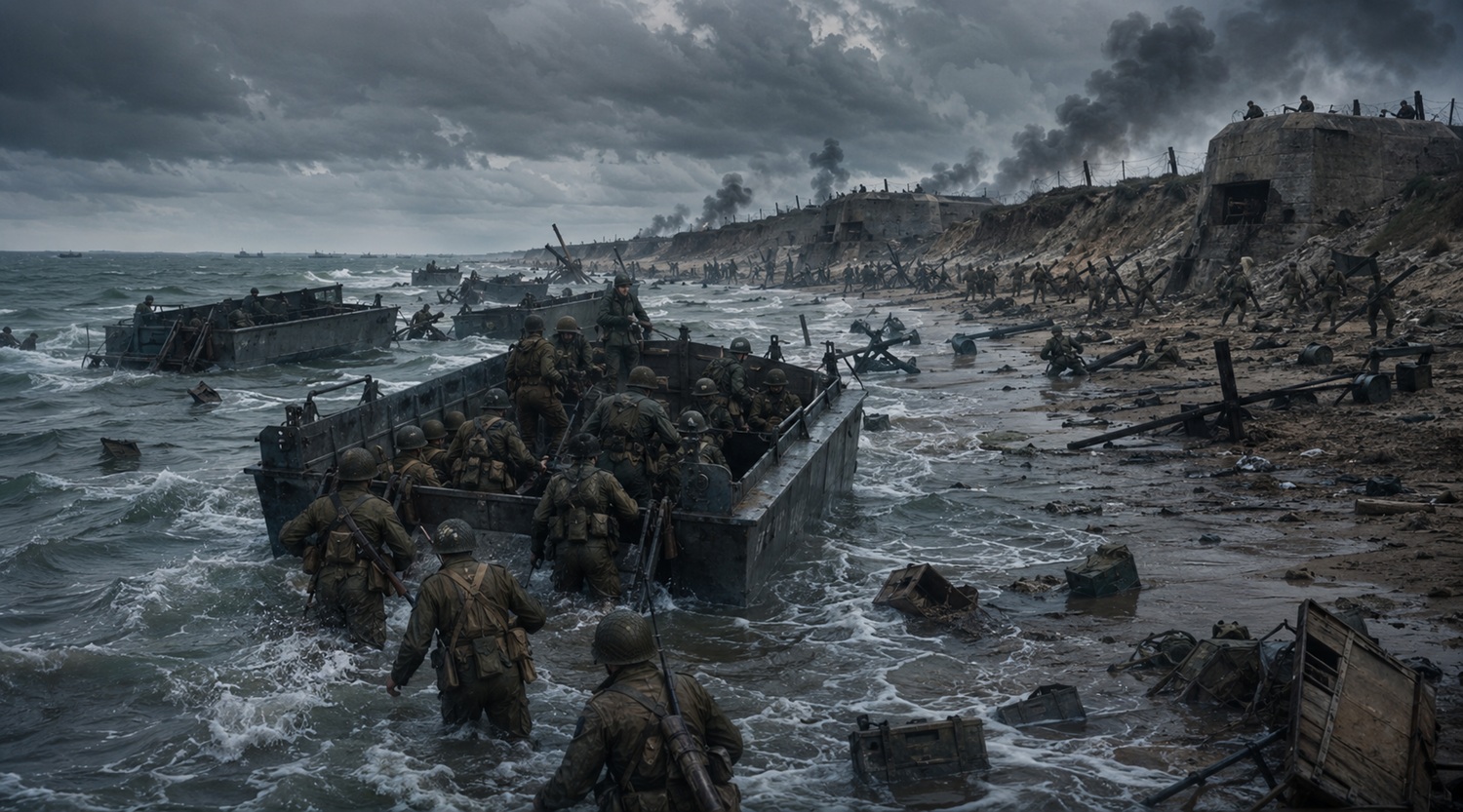
On June 6, 1944, Allied forces crossed the English Channel and attacked German-occupied France.
Operation Overlord was the culmination of years of planning. More than 150,000 Allied troops landed in Normandy on the first day, supported by more than 5,000 ships and landing craft and overwhelming air power. Despite severe losses—particularly at Omaha Beach—the Allies established footholds on all five invasion beaches. By the end of June, more than 850,000 men, 148,000 vehicles, and 570,000 tons of supplies had been landed in Normandy. (Army.mil)
That success created the western front that Allied leaders had promised Joseph Stalin. From Normandy, British, Canadian, American, Free French, Polish, and other Allied forces eventually broke the German armies in France, liberated Paris, reached the German frontier, crossed the Rhine, and advanced into Germany.
But success on June 6 was not predetermined.
General Dwight D. Eisenhower understood that clearly. Before the invasion, he wrote a short statement to be issued if the landings failed, accepting responsibility for the decision. The surviving handwritten document is preserved by the Eisenhower Presidential Library. (Eisenhower Presidential Library)
So what happens if Eisenhower actually has to issue it?
The most useful counterfactual is not one in which every Allied soldier is killed on the beaches or German forces somehow sink the entire invasion fleet.
Instead, define D-Day failure more realistically:
The Allies establish several temporary beachheads on June 6, but German counterattacks prevent them from linking securely. Reinforcement and supply become increasingly difficult, the Normandy lodgment becomes untenable, and Eisenhower ultimately orders evacuation back across the Channel within the following days or weeks.
That would be one of the greatest military disasters in British and American history.
It would not, however, mean that Nazi Germany wins World War II.
By June 1944, Germany was already facing a far larger strategic disaster in the east.
The more probable consequence of a failed D-Day is therefore not a victorious Third Reich.
It is a longer war and a much more Soviet postwar Europe.
---
What D-Day Was Supposed to Accomplish
Operation Overlord was not simply a raid intended to land troops temporarily in France.
The objective was to create a permanent Allied lodgment in northwestern Europe, build up a huge army there, seize ports and supply routes, defeat German forces west of the Rhine, and then invade Germany itself.
U.S. Army histories describe Eisenhower's basic concept as landing on the Normandy coast, accumulating sufficient troops and supplies for a breakout, liberating France, securing logistical bases, crossing the Rhine, and ultimately destroying Germany's ability to continue the war. (U.S. Army Center of Military History)
Normandy had advantages.
The beaches were within range of Allied fighter aircraft operating from Britain. They were less heavily defended than the Pas-de-Calais, the shortest cross-Channel route and the area German planners most strongly expected to be attacked. Airborne troops could secure important roads and flanks behind the beaches. (Army.mil)
But Normandy also had disadvantages.
The Allies initially lacked a major captured port.
Everything required to keep the armies alive—ammunition, fuel, food, vehicles, artillery, medical supplies, replacement troops—had to cross the Channel and land over beaches or artificial harbors until major ports could be secured.
That meant the first days were critical.
The invasion did not merely have to land.
It had to survive long enough to become too large for Germany to destroy.
---
Why D-Day Succeeded
Any plausible failure scenario first has to explain why the real invasion succeeded.
Several factors worked together.
Allied air superiority
The Allies had established overwhelming strength in the air over northwestern Europe.
Aircraft attacked German railways, bridges, transportation networks, headquarters, troop movements, and airfields. The U.S. Army notes that the pre-invasion air campaign was designed specifically to make it difficult for Germany to shift reserves into Normandy. (U.S. Army Center of Military History)
Once the invasion began, Allied tactical air forces made daylight German movement increasingly dangerous. (Imperial War Museums)
Naval gunfire
Battleships, cruisers, destroyers, and smaller vessels supported troops ashore with heavy naval artillery. The invasion armada included thousands of vessels and represented a concentration of maritime power Germany could not match in the Channel. (Naval History and Heritage Command)
Deception
Operation Fortitude and related deception measures encouraged German leaders to believe that Normandy might be a diversion and that the main Allied attack would later come through the Pas-de-Calais. This helped delay the concentration of some German reserves against the actual invasion area. (Imperial War Museums)
German command problems
German commanders disagreed about how armored reserves should be positioned and used.
Some wanted tanks close enough to the beaches to crush an invasion immediately. Others feared Allied air power and naval gunfire and preferred keeping major armored formations farther inland for a concentrated counterattack.
Hitler's command structure made matters worse by requiring approval for the release of important reserves.
Allied persistence
The invasion did not go according to plan everywhere.
Airborne units were scattered.
Landing schedules broke down.
Strongpoints survived preliminary bombardment.
Omaha Beach became particularly dangerous.
Yet local commanders, small units, engineers, naval personnel, infantrymen, paratroopers, and individual soldiers continued moving inland rather than waiting for the plan to recover.
Imperial War Museums cautions against reducing the Normandy victory to material superiority alone; tactical adaptation and the performance of formations on the ground mattered greatly. (Imperial War Museums)
The invasion succeeded because these advantages reinforced one another.
For it to fail, several of them must go wrong at the same time.
---
The Point of Divergence: Normandy Never Becomes Secure
A credible failure therefore requires a compound divergence, not one magic German decision.
Suppose the following occurs.
June 6: German commanders react faster
German intelligence concludes much earlier that Normandy is the principal invasion rather than a diversion.
Hitler releases armored reserves with less delay.
The 12th SS Panzer Division, Panzer Lehr Division, 21st Panzer Division, and other mobile formations are committed more quickly and more coherently.
The German attack does not need to drive every Allied soldier into the sea immediately.
It needs to prevent the beachheads from becoming one continuous, defensible lodgment.
Omaha deteriorates
Historically, Omaha nearly became a disaster before American units penetrated inland.
In the alternate timeline, German defenses inflict still heavier losses and American forces fail to establish enough exits from the beach.
The U.S. V Corps position remains dangerously shallow.
British and Canadian sectors remain disconnected
German armor strikes between or behind the eastern beachheads before British and Canadian forces can consolidate sufficiently.
Caen remains firmly in German hands and becomes the center of repeated counterattacks.
German reserves reach Normandy despite Allied air power
Allied air interdiction still hurts German movement, but unfavorable weather reduces air operations at several critical moments.
More German armor and artillery reaches the front intact.
The Channel weather worsens
The Allies remain completely dependent upon reinforcement from Britain.
A period of severe weather interrupts unloading before the beachhead has accumulated sufficient supplies and reserves.
This problem was historically real: Normandy weather seriously affected cross-Channel logistics, and the later June storm badly damaged the artificial Mulberry harbor system. The invasion survived because a substantial lodgment had already been established.
In this counterfactual, the weather arrives when the position is still precarious.
By June 10 or June 12, Eisenhower faces an ugly reality.
The Allied lodgment has not expanded enough.
Several sectors remain isolated.
German counterattacks are increasing.
Casualties are mounting.
Supply is deteriorating.
The commanders conclude that continuing to reinforce Normandy could turn a serious defeat into the destruction of several Allied armies.
Eisenhower orders evacuation.
---
What Would an Evacuation Look Like?
It would probably resemble neither Dunkirk nor a clean reverse amphibious operation.
Thousands of troops would already be in contact with German forces.
Heavy equipment would have to be abandoned.
Some beaches would be under artillery fire.
German aircraft, although much weaker than Allied air forces, would concentrate against evacuation points when possible.
Naval gunfire and Allied air power would be used aggressively to keep German forces away from the beaches.
Rear guards would have to hold defensive perimeters while units withdrew.
Some formations might escape largely intact.
Others could be cut off.
Airborne troops deep inland would face particularly poor prospects.
The result would likely involve large numbers of killed, wounded, missing, and captured Allied personnel.
Historically, the Eisenhower Library estimates approximately 10,300 Allied casualties during the initial D-Day landings alone. (Eisenhower Presidential Library)
A failed battle lasting another week or two could produce losses several times that figure.
Any precise number would be artificial.
But tens of thousands of casualties and prisoners are plausible.
---
Equipment Losses Could Be Almost as Important
The human losses would dominate public memory, but the equipment losses would seriously damage Allied readiness.
An evacuation could force troops to abandon:
tanks;
trucks;
artillery;
engineering equipment;
bulldozers;
ammunition;
fuel;
radios;
medical equipment;
anti-aircraft guns;
bridging equipment;
beach-handling machinery.
Landing craft would also be lost.
The Allies could replace most of that material eventually because American and British industrial capacity remained enormous.
But replacement takes time.
More importantly, amphibious shipping and landing craft were scarce strategic assets being demanded simultaneously in Europe, the Mediterranean, and the Pacific.
The Allies cannot simply rebuild Overlord the following week.
---
Eisenhower's Career After a Failed D-Day
No commander would suffer more immediately than Dwight D. Eisenhower.
His own failure statement is revealing because he had already decided that he would accept personal responsibility if the invasion failed. (Eisenhower Presidential Library)
Would Roosevelt and Churchill fire him?
Possibly.
But not necessarily.
Eisenhower's job was unusually political. He had to manage British and American commanders, armies, air forces, navies, competing national strategies, and difficult personalities.
A failed Overlord would create intense pressure for accountability.
American critics might demand the removal of the supreme commander.
British officers could blame American planning.
Americans could blame British operational command.
Some politicians could blame weather.
Others could blame intelligence or German armor.
Eisenhower's personal willingness to take responsibility might actually protect some of his subordinates while making his own position increasingly difficult.
Most plausible outcome
Eisenhower remains in command long enough to manage the evacuation and immediate reorganization.
Whether he commands the next invasion is far less certain.
His later political career—including his path to the presidency in 1952—could disappear entirely.
---
What Happens to Bernard Montgomery?
Field Marshal Bernard Montgomery commanded the Allied land forces during the initial Normandy phase.
A destroyed bridgehead would almost certainly damage his reputation.
Montgomery had publicly projected great confidence in Allied plans. After a defeat, disputes would erupt over whether British and Canadian forces had advanced quickly enough, whether reserves had been allocated correctly, and whether the battle plan had concentrated enough power to defeat German armored counterattacks.
But, as with Eisenhower, automatic dismissal should not be assumed.
Britain had invested heavily in Montgomery's reputation after El Alamein.
He remained one of Britain's most experienced field commanders.
The political question would become whether Churchill believed retaining him restored confidence or deepened the sense of failure.
A command shakeup affecting either Montgomery, Eisenhower, or both is therefore plausible.
---
Churchill After a Second Dunkirk
Winston Churchill's political position would be shaken but probably not destroyed.
Britain had already survived military catastrophes in Norway, France, Greece, Crete, Singapore, and elsewhere.
D-Day would be different because it had been presented as the long-awaited beginning of the liberation of western Europe.
A second evacuation across the Channel would produce bitter comparisons with Dunkirk.
The difference is that in 1944 Britain is no longer alone.
The United States is fully mobilized.
Germany is under sustained air attack.
Italy has already surrendered as an Axis power.
And the Red Army is advancing.
Churchill could therefore argue that the invasion had failed but the war had not.
His strategic preferences might even gain influence.
Churchill had repeatedly favored greater emphasis on Mediterranean operations, whereas Roosevelt and senior American planners generally prioritized the direct route into northwestern Europe. The dispute also appeared in arguments over Operation Anvil, later Dragoon, the invasion of southern France. (Naval History and Heritage Command)
After a Normandy disaster, Churchill could argue:
The Channel coast has proven too dangerous. Attack Germany through the Mediterranean, Italy, southern France, and perhaps the Balkans instead.
---
Roosevelt and the 1944 Election
Franklin D. Roosevelt would face a different political problem.
The United States was only five months from the presidential election of November 1944.
Historically, Roosevelt defeated Republican Thomas E. Dewey and won a fourth term.
A catastrophic defeat in France would give Republicans ammunition against the administration's military leadership.
Questions would dominate newspapers:
Why was the invasion launched?
Was German strength underestimated?
Were the casualties necessary?
Who approved the plan?
Could Eisenhower be trusted?
Could Roosevelt?
Yet an immediate American demand to negotiate peace with Hitler remains unlikely.
Germany had declared war on the United States in 1941.
American forces were already fighting in Italy and bombing Germany.
The Pacific War continued simultaneously.
A failed invasion could reduce confidence in Allied strategy without reducing the determination to defeat Nazi Germany.
Roosevelt's reelection could become closer.
But predicting a Dewey victory from D-Day alone would be too strong.
---
Allied Public Opinion
The psychological shock would be immense.
D-Day had been anticipated for years.
Western European resistance movements had been encouraged to expect liberation.
French civilians had endured bombing associated with preparations for the invasion.
Families in Britain, Canada, and the United States had watched enormous military forces assemble.
Then the armies would return defeated.
German propaganda would describe the evacuation as proof that Hitler's Atlantic Wall had defeated the Anglo-Americans.
Joseph Goebbels would present it as the turning point of the war.
But the propaganda claim would conceal Germany's real strategic situation.
On June 22, just sixteen days after D-Day, the Soviet Union historically launched Operation Bagration, one of the most devastating offensives suffered by the German army. Soviet forces shattered Army Group Centre and drove dramatically westward. U.S. Army studies describe Bagration as part of the period in which the Red Army held the strategic initiative, eventually advancing across eastern Europe and into Germany. (Army University Press)
So while Berlin celebrates Normandy, a German army group is being destroyed in Belarus.
That is why D-Day failure does not reverse the whole war.
---
Would the Allies Try Another Cross-Channel Invasion?
Almost certainly eventually, unless Germany collapses first.
But the timing would be difficult.
A second attempt in the summer of 1944 would be extremely unlikely.
The Allies would need to:
replace equipment;
reorganize shattered units;
replace casualties;
reassess German defenses;
rebuild landing-craft strength;
devise new deception plans;
restore morale;
identify another suitable invasion window.
The obvious strategic question would be whether to try Normandy again.
Once the Germans had defeated one invasion there, they would reinforce the coast even more heavily.
The Pas-de-Calais would remain heavily defended.
Other northern French beaches would have their own logistical disadvantages.
A second full-scale cross-Channel invasion might therefore have to wait until spring 1945.
And by then, the eastern front could look completely different.
---
The Mediterranean Alternative
The Allies already possessed armies in Italy and command of much of the Mediterranean.
Operation Dragoon historically landed American and French forces in southern France on August 15, 1944. The U.S. Army describes its objectives as preventing German forces in southern France from reinforcing Normandy and securing Mediterranean ports that could provide an additional Allied supply route. Resistance was comparatively light, and Allied forces advanced rapidly northward. (U.S. Army Center of Military History)
If Normandy has failed, Dragoon becomes much more important.
There are two plausible decisions.
Scenario A: Dragoon is enlarged
Landing craft released after the Normandy evacuation are reassigned south.
Additional divisions are moved from Britain or Italy.
Instead of supporting Overlord, the invasion of southern France becomes the main Western Allied attempt to establish a land front in France.
The Allies seize Marseille and Toulon and push north through the Rhône valley.
Scenario B: Churchill wins the strategic argument
Britain argues that southern France is insufficiently decisive and proposes stronger operations through Italy, the Adriatic, and possibly the Balkans.
Churchill hopes not only to fight Germany but also to prevent the Soviet Union from dominating southeastern Europe.
American military leaders, however, had long resisted strategies they considered indirect diversions from the central route toward Germany.
The Normandy failure would intensify rather than settle this debate.
---
Could an Enlarged Operation Dragoon Replace D-Day?
Not completely.
Southern France was strategically valuable and its ports could support large armies.
But advancing from the Mediterranean to Germany means crossing hundreds of miles of France before reaching the major German industrial regions.
Normandy had offered a much more direct route toward northern France, Belgium, the Ruhr, and the German heartland.
A southern campaign could liberate substantial portions of France.
It could force Germany to defend another front.
It could eventually reach the Rhine.
But it would take time.
That delay is exactly what benefits Stalin.
---
Germany Could Redeploy Forces East
A failed D-Day would free German forces that historically spent months fighting in Normandy, retreating through France, and defending against Allied advances from the west.
Some could move to the eastern front.
That matters.
Germany was desperately short of reserves.
Additional panzer and infantry formations might slow Soviet offensives.
German aircraft could be concentrated differently.
Fuel, ammunition, and railway capacity could be redirected east.
But there are major limitations.
Germany could not simply send every division in France to Russia.
Hitler and the German high command would have to assume that the Western Allies would try again.
Britain would still contain millions of Allied troops and enormous invasion infrastructure.
German forces would therefore have to remain along:
the Channel coast;
northern France;
Belgium;
the Netherlands;
Denmark;
Norway;
southern France.
The Allied strategic bombing campaign would also continue.
A failed D-Day gives Germany more flexibility.
It does not eliminate the western threat.
---
Operation Bagration Still Happens
This is the most important military constraint on the scenario.
Operation Bagration began on June 22, 1944.
By then, the Soviet Union possessed the strategic initiative, mature operational leadership, enormous forces, peak wartime production, and substantial Lend-Lease support. U.S. Army historical studies describe Bagration as part of the Red Army's decisive period of strategic offensives that destroyed German forces and drove toward Central Europe. (Army University Press)
The offensive was not created by D-Day.
Its planning, troop concentrations, and objectives were already well advanced before Allied soldiers landed in Normandy.
Therefore a D-Day disaster on June 6 does not cancel Bagration on June 22.
Army Group Centre still faces a massive Soviet assault.
Germany might transfer reinforcements sooner once it becomes clear that the Western Allies have evacuated.
But those units need time to move across Europe's damaged rail network.
Many formations in France would also need rest and rebuilding after the battle.
The Red Army therefore still probably achieves major victories in summer 1944.
---
Could Germany Stop the Red Army With Western Reinforcements?
Probably not permanently.
It could slow it.
That distinction is important.
By 1944, the strategic balance on the eastern front had transformed dramatically from 1941.
The Soviet Union had survived the worst German offensives.
It had won at Moscow, Stalingrad, and Kursk.
It possessed numerical strength, expanding mechanization, enormous artillery concentrations, improved commanders, and operational experience.
Germany increasingly lacked fuel, replacement troops, and equipment.
A few dozen additional western divisions could make individual battles much harder.
They could prevent or delay some Soviet breakthroughs.
They might keep the Red Army farther east for several additional months.
But reversing the entire eastern war would require much more than merely surviving Normandy.
Strongest conclusion
D-Day failure probably delays Germany's defeat. It does not reverse the strategic balance sufficiently to create a likely German victory.
---
How Much Longer Could the War Last?
There is no responsible way to name a precise surrender date.
Several broad possibilities are more useful.
Short delay: Germany falls in summer 1945
The Red Army continues advancing rapidly.
An enlarged Allied landing in southern France creates another western front.
The Western Allies reenter northern Europe in early 1945 or push north from the Mediterranean.
Germany survives several months beyond May but eventually collapses.
Medium delay: Germany survives into late 1945
Western Allied recovery takes longer.
Germany transfers enough formations east to slow Soviet offensives.
The Red Army pays a much higher cost crossing Poland and Germany.
The Allies need a second major invasion.
The war continues through summer and autumn 1945.
This brings the atomic bomb directly into European strategy.
Long delay: war enters 1946
This requires Germany to extract much more benefit from the Normandy victory than is obvious from the historical military balance.
It is possible as a counterfactual, but much weaker.
Germany would still face Soviet armies, strategic bombing, maritime blockade, severe resource shortages, and eventually American nuclear weapons.
The longer Germany survives, the more destructive the war becomes.
---
Would Germany Actually Win?
Probably not.
A failed D-Day would be an enormous German tactical and operational victory.
It would be one of Hitler's greatest propaganda successes.
It would delay the liberation of western Europe.
It could preserve German control of France for months longer.
It could increase Allied casualties enormously.
But by June 1944, Nazi Germany's strategic problems were much larger than Normandy.
The Soviet Union had gained the strategic initiative and was about to launch Operation Bagration. (Army University Press)
Allied bombers were attacking German transportation, fuel production, aircraft manufacturing, and cities.
Germany remained under blockade.
Italy was already lost as a reliable Axis ally.
The United States possessed an enormous industrial base.
Britain remained an unsinkable military base directly across the Channel.
Germany's fuel situation was deteriorating.
And the Allies could try again.
So the strongest conclusion is:
Failure in Normandy might save the Third Reich for months. It probably does not save it from eventual defeat.
---
Hitler's Political Position Would Temporarily Strengthen
The internal consequences inside Germany could still be significant.
On July 20, 1944, German officers historically attempted to assassinate Hitler and overthrow the Nazi government.
The conspiracy had many causes and had developed before D-Day.
It should therefore not be assumed that a German victory in Normandy automatically prevents the plot.
But political atmosphere matters.
A Hitler who has just overseen the destruction of the greatest amphibious invasion in history appears less obviously doomed.
Some wavering officers may conclude that Germany could still force the Western Allies to negotiate.
Others may postpone action.
The July 20 plot could therefore occur differently—or perhaps fail to reach the execution stage on the historical date.
If Hitler's domestic authority strengthens temporarily, the war could become even harder to end through internal German action.
---
France Pays a Heavy Price
France would suffer one of the most immediate political consequences.
The French Resistance had provided intelligence and sabotaged transportation networks in preparation for the Allied invasion. The Eisenhower Library records the important contribution of resistance intelligence to Overlord planning. (Eisenhower Presidential Library)
Once D-Day begins, resistance activity expands.
If the Allies then evacuate, many resistance fighters are left behind.
German security forces and collaborationist authorities could retaliate brutally.
Weapons drops and open resistance that made sense when Allied armies were nearby suddenly become dangerous liabilities.
Thousands of resistance members might be killed, captured, or forced back underground.
Charles de Gaulle's Free French movement would also face a political setback.
Liberation has been postponed.
Vichy-associated structures may survive longer in parts of France.
German occupation becomes harsher precisely because the population has demonstrated how strongly it expects liberation.
---
Paris Is Not Liberated in August 1944
Historically, Paris was liberated in August 1944 as German forces retreated following the Normandy campaign.
Without a western Allied breakout, that does not happen.
Paris could remain occupied into 1945.
A resistance uprising might still occur.
But without Allied armies nearby, its chances would be much worse.
France's ultimate liberation could instead come:
from Allied troops advancing north from southern France;
from a second cross-Channel invasion;
or, in the most dramatic scenario, partly from Soviet forces advancing much farther west than they did historically.
That last possibility would fundamentally change European politics.
---
The Biggest Likely Change: Postwar Europe
This is where the counterfactual becomes much larger than the military defeat itself.
In real history, Germany was conquered from both directions.
American, British, Canadian, French, and other Western Allied armies occupied western Germany.
The Red Army occupied eastern Germany.
The two great military advances therefore created a physical balance at the end of the war.
But occupation boundaries were not simply improvised wherever soldiers happened to stop.
The Allies had begun negotiating postwar zones before Germany's final collapse. The European Advisory Commission spent much of 1944 developing plans for occupation zones in Germany, and a protocol establishing the basic structure was signed on September 12, 1944. (Office of the Historian)
At Yalta, the Allied powers confirmed a system in which Germany would be divided into occupation zones and Berlin jointly occupied. (Office of the Historian)
This creates an important complication.
Soviet troops advancing farther west would not automatically make every territory they reached permanently Soviet-controlled.
Diplomatic agreements could still require withdrawals.
But military reality affects bargaining power.
And if the Western Allies have no large army inside Germany when the war ends, enforcing an occupation arrangement favorable to them becomes harder.
---
A Much Larger Soviet Military Presence in Germany
Historically, Soviet and Western forces met on the Elbe in April 1945. U.S. Army studies of the Soviet campaign identify that meeting as the culmination of the Red Army's westward advance. (Army University Press)
Without the Normandy campaign, imagine instead that the Red Army reaches:
all of Berlin;
the Elbe;
Hamburg;
much of central Germany;
perhaps parts of Denmark;
possibly areas farther west before Anglo-American armies arrive in strength.
Would Stalin withdraw from all of those territories simply because earlier occupation maps said he should?
Perhaps.
The Soviet Union did honor some negotiated occupation arrangements historically even where military lines did not perfectly correspond with later zones.
But the political negotiations would be considerably more difficult.
Stalin could demand compensation, altered boundaries, additional reparations, stronger communist participation in western governments, or revised occupation arrangements.
---
Germany Could Be Divided Farther West
The Federal Republic of Germany—West Germany—might still eventually exist.
But its territory could be substantially smaller.
A larger Soviet occupation zone could include more of central Germany.
Berlin might not become the same western enclave if no Western Allied armies can establish access under comparable circumstances.
Alternatively, Roosevelt, Churchill, and later Truman could insist strongly on the occupation-zone agreements already negotiated.
That might produce a delayed Allied movement into western zones after German surrender.
But the balance would be different.
A larger Red Army presence gives Stalin more bargaining power over:
reparations;
German political structures;
industrial assets;
borders;
prisoner transfers;
Berlin;
occupation administration.
The eventual Cold War frontier might lie significantly farther west.
---
Poland Becomes Even More Securely Soviet-Dominated
Poland's postwar political future was already one of the most serious disputes among the Allies.
At Tehran and Yalta, Roosevelt, Churchill, and Stalin discussed Poland's borders and government. Soviet security demands pushed Poland westward territorially, while Moscow supported a communist-dominated political structure. (Office of the Historian)
A failed D-Day makes the Western position weaker.
No British or American army is anywhere near Poland.
The Red Army liberates—or occupies, depending on perspective—the entire country.
Stalin can argue that Soviet blood has borne an even greater proportion of the burden of defeating Germany.
Western objections to communist consolidation become easier to disregard.
Poland therefore still almost certainly enters the Soviet sphere.
If anything, Western ability to influence its political evolution becomes still smaller.
---
Austria Could Also Look Different
Austria was historically divided into American, British, French, and Soviet occupation zones, while Vienna received a four-power occupation arrangement. The detailed zone agreements were negotiated in 1945. (Office of the Historian)
Without a successful northwestern European campaign, Western Allied access to Austria would depend heavily on operations from Italy.
That makes the Mediterranean war more important.
If American and British forces still advance through Italy and the Alps, they may secure western Austria.
If those operations are slower while the Red Army advances faster, Soviet forces could occupy a larger share of Austria before negotiations are finalized.
Austria's eventual neutral status might still emerge.
But a divided Austria resembling Germany becomes more plausible.
---
Czechoslovakia Could Be Entirely Liberated by the Red Army
Historically, American forces reached western Czechoslovakia, including Plzeň, while Soviet armies liberated Prague and most of the country.
In the alternate timeline, American armies are likely nowhere near western Czechoslovakia when Germany collapses.
The Red Army therefore becomes the uncontested liberating military power throughout the country.
Communist political influence after the war could consequently be even stronger.
The 1948 communist seizure of power might occur earlier, more smoothly, or under more direct Soviet control.
---
Could Soviet Forces Reach the Low Countries?
This is a much more speculative possibility.
For Soviet armies to reach Belgium or the Netherlands before Western Allied forces return to northern Europe, Germany would need to collapse very unevenly while the Red Army continued a massive advance across the entire country.
Logistics become increasingly difficult the farther Soviet forces move west.
German units released from France would also resist.
So Soviet troops occupying Amsterdam or Brussels should not be treated as the default outcome.
But Soviet occupation of substantially more Germany is much easier to imagine.
The greatest likely postwar shift is therefore not “Communist France.”
It is a stronger Soviet position in Germany and Central Europe.
---
What About France and Communism?
France had a powerful Communist Party and an important communist resistance movement.
A delayed liberation could enhance communist prestige because communist resistance groups would be able to argue that the Anglo-Americans had failed while the Soviet Union continued destroying German armies.
But France also possessed Gaullist, socialist, Christian democratic, conservative, and other political traditions.
An enlarged Allied landing in southern France could still place most of France under Western Allied control before the war ends.
Therefore a Soviet satellite France remains unlikely.
A stronger French Communist Party after liberation, however, is entirely plausible.
---
The Cold War Could Start From a Worse Western Position
The Cold War did not begin because American and Soviet troops happened to stop at one exact line in 1945.
It grew out of incompatible security interests, ideology, disputes over eastern Europe, Germany, atomic weapons, and postwar political reconstruction.
Those disagreements still exist.
But Western military failure in 1944 could alter their balance.
The Soviet Union could emerge with:
greater prestige;
more occupied territory;
a larger claim to having defeated Nazi Germany;
stronger communist movements across Europe;
more leverage over Germany;
a weaker Western presence on the continent.
Meanwhile, Britain and the United States would carry the political memory of having failed catastrophically in Normandy.
The Cold War therefore begins with an even stronger Soviet hand.
---
No Historical Berlin Airlift?
If Berlin lies entirely within an enlarged Soviet zone without the same four-power access arrangements, the Berlin crisis unfolds differently.
There may be no Western sectors of Berlin.
No Berlin Blockade of 1948–1949 in the historical form.
No Berlin Airlift.
No West Berlin as the symbolic Western island inside East Germany.
Instead, the central Cold War confrontation could occur elsewhere:
Hamburg.
Vienna.
The Rhine.
Denmark.
Or another disputed occupation zone.
Changing military geography changes Cold War symbolism.
---
NATO Could Form Earlier—or Stronger
A more threatening Soviet position does not necessarily make Western Europe weaker forever.
It could produce the opposite reaction.
If Soviet forces occupy substantially more of Germany, Britain, France, the United States, Belgium, the Netherlands, and other Western governments may feel an even stronger need for a permanent military alliance.
The North Atlantic Treaty Organization historically formed in 1949.
In this alternate environment, a comparable alliance could emerge sooner or with greater American troop commitments.
The West would have less strategic depth.
That makes collective defense more urgent.
---
The Atomic Bomb Enters the European War
This is the largest late-war wildcard.
The Manhattan Project was originally driven substantially by fear that Nazi Germany might develop an atomic bomb first. The project became one of the largest scientific-industrial programs of the war. (The Department of Energy's Energy.gov)
By 1944–1945, however, Germany's own nuclear effort remained far from producing a weapon. U.S. Department of Energy historical materials note that the German program had largely stalled. (The Department of Energy's Energy.gov)
Historically, Germany surrendered on May 8, 1945.
The first successful atomic test, Trinity, occurred in New Mexico on July 16.
Germany was therefore no longer available as a target when operational bombs became ready. DOE history explicitly notes that Germany was not targeted at that stage because it had already surrendered. (The Department of Energy's Energy.gov)
If D-Day failure extends the European war into summer 1945, that changes.
---
Would the United States Drop an Atomic Bomb on Germany?
It becomes possible.
It does not become automatic.
Washington would have to decide:
whether Germany was close enough to defeat conventionally;
whether atomic use could accelerate surrender;
whether a suitable target existed;
whether Soviet forces were too close to prospective targets;
whether demonstrating the weapon might be preferable;
how Britain would view nuclear use over Europe;
whether bombs should instead remain prioritized for Japan.
The political and moral debate surrounding atomic weapons would still exist.
But if American soldiers had recently suffered a catastrophic defeat in Normandy and Germany remained at war in August 1945, pressure to use every available weapon could be considerable.
Major German military-industrial cities could become candidates.
Berlin itself might be unsuitable if Soviet troops were nearby.
A transportation or industrial center deeper inside remaining German-held territory might be considered instead.
Any specific target would be speculative.
The important point is broader:
A failed D-Day could make Nazi Germany, rather than Japan alone, a potential target of the world's first atomic weapons.
---
Could the Atomic Bomb End the European War?
Perhaps.
But the situation would differ greatly from Japan in August 1945.
Germany lies directly beside advancing Allied armies.
German territory is already under massive conventional bombing.
Soviet forces might be deep inside the Reich.
Hitler's regime could be collapsing from military defeat before an atomic weapon is ready.
If Hitler remains alive and refuses surrender, however, one or more atomic strikes could become part of an attempt to force capitulation or destroy strategic targets.
The psychological impact would be extraordinary.
It could also dramatically affect Soviet-American relations.
Stalin would watch the United States employ a revolutionary weapon inside the European theater where Soviet armies had carried most of the ground fighting after the Normandy disaster.
The nuclear dimension of the Cold War might therefore begin even before World War II formally ends.
---
Could Stalin Race Farther West Because of the Bomb?
Possibly.
If Soviet intelligence indicates that the United States is nearing an atomic weapon, Stalin has an incentive to occupy as much strategically important European territory as possible before American nuclear power alters negotiations.
The United States, conversely, has an incentive to end the German war before Soviet armies acquire still more territory.
This could produce an extraordinary final race across Germany.
The military campaign would no longer be simply Allies versus Nazis.
Inside the Allied coalition, both Washington and Moscow would already be thinking about the postwar balance.
That happened to a degree in real history.
A failed Normandy campaign would intensify it.
---
Multiple Plausible Outcomes
The counterfactual is best understood through several branches rather than one definitive replacement history.
| Scenario | Western Allied Response | Soviet Advance | German Defeat | Likely Postwar Effect |
| ------------------------------ | ---------------------------------------------------------------- | ---------------------------------------------------------------- | ------------------------------------------------ | ---------------------------------------------------------------------------------------------------------- |
| 1. Rapid Recovery | Dragoon enlarged; second invasion prepared quickly | Similar to real history but somewhat farther west | Summer 1945 | Germany still divided, but USSR gains somewhat greater influence |
| 2. Soviet-Dominant Victory | Western Allies remain largely outside northern Europe until late | Red Army occupies most of Germany and Central Europe | Late 1945 | Cold War frontier moves substantially west; Soviet influence greatly expanded |
| 3. Mediterranean Strategy | Allies emphasize southern France, Italy, Alps, possibly Balkans | Soviets dominate Poland and central Germany | Mid-to-late 1945 | Western Allies preserve France and southern Germany/Austria; USSR gains stronger Central European position |
| 4. Second Overlord | New cross-Channel invasion launched in spring 1945 | Soviets advance deep into Germany before second landing succeeds | Late 1945 | Western Germany liberated later; occupation-zone negotiations become more difficult |
| 5. Atomic Europe | Conventional campaigns stall into summer 1945 | Soviets continue advancing | Atomic weapon used or threatened against Germany | Nuclear diplomacy begins before German surrender; Soviet-American rivalry intensifies immediately |
Scenario 2 is the most dramatic.
Scenario 1 requires the Allies to recover remarkably fast.
Scenario 5 becomes increasingly plausible the longer Germany survives beyond July 1945.
---
Real History vs. a Failed-D-Day Timeline
| Date | Real History | Plausible Failed-D-Day Path |
| ------------------ | --------------------------------------------------------------------------------------- | ------------------------------------------------------------------------------------------------------------------------------------------------------------ |
| June 6, 1944 | Allies establish beachheads on five Normandy beaches. | Allied forces land but beachheads remain fragmented and shallow. |
| June 10–15 | Lodgment expands and reinforcement accelerates. | German armored counterattacks and supply disruption make the lodgment untenable. Eisenhower orders evacuation. |
| June 22 | Soviet Union launches Operation Bagration. | Bagration still begins; Normandy victory allows Germany to plan some reinforcement of the east, but not soon enough to prevent initial Soviet breakthroughs. |
| July 1944 | Allies fight through Normandy; July 20 plot against Hitler fails. | Britain and U.S. rebuild forces. Hitler celebrates major western victory; July 20 conspiracy may unfold differently. |
| August 1944 | Normandy breakout liberates Paris; Dragoon lands in southern France. | Dragoon is either enlarged into the main French campaign or postponed while strategy is reconsidered. Paris remains occupied. |
| Autumn 1944 | Western Allies enter Belgium and approach Germany. | Soviets advance through eastern Europe while Western Allies remain concentrated in Britain, Italy, and southern France. |
| Winter 1944–45 | Western and Soviet armies pressure Germany from both sides. | Germany transfers more forces east but still faces Soviet numerical and material superiority; second Allied invasion preparations accelerate. |
| Spring 1945 | Western Allies cross Rhine; Soviets attack Berlin. | Red Army may occupy a much larger portion of Germany before a rebuilt Western offensive reaches the German heartland. |
| May 1945 | Germany surrenders. | Germany may still be fighting. |
| July 1945 | Trinity atomic test occurs after Germany's surrender. | If Germany remains at war, atomic weapons become part of European strategic planning. |
| Late 1945 | Occupation of Germany underway; Europe divided into emerging eastern and western blocs. | Germany finally collapses with the Soviet Union physically controlling substantially more of Central Europe. |
---
Strong, Moderate, and Weak Counterfactual Claims
| Claim | Assessment | Why |
| -------------------------------------------------------------------------------- | ---------------------- | -------------------------------------------------------------------------------------------------------------------------------------------------------------------------------------- |
| D-Day could conceivably have failed | Plausible | Eisenhower himself prepared for that possibility, and the operation depended on establishing and supplying a vulnerable lodgment. (Eisenhower Presidential Library) |
| Failure requires only Hitler releasing one panzer division earlier | Weak | Allied naval power, air superiority, multiple beachheads, and reinforcement capacity mean a major failure probably requires several things to go wrong. |
| Allied casualties would be dramatically higher | Strong | Even successful D-Day produced roughly 10,000 Allied casualties; a contested evacuation would add casualties and prisoners. (Imperial War Museums) |
| Eisenhower would certainly be fired | Uncertain | He had accepted responsibility, but replacing the supreme commander during crisis would itself carry serious costs. |
| The Allies would try to invade Europe again | Very strong | Germany still had to be defeated, and Britain remained an enormous staging base for Western forces. |
| Operation Dragoon becomes more important | Strong | Southern France was already an approved invasion route and historically opened major Mediterranean ports. (U.S. Army Center of Military History) |
| Germany wins World War II | Weak | Soviet strategic superiority and Allied industrial and air power remain. |
| Operation Bagration still occurs | Very strong | Soviet preparations were independent and the operation historically began only sixteen days after D-Day. (Army University Press) |
| Western German divisions slow the Red Army | Strong | Additional forces would matter tactically and operationally. |
| Western reinforcements reverse the entire eastern war | Weak | By 1944 the Soviet Union held the strategic initiative and Germany faced severe resource constraints. (U.S. Army Center of Military History) |
| Germany survives several additional months | Strongly plausible | Loss of the western front would remove enormous military pressure temporarily. |
| Germany survives for years | Much weaker | The Soviet Union, strategic bombing, blockade, Allied invasion capacity, and eventual atomic weapons remain. |
| Soviet troops advance farther west | Strongly plausible | A delayed Western return leaves the Red Army as the main ground force invading Germany. |
| Soviet troops permanently keep every area they reach | Too strong | Occupation zones were negotiated diplomatically and did not simply follow final battlefield lines. (Office of the Historian) |
| Soviet influence over Germany and Central Europe increases | Very strong | Greater military occupation provides Moscow significantly stronger leverage. |
| France becomes communist | Weak | Western forces still possess several routes for liberating France and France contains powerful noncommunist political movements. |
| An atomic bomb might be considered for Germany if the war lasts into summer 1945 | Strongly plausible | The Manhattan Project had originated partly from fear of Germany, and Germany escaped atomic targeting historically because it surrendered before the weapons were ready. (OSTI) |
| The United States definitely nukes Berlin | Weak | Target selection would depend on military lines, surrender prospects, available bombs, politics, and Soviet proximity. |
---
What Happens to the Western Alliance?
A failed D-Day could strain Anglo-American relations badly.
American officers could accuse British commanders of excessive caution.
British officers could blame American tactical failures.
Churchill could revive Mediterranean arguments.
American commanders could insist that only another direct invasion of northern Europe could prevent Soviet domination.
Yet the defeat could also force closer cooperation.
Neither country could defeat Germany quickly without the other.
Britain possessed geography, ports, airfields, naval infrastructure, intelligence networks, and troops.
The United States possessed enormous manpower, industrial production, transport, aircraft, and increasingly dominant economic strength.
The disaster might produce bitter arguments.
It would probably not break the alliance.
---
What Happens to Stalin's View of the West?
A failed invasion would reinforce one of Stalin's deepest suspicions.
For years, the Soviet government had demanded a major Anglo-American second front in western Europe.
The Tehran Conference of 1943 finally established Overlord as the central Allied western operation. (Office of the Historian)
If that operation fails spectacularly, Soviet propaganda could argue that the Red Army is once again carrying the overwhelming burden of defeating Germany.
Stalin's bargaining position improves.
He can say:
Soviet armies are destroying the Wehrmacht.
Soviet armies are liberating Poland.
Soviet armies are entering Germany.
The Western Allies tried to return to France and failed.
Why, then, should Washington and London dictate political outcomes in countries the Red Army has liberated?
That argument would not make Soviet claims morally or legally decisive.
But power matters in diplomacy.
---
Could Churchill Push Into the Balkans?
This is one of the more interesting alternate possibilities.
Churchill was deeply concerned about Soviet expansion into southeastern Europe.
A failed Normandy invasion gives him a powerful argument for shifting Western resources toward the Mediterranean.
British and American forces already possess bases in Italy.
From there, planners could consider operations toward:
northern Italy;
Yugoslavia;
Austria;
Greece;
the Adriatic coast.
But geography is unforgiving.
The Alps and Balkan terrain make large mechanized offensives difficult.
Supply lines are long.
German forces could defend mountain routes effectively.
American leaders had historically resisted Balkan strategies partly for precisely these reasons.
So a huge Allied march from Greece to Berlin is not a likely replacement for Overlord.
A stronger Allied presence in Austria and southeastern Europe is more plausible.
---
The Soviet Union Could Liberate More Concentration Camps
Another consequence is human rather than geopolitical.
As the Red Army advances farther west, Soviet troops would liberate more Nazi camps and forced-labor sites.
Historically, Soviet forces liberated Auschwitz in January 1945, while Western Allied armies later liberated camps including Buchenwald, Dachau, Bergen-Belsen, and others.
In a Soviet-dominant advance, the geography of liberation changes.
That affects:
which armies first document Nazi crimes;
where displaced survivors are located;
which governments manage camps after liberation;
how evidence is collected;
how the Holocaust enters immediate postwar political narratives.
The crimes themselves remain Nazi crimes.
But the politics of their discovery and prosecution could change considerably.
---
What Happens to Nuremberg?
Germany's eventual defeat still makes war-crimes trials likely.
But if Soviet forces occupy most of Germany and the Western Allies possess a much smaller occupation presence, the legal and political structure of prosecution could differ.
The Soviet Union could demand a larger role.
Trials might occur in a different city.
Some defendants historically captured by Western forces could instead fall into Soviet hands.
Others might escape through areas not yet occupied.
There could still be an international tribunal.
But the exact Nuremberg Trials of 1945–1946 would no longer be guaranteed.
---
Could the War End Through a German Coup?
A failed D-Day initially strengthens Hitler.
Later, however, the strategic picture could become even worse.
Imagine early 1945:
The Red Army is entering Germany.
Western Allies are preparing another invasion.
German cities are being bombed.
Fuel is disappearing.
The Normandy victory has proven temporary.
Some German officers could again conclude that Hitler must be removed before the Soviet Union occupies the entire country.
A later coup attempt could therefore become more likely even if the July 20 conspiracy is delayed or altered.
If successful, a new German government might attempt to surrender to Britain and the United States while continuing to resist the Soviets.
Western leaders had committed themselves to unconditional surrender, making a separate peace extremely difficult.
But German attempts to split the coalition could become more desperate as Soviet troops advance.
---
The Strategic Irony of a German Victory in Normandy
A failed D-Day creates a profound irony.
Germany wins the battle it most urgently needs to win in the west.
Yet by doing so it may change primarily who occupies Germany after Germany loses the war.
The Wehrmacht preserves France temporarily.
It inflicts enormous Allied losses.
It gains months.
It strengthens Hitler's prestige.
But those months are spent while the Red Army advances through Belarus, Poland, Hungary, the Balkans, and Germany.
The Western armies eventually return.
By then, however, Stalin may control far more of the continent.
The Normandy victory could therefore become one of the greatest tactical victories and greatest geopolitical disasters in German history.
It delays Anglo-American armies.
It does not stop Soviet ones.
---
The Biggest Likely Change: Postwar Europe
The most plausible lasting consequence of a failed D-Day is not Nazi victory.
It is a Cold War map shifted westward.
The Soviet Union already emerged from the actual war controlling or dominating Poland, East Germany, Czechoslovakia, Hungary, Romania, Bulgaria, and other parts of eastern and central Europe.
A failed Western invasion could increase that sphere.
The most credible changes include:
a larger Soviet occupation zone in Germany;
weaker Western leverage over Berlin;
deeper Soviet political influence in Austria;
even firmer Soviet control over Poland;
stronger communist movements in France and Italy;
a Soviet-dominated Czechoslovakia from the moment of liberation;
reduced Western ability to shape the political reconstruction of Central Europe;
an earlier and more urgent Western defense alliance;
a Cold War military frontier located farther west.
It is possible that prior occupation agreements would still limit the territorial change. The United States, Britain, and Soviet Union had already been negotiating occupation arrangements during 1944. (Office of the Historian)
But agreements are easier to enforce when one's own army occupies the territory one expects to administer.
Without a successful Western campaign, Stalin enters the postwar bargaining room from a substantially stronger physical position.
The central question of the alternate war therefore becomes:
not whether Hitler rules Europe, but how much of Europe Stalin controls when Hitler finally falls.
---
The AltHistAI Verdict
D-Day could have failed.
Eisenhower himself prepared a statement accepting responsibility if the landings were unable to establish a satisfactory foothold. (Eisenhower Presidential Library)
But a serious failure scenario requires more than one German tactical success.
The historical invasion benefited from overwhelming Allied naval strength, air superiority, deception, attacks on German transportation, massive industrial support, and the ability of Allied units to continue fighting when individual plans broke down. (Imperial War Museums)
For Normandy to collapse, several things probably have to change together.
German commanders recognize the invasion as the main attack sooner.
Armored reserves are released faster.
Omaha produces an even greater American disaster.
The British and Canadian beachheads remain dangerously separated.
German counterattacks prevent consolidation.
And Channel weather disrupts reinforcement before Allied numerical superiority becomes overwhelming.
If that happens, Eisenhower could decide that preserving the Allied armies is more important than reinforcing a doomed position.
The evacuation would be devastating.
The roughly 10,000 Allied casualties suffered during the successful first day would become only the beginning. (Eisenhower Presidential Library)
Thousands more troops could be killed, wounded, or captured.
Large quantities of vehicles, artillery, armor, ammunition, and engineering equipment would be abandoned.
Eisenhower's command might not survive politically.
Montgomery's reputation would be badly damaged.
Churchill would confront accusations of another Dunkirk.
Roosevelt would face a military catastrophe months before the 1944 presidential election.
German propaganda would proclaim that the Atlantic Wall had saved Europe from Anglo-American invasion.
But Germany would have solved only one part of its problem.
Sixteen days after D-Day, the Soviet Union historically launched Operation Bagration. The Red Army had already acquired the strategic initiative and was preparing a massive offensive against Army Group Centre independently of what happened in Normandy. (Army University Press)
Bagration therefore still comes.
German divisions eventually released from France could reinforce the eastern front and slow the Soviets.
They could make the Red Army pay more heavily.
They might save particular cities or defensive lines for additional months.
But they probably could not reconstruct the strategic position Germany had lost after Stalingrad and Kursk.
The Soviet Union was no longer fighting for survival outside Moscow.
It was driving west.
That means a failed D-Day most likely changes the timing and geography of Germany's defeat rather than its ultimate outcome.
The Anglo-Americans would try again.
Operation Dragoon in southern France could become the main western offensive. The Mediterranean route could receive more forces. Churchill could push harder for operations toward Austria and southeastern Europe. Another cross-Channel invasion could be prepared for 1945. (U.S. Army Center of Military History)
But all of those alternatives consume time.
And time in 1944 increasingly belongs to Stalin.
Every month that American, British, Canadian, and French armies remain outside northern Europe is another month in which Soviet forces can move westward.
That produces the strongest long-term counterfactual.
When Germany finally collapses, the Red Army could occupy substantially more of Germany and Central Europe than it did historically.
The Western Allies had already begun negotiating German occupation zones before the war ended, so Soviet armies would not automatically retain everything they reached. (Office of the Historian)
Yet military possession creates bargaining power.
Stalin would enter postwar negotiations able to say that Soviet forces had borne an even greater share of the final destruction of Nazi Germany while the Western Allies had failed in France.
Poland would become even more securely embedded in Moscow's sphere.
Soviet influence in Czechoslovakia would strengthen.
Austria could become more vulnerable to division or Soviet dominance.
The Soviet occupation zone in Germany could grow.
The political future of Berlin could change fundamentally.
The Cold War frontier might therefore emerge much farther west.
There is also a final wildcard.
If D-Day failure keeps Germany fighting into the summer of 1945, the Manhattan Project reaches completion while the European war is still underway.
The project had been driven partly by fear that Germany might develop an atomic weapon. Historically, Germany avoided becoming an atomic target because it surrendered in May, before the Trinity test and operational bombs became available. (The Department of Energy's Energy.gov)
In the alternate timeline, that protection disappears.
An atomic attack on Germany would not be inevitable.
But it would become a real strategic option.
A Germany still fighting in August 1945 could therefore face something no European state experienced in the actual war: the possible combat use of an atomic bomb against a German military or industrial target.
That possibility could force surrender.
It could also transform relations between the United States and Soviet Union before the war had even ended.
The result would be a darker conclusion than the familiar claim that D-Day was the one event preventing Nazi victory.
D-Day mattered enormously.
Its success allowed Western armies to liberate France and the Low Countries, invade western Germany, and ensure that the defeat of Hitler would be accomplished from both east and west.
If the invasion fails, Hitler probably still loses.
But Stalin may win much more.
That is the central answer to What If D-Day Had Failed?
Not a thousand-year Reich.
Not Nazi armies conquering Britain.
Not Germany escaping defeat forever.
Instead:
a bloodier and longer European war, a second Western attempt to enter the continent, a Red Army advancing farther toward the Atlantic, and a postwar Europe in which Soviet power extends substantially farther west than it did in our history.
D-Day's greatest strategic achievement may therefore have been larger than the liberation of France itself.
It ensured that when Nazi Germany finally collapsed, the democratic Western Allies were already standing deep inside continental Europe.
Without that western foothold, the map drawn after Hitler's defeat could have been very different.
Key Takeaways
D-Day was intended to establish a permanent Allied lodgment from which Western forces could liberate France and invade Germany. (U.S. Army Center of Military History)
Roughly 150,000 Allied troops landed on June 6, supported by thousands of ships and overwhelming air power. (Army.mil)
Approximately 10,000 Allied casualties were suffered during the successful D-Day landings. (Imperial War Museums)
Eisenhower prepared an “In Case of Failure” message accepting responsibility if the landings failed. (Eisenhower Presidential Library)
A realistic failed-D-Day scenario requires the beachhead to be destroyed or evacuated after several days, rather than assuming the entire invasion fails instantly.
German victory probably requires several things to go wrong simultaneously: faster armored response, disconnected beachheads, greater Allied losses, and disrupted reinforcement.
Eisenhower and Montgomery would face enormous political and professional consequences, although neither can be assumed to be automatically dismissed.
Churchill would probably push harder for his preferred Mediterranean strategies.
Operation Dragoon in southern France could become much larger and more strategically important. (U.S. Army Center of Military History)
Another cross-Channel invasion would remain likely but could be delayed until 1945.
Germany could transfer some western forces east, but it would still need to defend France and the Channel against another invasion.
Operation Bagration would still occur because Soviet preparations were already underway independently of Normandy. (Army University Press)
Western reinforcements could slow the Red Army but probably would not reverse the entire eastern war.
Germany therefore probably still loses World War II.
The war could plausibly continue several months beyond May 1945.
A longer war gives the Soviet Union more opportunity to occupy Germany and Central Europe before Western armies return in strength.
Historical occupation zones were negotiated diplomatically, so battlefield possession would not automatically determine every postwar boundary. (Office of the Historian)
Nevertheless, Soviet physical occupation of more territory would significantly strengthen Stalin's negotiating position.
Poland would almost certainly remain inside the Soviet sphere and Western ability to influence its political future would be even smaller.
Austria and Czechoslovakia could experience substantially greater Soviet influence.
Germany's east-west division could occur along a different frontier.
Berlin might never develop into the same four-power divided city.
The Cold War could begin with Soviet military power positioned significantly farther west.
If the European war continues past July 1945, atomic weapons become a possible factor in Germany's defeat. (The Department of Energy's Energy.gov)
Nazi Germany historically escaped atomic attack in part because it surrendered before operational bombs were available.
The strongest long-term consequence of D-Day failure is therefore a different division of postwar Europe, not a Nazi victory.
Sources and Further Reading
Dwight D. Eisenhower Presidential Library, “World War II: D-Day, The Invasion of Normandy.”
Preserves Eisenhower's invasion records, including his famous handwritten “In Case of Failure” statement, and provides figures for the initial landing and Allied buildup. (Eisenhower Presidential Library)
U.S. Army Center of Military History, Cross-Channel Attack.
The official U.S. Army history of the planning and execution of the Normandy invasion and one of the most detailed primary institutional studies of Overlord. (U.S. Army Center of Military History)
U.S. Army Center of Military History, “Normandy.”
Official campaign history covering the invasion force, naval support, beach operations, German defenses, and subsequent Normandy campaign. (U.S. Army Center of Military History)
U.S. Army, Operation Overlord Heritage Site.
Provides the basic scale of the operation, including troop, naval, and air strength and the establishment of the Allied foothold on June 6. (Army.mil)
Naval History and Heritage Command, “Operation Neptune: The U.S. Navy on D-Day.”
Official naval history of the cross-Channel assault and the huge maritime operation required to place and sustain forces in Normandy. (Naval History and Heritage Command)
Imperial War Museums, “Why D-Day Was So Important to Allied Victory.”
Explains the strategic importance of the western lodgment and the subsequent defeat of German forces in France. (Imperial War Museums)
Imperial War Museums, “The Lies and Deceptions That Made D-Day Possible.”
Overview of Allied deception operations intended to keep German attention focused away from Normandy and toward the Pas-de-Calais. (Imperial War Museums)
Imperial War Museums, “D-Day in the Air.”
Explains Allied air superiority and attacks on German transportation that hindered reinforcement of Normandy. (Imperial War Museums)
Imperial War Museums, “Tactics and the Cost of Victory in Normandy.”
Useful corrective to explanations that attribute Allied success solely to overwhelming firepower and material superiority. (Imperial War Museums)
U.S. Army Center of Military History, “World War II—European-African-Middle Eastern Theater.”
Official overview of both Normandy and Operation Dragoon, including the strategic purpose of the invasion of southern France and the use of Mediterranean ports. (U.S. Army Center of Military History)
U.S. Army Center of Military History, Riviera to the Rhine.
Detailed official history of Operation Dragoon and the Allied advance from southern France toward Germany. (U.S. Army Center of Military History)
U.S. Army Combat Studies Institute, Operation Bagration, Belorussia, 22 June–29 August 1944.
Detailed military study of the Soviet offensive that shattered German positions in Belarus and illustrates why D-Day failure would not have removed Germany's enormous eastern-front crisis. (Army University Press)
U.S. Department of State, Office of the Historian, “The Tehran Conference, 1943.”
Documents Allied strategic agreements concerning Overlord and postwar issues including Poland. (Office of the Historian)
U.S. Department of State, Office of the Historian, “The Yalta Conference, 1945.”
Provides the diplomatic context for Poland, Germany, and the emerging political division of postwar Europe. (Office of the Historian)
Foreign Relations of the United States, European Advisory Commission records.
Primary diplomatic documentation showing that the United States, United Kingdom, and Soviet Union had been negotiating German occupation zones from 1944 rather than simply allowing the final battlefield line to determine postwar administration. (Office of the Historian)
Foreign Relations of the United States, Protocol on Zones of Occupation in Germany.
Records the tripartite planning for occupation zones and joint administration of Greater Berlin. (Office of the Historian)
Foreign Relations of the United States, Austria occupation records.
Documents the later negotiations for American, British, French, and Soviet occupation zones in Austria and Vienna. (Office of the Historian)
U.S. Department of Energy, The Manhattan Project.
Official history of the American atomic bomb program and its wartime origins. (The Department of Energy's Energy.gov)
U.S. Department of Energy / Office of Scientific and Technical Information, Manhattan Project history.
Documents that by the closing phase of the European war Germany was no longer the intended primary atomic target as its defeat approached. (OSTI)
U.S. Department of Energy, Origins of the Nevada Test Site.
Notes explicitly that Germany was no longer a possible atomic target after surrendering in May 1945 and that the German nuclear program remained far behind the American effort. (The Department of Energy's Energy.gov)