 Alternate History AI
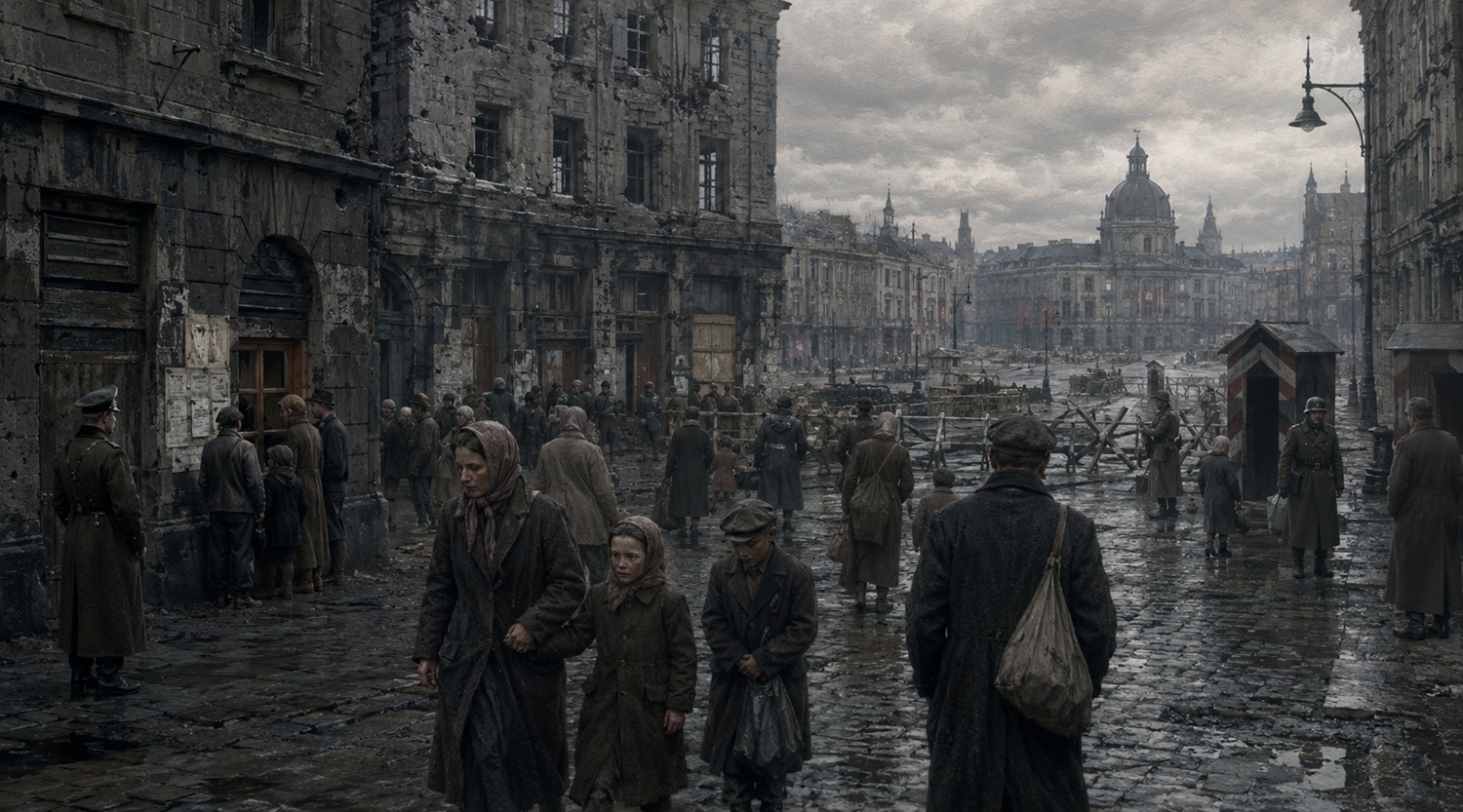
A Nazi victory in the Second World War would not simply have produced a different map of Europe.
It would have extended the life of a regime already engaged in systematic mass murder, racial persecution, forced labor, territorial depopulation, and genocide. The Holocaust had killed six million European Jews by the end of the actual war, while Nazi Germany also persecuted and murdered millions of other victims. German occupation policy in eastern Europe was explicitly connected to plans for racial colonization in which enormous populations would be expelled, enslaved, deliberately deprived of food, or killed.
Any serious counterfactual therefore has to begin with a clarification.
“Nazi Germany wins World War II” cannot reasonably mean that Germany conquers the entire planet.
Germany did not possess the naval, industrial, manpower, transport, or resource base necessary to occupy Britain, defeat the Soviet Union, conquer the United States, destroy the British Empire, subdue Asia, and govern the resulting territories simultaneously. A Cambridge history of wartime resources states directly that Germany's resources were insufficient for a global war; even by the autumn of 1941, major portions of the German war economy were struggling to meet the requirements of the army fighting in the Soviet Union.
A more plausible—though still extremely difficult—German victory would be narrower:
Nazi Germany establishes durable military domination over continental Europe while Britain leaves the European war, the Soviet Union is defeated or forced into an armistice, and the United States remains unable or unwilling to launch a successful liberation of Europe.
Even that outcome requires several major historical events to change.
And if it happened, the result would not be a stable, prosperous European federation under German leadership.
It would be a violent racial empire built around occupation, extraction, forced migration, forced labor, political repression, and continuing resistance.
What Would “German Victory” Actually Mean?
For this scenario, German victory means something like the following:
- France remains defeated and subordinated.
- Belgium, the Netherlands, Denmark, Norway, Poland, Czechoslovak territories, and other conquered areas remain under varying forms of German occupation or control.
- Fascist and collaborationist governments operate under German dominance where Berlin finds them useful.
- Britain retains its home islands and at least much of its empire but withdraws from the European war and accepts German predominance on the continent.
- The Soviet Union loses most or all of its western territories and is either politically shattered, reduced to a state farther east, or forced into an armistice.
- Germany dominates the European economy and gains access to large portions of eastern European agriculture, minerals, labor, and territory.
- The United States remains a powerful external rival rather than being conquered.
- Japan controls its own sphere in East Asia and the Pacific rather than becoming a subordinate province of a German world empire.
This is already an enormous German victory.
It gives Hitler the continental empire that was far closer to the ideological center of Nazi ambitions than fantasies of German troops occupying New York, Australia, or the entire globe. Nazi plans for Lebensraum focused especially on conquering eastern Europe and transforming it into territory for German racial colonization.
Even this outcome, however, would be extremely difficult to achieve.
Why This Scenario Was Difficult
Germany won astonishing military victories between 1939 and 1941.
Poland was defeated rapidly.
Denmark and Norway were invaded.
The Netherlands, Belgium, Luxembourg, and France fell in 1940.
German forces then drove deep into the Soviet Union after Operation Barbarossa began on June 22, 1941.
Those victories can make German domination appear more inevitable in retrospect than it actually was.
Three problems stood in Hitler's way.
Britain could not easily be invaded
Germany's victory over France did not give it command of the English Channel.
The Luftwaffe failed to destroy RAF Fighter Command during the Battle of Britain. Because Germany failed to obtain air superiority, Hitler indefinitely postponed Operation Sea Lion, the planned invasion of Britain. Imperial War Museums describes the RAF victory as making a German invasion effectively impossible under the circumstances.
Germany also lacked the sea power required for a secure cross-Channel invasion. U.S. Naval History's treatment of the war at sea similarly notes that Germany, despite its enormous strength on land, lacked the maritime strength necessary to invade Britain successfully.
The Soviet Union was far harder to destroy than German planners expected
Operation Barbarossa assumed that the Soviet Union could be defeated in a short campaign.
German intelligence underestimated Soviet military and economic capacity, while the German army's operational successes carried it farther and farther from reliable supply systems. Railroads had to be converted, trucks broke down, distances expanded, roads deteriorated, and the demands of enormous armies exceeded what Germany's logistical network could reliably deliver.
The Soviet Union had also become a major heavy-industrial power before the invasion. Its ability to mobilize additional men and industrial production proved far greater than German planners had anticipated.
Germany eventually faced the United States
American power was already moving toward the Allied side before formal U.S. entry into the war through measures such as Lend-Lease. Britain and later the Soviet Union received substantial American assistance.
Japan's attack on Pearl Harbor brought the United States into the Pacific War on December 7, 1941. Four days later, Hitler voluntarily declared war on the United States, turning an already dangerous strategic situation into a direct conflict with the world's greatest potential industrial power.
A German victory therefore requires changing more than a single battle.
The Most Plausible Divergence: Britain Leaves the War in 1940
The strongest starting point comes during the crisis of May 1940.
British forces and their allies were being driven toward the Channel.
France was collapsing.
The British Expeditionary Force faced possible destruction.
Inside the British government, Foreign Secretary Lord Halifax argued that Britain should explore whether Mussolini could mediate negotiations with Hitler. Churchill rejected the idea and ultimately carried the War Cabinet toward continued resistance. Imperial War Museums documents the sharp disagreement between Churchill and Halifax during those critical meetings.
In the alternate timeline, several events go worse for Britain.
The Dunkirk evacuation is substantially less successful.
A much larger portion of the British Expeditionary Force is captured, along with more equipment.
The military disaster strengthens Halifax's argument.
Churchill cannot maintain enough support in the War Cabinet.
Britain therefore authorizes an Italian-mediated exploration of German peace terms.
This does not mean Germany invades and occupies Britain.
That would remain extremely difficult.
Instead, Britain agrees to leave the European war.
The Alternate Anglo-German Settlement
The exact terms would be uncertain, but a plausible agreement might include:
- Britain recognizes the new German-dominated political order in continental western Europe.
- Britain ends its naval blockade of Germany.
- Germany abandons plans for invasion of Britain.
- British forces withdraw from direct European operations.
- Britain retains its Royal Navy and most of its overseas empire.
- German demands regarding selected former German colonies remain subject to later negotiation.
- Britain provides no bases from which another power can wage war against Germany.
- Germany formally promises not to attack the British Isles or dismantle the British Empire.
This would not make Britain friendly to Nazi Germany.
It would produce something closer to a tense armed peace.
Britain would continue rearming.
The Royal Navy would remain intact.
The British government would distrust German guarantees.
But Hitler would have achieved his most important immediate strategic objective:
the western war would be over without Germany having to invade the British Isles.
That changes the entire strategic geometry of World War II.
Why Britain's Withdrawal Matters So Much
Britain historically served several roles simultaneously.
It was an active belligerent.
It maintained the naval blockade against Germany.
It fought German and Italian forces in North Africa and the Mediterranean.
Its bombing campaign increasingly struck German industry and cities.
Its empire supplied manpower, bases, food, raw materials, and military forces.
Most importantly for the later liberation of western Europe, Britain became the enormous aircraft carrier, warehouse, training ground, and staging base from which Allied forces eventually invaded the continent.
Without Britain in the war, the United States would face a much harder problem even if it later decided to fight Germany.
Where would American forces assemble for a cross-Channel invasion?
Where would thousands of bombers operate?
Where would landing craft, fuel, divisions, repair facilities, and logistics bases be concentrated?
German domination of western Europe becomes considerably harder to reverse if Britain is neutralized politically rather than conquered militarily.
The Second Necessary Change: Hitler Does Not Declare War on the United States
Japan's attack on Pearl Harbor can still occur.
The causes of U.S.-Japanese confrontation included the war in China, Japanese expansion into Southeast Asia, U.S. economic pressure, asset freezes, and the oil embargo. Those conflicts did not depend solely on Britain's war with Germany.
The United States therefore enters a war with Japan in December 1941.
But Hitler makes a different decision.
He does not declare war on the United States.
The Tripartite Pact did not mechanically require Germany to declare war because Japan had initiated hostilities against the United States, and contemporary diplomatic records show that the Axis relationship left room for political choice.
Roosevelt still views Germany as a grave threat.
American aid may continue reaching Germany's enemies.
U.S. and German naval forces could still clash in the Atlantic.
Formal war might eventually come anyway.
But politically, it becomes much harder for Roosevelt to make defeating Germany the immediate priority while the United States is fighting Japan and Britain itself is no longer at war with Berlin.
That gives Germany something it never possessed historically:
time to concentrate on the Soviet Union without simultaneously fighting Britain and the United States as active European belligerents.
The Third Change: The Soviet Crisis Becomes Catastrophic
Even with Britain out of the war, Germany does not automatically defeat the Soviet Union.
This is the least plausible and most important part of the scenario.
German armies historically achieved enormous victories in 1941, destroying or capturing large Soviet forces and occupying huge territories. Yet the offensive failed to eliminate Soviet military resistance, while Germany's supply problems worsened as the Wehrmacht moved eastward.
For German victory, several additional developments must align.
Germany captures Moscow before winter.
The Soviet government successfully evacuates many institutions eastward, so Moscow's fall does not itself end the war.
But Soviet command and railway coordination suffer badly.
German armies enter 1942 in better condition because Germany has not been fighting Britain in North Africa or conducting the same air and naval war in the west.
The 1942 German offensive then succeeds where the historical campaign failed.
German forces sever key Volga transportation links and gain much more secure access to the Caucasus region.
Soviet oil supplies and internal transport are severely disrupted.
Additional Soviet military disasters produce a political crisis inside Stalin's government.
The result is not necessarily Germany conquering every kilometer to the Pacific.
Instead, the Soviet political system fractures sufficiently that organized resistance in western Russia collapses and some form of armistice, rump Soviet government, or civil conflict develops farther east.
This is a low-probability compound outcome.
Capturing Moscow alone would not be enough.
Capturing the Caucasus alone would not be enough.
German logistics would still be stretched enormously.
The Soviet Union would still possess territory, people, factories, and armed forces farther east.
But without some Soviet political collapse of this magnitude, a Nazi continental victory remains very difficult to construct honestly.
A German Victory Would Not Mean Peace
Assume these unlikely conditions occur.
By roughly 1943, organized great-power resistance to Germany on the European continent has ended.
Hitler can proclaim victory.
The map would be enormous.
The political problem would be even larger.
Germany now has to govern, police, feed, exploit, settle, and militarily defend territories inhabited by hundreds of millions of people, many of whom despise German occupation.
Nazi victory would therefore mark the beginning of a new phase of violence rather than the end of war.
What Nazi Plans Tell Us
This counterfactual does not require historians to invent Nazi intentions.
German occupation policy had already revealed them.
Nazi ideology viewed eastern Europe as the central field for German Lebensraum—“living space.” The conquest of Poland and especially the Soviet Union was not conceived simply as ordinary territorial expansion. Nazi leaders imagined a racial reordering in which Germans would colonize land while populations classified as racially undesirable or politically dangerous were expelled, enslaved, deprived of resources, or murdered.
The planning commonly grouped under Generalplan Ost envisioned vast demographic transformation in the east.
USHMM summarizes planning documents in which Nazi officials expected “many tens of millions” of people to become superfluous and face death or forced migration as Germany colonized eastern territories.
The exact versions of Generalplan Ost evolved, and historians should not treat every draft as a finalized timetable guaranteed to be implemented exactly as written.
But the racial objective is unmistakable.
Victory meant far more than German flags over new capitals.
It meant remaking the population of eastern Europe.
The Holocaust Would Continue
The most immediate human consequence would be catastrophic.
The Holocaust was the systematic, state-sponsored persecution and murder of six million European Jews by Nazi Germany, its allies, and its collaborators. By 1945, nearly two-thirds of Europe's prewar Jewish population had been murdered.
German victory would remove the military force that historically liberated camps, overran killing centers, and ended Nazi control.
There is no reason to imagine that the Nazi leadership, having won, suddenly abandons its genocidal program.
The opposite is more consistent with the evidence.
Areas that remained beyond secure German reach would become the next targets of diplomatic pressure, deportation demands, or military expansion where possible.
Surviving Jewish communities within a German-controlled continental sphere would face continuing efforts at identification, dispossession, deportation, forced labor, and murder.
It is impossible and inappropriate to assign a precise hypothetical death toll.
But the direction is clear:
Nazi victory would expand the opportunity for genocide rather than bring the Holocaust to an end.
Jewish Survival Would Become Far More Precarious
In real history, some Jews survived by hiding, fleeing, joining partisan groups, receiving assistance from rescuers, or reaching territories outside German control. Resistance occurred in ghettos, camps, forests, partisan movements, and underground organizations despite extraordinarily unfavorable conditions.
A victorious Nazi empire would make survival more difficult.
Partisan zones would lose the expectation that advancing Allied or Soviet armies might eventually arrive.
Neutral countries would face increased German pressure.
Escape routes could shrink.
Resistance organizations would have fewer external sources of weapons and intelligence.
Some people would continue hiding.
Some communities would continue resisting.
Some governments outside the German sphere might accept refugees.
But time would now favor the persecutors rather than the victims.
The historical defeat of Nazi Germany placed a limit on how long its machinery of persecution could operate.
Victory removes that limit.
Generalplan Ost and the Slavic Populations
The consequences for Poles, Russians, Ukrainians, Belarusians, and other eastern European populations would also be devastating.
Nazi rule already treated the war against the Soviet Union as a racial and ideological war of annihilation. German military orders authorized extraordinary violence against civilian resistance, while Nazi policy depicted Slavic populations as racially inferior and obstacles to German colonization.
Millions of Soviet prisoners of war were subjected to deliberate starvation, disease, exposure, shooting, and forced labor. USHMM notes that Nazi policy toward Soviet POWs was driven from the start by racial ideology and the conquest of “living space.”
A victorious regime would possess greater freedom to expand those policies into long-term population planning.
Depending on region and racial classification, people could face:
- expulsion eastward;
- forced agricultural labor;
- industrial slavery;
- removal of children selected for Germanization;
- destruction or restriction of higher education;
- settlement of German colonists;
- starvation through deliberate diversion of food;
- suppression of political and cultural institutions;
- executions of perceived political opponents;
- destruction of communities resisting occupation.
Not every person would be treated identically.
Nazi racial planners differentiated among populations and regions.
But German victory would institutionalize an order based explicitly on racial hierarchy.
Forced Labor Would Become a Permanent Economic Institution
Forced labor already played a major role in the German wartime economy.
German military, civilian, and SS authorities exploited Jews, Poles, Soviet civilians, prisoners of war, concentration-camp prisoners, and others, often under brutal and lethal conditions.
A victorious Nazi Europe would still face severe manpower problems.
Germany could conquer territory faster than it could populate it with Germans.
Its economy would need miners, agricultural laborers, factory workers, railway crews, construction workers, domestic servants, and workers rebuilding infrastructure.
The racial empire would therefore likely depend heavily on coerced foreign labor.
That creates another contradiction inside the Nazi project.
Ideology demands separation and German racial dominance.
Economic reality demands millions of non-German workers.
The regime would attempt to solve that contradiction through apartheid-like separation, forced migration, labor camps, police surveillance, and selective Germanization.
The result would not resemble a normal European common market.
It would resemble an imperial extraction system maintained by coercion.
Western Europe Would Not All Be Governed the Same Way
Nazi occupation policy varied substantially across Europe.
Some territories were annexed directly.
Others were governed through military administrations.
Others retained collaborationist governments.
Local institutions and collaborators assisted German authorities in policing populations and, in many cases, implementing persecution and genocide. USHMM emphasizes that Nazi Germany depended heavily on Axis governments and local collaborators in carrying out the Holocaust.
That variety would likely continue after victory.
France
A collaborationist French state could survive under strict German strategic supervision.
France might retain limited domestic administration while losing independent military and foreign policy.
Alsace-Lorraine and perhaps additional territories could be incorporated more directly into Germany.
French industry and agriculture would be integrated into the German continental economy.
Netherlands, Belgium, and Luxembourg
These countries could experience stronger efforts at political Nazification or territorial incorporation, particularly where Nazi racial ideologues regarded local populations as more compatible with a Germanic racial order.
Scandinavia
Denmark and Norway could remain formally distinct but strategically subordinated, with Germany controlling ports, military facilities, trade, and foreign policy.
Central and eastern Europe
German control would become much harsher.
Poland had already been treated not simply as a defeated country but as territory for racial transformation and exploitation.
The further east one moved, the more explicitly German policy became tied to colonization and population destruction.
Collaborationist Governments Would Remain Useful—and Disposable
Germany would probably continue using local fascist movements, conservative elites, police organizations, bureaucrats, and nationalist groups where they served German interests.
Collaboration had already been essential to occupation and the Holocaust.
But collaboration would not imply equality.
A victorious German government would determine how much sovereignty each satellite possessed.
Local regimes could be replaced whenever Berlin considered them unreliable.
German authorities could encourage rival ethnic or political groups against each other.
Some collaborators would discover that assisting German conquest did not guarantee meaningful national independence.
The Nazi empire would therefore contain constant tension between local nationalist movements and the German racial hierarchy that ultimately placed German interests above theirs.
Resistance Would Not Disappear
Military victory would not eliminate resistance.
During the actual war, resistance movements developed across occupied Europe despite severe reprisals. Jewish and non-Jewish resistance included underground newspapers, sabotage, intelligence gathering, escape networks, strikes, armed partisan warfare, and assassination attempts.
German victory would initially devastate many resistance movements because they would lose external military support and hope of near-term liberation.
But Nazi policies themselves would continually generate new enemies.
A farmer whose food is confiscated has a reason to resist.
A family facing deportation has a reason to resist.
A worker forced into Germany has a reason to sabotage.
A Polish, Ukrainian, Russian, French, Yugoslav, Dutch, Czech, or Norwegian nationalist who sees his country permanently subordinated has a reason to organize.
The question would not be whether resistance survives.
It would be whether Germany could keep insurgencies weak enough that occupation remained economically profitable.
Eastern Europe Could Become a Permanent Counterinsurgency Zone
This is one of the largest weaknesses in the idea of a stable Nazi empire.
The territory Germany wanted most was also territory in which its policies were most destructive.
Mass deportation, forced settlement, starvation, executions, and racial subordination would make peaceful legitimacy nearly impossible.
German security forces would therefore face continuing partisan warfare.
Their historical response to resistance was already extraordinarily brutal and often collective, with reprisals against civilians and entire communities.
Victory would allow that system to continue for years or decades.
The likely result is a cycle:
occupation produces resistance;
resistance produces German reprisals;
reprisals create more resistance;
Germany deploys more police and military forces;
occupation becomes more expensive;
economic exploitation requires still more coercion.
A German victory is therefore not equivalent to a pacified German empire.
What Happens to Britain?
Britain in this scenario is defeated politically, not occupied militarily.
It retains the Royal Navy and much of the British Empire but has accepted German continental supremacy.
That would be humiliating.
British politics after the settlement could take several directions.
One possibility is that the government treats the agreement as temporary necessity and undertakes a huge rearmament program.
The Royal Navy remains the foundation of British security.
The RAF remains essential.
Imperial bases from Canada to India and the Middle East remain strategically important.
Britain could gradually become the western anchor of an anti-German balance alongside the United States.
Another possibility is that politicians favoring accommodation argue that British security depends on staying out of continental conflict and preserving the empire.
The result could resemble an armed cold peace across the English Channel.
Britain would remain one of the few European centers from which exiles, anti-Nazi politicians, and perhaps some refugees could operate—assuming German treaty pressure did not sharply limit those activities.
London would no longer be capable of liberating Europe by itself.
But neither would Berlin have solved the strategic problem Britain represented.
The British Empire Might Survive Longer—But Under Greater Pressure
World War II historically accelerated political changes across Britain's empire.
Colonial societies contributed soldiers, workers, taxes, resources, and production to the Allied war effort, while wartime mobilization strengthened political demands for a greater role in shaping the postwar world. Scholarship on African wartime experience emphasizes how the conflict intensified political mobilization and altered relationships within European empires.
If Britain leaves the European war in 1940, some of those changes occur differently.
Britain suffers less wartime destruction and debt.
Its empire is less militarily exhausted.
India, African colonies, and other possessions are not mobilized for a six-year European struggle on exactly the historical scale.
That could allow imperial rule to persist longer.
But anticolonial nationalism already existed.
Indian independence politics did not originate in 1939.
Neither did nationalism elsewhere.
Britain might preserve the empire longer, but it would still face rising demands for sovereignty.
Nazi Colonial Ambitions Could Return
Germany had lost its overseas colonies after World War I.
Nazi-era officials and activists continued discussing the recovery of colonial territory, particularly in Africa. Modern scholarship has documented how the possibility of restoring German African colonies entered contemporary political discussions and caused concern among Africans whose territories might potentially be transferred.
A victorious Germany could demand colonial concessions from defeated France, Belgium, or perhaps Britain.
Former German territories in Africa would be obvious targets.
Yet large-scale overseas empire creates another strategic problem:
Germany would still lack Britain's naval infrastructure.
Continental victory does not suddenly give Berlin effortless control of oceanic trade.
A German African empire would therefore depend on negotiated access, naval expansion, and the willingness of other powers to tolerate German overseas movement.
The racial ideology governing such colonies would give their inhabitants little reason to welcome the change.
What Happens to the Soviet Union?
A complete German occupation extending to Vladivostok is not a serious outcome.
The distances alone make it implausible.
The stronger scenario is a rump Soviet or post-Soviet state surviving east of the German-controlled zone.
If Stalin remains alive and in control, he could attempt to rebuild beyond the Urals.
If the scale of military defeat destroys his political authority, another Soviet leadership could emerge.
Nationalist movements could try to separate from Moscow.
Military commanders could compete for control.
Some territories might become independent or German satellites.
Others might remain committed to a Soviet state.
The German-Soviet frontier could become one of the most militarized borders in the world.
A bitter revanchist Soviet successor would spend years preparing for another war.
So even a German victory in the east might produce only an extended armistice rather than permanent resolution.
Stalin's Fall Would Not Make Eastern Europe Free
This distinction is crucial.
Nazi propaganda described the invasion as a struggle against “Judeo-Bolshevism,” but German plans did not envision liberating the peoples of the Soviet Union into independent democracies.
The German campaign was explicitly linked to racial domination and colonization.
Some Ukrainians, Baltic nationalists, anti-Soviet Russians, Cossacks, and other groups historically opposed Stalin's rule and in some cases initially saw German invasion as a possible opportunity.
Nazi racial policy rapidly destroyed many such hopes.
A German victory would not reverse that contradiction.
Berlin might create nominal client states where useful.
But strategic resources, settlement zones, agricultural land, and security would remain subordinate to German priorities.
The collapse of Soviet rule would therefore replace one dictatorship with a racial colonial empire across much of the conquered territory.
What Happens to the United States?
The United States would be the greatest external obstacle to a Nazi-dominated Europe.
Even if Hitler avoids declaring war in December 1941, Washington would still regard a German continental empire as a major strategic threat.
Roosevelt's government had already moved from strict neutrality toward extensive support for nations resisting the Axis before Pearl Harbor.
But Britain's withdrawal changes what the United States can do immediately.
There is no friendly British base for a massive bomber offensive.
No straightforward staging area for Operation Overlord.
No British-controlled island directly across the Channel functioning as an unsinkable logistics platform.
The United States could still employ economic pressure, naval power, intelligence, covert operations, and support for resistance movements.
It could cooperate with Britain despite British formal neutrality.
It could eventually enter war with Germany after another Atlantic confrontation.
But liberating a continent controlled from France to western Russia would be far harder than the actual Allied task.
The most likely long-term result would therefore be rivalry rather than American conquest of Nazi Europe.
A German-American Cold War
By the late 1940s, the world could contain two enormous hostile blocs.
On one side:
the United States, probably tied closely to Canada, Latin American allies, Britain, and other surviving democratic or anti-German states.
On the other:
Nazi-dominated continental Europe, controlling much of Europe's industrial capacity and exploiting large territories to the east.
The ideological conflict would be profound.
The United States would portray Nazi Germany as a genocidal dictatorship threatening the balance of power.
German propaganda would depict the United States as a racial and ideological enemy.
Espionage, arms races, proxy conflicts, economic competition, refugee crises, and support for underground movements could dominate international politics.
In other words, victory in World War II might simply prepare the ground for a different Cold War.
Japan Would Not Become Germany's Loyal Junior Partner
The Axis is often imagined in alternate history as if Berlin, Rome, and Tokyo formed one centrally coordinated imperial machine.
They did not.
Germany and Japan had different priorities, strategic theaters, racial ideologies, military establishments, and imperial ambitions.
Japanese policy in 1941 was driven heavily by the war in China, the need for strategic resources, expansion into Southeast Asia, and the escalating confrontation with the United States.
If Japan still attacks Pearl Harbor, the United States fights a major Pacific war.
Germany's refusal to declare war on America does not oblige Washington to ignore Japan.
The U.S. Pacific campaign could therefore continue while Europe remains temporarily outside formal U.S.-German war.
Japan might seize substantial European colonial territory in Southeast Asia.
But once the immediate common enemies weakened, Japanese and German interests could clash.
Where does Japan's Asian sphere end?
What happens in India?
Who dominates the Indian Ocean?
What happens to the Soviet Far East if Moscow collapses?
Who controls trade between Europe and Asia?
A victorious Axis could eventually discover that successful imperial powers make uncomfortable neighbors.
Could the United States Still Defeat Japan?
Very possibly.
American industrial, naval, and technological power would remain enormous.
Japan still confronts the fundamental difficulty of fighting a prolonged industrial war against the United States.
But the Pacific conflict would not be identical.
Britain's status matters enormously.
If Britain remains neutral toward Germany but Japan attacks British possessions such as Malaya, Singapore, or Burma, Britain could still become an American partner against Japan without reopening war against Germany.
That could produce the remarkable situation of Britain cooperating militarily with the United States in Asia while maintaining an armed peace with Nazi Germany in Europe.
Alternatively, Tokyo might moderate its southern strategy to avoid adding Britain to its enemies.
The Pacific War therefore diverges rapidly.
But German victory in Europe does not automatically mean Japanese victory over the United States.
Nuclear Weapons Become the Great Strategic Wild Card
The possibility of nuclear weapons makes a long-term Nazi victory especially unstable.
The American atomic program began before U.S. entry into the war.
Albert Einstein's 1939 letter warned President Roosevelt about the possibility of nuclear chain reactions and German research. Roosevelt later approved full-scale bomb development, and the Army established the Manhattan Engineer District in 1942.
The historical German nuclear program never approached an operational atomic bomb.
Department of Energy historical material notes that Allied investigators eventually learned that the German effort had stalled and remained far from producing nuclear weapons.
Therefore:
German victory in 1941 or 1942 does not mean Nazi Germany suddenly possesses atomic bombs.
The United States could still become the first nuclear-armed power.
That would transform the strategic balance.
Would America Use an Atomic Bomb Against Nazi Europe?
That is much harder to answer.
If the United States and Germany are not formally at war when the bomb becomes available, there is no obvious legal or political path to immediate use.
If a German-American war has begun by 1945 or later, atomic weapons could become central.
But delivering early nuclear weapons against Germany would still require suitable air bases and bombers.
A neutral Britain might refuse access.
Or fear of German domination might eventually drive Britain back into alliance with Washington.
The possession of nuclear weapons could itself alter British calculations.
A plausible sequence is therefore:
- the United States develops atomic weapons first;
- Germany realizes the strategic implications;
- Britain faces enormous pressure to align more openly with Washington;
- Nazi Germany launches a crash nuclear program;
- the late 1940s or 1950s become an atomic arms race.
That is far more plausible than a victorious Hitler possessing a stockpile of nuclear weapons in 1943.
Nazi Germany Could Eventually Build Nuclear Weapons
Historical failure does not mean permanent impossibility.
If Germany controls continental European universities, mines, industry, laboratories, captured scientists, and years of peacetime or semi-peacetime research, a nuclear program could eventually succeed.
The question is when.
It might take years beyond the American program.
Political interference, scientific exile, bureaucratic rivalry, resource allocation, and the Nazi regime's own ideological destruction of German academic life had already damaged its scientific capacity.
Yet an existential nuclear rivalry with the United States would create enormous incentives.
A nuclear Nazi regime by the 1950s is therefore conceivable.
That creates the possibility of a German-American atomic standoff much like the U.S.-Soviet confrontation of actual history—but with a genocidal fascist dictatorship controlling continental Europe.
There Is No Nuremberg
An Allied defeat means there are no Nuremberg Trials in their historical form.
There is no Allied occupation of Germany.
No denazification directed by the victorious Allies.
No dismantling of Nazi institutions.
No international trials exposing senior German leaders and institutions to public judicial scrutiny under Allied control.
The perpetrators remain the rulers.
Nazi crimes would still be documented by victims, underground movements, refugees, foreign intelligence services, and surviving witnesses.
But Germany would suppress evidence inside its sphere.
It would portray genocide as state policy or deny and conceal aspects of it according to political convenience.
Historical reckoning would have to wait for internal regime change or a later military defeat.
There Is No Postwar Democratic West Germany
The Federal Republic of Germany emerged from Germany's defeat, Allied occupation, and the destruction of Nazi state power.
In this alternate timeline, none of that happens.
There is therefore no West German democracy created in 1949 under the historical circumstances.
There is no East German state created by Soviet occupation either.
No Berlin Airlift.
No divided Berlin in the familiar Cold War sense.
No Federal Republic joining NATO.
No later German reunification following the collapse of Soviet communism.
Instead, Germany is the imperial center of continental Europe.
The political future of Europe becomes inseparable from the future of the Nazi regime itself.
No NATO, Warsaw Pact, or European Union as We Know Them
The institutional architecture of actual postwar Europe depended on Allied victory and the emerging U.S.-Soviet conflict.
A Nazi victory destroys that sequence.
There is no NATO founded in 1949 for the same reasons.
There is no Soviet-dominated Warsaw Pact.
There is no European Coal and Steel Community built around Franco-German reconciliation after Nazi defeat.
There is no European Economic Community or European Union following the same historical route.
Germany might establish its own continental economic institutions.
They could use language of European cooperation.
But they would operate within a hierarchy enforced by German political and military power.
A customs union under occupation is not equivalent to voluntary European integration.
A German Victory Is Not the Same as a Stable Empire
This is the central long-term weakness in the scenario.
Hitler could win a war without solving the political problem of governing what he had conquered.
Nazi Germany was not a constitutional monarchy with an orderly succession process.
The regime combined Hitler's personal authority with competing institutions involving the Nazi Party, state ministries, the SS, military organizations, regional party leaders, police bodies, and economic agencies. Historians have long debated the “polycratic” character of the Nazi state precisely because authority below Hitler could be fragmented and competitive.
That system could function while everyone appealed ultimately to Hitler.
What happens when Hitler dies?
There is no established democratic election.
No neutral constitutional monarch.
No universally legitimate succession mechanism.
Instead there are armed institutions competing inside an enormous racial empire.
The Succession Crisis
A victorious Hitler could attempt to designate a successor.
But personal designation would not remove institutional rivalry.
The SS possesses enormous police and ideological power.
The Wehrmacht controls major military forces.
The Nazi Party controls political organization.
Industrial elites control important economic resources.
Occupation authorities govern enormous territories.
Regional Nazi leaders build local power bases.
A successor who lacks Hitler's personal authority might discover that ruling the empire requires bargaining with all of them.
Several outcomes are possible.
A successful successor dictatorship
One leader rapidly controls the Party, military, police, and state and continues Hitler's system.
Collective leadership
Senior Nazi figures divide responsibility while preserving the regime.
SS dominance
The police and racial apparatus becomes the most important pillar of government.
Military intervention
Senior commanders attempt to constrain Party or SS authority during a succession struggle.
Civil conflict
Rival factions use armed formations and occupation forces against each other.
None can be predicted confidently.
What can be said is that victory does not solve the succession problem inherent in a highly personalized dictatorship.
Hitler's Death Could Be More Dangerous Than Any Foreign Enemy
Imagine a Nazi empire stretching across continental Europe when Hitler dies.
Resistance movements are waiting.
Foreign intelligence agencies are financing underground organizations.
Millions of forced laborers live inside German-controlled territory.
German settlers are moving east.
Collaborationist regimes depend upon Berlin.
SS and military forces occupy overlapping jurisdictions.
A succession crisis could cause uprisings across several countries simultaneously.
A weak central government might lose peripheral territories.
A ruthless new leader might respond with enormous massacres.
A German civil struggle could turn into a continental war.
The empire's apparent size would therefore conceal profound political fragility.
The Economy Would Face Its Own Contradictions
Nazi conquest was partly driven by the desire for resources.
But occupying resources and efficiently exploiting them are not the same thing.
Germany would inherit:
- damaged railroads;
- devastated Soviet agricultural regions;
- destroyed cities;
- mines requiring reconstruction;
- hostile workers;
- partisan sabotage;
- enormous occupation expenses;
- millions of displaced people.
The historical German war economy had already resorted heavily to plunder and forced labor while suffering significant resource and manpower constraints.
Victory removes battlefield losses but adds the cost of permanent empire.
German authorities might extract large quantities of food and raw materials.
But doing so too aggressively could destroy local productivity and provoke revolt.
The Nazi racial project therefore conflicts repeatedly with rational economic administration.
Killing, deporting, starving, and displacing millions of people destroys workers, consumers, skills, agricultural knowledge, and local institutions.
Ideological empire could make Germany strategically larger while making parts of its conquered economy less productive.
Would Ordinary Germans Become Prosperous?
Some might benefit materially from conquest.
German settlers could receive confiscated land.
Workers might gain access to goods extracted from conquered regions.
Businesses could profit from forced labor and captured markets.
The regime had already shifted burdens onto occupied territories and exploited foreign labor during the actual war.
But victory would not create unlimited prosperity.
Germany would have to fund:
- enormous occupation armies;
- police and SS organizations;
- settlement projects;
- reconstruction;
- military defenses against Britain, the United States, and a possible rump Soviet state;
- naval expansion;
- nuclear research;
- suppression of resistance.
A racial empire maintained by permanent militarization is expensive.
The regime could distribute plunder for a time.
Long-term prosperity would require stable productivity and trade.
Its own ideology would repeatedly undermine both.
Resistance and Repression Could Become Normal European Life
Imagine a German-dominated Europe in 1950.
A railway is sabotaged in Poland.
German authorities arrest hundreds of villagers.
A French underground cell attacks a military office.
Police round up suspected supporters.
Partisans destroy an agricultural settlement in occupied Soviet territory.
SS units retaliate.
Workers in the Netherlands conduct a clandestine strike.
A collaborationist government arrests organizers.
American intelligence supplies radios and money to resistance movements.
German security services infiltrate exile networks operating through Britain or neutral states.
This would not necessarily appear as one continuous conventional war.
It might resemble decades of overlapping insurgencies, terrorism, counterterrorism, police repression, sabotage, and proxy warfare.
Calling that “peace after German victory” would be misleading.
Could Germany Eventually Lose Anyway?
Absolutely.
A Nazi victory in 1942 or 1943 is not the end of history.
Several later developments could destroy the empire.
German-American war
A naval, diplomatic, colonial, or nuclear confrontation could eventually escalate into open war.
Soviet resurgence
A rump Soviet state or Russian successor could rebuild and attempt reconquest.
British reentry
A heavily rearmed Britain might abandon its settlement once American power makes renewed war viable.
Continental uprisings
A German succession crisis could trigger simultaneous national revolts.
Economic crisis
The costs of occupation and racial restructuring could overwhelm the benefits of conquest.
Coup or civil war
Party, SS, and military leaders could fight after Hitler.
Nuclear coercion
An American nuclear monopoly could fundamentally alter the balance before Germany acquires its own weapons.
German victory therefore creates a new historical period.
It does not guarantee a thousand-year Reich.
Would the Holocaust Ever End Without German Defeat?
Eventually, the regime's demographic objectives might shift because the communities it targeted had been destroyed, expelled, or driven beyond its reach.
But that is not “ending the Holocaust” in any humane sense.
It would mean genocide progressing farther toward completion.
The Nazi state could then continue persecuting additional groups defined as racial, biological, political, or social enemies.
The concentration-camp and forced-labor systems could remain permanent tools of rule.
Nazi camps historically imprisoned millions of people for political repression, racial persecution, forced labor, and mass murder.
A victorious dictatorship would have no external liberating army forcing those institutions to close.
They could evolve into a permanent archipelago of repression across the empire.
What Happens to Europe's Remaining Jewish Population?
A precise answer cannot be responsibly given.
Different territories would have different conditions.
Some Jews might remain concealed for years.
Some might escape to Britain, its empire, the United States, Latin America, Palestine, or other territories outside German control.
Some governments might refuse German demands for deportation.
Others might collaborate.
But the Nazi record gives little reason for optimism inside the German sphere.
The Holocaust depended not only on German personnel but on networks of allied governments, local police, administrators, railways, businesses, and collaborators.
German victory strengthens those networks and eliminates liberation as an imminent possibility.
The likely result is further destruction of Jewish life throughout Nazi-controlled Europe.
What Happens to Zionism and Palestine?
This becomes extraordinarily uncertain.
The Zionist movement predates World War II and therefore would not disappear.
Jewish refugees outside Nazi-controlled Europe would have even greater incentive to seek safety.
If Britain retains Palestine within its empire, the political conflict over Jewish immigration, Arab opposition, and the future of the mandate continues.
But there is no post-1945 international environment produced by Allied victory.
No displaced-persons crisis in liberated Europe in the same form.
No United Nations partition process on the historical timetable.
Whether a Jewish state emerges, when it emerges, and under what borders becomes impossible to predict confidently.
The only strong conclusion is that Nazi victory would make the refugee crisis even more desperate while destroying the postwar diplomatic sequence that led to Israel's establishment in 1948.
What Happens to Italy?
Italy is technically a victor in this scenario, but Germany's overwhelming power would transform the Axis relationship.
Mussolini's regime had already demonstrated military weakness in several theaters, requiring German intervention.
A victorious Germany would be the unquestioned continental hegemon.
Italy might retain ambitions in the Mediterranean, Balkans, and Africa.
But wherever Italian interests collided with German strategy, Berlin would possess greater leverage.
A post-Mussolini Italy could become one of the first arenas testing whether German hegemony permitted genuine allied sovereignty or only subordinate dictatorship.
A successful Axis therefore contains rivalry even inside the winners' camp.
What Happens to France's and Britain's Colonial Empires?
The absence of Allied victory changes decolonization profoundly.
France remains defeated and subordinate.
Some French colonial territories could remain under a collaborationist government.
Others might revolt or align with Britain.
Germany could demand access to resources or even territorial concessions.
Britain, because it leaves the European war early, might retain greater economic and military capacity for controlling its empire.
Decolonization could therefore be delayed or redirected.
But it would not disappear.
Nationalist movements in India, Southeast Asia, the Middle East, and Africa had histories predating 1939.
Japanese attacks on European empires could still demonstrate that colonial rulers were militarily vulnerable.
A German racial empire would also provide anticolonial movements with a terrifying example of what European domination could become rather than a persuasive argument for permanent colonial rule.
Would Democracy Disappear From Europe?
Across the Nazi sphere, democratic government would be severely weakened or eliminated.
Political parties unacceptable to Berlin would be suppressed.
Independent trade unions would face restrictions or destruction.
Press freedom would disappear.
Collaborationist regimes would survive only so long as Germany permitted them.
But democracy could remain outside the Nazi sphere.
Britain could remain parliamentary.
The United States would remain democratic.
Sweden, Switzerland, Ireland, and other states might retain varying degrees of independence depending on German pressure.
The ideological geography of the world would therefore resemble a confrontation between authoritarian continental Europe and democratic maritime powers.
That could give the later German-American conflict an explicitly ideological character.
Would Christianity Be Suppressed?
A victorious Nazi regime would continue its complicated and often hostile relationship with Christian institutions.
Some clergy and churches collaborated.
Others resisted.
Nazi ideology competed with Christian ethical and institutional authority in important ways.
But predictions of the complete abolition of Christianity across Europe are too strong.
The churches were deeply embedded social institutions with hundreds of millions of adherents.
A victorious regime could subordinate, manipulate, persecute, divide, or reshape them.
Policies could vary from country to country.
The broader pattern would probably be one of state pressure and political control rather than one uniform overnight abolition of European Christianity.
Could Nazi Rule Become Less Radical After Victory?
It is conceivable that some officials would argue for moderation once military victory was secure.
Occupation is expensive.
Permanent insurgency is damaging.
Businesses prefer predictable administration.
Collaborationist elites want greater autonomy.
Some German officials might therefore advocate less disruptive rule.
But the strongest evidence runs in the opposite direction for the central racial objectives.
The conquest of the Soviet Union was undertaken specifically as a racial war designed to create Lebensraum. The genocide of Europe's Jews continued even when Germany desperately needed labor and military resources, demonstrating that exterminatory policy was not simply a temporary luxury abandoned whenever it conflicted with economic logic.
Victory would remove some wartime constraints.
It would give Nazi planners more freedom, not less, to attempt their demographic projects.
Administrative tactics could become more pragmatic.
The racial purpose of the empire would remain.
A Plausible Alternate Timeline
| Year | Real History | Nazi-Victory Scenario |
|---|---|---|
| 1940 | Britain rejects negotiation, evacuates much of the BEF from Dunkirk, and continues the war. Germany fails to defeat the RAF. | Dunkirk becomes a greater British disaster. Halifax wins the War Cabinet argument for mediation. Britain negotiates withdrawal from the European war while retaining its fleet and empire. |
| 1941 | Germany invades USSR. Japan attacks Pearl Harbor. Hitler declares war on United States. | Germany invades USSR with Britain no longer an active western belligerent. Japan still attacks U.S., but Hitler avoids declaring war on America. |
| 1942 | German advance stalls strategically; Soviet resistance strengthens; U.S. and Britain coordinate global war. | Moscow has fallen and German position in east is stronger. A more successful 1942 offensive threatens Soviet transport and oil access. |
| 1943 | Stalingrad has ended in German disaster; Allies invade Italy; Soviet forces increasingly advance. | Soviet military and political crisis produces an armistice, fragmentation, or retreat of central government far east. Germany proclaims continental victory. |
| 1944 | Western Allies land in Normandy while Soviet armies advance from east. | No Normandy invasion is possible from neutral Britain. Germany intensifies occupation and racial restructuring of eastern Europe. |
| 1945 | Nazi Germany collapses; camps liberated; Hitler dies; war in Europe ends. | Nazi rule continues. Holocaust and forced population policies extend into territories still under German control. United States likely approaches or achieves atomic weapons while Germany remains non-nuclear. |
| Late 1940s | Germany divided; NATO-era Western order begins emerging; Soviet bloc forms in eastern Europe. | German-American strategic rivalry replaces the historical U.S.-Soviet Cold War. Britain balances uneasily between armed neutrality and cooperation with Washington. |
| 1950s | NATO and Warsaw Pact blocs dominate Europe. | Nazi Europe faces resistance, succession questions, nuclear competition, and possible confrontation with the United States and rump eastern powers. |
The farther this timeline moves from 1940, the more speculative it becomes.
Strong, Moderate, and Weak Counterfactual Claims
| Claim | Assessment | Why |
|---|---|---|
| Germany conquers the entire world | Extremely weak | Germany lacked the resources, naval power, and logistics for true global conquest. |
| Britain could conceivably leave the war through negotiation in 1940 | Plausible but difficult | Halifax actually advocated exploring mediation during the May 1940 crisis. |
| Germany could invade and permanently occupy Britain in 1940 | Weak | Germany failed to gain air superiority and lacked adequate sea power. |
| Britain's withdrawal would greatly strengthen Germany's continental position | Strong | Britain was a continuing belligerent, economic enemy, imperial power, and later the indispensable western Allied base. |
| Capturing Moscow automatically defeats the USSR | Weak | The Soviet state possessed enormous territory, population, and industrial capacity beyond Moscow, while German logistics were already overstretched. |
| Soviet defeat becomes more plausible if Britain exits and several additional Soviet disasters occur | Possible, but still difficult | Germany would face fewer theaters, but its eastern logistical and economic constraints remain formidable. |
| Hitler could have chosen not to declare war on the United States after Pearl Harbor | Strong as a decision-point counterfactual | Germany's declaration was a political choice rather than an unavoidable automatic response. |
| Nazi victory would end the Holocaust | False | Nazi racial and genocidal policy would remain in power rather than being defeated. |
| Nazi victory would intensify racial colonization in eastern Europe | Very strong | Nazi Lebensraum and Generalplan Ost planning explicitly envisioned massive forced demographic transformation. |
| Slavic populations would all simply be exterminated | Too simplistic | Nazi policy differentiated among populations and involved a mixture of murder, starvation, expulsion, Germanization, and forced labor rather than one identical policy for everyone. |
| Resistance would disappear after victory | Very weak | Resistance already persisted under extreme occupation terror; Nazi victory removes liberation but not the causes of resistance. |
| The Nazi empire would be permanently stable | Weak | Occupation costs, insurgency, racial policy, economic contradictions, and succession problems would remain. |
| Germany has atomic bombs by 1945 | Very weak | The historical German nuclear project had stalled far short of a weapon. |
| Germany eventually develops nuclear weapons if the regime survives | Plausible | A long-lived industrial great power facing a nuclear rival would have powerful incentives to pursue them, though timing cannot be established. |
| The United States remains a major rival | Very strong | German continental victory does not remove American industrial, naval, economic, or technological power. |
| A German-American Cold War emerges | Plausible | The two systems would possess major strategic and ideological conflicts even without immediate direct war. |
| The Nazi regime lasts for centuries | Highly speculative | Hitler's eventual death, factional competition, resistance, economic problems, and foreign rivals create repeated opportunities for collapse. |
What Would Probably Still Happen?
Even this enormous Nazi victory would not make every later development dependent on Berlin.
The United States remains an industrial superpower
Germany does not acquire North America's population, factories, agriculture, oil, and geography merely by defeating the Soviet Union.
Japan pursues its own empire
Tokyo has its own interests in China, Southeast Asia, and the Pacific.
Anticolonial nationalism continues
European imperial rule was already contested before the war.
Technology continues developing
Radar, jet aircraft, rockets, nuclear physics, computing, and electronics have scientific and military drivers extending beyond one regime.
Nuclear weapons remain possible
The American program began from scientific discoveries and fear of a German bomb before formal U.S. entry into the European war.
Hitler eventually dies
Even a victorious dictatorship faces succession.
Occupied peoples continue seeking autonomy
Military defeat does not erase Polish, French, Czech, Dutch, Ukrainian, Russian, Norwegian, Yugoslav, Greek, and other national identities.
The Nazi empire continues needing resources
Victory does not repeal economics.
Germany still needs oil, labor, transportation, agricultural output, and international trade.
What Changes Most?
The Holocaust continues longer
This is the most serious consequence.
There is no Allied liberation of occupied Europe in 1944–1945 and no collapse of Nazi institutions.
Generalplan Ost has an opportunity to move from wartime planning toward longer-term implementation
The forced demographic transformation of eastern Europe becomes a central postwar project rather than a plan terminated by military defeat.
There is no democratic reconstruction of Germany
Nazism remains the governing system.
Eastern Europe experiences vastly greater German settlement and population displacement
The war of conquest becomes a colonial order.
The postwar international system disappears
No Allied occupation, Nuremberg, NATO, Warsaw Pact, Marshall Plan, or European integration occurs in the historical form.
The United States faces a continental fascist superpower
The primary global strategic confrontation changes from Washington versus Moscow to Washington versus Berlin.
Britain's role changes from victor to armed survivor
Its empire may last longer, but its influence in Europe collapses.
The Soviet Union no longer becomes the victorious superpower of 1945
A rump state, fragmented successor system, or eventual Russian revival replaces it.
The Myth of the Efficient Nazi Superstate
Alternate history often imagines a German victory producing a technologically brilliant, flawlessly organized superpower.
That image confuses dictatorship with efficiency.
The Nazi system frequently contained competing bureaucracies, overlapping jurisdictions, political favoritism, ideological interference, and rivalry among institutions.
Its war economy depended increasingly on plunder and forced labor.
Its occupation policies could sacrifice economically useful populations because racial ideology demanded persecution and murder.
A victorious Reich might produce impressive weapons, infrastructure, aerospace projects, and scientific programs.
It could also waste vast resources on racial settlement projects, security forces, competing institutions, monumental construction, repression, and permanent occupation.
Technological sophistication would not make the political system rational.
A Nazi Victory Would Produce More Victims, Not Just Different Borders
This point deserves to be stated without ambiguity.
A map showing Germany controlling more territory can make the counterfactual look like a conventional geopolitical exercise.
But territory was not the ultimate issue.
Nazi Germany had already demonstrated what its occupation meant.
Jews were deported and murdered.
Soviet prisoners of war were deliberately starved and killed.
Civilians were subjected to reprisals.
Poles and Soviet citizens were forced into labor.
Communities were destroyed.
Local collaborators were incorporated into systems of persecution.
German military forces themselves participated in Nazi racial warfare and the Holocaust.
German victory therefore means millions of people who historically survived liberation instead remain under the authority of those institutions.
It means German planners have more years to implement projects that Allied victory interrupted.
That must remain at the center of any responsible analysis.
Could Hitler's Empire Reach the 1960s?
It is possible.
Authoritarian regimes can survive for decades.
A victorious state also gains prestige that can strengthen domestic legitimacy.
Germany could exploit conquered economies and use police power to suppress opposition.
But survival for twenty years would require repeatedly solving major problems:
- Hitler's aging and eventual death;
- succession;
- resistance;
- relations with Britain;
- relations with the United States;
- nuclear competition;
- Soviet or Russian recovery;
- conflicts with Japan;
- economic integration;
- German manpower shortages;
- settlement of the east;
- managing collaborationist states.
A 1960 Nazi Europe is therefore conceivable.
It is not inevitable.
And it would probably look far more militarized and unstable than fictional depictions of a smoothly administered thousand-year empire.
Could Nazi Germany Liberalize After Hitler?
It cannot be ruled out over very long periods, but there is little basis for predicting it confidently.
A successor might reduce some of the regime's most destabilizing policies in order to preserve power.
Economic managers might seek normalized trade.
Military leaders might want détente with the United States.
Some occupied territories might receive greater autonomy.
But liberalization would threaten the ideological and political institutions on which the empire was founded.
The regime's legitimacy would rest partly on victory, German racial privilege, dictatorship, and the conquered eastern order.
Reform could therefore trigger the same problem faced by many empires:
how do you loosen coercion without encouraging the subjects of the empire to demand complete freedom?
A reforming Nazi successor might preserve the system.
Or accidentally begin its collapse.
The Long-Term Empire Is More Fragile Than the Short-Term Victory
This distinction is crucial.
Winning continental supremacy in the early 1940s is already difficult.
Keeping it until 1980 is far harder.
Every additional decade introduces new unknowns:
new technology;
new generations;
new leaders;
new resistance movements;
new economic crises;
new foreign alliances;
new nuclear weapons;
new ideological movements.
The probability of accurately predicting the political map declines rapidly.
That is why the strongest counterfactual claims concern the years immediately following victory.
Those years would almost certainly be marked by intensified racial restructuring, forced labor, persecution, and occupation.
Claims about a Nazi Moon landing in 1970 or a permanent German global empire belong much more to speculative fiction.
The AltHistAI Verdict
Could Nazi Germany have “won” World War II?
Only if victory is defined far more narrowly than world conquest.
Germany was extraordinarily powerful on land, but it could not force Britain from the war militarily in 1940. The RAF survived the Battle of Britain, Germany failed to obtain air superiority, and German sea power was inadequate for a secure invasion of the British Isles.
Germany then attacked the Soviet Union expecting a rapid collapse.
Instead, the Wehrmacht advanced across enormous distances while its logistics deteriorated and Soviet military and industrial capacity proved far greater than German planners expected.
Then Hitler declared war on the United States.
By doing so, he helped create the coalition whose combined industrial, demographic, geographic, and military resources Germany could not match.
A plausible German victory therefore requires several major changes rather than one convenient battlefield decision.
The strongest compound scenario is:
Britain negotiates its withdrawal from the war during the crisis of 1940; Hitler avoids declaring war on the United States after Pearl Harbor; and the Soviet Union suffers a much deeper military and political collapse during 1941–1942.
Even then, German victory is difficult.
But suppose it happens.
The resulting empire is not a peaceful German-led European union.
It is the continuation and enlargement of a racial dictatorship.
The Holocaust does not end because Germany has won.
The regime that organized it remains in power.
The military forces, SS agencies, police structures, transport systems, occupation bureaucracies, allied governments, and collaborators that enabled persecution and mass murder continue operating.
Jewish communities still within German reach face further destruction.
There is no Allied liberation of the camps.
There is no military defeat compelling the killing centers and concentration-camp network to close.
There is no Nuremberg.
There is no denazification.
The perpetrators remain the government.
In eastern Europe, the consequences extend even farther.
Nazi conquest of the Soviet Union was always about more than defeating Stalin.
It was envisioned as a racial war for Lebensraum.
Generalplan Ost and related policies contemplated vast forced demographic change, with Nazi planners expecting tens of millions of inhabitants to die, be expelled, or otherwise removed from territory intended for German colonization.
A German victory gives those projects time.
Poland and conquered Soviet territories become laboratories for forced settlement.
Millions of Slavic inhabitants face expulsion, coercive labor, starvation, political repression, and murder.
German settlers receive confiscated territory.
Local education and political institutions are reshaped according to German racial priorities.
The continent becomes more violent after the war has supposedly ended.
Resistance would continue because the occupation itself would continuously manufacture resistance.
Partisans would fight in forests and cities.
Underground organizations would operate in western Europe.
Foreign powers would fund insurgencies.
Germany would answer with collective reprisals, deportations, executions, and police terror.
The eastern territories in particular could become a permanent counterinsurgency zone.
Britain would survive geographically but lose its ability to determine the European balance.
Its most plausible future would be an uneasy armed neutrality, preserving the Royal Navy and empire while gradually moving closer to the United States.
The United States would remain the greatest power outside the German sphere.
If Hitler avoids an immediate declaration of war, Washington might concentrate first on Japan.
But a continental Nazi empire controlling Europe's industrial heartland could hardly become an ordinary American diplomatic partner.
Strategic rivalry would grow.
The atomic bomb makes that rivalry especially dangerous.
The United States historically developed nuclear weapons while the German bomb program remained far behind.
A victorious Germany therefore might initially confront an American nuclear monopoly.
If the regime survives, it would almost certainly have powerful incentives to pursue atomic weapons of its own.
The postwar world could become an American-German nuclear confrontation instead of the American-Soviet Cold War.
Japan would form a third imperial center rather than obediently following Berlin.
Britain would remain a major maritime power.
A rump Soviet or Russian state could survive east of German-controlled territory.
The result is not one unified Axis planet.
It is a highly unstable multipolar world dominated by competing empires.
And then there is Hitler himself.
Victory does not make him immortal.
The Nazi state relied heavily on his personal authority while containing numerous rival institutions and power centers.
When Hitler dies, someone has to control the Nazi Party, SS, military, police, economy, occupation administrations, German settlement projects, satellite governments, and perhaps nuclear arsenal.
That succession could succeed.
It could also create the most dangerous crisis the empire had faced since the war.
Occupied nations could revolt.
German factions could compete.
Britain and the United States could intervene covertly.
A rump Soviet power could attack.
An empire that looked invincible under Hitler could begin fragmenting within a few years of his death.
So the strongest answer to “What if Nazi Germany won World War II?” is not the familiar image of an efficient thousand-year Reich ruling a permanently pacified Europe.
It is something darker and less stable:
a temporary German continental supremacy built upon genocide, racial colonization, forced labor, military occupation, and permanent political violence.
Its initial victory would be catastrophic for the peoples under Nazi rule.
It would likely allow the Holocaust to claim more victims.
It would give Generalplan Ost and related racial projects greater opportunity for implementation.
It would destroy the possibility of democratic postwar reconstruction across much of Europe.
It could delay decolonization.
It would create a new global arms race.
And it would leave the world facing another great-power confrontation rather than lasting peace.
The Nazi regime could win battles.
It might even, under a highly favorable chain of circumstances, win its continental war.
But military victory would not solve the fundamental contradiction at the center of Hitler's project:
an empire built by treating enormous populations as expendable enemies would have to spend its future ruling those same populations.
That is not a recipe for a stable thousand-year Reich.
It is a recipe for an extraordinarily violent empire whose apparent triumph creates the conditions for decades of rebellion, repression, international confrontation, and perhaps another war.
Key Takeaways
- A realistic Nazi “victory” means domination of continental Europe, not conquest of the entire world.
- Germany lacked the resources and naval capacity necessary for genuine global conquest.
- The RAF's survival in 1940 made a German invasion of Britain extraordinarily difficult.
- Lord Halifax genuinely advocated exploring mediated negotiations during the British political crisis of May 1940, making British withdrawal through a negotiated settlement a more plausible divergence than German military conquest of Britain.
- Operation Barbarossa suffered from serious logistical problems and German underestimation of Soviet military and industrial resources.
- Capturing Moscow alone should not be treated as an automatic German victory.
- Hitler's declaration of war on the United States after Pearl Harbor was a political decision rather than an unavoidable requirement.
- A plausible Nazi continental victory therefore requires multiple favorable divergences rather than one altered battle.
- Nazi victory would not end the Holocaust. It would leave the perpetrators and institutions of genocide in power.
- The Holocaust historically murdered six million European Jews, and German victory would give the regime additional opportunity to target surviving Jewish communities.
- Generalplan Ost and related Nazi planning envisioned enormous population displacement and death in eastern Europe to create German Lebensraum.
- Slavic populations would face differing combinations of expulsion, forced labor, starvation, Germanization, political repression, and murder rather than one simple uniform policy.
- Nazi Germany already exploited millions of foreign and imprisoned workers; a victorious empire would probably make coerced labor a long-term pillar of its economy.
- Collaborationist regimes would continue to exist, but their sovereignty would remain subordinate to German interests.
- Resistance would not disappear after German military victory.
- Eastern Europe could become a permanent insurgency and counterinsurgency zone.
- Britain would most plausibly survive as an armed but strategically weakened imperial power rather than becoming German territory.
- British and other European colonial empires might survive longer, though anticolonial nationalism would continue.
- A rump Soviet or Russian state could survive beyond the German occupation zone even after catastrophic Soviet military defeat.
- Japan would remain an independent imperial power with interests that could eventually conflict with Germany's.
- The United States would remain too powerful to fit comfortably into a German-controlled world system.
- A German-American Cold War is more plausible than Nazi conquest of the United States.
- The United States could still become the first nuclear power; Germany's actual wartime atomic program had not come close to producing a bomb.
- A long-lived Nazi state might eventually develop nuclear weapons, potentially creating an atomic German-American standoff.
- There would be no Nuremberg Trials, Allied denazification, democratic West Germany, NATO, Warsaw Pact, or European Union on the historical path.
- Nazi victory would not guarantee long-term regime stability.
- Hitler's eventual death would expose a major succession problem in a dictatorship containing competing Party, SS, military, governmental, and economic institutions.
- A German victory would therefore be best understood as the beginning of a violent racial empire, not the conclusion of European conflict.
Sources and Further Reading
Holocaust, Nazi Racial Policy, and Generalplan Ost
United States Holocaust Memorial Museum, Holocaust Encyclopedia, “Introduction to the Holocaust.”
Authoritative overview of the systematic Nazi persecution and murder of six million European Jews and the persecution and murder of millions of other victims.
United States Holocaust Memorial Museum, Holocaust Encyclopedia, “Lebensraum.”
Essential source for Nazi plans to conquer eastern Europe for German colonization and the demographic thinking associated with Generalplan Ost, including plans anticipating the forced removal or death of tens of millions.
United States Holocaust Memorial Museum, “The German Army and the Racial Nature of the War against the Soviet Union.”
Explains why Operation Barbarossa was not merely a conventional military campaign but a racial and ideological war tied to the destruction of Jews, communism, and populations classified as inferior.
United States Holocaust Memorial Museum, “The German Military and the Holocaust.”
Documents the Wehrmacht's participation in persecution, forced labor, and mass murder, correcting the postwar myth of a German military institution separate from Nazi crimes.
United States Holocaust Memorial Museum, “Collaboration.”
Examines the indispensable role of Axis governments, local administrations, police units, and other collaborators in implementing Nazi persecution and the Final Solution across occupied Europe.
Soviet POWs, Forced Labor, and the War in the East
United States Holocaust Memorial Museum, “Nazi Persecution of Soviet Prisoners of War.”
Provides an overview of the German war of annihilation against the Soviet Union and the mass death of Soviet POWs.
United States Holocaust Memorial Museum, “The Treatment of Soviet POWs: Starvation, Disease, and Shootings.”
Documents deliberate starvation and brutal treatment of Soviet prisoners during the first phase of Operation Barbarossa.
United States Holocaust Memorial Museum, “Forced Labor: An Overview.”
Documents the central role of coerced Jewish, Polish, Soviet, prisoner, and concentration-camp labor in the German wartime economy.
German Military Prospects and Operation Barbarossa
The Cambridge Companion to the Nazi-Soviet War, “Operation Barbarossa, 1941.”
Modern scholarly overview of German planning and the enormous 1941 campaign, including the battles of Minsk, Smolensk, Kiev, and Moscow.
David Stahel, Operation Barbarossa and Germany's Defeat in the East. Cambridge University Press.
A major modern study emphasizing that the eastern campaign was already encountering fundamental operational and material problems during the period often portrayed as Germany's moment of greatest triumph.
The Cambridge History of the Second World War, “Logistics by Land and Air.”
Explains the escalating road, railway, transport, and supply problems that afflicted German forces as they advanced deep into the Soviet Union.
The Cambridge History of the Second World War, “Controlling Resources.”
Places Barbarossa within Germany's larger resource problem and explicitly notes that German resources were insufficient for a truly global war.
Hitler's Fatal Miscalculation, “The Crisis of the German War Economy, 1940–1941.”
Shows that German war production was already struggling to meet the requirements of the eastern army by late 1941.
Britain in 1940
Imperial War Museums, “The People Who Helped Shape the Future of Britain in May 1940.”
Documents the critical War Cabinet dispute in which Foreign Secretary Lord Halifax advocated exploring negotiations while Winston Churchill argued for continued resistance.
Imperial War Museums, “8 Facts You Need to Know About the Battle of Britain.”
Explains the Luftwaffe's failure to defeat Fighter Command and Hitler's resulting postponement of Operation Sea Lion.
U.S. Naval History and Heritage Command, “Conduct of War at Sea.”
Provides historical analysis emphasizing that German land power did not translate into sufficient maritime power for an invasion of Britain.
The United States and the War
U.S. Department of State, Office of the Historian, “Lend-Lease and Military Aid to the Allies.”
Documents the movement of the United States from neutrality toward material support of nations fighting the Axis before formal American entry.
U.S. Department of State, Office of the Historian, “Japan, China, the United States and the Road to Pearl Harbor.”
Explains the economic sanctions, oil embargo, Japanese expansion, and strategic tensions that produced the Pacific confrontation independently of a German-American war.
U.S. Department of State, Foreign Relations records, December 11, 1941.
Primary diplomatic record of Germany's declaration of war on the United States—an essential reminder that Hitler made a strategic choice after Pearl Harbor.
U.S. Department of State, Office of the Historian, “U.S.-Soviet Alliance, 1941–1945.”
Explains the development of American aid to the Soviet Union and the later wartime coalition.
Nuclear Weapons
U.S. Department of Energy, “The Manhattan Project.”
Official history of the American wartime atomic bomb program, its scientific origins, industrial scale, and development.
U.S. Department of Energy, historical timeline of the Manhattan Project.
Documents Einstein's warning concerning German uranium research and Roosevelt's authorization of the American bomb effort.
U.S. Department of Energy, historical material on the German nuclear program.
Explains that the German atomic effort had largely stalled and remained far short of an operational weapon by the end of the actual war.
Occupation and Resistance
The Cambridge History of the Second World War, “Occupation, Collaboration, Resistance and Liberation.”
Broad scholarly treatment of German occupation systems, exploitation, collaboration, and resistance across Europe.
United States Holocaust Memorial Museum, “Jewish Resistance.”
Documents the many forms of Jewish resistance throughout German-occupied Europe, including armed organizations, underground activity, escape, documentation, and revolt.
United States Holocaust Memorial Museum, “Non-Jewish Resistance.”
Documents resistance to Nazi rule by a wide range of political, national, religious, and underground organizations within Germany and occupied Europe.