 Alternate History AI
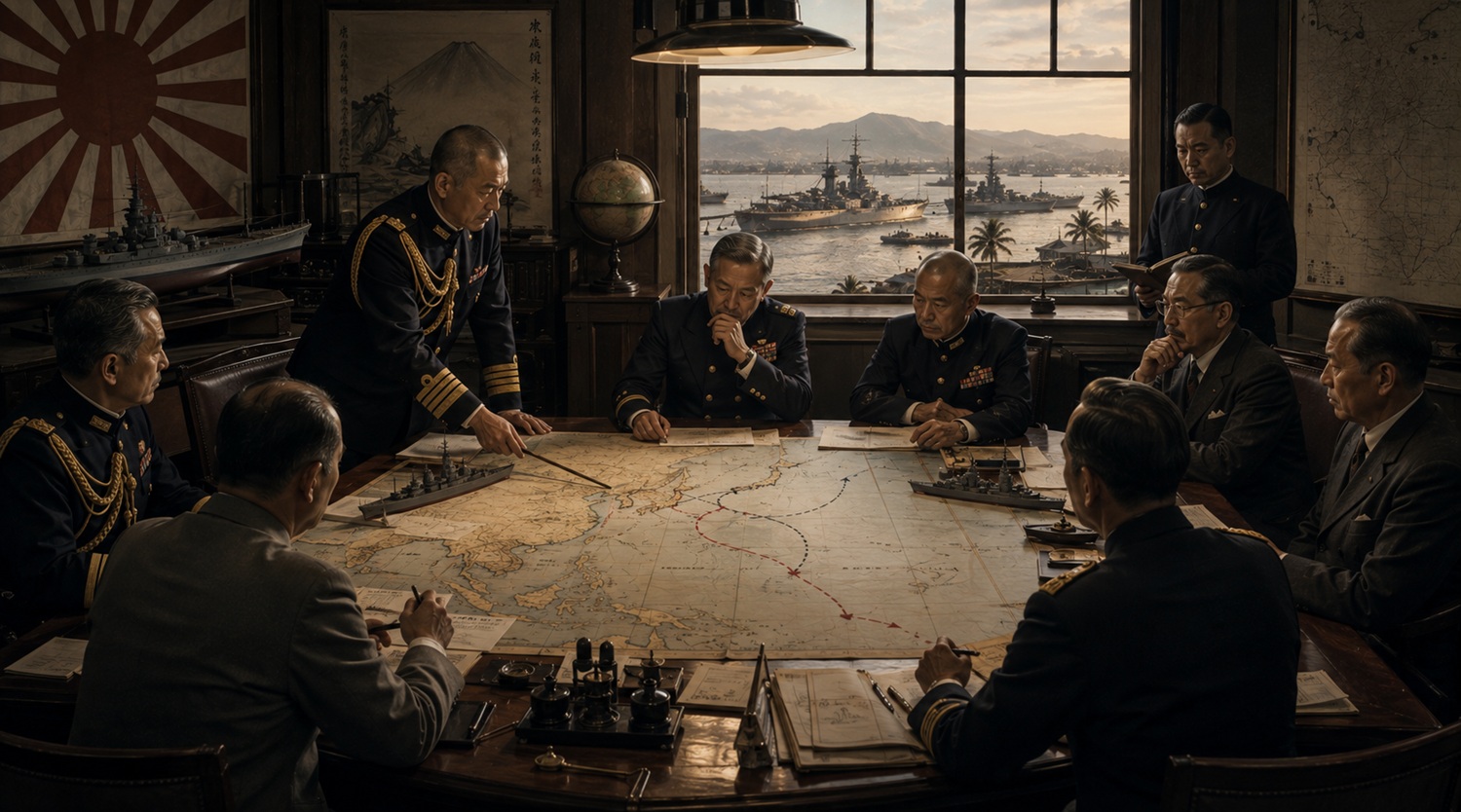
On the morning of December 7, 1941, aircraft from six Japanese carriers attacked the United States Pacific Fleet at Pearl Harbor, Hawaii.
The attack transformed American politics almost instantly.
The following day, Congress declared war on Japan. On December 11, Adolf Hitler's government declared war on the United States, bringing America formally into both the Pacific and European wars. (Office of the Historian)
That sequence can make Pearl Harbor seem like the inevitable endpoint of Japanese-American relations.
It was not.
By late 1941, however, Japan had created an extraordinarily difficult strategic problem for itself.
It had been fighting a major war in China since 1937 without achieving a decisive political settlement. Its industrial economy and armed forces depended heavily on imported raw materials, particularly petroleum. Japanese expansion into French Indochina intensified confrontation with the United States, Britain, and the Netherlands. After Japan moved into southern Indochina in July 1941, Washington froze Japanese assets, and the resulting licensing policy effectively stopped American oil exports to Japan. (Cambridge University Press)
Japanese leaders now confronted a shrinking supply of fuel while continuing expensive wars and occupations.
One solution was diplomatic compromise.
Another was retrenchment from China or Indochina.
A third was seizure of the oil-rich Netherlands East Indies and other Southeast Asian territories.
But that third option presented another problem.
The American-controlled Philippines sat directly beside the sea routes connecting Japan with the resources of Southeast Asia. U.S. planners had considered the Philippines central to a future Pacific war, while Japanese plans for the “Southern Resource Area” ultimately included simultaneous attacks on Malaya, the Netherlands East Indies, and the Philippines. (Cambridge University Press)
Pearl Harbor was designed partly to neutralize the American Pacific Fleet long enough for Japan to seize and fortify its new southern empire.
So a scenario in which Japan simply decides, “Do not bomb Hawaii,” does not solve Japan's deeper strategic dilemma.
It merely leaves the dilemma intact.
The strongest alternate history is therefore not:
Japan avoids Pearl Harbor and peacefully dominates Asia.
It is:
Japan abandons the Pearl Harbor strike while still having to choose between compromise, economic decline, a different war, or a delayed confrontation with the United States.
That produces several very different possible futures.
---
The Road to Pearl Harbor
The American-Japanese confrontation of 1941 did not begin in Hawaii.
Its deepest immediate source was Japan's expansion in China and Southeast Asia.
Japan had seized Manchuria in 1931 and expanded its control there through the creation of the puppet state of Manchukuo.
In July 1937, fighting between Chinese and Japanese forces developed into a much larger war.
Japan captured major Chinese cities, including Nanjing, but it did not force Chiang Kai-shek's Nationalist government to surrender.
Instead, the war expanded.
By 1941, Japan controlled extensive territory but remained trapped in a costly conflict with Chinese forces continuing to resist. Modern scholarship describes the China war as a central element of the strategic predicament that eventually pushed Japan toward wider war. (Cambridge University Press)
The United States increasingly supported China politically and economically.
Washington objected both to Japanese aggression and to efforts to establish a Japanese-dominated political and economic order in East Asia.
The two governments therefore disagreed over something much larger than trade.
Japan wanted recognition of the strategic gains it had already made.
The Roosevelt administration increasingly insisted that a stable settlement required an end to further military expansion and meaningful withdrawal of Japanese forces from China and Indochina. The diplomatic record from 1941 repeatedly shows the question of Japanese troop withdrawal as one of the central obstacles to agreement. (Office of the Historian)
That dispute could not easily be solved by diplomats because military expansion had become connected to the political legitimacy of Japan's government and armed forces.
---
Japan's Oil Problem
Japan was a major industrial and military power without the domestic resource base necessary to sustain that power indefinitely.
Oil was particularly serious.
Modern navies required fuel.
Aircraft required fuel.
Trucks and tanks required fuel.
Industry required petroleum products.
Japan therefore imported much of what it consumed.
American economic pressure was dangerous precisely because Japan had few easy replacements.
The U.S. government had actually hesitated before completely interrupting oil supplies. Roosevelt told officials in July 1941 that cutting Japan off could encourage Tokyo to seize the Netherlands East Indies by force, producing precisely the war Washington hoped to avoid. (Office of the Historian)
But Japan's occupation of southern French Indochina changed the calculation.
Washington froze Japanese assets.
Britain and the Netherlands took similar measures.
The American licensing system then produced what historian Akira Iriye describes as a de facto oil embargo: effectively no American oil reached Japan after the beginning of August 1941. (Cambridge University Press)
Japan's leaders now faced a clock.
The longer the embargo continued, the more fuel the armed forces consumed without replacement.
Eventually Japan would have to reduce operations dramatically or find another source.
And the richest obvious source was to the south.
---
The Netherlands East Indies
The Netherlands East Indies—roughly modern Indonesia—contained the petroleum Japan desperately wanted.
Tokyo had already been negotiating for expanded oil purchases before the embargo. American diplomatic records show Japanese efforts to obtain millions of tons annually from producers in the Indies. (Office of the Historian)
But purchasing oil required Dutch cooperation.
And the Dutch government in exile was aligned increasingly closely with Britain and the United States.
Japan could not simply demand unlimited petroleum while simultaneously threatening the regional order.
That left conquest.
Japanese military planners increasingly favored a southern strategy aimed at the resource-rich territories of Southeast Asia. The Naval History and Heritage Command summarizes the logic clearly: Japanese leaders concluded that they needed to seize the resource-rich south even though doing so risked war with the United States. (Naval History and Heritage Command)
Pearl Harbor was therefore not the purpose of the war.
The southern resources were closer to the purpose.
Pearl Harbor was a military means intended to protect that seizure from American interference.
---
The Strategic Debate in Tokyo
Japan did have alternatives.
The military and political establishment had long debated northern and southern directions of expansion.
A northern strategy pointed toward Soviet territories.
A southern strategy pointed toward French Indochina, British Malaya, the Philippines, and the Netherlands East Indies.
By 1941, the southern option had become dominant.
Japan had signed a neutrality pact with the Soviet Union in April, and Japanese diplomatic reporting noted competing schools of thought about how rapidly the southward advance should proceed. (Office of the Historian)
Even after Germany invaded the Soviet Union in June 1941, Tokyo did not automatically join Hitler by attacking Siberia.
Some Japanese officials favored such a move, and Germany encouraged it.
But the resource problem pushed attention south.
This matters for our alternate history.
If Japan does not attack Pearl Harbor, there is no single obvious replacement strategy.
Tokyo has to reopen a debate it had nearly settled.
---
The Point of Divergence: Yamamoto's Pearl Harbor Plan Is Rejected
Admiral Isoroku Yamamoto believed that if Japan went to war with the United States, the Pacific Fleet had to be struck immediately.
Japanese strategy assumed that a surprise blow would temporarily cripple American naval power, allowing Japan to seize the Philippines, Malaya, the Netherlands East Indies, and other objectives before the United States could react effectively. U.S. Army histories describe the Japanese plan by September 1941 as a coordinated offensive against Malaya, the Philippines, and the East Indies accompanied by a crushing attack on Pearl Harbor. (U.S. Army Center of Military History)
Our divergence occurs during the final strategic debates of autumn 1941.
The Japanese high command rejects Yamamoto's Hawaiian operation.
The reasons are plausible.
The voyage to Hawaii is extraordinarily ambitious.
Surprise cannot be guaranteed.
Japan's carriers are among its most valuable strategic assets.
A failed raid could destroy the offensive striking force before the southern campaign even begins.
Some commanders also question whether attacking Hawaii will unite American public opinion so completely that any negotiated settlement becomes impossible.
Tokyo therefore decides:
No attack on Hawaii.
But that decision does not yet answer the harder question:
What does Japan do instead?
Three broad possibilities emerge.
---
Strategy One: Continue Negotiations
The least destructive alternative is continued diplomacy.
Negotiations between Washington and Tokyo were still taking place in November 1941.
Japan offered proposals involving limited withdrawals and temporary arrangements.
American officials themselves considered a temporary modus vivendi under which Japan would withdraw forces from southern French Indochina while negotiations continued and the United States provided limited economic relief. (Office of the Historian)
That is significant.
It means there was at least conceptual space for a short-term agreement.
The problem was that the political gap remained enormous.
Japan wanted economic relief without surrendering the basic position it had built through years of warfare.
The United States did not want to resume supplying the military resources that would allow Japan to continue aggressive expansion.
Secretary of State Cordell Hull's November 26 proposal therefore returned to fundamental issues such as withdrawal from China and Indochina and respect for international commercial principles. Japanese representatives regarded the proposal as effectively ending the immediate negotiations. (Office of the Historian)
For peace to survive, one side would have to retreat politically.
---
What Would Japan Have to Concede?
A durable agreement would probably require Japan to do at least some of the following:
withdraw from southern Indochina;
halt further movement into Southeast Asia;
reduce military pressure on the Netherlands East Indies;
negotiate seriously over troop withdrawal from China;
accept continued American support for Chiang Kai-shek at least temporarily;
reduce the practical significance of the Tripartite Pact with Germany and Italy.
In exchange, the United States could:
unfreeze some Japanese assets;
permit limited imports;
restore at least civilian petroleum shipments;
reopen broader commercial negotiations;
assist in building a diplomatic settlement with China.
American officials explicitly discussed helping Japan obtain oil for civilian needs if Tokyo demonstrated peaceful intentions. (Office of the Historian)
So a compromise was not physically impossible.
It was politically difficult.
---
Why a Negotiated Settlement Was So Difficult
Japan had already spent years of blood and treasure in China.
A withdrawal could be portrayed domestically as surrender.
The army had enormous political influence.
Prime Minister Fumimaro Konoe's government had fallen in October 1941, and General Hideki Tojo became prime minister.
The new leadership was not enthusiastic about abandoning the gains for which Japan had fought since 1937.
Washington faced its own political constraints.
Roosevelt had increasingly presented Japanese expansion as part of a wider authoritarian threat.
American aid to China had become connected conceptually with aid to Britain.
Hull told Japanese representatives that Washington could not reasonably be expected to abandon China while Japan supported the Axis powers. (Office of the Historian)
A successful agreement therefore requires more than removing Yamamoto's aircraft carriers from the equation.
It requires a Japanese government willing to accept strategic retrenchment.
That is possible.
It is not the most likely outcome.
---
Strategy Two: Consolidate the War in China
Japan could avoid a wider Pacific war by abandoning further southern expansion and concentrating on China.
This postpones the American confrontation.
It does not solve the oil crisis.
Japan could reduce naval training.
It could restrict civilian fuel consumption.
It could attempt to operate armies more economically.
It could search for smaller oil supplies elsewhere.
It could increase pressure on the Chinese government and hope for eventual negotiation.
But there is a fundamental problem.
The China war itself consumes resources.
Japanese forces occupy enormous areas.
Garrisons require transportation and supplies.
Aircraft require aviation fuel.
The navy still has to protect maritime routes.
Without restored imports, Japan's strategic reserves continue declining.
Consolidation therefore buys time.
It does not create petroleum.
---
Could Japan Defeat China Instead?
Possibly in particular campaigns.
Probably not through one simple final offensive.
By 1941, Chiang Kai-shek's government had survived the loss of many of China's richest cities and coastal regions.
Its capital had moved inland to Chongqing.
Chinese Nationalist and Communist forces continued resisting.
The United States supplied China even before Pearl Harbor, and U.S. Army histories note that this commitment predated America's formal entry into the war. (U.S. Army Center of Military History)
If Japan avoids a Pacific war, it can direct additional resources toward China.
But the embargo simultaneously restricts those resources.
Japan therefore faces a strategic contradiction:
to win the China war it needs fuel and matériel;
to regain access to American fuel it likely needs to change the China war.
That is the trap at the center of 1941.
---
Strategy Three: Go South—but Do Not Attack Hawaii
This is the most interesting alternative.
Japan proceeds with the southern offensive.
British Malaya is attacked.
Singapore is threatened.
The Netherlands East Indies are invaded.
Perhaps Thailand is pressured or occupied.
But Pearl Harbor remains untouched.
At first glance, this seems like the perfect solution.
Japan gets oil.
America is not attacked.
The United States stays out.
The historical evidence suggests otherwise.
---
The Philippines Problem
The Philippines was an American commonwealth moving toward promised independence, but in 1941 the islands remained under U.S. sovereignty and contained major American military forces.
Their geography made them strategically dangerous to any Japanese empire built around the Netherlands East Indies.
Japanese tankers carrying oil north from the Indies would have to travel through maritime routes vulnerable to American aircraft, submarines, and warships operating from the Philippines.
American military planners had spent decades preparing for a possible war with Japan in which defense of the Philippines played a major role. (Naval History and Heritage Command)
This is why Japan's historical southern offensive included the Philippines.
Leaving them untouched would place a hostile American position near the center of Japan's new resource lifeline.
Japan could gamble that Roosevelt would remain neutral.
But once Japanese forces attacked British and Dutch territories, Washington could reinforce the Philippines dramatically.
Every month of delay would make the American position more dangerous.
---
Could Japan Simply Bypass the Philippines?
Militarily, yes—for a while.
Strategically, it would be hazardous.
Imagine Japanese armies moving through Malaya and toward the Netherlands East Indies while American bombers and submarines remain based on Luzon.
The United States could:
reinforce the Philippines;
base more aircraft there;
strengthen submarine forces;
provide intelligence to Britain and the Dutch;
escort shipping;
expand sanctions;
prepare to interdict Japanese oil routes.
Japan would therefore have seized the oil fields without securing the maritime system required to transport their output safely back to Japan.
Modern scholarship on Japan's wartime petroleum system emphasizes that controlling oil deposits was only part of the problem. Japan also needed tankers and secure sea lanes connecting Southeast Asia with the industrial home islands. (Cambridge University Press)
The Philippines sat across that system.
A southward offensive that permanently ignores them is therefore one of the weaker long-term strategies.
---
If Japan Attacks the Philippines but Not Hawaii
This is a much more plausible alternate offensive.
Japanese forces attack the Philippines, British Malaya, and the Netherlands East Indies as planned.
They simply omit the carrier strike on Hawaii.
In that case, Pearl Harbor never happens.
But the United States is still attacked.
Congress almost certainly declares war on Japan.
The Pacific War begins anyway.
The difference is military, not political.
And it could be extremely important.
---
An Intact Pacific Fleet
Without Pearl Harbor, the U.S. Pacific Fleet begins the war largely intact.
Its battleships have not been sunk or damaged at their anchorages.
Thousands of American sailors have not been killed in Hawaii.
Airfields on Oahu remain operational.
Japanese carriers have not exposed themselves in the central Pacific.
But this does not mean the United States immediately sails west and destroys the Japanese navy.
Prewar American planning recognized that the Philippines could be extremely difficult to reinforce directly once war began. (Naval History and Heritage Command)
Japanese land-based aircraft and island bases would still threaten a western advance.
The American fleet would have to operate cautiously.
And in one strange respect, Pearl Harbor's absence could even complicate American naval adaptation.
The historical destruction of battleships at Pearl Harbor pushed the U.S. Navy even more firmly toward carrier-centered operations.
Without the attack, commanders might initially place greater faith in the traditional battle fleet.
Whether that helps or hurts in 1942 would depend on subsequent battles.
---
Pearl Harbor Was Not Necessary for Japan to Seize the Southern Resource Area
Modern scholarship makes an important point: the tactical results at Pearl Harbor were not themselves what allowed Japan to conquer Southeast Asia.
The Japanese southern campaigns were already designed to proceed rapidly across Malaya, the Philippines, and the Netherlands East Indies. A Cambridge history of the Pacific War notes that Pearl Harbor's material effects were less important to seizure of the Southern Resource Area than the symbolism of the attack often suggests. (Cambridge University Press)
So Japan could still win dramatic early victories without bombing Hawaii.
Singapore could still fall.
The Dutch East Indies could still be conquered.
The Philippines could still face invasion.
But an intact U.S. Pacific Fleet would make the later defensive phase substantially harder for Japan.
---
Could Japan Solve Its Oil Problem Without War?
This is the central economic question.
The answer is:
Not easily.
Japan had four theoretical paths.
1. Obtain oil from the United States again
This requires diplomatic concessions substantial enough for Washington to ease the freeze and licensing restrictions.
A temporary deal involving withdrawal from southern Indochina and limited civilian oil shipments was conceptually possible. (Office of the Historian)
But long-term normalization probably requires deeper concessions over China.
2. Buy much more from the Netherlands East Indies
Japan tried.
Negotiations produced some access, but not the enormous quantities Tokyo wanted. American records document a Japanese request for more than three million tons annually and a smaller arrangement of roughly 1.8 million tons. (Office of the Historian)
Once the wider embargo system hardened, Dutch willingness to expand sales became still less likely.
3. Find substitute suppliers
No alternative source could quickly replace the American and Southeast Asian supply on the scale Japan required.
Transport itself also created problems.
4. Reduce consumption dramatically
Japan could prolong its reserves by reducing naval, air, industrial, and civilian use.
But that means abandoning or sharply reducing the very military operations for which the government wanted the oil.
Japan therefore could solve its oil problem peacefully only by changing its foreign policy.
It could not easily solve it while simultaneously maintaining a massive China war and expanding southward.
That is why Pearl Harbor was a symptom of a larger strategic crisis.
---
What Happens to British Malaya and Singapore?
If Japan chooses the southward offensive but avoids American territory initially, Britain becomes the first major Western power at war with Japan.
The timing remains terrible for London.
Britain is already fighting Germany and Italy.
It has major forces committed in the Middle East and Mediterranean.
Japan's historical campaigns demonstrated serious weaknesses in British defenses in Malaya and Singapore.
Those weaknesses do not disappear because Hawaii is untouched.
Japan could therefore still conquer Malaya.
Singapore could still fall.
Britain would urgently pressure Roosevelt for stronger American support.
The political question would become whether attacks on Britain's empire are enough to bring the United States formally into the Pacific war.
That is less certain than the response to an attack on American territory.
But American neutrality would become increasingly difficult to sustain.
---
The Netherlands East Indies
Japan's main resource objective remains the oil fields and other raw materials of the Dutch colonial empire.
The Dutch would resist.
Roosevelt himself predicted in July 1941 that a Japanese seizure of the Indies would lead to Dutch resistance, British intervention, and an extremely serious situation for the United States. (Office of the Historian)
If Japan conquers the islands without attacking U.S. forces, American policy would probably become even more hostile.
Assets remain frozen.
Trade remains cut off.
Military aid to Britain and China expands.
The Philippines are reinforced.
American naval forces could begin escorting allied shipping or shadowing Japanese movements.
A shooting war becomes increasingly likely even without a December 7 declaration.
---
China Without Pearl Harbor
China could be one of the major beneficiaries of any delayed Japanese-American war.
Historically, Japan's decision to open wars across the Pacific forced its armed forces to spread themselves across an immense theater.
Without that wider war, Japan can devote more attention to China.
That could make conditions worse for Chiang Kai-shek in the short term.
But if Japan still expands into Southeast Asia, its forces remain stretched anyway.
Meanwhile Washington continues supporting China.
The American diplomatic record makes clear that the Roosevelt administration regarded aid to China as an important part of resistance to Japanese expansion before Pearl Harbor. (Office of the Historian)
A negotiated U.S.-Japanese settlement might therefore require difficult compromises over Chinese sovereignty.
Chiang Kai-shek's government would resist an agreement that rewarded Japanese conquest.
China is consequently one reason Washington and Tokyo found compromise so difficult.
---
Would Japan Attack the Soviet Union Instead?
This is another famous alternative.
Germany invaded the Soviet Union on June 22, 1941.
Hitler would have welcomed Japanese pressure on Siberia.
A Japanese attack could force Stalin to keep additional forces in the Far East.
But Tokyo had signed the Soviet-Japanese Neutrality Pact only two months before Germany attacked, and Japanese policy in 1941 increasingly favored the southern route. (Office of the Historian)
A northern war also does not solve the resource problem particularly well.
Siberia did not offer Japan an immediately accessible replacement for the Southeast Asian petroleum supply.
Conquering territory there would require another major land war.
Japan was already fighting China.
Attacking the Soviet Union therefore adds another demanding military commitment without quickly fixing the oil shortage.
Assessment
A Soviet attack remains possible, particularly if Moscow appears close to collapse in late 1941.
But as a substitute for the southern resource strategy, it is comparatively weak.
---
Stalin's Far Eastern Forces
There could still be major consequences if Japan merely threatens the Soviet Union.
The neutrality pact allowed Moscow to reduce some of its anxiety about a two-front Asian war.
If Japanese policy becomes uncertain again, Stalin may feel compelled to retain more forces in the Far East.
That could marginally improve Germany's situation around Moscow.
But this should not be turned into another simple domino argument.
The outcome of the Eastern Front depended on enormous Soviet and German armies, logistics, industry, geography, command decisions, and continued mobilization.
Japanese neutrality was relevant.
It was not the only reason the Soviet Union survived 1941.
---
American Public Opinion Without Pearl Harbor
Pearl Harbor solved Roosevelt's most difficult political problem.
The United States had been moving steadily away from strict neutrality, but the American public remained deeply wary of entering another major overseas war.
Congress had passed Lend-Lease in March 1941.
Roosevelt and Churchill issued the Atlantic Charter in August.
The U.S. Navy increasingly protected Atlantic shipping.
Congress was dismantling parts of the Neutrality Acts by autumn 1941. (Office of the Historian)
So America was not politically or strategically isolated.
It was already supporting Hitler's enemies.
But providing weapons and escorting ships was different from Congress declaring war.
Pearl Harbor turned that debate into near unanimity.
Without an attack on American territory, Roosevelt would have a much more complicated task.
---
Would America Still Enter WWII?
Almost certainly eventually under many plausible scenarios.
But not necessarily in December 1941.
The answer depends on what Japan does.
If Japan negotiates and retreats
The United States could remain formally outside the war for considerably longer.
Roosevelt would continue supporting Britain, China, and eventually the Soviet Union.
Atlantic incidents with German submarines could still produce escalation.
But formal U.S. entry might be delayed into 1942 or beyond.
If Japan attacks Britain and the Dutch but not U.S. territory
American intervention becomes increasingly likely but is not automatic on day one.
Roosevelt would probably expand aid, reinforce the Philippines, tighten naval cooperation, and prepare public opinion for possible conflict.
A later Japanese-American clash becomes highly plausible.
If Japan attacks the Philippines
The United States enters the Pacific War immediately.
Pearl Harbor is unnecessary politically because American territory and forces have been attacked.
If Germany declares war anyway
The United States enters the European war regardless of events in Hawaii.
But without an American-Japanese war, Hitler has less reason to make the same declaration.
That distinction could be enormously important.
---
Hitler's Declaration of War
Historically, Germany declared war on the United States on December 11, 1941.
It was not simply an automatic consequence that Japan's attack forced upon Hitler.
The Axis relationship and Tripartite Pact did not require Germany to declare war because Japan had initiated the conflict.
German policy had previously shown considerable concern about drawing the United States fully into the European war. American diplomatic reporting in 1941 even recorded German concern that Japanese action in the Pacific could bring the United States into the conflict. (Office of the Historian)
So if Pearl Harbor never occurs—and especially if there is no Japanese-American war—Hitler may never make the historical December 11 declaration.
That could delay formal American entry into the European war.
It might be the single largest global consequence of Japan avoiding Pearl Harbor.
---
But America and Germany Were Already Moving Toward Conflict
Avoiding Hitler's declaration does not create peaceful German-American relations.
Roosevelt was supplying Britain through Lend-Lease.
The United States was moving toward greater naval involvement in the Atlantic.
Parts of the Neutrality Acts were being repealed.
The Atlantic Charter publicly aligned Roosevelt with many of Britain's broad war aims. (Office of the Historian)
Germany and the United States therefore remained on a dangerous trajectory.
A German submarine attack causing major American casualties could trigger war.
Roosevelt could ask Congress for broader authority.
Germany could eventually decide American support to Britain had become indistinguishable from belligerency.
American entry into the European war remains plausible.
But without Pearl Harbor and Hitler's declaration, the timing becomes much less certain.
That matters enormously in 1942.
---
What Does Britain Lose From Delayed American Entry?
If the United States remains formally outside the European war for another six or twelve months, Britain still receives American equipment.
But full military integration develops more slowly.
There are no American armies immediately preparing for North Africa and Europe on the same timetable.
The Combined Chiefs of Staff system develops differently.
American bomber deployment to Britain is delayed.
Operation Torch might be postponed.
German submarine warfare could remain more difficult for Britain.
Most importantly, Germany gains additional time to fight the Soviet Union before facing large American land and air forces in Europe.
The United States would probably still become the “arsenal” of the anti-Axis powers.
It would simply remain an arsenal longer before becoming a full battlefield participant.
---
Does That Allow Germany to Defeat the Soviet Union?
Not automatically.
Germany had already failed to destroy the Soviet Union before the United States entered the European war.
The Soviet war effort depended overwhelmingly on Soviet troops, industry, geography, and mobilization, though Western aid became increasingly important. (Office of the Historian)
Delayed U.S. entry could improve Germany's strategic situation.
But Britain remains at war.
The Soviet Union remains at war.
American aid can still flow.
Germany still faces enormous logistical and manpower problems.
So “no Pearl Harbor means Hitler wins” is much too strong.
A longer and more dangerous European war is more defensible.
---
The Philippines Could Become the Event That Replaces Pearl Harbor
One of the strongest alternate paths is simply a delayed American entry.
Japan initially bypasses American positions and attacks British and Dutch territories.
Washington reinforces the Philippines.
Japan consolidates Malaya and begins invading the Netherlands East Indies.
By early 1942, Japanese commanders conclude that American bases in the Philippines are an intolerable threat to the oil route.
Japan attacks.
Congress declares war.
The United States enters the Pacific conflict several months later than it did historically.
That delay sounds small.
It could have major consequences.
American defenses in the Philippines would be stronger.
More aircraft could arrive.
Submarines could be dispersed.
The Pacific Fleet would be fully operational.
Japan would no longer possess the enormous advantage of coordinated surprise.
The Philippines campaign could therefore become significantly harder for Tokyo.
---
Pearl Harbor Might Have Been Japan's Best Chance to Start a War It Could Not Avoid
This is one of the deeper ironies of the scenario.
If Japanese leaders believed war with the United States was unavoidable once they moved south, then not attacking Pearl Harbor may not improve their position.
It could worsen it.
Historically, Pearl Harbor inflicted serious immediate losses and created operational freedom for Japan.
Its strategic failure was that it did not destroy the American carrier force, repair facilities, or the industrial power behind the fleet—and it unified American opinion around unconditional resistance. The Naval History and Heritage Command emphasizes Japan's goal of seizing southern resources before the United States could recover from the initial blow. (Naval History and Heritage Command)
If Japan starts the same war by attacking only the Philippines, it gets the political disadvantage of war with America without crippling the fleet in Hawaii.
That may be worse than historical Pearl Harbor from Tokyo's military perspective.
---
Scenario One: The Negotiated Settlement
This is the most peaceful branch and probably the least compatible with the Japanese government's late-1941 political trajectory.
December 1941
Tokyo cancels the Pearl Harbor operation and postpones the southern offensive.
Negotiations continue.
Japan offers to withdraw its forces from southern Indochina.
Washington agrees to permit limited civilian oil shipments and partially relax the asset freeze while broader negotiations continue.
A temporary modus vivendi resembles ideas American officials actually considered in November 1941. (Office of the Historian)
1942
Japan reduces further expansion but refuses complete withdrawal from China.
The United States continues supporting Chiang Kai-shek.
Diplomatic talks remain tense.
Japan experiences serious internal conflict between military leaders who consider the agreement humiliating and officials who believe war with the United States would be suicidal.
1943–1944
The long-term agreement begins to unravel unless Tokyo reaches some settlement in China.
Japan cannot indefinitely enjoy restored trade while maintaining policies Washington sees as aggressive conquest.
A new Pacific crisis therefore remains possible.
Plausibility
Low to moderate.
It requires real concessions but relies on diplomatic options that genuinely existed.
---
Scenario Two: War Delayed
This may be the strongest alternate path.
December 1941
Japan does not attack Hawaii.
Nor does it immediately attack the Philippines.
Instead, it continues military pressure and negotiations while stockpiling and rationing fuel.
Early 1942
The embargo continues.
Talks fail.
Japan moves south against British and Dutch possessions while attempting to avoid American forces.
Britain and the Netherlands enter direct war with Japan.
Roosevelt provides massive assistance but initially stops short of requesting a declaration.
Spring 1942
American reinforcements pour into the Philippines.
The Pacific Fleet moves to a heightened war footing.
Japanese oil routes through Southeast Asia appear increasingly vulnerable.
Summer 1942
Japan decides it can no longer tolerate the American position.
The Philippines are attacked.
The United States declares war.
The Pacific War begins six or seven months late.
Consequences
Japan faces a stronger U.S. fleet.
American bases are better prepared.
Japanese surprise is weaker.
But Japan may already possess important bases and resources in Southeast Asia.
The resulting Pacific War is different, not necessarily easier for either side.
Plausibility
High relative to the other alternate branches.
---
Scenario Three: The Southern War Without America
This is the great Japanese gamble.
December 1941
Japan attacks Malaya and the Netherlands East Indies.
Hawaii and the Philippines are deliberately untouched.
Tokyo announces that its war is against European colonial powers, not the United States.
Early 1942
Singapore falls.
Japanese forces seize major portions of the Dutch colonial empire.
Oil installations fall under Japanese control.
The United States remains formally neutral but freezes all remaining relations.
The Philippines receive aircraft, submarines, troops, fuel, and fortifications.
Mid-1942
Japanese tankers begin moving north.
American submarines in the Philippines monitor the routes.
Washington debates whether protection of Dutch and British interests justifies direct action.
Japan now faces the strategic situation it tried to prevent historically:
an increasingly powerful hostile American base sitting next to its southern lifeline.
Late 1942
One naval or air confrontation produces casualties.
Both governments accuse the other of aggression.
War follows.
Plausibility
Moderate in the short term, low as a permanent solution.
Japan can postpone war with America more easily than it can make an American-controlled Philippines harmless.
---
Scenario Four: Japan Attacks the Soviet Union
This is the least resource-efficient option.
Late 1941
Japan abandons the southern advance and repudiates or allows the neutrality arrangement with Moscow to collapse.
Japanese forces in Manchuria attack the Soviet Far East while Germany continues its assault on the Soviet Union.
Immediate consequences
Stalin must retain additional troops and aircraft in Asia.
Vladivostok becomes endangered.
Some Lend-Lease routes to the Soviet Union become more difficult.
Germany benefits indirectly.
The problem
Japan still lacks oil.
Now it is fighting China and the Soviet Union simultaneously.
The Netherlands East Indies remain inaccessible unless Tokyo later moves south anyway.
Plausibility
Low as a durable strategy.
It addresses Axis strategy better than Japan's central resource problem.
---
Comparing the Alternate Paths
| Path | Avoids Pearl Harbor? | Avoids U.S.–Japan War? | Solves Oil Problem? | Main Risk |
| ------------------------------------------ | -------------------: | ---------------------: | -----------------------------------: | ------------------------------------------------------- |
| Negotiated settlement | Yes | Possibly | Partly, if trade resumes | Requires politically painful Japanese withdrawal |
| Consolidate in China | Yes | Temporarily | No | Fuel reserves continue declining |
| South without attacking U.S. territory | Yes | Temporarily | Potentially | Philippines threaten sea lanes; later U.S. intervention |
| Attack Philippines but not Hawaii | Yes | No | Yes if southern conquest succeeds | U.S. fleet remains intact |
| Attack Soviet Union | Yes | Possibly | No | Adds another major land war without securing petroleum |
| Historical Pearl Harbor strategy | No | No | Intended to permit southern conquest | Unifies and mobilizes a vastly stronger United States |
The table illustrates the core problem.
Pearl Harbor was not Japan's only dangerous choice.
Japan's entire strategic position had become dangerous.
---
What Happens to the Pacific Balance of Power?
If the United States enters the war later with Pearl Harbor untouched, America's opening military position improves substantially.
The Pacific Fleet is intact.
Hawaiian airfields have not been devastated.
Battleships have not been sunk at anchor.
American repair facilities are untouched.
Japanese pilots and aircraft used against Hawaii remain available, but so do American assets that were historically lost.
Yet the deeper industrial imbalance still favors the United States.
Japan entered a maritime war against an economy with far greater long-term capacity to produce ships, aircraft, fuel, and weapons.
Modern strategic scholarship emphasizes this disparity as one of the central weaknesses of Japan's decision to fight the United States. (Cambridge University Press)
Avoiding Pearl Harbor cannot change American industrial potential.
It can change when and how that power is brought into the war.
---
Would There Still Be a Battle of Midway?
Almost certainly not in the exact historical form.
Midway in June 1942 developed from Japan's post-Pearl Harbor strategic situation and its attempt to extend its defensive perimeter while destroying the remaining U.S. carrier force.
Remove Pearl Harbor and the preceding campaigns change.
Carrier locations change.
American intelligence priorities change.
The Japanese navy's operational sequence changes.
There may still be a major carrier battle in the central Pacific.
But calling it “Midway” and assuming the same fleets meet on the same date would be false precision.
The same caution applies to Coral Sea, Guadalcanal, and many later campaigns.
The moment the December 1941 operations change, the Pacific calendar begins diverging rapidly.
---
The Colonial World Could Change Too
A Pearl-Harbor-free southern offensive would create a strange political narrative.
Japan could claim it was attacking European colonial empires rather than the United States.
Japanese propaganda already presented its expansion in terms of an Asian “Co-Prosperity Sphere.”
But Japanese occupation did not mean genuine liberation.
Across Southeast Asia, imperial Japanese rule frequently involved military coercion, forced labor, resource extraction, repression, and severe civilian suffering. (Cambridge University Press)
Nevertheless, the destruction of British and Dutch military prestige could still accelerate anticolonial nationalism.
That happened historically.
If the United States remains temporarily neutral, independence movements may see the conflict even more explicitly as a struggle among empires.
Postwar decolonization could follow a different political path.
---
What Happens to the Philippines?
Three futures are possible.
No war for several years
Washington accelerates Philippine defenses while continuing the planned transition toward independence.
An increasingly fortified independent or semi-independent Philippines becomes a major anti-Japanese strategic partner.
Delayed Japanese invasion
The islands become the event that finally triggers U.S. entry into the war.
A better-prepared defense inflicts heavier Japanese losses.
Negotiated Pacific settlement
If U.S.-Japanese relations genuinely improve, Philippine independence could occur close to the timetable already envisioned.
But Japan would still regard a U.S.-aligned Philippines as strategically uncomfortable.
The islands remain one of the hardest geopolitical problems even in the peaceful branch.
---
Roosevelt's Strategic Problem
Without Pearl Harbor, Roosevelt has to continue balancing military policy and democratic politics.
He clearly regarded Nazi Germany as the greatest global strategic danger.
He had already committed the United States to extensive aid for Britain through Lend-Lease, and he met Churchill in 1941 to articulate the Atlantic Charter. (Office of the Historian)
But presidents cannot simply declare public opinion irrelevant.
An unprovoked Japanese attack on Hawaii created political unity that incremental Atlantic incidents had not.
If Japan avoids American territory, Roosevelt has to persuade Congress and the public through a slower accumulation of crises.
That probably delays formal war.
It does not necessarily prevent it.
---
A Strange Possibility: America Fights Germany Before Japan
If Japan reaches a diplomatic accommodation or remains carefully outside American territory, the sequence of U.S. entry could reverse.
An Atlantic incident between U.S. and German naval forces could eventually lead to a declaration of war.
The United States could therefore become an active belligerent against Germany while remaining formally at peace with Japan.
Japan would then confront an extraordinary decision.
The Tripartite Pact was intended partly as deterrence against American intervention, yet Japanese leaders would have to decide whether to join Germany against the United States.
They might refuse.
Japan could continue its China war while watching Germany and America fight.
This is plausible enough to illustrate how much Pearl Harbor simplified a complicated global conflict into one unified American war.
---
Hitler Might Prefer Japan to Stay Out
Germany wanted Japanese pressure on Britain's empire and the Soviet Union.
But German officials were also wary that reckless Japanese action might draw the United States into war sooner than Hitler desired. American diplomatic reporting in 1941 recorded precisely such concerns. (Office of the Historian)
In an alternate world where Japan has carefully avoided attacking U.S. territory, Hitler could have powerful reasons not to force the issue.
He is already fighting Britain and the Soviet Union.
Another year of American legal neutrality is valuable.
That makes the historical German declaration of December 11 much less likely.
---
Atomic Weapons Without Pearl Harbor
Nuclear research had begun before Pearl Harbor.
Scientists and officials had already warned Roosevelt about the possible military implications of nuclear fission and concern about German research. Roosevelt met Vannevar Bush about the uranium program in October 1941, two months before the attack. (OSTI)
But the full Manhattan Project became a wartime industrial undertaking.
Roosevelt approved actual bomb production in January 1942, after American entry into the war, and the Army later organized the Manhattan Engineer District. (The Department of Energy's Energy.gov)
This makes the counterfactual particularly interesting.
If U.S. entry is delayed only a few months
The atomic program probably develops on a similar path, perhaps with a modest delay.
Fear that Germany might produce a weapon still exists.
If the United States remains formally neutral for years
The enormous industrial scale of the historical Manhattan Project becomes less certain.
Research almost certainly continues.
But the urgency, funding, secrecy, labor mobilization, and construction of vast production facilities might develop more slowly.
If America enters the European war but not the Japanese war
The atomic bomb may be developed primarily with Germany in mind.
If Germany is defeated before it is operational, Washington would then confront the question of whether a bomb should be used against a Japan with which it might not even be at war.
Clearly, the historical Hiroshima and Nagasaki sequence cannot simply be assumed.
---
Would Hiroshima and Nagasaki Still Happen?
Not necessarily.
If Japan and the United States avoid war entirely, there is no reason for American atomic attacks on Japanese cities in 1945.
If war begins later, the conflict may not reach the same strategic situation by August 1945.
If Japan fights Britain and the Netherlands but never the United States, the American bomb might remain a strategic deterrent rather than a battlefield weapon.
If Japan eventually attacks the Philippines and the war resembles the historical Pacific conflict with a delay, atomic weapons could again become relevant.
But target selection, timing, and even bomb availability could differ.
The only strong conclusion is:
No Pearl Harbor breaks the causal chain that led directly to Hiroshima and Nagasaki on August 6 and August 9, 1945.
It does not prove that nuclear weapons are never used.
---
Real History vs. Three Alternate Timelines
| Date | Real History | Delayed War | Negotiated Settlement | Southern Offensive Without Pearl Harbor |
| -------------- | ------------------------------------------------------------------------------------- | ------------------------------------------------------------------------------------ | ---------------------------------------------------------------------------------------- | --------------------------------------------------------------------------------------- |
| Dec. 1941 | Japan attacks Pearl Harbor, Philippines, Malaya and other targets; U.S. declares war. | Pearl Harbor cancelled; diplomacy and military preparations continue. | Japan withdraws from southern Indochina under temporary deal. | Japan attacks British and Dutch possessions but avoids U.S. territory. |
| Early 1942 | Japan rapidly conquers much of Southeast Asia. | Embargo continues; Japan prepares later southern offensive. | Limited oil imports resume; broader negotiations continue. | Japan advances through Malaya and East Indies; U.S. reinforces Philippines. |
| Mid-1942 | U.S. and Japan fight major carrier battles. | Japan attacks Philippines or another American target; U.S. enters war months late. | China remains central diplomatic obstacle; Japanese military factions resist compromise. | Tension around Philippines and sea lanes threatens U.S.-Japan war. |
| 1943 | U.S. begins sustained offensive across Pacific. | Pacific war underway on altered timetable with stronger initial U.S. fleet. | Japan remains at war in China but outside wider Pacific war. | Likely naval confrontation brings U.S. into conflict unless a new agreement is reached. |
| 1944 | U.S. advances toward Philippines and Japan. | Geographic sequence differs; Japan remains strategically disadvantaged industrially. | Economic strain and unresolved China war threaten agreement. | U.S. entry likely by this point unless Japan has accepted major limits. |
| 1945 | Atomic bombs used against Hiroshima and Nagasaki; Japan surrenders. | War may still be underway; nuclear use possible but timing and targets differ. | No U.S.-Japanese war means no historical atomic attacks on Japan. | Outcome depends on when U.S. enters and how rapidly Japan's maritime empire collapses. |
---
Which Scenario Is Most Plausible?
The strongest long-term scenario is probably delayed war.
Why?
Because every major source of tension remains.
Japan still occupies large areas of China.
The oil embargo still exists.
Britain and the Netherlands still block unrestricted Japanese access to Southeast Asian resources.
The Philippines still sit beside Japan's prospective oil lifeline.
Roosevelt still supports China and Britain.
Japan's military still regards retreat as politically dangerous.
The Japanese and American strategic systems therefore continue moving toward collision.
Canceling Pearl Harbor removes a powerful accelerant.
It does not remove the fuel.
---
What Would Change Most?
American public opinion
Without the attack on Hawaii, there is no equivalent single event instantly unifying public opinion for war.
Hitler's December 11 declaration
It becomes far less likely if Japan has not gone to war with the United States.
Timing of U.S. entry into Europe
Formal American participation could be delayed, potentially improving Germany's short-term strategic position.
The opening Pacific naval balance
If Japan later attacks American territory without first striking Pearl Harbor, the Pacific Fleet begins the conflict far stronger.
The Philippines
They become even more central to the decision over when a Japanese-American war begins.
Japanese access to oil
This remains the problem Japan must solve regardless of Hawaii.
Atomic-war chronology
Delayed or avoided U.S.-Japanese war breaks the exact chain leading to Hiroshima and Nagasaki.
---
What Changes Less Than People Assume?
Japan's war in China does not disappear
Pearl Harbor did not cause it.
Japan still lacks domestic petroleum resources
The structural resource problem remains.
Britain still fights Germany
Japan cancelling its Hawaii operation does not change the European War directly.
Roosevelt still supports Britain
Lend-Lease and the Atlantic relationship were already established before December 1941. (Office of the Historian)
German-American tension still rises
Formal neutrality had already become increasingly strained.
Japan still faces overwhelming American industrial capacity if war begins
Avoiding Hawaii changes initial military conditions, not the underlying economic balance.
Southeast Asian anticolonial nationalism still grows
European colonial rule already faced serious political challenges.
---
Could Japan Have Remained at Peace With America?
Yes—but only by changing more than one military plan.
Japan would have to recognize that its war in China and southern expansion were producing an economic confrontation it could not win indefinitely.
A durable peace therefore requires some combination of:
ending further expansion;
reducing forces in Indochina;
reaching a negotiated settlement in China;
restoring trade with the United States and the Netherlands;
accepting that Japan could not build a self-sufficient Asian empire through unlimited military conquest without provoking stronger powers.
That would represent a profound strategic reversal.
It was possible.
But Japan's government in late 1941 had already moved very far in the opposite direction.
---
Was Pearl Harbor a Strategic Mistake?
In hindsight, the attack was disastrous for Japan.
It failed to prevent America's eventual naval recovery.
It did not destroy the U.S. aircraft carriers.
It did not remove the industrial capacity that produced vast new fleets.
And politically, it created the unity required for the United States to wage an enormous war until Japan's unconditional military position had collapsed.
But this does not mean Japanese leaders had an easy winning alternative.
That is the key distinction.
If Japan still intended to conquer Southeast Asia, war with the United States was very difficult to avoid permanently because of the Philippines and America's broader regional commitments.
If Tokyo simply omitted Pearl Harbor while attacking American forces elsewhere, it could enter the same war from a worse military position.
The genuine alternative was not merely:
Do not bomb Pearl Harbor.
It was:
Do not pursue the strategic program that made Japanese leaders believe Pearl Harbor was necessary.
---
Would America Still Enter WWII?
Probably, but the timing and sequence could change dramatically.
If Japan attacks the Philippines, American entry is nearly immediate.
If Japan attacks only British and Dutch possessions, U.S. entry is delayed but becomes increasingly likely as Roosevelt reinforces the Pacific and supports America's allies.
If Japan negotiates, America might remain outside the Pacific War altogether.
The European situation is more uncertain.
Without Pearl Harbor there may be no German declaration of war on December 11.
America can therefore remain technically outside the European war while becoming progressively more involved through Lend-Lease, naval activity, and support for Britain and the Soviet Union. (Office of the Historian)
Eventually, another Atlantic crisis could produce war with Hitler.
But six months or a year of delay could matter enormously.
Germany would have additional time before confronting the full military weight of the United States.
Britain would remain under greater pressure.
The Soviet Union would have to carry an even larger share of the land war.
The later Allied campaigns in North Africa and Europe could occur on a different timetable.
So Pearl Harbor's greatest global consequence may not have been the ships damaged in Hawaii.
It was the way the attack collapsed America's separate Asian and European crises into one global war.
---
The AltHistAI Verdict
If Japan had never attacked Pearl Harbor, the United States probably would not have entered World War II in exactly the same way or on exactly the same date.
That is the strongest conclusion.
But the much more dramatic claim—
“No Pearl Harbor means no American-Japanese war”—
is considerably weaker.
Japan's conflict with the United States was rooted in problems that existed before the carrier force sailed toward Hawaii.
Japan was fighting a long war in China.
Its military occupation of French Indochina alarmed the United States, Britain, the Netherlands, and China.
Washington responded by freezing Japanese assets, and the resulting export controls effectively stopped American oil shipments. (Cambridge University Press)
That created an economic clock.
Japan could conserve fuel.
It could negotiate.
It could withdraw.
Or it could seize the resources of Southeast Asia.
But it could not indefinitely maintain the same aggressive military commitments while losing access to imported petroleum.
The most peaceful solution therefore required a change in Japanese grand strategy, not simply a change in Admiral Yamamoto's target list.
A temporary diplomatic settlement was conceivable.
American officials themselves considered a short modus vivendi under which Japan would withdraw from southern Indochina while the United States provided limited economic relief. (Office of the Historian)
Such an arrangement could postpone war.
Perhaps it could even prevent it.
But the unresolved war in China would remain.
Japan wanted recognition of gains it had already purchased through years of fighting.
The United States increasingly insisted that regional peace required Japanese withdrawal and respect for Chinese sovereignty.
That was not an easy difference to split.
The more plausible alternative is therefore a delayed war.
Japan cancels the Hawaiian operation because of its danger but refuses strategic retreat.
The embargo continues.
Tokyo eventually moves south.
If Japan attacks the Philippines, the United States enters the war without a Pearl Harbor attack.
In some respects that outcome could be even worse for Japan.
The Pacific Fleet would remain intact.
Hawaiian bases would remain undamaged.
American sailors killed at Pearl Harbor would still be alive.
Japan would face the enormous industrial power of the United States without having first achieved Yamamoto's temporary naval advantage.
If Japan instead attacks only British and Dutch territories, it can delay American intervention.
But it cannot make the Philippines disappear.
American aircraft, submarines, and naval forces there would sit next to the maritime routes carrying oil from the Netherlands East Indies toward Japan. Prewar American and Japanese planning both recognized the islands' strategic importance. (Cambridge University Press)
Washington would reinforce them.
Tokyo would watch its strategic danger grow.
Eventually, war might begin through the Philippines, a naval incident, attacks on allied shipping, or another escalation.
The Soviet alternative is less convincing.
Japan could have attacked the Soviet Far East after Hitler invaded the USSR.
That might have complicated Stalin's defense.
But Siberian expansion did not provide Japan with an easy substitute for Southeast Asian petroleum.
It would add another major land war while leaving the oil problem unresolved.
The southern strategy was attractive precisely because resources—not merely ideology—had become central to Japan's predicament.
The largest change outside Asia involves Germany.
Without an American-Japanese war, Hitler has far less reason to make his historical declaration of war against the United States on December 11, 1941.
That declaration was a political choice, not a mechanical treaty requirement. German officials had previously worried that Japanese action could bring America fully into the conflict. (Office of the Historian)
America and Germany would still be moving toward confrontation.
Roosevelt was already supplying Britain.
Lend-Lease already existed.
The Atlantic Charter had already aligned Washington closely with London.
The Neutrality Acts were already being weakened. (Office of the Historian)
But without Pearl Harbor and Hitler's declaration, formal American entry into the European war could be postponed.
That might give Nazi Germany additional months before American forces begin entering the European theater in strength.
It could delay North African operations.
It could increase pressure on Britain and the Soviet Union.
It could lengthen the European war.
It does not automatically give Hitler victory.
The United States would remain an enormous industrial supporter of his enemies, Britain would remain unconquered, and the Soviet Union would still possess its vast armies and industrial base.
Pearl Harbor's absence changes the schedule more confidently than it changes the final European result.
The atomic bomb becomes another major uncertainty.
American nuclear research was already underway before December 7. Roosevelt had discussed the uranium program with Vannevar Bush in October 1941. (OSTI)
But the enormous Manhattan Project accelerated within the context of full wartime mobilization. Roosevelt formally approved bomb production in January 1942, and the Army subsequently created the Manhattan Engineer District. (The Department of Energy's Energy.gov)
If America enters the war only a few months later, the bomb may still arrive near the historical timetable.
If America remains formally neutral much longer, the project could develop more slowly.
And if the United States never fights Japan, there is no historical path to Hiroshima and Nagasaki in August 1945.
Nuclear weapons may still be developed.
They may even eventually be used.
But the targets, dates, and political circumstances become completely different.
That is ultimately the best way to understand the counterfactual.
Pearl Harbor was not the original cause of the U.S.-Japanese strategic conflict.
It was the event that resolved the conflict's political uncertainty through war.
Remove the attack and all of the unresolved choices return.
Can Japan sacrifice some of its gains in China to restore trade?
Can it survive an oil cutoff through austerity?
Can it seize the Dutch East Indies without fighting the United States?
Can it leave the Philippines untouched while American forces sit beside its new oil routes?
Can Roosevelt move the United States into war without an attack on American soil?
Will Hitler wait rather than declaring war?
None has a predetermined answer.
The strongest AltHistAI scenario is therefore not a peaceful Japan quietly building an Asian empire while America remains isolated.
Such an empire would still threaten the same interests that had created the 1941 crisis.
The strongest scenario is a delay.
Pearl Harbor is cancelled.
America does not enter the war on December 8.
Hitler does not necessarily declare war on December 11.
Diplomats receive more time.
Japan's fuel reserves continue declining.
The Philippines become stronger.
Britain and the Netherlands prepare for attack.
China continues fighting.
And Tokyo eventually has to make the decision Pearl Harbor temporarily allowed it to avoid examining honestly:
Is preserving Japan's existing empire worth fighting a much richer and more powerful United States?
If the answer remains yes, the Pacific War probably still comes.
It simply begins later, somewhere other than Hawaii, against an America that is less shocked—but potentially much better prepared.
If the answer becomes no, then avoiding Pearl Harbor is only the first step.
The real alternate history begins when Japan chooses retrenchment over a war for resources.
Key Takeaways
Pearl Harbor was part of a larger Japanese strategy for seizing the resource-rich territories of Southeast Asia, not an isolated attack without strategic context. (U.S. Army Center of Military History)
Japan had been fighting a costly war in China since 1937 and had failed to force the Chinese government to surrender. (Cambridge University Press)
Japan's occupation of southern French Indochina in July 1941 led the United States to freeze Japanese assets, and export licensing effectively stopped American oil shipments. (Cambridge University Press)
Japan could solve its oil crisis peacefully only by changing policies enough to regain access to foreign supplies.
U.S. officials did consider a temporary agreement involving Japanese withdrawal from southern Indochina and limited economic relief. (Office of the Historian)
A durable settlement remained difficult because Washington and Tokyo fundamentally disagreed about China and Japanese military expansion. (Office of the Historian)
Simply continuing the China war would conserve Japan's freedom of action but would not solve the petroleum shortage.
The Netherlands East Indies contained the oil Japan most urgently wanted, and Japan had already attempted to negotiate much larger supplies from the colony. (Office of the Historian)
A southern offensive that bypassed American territory might delay U.S. entry but would leave the U.S.-controlled Philippines beside Japan's vital resource routes.
Japanese and American planners both regarded the Philippines as strategically important in a Pacific war. (Cambridge University Press)
If Japan attacked the Philippines but not Hawaii, the United States would still enter the Pacific War—while the U.S. Pacific Fleet remained largely intact.
Avoiding Pearl Harbor therefore does not necessarily improve Japan's military position if war with America still occurs.
An attack on the Soviet Union was possible but would not provide an easy solution to Japan's petroleum shortage.
Pearl Harbor instantly transformed American public and congressional politics, while U.S. policy before December 1941 had been moving gradually from neutrality toward active support of the Allies. (Office of the Historian)
Without Pearl Harbor, formal U.S. entry into World War II could be delayed.
Hitler's December 11 declaration of war on the United States was not an unavoidable treaty consequence of Japanese action. (Office of the Historian)
Without a U.S.-Japanese war, Hitler could plausibly avoid declaring war and leave America technically outside the European conflict longer.
Roosevelt would still support Britain, China, and eventually the Soviet Union, so American neutrality would continue eroding.
Germany could benefit from delayed U.S. military entry, but this would not automatically produce German victory.
Nuclear research in the United States had already begun before Pearl Harbor, but the full Manhattan Project expanded under wartime mobilization. (OSTI)
Without a U.S.-Japanese war, there is no reason to assume Hiroshima and Nagasaki are attacked in August 1945.
The most plausible broad outcome is a delayed Pacific War, not permanent peace.
Preventing war entirely would require Japan to change the expansionist policies that created the oil embargo and strategic confrontation—not merely cancel the attack on Hawaii.
Sources and Further Reading
U.S. Department of State, Office of the Historian, “Japan, China, the United States and the Road to Pearl Harbor, 1937–41.”
Authoritative overview of the China war, Japanese expansion into Indochina, economic sanctions, the oil embargo, negotiations, Pearl Harbor, and the subsequent declarations of war. (Office of the Historian)
Foreign Relations of the United States, Japan: 1931–1941, Volume II.
Extensive primary diplomatic record of Japanese-American negotiations, including disputes over China, Indochina, economic policy, Japanese withdrawal, and the final November–December 1941 crisis. (Office of the Historian)
Foreign Relations of the United States, 1941, Volume IV.
Includes American deliberations concerning oil policy, the Japanese November proposals, and proposed temporary modus vivendi arrangements that could have provided limited economic relief in exchange for Japanese military restraint. (Office of the Historian)
U.S. Naval History and Heritage Command, “The Pearl Harbor Attack, 7 December 1941.”
Official naval history explaining Japan's resource problem and the decision to seize Southeast Asian territories while attempting to neutralize American intervention. (Naval History and Heritage Command)
U.S. Naval History and Heritage Command, The “Magic” Background of Pearl Harbor.
Declassified documentary history based heavily on intercepted Japanese communications and diplomatic intelligence, useful for examining Japanese strategic debates and the diplomatic crisis preceding the attack. (Naval History and Heritage Command)
U.S. Army Center of Military History, “World War II—Asiatic-Pacific Theater.”
Official campaign overview showing that by September 1941 Japan had developed a coordinated plan against Malaya, the Philippines, the Netherlands East Indies, and Pearl Harbor. (U.S. Army Center of Military History)
U.S. Army Center of Military History, Strategy and Command: The First Two Years.
Detailed study of American and Japanese prewar planning and early Pacific strategy, including the long-standing strategic importance of the Philippines.
Akira Iriye, “The Road to Pearl Harbor,” in The New Cambridge History of American Foreign Relations.
Major scholarly account of the evolution of American-Japanese relations, including the effect of the July 1941 asset freeze and resulting de facto oil embargo. (Cambridge University Press)
Alessio Patalano, “Feigning Grand Strategy,” in The Cambridge History of the Second World War.
Analyzes Japanese grand strategy and the rise of the southern advance as Japan confronted its worsening strategic and resource position. DOI: 10.1017/CHO9781139855969.009. (Cambridge University Press)
John T. Kuehn, “The War in the Pacific, 1941–1945,” in The Cambridge History of the Second World War.
Modern strategic analysis emphasizing both the larger causes of the Pacific War and the relationship between Pearl Harbor and Japan's campaign for the Southern Resource Area. DOI: 10.1017/CHO9781139855969.019. (Cambridge University Press)
The New Cambridge History of Japan, “Building Japan's Oil Empire.”
Useful recent scholarship on Japan's dependence on imported petroleum, the importance of the Netherlands East Indies, the Philippines, tanker routes, and the relationship between oil strategy and the Pacific War. (Cambridge University Press)
U.S. Department of State, Office of the Historian, “Lend-Lease and Military Aid to the Allies.”
Documents how far American support for Britain and other Allied governments had already progressed before Pearl Harbor. (Office of the Historian)
U.S. Department of State, Office of the Historian, “The Atlantic Conference & Charter, 1941.”
Shows Roosevelt's increasingly close strategic and political alignment with Churchill months before formal American entry into the war. (Office of the Historian)
U.S. Department of State, Office of the Historian, “The Neutrality Acts.”
Useful for tracing the gradual erosion of statutory American neutrality during 1941, including congressional changes affecting armed merchant shipping. (Office of the Historian)
U.S. Department of Energy, Manhattan Project historical records and timeline.
Documents the pre-Pearl Harbor uranium research effort, Roosevelt's January 1942 approval of bomb production, and the subsequent creation of the Manhattan Engineer District. (The Department of Energy's Energy.gov)