 Alternate History AI
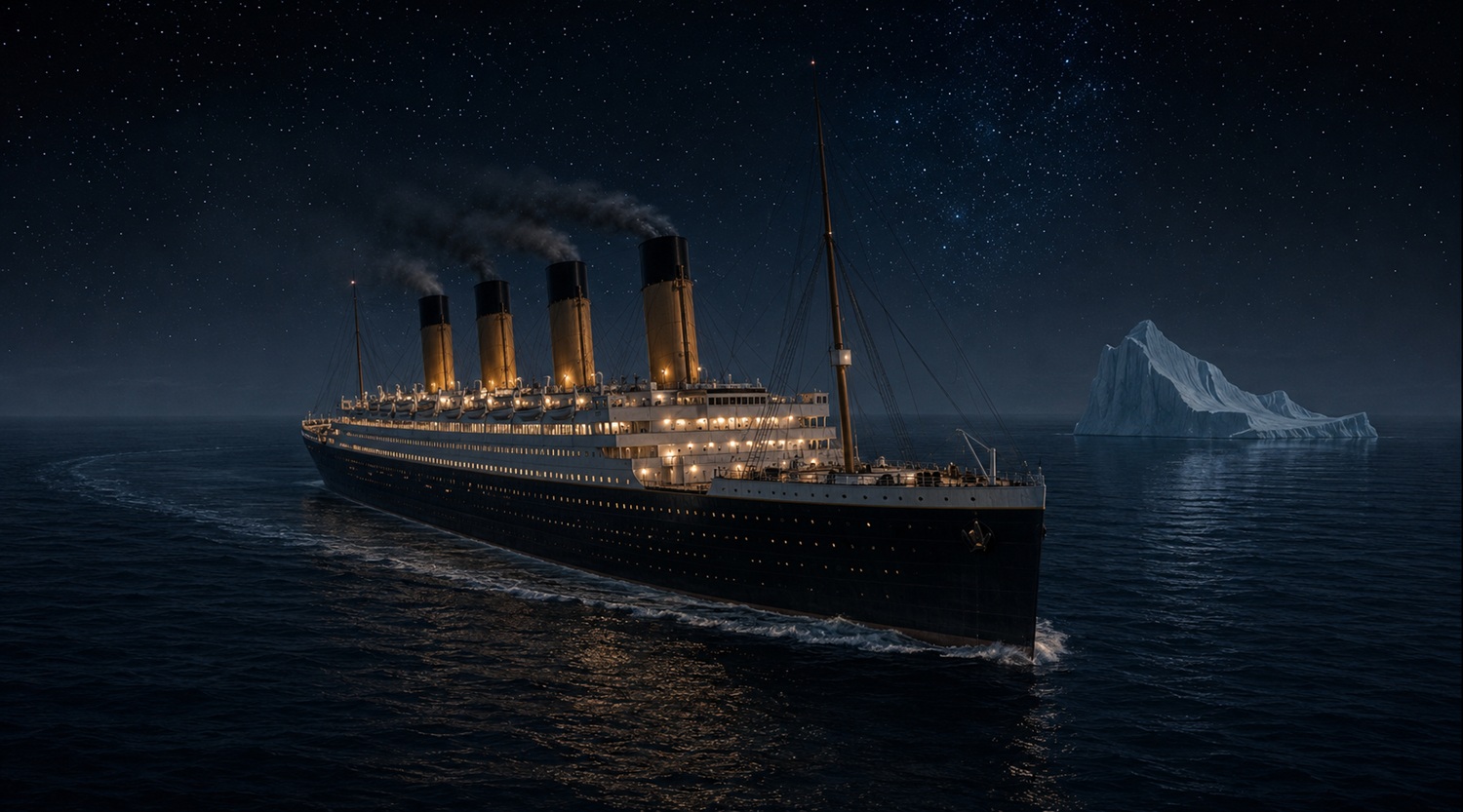
RMS Titanic left Southampton on April 10, 1912, on her maiden voyage to New York, calling at Cherbourg and Queenstown before entering the North Atlantic.
Four days later, shortly before midnight on April 14, she struck an iceberg. In the early hours of April 15, the ship sank. More than 1,500 people died, while only about 700 survived. The disaster immediately triggered investigations in the United States and Britain and exposed serious weaknesses in contemporary maritime safety practices. (National Archives)
The tragedy became more than the loss of a single ship.
It challenged assumptions about the safety of enormous modern liners. It exposed lifeboat regulations that had not kept pace with increasing ship size. It drew attention to the handling of ice warnings and wireless communications. It led directly to international negotiations over passenger-ship safety and helped create the International Ice Patrol. (International Maritime Organization)
That makes a world in which Titanic never sinks more interesting than a simple question about which famous passengers live longer.
The important issue is systemic:
What happens to maritime safety if the disaster that forced governments and shipping companies to confront these weaknesses never occurs?
For this counterfactual, the divergence is deliberately small.
There is no radically redesigned ship.
No supernatural warning.
No different captain.
No elaborate conspiracy.
On the night of April 14, Titanic avoids the iceberg.
Perhaps the turn begins a little earlier. Perhaps the ship passes a few hundred yards farther from the obstruction. Perhaps officers react differently to the ice conditions and reduce speed earlier in the evening.
Whatever the precise mechanism, there is no collision.
The passengers sleep through the night.
Several days later, Titanic enters New York Harbor.
Her maiden voyage is considered a success.
And one of the most important maritime disasters in modern history simply never happens.
---
Titanic Arrives in New York
The immediate consequences would be almost completely ordinary.
Newspapers report the arrival of White Star Line's enormous new liner.
Photographers take pictures.
Passengers disembark.
Reporters interview prominent travelers.
The ship takes on passengers, cargo, mail, coal, food, and supplies for another Atlantic crossing.
The attention surrounding the maiden voyage gradually subsides.
Instead of becoming a wreck on the North Atlantic seabed, Titanic becomes a working ship.
That sounds trivial.
It is not.
A successful maiden voyage removes the event that exposed several weaknesses in contemporary maritime regulation simultaneously.
The liner had complied with the legal lifeboat requirements applicable to it, and indeed carried more lifeboat accommodation than the minimum demanded under the rules. Yet those rules were badly mismatched with the scale of new passenger ships. The British National Archives notes that the U.S. investigation focused heavily on the fact that there was nowhere near enough lifeboat capacity for everyone aboard. (National Archives)
If Titanic reaches New York safely, there is no obvious reason in April 1912 for the public to focus on that fact.
The shortage exists.
The catastrophe demonstrating its consequences does not.
---
White Star Line Gets the Success It Expected
For White Star Line, the difference is enormous.
Instead of losing its newest prestige liner on her first voyage, the company gains another major transatlantic ship alongside Olympic.
The Olympic-class vessels had been designed around size, comfort, passenger accommodation, and regular service rather than simply competing for speed. Their luxurious facilities were important selling points in an intensely competitive transatlantic market. (Titanic Belfast)
A successful Titanic strengthens that strategy.
Advertisements can emphasize two enormous sister ships operating regular crossings.
First- and second-class travelers receive the elaborate accommodations for which the ships were designed.
Large numbers of third-class passengers continue using the line as part of the transatlantic migration economy.
White Star avoids the immediate reputational damage of the sinking.
It avoids losing the ship itself.
It avoids the litigation and investigations produced by the disaster.
And its managers are not forced to defend company practices before horrified audiences in Britain and the United States.
None of this guarantees White Star permanent commercial dominance.
The North Atlantic liner business remained expensive and competitive. The First World War was only two years away. The postwar shipping industry would face new vessels, changing immigration patterns, economic disruption, and eventually the Great Depression.
Saving Titanic improves White Star's position in 1912.
It does not immunize the company against the twentieth century.
---
Titanic's Successful Voyage Could Reinforce Confidence in Giant Liners
One subtle consequence might be psychological.
The early twentieth century was an era of increasingly enormous passenger ships, powerful machinery, wireless communication, watertight subdivision, and intense confidence in modern engineering.
A disaster on Titanic's scale demonstrated that a technologically advanced liner could still be overwhelmed by a sequence of ordinary operational risks.
Without the sinking, the lesson is absent.
Instead, the Olympic class appears to validate its designers.
Olympic works.
Titanic works.
The third sister, later named Britannic, is under construction.
The industry has fewer reasons to reconsider whether growing ship size has moved faster than emergency planning.
The result need not be reckless arrogance.
It is more likely to be institutional complacency:
the existing system appears to be working because nothing has yet demonstrated otherwise.
---
Safety Reforms That Followed the Disaster
The real Titanic disaster produced unusually concentrated pressure for reform.
The U.S. Senate began hearings only days after the sinking. The National Archives preserves the extensive testimony and documentation collected during the seventeen-day investigation. Britain subsequently conducted its own Wreck Commissioner's inquiry from May through July 1912. (National Archives)
Several major areas became central to the safety debate.
Lifeboats
The most obvious problem was lifeboat capacity.
The contemporary British rules tied lifeboat requirements partly to tonnage using a regulatory framework that had failed to keep pace with the enormous growth of liners. Parliamentary debate after the disaster noted that ships of 10,000 tons and above had been required to carry sixteen boats under davits even though vessels several times that size were entering service. (UK Parliament API)
Titanic carried twenty boats of several types, but their aggregate capacity was still far below the number of passengers and crew who could be aboard.
The disaster made the absurdity visible immediately:
a ship could comply with existing safety regulation yet still lack evacuation capacity for a large portion of the people aboard. (National Archives)
Emergency preparedness
Having boats was not sufficient.
Crews had to know how to launch them.
Passengers had to know where to go.
Emergency procedures needed organization.
The investigations therefore focused not only on hardware but also on drills, evacuation, loading practices, and the general state of preparedness aboard passenger vessels. (National Archives)
Wireless communication
Titanic carried powerful contemporary wireless equipment, but maritime radio was still developing from a commercial communications service into an essential safety system. (U.S. Department of War)
The disaster showed how dangerous it could be when ships did not maintain continuous radio monitoring.
The nearby Californian did not receive Titanic's wireless distress calls because its operator was no longer at the set. That episode became one of the reasons continuous radio watches acquired such importance in subsequent international safety regulation. The 1914 safety convention required continuous radio watches for major passenger ships. (National Archives)
Ice reporting
Ships already exchanged ice information before the disaster. The U.S. Hydrographic Office had reports concerning ice in the North Atlantic around the period of Titanic's voyage. (National Archives)
What did not yet exist was the later institutionalized international system devoted specifically to monitoring the iceberg danger.
After the sinking, the United States began sending vessels to patrol the Grand Banks and report ice hazards. This developed into the International Ice Patrol, formally associated with the international safety regime that followed. (MyCG)
International rules
The largest regulatory consequence was the first International Convention for the Safety of Life at Sea.
The International Maritime Organization identifies the 1914 convention as a direct response to the Titanic disaster. Representatives from thirteen countries and associated territories gathered in London to establish international safety standards. (International Maritime Organization)
Among the issues addressed were lifesaving equipment, radio communication, emergency measures, ship construction, and navigation in dangerous ice regions.
The First World War disrupted implementation of the original convention, but the 1914 agreement became the foundation for the later SOLAS system. Successive conventions followed in 1929, 1948, 1960, and ultimately the modern 1974 framework. (International Maritime Organization)
In other words, Titanic did not simply generate a few additional lifeboats.
It helped make international passenger-ship safety a coordinated diplomatic problem.
---
Without the Disaster, Lifeboat Reform Does Not Disappear
One of the most important facts in this counterfactual is that concern about lifeboat regulations existed before Titanic sank.
The British Board of Trade had already asked its Merchant Shipping Advisory Committee in April 1911 to reconsider boat requirements for large ships. The committee had reported back in July 1911, months before Titanic's maiden voyage. (UK Parliament API)
That means it would be incorrect to write:
No Titanic disaster, therefore British officials never realize the lifeboat regulations are obsolete.
They already knew the rules required attention.
The better question is how quickly bureaucratic concern becomes binding regulation without a catastrophe.
History provides no guarantee that recognition of a regulatory weakness produces immediate action.
Committees can recommend.
Shipping interests can object.
Technical questions can delay implementation.
Government priorities can change.
Officials can decide existing practice is adequate pending further investigation.
The absence of disaster removes the political urgency that turns a technical regulatory issue into a public demand.
So revised lifeboat rules probably still appear.
They may be less ambitious.
They may arrive later.
And they may remain primarily national rather than rapidly becoming part of a broad international system.
---
Titanic Might Carry More Lifeboats Within a Few Years Anyway
Even if the ship enters service in April 1912 with her historical arrangement, later regulatory changes could force White Star to add boats.
This could happen during a routine refit.
Additional collapsible boats could be installed.
New davit arrangements could be adopted.
Crew procedures could improve.
The crucial difference is timing.
If the change occurs in 1914 rather than April 1912, Titanic spends two years carrying thousands of passengers under the older standard.
Nothing happens—
unless something does.
That is how safety regulation often works in the absence of disaster.
A weakness can remain invisible to the public precisely because the system keeps getting lucky.
---
The International Ice Patrol Is Much Less Likely to Appear in 1913
The Ice Patrol is one of the changes most directly dependent on the Titanic shock.
The U.S. Coast Guard traces the service directly to the disaster. After the sinking, American naval and revenue vessels began dedicated iceberg patrol operations, and an international system followed. (MyCG)
Without Titanic, ships still report ice.
Masters still know the Grand Banks can be dangerous.
Wireless reporting continues improving.
But the political case for nations jointly funding a permanent dedicated patrol is much weaker.
A company may ask its captains to exercise greater caution.
Hydrographic offices may circulate more warnings.
Individual ships may alter routes.
Those measures are cheaper than creating an international institution.
The International Ice Patrol might therefore emerge only after another serious iceberg accident—or as part of a later general maritime convention.
---
Continuous Radio Watch Is Also Likely Delayed
Wireless telegraphy was expanding rapidly regardless of Titanic.
Ships wanted radio for commercial messages, weather, navigation information, company communications, and contact with shore.
So maritime wireless would continue advancing.
What the disaster demonstrated was that a radio set that no one was listening to could be nearly useless during an emergency.
That lesson helped drive rules requiring continuous watch on important passenger vessels. (National Archives)
Without Titanic, 24-hour monitoring still has obvious value.
Larger liners could voluntarily expand their radio staffs.
Governments might eventually mandate it.
But the requirement loses one of its most famous and politically persuasive examples.
That could mean years during which ships carry increasingly powerful radio equipment without equivalent standards for continuous emergency listening.
---
SOLAS Probably Does Not Exist in 1914
This is one of the strongest consequences.
The International Maritime Organization and Britain's National Archives both identify the 1914 Safety of Life at Sea Convention directly with the international response to Titanic. (International Maritime Organization)
Without the disaster, there is little reason to expect thirteen countries to gather on the same schedule and negotiate the same convention.
International maritime regulation would continue developing.
Another conference might eventually occur.
But the precise 1913–1914 diplomatic process disappears.
This matters because the calendar is unusually important.
Europe is only two years away from the First World War.
If the safety conference is delayed until 1915, international cooperation becomes vastly harder.
Governments are at war.
Merchant fleets are serving military purposes.
Shipping is being attacked.
Maritime policy is dominated by wartime survival.
A peacetime international safety convention postponed by only two or three years could therefore be postponed much longer in practice.
---
Titanic's Sister Olympic Changes Less
One of the direct consequences of the disaster was the refitting of Olympic.
Titanic Belfast records that work began on a substantial inner skin as part of a major safety-improvement program, while other post-disaster modifications increased protection and lifesaving capacity. (Titanic Belfast)
In the alternate timeline, there is no emergency reason to withdraw or heavily alter the design in response to a sister ship sinking.
Olympic continues operating.
Routine improvements still occur.
Regulatory changes could add lifeboats.
Shipyard experience could lead to structural refinements.
But the expensive post-Titanic safety reconstruction does not happen on the same schedule.
The Olympic class consequently enters the First World War closer to its original design.
---
Britannic Becomes the Most Interesting Sister Ship
The third Olympic-class ship was already under construction when Titanic sank.
Historically, lessons from the disaster were incorporated into her before completion.
Britannic received important changes to watertight subdivision, hull protection, and lifesaving arrangements. Her design was altered while she was still being built, making her structurally different from the original Titanic arrangement. (Wikipedia)
Without Titanic's loss, many of those emergency-driven modifications are less likely.
Some improvements may still appear through ordinary naval architecture.
New lifeboat regulations could influence the design.
White Star and Harland & Wolff might refine aspects of the third ship based on operational experience with Olympic and Titanic.
But there is no reason to expect precisely the same package of post-disaster changes.
That becomes important once the First World War begins.
---
Another Disaster Is Coming: Empress of Ireland
Even if Titanic reaches New York, maritime history does not become safe.
On May 29, 1914, the Canadian Pacific liner Empress of Ireland sank in the St. Lawrence after colliding with the Norwegian collier Storstad. More than a thousand people died. The tragedy became one of the worst peacetime maritime disasters involving an ocean liner. (Liverpool Museums)
In the alternate timeline, Empress of Ireland could become the event remembered as the great prewar passenger-ship safety catastrophe.
Its lessons, however, would not be identical.
It was a collision in confined waters rather than an iceberg encounter in the open North Atlantic.
The ship sank extremely rapidly.
The circumstances of evacuation differed.
The incident could create powerful demand for lifesaving equipment and emergency readiness.
It would not provide the same impetus for a North Atlantic iceberg patrol.
And the timing would be terrible.
The sinking occurs only a little more than two months before the crisis that begins the First World War.
An international safety conference organized in response might be overtaken by events before meaningful agreements could be completed.
---
World War I Could Delay the Safety Revolution
This creates one of the largest indirect effects of saving Titanic.
Historically, the disaster occurred in a short remaining window of European peace.
Governments had time during 1912 and 1913 to investigate the sinking and convene an international conference before war began.
The 1914 SOLAS convention itself was then disrupted by the war, but much of the intellectual and regulatory framework had already been created. (National Archives)
Remove the 1912 disaster and the next major liner catastrophe arrives almost on the eve of war.
Instead of safety officials dominating the maritime agenda, governments are suddenly concerned with:
troop transport;
naval mobilization;
submarine warfare;
mines;
blockades;
hospital ships;
merchant losses;
and military logistics.
Passenger-liner safety reform becomes one issue among many wartime emergencies.
The broad peacetime international safety regime could therefore be delayed until after 1918.
That is potentially a larger difference than simply adding a few years to lifeboat reform.
---
Titanic Goes to War
If Titanic survives until August 1914, her future becomes much less predictable.
She is one of the largest and most valuable ships in the British merchant fleet.
Her sister Olympic was eventually requisitioned and served as a troop transport, carrying thousands of soldiers at a time. Britannic, meanwhile, was requisitioned before beginning her intended passenger career and served as a hospital ship. (Wikipedia)
A surviving Titanic would therefore be extremely difficult to leave out of the war indefinitely.
Several paths are possible.
---
Scenario One: Titanic Becomes a Troopship
This may be the most natural parallel to Olympic.
The expensive interiors are protected or removed where necessary.
Military equipment is installed.
Passenger spaces are converted for troops.
Her enormous capacity makes her useful for moving large numbers of soldiers between Britain, Canada, the Mediterranean, and other Allied ports.
Olympic historically demonstrated the military value of very large liners as troop transports, eventually carrying thousands of personnel per voyage. (Wikipedia)
Titanic could perform similar work.
If so, her peacetime identity as a luxury liner temporarily disappears beneath wartime paint, guns, bunks, and military discipline.
---
Scenario Two: Titanic Becomes a Hospital Ship
Britannic provides the obvious precedent.
A large liner possesses many characteristics useful for hospital service:
large internal spaces;
extensive kitchens;
water systems;
electrical power;
cabins capable of conversion;
and the ability to transport large numbers of wounded personnel.
A surviving Titanic could therefore be converted into a hospital ship instead.
That assignment might keep her away from some of the North Atlantic submarine routes faced by troopships.
It introduces other risks, particularly in the Mediterranean.
There is no way to determine which assignment the Admiralty would select in an altered wartime fleet.
---
Scenario Three: Titanic Is Initially Laid Up
Large liners consumed enormous amounts of coal and operating resources.
Early in the war, some vessels could be laid up before military shipping demands increased enough to make them valuable.
Olympic herself was not immediately converted into a troopship at the outbreak of war; the Admiralty's requirements evolved as the conflict expanded. (Wikipedia)
Titanic might therefore spend part of 1914 or early 1915 inactive before eventually being requisitioned.
Saving her from an iceberg does not save her from history.
---
Titanic Could Still Sink During the War
This possibility must be taken seriously.
The First World War was lethal to merchant shipping.
Mines and submarines created risks that no 1912 passenger-ship design had originally been intended to withstand.
Britannic struck a German mine near Kea in the Aegean on November 21, 1916, and sank despite the extensive modifications made after Titanic. Thirty people died among more than a thousand aboard. (AP News)
Lusitania was torpedoed by a German U-boat in May 1915 and sank in about eighteen minutes, killing nearly 1,200 people. (National Archives Foundation)
A wartime Titanic could therefore:
survive repeated troop voyages;
hit a mine;
be torpedoed;
collide with another ship;
or complete the entire war safely.
Nothing about avoiding one iceberg determines which outcome occurs.
---
Britannic's Fate Might Also Change
This produces another subtle counterfactual.
Historically, Britannic went to war incorporating safety modifications influenced by the loss of Titanic. She still sank after hitting a mine, but most people aboard survived. (Wikipedia)
In the alternate timeline, her design would probably be closer to the original Olympic-class configuration.
Would that cause more deaths in the 1916 mine explosion?
Possibly.
Would she sink faster?
Possibly.
Would she encounter the same mine at precisely the same time?
Once schedules, ship assignments, refits, and wartime operations have changed, even that becomes uncertain.
The responsible conclusion is narrower:
removing the Titanic disaster removes some of the safety modifications incorporated into Britannic, making her wartime risk profile worse—but her exact fate cannot be reconstructed.
---
What If Titanic Survives World War I?
Suppose the ship gets lucky twice.
She avoids the iceberg in 1912.
She survives the First World War.
By 1919 or 1920, White Star possesses Olympic and Titanic as major surviving prewar liners.
They are restored for passenger service.
Interiors altered for wartime purposes are rebuilt.
Cabins are modernized.
New safety regulations require additional equipment.
The two sisters resume Atlantic crossings.
At this point Titanic's history starts looking much more like Olympic's.
---
Titanic in the 1920s
The ship would be impressive but no longer revolutionary forever.
Newer liners appear.
Passenger expectations change.
Oil-fired vessels increasingly compete with older coal-burning ships.
Cabin arrangements are updated.
Tourist-class travel becomes increasingly important.
Immigration legislation alters portions of the transatlantic passenger market.
White Star would continue modifying the ship to keep her commercially useful.
Perhaps Titanic receives major refits.
Perhaps her famous interiors are altered repeatedly.
Perhaps one funnel is modified.
Perhaps machinery is improved.
The exact details cannot be predicted.
What can be predicted is aging.
A liner built in 1912 is no longer new in 1925.
---
Titanic in the Great Depression
By the early 1930s, maintaining enormous aging liners becomes increasingly difficult.
Olympic, the historical sister ship, remained in service until the 1930s and was ultimately scrapped in 1935. (Royal Museums Greenwich)
That provides the strongest model for a surviving Titanic.
If she escapes wartime loss and serious accident, she might remain in commercial service into the early or mid-1930s.
Then the combination of age, operating costs, newer competition, and depression-era passenger demand makes retirement increasingly attractive.
The most historically mundane fate may therefore be the most plausible:
RMS Titanic is broken up for scrap sometime in the 1930s.
No wreck.
No intact ship.
No museum.
Just photographs, furnishings sold at auction, shipyard records, and memories from people who once crossed the Atlantic aboard her.
---
White Star Line Still Faces Larger Economic Forces
A surviving Titanic would be a valuable asset.
But White Star's later problems cannot be reduced to the loss of one ship.
The First World War transformed fleets.
Competition intensified afterward.
The global economic environment changed.
By the 1930s the British government supported the combination of Cunard and White Star's North Atlantic interests, creating Cunard-White Star.
Saving Titanic could improve White Star's balance sheet and fleet strength.
It might affect which ships remain active and when they are retired.
It might modestly improve the company's bargaining position.
It is much harder to claim that one surviving 1912 liner prevents the later restructuring of British transatlantic shipping.
---
Ship Design Evolves Anyway
Another important correction is that shipbuilding would not freeze at Titanic's specifications.
Naval architects learn continuously.
Classification societies change requirements.
New ships reveal operational problems.
Materials improve.
Engine technology develops.
War produces new knowledge about damage control and subdivision.
Other accidents expose weaknesses.
Insurance companies influence design.
Governments revise regulations.
Thus double hulls, higher bulkheads, improved lifesaving arrangements, pumps, radio systems, and better evacuation planning would not vanish from history because Titanic survives.
The difference is the speed and coordination of adoption.
A spectacular failure can compress years of gradual reform into months.
Without it, change is more incremental.
---
Another Maritime Disaster Would Eventually Force Similar Reforms
This is highly likely.
The early twentieth century was full of large passenger and merchant vessels operating in dangerous conditions.
Collisions.
Groundings.
Fires.
Fog.
Ice.
Structural failures.
Mines.
Submarines.
Mechanical failures.
Human mistakes.
The assumption that Titanic was the only event capable of exposing outdated safety regulation gives one ship too much historical power.
Empress of Ireland alone demonstrates that another catastrophic passenger-ship loss was only two years away. (Liverpool Museums)
Lusitania would then demonstrate the vulnerability of liners in wartime. (National Archives Foundation)
Britannic would provide another enormous ship loss if its broad wartime history remained recognizable. (AP News)
Eventually, governments would act.
The counterfactual issue is which lessons they would act on.
---
A Different Disaster Produces Different Regulation
Suppose Empress of Ireland becomes the great catalyst.
Officials might focus particularly on:
collision avoidance;
fog navigation;
rapid flooding;
watertight subdivision;
emergency evacuation;
lifeboat launching under severe list;
and navigation in confined waterways.
Iceberg patrol receives less attention.
Suppose instead a major wireless failure contributes to a later sinking.
Continuous radio watch becomes the defining reform.
Suppose a liner burns.
Fireproofing dominates the convention.
Suppose a poorly equipped ship sinks during a storm.
Lifesaving equipment becomes central.
The historical SOLAS framework brought multiple safety issues together partly because Titanic exposed so many at once.
A replacement disaster could produce a narrower regulatory response.
---
The International Ice Patrol Might Be the Most Delayed Reform
Lifeboats are useful in many types of emergency.
Radio is useful almost everywhere at sea.
Watertight subdivision protects against multiple kinds of hull damage.
Ice patrol is much more geographically specific.
Without Titanic, there is therefore less reason for the world's maritime powers to create a dedicated North Atlantic iceberg-monitoring system immediately.
Individual companies would still receive ice reports.
Naval hydrographic services could improve warnings.
Captains might alter tracks seasonally.
But an internationally financed patrol could wait until another North Atlantic ice disaster provided the political justification.
This means that one of Titanic's clearest institutional legacies might genuinely be postponed for many years. (MyCG)
---
Radio Safety Is More Likely to Catch Up Quickly
Wireless technology was advancing too rapidly for radio-watch practices to remain primitive indefinitely.
Commercial demand alone encouraged ships to expand radio service.
Governments increasingly recognized wireless as strategically important.
Navies understood its value.
Passenger expectations were changing.
So even without Titanic, large liners would probably move toward longer radio watches.
A later regulation requiring continuous monitoring is highly plausible.
The difference could be a few years rather than decades.
Those few years could still matter enormously to the occupants of one ship whose distress message goes unheard.
---
Public Attitudes Toward Maritime Safety Change More Slowly
The cultural effect of Titanic was partly that it transformed abstract risk into a vivid human story.
Thousands of people could understand:
there were not enough lifeboats;
the ship struck ice;
wireless messages mattered;
nearby vessels might have helped;
modern engineering had limits.
Without the disaster, these remain professional maritime issues.
A parliamentary committee discussing lifeboat cubic capacity does not capture public attention like a famous liner sinking with more than a thousand people aboard.
That distinction matters politically.
Regulation supported only by specialists can be slow.
Regulation supported by millions of horrified voters moves differently.
---
Titanic Becomes Evidence That the System Works
A successful crossing could actually produce the opposite public lesson.
The largest new liner leaves Britain.
She encounters the North Atlantic.
She arrives safely.
Then she does it again.
And again.
Each voyage strengthens confidence.
Passengers do not ask whether the boats can hold everyone because they expect never to use them.
Shipbuilders do not face mass public criticism of watertight subdivision because the compartments have never been tested in a catastrophic accident.
Wireless remains a luxury and commercial tool because its emergency value has not been demonstrated globally.
Safety weaknesses survive partly because successful systems are harder to question.
---
What Happens to the Famous Passengers?
Some would undoubtedly affect history in small or perhaps meaningful ways.
People who died would live.
Businesses would have different decisions.
Families would develop differently.
Fortunes would be inherited differently.
Political and social networks would change.
But turning the entire counterfactual into stories about John Jacob Astor, Benjamin Guggenheim, Isidor Straus, or any other prominent traveler exaggerates what can be known.
Individual lives are exceptionally difficult to forecast.
A person saved in 1912 could die in 1914.
A businessman could make one successful investment or one disastrous one.
A political donor could change allegiance.
A child not orphaned could pursue a completely different life.
Those effects are real but impossible to model responsibly.
The maritime systems are much easier to analyze.
---
The Cultural Titanic Never Exists
Here the consequences are enormous but mostly cultural rather than geopolitical.
There is no famous shipwreck on the North Atlantic floor.
There are no expeditions searching for Titanic's wreck.
No 1985 discovery of the wreck.
No enduring fascination with the broken bow and stern thousands of meters below the Atlantic.
No museum industry built around recovered objects and the archaeology of the wreck.
No endless argument over how the ship broke apart.
No iconic images of the grand staircase tied to disaster.
No genre of Titanic documentaries, novels, television programs, exhibitions, and films in anything resembling its historical form.
The name Titanic does not become a universal synonym for a magnificent project destroyed by overconfidence.
---
There Is Probably No Famous Titanic Movie
Ships have inspired films without sinking.
But an aging liner that completed an ordinary commercial career would not generate the same cultural mythology.
A successful Titanic might appear occasionally in:
newsreels;
shipping histories;
wartime footage;
company advertisements;
maritime documentaries;
or books about the great liners.
It does not become one of the most recognizable ships in human history.
A 1930s newspaper might describe her retirement.
A few enthusiasts preserve photographs.
Furniture from the ship could end up in hotels, private collections, or museums.
Her name might be less famous today than Queen Mary.
---
Olympic Might Actually Be the More Famous Sister
Historically, Olympic survived a long commercial and wartime career but lives culturally in the shadow of the sister that sank on her maiden voyage.
Remove that disaster and the hierarchy changes.
Olympic has the distinction of being the first ship of the class.
She had a notable First World War career.
If Titanic has an uneventful career, historians may discuss the pair together.
If Titanic is lost in wartime, her war service rather than her 1912 maiden voyage defines her memory.
If both survive into the 1930s, they may become remembered collectively as the famous Olympic-class liners.
The name Titanic would no longer dominate the class.
---
Popular Memory Could Attach to Britannic Instead
If Britannic still hits a mine and sinks in 1916, she becomes the only lost sister.
That could shift historical fascination toward her.
But even then the cultural effect would be different.
A hospital ship lost during a world war belongs to a crowded history of wartime maritime disaster.
The emotional framework surrounding a luxury liner sinking during peacetime on its maiden voyage would be absent.
Britannic could become famous.
She probably would not become Titanic-famous.
---
Significant Historical Effects vs. Popular-Cultural Effects
The distinction is worth making explicitly.
| Consequence | Significance |
| ---------------------------------------------------------------- | -------------------------------------------------------------- |
| No immediate 1912 overhaul of lifeboat policy | Historically significant |
| No Titanic-driven 1914 SOLAS conference on the same schedule | Highly significant |
| International Ice Patrol delayed | Highly plausible and significant |
| Continuous radio-watch regulation delayed | Plausible and significant |
| Olympic does not receive the same emergency safety refit | Significant to ship design and wartime risk |
| Britannic is built without some Titanic-inspired modifications | Potentially significant but outcome uncertain |
| White Star retains Titanic as a major asset | Commercially significant |
| Titanic participates in World War I | Highly plausible, exact role uncertain |
| Titanic survives into the 1930s | Plausible branch, not predictable |
| Another liner eventually triggers safety reform | Very likely |
| No famous Titanic wreck archaeology | Major cultural effect, limited geopolitical effect |
| No Titanic films and popular mythology | Enormous cultural effect, small systemic historical effect |
| Famous passengers live longer | Real but individually unpredictable |
| White Star permanently dominates shipping | Weak speculation |
| Modern maritime safety never develops | Extremely implausible |
---
A Plausible Alternate Timeline
| Date | Real History | Titanic-Survives Timeline |
| --------------------- | ---------------------------------------------------------------------------------------------------------------------- | ------------------------------------------------------------------------------------------------------------------------------------------------------------ |
| April 10, 1912 | Titanic leaves Southampton for New York. | Same. |
| April 14–15, 1912 | Ship strikes iceberg and sinks; more than 1,500 people die. | Titanic avoids the iceberg and continues toward New York. |
| April–July 1912 | U.S. Senate and British inquiries investigate the catastrophe. | No major Titanic inquiries; maritime safety remains primarily a regulatory and professional issue. (National Archives) |
| 1912–13 | Shipping companies and regulators rapidly reconsider lifeboats, radio procedures, subdivision, and emergency planning. | Lifeboat regulations continue being reviewed, but without equivalent political urgency. |
| 1913 | Dedicated North Atlantic ice-patrol efforts develop after the disaster. | Ice information continues through ships and hydrographic services; no dedicated international patrol on the same timetable. (MyCG) |
| 1913–14 | International delegates negotiate the first SOLAS convention. | No Titanic-driven conference; international safety negotiations are likely postponed. (National Archives) |
| May 1914 | Empress of Ireland sinks, killing more than 1,000. | This may become the defining prewar passenger-ship disaster and the strongest new catalyst for reform. (Liverpool Museums) |
| August 1914 | First World War begins. | Same broad geopolitical crisis, potentially interrupting maritime-safety negotiations before a comprehensive international settlement emerges. |
| 1915 onward | Olympic serves as troop transport; Britannic becomes hospital ship. | Titanic is likely requisitioned for military service as well, although the exact assignment is unknowable. (Wikipedia) |
| 1916 | Britannic sinks after striking a mine. | Her design and possibly her wartime schedule differ because Titanic-inspired modifications were not made in the same form; exact outcome cannot be forecast. |
| 1918–20s | International maritime safety regime develops further after war. | A delayed international convention becomes increasingly likely as governments absorb lessons from multiple wartime and peacetime losses. |
| 1920s | Olympic returns to passenger service. | A surviving Titanic likely does the same. |
| 1930s | Aging Olympic is eventually retired and scrapped in 1935. | A surviving Titanic may follow a broadly similar commercial path and be retired during the depression era. (Royal Museums Greenwich) |
| 1985 | Titanic wreck is discovered. | Nothing is discovered; there is no Titanic wreck at the historical site. |
---
Would Maritime Travel Be More Dangerous?
For a period, probably somewhat.
That does not mean ships would suddenly begin sinking everywhere.
Most voyages were successful.
Captains were experienced.
Naval architecture was sophisticated.
Companies had powerful economic incentives not to lose ships or passengers.
But several vulnerabilities exposed by Titanic would remain inadequately addressed for longer.
Some ships would carry insufficient evacuation capacity.
Continuous radio watch might remain inconsistent.
Ice surveillance would remain decentralized.
International rules would be less standardized.
Emergency drills could vary more widely.
The increased risk would therefore be distributed across many voyages.
Most passengers would never notice.
A few might pay the price.
---
Regulation Written Before Disaster vs. Regulation Written After Disaster
The Board of Trade's pre-1912 review of lifeboat rules is particularly revealing.
It shows that institutions did not need 1,500 deaths to recognize that ship size had outgrown old rules. (UK Parliament API)
What catastrophe supplied was urgency.
Before disaster:
“What lifeboat requirements should apply to the newest liners?”
After disaster:
“How can we ensure this never happens again?”
Those are politically different questions.
The technical evidence may be similar.
The willingness to impose costs on shipping companies is not.
The willingness of governments to cooperate internationally is not.
The willingness of passengers to accept more crowded boat decks is not.
And the willingness of executives to spend large sums on risks perceived as remote is not.
This is why the alternate timeline probably still reaches many of the same safety ideas—but later.
---
Would They Have Happened Anyway?
Most of the major safety reforms probably would have appeared eventually.
The evidence strongly supports that conclusion.
Lifeboat regulations were already being reconsidered before Titanic. (UK Parliament API)
Wireless communication was expanding independently of the disaster.
Naval architecture was continually changing.
Hydrographic organizations were already distributing ice reports. (National Archives)
Governments had already begun developing international mechanisms for other maritime and technical issues.
Shipowners had direct financial reasons to prevent collisions, fires, sinkings, and loss of passenger confidence.
And other catastrophic accidents were inevitable enough that one was likely eventually to expose the inadequacies of the existing system.
The Empress of Ireland disaster in 1914 provides the clearest evidence.
The question is therefore not:
Would maritime safety ever improve without Titanic?
It would.
The better question is:
Would the reforms occur before another thousand people had to die?
That answer is much less comforting.
---
Lifeboats Probably Improve First
Because the Board of Trade had already been reviewing requirements, this is one reform that could advance even without a disaster.
Perhaps new rules appear in 1913 or 1914.
Perhaps they require more boats but stop short of capacity for every person aboard.
Perhaps shipping companies voluntarily add collapsible boats to new liners.
Then Empress of Ireland or another accident pushes the rule farther.
So the dramatic post-Titanic jump may instead occur through two or three incremental reforms.
The destination is similar.
The route is slower.
---
Radio Watch Probably Follows
Wireless is too useful to remain purely commercial.
A succession of distress incidents would reveal the obvious value of continuous listening.
Governments would eventually require adequate radio staffing on major passenger ships.
The difference might be only several years.
But during the early 1910s, several years represent thousands of ship movements.
This is one of the uncomfortable truths of counterfactual safety history:
a regulation can be inevitable in the long run and still arrive too late for particular people.
---
Ice Patrol Is Less Inevitable
Dedicated iceberg surveillance requires more than recognizing that ice is dangerous.
Someone has to pay for ships or aircraft.
Governments have to divide costs.
Reports must be standardized.
Shipping nations have to agree that the service benefits everyone.
The Titanic catastrophe created an unusually persuasive case for doing exactly that.
Without it, decentralized reporting might appear good enough.
The International Ice Patrol could therefore be delayed until another iceberg disaster demonstrates why ordinary reporting is insufficient.
Of all the reforms associated with Titanic, this may be among the most dependent on the specific event. (MyCG)
---
International Safety Standards Could Be Delayed the Longest
National governments can revise their own lifeboat rules.
Shipping companies can hire additional radio operators.
Captains can change ice procedures.
An international convention requires diplomatic coordination.
That process benefits enormously from a crisis that affects citizens and shipping interests across many countries.
Titanic provided exactly that.
The first SOLAS conference was therefore not simply a technical meeting that happened to occur after the sinking. Official histories explicitly describe the convention as a response to the disaster. (International Maritime Organization)
Remove the disaster and there is no reason for the same conference to happen at the same time.
Then World War I closes the window.
A comprehensive peacetime international maritime-safety agreement might not reappear until the 1920s.
That is probably the largest regulatory consequence of all.
---
What Titanic Itself Would Probably Become
If Titanic survives 1912 and the First World War, her later fate is likely much less romantic than her historical one.
She becomes an aging ship.
That is what ships do.
Passengers stop treating her as the newest thing afloat.
New liners surpass her.
Her fittings become dated.
Her engines require more maintenance.
Her economics become less favorable.
She undergoes refits.
Eventually White Star decides that restoring her again costs more than replacing or retiring her.
Then she is sold.
Furniture, fittings, paneling, lamps, machinery, and decorative pieces are removed.
Workers cut apart the hull.
Steel is recycled.
The ship disappears not in two hours on an April night—
but piece by piece in a shipbreaking yard.
For the people involved, it would be the ordinary end of a long-serving ocean liner.
For alternate historians, it would be almost impossible to explain why anyone should have expected something different.
---
Sources and Further Reading
U.S. National Archives, “They Said It Couldn't Sink.”
A detailed introduction to the U.S. Senate investigation and the large body of federal records created by the Titanic disaster. (National Archives)
The National Archives of the United Kingdom, records of the British Wreck Commissioner's Inquiry.
Primary-document context for the British investigation and the causes of the high loss of life. (National Archives)
The National Archives of the United Kingdom, “The Convention for the Safety of Life at Sea.”
Especially useful for tracing the direct relationship between the Titanic disaster and the 1913–1914 international safety conference. (National Archives)
International Maritime Organization, history of SOLAS.
The authoritative institutional history identifying the first 1914 SOLAS convention as a response to Titanic and tracing the later 1929, 1948, 1960, and 1974 conventions. (International Maritime Organization)
U.S. Coast Guard, International Ice Patrol histories.
Documents the direct connection between the 1912 disaster, early U.S. ice reconnaissance, and the permanent international iceberg-monitoring system. (MyCG)
U.S. National Archives, “The Titanic: A Warning Ignored.”
Useful primary-source context showing that hydrographic authorities were already collecting and distributing North Atlantic ice reports before the disaster. (National Archives)
Historic Hansard, House of Commons debate on Board of Trade lifeboat regulation, May 1912.
Important evidence that the British government had begun reconsidering requirements for large ships before Titanic sank. (UK Parliament API)
Royal Museums Greenwich, RMS Titanic and Olympic-class materials.
Useful for the careers and eventual fates of Olympic and Britannic, providing the best historical comparison for a surviving Titanic. (Royal Museums Greenwich)
Titanic Belfast, history of Olympic's post-disaster alterations.
Documents the substantial safety work undertaken on Olympic after her sister's loss. (Titanic Belfast)
U.S. Coast Guard Proceedings, history of maritime radio communications.
Useful technical context for Titanic's wireless installation and the transition toward treating shipboard radio as an essential safety system rather than merely a communications convenience. (U.S. Department of War)
National Archives Foundation, RMS Lusitania records.
Provides an important comparison with a later liner catastrophe and demonstrates the continuing hazards large passenger ships faced during the First World War. (National Archives Foundation)
The AltHistAI Verdict
What if Titanic never sank?
The most important result would not be that a handful of famous passengers lived longer.
It would be that the maritime world lost its most powerful warning of 1912.
The ship herself could avoid the iceberg through an almost trivial divergence.
A slightly different turn.
A little more distance.
A modest speed reduction.
A few seconds.
Then she reaches New York.
That part of the counterfactual is easy.
The consequences are harder because Titanic did not create the weaknesses that killed her passengers.
Those weaknesses already existed.
The lifeboat regulations were already outdated enough that the British Board of Trade had begun reviewing them before the ship sailed. (UK Parliament API)
Wireless communication already existed.
Ice reports already existed. (National Archives)
Watertight subdivision already existed.
Professional regulators already worried about passenger safety.
So saving Titanic does not freeze maritime technology in 1912.
Lifeboats eventually increase.
Wireless watches become more reliable.
Ship subdivision improves.
Emergency drills become more formal.
International agreements emerge.
Another disaster eventually forces governments to confront whatever has not already changed.
But eventually is the key word.
The actual Titanic sinking compressed reform.
Within days, investigators were taking testimony.
Within months, regulators and shipowners were reconsidering practices.
The United States began dedicated ice reconnaissance.
International negotiations followed.
By 1914, governments had produced the first Safety of Life at Sea convention, explicitly in response to the disaster. (International Maritime Organization)
Without Titanic, that sequence breaks.
Lifeboat reform probably proceeds first because officials were already considering it.
But continuous radio requirements may come later.
The International Ice Patrol almost certainly does not appear on its historical timetable.
And the international SOLAS conference probably does not occur before the First World War.
That timing could matter more than any single technical rule.
Only two years separated Titanic from the outbreak of war.
The Empress of Ireland would sink in May 1914, killing more than a thousand people. (Liverpool Museums)
That disaster could become the alternate world's great maritime-safety catalyst.
But there would be barely two months before Europe's political order collapsed into war.
Instead of thirteen nations negotiating peacetime passenger-ship safety, governments would be mobilizing fleets and armies.
The regulatory moment could be lost.
A comprehensive international safety system might therefore emerge only after 1918.
Meanwhile, Titanic herself would enter a completely different danger.
War.
Her sister Olympic became a troop transport.
Her other sister Britannic became a hospital ship. (Wikipedia)
A surviving Titanic would almost certainly attract Admiralty interest eventually.
She might carry troops.
She might carry wounded soldiers.
She might initially sit idle before military demand required her.
And then her survival becomes unknowable.
A German mine could accomplish what the iceberg did not.
A U-boat could find her.
A collision could destroy her.
Or she could complete dozens of wartime voyages and return home as one of Britain's most celebrated transports.
If Titanic survives the war as well, her future becomes almost disappointingly ordinary.
She returns to the Atlantic.
She carries passengers through the 1920s.
She is refitted.
Her accommodations change.
New liners make her seem old-fashioned.
The Depression makes large aging vessels increasingly difficult to justify.
And sometime in the 1930s she may follow Olympic to the breakers, where workers dismantle the ship that our world still preserves more than two miles beneath the Atlantic. Olympic herself was scrapped in 1935, making that a reasonable model rather than a prediction. (Royal Museums Greenwich)
White Star would benefit from years of additional service from its great liner.
But one surviving ship probably cannot prevent the larger forces transforming transatlantic shipping.
Nor does saving Titanic eliminate technological progress.
The mistake would be to assume that without one disaster, no one learns anything.
Another ship would sink.
Another radio call would be missed.
Another outdated rule would be exposed.
Another inquiry would ask why regulations had failed to keep pace with technology.
Safety reform was not unique to Titanic.
Its speed was.
That distinction produces the strongest alternate conclusion.
A world without the Titanic disaster is not one in which ocean travel remains permanently unsafe.
It is a world in which the transition toward modern maritime safety happens more gradually—and therefore probably costs additional lives before the same lessons become impossible to ignore.
The cultural consequences are almost the reverse.
There the change is permanent.
No wreck lies at the historical coordinates.
No expedition discovers Titanic in 1985.
No preserved bow appears in deep-ocean photographs.
No generation grows up knowing the name from books, exhibitions, documentaries, and films.
The word Titanic never acquires its modern metaphorical meaning.
Perhaps maritime enthusiasts remember her.
Perhaps historians admire photographs of the Olympic class.
Perhaps a museum displays a carved panel or dining-room chair removed when the ship was scrapped.
Perhaps wartime historians know her as a troopship.
But the general public probably does not.
That may be the strangest result.
In our world, Titanic became immortal because she survived for less than five days as a passenger liner.
In the alternate world, she might serve successfully for twenty years—
and be almost forgotten.
The strongest AltHistAI conclusion is therefore:
If Titanic had avoided the iceberg, most modern maritime safety reforms would eventually have emerged, because the technological and regulatory pressures behind them already existed. But the disaster accelerated those reforms at an unusually important moment just before World War I. Without it, lifeboat rules, continuous radio watch, coordinated iceberg surveillance, and especially international safety regulation could have developed later and less coherently. Titanic herself might have gone on to war service, survived into the interwar years, and ended as scrap rather than legend.
The ship would have been saved.
Some of the people who later depended on the safety lessons learned from its loss might not have been.