 Alternate History AI
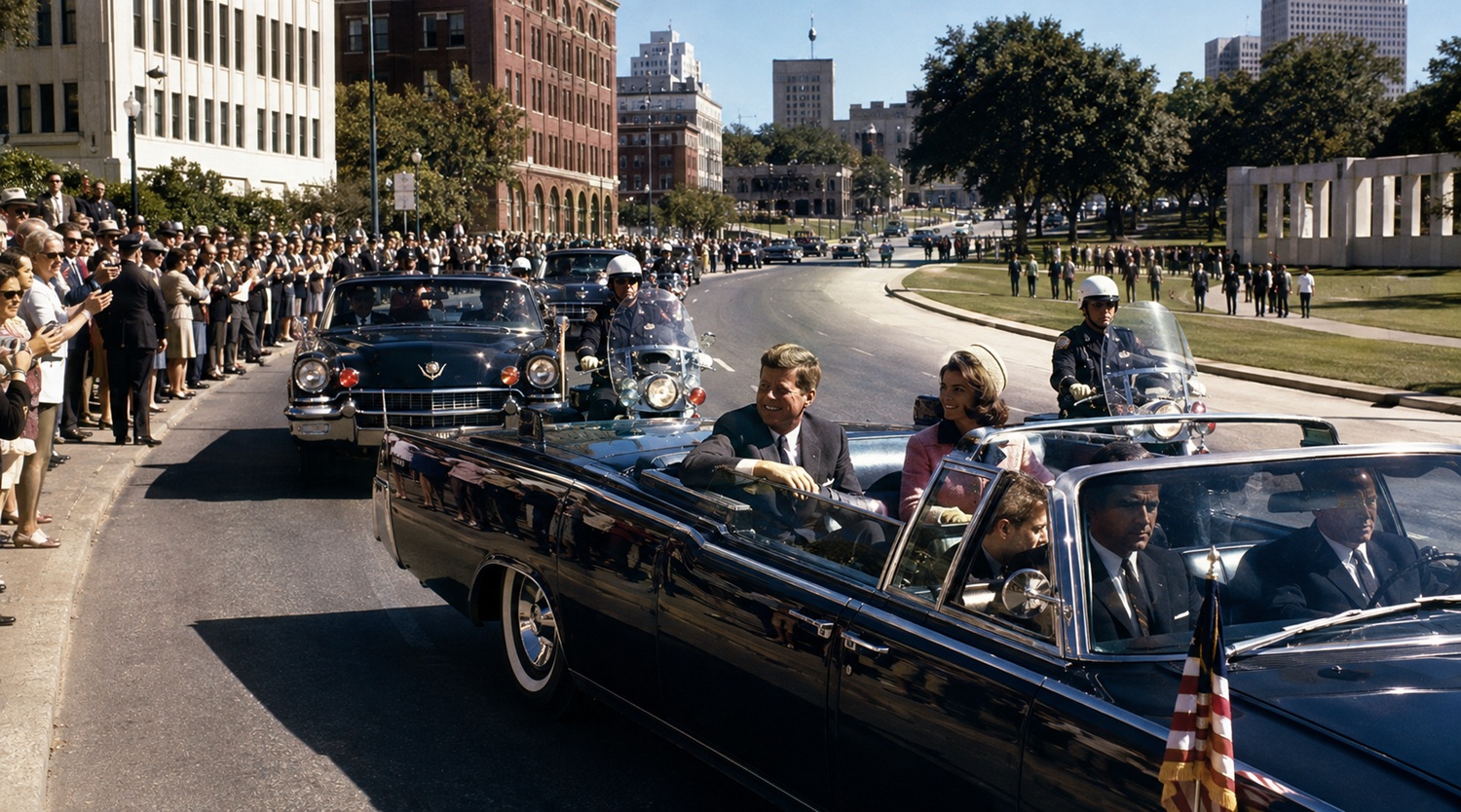
On November 22, 1963, President John F. Kennedy traveled through Dallas, Texas, in an open limousine.
The trip was political as well as presidential. Kennedy was already thinking about the 1964 election, and Texas mattered. Internal conflict among Texas Democrats threatened a state Kennedy had narrowly carried in 1960, and one purpose of the trip was to strengthen the party coalition before the next campaign.
In real history, Kennedy was assassinated in Dealey Plaza.
Lyndon B. Johnson became president that afternoon.
Within the next five years, the United States enacted the Civil Rights Act of 1964 and Voting Rights Act of 1965, launched the Great Society, dramatically escalated the war in Vietnam, deployed hundreds of thousands of American troops to Southeast Asia, experienced major urban unrest and antiwar protest, and entered the turbulent election of 1968.
Those events have made November 22 one of the most tempting counterfactual turning points in modern American history.
What if the shots miss?
What if Kennedy survives Dallas, wins another term in 1964, and remains president until January 1969?
Would the United States still send combat forces to Vietnam?
Would the Civil Rights Act pass?
Would there still be a Voting Rights Act?
Would Lyndon Johnson remain vice president?
Would Kennedy continue improving relations with the Soviet Union after the Cuban Missile Crisis?
Could Washington and Havana have reached some limited accommodation?
Would Americans still land on the Moon?
And what would American politics look like in 1968 without the martyrdom of John F. Kennedy and the presidency of Lyndon Johnson?
Some answers are more defensible than others.
Kennedy was strongly positioned for reelection.
He had made a major commitment to civil-rights legislation.
His administration remained committed to preventing a communist victory in South Vietnam, even while planning a limited withdrawal of American personnel.
He was exploring further arms-control cooperation with the Soviet Union.
He remained publicly committed to reaching the Moon before the end of the decade, while also experimenting with the possibility of U.S.-Soviet cooperation in space.
But the most famous claim about a surviving Kennedy—that he certainly would have withdrawn from Vietnam and prevented the major American war—is much harder to establish.
The surviving documentary record supports multiple plausible Kennedys.
One might resist sending American ground troops.
Another might escalate gradually when South Vietnam deteriorates.
A third might increase bombing and military pressure while trying to avoid the massive deployment eventually ordered by Johnson.
The honest alternate history therefore begins with uncertainty.
Kennedy surviving Dallas changes who makes the decisions.
It does not tell us automatically what those decisions would be.
The Point of Divergence: Dallas, November 22, 1963
The smallest useful divergence is straightforward.
The presidential limousine proceeds through Dealey Plaza.
Shots are fired, but Kennedy is not fatally struck.
Perhaps the first bullet misses and the vehicle accelerates before another can hit him.
Perhaps he is wounded but survives.
The exact mechanics are not important for this article. There is no need to enter the enormous body of assassination-conspiracy speculation because the historical consequences of survival begin regardless of why the attack fails.
Kennedy returns to Washington shaken but alive.
The public reaction would almost certainly produce a temporary surge of sympathy and political support.
But unlike the historical Johnson, Kennedy does not inherit a dead president's legislative agenda.
He must continue trying to pass his own.
And on November 22, 1963, that agenda was far from complete.
Kennedy's Political Position in Late 1963
Kennedy's later reputation can obscure how politically unfinished his presidency was.
He had won the 1960 election extremely narrowly.
Congress contained large Democratic majorities, but the label “Democratic” did not guarantee support for Kennedy's agenda. Conservative Southern Democrats frequently aligned with Republicans to block or weaken domestic legislation, particularly civil-rights measures.
Yet Kennedy entered the final year before reelection with significant political strengths.
His average Gallup job approval during his presidency was approximately 70 percent, the highest average recorded for a president in Gallup's modern approval series. In March 1963, 74 percent of those surveyed expected him to be reelected, and a Gallup trial heat showed him leading Republican Senator Barry Goldwater 67 percent to 27 percent.
Those numbers do not prove Kennedy would win in November 1964.
Elections can change rapidly.
Civil rights was reshaping party coalitions.
Vietnam could deteriorate.
Economic conditions could change.
Republicans had not yet selected their nominee.
But the evidence strongly suggests that Kennedy would begin the 1964 campaign as the favorite.
His Texas trip itself shows that the White House was already attending to the electoral map.
Civil Rights Had Become a Central Kennedy Issue
Kennedy had entered the White House cautiously on civil rights.
African American voters had supported him heavily in 1960, but Kennedy initially worried about provoking Southern Democrats whose votes he needed in Congress.
Events increasingly made that caution unsustainable.
Freedom Rides, voter-registration struggles, confrontations over university integration, Birmingham demonstrations, police violence, and the expanding national civil-rights movement forced the administration to confront segregation more directly.
On June 11, 1963, Kennedy delivered a major televised address describing civil rights as a moral as well as legal issue and calling for congressional action protecting access to public facilities, education, voting, and other rights.
His administration then submitted the legislation that became the foundation for the Civil Rights Act of 1964.
This matters enormously for the counterfactual.
Johnson did not invent the 1964 civil-rights bill after Kennedy's death.
Kennedy had already committed his administration to it.
What Johnson did was use presidential power, Kennedy's martyrdom, congressional experience, and his own extraordinary legislative skills to push a strengthened version through Congress.
So the correct question is not:
Would Kennedy have supported the Civil Rights Act?
He already did.
The harder question is:
Could he have gotten it passed?
Would Kennedy Win Reelection in 1964?
Probably—but not automatically.
Assume Republicans still nominate Barry Goldwater.
That is not guaranteed. Kennedy's survival could subtly alter Republican strategy, but Goldwater's rise reflected forces within the Republican Party that were already well advanced before November 1963.
A Kennedy-Goldwater election would likely favor Kennedy.
Kennedy led Goldwater heavily in polling during 1963, and the actual 1964 electorate gave Lyndon Johnson a landslide victory over Goldwater. But Johnson benefited from circumstances Kennedy would not share completely, including the national emotional aftermath of the assassination and a campaign in which Johnson successfully portrayed Goldwater as dangerously extreme.
Kennedy would also face complications Johnson avoided.
His administration would own the deteriorating situation in South Vietnam.
His civil-rights stance could cost more white Southern support.
His first-term legislative record was mixed.
And unlike Johnson, he could not campaign as the steward of a fallen president's legacy.
Even so, the starting conditions remain favorable.
The economy was expanding, Kennedy was personally popular, and Republicans were internally divided over Goldwater's conservative insurgency.
Assessment
Kennedy reelection in 1964: Strongly plausible.
A Johnson-sized 1964 landslide: Much less certain.
What Happens to Lyndon Johnson?
Kennedy's survival leaves Johnson in one of the strangest positions in American politics.
He remains vice president.
That alone changes the careers of both men.
Johnson had once been the enormously powerful Senate majority leader, but the vice presidency had sharply reduced his institutional power.
Would Kennedy keep him on the 1964 ticket?
There were rumors in 1963 that Johnson might be removed. The Bobby Baker scandal and investigations touching Johnson's political circle created uncertainty.
But Kennedy repeatedly said publicly when asked that Johnson would remain on the ticket. Historian Robert Caro, discussing the question at the Kennedy Library, emphasized both facts: Kennedy repeatedly indicated Johnson would stay, but historians cannot know with certainty what he ultimately would have decided.
Texas also provided a strong political reason to retain him.
Most plausible outcome
Kennedy keeps Johnson as vice president in 1964.
If Kennedy wins, Johnson serves another four years.
But he never becomes president in 1963.
That has enormous consequences.
There is no Johnson presidency during the passage of the civil-rights bill.
No Great Society in exactly its historical form.
No Johnson personally deciding the scale of Vietnam escalation.
And Johnson enters 1968 as a possible presidential candidate rather than as an exhausted incumbent destroyed politically by the war.
The Civil Rights Act: Would Kennedy Get It Passed?
Probably some major civil-rights act passes.
Whether it is as strong as the historical Civil Rights Act of 1964 is harder to answer.
Kennedy had already proposed sweeping legislation, but it encountered fierce congressional opposition. His administration struggled with the conservative coalition and the power of committee chairmen who could delay legislation.
Johnson possessed advantages Kennedy did not.
He had spent decades mastering Congress.
He knew Senate rules and personalities intimately.
He understood which senators could be pressured, persuaded, traded with, flattered, or isolated.
After Kennedy's death, Johnson also framed passage as part of fulfilling the slain president's unfinished work. On November 27, 1963, he urged Congress to enact Kennedy's civil-rights program.
Some historians and Kennedy-era participants have therefore argued that Johnson was uniquely effective in securing the extraordinarily strong 1964 law. Discussions preserved by the Kennedy Library acknowledge the possibility that Kennedy himself might have had more difficulty obtaining a bill as strong as Johnson ultimately did.
But difficulty is not impossibility.
The civil-rights movement would continue.
Southern resistance would continue producing national political pressure.
Kennedy would continue advocating the bill during an election year.
Moderate and liberal Republicans remained important potential supporters.
Strongest conclusion
A major Civil Rights Act remains likely, but its timing and final provisions could differ.
It might pass later in 1964.
It might initially be somewhat weaker.
Or Kennedy might win reelection and use the result to push a stronger measure through in early 1965.
The historical statute signed by Johnson on July 2, 1964 outlawed discrimination in public accommodations, strengthened school desegregation authority, and prohibited employment discrimination, among other provisions.
Those broad goals were already part of Kennedy's political direction.
The Voting Rights Act Is Less Certain on the Same Schedule
The Voting Rights Act of 1965 requires a different analysis.
Kennedy supported voting rights before his death. His 1963 civil-rights messages included the protection of voting rights among the administration's objectives.
But the historical Voting Rights Act of 1965 arose from developments that had not yet occurred in November 1963.
Most importantly, the Selma voting-rights campaign of 1965 and the televised attack on peaceful marchers on “Bloody Sunday” generated a national political crisis. Johnson responded by addressing Congress and introducing the legislation that became the Voting Rights Act.
Would something like Selma still happen with Kennedy president?
Quite possibly.
Black citizens would still face disfranchisement across much of the South.
Civil-rights organizations would still organize voter-registration campaigns.
Southern officials would still resist.
Violent confrontation remains plausible.
A reelected Kennedy confronted by nationally televised violence against peaceful voting-rights demonstrators might respond much as Johnson did.
Assessment
Federal voting-rights legislation: Strongly plausible.
The exact Voting Rights Act passing in August 1965: Moderately plausible, but dependent on events.
Kennedy's survival changes the president.
It does not remove the movement pushing the federal government toward action.
Vietnam: The Great Uncertainty
No part of the Kennedy-survives scenario is debated more intensely.
Two confident claims are often made.
One says:
Kennedy had already decided to withdraw from Vietnam, so there would have been no major American war.
The other says:
Kennedy was a committed Cold Warrior who had already escalated U.S. involvement, so he would eventually have done what Johnson did.
Neither conclusion is fully supported by the evidence.
Kennedy's actual record contains evidence for both caution and commitment.
That is precisely why historians disagree.
What Kennedy Had Already Done in Vietnam
Kennedy inherited a U.S. commitment to South Vietnam from the Eisenhower administration.
He substantially increased American military involvement.
The number of U.S. military advisers and support personnel rose dramatically during his presidency, ultimately reaching roughly 16,000 by 1963.
American helicopters, aircraft, intelligence, training, equipment, and personnel became increasingly involved in the conflict.
Kennedy repeatedly rejected the idea that the United States could simply treat South Vietnam as strategically irrelevant.
His administration's official objective remained helping the South Vietnamese government defeat the communist insurgency. NSAM 263 and the subsequent Kennedy-era policy record did not announce abandonment of South Vietnam.
That fact is essential.
Kennedy had not decided by November 1963 simply to surrender the American commitment.
But Kennedy Had Also Resisted a Full American Ground War
Kennedy demonstrated caution about large-scale American troop deployments.
His broader Cold War record included a tendency to seek alternatives between doing nothing and committing large conventional forces.
In Laos, for example, his administration supported negotiations that produced an agreement for a neutral Laos rather than choosing a major American ground war there.
Vietnam presented different circumstances, but Kennedy understood that dispatching American combat divisions could turn a limited commitment into an open-ended war.
That caution provides real evidence for historians who believe he might have resisted the massive escalation Johnson eventually approved.
But caution is not the same thing as a decision to withdraw regardless of events.
NSAM 263 and the Withdrawal Debate
On October 11, 1963, Kennedy approved National Security Action Memorandum 263.
It incorporated recommendations from Defense Secretary Robert McNamara and General Maxwell Taylor and included plans to withdraw approximately 1,000 U.S. military personnel by the end of 1963.
Planning also envisioned the possibility that South Vietnamese forces could increasingly assume the military burden, with the U.S. military role eventually being reduced substantially.
This document is the foundation of the argument that Kennedy had already decided to leave Vietnam.
But historians disagree strongly about what it meant.
Marc J. Selverstone's study The Kennedy Withdrawal, based heavily on presidential tapes and declassified records, argues that the withdrawal program should not be interpreted as proof that Kennedy intended to abandon South Vietnam. Selverstone concludes that the plan was tied to expectations of progress and served several purposes, including imposing discipline on the American advisory effort and preserving the larger U.S. commitment while signaling limits.
The State Department's historical documents similarly show that U.S. withdrawal intentions were linked to the assumption that South Vietnamese forces would increasingly be able to carry the war themselves.
In other words:
Kennedy supported withdrawing American personnel if South Vietnam could take over the job.
That is not the same as promising withdrawal if South Vietnam began losing.
The Case That Kennedy Would Avoid Johnson's Escalation
There is nevertheless substantial reason to think Kennedy might not have reproduced Johnson's 1965 choices.
Kennedy had repeatedly shown skepticism about sending large American ground armies into Asian conflicts.
He had survived the Bay of Pigs disaster and Cuban Missile Crisis and had become increasingly conscious of the dangers of military advice that treated escalation as controllable.
His 1963 diplomacy with the Soviet Union showed growing interest in reducing Cold War risks.
Historian Fredrik Logevall, among others, has argued that U.S. leaders possessed alternatives to large-scale escalation and that Kennedy's caution makes a different outcome plausible.
A reelected Kennedy would also have one political advantage Johnson did not possess in early 1965:
he could make difficult Vietnam decisions immediately after winning his final presidential election.
He would not need to worry about personally running again in 1968 because the Twenty-Second Amendment would prevent him from being elected to a third term.
That could make politically risky disengagement easier.
The Case That Kennedy Might Still Escalate
The counterargument is equally serious.
Kennedy had already increased the American commitment dramatically.
His administration remained publicly committed to preventing communist victory.
It opposed the neutralization of South Vietnam.
American policy in November 1963 remained focused on strengthening the new South Vietnamese government after the coup that overthrew and killed President Ngo Dinh Diem.
If South Vietnam deteriorated badly during 1964 and 1965, Kennedy would face the same basic choice Johnson faced:
accept possible communist victory;
increase bombing and military assistance;
send U.S. combat troops;
or attempt some negotiated settlement.
There is no document proving Kennedy would choose the first or fourth option.
Selverstone's recent scholarship specifically cautions against depicting Kennedy as having already decided on unconditional withdrawal.
A Cold War president who had campaigned on American strength and increased the Vietnam commitment could find it politically and strategically difficult to accept the collapse of South Vietnam.
Three Plausible Kennedy Paths in Vietnam
The evidence supports at least three serious scenarios.
| Kennedy Vietnam Path | What It Means | Plausibility |
|---|---|---|
| Conditional withdrawal | Kennedy continues reducing advisers while pressing South Vietnam to carry the war; if deterioration becomes severe, he accepts negotiation or disengagement rather than sending a large U.S. army. | Plausible |
| Limited escalation | Kennedy increases advisers, air power, covert operations, and perhaps bombing but resists hundreds of thousands of American ground troops. | Highly plausible |
| Major escalation | After continued South Vietnamese instability and communist gains, Kennedy concludes credibility requires U.S. combat troops and expands the war substantially. | Plausible |
The important conclusion is that Johnson's exact escalation is not inevitable.
Neither is American withdrawal.
Would the Gulf of Tonkin Crisis Still Happen?
Not necessarily in its historical form.
The Gulf of Tonkin events of August 1964 occurred within a specific pattern of U.S. and South Vietnamese operations and produced the congressional resolution Johnson used as broad authorization for military action.
A surviving Kennedy administration could pursue similar covert and naval operations, making some confrontation possible.
But changing the president's decisions from November 1963 onward changes the sequence producing the historical incident.
Therefore it is safest to say:
There is no reason to assume the exact Gulf of Tonkin episode or resolution occurs.
A Kennedy seeking escalation could obtain authority by another route.
A Kennedy seeking restraint could avoid creating such a broad mandate.
The Diem Coup Makes Kennedy's Problem Harder
Only three weeks before Kennedy's assassination, South Vietnamese President Ngo Dinh Diem and his brother Ngo Dinh Nhu were killed after a military coup.
The Kennedy administration had lost confidence in Diem during the Buddhist crisis and had signaled willingness to consider alternative leadership, although the precise degree of American responsibility for the coup and its outcome remains historically complex.
By November 1963, Washington faced a new South Vietnamese government that was politically fragile.
Kennedy therefore survives Dallas at almost the worst possible moment for a withdrawal strategy based on increasing South Vietnamese stability.
Military governments and coups could still follow.
If they do, the timetable envisioned in 1963 becomes harder to sustain.
That is one of the strongest reasons not to treat NSAM 263 as a guaranteed exit ticket.
Cuba After the Missile Crisis
Kennedy's Cuba policy was also moving in more than one direction.
His administration had supported the disastrous Bay of Pigs invasion in 1961 and then initiated Operation Mongoose, a covert program intended to undermine Castro's government.
The Cuban Missile Crisis of October 1962 brought the United States and Soviet Union extraordinarily close to nuclear war.
Its resolution changed Kennedy.
Washington and Moscow established improved crisis communications and moved toward the Limited Test Ban Treaty.
Yet hostility toward Castro remained.
So did U.S. economic pressure.
Kennedy was not preparing to become an ally of revolutionary Cuba.
But another development is significant.
Kennedy Was Quietly Exploring Contact With Castro
In 1963, U.S. officials explored discreet communications with Cuban representatives.
William Attwood, serving at the United Nations, documented a chain of contacts indicating that Castro was interested in discussing whether some accommodation with Washington might be possible.
Attwood's November 8 memorandum records that President Kennedy had approved discreet exploratory contact with Cuban representative Carlos Lechuga.
The administration's position remained demanding.
Any meaningful improvement would require changes in Cuba's relationship with the Soviet bloc and its support for revolutionary activity elsewhere in the hemisphere.
This evidence supports a carefully limited counterfactual.
Plausible
Kennedy continues exploratory discussions after reelection.
Much less certain
Kennedy normalizes relations with Castro.
Cuba's Soviet alignment, U.S. domestic politics, exile politics, economic sanctions, and regional revolutionary activity remain enormous obstacles.
A surviving Kennedy therefore might produce quiet détente without normalization.
Relations With the Soviet Union
This is one area where Kennedy's direction in late 1963 is comparatively clear.
He remained a Cold War president.
He supported NATO.
He opposed Soviet expansion.
He had confronted Khrushchev over Berlin and Cuba.
But after the missile crisis he increasingly sought mechanisms to reduce the danger of nuclear confrontation.
The Limited Test Ban Treaty was signed by the United States, Soviet Union, and Britain in August 1963. It prohibited nuclear testing in the atmosphere, outer space, and underwater, although underground testing remained permitted.
The Cuban crisis also produced the Washington-Moscow hotline and gave both governments strong incentives to improve crisis management.
Kennedy's surviving correspondence with Khrushchev shows sustained efforts to find workable areas of agreement while maintaining fundamental competition.
So a second Kennedy term likely continues what might be called competitive détente.
Not an end to the Cold War.
Not trust.
But more effort to control it.
Khrushchev Creates Another Counterfactual
One complication is that Kennedy's Soviet counterpart might still disappear from power.
Nikita Khrushchev was historically removed in October 1964 and replaced by a leadership in which Leonid Brezhnev became increasingly dominant.
Kennedy's survival does not obviously prevent that internal Soviet political event.
If Khrushchev is still removed, Kennedy's developing personal communication with him ends.
The new Soviet leadership would reassess relations with Washington.
Arms control could continue.
Or progress could slow.
This is another reason not to project a straight line from the 1963 Test Ban Treaty to permanent détente.
The Moon Program Almost Certainly Continues
Kennedy had publicly committed the United States in 1961 to landing a man on the Moon and returning him safely to Earth before the end of the decade.
By 1963, Apollo had become a huge national project.
NASA facilities, spacecraft, launch vehicles, contractors, engineering teams, and appropriations were already deeply committed.
A surviving Kennedy is therefore extremely unlikely simply to cancel the program immediately after reelection.
Strong conclusion
The United States continues toward a crewed lunar landing.
The more interesting question is whether it remains purely an American-Soviet race.
Kennedy Had Proposed a Joint Moon Mission
On September 20, 1963, Kennedy addressed the United Nations and publicly proposed exploring a joint U.S.-Soviet expedition to the Moon. NASA's historical records confirm that he was actively raising the idea in the final months of his presidency.
Khrushchev did not enthusiastically accept the proposal, and substantial technical, security, military, prestige, and institutional barriers made a true joint lunar program difficult.
Kennedy's survival therefore does not make a joint Moon landing likely.
But it does make continued discussion more plausible.
If U.S.-Soviet relations improve, Apollo could develop a modest cooperative component:
- shared scientific observations;
- tracking cooperation;
- rescue protocols;
- exchanges of information;
- perhaps discussion of compatible docking or communications systems.
The actual Apollo-Soyuz cooperation that eventually emerged in the 1970s demonstrates that U.S.-Soviet human-spaceflight cooperation was possible under later political conditions.
But the central Apollo objective probably remains American.
Would Kennedy Still Be President When Americans Land on the Moon?
Probably not.
Even if Kennedy wins reelection in November 1964, his second elected term ends on January 20, 1969.
Apollo 11 historically landed on the Moon in July 1969.
Unless the program moves approximately six months faster, Kennedy would watch the first landing as a former president.
That creates a striking alternate image:
John F. Kennedy—the president who set the lunar goal—sitting in private life as an American astronaut steps onto the Moon.
The achievement might be identified even more strongly with Kennedy's legacy than it was historically.
A Plausible Alternate Timeline: 1963–1964
| Date | Real History | Kennedy-Survives Scenario |
|---|---|---|
| Nov. 22, 1963 | Kennedy is assassinated; Johnson becomes president. | Assassination attempt fails; Kennedy remains president. |
| Late 1963 | Johnson promises continuity and pushes Kennedy's tax and civil-rights agenda. | Kennedy resumes his own agenda, with temporary public sympathy strengthening his position. |
| Late 1963 | Johnson signs NSAM 273, broadly maintaining U.S. objectives in South Vietnam. | Kennedy reassesses Vietnam after Diem's fall while retaining the NSAM 263 withdrawal concept conditionally. |
| Early 1964 | Johnson intensifies legislative pressure for civil rights. | Kennedy makes passage of civil rights a central reelection-year objective. |
| Summer 1964 | Civil Rights Act becomes law July 2. | Major civil-rights legislation remains likely, though passage may come later or in somewhat different form. |
| Aug. 1964 | Gulf of Tonkin crisis produces broad congressional authorization. | Exact Tonkin episode is not inevitable; Kennedy must choose between continued advisory policy, limited escalation, or broader intervention. |
| Nov. 1964 | Johnson defeats Goldwater in a landslide. | Kennedy is favored against Goldwater but likely wins by a smaller margin than Johnson's historical landslide. |
The Second Kennedy Term: 1965–1968
Assume Kennedy wins reelection.
His second term would begin with three dominant domestic and foreign-policy questions:
- civil rights;
- Vietnam;
- the continuing management of the Cold War.
Each contains momentum created during his first term.
Each also contains dangers that could overwhelm presidential planning.
1965: Voting Rights Could Become Kennedy's Great Domestic Test
If civil-rights activists still organize campaigns in places such as Selma, discriminatory voting systems remain exposed.
The problem the Voting Rights Act addressed does not depend on Lyndon Johnson being president.
Southern states still use discriminatory rules and administration to suppress Black voting.
Activists still have strong reasons to confront those systems.
The historical Selma events transformed national politics and drove the Johnson administration toward an exceptionally strong federal law.
A Kennedy response could be similar.
But Kennedy's style might differ.
He could propose federal examiners and stronger Justice Department authority while negotiating extensively with congressional leaders.
If his 1964 Civil Rights Act had been weaker than Johnson's historical law, the 1965 crisis could also become the moment when the administration moves decisively farther.
The deeper trend remains:
A surviving Kennedy is unlikely to spend his second term retreating from civil rights.
His administration had already crossed a political threshold in 1963.
But There Is Probably No Great Society as We Know It
This is one of the largest domestic differences.
Johnson's Great Society included Medicare, Medicaid, major federal education legislation, the War on Poverty, environmental measures, immigration reform, arts and humanities programs, housing measures, and a greatly expanded federal role in social policy.
Some of these ideas had antecedents in Kennedy's New Frontier.
Kennedy supported health insurance for the elderly, federal education initiatives, antipoverty efforts, tax reform, and other domestic programs.
But Johnson's 1964 landslide produced extraordinarily large Democratic congressional majorities and Johnson possessed exceptional legislative skill.
A second Kennedy term likely expands domestic government.
It does not follow that it produces the exact Great Society.
Medicare could still pass.
Federal education aid could still pass.
Antipoverty programs could expand.
Immigration reform remains possible.
But timing, scale, and legislative design would differ.
Kennedy's domestic legacy might therefore look like an enlarged New Frontier, not the Great Society.
What Happens to Robert Kennedy?
Kennedy's survival also transforms the career of his brother.
Robert F. Kennedy was attorney general in 1963.
Historically, his relationship with President Johnson was deeply uncomfortable. He left the administration and won election to the U.S. Senate from New York in 1964, later becoming a major critic of Vietnam and a presidential candidate in 1968.
With John Kennedy alive, that sequence is unlikely.
Robert might remain attorney general for part of the second term.
He might still seek elective office.
He could run for the Senate in 1964 or later.
He could become a major figure in his brother's administration or prepare for his own presidential future.
But the famous Robert Kennedy candidacy of 1968 depended heavily on Johnson's presidency, the Vietnam War, Democratic division, and the political meaning of JFK's assassination.
Change those conditions and RFK's path becomes impossible to predict confidently.
Vietnam by 1965: The Critical Fork
Suppose the South Vietnamese government continues experiencing coups and instability.
Suppose communist forces continue gaining strength.
Kennedy now faces the decision that defines the alternate presidency.
Option A: American combat troops
Military advisers argue that South Vietnam cannot survive without direct U.S. intervention.
Kennedy accepts escalation.
Marines land.
Bombing of North Vietnam expands.
The alternate history begins converging with Johnson's war—although Kennedy might still impose different ceilings and strategic goals.
Option B: Bombing without a huge ground army
Kennedy authorizes sustained air attacks and greater military aid but resists taking over the ground war.
This may be one of the strongest middle scenarios.
It preserves American commitment while trying to avoid complete ownership of the conflict.
Option C: Negotiated disengagement
Kennedy concludes that a noncommunist South Vietnam cannot be maintained at acceptable cost.
His administration explores neutralization, coalition arrangements, or negotiated withdrawal.
This would be politically difficult because it contradicts earlier American commitments, but a second-term president who cannot run again has more room to absorb the political damage.
No surviving document tells us which decision he ultimately chooses.
The Most Defensible Vietnam Counterfactual
The strongest conclusion is narrower than either popular extreme:
Kennedy was probably less likely than Johnson to move quickly toward a massive American ground-war commitment, but there is insufficient evidence to say he would definitely have withdrawn.
His record supports skepticism about large deployments.
His record also supports continued commitment to preventing defeat.
Recent scholarship emphasizes exactly this ambiguity.
That means a smaller American war may be more plausible than either “no war” or the exact Johnson escalation.
But even that remains a judgment, not a documented intention.
The Cold War Could Become Somewhat Less Dangerous
Kennedy's second term would probably continue seeking arms-control opportunities.
The 1963 Limited Test Ban Treaty had demonstrated that Washington and Moscow could conclude meaningful agreements even while remaining global rivals.
Kennedy had also begun using presidential correspondence with Khrushchev as part of a more direct superpower dialogue.
Potential second-term subjects could include:
- nuclear nonproliferation;
- further test limitations;
- crisis communications;
- European security;
- rules governing space;
- arms-control verification.
The Nuclear Non-Proliferation Treaty historically opened for signature in 1968 after negotiations under Johnson and other governments.
A Kennedy administration could participate in a similar process.
But Vietnam matters here too.
A major Kennedy escalation in Southeast Asia could make cooperation with Moscow more difficult, even though the Soviet Union and China themselves were increasingly divided.
So the foreign-policy trajectories are connected.
Cuba: A Frozen Conflict or Limited Accommodation?
Kennedy probably does not invade Cuba after surviving Dallas.
The Cuban Missile Crisis had demonstrated the danger of direct escalation, and Soviet nuclear missiles had been removed.
But economic and diplomatic pressure on Castro likely continues.
The secret Attwood channel gives us a second possibility.
If Cuba shows willingness to reduce revolutionary activity abroad and loosen aspects of its Soviet dependence, Kennedy might test a limited accommodation. The archival record shows that the White House had authorized listening to what Castro's government might propose without committing the United States to normalization.
That could lead to:
- confidential talks;
- prisoner or migration agreements;
- lower military tensions;
- modest diplomatic contacts.
Full normalization remains much weaker as a prediction.
Domestic opposition would be intense, particularly in Florida and among Cuban exiles.
Castro would also have little reason to abandon the Soviet relationship without substantial American concessions.
Most plausible result
Cuba remains communist and hostile to Washington, but the relationship may become somewhat less dangerous than during 1961–1962.
The 1966 Midterms Could Restrain Kennedy
Another reason not to construct an omnipotent second-term Kennedy is the normal cycle of American politics.
Presidential parties often lose congressional seats in midterm elections.
Kennedy would also have already served nearly six years by November 1966.
If civil rights provokes Southern backlash, domestic spending alarms conservatives, or Vietnam becomes unpopular, Republicans could gain significantly.
A weaker congressional position after 1966 could limit domestic legislation.
Thus even a successful Kennedy reelection would not automatically reproduce the legislative opportunity Johnson enjoyed after the extraordinary Democratic landslide of 1964.
The 1968 Election Becomes Completely Different
Kennedy cannot run again after serving two elected terms.
So who succeeds him?
Several major possibilities emerge.
Lyndon Johnson
If Johnson remains vice president through 1968, he begins as an obvious candidate for the Democratic nomination.
He would possess sixteen years of congressional experience, eight years as vice president, strong ties to the party organization, and likely Kennedy administration support.
But he would lack something enormous:
the presidency itself.
He would not have signed the Civil Rights Act.
He would not have launched the Great Society.
He would not be commander in chief of the Vietnam War.
The Lyndon Johnson who runs in 1968 would therefore be almost a different historical figure.
Robert Kennedy
If Robert Kennedy has established an independent political career, he could compete.
But a sitting president trying to transfer power to his own brother only eight years after taking office would raise serious accusations of dynasty.
John Kennedy might actively discourage it.
Hubert Humphrey
Humphrey could remain a major national Democrat, particularly as a leading liberal and civil-rights advocate.
But if Johnson remains vice president, Humphrey never becomes vice president in 1965.
A different Democrat
Senators, governors, or cabinet figures could emerge in a political environment no longer dominated by a sitting Johnson administration.
The Democratic nomination is therefore genuinely open.
Republicans in 1968
Richard Nixon remains one of the most interesting beneficiaries of Kennedy's survival.
Nixon narrowly lost to Kennedy in 1960.
Historically, he returned to win the Republican nomination and presidency in 1968.
That comeback depended partly on Democratic fracture over Vietnam, urban unrest, and Johnson's political collapse.
Without those exact conditions, Nixon's path is less certain.
Goldwater's defeat in 1964 could still leave the Republican Party searching for a more broadly electable figure.
Nixon remains plausible.
Nelson Rockefeller remains important.
George Romney could become more significant.
Ronald Reagan, elected governor of California historically in 1966, could still emerge as a conservative national figure depending on how California politics develop.
A less divisive Democratic presidency might make the 1968 Republican task harder.
A failed Kennedy Vietnam policy could make it easier.
What Happens to the Antiwar Movement?
This depends almost entirely on Vietnam.
If Kennedy avoids deploying a large American ground army, the enormous antiwar movement of the late 1960s does not develop in the same form.
Students still organize around civil rights, nuclear policy, university governance, and other issues.
The New Left still exists.
Counterculture still develops from social and generational forces much broader than Vietnam.
But hundreds of thousands of American troops in Southeast Asia and the military draft were powerful engines of radicalization.
Remove the massive ground war and the politics of American youth change substantially.
If Kennedy escalates anyway, opposition still grows.
And because Kennedy himself would now own the war, the later myth of the peace-seeking president killed before he could withdraw could never develop.
What About 1968's Racial Crisis?
Civil-rights conflict would continue even if the legislation of 1964–1965 passes.
Federal law cannot instantly eliminate segregated housing, unequal schools, police discrimination, economic inequality, or racist violence.
Urban unrest could therefore still occur.
Martin Luther King Jr. could still shift attention toward northern inequality, poverty, and economic justice.
Malcolm X's political trajectory is largely independent of Kennedy's assassination.
Black Power could still emerge from frustration with the limits of integrationist reform.
The civil-rights history of the late 1960s therefore remains turbulent.
Kennedy surviving does not make racial conflict disappear.
Would Martin Luther King Jr. Still Be Assassinated?
This lies too far outside the direct divergence to predict responsibly.
King's assassination in April 1968 resulted from circumstances and actors that do not depend straightforwardly on Kennedy's death in 1963.
A different federal administration and different national environment could change security, travel, political campaigns, and movement priorities.
But claiming Kennedy's survival either prevents or ensures King's death would be unjustified.
The same caution applies to Robert Kennedy's assassination.
If RFK never runs for president in 1968, he is not at the Ambassador Hotel under the same circumstances.
That makes the historical assassination sequence unlikely.
But what his alternate life contains cannot be predicted.
A Plausible Alternate Timeline Through 1968
| Year | Real History | Plausible Kennedy-Survives Path |
|---|---|---|
| 1963 | Kennedy killed; Johnson becomes president. | Kennedy survives and resumes presidency. |
| 1964 | Johnson pushes Civil Rights Act and defeats Goldwater overwhelmingly. | Kennedy secures major civil-rights legislation and defeats Goldwater, probably by a comfortable but smaller margin. |
| 1965 | Voting Rights Act passes; Medicare and Great Society legislation expand; U.S. combat troops enter Vietnam in large numbers. | Voting-rights legislation remains likely. New Frontier domestic programs expand. Vietnam reaches decisive fork: withdrawal, limited escalation, or ground-war commitment. |
| 1966 | U.S. troop levels in Vietnam continue increasing; Republicans gain in midterms. | Kennedy may face congressional losses, especially if Vietnam or racial conflict worsens. |
| 1967 | Antiwar movement grows; urban unrest intensifies; Johnson's popularity deteriorates. | If Kennedy has avoided a large ground war, antiwar politics are far smaller. If he has escalated, he faces many of the same pressures. |
| 1968 | Tet Offensive, Johnson withdraws from race, Democratic Party fractures; Nixon wins presidency. | Kennedy cannot seek another term. Vice President Johnson, another Democrat, or possibly Robert Kennedy contests the nomination. Republican prospects depend heavily on Vietnam and domestic unrest. |
The Tet Offensive Probably Does Not Happen in Exactly the Same Form
The Tet Offensive of January 1968 was shaped by years of escalating American and North Vietnamese military involvement.
If Kennedy's policies differ substantially after 1963, the force levels, bombing campaigns, strategic decisions, South Vietnamese politics, and North Vietnamese calculations leading to Tet all change.
Therefore:
The exact Tet Offensive cannot simply be imported into the alternate timeline.
If Kennedy commits a large American army, some major communist offensive remains plausible.
If American ground forces remain comparatively limited, Hanoi's strategy would be different.
The same principle applies to nearly every famous Vietnam event after 1964.
A Plausible 1968 Without a Major American Vietnam War
Suppose Kennedy follows the restrained path.
American personnel decline gradually after reelection.
South Vietnamese instability continues.
Kennedy eventually accepts negotiations or a political arrangement rather than sending hundreds of thousands of American soldiers.
South Vietnam could still survive temporarily.
It could become neutral.
It could eventually fall to communist control.
Any of those outcomes is possible.
Domestically, however, the United States enters 1968 without:
- hundreds of thousands of troops in Vietnam;
- enormous weekly casualty lists;
- the same draft crisis;
- massive antiwar demonstrations;
- Johnson's war-driven political collapse.
The Democratic Party is therefore much less fractured.
A Kennedy-backed candidate—perhaps Johnson—could enter the election in a relatively strong position.
Nixon might still run on experience, crime, social disorder, and Cold War leadership.
But he would lose one of his most powerful historical issues: ending the Vietnam War.
Democratic victory in 1968 becomes more plausible.
It is not guaranteed.
A Plausible 1968 If Kennedy Escalates
Now take the opposite branch.
Kennedy authorizes bombing and large combat deployments during 1965.
By 1967, hundreds of thousands of Americans are fighting in Vietnam.
Casualties rise.
The antiwar movement grows.
Kennedy's approval declines.
The difference is that he cannot seek another term in 1968.
The Democratic nominee must decide whether to defend his policy.
Vice President Johnson could become identified with the war even though Kennedy made the central decisions.
Robert Kennedy could challenge the administration's course.
Eugene McCarthy or another antiwar figure could emerge.
Nixon again becomes a strong Republican contender.
Ironically, a Kennedy escalation could produce something resembling the historical politics of 1968—
but with Kennedy, not Johnson, remembered as the president who Americanized the Vietnam War.
Through 1972: The Divergence Becomes Much Larger
By 1972, precise predictions are increasingly unreliable.
Still, some broad scenarios can be traced.
Scenario One: Kennedy avoids the large Vietnam War
A Democrat may win in 1968.
The political conditions producing Richard Nixon's historical presidency are weakened.
There may therefore be:
- no Nixon administration in 1969;
- no Nixon Doctrine in the same form;
- no historical Vietnamization strategy;
- no invasion of Cambodia as ordered in 1970;
- no Kent State shootings under those circumstances;
- no opening to China on Nixon's historical timetable;
- no Watergate scandal as we know it.
None of those outcomes is impossible under another administration.
They simply lose their historical causal chain.
Scenario Two: Kennedy escalates
A Republican victory in 1968 becomes more likely.
Nixon could still win and inherit Kennedy's war rather than Johnson's.
His subsequent withdrawal strategy might look surprisingly familiar.
Scenario Three: Kennedy limits the war without ending it
The United States could enter the 1970s with a smaller advisory or air commitment to South Vietnam.
The issue remains politically important but does not dominate American society to the same degree.
This middle course may produce the most unfamiliar political landscape of all.
A Real-vs-Alternate Timeline Through 1972
| Date | Real History | One Plausible Alternate Path |
|---|---|---|
| Nov. 1963 | Kennedy assassinated; Johnson becomes president. | Kennedy survives. |
| 1964 | Civil Rights Act; Johnson defeats Goldwater. | Kennedy signs major civil-rights legislation and defeats Goldwater. |
| 1965 | Voting Rights Act; Great Society; major Vietnam escalation. | Voting-rights legislation passes; New Frontier expands; Kennedy limits Vietnam escalation while increasing pressure on Saigon to carry the war. |
| 1966 | U.S. troop commitment grows rapidly. | U.S. advisers remain but major ground-force expansion is resisted. |
| 1967 | Antiwar protests intensify. | Antiwar politics remain smaller because U.S. casualties and draft pressures are lower. |
| 1968 | Tet; Johnson exits race; Humphrey nominated; Nixon wins. | Kennedy completes second term; Johnson or another Democrat seeks succession against Nixon or another Republican. |
| 1969 | Nixon takes office; Apollo 11 lands on Moon. | Kennedy leaves office in January; Apollo lunar landing proceeds under his successor, giving former President Kennedy an unusually direct connection to the achievement. |
| 1970 | U.S. expands war into Cambodia; Kent State follows amid protests. | No reason to expect the exact Cambodia/Kent State sequence without the same Vietnam war. |
| 1972 | Nixon visits China and USSR and wins reelection; Watergate break-in occurs. | U.S.-Soviet arms control and possible opening toward China remain strategically plausible, but actors and timing could be entirely different. |
What We Can Infer From Kennedy's Record
Counterfactual history works best when it distinguishes evidence from projection.
Several conclusions have unusually strong foundations.
Kennedy would probably run for reelection in 1964
His administration was already preparing politically for the election, and the Texas trip was partly connected to maintaining Democratic support there.
He would probably be favored to win
Polling during 1963 showed high approval and a substantial lead over Goldwater in trial heats.
Civil rights would remain a major presidential priority
Kennedy had publicly defined civil rights as a national moral issue and had already submitted major legislation to Congress.
He would continue supporting Apollo
The lunar goal was already an established national commitment, and Kennedy repeatedly reinforced it.
He would seek further ways to manage nuclear competition
The Limited Test Ban Treaty and post-Cuba communication with Moscow show a genuine movement toward arms control alongside continued Cold War rivalry.
He had authorized exploratory Cuba contacts
The Attwood records demonstrate that the administration was willing to listen quietly to possible Cuban proposals while maintaining stringent conditions.
He had not decided to abandon South Vietnam unconditionally
NSAM 263's withdrawal planning existed alongside an explicit continuing objective of helping South Vietnam prevail.
What We Cannot Know
Other popular claims go far beyond the evidence.
“Kennedy definitely would have ended the Vietnam War”
We cannot know this.
His record contains both withdrawal planning and substantial commitment to South Vietnam.
“Kennedy definitely would have escalated exactly like Johnson”
We cannot know this either.
His skepticism toward large ground deployments makes divergence plausible.
“Kennedy would have normalized relations with Cuba”
Too strong.
Exploratory contacts were real. Agreement was not.
“Kennedy would have passed the exact Civil Rights and Voting Rights Acts on the same dates”
Unknowable.
He supported their broad goals, but congressional politics and movement events shaped the historical statutes.
“Kennedy would have created the Great Society”
Unlikely in exact form.
Some Great Society measures grew from New Frontier proposals, but Johnson's program reflected his own politics and exceptional 1964 congressional position.
“Kennedy would have ensured a Democratic victory in 1968”
Too strong.
Vietnam, racial conflict, the economy, Republican strategy, and events not yet visible in 1963 would matter.
“Kennedy's survival would produce a peaceful 1960s”
Unsupported.
Civil rights, Cold War rivalry, social change, urban inequality, generational conflict, and Vietnam all existed independently of the assassination.
Strong, Moderate, and Weak Counterfactual Claims
| Claim | Assessment | Why |
|---|---|---|
| Kennedy seeks reelection in 1964 | Very strong | His administration was already preparing politically for the campaign. |
| Kennedy defeats Goldwater | Strong | High approval and 1963 polling favored Kennedy substantially. |
| Johnson remains on the 1964 ticket | Moderately strong | Kennedy repeatedly said Johnson would remain, though historians note uncertainty. |
| A major Civil Rights Act passes | Strong | Kennedy had already proposed major legislation and publicly committed to the issue. |
| The exact 1964 Act passes on July 2 | Moderate | Johnson's legislative role and Kennedy's assassination affected the congressional process. |
| Major voting-rights legislation passes | Strong | Disfranchisement and civil-rights organizing remain unresolved. |
| Exact Voting Rights Act passes in August 1965 | Moderate | Selma and Johnson's response were important to the historical timing. |
| Kennedy completely withdraws from Vietnam | Possible but uncertain | His administration planned limited withdrawal while remaining committed to preventing defeat. |
| Kennedy avoids Johnson-scale ground escalation | Plausible | His record shows significant caution about large U.S. troop commitments. |
| Kennedy escalates substantially if South Vietnam collapses | Also plausible | He had already deepened U.S. involvement and rejected easy abandonment. |
| U.S.-Soviet détente continues | Moderately strong | Kennedy was actively pursuing test-ban and crisis-management cooperation. |
| Cold War ends early | Weak | Fundamental geopolitical rivalry remains. |
| Kennedy normalizes Cuba relations | Weak | Exploratory contacts existed, but major political obstacles remained. |
| Apollo continues | Very strong | The program was deeply institutionalized and remained a Kennedy priority. |
| Joint Soviet-American Moon landing occurs | Weak | Kennedy proposed cooperation, but Soviet interest and practical obstacles were limited. |
| Nixon definitely never becomes president | Weak | His political future depends heavily on the 1968 environment. |
| The 1960s become politically calm | Very weak | Major racial, social, generational, and Cold War conflicts remain. |
The Most Plausible Second Kennedy Term
If the evidence is kept within reasonable limits, one particularly coherent scenario emerges.
Kennedy survives Dallas.
He defeats Goldwater in 1964.
Johnson remains vice president.
A substantial Civil Rights Act passes, perhaps somewhat later than July 1964.
Events in the South create pressure for stronger federal voting protections during 1965, leading to a Voting Rights Act or close equivalent.
Kennedy expands antipoverty, health-care, education, and social programs, but the package is smaller and less sweeping than Johnson's Great Society.
Apollo continues at full speed.
The administration pursues additional nuclear arms-control discussions.
Secret exploratory communications with Cuba continue but do not produce full normalization.
And in Vietnam, Kennedy tries to hold the middle.
He refuses to accept communist victory casually.
He sends additional aid and advisers if needed.
He may authorize expanded air operations.
But he delays or refuses the transformation of the conflict into an American ground war involving half a million U.S. troops.
That policy may succeed.
It may merely postpone a decision.
South Vietnam could still collapse.
Kennedy could still change his mind.
But this scenario fits the contradictory evidence better than portraying him as either a secret peace president already committed to withdrawal or as Johnson with a Boston accent.
The AltHistAI Verdict
If John F. Kennedy had survived November 22, 1963, the strongest immediate counterfactual is political rather than military:
he probably would have entered the 1964 election as the favorite and, if Barry Goldwater remained the Republican nominee, probably would have won a second term.
Kennedy's popularity remained high, and 1963 polling showed him substantially ahead of Goldwater. His Texas trip itself reflected active preparation for the upcoming electoral fight.
From there, however, the alternate history becomes progressively less certain.
Civil rights provides one of the firmer paths.
Kennedy had already publicly transformed his position in 1963, describing racial equality as a moral issue and sending major civil-rights legislation to Congress.
A surviving Kennedy therefore does not abandon the Civil Rights Act.
The harder issue is whether he can pass legislation as strong as the bill Johnson secured in 1964.
Johnson possessed extraordinary congressional skills and benefited politically from the determination to complete the murdered president's agenda. It is plausible that Kennedy would have needed more time or accepted compromises that Johnson ultimately avoided.
Even so, the civil-rights movement would continue applying pressure.
A major act remains likely.
Voting rights would follow a similarly recognizable but not identical path.
Kennedy already supported stronger voting protections, but the landmark Voting Rights Act of 1965 emerged after Selma and “Bloody Sunday.” If similar confrontations occurred under a second Kennedy administration, the political logic for strong federal intervention would remain.
The great unresolved question is Vietnam.
The evidence does not support certainty.
Kennedy approved plans to remove 1,000 U.S. military personnel by the end of 1963.
But those plans rested on expectations that South Vietnam would increasingly assume responsibility for fighting the war.
The same administration remained committed to preventing communist victory and rejected the idea that South Vietnam should simply be abandoned. Recent scholarship by Marc Selverstone argues persuasively that the withdrawal program cannot be treated as proof that Kennedy had already made an unconditional decision to leave.
At the same time, Kennedy's record provides good reason to doubt that he would have moved as readily as Johnson toward the enormous American ground commitment of 1965–1968.
He had repeatedly sought ways to control escalation.
He understood the danger of military commitments acquiring their own momentum.
He would begin his second term knowing he could never run for president again.
Those factors make a smaller American war—or an eventual negotiated disengagement—genuinely plausible.
But not certain.
If South Vietnam appeared close to collapse, Kennedy might still decide that American credibility required intervention.
The honest verdict is therefore:
Kennedy probably changes the Vietnam War, but we cannot know whether he prevents it.
Cold War diplomacy offers more evidence of direction.
After nearly reaching nuclear war over Cuba, Kennedy and Khrushchev had begun building mechanisms to control superpower confrontation. The hotline and Limited Test Ban Treaty were concrete achievements, not retrospective mythology.
A second Kennedy term would probably continue searching for arms-control agreements while maintaining military deterrence and alliance commitments.
Cuba presents an intriguing but weaker possibility.
The Kennedy administration had authorized discreet exploratory contact with Castro's government before Dallas.
Had Kennedy lived, those conversations might have continued.
They probably would not have produced immediate normalization.
But the United States and Cuba might have begun moving away from the extreme confrontation of the Bay of Pigs and missile-crisis years.
Apollo is clearer still.
Kennedy would almost certainly keep the Moon program.
Indeed, he might continue exploring the extraordinary proposal he made at the United Nations in September 1963 for some form of Soviet-American lunar cooperation.
A joint landing remains unlikely.
But a former President Kennedy watching Apollo astronauts land on the Moon in 1969 is one of the more plausible images in this entire alternate history.
Then comes 1968.
Kennedy cannot run again.
Lyndon Johnson, if retained as vice president, becomes an obvious potential Democratic successor.
But he is no longer the Lyndon Johnson history remembers.
He has never been president.
He has never personally pushed the Great Society through Congress.
He has never ordered the massive escalation of the Vietnam War.
He has never become the symbol of that war.
Robert Kennedy's career is also transformed.
Richard Nixon's comeback becomes less certain.
The Democratic Party may be less divided.
The antiwar movement may be dramatically smaller if Kennedy avoids a major ground war.
And the political chain leading to Nixon's victory, Cambodia, Watergate, and the crises of the early 1970s is broken.
None of those later events simply disappears by decree.
History generates new crises.
But they no longer follow the same sequence.
That is ultimately the most defensible answer to the Kennedy counterfactual.
John F. Kennedy's survival would not automatically create the optimistic future sometimes associated with the mythology of Camelot.
Racial conflict would continue.
Civil-rights activists would still have to force reluctant institutions to act.
The Cold War would continue.
Cuba would remain difficult.
Vietnam could still become a disaster.
American cities would still face inequality and unrest.
The cultural upheavals of the 1960s would still develop.
Kennedy surviving changes none of those underlying forces.
What it changes is who must choose how the federal government responds to them.
And Kennedy's documented record tells us something important about that choice.
By late 1963 he had become more willing to confront racial injustice than he had been in 1961.
He had become more cautious about nuclear confrontation after Cuba.
He was experimenting with arms control.
He was quietly willing to listen to Castro.
He was trying simultaneously to limit the American military role in Vietnam and preserve South Vietnam.
He was committed to the Moon while wondering whether the space race itself could become an arena for cooperation.
He was not a president who had discovered a simple doctrine of peace.
He was a president becoming increasingly aware of the costs of uncontrolled escalation.
That does not tell us exactly what he would do between 1964 and 1968.
It tells us why the question remains genuinely open.
The strongest AltHistAI conclusion is not that Kennedy's survival produces a better 1960s.
It is that Kennedy's survival preserves several political choices that were closed, redirected, or transformed by his death.
Civil rights would still advance, but through Kennedy's coalition rather than Johnson's.
Vietnam would still demand a decision, but Kennedy rather than Johnson would make it.
The Cold War would still continue, but the president who had survived the Cuban Missile Crisis would have five additional years to test whether competition and coexistence could be reconciled.
Apollo would still aim for the Moon.
And in January 1969, instead of existing permanently as the young president America lost in Dallas, John F. Kennedy would leave the White House as something history never allowed him to become:
a former president whose second term could be judged by what he actually chose to do.
Key Takeaways
- Kennedy's November 1963 trip to Texas was partly connected to strengthening Democratic unity before the 1964 election.
- Kennedy remained personally popular and led Barry Goldwater substantially in 1963 trial polling, making reelection a strong possibility.
- Kennedy had already made major civil-rights legislation an administration priority before his death.
- Johnson played an unusually important role in pushing the eventual Civil Rights Act of 1964 through Congress, so Kennedy should not automatically be credited with passage of the exact same law on the same timetable.
- Strong federal voting-rights legislation would remain likely because the political conditions that produced the voting-rights movement did not depend on Kennedy's assassination.
- The historical Voting Rights Act of 1965 was strongly shaped by the Selma campaign and Bloody Sunday, so its exact timing cannot simply be transferred to a Kennedy administration.
- Kennedy had substantially expanded American involvement in Vietnam and remained committed to helping South Vietnam resist communist victory.
- NSAM 263 approved withdrawal of approximately 1,000 American military personnel by the end of 1963.
- The withdrawal plan was tied to expectations that South Vietnamese forces would increasingly take responsibility for the war; it was not an unconditional promise to abandon South Vietnam.
- Historians therefore remain divided over whether Kennedy would ultimately have withdrawn, limited escalation, or eventually committed U.S. combat troops.
- Avoiding Johnson's massive ground escalation is plausible, but claiming Kennedy definitely would have prevented the Vietnam War is too strong.
- Kennedy's administration had begun a more sustained arms-control dialogue with the Soviet Union following the Cuban Missile Crisis.
- The Limited Test Ban Treaty of 1963 provides concrete evidence of this emerging cooperation.
- Kennedy had authorized discreet exploratory contact with Castro's government, though normalization remained distant and conditional.
- Apollo would almost certainly continue; Kennedy had repeatedly committed the United States to a lunar landing before the end of the decade.
- Kennedy also proposed exploring a joint U.S.-Soviet lunar expedition in September 1963, although Soviet enthusiasm and practical prospects were limited.
- Lyndon Johnson would most likely remain vice president, though his position on the 1964 ticket cannot be treated as absolutely certain.
- Without becoming president in 1963, Johnson enters 1968 with a radically different political record.
- A Kennedy presidency avoiding a large Vietnam War could produce a much less divided Democratic Party and a very different 1968 election.
- Nixon's eventual presidency remains possible but is not inevitable.
- Kennedy's survival would not eliminate racial conflict, Cold War rivalry, generational upheaval, or other forces transforming American society.
- The most defensible conclusion is that Kennedy's survival preserves a different set of choices—especially in Vietnam—rather than guaranteeing a peaceful or more successful decade.
Sources and Further Reading
Kennedy Presidential Records
John F. Kennedy Presidential Library and Museum, National Security Action Memoranda.
The Kennedy Library preserves the administration's NSAM series, including NSAM 263 on South Vietnam, essential primary documentation for evaluating claims about Kennedy's Vietnam intentions.
John F. Kennedy Presidential Library, “The Modern Civil Rights Movement and the Kennedy Administration.”
Provides archival context for Kennedy's evolving civil-rights policy and the political importance of Black voters to his presidency.
John F. Kennedy Presidential Library, “Report to the American People on Civil Rights,” June 11, 1963.
Primary presidential record of Kennedy's pivotal civil-rights address and his call for federal legislation.
John F. Kennedy Presidential Library, “November 22, 1963: Death of the President.”
Provides context for Kennedy's Texas trip, including its connection to Democratic politics and the approaching 1964 election.
Vietnam
Foreign Relations of the United States, 1961–1963, Volume IV, National Security Action Memorandum No. 263.
Primary State Department record of Kennedy's October 1963 approval of plans including withdrawal of 1,000 U.S. military personnel by the end of the year.
Foreign Relations of the United States, Vietnam documents, 1963.
The documentary record shows that withdrawal planning was associated with the expectation that South Vietnamese forces could increasingly assume responsibility for the conflict rather than with a clear decision to abandon South Vietnam regardless of circumstances.
Marc J. Selverstone, The Kennedy Withdrawal: Camelot and the American Commitment to Vietnam. Harvard University Press, 2022.
A major recent reassessment using presidential recordings and declassified records. Selverstone challenges the idea that Kennedy had already committed himself to unconditional withdrawal and argues that the withdrawal plan existed alongside continued commitment to South Vietnam.
Marc J. Selverstone, “Kennedy and Vietnam,” in The Cambridge History of the Vietnam War.
Recent scholarly treatment placing Kennedy's Vietnam decisions within the wider political and military history of the conflict.
Fredrik Logevall, Choosing War: The Lost Chance for Peace and the Escalation of War in Vietnam.
Influential scholarship emphasizing the existence of alternatives to full-scale American escalation and the contingent character of U.S. decision-making.
Civil Rights
National Archives, Civil Rights Act of 1964.
Official record of the landmark statute ultimately signed by President Johnson on July 2, 1964.
National Archives, “LBJ Champions the Civil Rights Act of 1964.”
Documents Johnson's role in securing passage and helps distinguish Kennedy's initiation of the legislation from Johnson's later legislative campaign.
National Archives, Voting Rights Act of 1965.
Official record of the federal legislation signed by Johnson on August 6, 1965.
National Archives, “Congress and the Voting Rights Act of 1965.”
Provides primary documentation surrounding Selma, Johnson's March 1965 voting-rights address, and congressional passage.
Kennedy's Electoral Position
Gallup, historical presidential approval data.
Kennedy maintained the highest average approval rating in Gallup's presidential series during his approximately thousand days in office.
Pew Research Center, “JFK's America.”
Summarizes contemporary polling showing that in March 1963 most Americans expected Kennedy to win reelection and that he held a large trial-heat lead over Goldwater.
Soviet Relations and Arms Control
U.S. Department of State, Office of the Historian, “The Limited Test Ban Treaty, 1963.”
Official historical account of the treaty signed by the United States, Soviet Union, and Britain banning nuclear tests in the atmosphere, outer space, and underwater.
U.S. Department of State, Office of the Historian, “The Cuban Missile Crisis, October 1962.”
Explains how the crisis produced both the Washington-Moscow hotline and renewed impetus toward nuclear arms control.
Foreign Relations of the United States, Kennedy-Khrushchev Exchanges.
Primary diplomatic correspondence documenting Kennedy and Khrushchev's continued negotiations over nuclear testing and other Cold War issues.
Cuba
Foreign Relations of the United States, Volume XI, William Attwood memorandum, November 8, 1963.
Primary-source chronology showing that Kennedy approved discreet exploratory contact with Cuban representatives and that Castro had indicated interest in discussions.
Foreign Relations of the United States, Cuba, 1963.
Records White House guidance that exploratory talks remained conditional on significant changes in Cuban policies concerning Soviet influence and revolutionary activity elsewhere in the hemisphere.
U.S. Department of State, Office of the Historian, “The Bay of Pigs Invasion and its Aftermath.”
Provides context for the Kennedy administration's earlier hostile Cuba policies, including Operation Mongoose.
The Space Program
NASA, “President John F. Kennedy and NASA.”
Documents Kennedy's role in establishing Apollo's lunar goal and his September 1963 proposal for possible U.S.-Soviet cooperation on a Moon expedition.
NASA, “The Decision to Go to the Moon.”
Historical account of Kennedy's May 25, 1961 commitment to a crewed lunar landing before the decade's end.
NASA, “Kennedy Reaffirms Moon Landing Goal at Rice University.”
Documents Kennedy's September 1962 reaffirmation of the Apollo goal as a major national commitment.
NASA, Space Policy Historical Documents.
Includes Kennedy's 1963 United Nations proposal for a joint U.S.-Soviet lunar mission and other foundational space-policy records.