 Alternate History AI
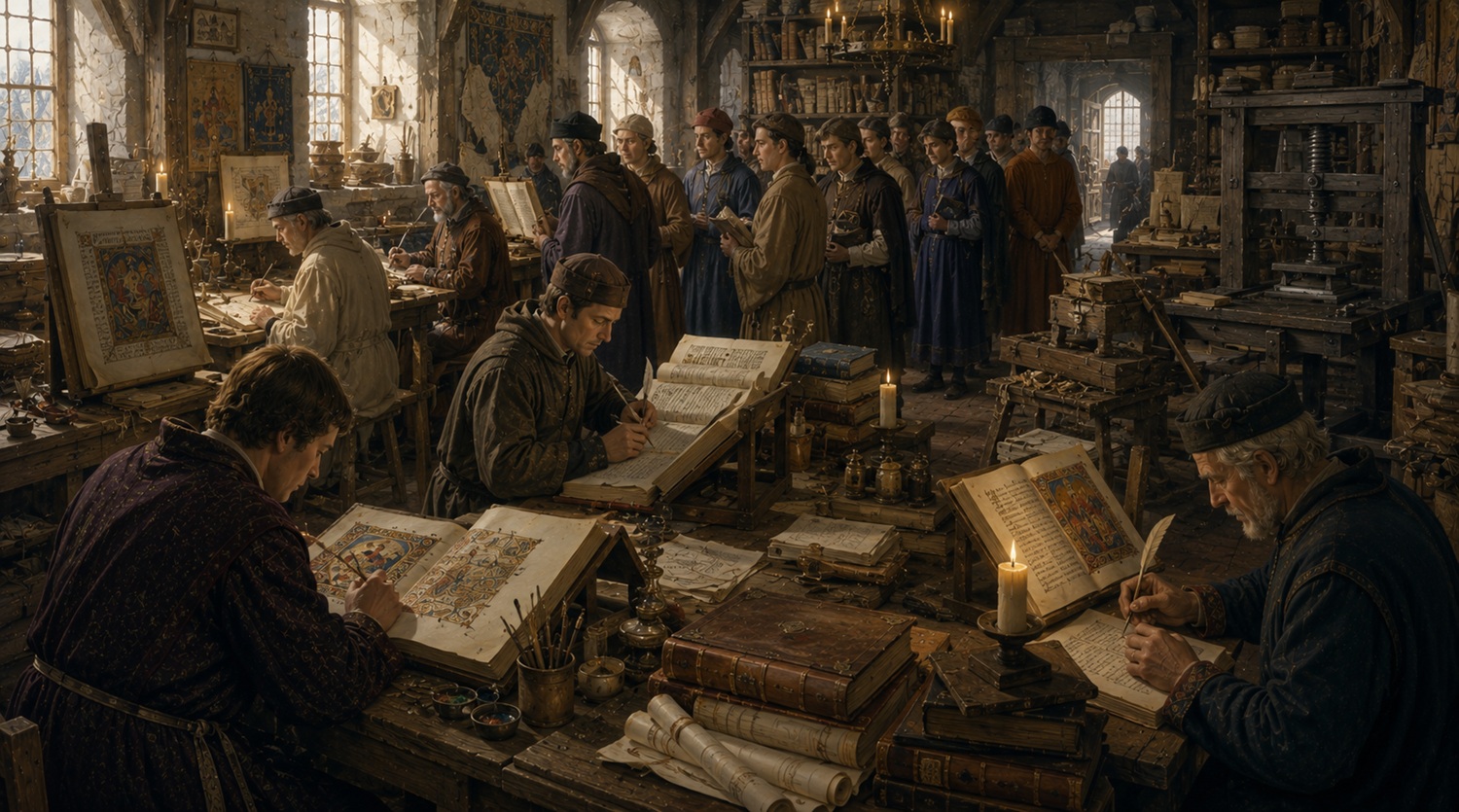
The familiar story of printing begins with Johannes Gutenberg in Mainz around 1450.
That is convenient.
It is also incomplete.
Printing did not begin in fifteenth-century Europe. Woodblock printing had been used in East Asia for centuries, and movable type had also been developed in Asia before Gutenberg. The Library of Congress specifically cautions against calling Gutenberg's Bible the world's first printed book: movable metal type had been used in Korea before Gutenberg, while Chinese, Korean, and Japanese traditions had long histories of woodblock printing and experiments with movable type. (Library of Congress Blogs)
What Gutenberg and his European contemporaries accomplished was more specific and, for Europe, transformative. They developed a commercially workable system combining reusable movable metal type, typecasting, suitable inks, paper, and a mechanical press. Around 1455, Gutenberg's famous Bible demonstrated that large, sophisticated books could be reproduced in many nearly identical copies rather than copied one at a time by scribes. (The Library of Congress)
The technology spread extraordinarily rapidly. By 1500, presses operated in hundreds of European towns, and estimates for books produced during printing's first half-century run into many millions of copies. One recent Cambridge synthesis estimates roughly 8 million copies in about 30,000 editions produced before 1500 by approximately 1,000 printers in 300 European towns. (Cambridge University Press)
The consequences were enormous.
Books became easier to reproduce.
More copies of the same text could circulate.
Universities could acquire more books.
Religious arguments could reach large audiences.
Maps could be replicated.
Governments could print laws and proclamations.
Pamphlets could be produced quickly during political crises.
Scholars could compare the same diagrams and tables.
Vernacular languages acquired much larger written markets.
Eventually newspapers and scientific journals became possible on scales that manuscript copying could not easily match. (Cambridge University Press)
But this does not mean the printing press single-handedly created modern Europe.
The Protestant Reformation was not caused by one machine.
The Scientific Revolution was not waiting helplessly for Gutenberg.
Literacy existed before printing.
Universities existed before printing.
Merchants, governments, churches, diplomats, and scholars already maintained extensive correspondence networks.
Paper manuscripts were already becoming increasingly important in late medieval Europe. (Cambridge University Press)
The most useful counterfactual therefore is not:
What if Europeans could never copy information?
They obviously could.
Instead, imagine that the particular combination of movable metal type and mechanical press developed around Mainz fails to become commercially viable in the fifteenth century.
Perhaps Gutenberg's venture collapses before the process can be successfully replicated.
Perhaps the metallurgy needed for durable, uniform type remains unreliable.
Perhaps investors conclude that the machinery is too expensive.
Perhaps early printers fail to achieve sufficiently predictable ink, paper, and type production to establish profitable workshops.
Woodblock printing survives.
Engraving survives.
Manuscripts survive.
Paper remains available.
Scribes become better organized.
Postal networks expand.
But Europe does not obtain inexpensive, scalable movable-type book production around 1450.
Then the central question becomes:
How long can Europe's existing information systems compensate before someone reinvents mass printing anyway?
The answer is probably not forever.
A delay of fifty years creates one alternate Europe.
A delay of a century creates a much more different one.
A delay of two centuries transforms the Reformation, scientific communication, journalism, administration, and perhaps the political development of Europe beyond easy recognition.
---
Printing Did Not Begin With Gutenberg
Any counterfactual about Gutenberg has to avoid treating printing as a uniquely European conceptual breakthrough.
Chinese woodblock printing had a long history before Gutenberg. East Asian printers could reproduce whole pages from carved blocks, and movable-type technologies were developed using different materials, including ceramic, wood, and metal. Korean movable metal type predates Gutenberg by generations. (OUP Academic)
Why, then, did Gutenberg-style movable type have such dramatic effects in Europe?
Part of the answer lies in the writing systems and economic environment.
An alphabetic writing system requires a comparatively small recurring set of characters. A printer using Latin letters could cast and reuse large quantities of a limited number of symbols. Chinese textual production faced a very different typographic problem because written Chinese required vastly more distinct characters. That did not prevent East Asian print culture from flourishing; it simply meant woodblock and movable-type techniques had different economic advantages in different environments. (Library of Congress Blogs)
Gutenberg therefore should not be imagined as the person who invented the idea of printing.
His importance lies in establishing a particularly powerful European production system at a historical moment when universities, commerce, paper supplies, urban markets, religious institutions, and growing demand for texts gave that system room to spread.
---
Europe Before Mass Printing Was Not Illiterate
Before Gutenberg, Europe possessed a large manuscript culture.
Monasteries copied books.
Universities employed professional scribes and stationers.
Royal and municipal governments generated records.
Merchants wrote letters and accounts.
Lawyers copied legal material.
Students sometimes rented sections of academic texts for copying.
Private libraries existed.
Religious communities commissioned books.
Paper increasingly supplemented more expensive parchment. Cambridge scholarship documents hundreds of English paper manuscripts from the fourteenth and fifteenth centuries alone, illustrating that manuscript production itself was evolving before mechanical printing arrived. (Cambridge University Press)
Written information could therefore travel.
The problem was scale.
A manuscript had to be copied.
If ten copies were required, someone had to produce ten copies.
If one hundred were required, the labor multiplied again.
Copying also introduced variation.
Scribes could omit lines, alter spelling, misunderstand passages, add notes, make deliberate corrections, or reproduce earlier errors.
That did not make manuscript culture defective.
It made every text partly dependent on chains of human reproduction.
---
What Printing Actually Changed
The central advantage of the press was not simply speed.
It was the combination of:
scale;
repeatability;
lower marginal cost;
commercial distribution;
and relative textual stability across large print runs.
Cambridge's history of the European book emphasizes that a press could produce many more copies than scribal reproduction and sell those copies for much less than handwritten books. The availability of cheaper paper was itself essential: printing on parchment alone would have greatly reduced the economic advantage of the new technology. (Cambridge University Press)
Once the expensive work of setting type was completed, hundreds of impressions could be made.
That altered the economics of knowledge.
An author no longer needed someone to decide individually that each copy was worth making.
A printer could gamble that hundreds of buyers existed.
The book became increasingly a market commodity.
That change is difficult to reproduce through handwriting alone.
---
The Point of Divergence: Gutenberg's System Fails to Spread
In this alternate timeline, Gutenberg still experiments.
Perhaps his Bible project even produces a few impressive volumes.
But the wider system fails.
His financial disputes become terminal.
Typecasting knowledge fragments among a small circle of craftsmen.
No successful Mainz workshop demonstrates that a large commercial press can repeatedly turn manuscripts into profitable editions.
Potential imitators conclude that the capital requirements are too high.
European printers continue using woodblocks for images and some short texts but do not establish a scalable movable-type industry.
The critical difference appears during the 1460s and 1470s.
Historically, printing quickly spread from German centers into Italy, France, the Low Countries, Spain, and eventually England; major Western European cities possessed presses by the early sixteenth century. (Cambridge University Press)
In the alternate Europe, that diffusion never starts.
Venice does not become a great printing center.
Parisian printing develops decades later.
William Caxton does not establish England's Westminster press in the 1470s. Historically, Caxton brought printing to England after working on the Continent. (Research Guides)
The year 1500 therefore arrives with Europe still predominantly dependent on handwritten books.
But it is not the Europe of 1400.
Necessity begins generating substitutes.
---
Manuscript Culture Would Become More Efficient
The first response to the missing press would probably be organizational rather than technological.
Demand for books would continue growing.
Universities would still expand.
Urban bureaucracies would still generate records.
Humanist scholars would still search for classical manuscripts.
Merchants would still need commercial information.
Churches would still require liturgical books.
Instead of printers meeting that demand, professional copying industries would grow.
Large urban scriptoria might organize scribes more like workshops.
One person could prepare an authoritative exemplar.
Multiple scribes could copy portions simultaneously.
Proofreaders could compare finished copies.
Standard page layouts could emerge.
Specialists could produce diagrams and decoration separately.
The manuscript book becomes more standardized because the market rewards efficiency.
In other words, Europe might begin industrializing copying without yet mechanizing it.
---
Dictation Could Scale Manuscript Production
Another possibility is coordinated dictation.
A trained reader could dictate a text to a room containing multiple scribes.
Instead of one scribe producing one copy, twenty scribes could create twenty copies simultaneously.
Universities already had institutional traditions designed to improve access to required texts. A no-print Europe would have much stronger incentives to improve those methods.
The result would still be expensive compared with a mature printing press.
Twenty scribes require twenty incomes.
But the gap between manuscript and print would narrow somewhat.
Books remain scarce.
They do not remain unchanged.
---
Woodblock Printing Would Become Much More Important
Europe already knew how to reproduce images and pages using carved wooden blocks.
Fifteenth-century European “block books” contained text and images cut into blocks rather than composed with movable metal type. The Library of Congress describes these as books in which both text and pictures were produced from carved wooden blocks. (The Library of Congress)
Without movable type, investment in block printing would increase dramatically.
Short religious works are ideal candidates.
Alphabet primers.
Prayers.
Calendars.
Popular devotional texts.
Maps.
Playing cards.
Illustrated medical guides.
Government notices.
Simple educational books.
A woodblock requires substantial labor initially, but once cut, it can generate multiple impressions.
The major disadvantage is flexibility.
Change one sentence and the block may need recutting.
A movable-type printer simply rearranges letters.
This means woodblock technology could partially fill the gap without achieving Gutenberg's extraordinary adaptability.
---
Europe Could Develop a Hybrid Information System
By 1500, an alternate European city might possess several overlapping technologies.
Handwritten luxury books.
Cheap paper manuscripts.
Professional scribal workshops.
Woodblock religious texts.
Engraved maps.
Printed pictures.
Handwritten merchant newsletters.
Government clerks producing standardized forms manually.
University copying centers.
Public readings.
Sermons.
Oral political announcements.
The information system is slower than historical European print culture.
It is not primitive.
This distinction becomes essential when considering everything that follows.
---
What Happens to Book Prices?
Books remain more expensive.
That is among the strongest consequences.
Historical printing drastically increased the number of available books and lowered production costs relative to handwritten copying. Quantitative research on European book production finds that the great increase after the mid-fifteenth century was associated with lower prices and expanding literacy. (Cambridge University Press)
Without movable type, labor remains a much larger percentage of the cost of every copy.
Paper helps.
Less decoration helps.
Smaller formats help.
Dictation helps.
Specialized workshops help.
But someone still has to write most words individually.
A student who historically could buy or borrow a printed textbook may instead depend on:
a university library;
a shared manuscript;
a teacher's dictation;
or a cheaply produced excerpt.
The private ownership of books expands more slowly.
---
Libraries Become More Important
Scarcity increases the value of shared collections.
University libraries grow in importance.
Monasteries retain greater intellectual significance because their manuscript collections remain difficult to duplicate.
Royal libraries acquire more strategic value.
Urban governments may establish collections for officials.
Books are chained, catalogued, lent, and copied intensively.
A single rare manuscript can influence an entire scholarly community.
The alternate information economy is therefore more institution-centered.
Printing historically allowed texts increasingly to leave the institutions that had preserved them.
Without printing, libraries and copying centers remain more powerful gatekeepers.
---
Literacy Would Probably Rise More Slowly
Printing did not create literacy from nothing.
Literacy depends on schooling, religion, occupations, urbanization, family strategies, state policy, and economic demand.
But inexpensive texts create powerful reasons to learn to read, while growing numbers of readers create markets for inexpensive texts. The two processes reinforce each other. Historical scholarship finds substantial growth in European literacy alongside the expansion of print but cautions against treating technology as an isolated cause. (Cambridge University Press)
Without mass printing, elite literacy still expands.
Merchants still need records.
Clergy still study.
Government officials still write.
University education still grows.
Urban professions still depend on texts.
What develops more slowly is mass reading culture.
A village school with only a few books cannot offer the same reading environment as one supplied with inexpensive primers, catechisms, prayer books, almanacs, and popular literature.
The strongest conclusion is therefore not “Europe remains illiterate.”
It is:
the social expansion of routine reading happens more slowly and unevenly.
---
Universities Would Survive
Oxford, Paris, Bologna, Prague, Heidelberg, Salamanca, and other universities existed before movable-type printing.
So universities do not disappear.
Professors continue teaching.
Students continue taking notes.
Disputation remains central.
Lectures may remain more important precisely because books are expensive.
University copying systems become larger.
Academic libraries become more heavily used.
The oral component of advanced learning remains stronger.
A famous professor's presence is especially valuable because acquiring a perfect written version of the professor's sources may be difficult.
---
But Universities Spread Knowledge More Slowly
Imagine a new medical text written in Padua.
Historically, a successful printed edition could circulate across many European universities.
In the manuscript world, copies must be requested, commissioned, carried, recopied, checked, and copied again.
Every stage adds time and cost.
The result is not intellectual isolation.
It is greater latency.
An important book might take years rather than months to penetrate distant scholarly networks.
Different universities could continue using substantially different textual traditions longer.
That could encourage intellectual diversity.
It could also preserve errors longer.
---
The Renaissance Still Happens
The Renaissance did not begin because Gutenberg pushed a button.
Italian humanism predated the mature European printing industry.
Classical manuscripts were already being collected, copied, translated, studied, and debated.
Scholars traveled.
Patrons funded research.
Greek learning entered western intellectual networks through multiple channels.
The humanist revival therefore continues.
What printing changed was its ability to stabilize, multiply, compare, and distribute texts on a much larger scale. Elizabeth Eisenstein famously argued that print profoundly transformed Renaissance scholarship while later book historians have emphasized continuities between manuscript and print rather than a clean technological rupture. (Cambridge Assets)
In the alternate timeline, humanism remains more concentrated in wealthy courts, universities, monasteries, and scholarly correspondence networks.
The Renaissance becomes less reproducible.
---
Classical Texts Would Remain More Vulnerable
Printing has an important preservation effect.
Once a text exists in hundreds or thousands of copies stored in many cities, destroying it becomes difficult.
A manuscript work represented by four known copies is much more vulnerable.
Fire matters.
War matters.
Neglect matters.
Library dispersal matters.
Copying errors matter.
Without mass printing, some ancient works rediscovered during the Renaissance might later disappear again.
Others survive in divergent manuscript families.
Modern historians in this alternate world could possess fewer classical works—
and more uncertainty about the wording of those that survive.
---
The Protestant Reformation Still Has Causes
No-print counterfactuals often make an enormous mistake here:
No printing press, therefore no Martin Luther, therefore no Reformation.
The historical relationship was not that simple.
The Reformation involved disputes over theology, church authority, indulgences, political power, ecclesiastical wealth, princely interests, pastoral reform, universities, humanism, local grievances, and longstanding criticism of church practices.
Printing did not create those tensions.
It transformed the speed and scale with which they could be mobilized.
Research on Luther and early Protestantism emphasizes the extraordinary usefulness of cheap printed pamphlets while also noting that literacy remained limited and oral preaching continued to matter enormously. (Cambridge University Press)
So religious reform still comes.
The more difficult question is what form it takes.
---
Luther Without the Printing Press
Martin Luther could still become a professor.
He could still dispute indulgence preaching.
He could still write theological criticisms.
His arguments could circulate among university scholars and church authorities.
He could still preach.
Students could copy his works.
Correspondence networks could distribute them.
But the explosive print phenomenon associated with Luther changes radically.
Historically, printers turned controversial religious writing into a mass communication phenomenon. Cheap pamphlets allowed theological arguments to escape universities and clerical channels rapidly, while Protestant and Catholic writers competed for readers. (OUP Academic)
Without presses, one sermon can influence hundreds.
One manuscript can influence dozens.
One printed pamphlet can influence thousands.
Removing the last mechanism does not silence Luther.
It changes the scale at which “Luther” can become a European phenomenon.
---
The Reformation Becomes More Local
The strongest short-term result is fragmentation.
A reform movement in Wittenberg develops.
Another develops in Switzerland.
Humanist reformers debate church practices elsewhere.
Bohemian religious traditions remain influential.
Local rulers decide whether to protect particular theologians.
But common texts spread much more slowly.
The idea of one rapidly expanding “Protestant Reformation” may therefore emerge later.
Different reform movements could develop more independently.
Their doctrines might diverge farther before they encounter one another intensively.
The Lutheran, Reformed, Anabaptist, Anglican, and other traditions of our history would not simply appear unchanged on a slower schedule.
---
Vernacular Bibles Become Harder to Distribute
Translation itself remains possible.
The challenge is multiplication.
A scholar can translate Scripture into German, English, French, Dutch, or another language.
But producing thousands of affordable copies is impossible without scalable reproduction.
A vernacular Bible could remain a prestigious manuscript copied by wealthy communities rather than a household object purchased by ordinary readers.
This has a major religious effect.
Protestant movements that emphasize lay reading of Scripture face a technological constraint.
They may therefore rely more heavily on:
public reading;
memorization;
sermons;
small copied excerpts;
woodblock primers;
and communal manuscripts.
Religion remains intensely textual.
Text ownership remains less individual.
---
Protestantism Could Become More Clerical
This is an interesting paradox.
Reformers might challenge Catholic ecclesiastical authority while simultaneously depending more heavily on educated ministers because books are scarce.
A congregation could own one vernacular Bible.
The minister reads from it.
Members hear Scripture rather than independently checking passages at home.
Catechisms could be copied or block-printed in simplified form.
Songs become important because they spread orally.
This would create a Reformation with powerful vernacular preaching but weaker household print culture.
It could become politically successful while remaining less literate in everyday practice than historical Protestantism.
---
Could the Reformation Fail?
In some regions, yes.
Printers historically made it difficult to contain controversial religious writing once demand existed. Catholic opponents recognized the power of cheap print and responded through censorship as well as their own publication campaigns. (OUP Academic)
Without that technology, authorities gain advantages.
A bishop can seize fifty manuscripts more easily than fifty thousand pamphlets.
A ruler can monitor professional scribal workshops.
Universities can restrict copying.
Border controls matter more when texts are bulky and scarce.
Religious dissent does not vanish.
Its ability to become a mass movement may diminish.
The Reformation could therefore remain a collection of regional reform crises rather than creating the same continent-wide confessional rupture of the sixteenth century.
---
Or the Reformation Could Arrive Anyway Through Politics
The opposite possibility remains important.
If powerful princes decide that religious reform serves political and theological goals, they can provide institutional distribution.
A ruler can order churches to use a new liturgy.
Universities can train reformist clergy.
Sermons can spread doctrines orally.
Government scribes can issue standardized summaries.
Songs can circulate.
Local congregations can copy catechisms.
Political authority itself can substitute partly for print.
This demonstrates why technology cannot be treated as the sole cause.
A state-backed Reformation may still succeed without cheap books.
It would simply be more dependent on rulers and institutions.
---
Catholic Reform Also Changes
The Catholic response to Protestantism historically used print extensively.
Church authorities printed catechisms, decrees, liturgical material, apologetics, polemics, and indexes of prohibited works. Early modern governments and churches were not merely victims of print; they used presses actively to impose orthodoxy and administer institutions. ([Library of Congress Tile
]16)
Without mass printing, Catholic reform becomes harder to standardize too.
Rome can issue decrees.
Bishops can distribute manuscripts.
Church councils can legislate.
But ensuring that thousands of priests possess identical authoritative texts takes longer.
This creates greater local variation.
A world without Protestant pamphlets is also a world without inexpensive Catholic catechisms.
The information disadvantage works in both directions.
---
The Catholic Church Might Remain Less Uniform
Later Catholic reform placed great emphasis on education, discipline, doctrine, and liturgical standardization.
Printing made uniform texts much easier to distribute.
Without it, bishops and religious orders still reform seminaries and clerical conduct.
But practices remain regionally diverse longer.
Parishes rely more on local manuscript traditions.
Corrections take longer to propagate.
Rome's ability to communicate detailed textual uniformity across Catholic Europe is weaker.
The result could be a church that remains institutionally powerful but somewhat more locally varied.
---
Scientific Development Would Continue
Another simplistic claim should be rejected:
No Gutenberg, no Scientific Revolution.
Observation does not require printing.
Mathematics existed before printing.
Astronomy existed before printing.
Universities existed.
Correspondence existed.
Instruments could be built.
Experiments could be repeated.
Scholars traveled.
Manuscripts circulated.
The famous seventeenth-century “Republic of Letters” relied heavily on correspondence in addition to printed works. Early modern Europe experienced a major expansion in letter writing and organized postal communication. (Cambridge University Press)
So Copernicus, Vesalius, Galileo, Kepler, Harvey, Descartes, Boyle, Newton, or their intellectual equivalents are not automatically erased.
What changes is the communication environment in which discoveries accumulate.
---
Science Becomes Harder to Replicate
Scientific knowledge is unusually dependent on precision.
A theological argument may survive modest wording changes.
A table of planetary positions is less forgiving.
A mathematical symbol copied incorrectly can invalidate a calculation.
A mislabeled anatomical diagram can mislead a physician.
Printing allowed increasingly standardized diagrams, tables, illustrations, and technical books to circulate among large numbers of readers. Scholarship on early modern print emphasizes the growing importance of reproducible visual material in astronomy, instructional manuals, and other observational sciences. (Cambridge University Press)
Without printing, technical knowledge becomes more vulnerable to copying errors.
Science still advances.
Replication becomes more expensive.
---
Scientific Correspondence Becomes Even More Important
Scholars would build larger private letter networks.
Universities might maintain dedicated copying bureaus for important discoveries.
Scientific societies could emerge specifically to solve the distribution problem.
Imagine a seventeenth-century academy receiving a manuscript describing an experiment.
Instead of printing 500 copies, it employs ten scribes.
Those copies go to ten major universities.
Each university makes further copies.
The system works.
It is simply slower and more hierarchical.
This could make scholarly institutions more powerful than individual authors.
---
Scientific Journals Arrive Later
Historically, Philosophical Transactions began in 1665 and became one of the earliest enduring scientific periodicals. The Royal Society describes it as the world's first and longest-running scientific journal. (Royal Society Publishing)
A periodical depends heavily on regular economical reproduction.
Without movable type, the journal model becomes difficult.
There could be handwritten scientific newsletters.
There could be annual manuscript compilations.
There could be correspondence circulars copied by assistants.
But “publish every month and distribute many nearly identical copies” becomes expensive.
The culture of priority claims changes too.
Who discovered something first may depend more heavily on dated letters, witnesses, academy registers, and sealed manuscripts.
---
Newton's World Would Be Different Even If Newton Still Exists
Suppose the major mathematical and astronomical breakthroughs of the seventeenth century still occur.
Newton could write the Principia.
But without mass printing, perhaps only fifty manuscript copies circulate during his lifetime.
University mathematicians encounter it slowly.
Diagrams vary slightly between copies.
A French scholar waits a year for access.
A German reader receives only selected propositions.
Criticism and correction spread through letters.
The science may ultimately survive.
Its diffusion curve looks very different.
The crucial effect of printing is therefore not necessarily making discovery possible.
It is making distributed cumulative science much easier.
---
Maps Become More Valuable and Less Uniform
Printing had enormous consequences for cartography.
After European Atlantic voyages, printed maps allowed newly reported geographic information to be preserved and distributed widely. The Library of Congress emphasizes the role of printing, woodcut, and engraving in circulating the new geographic knowledge generated by exploration. (The Library of Congress)
Without movable-type book printing, maps are not impossible.
Engraving and woodcut can reproduce images independently.
In fact, cartography may become one of the strongest alternative print industries precisely because a map can be reproduced from a single engraved plate.
This creates an interesting divergence.
Maps may become mechanically reproducible before books do.
---
A Map-Printing Industry Could Flourish Without Book Printing
Copper engraving and woodblock techniques could support commercial map production.
Atlases would be harder because accompanying text must be handwritten, block-cut, or engraved.
But individual charts could circulate.
Portolan traditions continue.
Maritime states have powerful incentives to reproduce navigational information.
Royal governments may subsidize map workshops.
The gap between visual and textual reproduction widens.
A merchant might own a printed map but only handwritten books.
That would be a distinctive information culture.
---
Exploration Still Happens
Portuguese navigation along Africa predates Gutenberg's mature print revolution.
Columbus does not require a printing press to sail.
Shipbuilding, navigation, commercial rivalry, royal patronage, geography, diplomacy, and the search for trade routes all possess independent histories.
So Europeans still explore the Atlantic and Indian oceans.
What changes is how reports circulate afterward.
News of discoveries spreads through:
court correspondence;
merchant letters;
diplomatic reports;
handwritten travel narratives;
public announcements;
sermons;
and reproducible maps.
Knowledge travels.
It is easier for governments and commercial elites to monopolize.
---
Geographic Secrets Become Easier to Keep
This could matter greatly to Portugal and Spain.
A printed book can escape.
A manuscript can too—but restricting a few dozen copies is easier than suppressing an edition of thousands.
Navigational information may therefore remain a strategic state secret longer.
Rival states depend more heavily on espionage.
Pilots become more valuable.
Captured charts matter more.
Merchants and diplomats serve as intelligence networks.
The Age of Exploration still occurs.
It may be more secretive and less publicly documented.
---
Governments Would Miss Printing Too
Modern bureaucracy did not begin with the press.
Medieval states already produced charters, accounts, tax records, legal registers, diplomatic correspondence, and administrative archives.
But printing offered governments a powerful new capability: identical copies of laws, forms, proclamations, decrees, and instructions. The Library of Congress notes that books, pamphlets, and broadsides became common media for government laws and proclamations, while scholarship on early modern European states shows rulers actively using print as an instrument of administration and authority. (Research Guides)
Without the press, bureaucracy still expands.
It requires more clerks.
---
The Scribal Bureaucracy Becomes Enormous
A centralized monarchy wants instructions sent to 100 provincial officials.
Historically, a government printer can produce 100 copies.
In the alternate timeline, 100 copies require scribes.
That creates a growing civil-service occupation.
Royal chancelleries develop copy departments.
Standard handwriting becomes important.
Templates proliferate.
Blank forms may be produced using woodblocks while variable information is entered manually.
Governments could therefore partially industrialize administration without movable type.
The absence of printing does not stop state-building.
It makes state-building more labor-intensive.
---
Administrative Errors Become a Political Problem
When statutes are copied repeatedly by hand, local versions can diverge.
Officials may claim to possess different instructions.
Old laws remain in circulation after revisions.
Forgery becomes easier to dispute and harder to detect.
Central states respond by developing stronger authentication practices:
seals;
registries;
numbered copies;
authorized exemplars;
notarial certification.
The culture of the official document becomes more elaborate because reproduction cannot guarantee identity.
---
Newspapers Arrive Much Later
Regular newspapers are one of the clearest casualties.
News existed before newspapers.
Merchants circulated letters.
Diplomats sent reports.
Professional manuscript newsletters developed in early modern Europe and could serve paying elite subscribers. Oxford scholarship notes that manuscript newsletters, merchant correspondence, and expanding postal systems all transmitted news before and alongside printed periodicals. (OUP Academic)
What printing changed was the economics of audience size.
One handwritten newsletter can serve one customer.
A printer can make hundreds of copies from one setting.
Without movable type, news remains an elite subscription service much longer.
---
The Manuscript Newspaper
By the seventeenth century, wealthy Europeans in the alternate timeline might subscribe to handwritten weekly news sheets.
A central bureau gathers:
diplomatic intelligence;
war reports;
commodity prices;
court gossip;
ship arrivals;
religious news.
Editors prepare a master copy.
Teams of scribes reproduce twenty or fifty editions.
Regional copying centers distribute summaries farther outward.
The system resembles a news agency combined with a scribal workshop.
Information circulates internationally.
Ordinary people encounter it through tavern readings, public rumor, sermons, and town criers rather than personal newspaper subscriptions.
---
Political Pamphlets Become Less Explosive
Cheap print became enormously important to early modern political controversy.
Pamphlets and broadsides could be short, inexpensive, topical, anonymous, provocative, and rapidly produced. Scholarship on early modern cheap print emphasizes precisely these low-cost formats, while studies of political culture show that print markets expanded public participation beyond narrow educated elites. (Cambridge University Press)
Without movable type, political controversy remains.
Satirical songs spread.
Manuscripts circulate.
Handwritten libels appear.
Public speeches matter.
Woodcut cartoons flourish.
But the pamphlet explosion becomes much smaller.
Political communication remains more oral and visual.
---
Revolutions Would Still Produce Propaganda
Technology does not create grievances.
Tax revolts still occur.
Religious wars can still occur.
Dynastic crises occur.
Urban crowds mobilize.
Parliaments challenge kings.
Peasants rebel.
But movements find it harder to produce a common written narrative across wide territories.
This could favor governments.
It could also favor local radicals whose oral networks authorities cannot easily monitor.
The major change is not simply less politics.
It is different political scale.
---
National Languages Develop Differently
Printing played an important role in the history of vernacular standardization.
Printers faced commercial incentives to use forms understandable across large markets, while repeated printed spellings and grammars could help normalize particular written forms. Comparative research finds a significant association between adoption of printing and European language standardization. (Cambridge University Press)
But languages existed before presses.
Dante wrote about vernacular language long before Gutenberg.
Royal administrations used vernaculars.
Poetry circulated.
Regional literary traditions existed.
So English, French, German, Spanish, Italian, Polish, and other languages still change.
They change less uniformly.
---
Dialects Remain More Visible in Writing
A printer selling 1,000 books has reasons to choose spellings that reach a broad audience.
A scribe producing one manuscript for a local patron has fewer such incentives.
Without national print markets:
regional spelling remains stronger;
local vocabulary survives longer;
scribal conventions differ by city;
grammars appear later;
dictionaries become rarer;
royal bureaucracies rather than commercial printers become more important agents of standardization.
The eventual standard form of English might therefore differ significantly from historical Standard English.
The same would apply elsewhere.
---
Latin Remains Stronger Longer
Printing helped create huge vernacular markets, although Latin itself also flourished as an international printed language.
Without cheap vernacular books, Latin retains several advantages.
Universities already use it.
Clergy use it.
Scholars across countries can communicate through it.
A manuscript in Latin can circulate internationally without translation.
This could preserve Latin's position as Europe's intellectual lingua franca longer.
Vernacular languages still rise through courts, administration, literature, and religion.
The shift is slower.
---
What Happens to Literature?
Literary authors still exist.
Poetry may flourish particularly well because poems can circulate orally and in manuscript.
Drama remains powerful because a play communicates to hundreds without requiring hundreds of books.
Songs become especially important.
Epic and narrative traditions remain strongly performative.
The commercial novelist, however, faces a much smaller market.
Without inexpensive editions, writing a very long work for thousands of private readers becomes economically less attractive.
Patronage survives longer.
Authors depend more heavily on courts, aristocrats, churches, universities, and wealthy urban sponsors.
---
Shakespeare Could Still Write Plays
A playwright does not need printed books for audiences to experience theater.
London theater could still develop if its economic and political conditions remain.
But Shakespeare's textual afterlife changes.
Individual plays circulate in manuscript.
Actors maintain prompt books.
Collectors commission copies.
There is no inexpensive quarto market in the same form.
There may be no printed First Folio in 1623.
Future generations could lose more plays.
Theater thrives.
Literary preservation suffers.
---
Copyright Develops Differently
Printing created a commercial problem that manuscript culture faced on a much smaller scale:
one printer could invest in an edition only to have another printer reproduce it.
Governments responded with privileges, monopolies, licensing systems, and eventually copyright structures.
Without a large printing industry, the political economy of literary property develops more slowly.
A manuscript can still be copied without permission.
But the commercial stakes are smaller.
Patronage rights, physical manuscript ownership, guild controls, and secrecy may matter more than abstract rights to reproduce a text.
Modern copyright could therefore emerge much later or from different industries such as engraving and mapmaking.
---
Censorship Becomes Easier—and Harder
It becomes easier because fewer copies exist.
Governments can monitor known scribes.
Churches can inspect university collections.
A manuscript workshop can be closed.
An edition of ten copies is easier to seize than an edition of ten thousand.
But censorship also becomes harder in another sense.
Handwritten texts leave fewer commercial records.
Anonymous copies can circulate privately.
A manuscript can be altered during copying.
There is no central printer whose shop authorities can raid.
The information environment becomes less massive but more intimate.
Suppression becomes a contest among networks.
---
Heresy Could Become a Network Phenomenon
Underground religious movements could depend heavily on hand copying.
Small texts pass between trusted households.
Songs carry doctrine.
Secret teachers memorize sermons.
A manuscript confession is copied by each congregation.
This makes movements harder to scale.
It may make committed minorities harder to eradicate completely.
The resulting religious map could contain many small, durable dissident traditions rather than a few enormous printed confessions.
---
What Technology Would Fill the Gap?
Europe would not wait passively for movable type.
Several technologies and institutions could absorb parts of its function.
| Alternative | What It Can Do Well | Main Limitation |
| ------------------------------------- | ----------------------------------------------------------- | ---------------------------------------------------------- |
| Professional manuscript workshops | Produce accurate books using organized teams of scribes | Labor cost rises with every copy |
| Dictation copying | Produce multiple manuscripts simultaneously | Still requires one skilled scribe per copy |
| Woodblock books | Reproduce fixed pages, images, primers and devotional works | Every page requires carving; revision is difficult |
| Woodcuts and engravings | Excellent for maps, diagrams, images and single sheets | Long texts are cumbersome |
| Paper manuscript production | Cheaper than parchment and suitable for large bureaucracies | Does not solve copying labor |
| Postal networks | Move letters and manuscript newsletters rapidly | Transportation does not multiply copies |
| Public reading and preaching | One text can reach large audiences | Audience receives information orally rather than owning it |
| Libraries and copying centers | Share scarce books efficiently | Access remains institutionally concentrated |
| Government scriptoria | Standardize laws, orders and bureaucratic records | Expensive clerical workforce |
| Stencil or template systems | Useful for repetitive forms and short standardized texts | Poor substitute for flexible book composition |
The most important substitute would probably not be one invention.
It would be a hybrid information economy.
---
Could Woodblock Printing Become Europe's Dominant Book Technology?
For some genres, yes.
A popular prayer book that is expected to remain unchanged for decades is suitable for block printing.
So is an alphabet book.
A fixed legal code could be carved into blocks.
Illustrated medical instructions could work.
But a 400-page philosophical treatise would require hundreds of carefully carved page blocks.
A revised edition becomes expensive.
A translation requires an entirely new set.
Movable type's great strength was that the same letters could be endlessly rearranged.
Without that flexibility, block printing can support mass reproduction without supporting the same explosive diversity of titles.
Europe could have many copies of fewer works.
That difference matters.
---
Engraving Could Produce a Visual Information Revolution
Maps, anatomical plates, astronomical diagrams, architectural drawings, portraits, political cartoons, and technical illustrations could spread through engraving even while long prose remained handwritten.
This might make alternate Europe unusually visual.
A scholar receives a handwritten explanation accompanied by a mechanically reproduced diagram.
A navigator owns several printed charts but handwritten sailing instructions.
A political dissident circulates engraved satire with a few carved words.
A physician purchases anatomical plates without owning the expensive manuscript treatise they illustrate.
The separation between image reproduction and text reproduction could persist for decades.
---
Could Typewriters Appear Early?
Not in anything resembling the modern mechanical typewriter without several additional developments.
The problem Gutenberg solved was not simply how to make letters mechanically.
It involved mass production, durable type, alignment, ink transfer, paper handling, and commercial workflow.
Other machines could eventually be invented, but there is no reason to expect Europeans to leap directly from scribes to nineteenth-century office technology.
The likely replacement for a failed fifteenth-century press is another printing technology, not a four-century technological jump.
---
Mass Printing Would Probably Be Reinvented
This is perhaps the strongest long-term conclusion of the entire counterfactual.
Europe possessed:
alphabetic writing;
metalworking;
paper;
woodblock techniques;
screw presses used in other industries;
large urban markets;
universities;
commercial capital;
growing states;
churches demanding standardized texts;
and ever-increasing quantities of written administration.
Those conditions create repeated incentives to mechanize copying.
If Gutenberg fails, another goldsmith, engraver, papermaker, metalworker, bookseller, or consortium could eventually solve the problem.
The question is less whether Europe ever obtains scalable typography than when.
That is why delays of fifty, one hundred, and two hundred years produce very different histories.
---
Scenario One: Printing Is Delayed 50 Years
In this branch, commercially successful movable-type printing appears around 1500 rather than 1450.
This is the least disruptive scenario.
Renaissance
Humanism spends another generation in manuscript culture, making classical scholarship somewhat more elite and geographically concentrated.
Once presses spread after 1500, humanist works are rapidly printed.
The cultural movement survives substantially intact but its first phase looks different.
Reformation
This is where the timing becomes extraordinarily important.
Luther's historical challenge begins in 1517, only a few years after the alternate printing industry takes off.
Printing is therefore newer, less widespread, and has smaller distribution networks.
The Reformation may still occur but spreads more slowly.
Printers are fewer.
Authorities can suppress workshops more effectively.
Religious pamphlet culture develops during the controversy rather than already existing at scale.
Literacy
Popular reading culture is delayed by roughly a generation or two.
Science
The sixteenth-century scientific world still receives print early enough that Copernican astronomy, anatomy, and later seventeenth-century science develop within a print environment.
Overall effect
Large but recognizable.
By 1600, Europe may be converging toward something resembling historical print culture.
---
Scenario Two: Printing Is Delayed 100 Years
Now movable-type mass printing appears around 1550.
The consequences become much greater.
Reformation
The historical Reformation cannot occur in the same form.
Luther's writings circulate by manuscript, sermons, correspondence, and institutional protection.
Local reform succeeds in some territories.
But there is no immense early-sixteenth-century pamphlet market.
Different reform traditions develop more independently.
By the time presses appear around 1550, Europe may already contain several established reform churches.
Printing then accelerates a second phase of confessional competition rather than creating the original explosion.
Catholic Reform
The Catholic Church has also spent decades attempting reform through councils, episcopal networks, preaching orders, schools, and manuscript standardization.
Once printing appears, Catholic authorities adopt it rapidly.
National languages
Vernacular standardization is substantially delayed.
Mid-sixteenth-century printers inherit more divergent regional written traditions.
Science
Copernicus's generation works largely through manuscripts.
Astronomical tables and anatomical illustrations circulate slowly.
Scientific printing appears just in time to accelerate the later sixteenth and seventeenth centuries.
The Scientific Revolution is altered but not necessarily eliminated.
News
Regular printed news begins decades later.
Overall effect
By 1650, European religious and political boundaries could be substantially different.
The new printing revolution enters a Europe already changed by a century of manuscript-era Renaissance and reform.
---
Scenario Three: Printing Is Delayed 200 Years
Now scalable movable-type printing does not appear until around 1650.
This is no longer simply delayed historical Europe.
It is another information civilization.
The consequences before printing appears would accumulate for eight generations.
---
Religion After a 200-Year Delay
There is no historical sixteenth-century Reformation.
That does not mean permanent Catholic unity.
Religious reform movements could still divide western Christianity.
But they do so through:
princes;
universities;
preachers;
church councils;
manuscript networks;
regional political movements;
and warfare.
Theological boundaries might be more closely tied to states because states possess the infrastructure required to spread doctrine.
A successful reforming monarch can impose a church.
An independent dissident writer has much less capacity to create a transnational readership.
Europe could therefore become religiously diverse while producing fewer international mass movements centered around famous authors.
---
Religious Uniformity Might Actually Be More Political
Without cheap personal books, the religious identity of a territory may depend even more heavily on institutions.
Which priests preach?
Which liturgy is used?
Which university trains clergy?
Which songs are taught?
What does the ruler require?
This could strengthen the principle that the ruler determines public religion.
Individual religious reading remains important among elites but plays a smaller role in mass confessional formation.
Then printing arrives around 1650 and destabilizes this structure.
Suddenly millions of people encounter competing religious arguments on paper.
The major European print-driven religious crisis might therefore occur not in the age of Luther but in the age that historically produced Louis XIV, Cromwell, and the early scientific societies.
---
Science After a 200-Year Delay
This branch creates perhaps the largest intellectual divergence.
Copernican astronomy might still develop.
Anatomical investigation continues.
Mathematics continues.
Instrumentation continues.
Natural philosophy continues.
But the infrastructure for rapid cumulative publication is missing.
Scientific centers become more locally distinctive.
One astronomical school may use different data from another.
New methods travel through letters and students.
Priority disputes proliferate.
Diagrammatic errors accumulate.
Technical handbooks are expensive.
A discovery made in Prague might take years to reach London.
The formation of an integrated European scientific community is delayed.
---
Scientific Societies Could Arrive Before Scientific Journals
This reverses part of our historical sequence.
Scholars may create academies precisely because they need physical centers for exchanging scarce texts.
Meetings become essential.
A society maintains a copying office.
Foreign correspondence is read aloud.
Important letters are copied and archived.
Annual manuscript volumes circulate between selected institutions.
Then movable type finally becomes commercially successful around 1650.
Scientific societies become some of its most enthusiastic customers.
The impact is immediate.
A manuscript-based network already exists.
Printing suddenly gives that network enormous reproductive power.
The alternate equivalent of Philosophical Transactions might appear within a few years rather than waiting for print culture itself to mature.
---
The Printing Revolution of 1650 Could Be More Politically Explosive Than Gutenberg's
By 1650, European states are larger.
Postal networks are better.
Cities are bigger.
Universities are more numerous.
Atlantic trade networks span oceans.
Religious conflict has accumulated.
Merchants possess international information systems.
Literacy among elites is well established.
Governments depend heavily on written administration.
If movable-type printing suddenly enters that environment, adoption could be astonishingly fast.
The fifteenth-century printing revolution required markets to develop alongside the technology.
A seventeenth-century printing revolution would encounter enormous pent-up demand.
The first generation might produce an information shock even more dramatic than Gutenberg's historical one.
---
Newspapers Could Explode Almost Immediately
The infrastructure already exists.
Postal routes.
Manuscript news bureaus.
Commercial correspondents.
Diplomatic information networks.
Urban readerships.
The missing ingredient is cheap multiplication.
When printing arrives, handwritten newsletters can be converted rapidly into printed news sheets.
A mature information network suddenly obtains mass reproduction.
The newspaper age might begin almost instantly.
Political authorities would be confronted with mass public information before they had generations to develop historical printing regulations gradually.
Censorship systems could become extremely aggressive.
---
Governments Might Initially Monopolize the New Technology
A seventeenth-century state would understand the strategic importance of mechanical copying immediately.
Royal governments could attempt to license every press.
Military authorities could classify printing equipment.
Churches could demand monopolies.
Unauthorized presses could be treated as weapons.
The first printed Europe might therefore be more centralized and censored than the historical one.
Yet clandestine presses would inevitably appear.
The battle between government information and underground publication could begin from the technology's first decade.
---
The Comparison
| Area | Historical Printing c. 1450 | 50-Year Delay | 100-Year Delay | 200-Year Delay |
| ----------------------- | ---------------------------------------------------------- | ---------------------------------- | ---------------------------------------------- | ----------------------------------------------------------- |
| Book supply | Explodes during late 15th century | Expands after 1500 | Expands after 1550 | Manuscripts dominate until c. 1650 |
| Book prices | Fall substantially relative to manuscripts | Higher for another generation | High through early Reformation era | High for most of early modern period |
| Literacy | Reinforced by expanding cheap-text market | Slower initial growth | Mass reading delayed significantly | Elite/professional literacy dominates much longer |
| Universities | Rapidly gain printed textbooks | Longer dependence on copying | Large manuscript bureaus | Libraries and scribal centers become core infrastructure |
| Renaissance | Print amplifies humanism | Similar movement, slower diffusion | More elite and regional | Deeply manuscript-based |
| Reformation | Cheap print accelerates mass controversy | Still recognizable but slower | Fundamentally altered | Historical Reformation impossible in same form |
| Catholic reform | Uses print for standardization and polemic | Slight delay | Greater regional variation | Institutional/oral reform dominates |
| Science | Printed diagrams, tables and books aid cumulative exchange | Modest delay | Significant communication delay | Scientific societies may precede mass scientific publishing |
| Maps | Printed atlases flourish | Similar but later | Engraving may outpace books | Map printing may develop as separate industry |
| Government | Print increasingly distributes laws/forms | Larger scribal offices | Major clerical bureaucracies | Highly developed manuscript states |
| News | Printed periodicals emerge in early modern era | Slight delay | Manuscript newsletters remain important longer | Manuscript news dominates until sudden print explosion |
| Political pamphlets | Become major mass medium | Reduced initially | Much weaker Reformation-era pamphlet culture | Political mass print arrives centuries later |
| Languages | Print supports vernacular standardization | Standardization delayed | Stronger regional writing traditions | National orthographies may be substantially different |
| Long-term outcome | Historical Europe | Recognizable alternate Europe | Major divergence | Entirely different early modern information order |
---
Would Literacy Eventually Catch Up?
Probably.
Industrial, commercial, governmental, religious, and educational institutions all create incentives for literacy independent of printing.
A growing state needs clerks.
A merchant needs accounts.
A lawyer needs documents.
An urban artisan can benefit from written instructions.
A religious community may want Scripture.
Parents may seek education for children.
The long-term literacy ceiling therefore does not depend solely on Gutenberg.
But cheap printed material lowers the cost of maintaining literacy.
It gives readers something to read.
Without it, universal or near-universal literacy is much more expensive to sustain.
Mass schooling consequently develops more slowly unless states deliberately subsidize books and copying.
---
Could Governments Invent Printing for Administrative Reasons?
Very plausibly.
Suppose private book entrepreneurs never perfect movable type.
By the sixteenth or seventeenth century, expanding monarchies face huge copying costs.
A ruler may fund engineers specifically to mechanize official documents.
The first successful European movable-type system could therefore emerge not from a commercial Bible project but from a royal bureaucracy.
That produces a very different institutional history.
Printing begins as a state technology.
Private printing comes later.
Governments may claim the machinery as a royal monopoly.
Free commercial publishing would then need to fight its way out of the bureaucracy that invented the technology.
---
Could Universities Invent It?
Also plausible.
A university town faces constant demand for repeatable textbooks.
Professors need identical diagrams.
Students need excerpts.
Libraries need catalogues.
If the technology is technologically possible but commercially difficult, universities could subsidize experimental workshops.
The first successful presses might therefore become university property.
This could give universities enormous influence over early intellectual publishing.
Academic censorship would be powerful.
---
Could Religious Institutions Invent It?
Certainly.
The demand for standardized religious texts was one of the strongest real markets for early printing.
A church that wants thousands of identical liturgical texts has an obvious incentive to mechanize reproduction.
A delayed European press could emerge from a monastery, episcopal bureaucracy, missionary order, or papal workshop.
Ironically, the machine later associated with challenging ecclesiastical authority might initially become a tool designed to strengthen it.
History already demonstrates that early modern churches and states used print intensively rather than standing simply in opposition to it. ([Library of Congress Tile
]16)
---
Could Knowledge From East Asia Reach Europe and Restart the Process?
Possibly.
Long-distance Eurasian contacts continued.
European travelers eventually acquired better information about Asian societies.
A Europe that had somehow failed to commercialize movable type might encounter clearer descriptions or examples of East Asian printing traditions.
But technological diffusion is not automatic.
Knowing that another society possesses movable type does not instantly provide:
the right alloy;
casting methods;
press engineering;
ink chemistry;
paper supply;
trained workers;
capital;
or a viable market structure.
The concept could inspire experimentation.
Europe would still need to build its own production system.
---
Would the Age of Exploration Eventually Force Mass Printing?
It would create powerful additional pressure.
Oceanic empires generate information.
Charts.
Port records.
Navigation manuals.
Commodity lists.
Missionary grammars.
Administrative decrees.
Commercial correspondence.
Treaties.
Travel accounts.
Foreign-language guides.
A Portuguese, Spanish, Dutch, French, or English Atlantic empire managed entirely through hand copying becomes increasingly expensive.
The larger the imperial system, the stronger the incentive to mechanize documentation.
Mass expansion therefore makes a two-century delay less and less stable.
By 1650, the economic case for some form of scalable textual reproduction would be overwhelming.
---
No Printing Press Does Not Mean No Information Revolution
This is the central corrective to the entire scenario.
Europe already possessed information networks.
Merchant letters crossed borders.
Diplomatic correspondence intensified.
Postal systems improved.
Professional manuscript newsletters served elites.
Governments accumulated archives.
Universities exchanged scholars.
Religious orders connected distant institutions.
Oxford research on long-distance communication emphasizes precisely these parallel systems and warns against reducing early modern information history to print alone. (OUP Academic)
Without Gutenberg, those networks would expand more aggressively.
The information revolution still occurs.
It becomes more expensive, more institutional, more selective, and more dependent on human copying.
Printing's significance lies partly in opening those networks to vastly larger audiences.
---
What Changes Most?
Several effects are especially robust.
Books remain expensive longer
Labor cannot be removed from manuscript copying.
Private libraries remain smaller
Institutions hold a greater share of Europe's books.
Universities rely more on oral teaching
Lectures, dictation, and copying remain central.
Reformation-era religious controversy spreads more slowly
Theological conflict survives; its mass communications system changes.
Vernacular Bibles are scarcer
Public reading remains more important than household ownership.
Governments employ more scribes
Bureaucratic growth becomes labor-intensive.
Political pamphleteering is weaker
Oral, manuscript, and visual propaganda gain importance.
Scientific communication is slower
Correspondence and academies compensate.
National language standardization is delayed
Regional written traditions remain stronger.
Newspapers emerge later
Manuscript news services persist.
These do not require assuming that Europe stops developing.
They follow directly from the economics of reproduction.
---
What Changes Less Than Expected?
Several processes probably continue.
Universities
They predate Gutenberg.
Renaissance humanism
It already existed in manuscript culture.
Oceanic exploration
Its motives and technologies were broader than printing.
State formation
Kings and cities administered territories before print.
Scientific observation
Experiments, mathematics, and instruments do not require printed books to exist.
Religious criticism
Church reform movements long predated Luther.
Vernacular literature
Poetry, drama, songs, and manuscript literature remain viable.
Long-distance commerce
Merchants already depended on correspondence.
Printing accelerated and reshaped these processes.
It did not create each one from nothing.
---
The Largest Error Would Be Technological Determinism
It is tempting to write history as a sequence of inventions:
printing press → Reformation → Scientific Revolution → Enlightenment → modern democracy.
Real history is not that linear.
Technologies operate through institutions.
Printing mattered because printers found markets.
Religious reform mattered because rulers, clergy, universities, congregations, and political authorities acted on texts.
Scientific books mattered because scholars had institutions capable of interpreting and testing them.
Newspapers mattered because postal systems, cities, literacy, commercial markets, and politics created readers.
Language standardization involved schools, governments, literature, administration, and identity as well as printers. Modern scholarship increasingly treats print not as an isolated machine that automatically produced modernity but as a medium operating within existing social and institutional structures. (Cambridge Assets)
That principle is even more important in the alternate timeline.
Remove the press and Europe adapts.
The institutions do not vanish.
They build substitutes.
---
The Most Plausible Alternate Europe
The strongest scenario is probably a delay rather than permanent non-invention.
Gutenberg's commercial system fails around 1450.
Professional manuscript production expands.
Woodblock printing becomes much more sophisticated.
Engraved maps flourish.
Universities develop organized copying bureaus.
Governments enlarge their chancelleries.
Merchants operate sophisticated manuscript news networks.
Religious reform proceeds through preaching, institutional politics, handwritten texts, and public ritual.
Then sometime between 1500 and 1550 another European workshop finally combines metal type, casting, ink, paper, and press technology into a commercially successful system.
When it happens, the effect is explosive.
There is already enormous demand.
Universities want textbooks.
Reformers want propaganda.
Churches want standardized liturgy.
Governments want proclamations.
Merchants want news.
Explorers want maps and accounts.
Writers want readers.
The delayed printing revolution could therefore spread even faster than the historical one.
Within a few decades, Europe begins catching up in sheer textual production.
What it cannot recover is the history that occurred during the delay.
---
A Fifty-Year Delay Is Recoverable
Printing around 1500 still arrives before the great religious confrontations of the sixteenth century fully develop.
The Renaissance changes modestly.
The Reformation develops differently but recognizably.
Scientific printing still exists before the major seventeenth-century breakthroughs.
By 1650, this Europe may look broadly familiar.
Specific authors, religious boundaries, spellings, and political movements differ.
The broad structure survives.
---
A Hundred-Year Delay Rewrites the Reformation
Printing around 1550 arrives after decades of religious conflict have already unfolded without mass pamphlet culture.
Protestantism is less likely to develop into precisely the confessional map we know.
The Catholic response is different.
National languages standardize differently.
Scientific communication enters print later.
Political propaganda remains more aristocratic and institutional through the first half of the sixteenth century.
By 1700, Europe may possess a thriving print culture.
It reaches that world through a different religious and political history.
---
A Two-Hundred-Year Delay Creates Another Europe
Printing around 1650 is the most transformative branch.
The Renaissance remains a manuscript intellectual movement.
The historical Reformation cannot occur.
The Scientific Revolution develops through correspondence, academies, and manuscripts before suddenly gaining mass publication.
Large bureaucratic states develop enormous copying institutions.
Manuscript newsletters become established commercial media.
Maps and engravings may be mechanically reproduced while prose remains handwritten.
Then movable type arrives in a society vastly more connected than Gutenberg's.
The resulting printing revolution could become one of the greatest political disruptions of the seventeenth century.
Millions of people encounter inexpensive competing texts for the first time.
Religious controversy explodes.
Governments rush to license presses.
Scientific societies begin journals.
News becomes commercial.
Vernacular standardization accelerates.
Political opposition discovers pamphlets.
The world does not remain medieval.
Its transition into mass textual culture simply occurs later—and much more abruptly.
---
Credible Sources and Further Reading
Library of Congress, Gutenberg Bible and Incunabula collections.
The Library's historical material is particularly useful for distinguishing Gutenberg's achievement from earlier Asian printing. It identifies the Gutenberg Bible as the first great Western European book produced with movable metal type rather than the world's first printed book and discusses earlier Korean movable-type printing. (The Library of Congress)
Library of Congress, “The History of Printing in Asia.”
A useful introduction to Chinese woodblock printing and East Asian movable-type traditions, helping correct the common misconception that printing itself originated in fifteenth-century Germany. (Library of Congress Blogs)
David Rundle, “The Coming of Print to Europe,” in The Cambridge Companion to the History of the Book.
A strong overview of why European print spread so rapidly and why press production could generate far more books at lower prices than scribal reproduction. (Cambridge University Press)
Elizabeth L. Eisenstein, The Printing Revolution in Early Modern Europe.
The classic argument for print as a transformative communications technology, especially in relation to Renaissance scholarship, the Reformation, and early modern science. Later scholarship has modified some of Eisenstein's strongest causal claims, but the work remains foundational. (Cambridge University Press)
Julia Crick and Alexandra Walsham, eds., The Uses of Script and Print, 1300–1700.
Especially important as a corrective to overly simple “manuscript versus print” narratives. It emphasizes continuity, interaction, and the continuing importance of script after printing appeared. (Cambridge Assets)
Eltjo Buringh and Jan Luiten van Zanden, research on European manuscript and printed-book production.
Provides quantitative evidence for the enormous expansion of European book production and the relationship among printing, falling book costs, and literacy. (Cambridge University Press)
Andrew Pettegree and related Cambridge scholarship on printing and the Reformation.
Useful for understanding how early printing markets, pamphlets, and urban networks contributed to religious controversy without reducing the Reformation to technology alone. (Cambridge University Press)
Paul M. Dover, The Information Revolution in Early Modern Europe.
Particularly valuable for placing print beside correspondence, diplomacy, postal systems, manuscript news, and other technologies of information rather than treating it as the only communications system of early modern Europe. (Cambridge University Press)
Royal Society, historical materials on Philosophical Transactions.
Documents the emergence in 1665 of the world's longest-running scientific journal and provides an important example of how regular print publication became part of organized scientific communication. (Royal Society Publishing)
Cambridge scholarship on early modern print media and scientific observation.
Useful for the role of printed diagrams, astronomy manuals, instructional books, tables, and reproducible visual information in early scientific culture. (Cambridge University Press)
Library of Congress, “Exploring the Early Americas: Documenting New Knowledge.”
Shows how printing, woodcuts, engravings, and maps helped preserve and distribute geographic information generated by European exploration. (The Library of Congress)
Yasushi Sasaki, “Publishing Nations: Technology Acquisition and Language Standardization for European Ethnic Groups,” Journal of Economic History.
A useful quantitative study linking the acquisition of printing with patterns of European language standardization. (Cambridge University Press)
Nina Lamal, Jamie Cumby, and Helmer J. Helmers, eds., Print and Power in Early Modern Europe.
An important corrective to the idea that print was inherently subversive. Governments and churches were themselves major users of print for administration, law, propaganda, censorship, and religious standardization. (The Library of Congress)
The AltHistAI Verdict
What if the printing press had never been invented?
Taken literally, never is the least plausible part of the scenario.
Fifteenth-century Europe already possessed nearly all the forces pushing toward mechanized textual reproduction.
Paper.
Metalworking.
Alphabetic writing.
Urban commerce.
Universities.
Religious institutions.
Large bureaucracies.
Woodblock printing.
Engraving.
Growing literacy.
International trade.
And a market desperately interested in producing more copies of useful texts.
Gutenberg did not create that demand.
He found a way to satisfy it extraordinarily well.
That is why a failed Gutenberg probably delays mass printing rather than eliminates it.
The immediate world without his successful press would remain much more manuscript-centered.
Books would cost more.
Libraries would matter more.
Universities would rely more heavily on lectures and copying.
Professional scribes would become more numerous and more organized.
Woodblock books would expand into niches historically occupied by cheap printed texts.
Engraved maps and images could circulate mechanically even when long prose remained handwritten.
Governments would employ armies of clerks.
Merchant and diplomatic correspondence would carry news.
Public reading, preaching, theater, and song would remain unusually powerful means of mass communication.
Europe would still possess an information system.
It would simply be an information system in which copying remained expensive.
That difference would matter enormously.
The Renaissance would survive because humanism predated Gutenberg.
But its texts would circulate more slowly.
Some rediscovered works might disappear again because only a handful of manuscript copies existed.
Different scholarly centers could preserve different versions of the same text.
Intellectual life would remain more dependent on universities, courts, monasteries, and wealthy patrons.
The Reformation would change even more.
Religious grievances did not come from the printing press.
Neither did disputes about indulgences, church authority, salvation, ecclesiastical wealth, political sovereignty, or clerical reform.
A Luther-like figure could still appear.
He could preach.
Write.
Debate.
Teach.
Gain princely protection.
And inspire a regional religious movement.
What he could not easily do is become a mass-produced author across Europe within a few years.
Historical reformers and their opponents exploited cheap print because it multiplied polemic at extraordinary speed. (OUP Academic)
Without that mechanism, reform becomes more local, more oral, and more dependent on political institutions.
Some Protestant movements still succeed.
Others are contained.
Different theological traditions develop separately for longer.
Vernacular Bibles exist but remain expensive communal objects instead of entering households on the same scale.
The Catholic Church also loses printing's advantages.
Rome cannot cheaply standardize catechisms, decrees, apologetics, and liturgical books across thousands of parishes.
The alternate religious world is therefore not simply “Catholic Europe without Luther.”
It is a Europe in which both reform and counter-reform operate through slower communications systems.
Science changes similarly.
A person does not need Gutenberg to observe Jupiter.
A mathematician does not need movable type to prove a theorem.
A physician does not need a press to dissect a body.
But cumulative science depends on communicating precise results.
Tables.
Diagrams.
Measurements.
Corrections.
Criticism.
Replication.
Printing made those things much easier to stabilize and distribute. (Cambridge University Press)
Without it, universities and scientific academies compensate through correspondence and manuscript copying.
They can succeed.
But scientific communication becomes slower, more expensive, and more concentrated in institutions.
The Scientific Revolution should therefore be thought of as delayed and reshaped, not automatically erased.
Maps may actually become an important exception.
Woodcuts and engravings can reproduce visual information without movable type.
Maritime governments and merchants have powerful incentives to reproduce charts.
A no-Gutenberg Europe could consequently develop a strange information hierarchy in which printed maps are common while prose books remain predominantly handwritten.
Exploration still happens.
Columbus, da Gama, and their equivalents do not require movable type in order to cross oceans.
But reports from exploration remain more controllable.
Governments can guard manuscripts.
Merchants can hoard information.
Espionage matters more.
The geography of the new Atlantic world becomes public knowledge more slowly.
Politics changes because pamphlets and newspapers arrive later.
Governments still face rebellions.
Religious conflicts.
Tax disputes.
Dynastic crises.
Parliamentary challenges.
Urban unrest.
But political movements lack one of the great amplifiers of early modern politics.
Cheap pamphlets can put the same argument into thousands of hands.
A manuscript network cannot do that cheaply.
The political public therefore remains more oral, local, and socially selective for longer.
Language changes too.
Printing did not invent English, French, German, Spanish, or Italian.
But printers helped stabilize written forms because large markets rewarded consistency. Comparative research finds that the acquisition of printing played a significant role in European language standardization. (Cambridge University Press)
Without it, dialects remain more visible in writing.
Latin retains greater importance in international scholarship.
National spellings emerge later.
The modern forms of European languages could therefore look surprisingly different even when the spoken languages follow broadly similar evolutionary paths.
The length of the delay is decisive.
A 50-year delay changes the first phase of the Renaissance and weakens the communications infrastructure available to early Protestant reformers, but mass printing still arrives early enough to participate in sixteenth-century religious and scientific change.
A 100-year delay is much more consequential. The historical Reformation cannot simply be replayed. Religious boundaries have already developed through preaching, politics, and manuscripts before presses appear. Print then enters an already divided Europe and accelerates a second generation of conflict.
A 200-year delay produces another civilization of information.
By 1650 Europe would possess advanced manuscript bureaucracies, organized postal systems, commercial newsletters, scientific correspondence networks, universities, overseas empires, and sophisticated engraving—all without inexpensive mass-produced books.
Then printing arrives.
The effect could be astonishing.
The technology Gutenberg introduced into a fifteenth-century world would instead enter a seventeenth-century one already containing large states, global trade routes, mature universities, intense religious divisions, and enormous administrative systems.
Rather than gradually building European print culture over generations, the new presses would encounter centuries of accumulated demand.
Books.
News.
Science.
Religion.
Law.
Politics.
Navigation.
Education.
All begin moving through the new technology at once.
That might produce an information shock even more politically disruptive than the historical printing revolution.
And this points to the most important conclusion.
The printing press did not create Europe's desire to communicate.
It transformed the economics of satisfying that desire.
Without Gutenberg, Europeans would write.
Copy.
Dictate.
Read aloud.
Preach.
Sing.
Engrave.
Carve blocks.
Build libraries.
Send letters.
Employ scribes.
Create postal systems.
Form academies.
Maintain archives.
And eventually try again to mechanize the process.
The greatest change would therefore not be a Europe without knowledge.
It would be a Europe in which knowledge remains scarce enough that institutions control access to it for much longer.
The manuscript library matters more.
The university matters more.
The church matters more.
The royal chancery matters more.
The wealthy patron matters more.
The individual reader matters less.
Once scalable printing finally appears, that balance begins to collapse.
Books multiply.
Readers multiply.
Arguments multiply.
Errors multiply.
Corrections multiply.
Governments discover that information can escape them.
Religious movements discover audiences they could never personally preach to.
Scientists discover colleagues they will never meet.
Languages acquire markets larger than their regions.
News becomes something ordinary people can buy.
The decisive historical power of the printing press was therefore not that it invented ideas.
It allowed ideas to acquire copies.
And once a society can make copies cheaply, every institution built around the scarcity of information has to adapt.
That is the AltHistAI verdict:
Without Gutenberg's fifteenth-century printing revolution, Europe would not stop learning, reforming, exploring, governing, or discovering. Those processes would become slower, more expensive, more institutional, and more unequal in their access to information. A delay of decades could be absorbed. A delay of two centuries would rewrite early modern history. But permanent non-invention is unlikely, because the social and economic pressure to mechanize copying would only grow stronger with every new university, bureaucracy, religious controversy, scientific discovery, and overseas empire.
Gutenberg did not make knowledge possible.
He helped make its reproduction cheap enough that knowledge could escape the rooms in which it had been copied.