 Alternate History AI
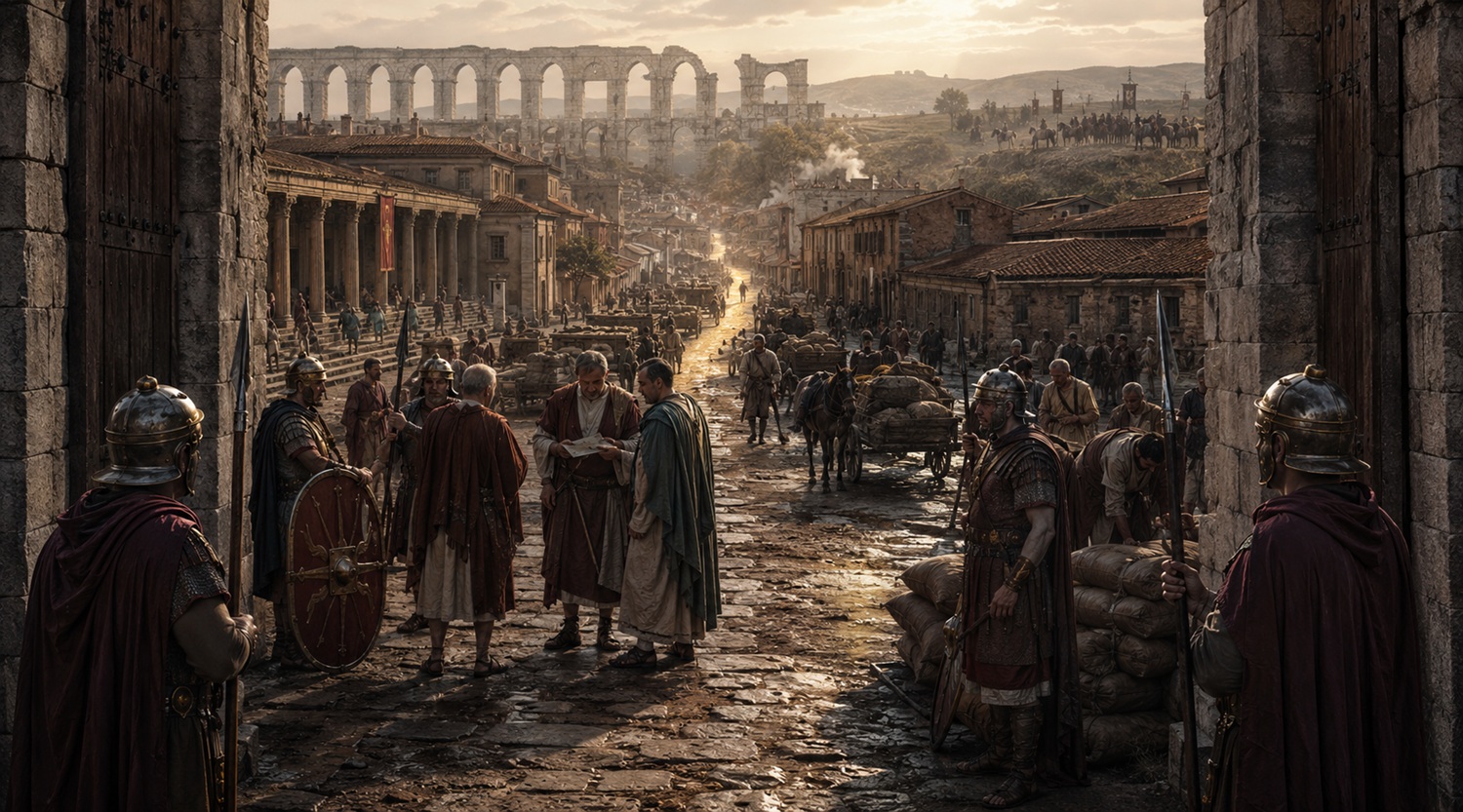
The Roman Empire did not fall on a single afternoon.
There was no moment when people throughout Europe looked outside and realized that antiquity had ended and the Middle Ages had begun.
The traditional date—476 CE—is useful, but misleading if treated too literally.
That year, the Germanic military leader Odoacer deposed the young western emperor Romulus Augustulus in Italy. Yet even this was not quite the clean ending later textbooks made it seem. Julius Nepos, an earlier western emperor driven from Italy, remained in Dalmatia and was still recognized as the legitimate western ruler by the emperor Zeno in Constantinople. Modern scholarship notes that the events of 476 probably did not strike contemporaries as the sudden civilizational rupture they later became in historical memory.
More importantly, the Roman Empire itself continued to exist.
Its eastern government, centered on Constantinople, survived the disappearance of western imperial rule. The people historians conventionally call “Byzantines” continued to understand their state as Roman. The Eastern Roman Empire survived repeated invasions, religious conflicts, civil wars, territorial losses, and transformations before Constantinople finally fell to the Ottoman Empire in 1453.
So the better counterfactual is not:
What if the Roman Empire magically remained unchanged forever?
It is:
What if a recognizable Roman imperial state had remained politically viable in western Europe after the fifth century?
That is a much more interesting question—and a much more plausible one.
The surviving Western Roman Empire would probably not resemble the empire of Augustus. It would not indefinitely control Britain, Spain, Gaul, North Africa, Italy, the Balkans, Egypt, Syria, and Anatolia from one seamless administrative system.
It would have to change.
It might become smaller.
More militarized.
More decentralized.
More dependent on regional commanders and Germanic military communities.
More closely intertwined with the Christian Church.
Perhaps even something resembling a federation of Roman provinces and semi-autonomous kingdoms under an emperor.
The most plausible alternate Rome is therefore not an immortal ancient superpower.
It is a Roman state that learns how to survive the transformation of late antiquity.
Rome Did Not Have One Fall
By the late fourth century, Roman government had long ceased to operate as a single court ruling the entire empire from the city of Rome.
Political and military pressures encouraged emperors to govern from multiple centers. After the death of Theodosius I in 395, his sons Arcadius and Honorius ruled eastern and western portions of the empire respectively. Although Romans could still conceive of a single Roman Empire, the two courts increasingly faced different strategic, fiscal, and political problems.
The eastern government possessed several enormous advantages.
It controlled wealthy territories including Egypt, much of Anatolia, Syria, and important eastern Mediterranean commercial centers.
Constantinople itself occupied a highly defensible strategic position.
The East faced formidable enemies, particularly Persia, but retained the tax system and administrative machinery needed to maintain armies and government.
The western government faced a more severe fiscal and military spiral.
During the fifth century, various groups established increasingly autonomous political control within territories that had once supplied western emperors with taxes and soldiers. Visigoths, Vandals, Burgundians, Sueves, and eventually Franks and others developed kingdoms within the former western imperial landscape. The process was gradual and complicated; these states often preserved Roman institutions, relied upon Roman elites, and sought Roman legitimacy rather than simply replacing everything Roman.
But from the standpoint of the imperial government, one problem was fundamental:
land that no longer produced reliable imperial taxes could no longer finance the same imperial army.
Historian Peter Heather has emphasized this fiscal-military relationship: territorial losses reduced the tax base, which reduced military resources, making further territorial losses harder to prevent.
No province illustrates the problem better than North Africa.
Why North Africa Mattered So Much
The Vandal seizure of Roman North Africa was one of the most damaging developments in the western empire's fifth-century crisis.
Vandal and Alan forces crossed from Iberia into North Africa in 429. In 439, they captured Carthage and established a durable kingdom controlling some of the richest Roman territories in the western Mediterranean.
Africa was valuable for more than grain shipments.
It contained prosperous agricultural estates, cities, ports, commercial networks, and a major taxable economy.
Once the imperial government lost effective control of this territory, it lost revenues that could otherwise have financed troops defending Gaul, Italy, Spain, and the Mediterranean coast. Modern studies of the late Roman fiscal system emphasize the importance of territorial tax revenues to the state's ability to maintain military forces.
Western emperors understood the problem.
They repeatedly tried to recover Africa.
Emperor Majorian assembled an invasion fleet in 460, only to have it destroyed in Spanish harbors by a Vandal raid before the expedition could properly begin.
Then came an even larger effort.
In 468, the eastern emperor Leo I and the western government of Anthemius launched a massive expedition against the Vandal kingdom. It represented an extraordinary commitment of Roman ships, soldiers, and money. The campaign ended disastrously when the Roman fleet commanded by Basiliscus was devastated near North Africa, including by Vandal fire ships. The failure badly damaged Roman finances and eliminated perhaps the best late opportunity to restore Africa before western imperial government disappeared.
That provides our divergence point.
The Most Plausible Divergence
The Roman fleet wins in 468
Instead of allowing the Vandals to destroy the invasion fleet near Cape Bon, Basiliscus refuses unfavorable negotiations, keeps the Roman fleet properly dispersed and guarded, and attacks before the Vandals can effectively employ fire ships.
The precise tactical change is less important than the result:
the enormous Roman expedition of 468 succeeds instead of collapsing.
The Vandal fleet is defeated.
Roman forces establish a secure base near Carthage.
King Geiseric either retreats, is defeated, or negotiates from a position of extreme weakness.
Carthage returns to Roman control.
The empire regains the central provinces of North Africa.
This is a meaningful counterfactual because Rome had already assembled the military force and committed the resources. No imaginary army, unknown technology, or miraculous new emperor is required. The historical expedition actually reached North Africa and posed a serious enough threat that its destruction became a lasting memory in later Roman military writing.
Victory still does not guarantee western survival.
But it changes the equation more than almost any other single event available in the final decade before 476.
Why Winning in Africa Could Change the West
Restoring Africa gives the western government something it desperately needs:
revenue.
Revenue allows soldiers to be paid.
Paid armies make the imperial court less dependent on constantly negotiating from weakness with military factions.
Secure African ports reduce Vandal naval pressure in the western Mediterranean.
Italian sea lanes become safer.
Carthage again becomes part of an imperial commercial and administrative network.
Imperial prestige also changes.
In real history, western emperors increasingly appeared unable to reverse territorial losses. A spectacular victory against the Vandals would demonstrate that cooperation between Constantinople and the western court could still produce results. The failed expedition of 468 was financially devastating; reversing that outcome removes a major loss while potentially restoring one of the richest pieces of the western fiscal system.
The surviving West would still face Visigoths, Burgundians, Sueves, Franks, military strongmen, political conspiracies, and succession disputes.
But it would confront those problems with substantially better resources.
This Does Not Restore the Empire of Trajan
The easiest mistake is to imagine victorious Roman legions marching outward from Carthage until every lost province is restored.
That is unlikely.
By 468, the transformation of the western provinces had already advanced too far.
Germanic-led kingdoms were not temporary camps waiting to disappear. They contained Roman populations, Roman aristocrats, bishops, landowners, military communities, and institutions that increasingly adapted to new political realities. Many successor rulers consciously retained Roman administrative and religious practices.
A surviving western emperor would therefore have to negotiate with the new world rather than simply erase it.
The result would probably be a smaller and more flexible Roman Empire.
What a Surviving Rome Would Actually Look Like
Imagine the western Roman state around 500 CE.
Its most secure territories might include:
- Italy;
- Sicily;
- restored Roman North Africa;
- parts of Mediterranean Gaul;
- Dalmatia;
- perhaps selected territories in Iberia;
- islands and strategic Mediterranean ports.
Beyond those core regions, the emperor might recognize substantial autonomy for Visigothic, Burgundian, Frankish, or other rulers in exchange for military cooperation, tribute, formal titles, or acknowledgement of imperial supremacy.
This would not be unprecedented.
Late Roman government already relied heavily on treaties, military settlements, allied forces, regional commanders, and rulers whose relationship with Constantinople or Ravenna did not fit a simple modern distinction between “inside” and “outside” the empire.
A surviving Rome could increasingly look like a federated imperial commonwealth rather than a centrally administered empire.
The emperor remains the highest source of legitimacy.
Roman law remains prestigious.
Imperial titles remain valuable.
The tax system operates effectively in core provinces.
Regional kings and generals exercise extensive local authority.
The Church connects communities that are politically decentralized.
That is a much more plausible survival mechanism than maintaining the bureaucratic structure of the fourth century unchanged.
What Happens to the Germanic Kingdoms?
They do not simply disappear.
That term itself can also be misleading. The kingdoms that developed in former Roman territory were not sealed ethnic enclaves composed only of “barbarians.” Their populations overwhelmingly included people with Roman legal, cultural, religious, and linguistic traditions, and rulers frequently governed using inherited Roman practices.
In the alternate timeline, their relationship with imperial government could develop in several ways.
Some become formal Roman client kingdoms
A Visigothic king might govern much of southwestern Gaul or Iberia while receiving an imperial title and acknowledging the emperor's superior status.
Some are gradually incorporated
If imperial finances recover, Rome could exploit dynastic disputes among regional kingdoms and recover selected provinces.
Some become permanent partners
A king could effectively become hereditary governor of a Roman region.
The distinction between a Germanic kingdom and a Roman province might blur.
Some remain enemies
The Franks, Visigoths, or other expanding powers could still fight Rome.
A surviving empire does not mean a peaceful empire.
The likely difference is that the western emperor remains an active competitor in European politics rather than disappearing from it.
Italy
Italy would be the political center of the surviving western state.
Whether the imperial court returns permanently to Rome is doubtful. Late Roman emperors often preferred more strategically useful residences such as Ravenna or Milan. Rome remained symbolically immense, but imperial government did not need to operate from the old capital.
In real history, Odoacer ruled Italy after 476, followed by the Ostrogothic kingdom of Theodoric. Roman senatorial elites continued to exercise considerable influence even without a western emperor.
In the alternate timeline, those elites remain tied to a functioning imperial court.
Italy might therefore retain stronger continuity in:
- imperial taxation;
- senatorial politics;
- secular administration;
- state-supported infrastructure;
- professional bureaucracy;
- military organization.
That would not prevent economic contraction or urban change.
It would simply preserve more of the institutional machinery surrounding them.
Gaul
Gaul would probably be the great contested frontier.
Historically, fifth-century Gaul became a complicated political landscape involving Roman officials, Visigoths, Burgundians, Franks, local aristocrats, bishops, and short-lived imperial claimants. Recent scholarship emphasizes that Roman cultural and urban life did not simply vanish when imperial power weakened.
A stronger western court might retain southern Gaul while recognizing semi-autonomous northern territories.
The Franks could still expand.
But a surviving Roman state changes what Frankish rulers are expanding against.
Instead of filling a vacuum left by the disappearance of western imperial authority, a Frankish king might spend generations negotiating titles, alliances, wars, marriages, and treaties with emperors in Italy.
The map of medieval France would therefore be far from guaranteed.
Iberia
Iberia could similarly remain divided.
Visigothic and Suevic political power already existed there.
A recovering empire with African revenues might attempt to maintain coastal cities and strategic corridors rather than reconquer the entire peninsula.
Over time, Roman Iberia might resemble a frontier zone of competing imperial governors and federated kingdoms.
A powerful Visigothic state could still emerge.
But it might do so as an officially subordinate—or nominally subordinate—part of a Roman political system.
Again, the likely alternate empire survives through compromise.
Britain Is Probably Still Lost
Britain is where restraint is particularly important.
Roman imperial administration had effectively withdrawn from Britain decades before 476.
A victory in North Africa does not suddenly make reconquering the island a high strategic priority.
The western government would be more concerned with defending Italy, Africa, southern Gaul, Mediterranean routes, and perhaps Spain.
Britain would therefore probably continue developing independently.
Anglo-Saxon settlement and the formation of post-Roman British kingdoms could still occur, although their relationship with continental Europe might differ if northern Gaul remained more Romanized politically.
A surviving Roman Empire does not require a Roman London in 800.
Christianity Would Still Transform the Empire
Rome's survival would not preserve pagan classical antiquity.
Christianization had already transformed Roman government and society long before 476.
By the fifth century, bishops had become major civic and religious figures throughout the empire. The Church possessed its own networks of authority, property, communication, education, and social influence.
The alternate western Roman Empire would therefore be profoundly Christian.
Its rulers might increasingly present imperial authority in religious terms, resembling developments already visible in the Eastern Roman Empire, where imperial ideology and Christianity became deeply intertwined.
The interesting change concerns not whether Christianity survives, but the political development of the papacy.
What Happens to the Pope?
The disappearance of western imperial government helped create political space in which the bishops of Rome gradually acquired responsibilities that emperors and imperial officials had once exercised.
Scholarship on post-imperial Rome emphasizes how the papacy increasingly assumed political roles after 476, although Rome did not become straightforwardly a “papal city” until much later.
If a western emperor continues ruling Italy, that space is smaller.
The pope remains enormously important.
The bishop of Rome already claimed special ecclesiastical status in late antiquity, drawing upon Rome's apostolic traditions and association with Peter. But those claims remained contested, particularly from the perspective of eastern churches.
A surviving emperor in Italy could therefore produce a Western Church more closely integrated with imperial government.
The pope might resemble the patriarch of Constantinople more closely: highly influential, prestigious, sometimes capable of confronting emperors—but operating continuously alongside an imperial state.
That could profoundly alter later European politics.
There may be no Papal States in the form known from medieval history.
There may be no need for popes to seek Frankish protection in exactly the historical circumstances that eventually linked Rome with the Carolingians.
And the relationship between Latin Christianity and Constantinople could develop differently.
None of that guarantees that East and West avoid religious schism.
Theological, linguistic, jurisdictional, and political disputes would still exist.
But the institutional landscape would change.
Would Charlemagne Ever Become Emperor?
Perhaps not.
In real history, Charlemagne's imperial coronation in Rome in 800 occurred in a western world where no emperor had ruled from Italy for more than three centuries while an emperor continued to exist in Constantinople.
A surviving Western Roman Empire removes that vacancy.
A powerful Frankish king might still emerge.
But if a recognized Roman emperor already governs Italy and Africa, there is no obvious reason for the pope to create—or recognize—another western imperial office in 800.
Charlemagne could instead become:
- a Roman generalissimo;
- a powerful federated king;
- an imperial rival;
- a usurper who seizes the Roman throne;
- or a monarch whose kingdom develops outside Roman control.
The Carolingian Empire as we know it is therefore unlikely.
But some powerful Frankish political structure could still appear.
Latin and the Romance Languages
A surviving empire would not keep everyone speaking classical Latin indefinitely.
Languages change even when governments remain stable.
Modern Romance languages continue forms of spoken Latin that developed throughout the western Roman world. Their divergence resulted from centuries of linguistic change, regional variation, migration, social structure, communication patterns, and political fragmentation.
Continued imperial administration could slow some divergence.
A large bureaucracy, imperial schools, legal documents, military administration, long-distance trade, and standardized elite communication would give formal Latin stronger institutional support.
But spoken Latin in Gaul, Iberia, Italy, and other regions would still evolve.
By 1000 or 1200, inhabitants of distant provinces would probably speak noticeably different vernaculars.
The result might therefore still be Romance languages—but perhaps with:
- greater mutual intelligibility;
- stronger standardized Latin influence;
- different national boundaries;
- different prestige dialects;
- fewer connections between language and independent kingdoms.
French, Spanish, Portuguese, Italian, Catalan, and Romanian would not necessarily emerge in their historical forms.
Political geography influences linguistic geography.
Change the states, and the language map changes with them.
Does Feudalism Still Develop?
Something resembling medieval lordship probably does.
But “feudalism” is not a single institution that suddenly replaced Roman government.
Historians have long debated what the term should encompass, and later medieval systems of lordship, landholding, military obligation, and fragmented political authority developed over centuries rather than appearing in 476.
A surviving Roman Empire could slow some forms of political fragmentation by maintaining:
- taxation;
- salaried soldiers;
- governors;
- courts;
- administrative districts;
- public law;
- imperial revenue.
Where centralized taxation weakens, rulers have greater incentive to compensate military followers with local rights, land, revenues, or jurisdiction.
If the Roman treasury remains viable, that pressure is reduced.
But local landowners would still accumulate power.
Military commanders would still demand rewards.
Distant provinces would still be difficult to govern.
The empire itself could gradually become more localized.
So the alternate West might develop a hybrid:
Roman public institutions at the top, increasingly hereditary regional lordship underneath.
That is not classical Rome surviving unchanged.
It is Roman government evolving into a medieval form.
Europe Would Probably Be Less Politically Fragmented
One of the most dramatic long-term consequences could be the political map.
The disappearance of centralized western imperial authority contributed to a European landscape of competing kingdoms and regional powers. The breakup of the western provinces produced new polities across Gaul, Iberia, Italy, Britain, and elsewhere.
A surviving empire gives western Europe a persistent supranational institution.
Even where the emperor does not govern directly, rulers might seek imperial titles and recognition.
Wars would still occur.
Usurpations would still occur.
Regions could still become virtually independent.
But the idea of one legitimate western Roman political order could prevent some kingdoms from developing exactly as they did historically.
Europe around 1000 might resemble a spectrum of overlapping Roman authority rather than a clean collection of independent states.
Ironically, such a system could resemble the later Holy Roman Empire in some respects—but with a much stronger claim to direct institutional continuity from antiquity.
What Happens to Byzantium?
Strictly speaking, there would be no separate “Byzantine Empire” in the way modern historians commonly describe it.
There would instead be Eastern and Western Roman governments that both survive.
They might share Roman identity while functioning as increasingly independent states.
That arrangement could be cooperative.
Or disastrous.
Eastern and western emperors could compete over:
- legitimacy;
- succession;
- Balkan territory;
- Italy;
- church appointments;
- taxes;
- trade;
- military commands.
A successful western recovery in 468 would initially owe much to eastern military support. That could encourage greater cooperation.
But a wealthy restored West might later become Constantinople's rival.
The Roman world could eventually resemble two related empires—Latin-speaking in the West and predominantly Greek-speaking in the East—each insisting that it represents legitimate Roman authority.
The idea would not have seemed entirely alien to late Romans, who had repeatedly lived under multiple emperors.
The Rise of Islam Probably Still Happens
A surviving Western Roman Empire should not be used to erase unrelated historical developments.
Islam emerged in Arabia in the seventh century within the political, economic, religious, and cultural environment of late antiquity. The Hijra occurred in 622, and after Muhammad's death in 632, Muslim armies expanded rapidly outside Arabia.
Western Rome surviving the fifth century does not prevent Muhammad's birth or the emergence of Islam.
But it could change the expansion that follows.
Historically, the Eastern Roman Empire and Sasanian Persia had exhausted themselves in prolonged warfare shortly before the early Muslim conquests. Arab forces then captured Syria, Palestine, Egypt, and other major eastern Roman territories during the seventh century.
The Western Empire's existence does not remove that eastern Roman-Persian conflict.
So Islamic expansion into the Levant and Mesopotamia remains highly plausible.
Egypt could also still fall.
North Africa becomes more interesting.
A Roman North Africa Meets the Caliphate
In real history, Byzantine rule had returned to much of North Africa after Justinian's armies destroyed the Vandal kingdom in the sixth century. Muslim conquest then expanded across North Africa in the seventh century.
Our alternate timeline places a Latin western Roman state there instead.
By approximately 650–700, Roman Africa could become the frontier between the Caliphate and the Western Empire.
This might produce:
- prolonged Roman-Muslim warfare in Libya and Tunisia;
- fortified Roman coastal cities;
- stronger western naval investment;
- alliances between eastern and western Roman governments;
- different routes for Islamic expansion toward Iberia.
Muslim armies could still conquer North Africa.
They might do so later.
Or an imperial defense centered on Carthage might hold.
The consequences for Iberia would be enormous.
Without Muslim control of North Africa, the historical conquest of Visigothic Iberia beginning in 711 becomes much less likely in its familiar form.
But that conclusion lies more than two centuries beyond our divergence and must remain highly uncertain.
Mediterranean Commerce
Roman political survival could preserve stronger commercial connections across the western Mediterranean.
The Roman world had supported extensive interregional trade, movement of manufactured goods, agricultural products, ceramics, metals, and other commodities. Historians debate exactly how integrated the Roman economy was, but the scale of Mediterranean connectivity is clear.
Political collapse did not make Mediterranean commerce disappear.
But political fragmentation, warfare, changes in taxation, changing urban demand, and later territorial shifts altered its character.
A West controlling both Italy and North Africa would have strong incentives to protect sea routes.
Carthage, Sicily, and Italian ports could remain parts of a unified fiscal and commercial zone.
That could mean:
- stronger urban continuity;
- greater movement of bulk goods;
- longer survival of standardized administrative systems;
- more reliable maritime taxation;
- stronger monetary circulation.
Later Islamic expansion would still reshape Mediterranean commerce, but it would encounter a different western institutional structure.
Roman Law
Roman law would probably be one of the clearest areas of continuity.
Even after western imperial government disappeared historically, Roman law continued influencing the successor kingdoms. Germanic rulers did not simply discard centuries of Roman legal thought, and late Roman law remained important to medieval European legal development.
A surviving western emperor strengthens that continuity.
Imperial constitutions continue to be issued.
Professional legal administration survives longer.
Courts remain tied to the state.
Roman legal education could remain institutionally important in Italy and Africa.
The great sixth-century codification associated historically with the eastern emperor Justinian might develop differently if a separate western legal tradition remains active.
Perhaps the two courts cooperate on legal codification.
Perhaps they produce rival legal systems.
Either way, the rediscovery of Roman law in medieval western Europe would be less dramatic because Roman law would never have ceased to be part of an active imperial legal system.
Education and Administration
The survival of government could also matter greatly for secular literacy.
The collapse of late Roman institutions in the West damaged secular traditions of literacy and reduced the institutional settings in which classical education and administrative writing had flourished. Churches and monasteries preserved literacy, but the social and institutional environment changed substantially.
A surviving state still needs:
- tax records;
- legal documents;
- military orders;
- diplomatic correspondence;
- land surveys;
- account keeping;
- trained administrators.
Those requirements sustain education.
This does not mean universal literacy.
Roman society had never possessed modern mass education.
But it could mean that classical and bureaucratic literacy remains less concentrated in ecclesiastical institutions.
Schools producing imperial administrators might survive in cities such as Rome, Ravenna, Milan, Carthage, and Arles.
The distinction between “classical” and “medieval” educational cultures could therefore become much less sharp.
Does Rome Invent Modern Technology Centuries Early?
Probably not.
This is one of the most common myths attached to Roman alternate history.
The argument usually goes something like this:
Rome possessed concrete, aqueducts, mills, sophisticated engineering, primitive steam devices, and large cities.
Therefore, if Rome had survived, it would eventually have invented steam engines, factories, electricity, railroads, and perhaps computers hundreds or even a thousand years early.
The problem is that technological history does not work as a simple progress bar.
The Roman economy remained overwhelmingly preindustrial and agricultural. Most people worked in agriculture or household production, and economic output remained constrained by the limits characteristic of preindustrial societies.
Roman engineers certainly possessed impressive technical knowledge, and imperial connectivity helped technical ideas circulate across large distances.
But the ancient energy economy remained overwhelmingly dependent upon organic sources—human labor, animals, wood, wind, and water—rather than the massive exploitation of fossil energy associated with industrialization.
The Industrial Revolution eventually required a specific combination of technological development, institutions, markets, energy conditions, labor incentives, scientific culture, capital formation, and other factors that developed over very long periods. Modern economic history does not treat industrialization as the automatic result of keeping one ancient state alive.
A surviving Rome might produce:
- better continuity of engineering knowledge;
- more sustained road and harbor maintenance;
- wider water-powered milling;
- stronger urban craft industries;
- improved military technology;
- more stable transmission of technical manuals;
- continued large-scale public works.
Those are reasonable possibilities.
It does not follow that Rome produces:
- steam locomotives in 900;
- electricity in 1100;
- factories in 1200;
- modern medicine centuries early;
- an industrial revolution simply because imperial government survived.
Those claims move from counterfactual analysis into speculative fiction.
What Probably Still Changes
Even if the western state survives, the ancient world still ends.
That is critical.
Cities change
Urban populations, economic functions, fortifications, religious buildings, and governing institutions would continue evolving.
Christianity becomes increasingly dominant
A surviving empire would be Christian and would continue experiencing theological disputes.
Local power grows
Regional commanders, bishops, aristocrats, landowners, and military communities would continue gaining influence.
Spoken Latin evolves
Political unity does not freeze language.
The army changes
Late Roman military organization was already evolving in response to changing enemies and recruitment patterns.
Germanic populations remain inside the empire
They would increasingly become part of Roman political and military society rather than somehow returning beyond the frontier.
The Mediterranean faces new powers
Sasanian Persia, the Caliphates, Slavic polities, steppe peoples, and later Turkish powers would still transform Eurasian politics.
Epidemics still occur
Roman survival does not prevent disease.
Climate still changes
Environmental conditions remain independent of the empire's political institutions.
Emperors still overthrow one another
The Roman state had experienced coups and civil wars for centuries.
Survival does not cure that vulnerability.
Real Europe and a Plausible Roman Europe
The farther we move from 468, the more speculative comparison becomes.
| Date | Real Historical Development | Plausible Surviving-Rome Development |
|---|---|---|
| c. 500 | Western imperial office has disappeared from Italy. Odoacer and then the Ostrogoths rule Italy; Visigoths, Vandals, Burgundians, Franks and other kingdoms control former Roman territory. | Western emperor controls Italy, Africa, Sicily and parts of the western Mediterranean. Germanic rulers govern substantial territories but several remain formally allied to or recognized by Rome. |
| c. 800 | Charlemagne rules much of western and central Europe and is crowned emperor in Rome. Papacy has grown into an important independent political institution. Eastern Roman Empire survives at Constantinople. | No obvious need to create a new western imperial title because one already exists. Western Rome may function as a decentralized Latin empire containing autonomous kingdoms. Papacy remains influential but operates alongside an imperial government in Italy. |
| c. 1200 | Europe contains numerous kingdoms, principalities, cities, ecclesiastical territories and the Holy Roman Empire. Latin Christendom and Byzantine Christianity have diverged politically and ecclesiastically. | A surviving western Roman commonwealth may span Italy and portions of the western Mediterranean while exercising looser authority over associated regions. Latin vernaculars have developed, but imperial Latin remains important in law and administration. Political fragmentation exists inside an imperial framework. |
| c. 1500 | France, England, Spain, Portugal and other territorial monarchies are emerging or consolidated; Byzantium has fallen; Renaissance Italy is politically fragmented; Atlantic expansion is accelerating. | The western Roman state, if it has survived this long, bears little resemblance to antiquity. It could be a multilingual, Christian, bureaucratic federation centered on Italy and the Mediterranean—or merely a prestigious imperial structure governing a patchwork of autonomous states. |
The alternate column should not be read as prediction.
By 1200 or 1500, countless wars, marriages, epidemics, migrations, inventions, religious disputes, and accidents would have created possibilities no historian could reconstruct in detail.
Would the Renaissance Happen Earlier?
Not necessarily.
The idea that Rome fell, classical learning disappeared, and then Europe suddenly rediscovered antiquity during the Renaissance is itself too simple.
Classical texts and Roman traditions survived through monasteries, cathedral schools, Byzantine scholarship, Islamic intellectual networks, and medieval educational institutions.
A surviving empire in the West could preserve more secular institutions and manuscripts.
That might produce greater continuity of classical study.
But the Renaissance was shaped by medieval universities, urban wealth, manuscript circulation, political competition, humanist networks, printing, contacts with Greek scholarship, and many other developments.
Preserving Roman government does not simply move Florence's fifteenth century to the eighth century.
It changes the entire route by which intellectual history unfolds.
Could Rome Become Democratic?
There is little reason to assume so.
A surviving Roman state could develop representative assemblies or stronger corporate institutions over centuries.
But Roman political survival by itself does not imply modern democracy.
The late Roman Empire was hierarchical, monarchical, militarized, bureaucratic, and deeply unequal.
Its survival could just as easily strengthen traditions of centralized imperial government.
Alternatively, a decentralized empire forced to bargain continuously with cities, regional aristocracies, church institutions, and federated kings might eventually develop political structures that constrain emperors.
Either route is possible.
Neither should be projected backward from modern expectations.
Could Rome Survive Into the Modern Era?
Surprisingly, the answer is yes—but only if “Rome” is allowed to change almost beyond recognition.
The real Eastern Roman Empire demonstrates the basic point.
A Roman state actually did survive antiquity.
It changed its territory.
Its dominant language shifted toward Greek.
Its military system changed.
Its bureaucracy evolved.
Its economy transformed.
Its relationship with Christianity deepened.
Its borders contracted and expanded repeatedly.
Yet the state centered on Constantinople retained Roman political identity for centuries.
A western Roman state could theoretically do the same.
By 1000, it might be a Latin Christian empire centered on Italy and North Africa.
By 1200, it might govern through provincial assemblies, hereditary governors, military aristocrats, and cities.
By 1500, it could be a sophisticated fiscal monarchy or federation that calls itself Roman while looking nothing like the government of Constantine.
By 1800, if it somehow survived the Reformation, gunpowder warfare, Atlantic expansion, printing, nationalism, scientific change, and revolutionary politics, “Roman Empire” might simply be the historical name of a Mediterranean multinational state.
That would still count as institutional survival.
But asking whether Augustus's Rome could survive unchanged until modern times is like asking whether the Britain of Alfred the Great could survive unchanged until today.
No state lasts by refusing to change.
The Greatest Challenge: Succession
Even with Africa restored, the western empire retains an old Roman weakness.
Who becomes emperor?
The fifth century suffered repeated coups, short reigns, military strongmen, rival courts, and disputes over legitimacy.
A wealthy imperial treasury does not solve the political problem of succession.
A surviving western state would need to develop a more predictable mechanism.
Possible solutions include:
- hereditary dynastic succession;
- designation of junior co-emperors;
- selection by senior military and civilian officials;
- formal recognition from Constantinople;
- some combination of Senate, army, Church, and imperial family.
Without such a mechanism, renewed civil wars could destroy the recovered state.
The counterfactual therefore depends less on one brilliant emperor than on institutional adaptation.
A More Plausible Roman Future
The strongest alternate scenario is not a triumphant empire reconquering the entire ancient Mediterranean.
It is a core Roman state surviving around Italy and Africa and gradually redefining what Roman rule means.
Imagine the year 700.
An emperor rules from Ravenna or Rome.
Carthage remains one of the empire's great cities.
Sicily connects its Italian and African territories.
Latin remains the language of state administration.
Local Romance dialects are increasingly distinct.
Southern Gaul contains Roman cities and semi-autonomous military rulers.
Frankish kingdoms dominate parts of the north but maintain complicated diplomatic relations with the emperor.
Visigothic rulers govern much of Iberia under varying degrees of imperial recognition.
The pope is the leading western bishop but not an independent territorial prince.
Constantinople recognizes the western emperor as a Roman colleague while periodically disputing theology, territory, and precedence.
Across the southern Mediterranean, Muslim expansion has created an entirely new geopolitical order.
This world would still feel medieval.
It would not be classical Rome preserved in amber.
But Rome would remain one of its living political institutions.
How Plausible Is This Scenario?
The Roman expedition succeeds in 468
Plausible counterfactual divergence.
The invasion actually occurred and represented a massive Roman military effort. Its failure depended partly upon operational decisions and the successful Vandal attack on the fleet.
Rome reconquers Carthage
Reasonably plausible following a decisive naval victory.
Destroying Vandal naval power and landing Roman forces successfully would put the kingdom under severe pressure.
The restored African provinces improve western finances
Strong inference.
Territorial tax revenues were fundamental to late Roman military capacity, and loss of Africa had seriously reduced western resources.
The western imperial office survives beyond 476
Plausible.
The disappearance of that office resulted from a political and military sequence rather than an unavoidable deadline.
Rome reconquers all of Gaul and Iberia
Much less certain.
Regional kingdoms were already deeply established.
Britain returns to Roman control
Unlikely.
The strategic costs would probably outweigh the benefits.
Feudalism never develops
Too strong.
Local lordship and land-based political power had deeper causes than the deposition of Romulus Augustulus.
Romance languages never appear
Unlikely.
Spoken languages evolve regardless of imperial borders.
Islam never expands
Unsupported.
The rise of Islam originated outside western Roman political developments.
Rome industrializes centuries early
Highly speculative.
The Roman economy remained preindustrial and constrained by agrarian production and organic energy systems.
A political state calling itself Roman survives into modernity
Possible but increasingly speculative.
The Eastern Roman example demonstrates that Roman institutions were capable of extraordinary adaptation and longevity, but no precise western trajectory can be projected across fifteen centuries.
What Probably Does Not Change
A useful alternate history must preserve forces that do not depend directly on the divergence.
Even if Western Rome survives:
- Christianity remains central to European and Mediterranean life.
- Germanic peoples remain deeply embedded in former western provinces.
- Latin continues evolving into regional spoken forms.
- Constantinople remains a major eastern imperial center.
- Persia remains a major rival until the seventh-century transformations.
- Islam can still arise in Arabia.
- political rebellions and imperial succession crises remain possible.
- epidemics and climate shifts still occur.
- local aristocrats and bishops continue accumulating influence.
- technological progress remains uneven rather than accelerating automatically.
- Britain's post-Roman political development probably continues largely outside imperial control.
The alternate world is different because a major institution survives.
It is not different because every independent historical process conveniently disappears.
The AltHistAI Verdict
Could the Western Roman Empire have survived?
Yes.
Not easily.
Not unchanged.
And probably not with all of its fifth-century territory.
The disappearance of western imperial government was the product of cumulative military, political, and fiscal pressures rather than a law of nature. The loss of taxable territory reduced the state's ability to support armies, which made recovering territory increasingly difficult. North Africa was especially important in that downward spiral.
That makes the enormous Roman expedition against Vandal Africa in 468 one of the best plausible divergence points.
The empire actually committed the resources.
The fleet actually reached North Africa.
Its catastrophic destruction actually helped exhaust the Roman state's remaining ability to reverse its losses.
If that expedition succeeds, Carthage and the African tax base can return to Roman control.
Western imperial survival beyond 476 becomes substantially more plausible.
But what survives would not be the classical Roman Empire.
A viable western state would need to accept the transformation already underway.
Germanic kings would become allies, provincial rulers, rivals, or Roman officeholders rather than simply disappearing.
Local aristocracies would retain substantial power.
The Christian Church would become even more deeply embedded in government.
The pope's political independence might develop more slowly because an emperor would still govern Italy.
Latin would continue evolving toward Romance languages.
Medieval forms of lordship could still emerge, though perhaps inside a stronger imperial framework.
Europe might remain less politically fragmented, but it would not remain centrally governed from Rome.
The Eastern Roman Empire would have a western counterpart instead of becoming the sole surviving Roman imperial state.
The rise of Islam would still transform the seventh-century Mediterranean, although the presence of a strong Roman North Africa could change the direction and speed of expansion westward.
Roman law, secular administration, education, long-distance commerce, and engineering traditions might experience greater institutional continuity.
But there is no reason to leap from that conclusion to steam engines in the Middle Ages.
Rome's survival does not abolish the economic and energy constraints of the preindustrial world.
The most believable alternate Roman Empire is therefore both more modest and more interesting than the usual fantasy.
By 800, it would not look like the empire of Augustus.
By 1200, it might barely resemble the empire of Constantine.
By 1500, its inhabitants might speak languages Caesar would not understand, fight with weapons he could not imagine, worship within institutions radically transformed since his time, and live under political arrangements unknown to antiquity.
And yet their emperor might still issue laws in the name of Rome.
Their state might still trace its legitimacy through an unbroken imperial succession.
Their citizens might still call themselves Romans.
That is how the Roman Empire could realistically “never fall”:
not by remaining ancient, but by surviving long enough to become something new.
Key Takeaways
- The Western Roman Empire did not collapse in a single event. The deposition of Romulus Augustulus in 476 is a conventional marker for a much longer political transformation.
- The Eastern Roman Empire continued after the fifth-century collapse of western imperial government and survived until 1453.
- Loss of territory weakened the West partly because it removed taxable resources needed to maintain armies.
- Vandal control of North Africa was especially damaging to western imperial finances and Mediterranean strategy.
- A successful Roman invasion of Vandal Africa in 468 provides a plausible divergence because the enormous historical expedition actually took place and failed militarily.
- Recovering Africa could plausibly allow a western emperor to survive beyond 476, but it would not automatically restore the entire old empire.
- Germanic kingdoms would probably remain important and might evolve into semi-autonomous parts of a Roman political system rather than disappearing.
- Britain would probably remain outside direct Roman government.
- Christianity would remain dominant, but the continued presence of a western emperor could constrain the papacy's later rise as an independent territorial power.
- Latin would continue evolving, so Romance languages would likely still emerge in some form.
- Roman law and secular administration could enjoy greater continuity.
- Islam could still arise and expand, though a surviving Roman North Africa could change the western Mediterranean consequences.
- The Roman Empire's survival would not automatically cause an early Industrial Revolution. The Roman economy remained fundamentally preindustrial and dependent largely on organic energy sources.
- For Rome to survive for centuries, it would have to decentralize, adapt, and transform—just as the Eastern Roman Empire did.
Sources and Further Reading
Peter Heather, The Fall of the Roman Empire. Oxford University Press.
A major modern interpretation emphasizing the military and fiscal consequences of territorial losses in the fifth-century West. Heather discusses how shrinking tax revenues reduced the imperial government's ability to maintain armies.
Hugh Elton, The Roman Empire in Late Antiquity: A Political and Military History. Cambridge University Press.
Useful for the military and political history of the fifth century, including territorial losses, Majorian, the Vandals, the 468 expedition, and the final western emperors.
Michael Maas, ed., The Cambridge Companion to the Age of Attila. Cambridge University Press.
Broad scholarly treatment of fifth-century government, military affairs, cities, law, identity, and the transformation of the Roman world.
Guy Halsall, Barbarian Migrations and the Roman West, 376–568. Cambridge University Press.
Important for understanding migration, military settlement, post-Roman kingdoms, and why the transformation of the West cannot be reduced to a simple story of external barbarians destroying Rome. Listed among the major scholarly starting points for the period in Cambridge's treatment of the late fifth century.
Jonathan Conant, Staying Roman: Conquest and Identity in Africa and the Mediterranean, 439–700. Cambridge University Press.
Detailed study of Roman identity and political transformation in North Africa after the Vandal conquest.
Michele Renee Salzman, The Falls of Rome: Crises, Resilience, and Resurgence in Late Antiquity. Cambridge University Press.
Challenges overly simple ideas of a single Roman collapse and emphasizes institutional continuity, senatorial elites, the Church, and Rome's capacity for recovery after repeated fifth-century crises.
Rosamond McKitterick, “The Popes as Rulers of Rome in the Aftermath of Empire, 476–769.”
Useful for understanding how the disappearance of western emperors opened political space for the bishops of Rome and why a surviving western imperial court could alter papal development.
The Cambridge History of the Papacy, Volume I. Cambridge University Press.
Provides recent scholarship on the political and ecclesiastical development of the Roman bishopric, including the limitations of late antique papal authority and the later emergence of papal Rome.
The Cambridge History of the Romance Languages. Cambridge University Press.
Useful for the transformation of spoken Latin into the Romance languages and for understanding the interaction between linguistic development and the political fragmentation of the post-imperial West.
A History of Law in Europe: From the Early Middle Ages to the Twentieth Century. Cambridge University Press.
Discusses the continuing influence of late Roman law on the legal traditions of the Germanic successor kingdoms and medieval Europe.
Nicholas Everett, “Literacy from Late Antiquity to the Early Middle Ages, c. 300–800 AD,” in The Cambridge Handbook of Literacy.
Discusses the consequences of western imperial collapse for secular literacy and educational traditions.
The New Cambridge History of Islam, Volume I. Cambridge University Press.
Provides scholarly context for the emergence of Islam and the rapid political expansion of the early Muslim state in the seventh century.
The Cambridge History of the Byzantine Empire c. 500–1492. Cambridge University Press.
Essential for understanding the Eastern Roman Empire as a continuously adapting Roman state and for evaluating what long-term western Roman survival might actually require.
Oxford Classical Dictionary, “Roman Economy.”
Provides a concise scholarly overview of the Roman economy as a fundamentally preindustrial system in which agriculture and household production remained central.
Oxford Classical Dictionary, “Energy and Power.”
Useful for understanding the organic-energy constraints of ancient economies and why Roman engineering achievements should not be equated with imminent industrialization.