 Alternate History AI
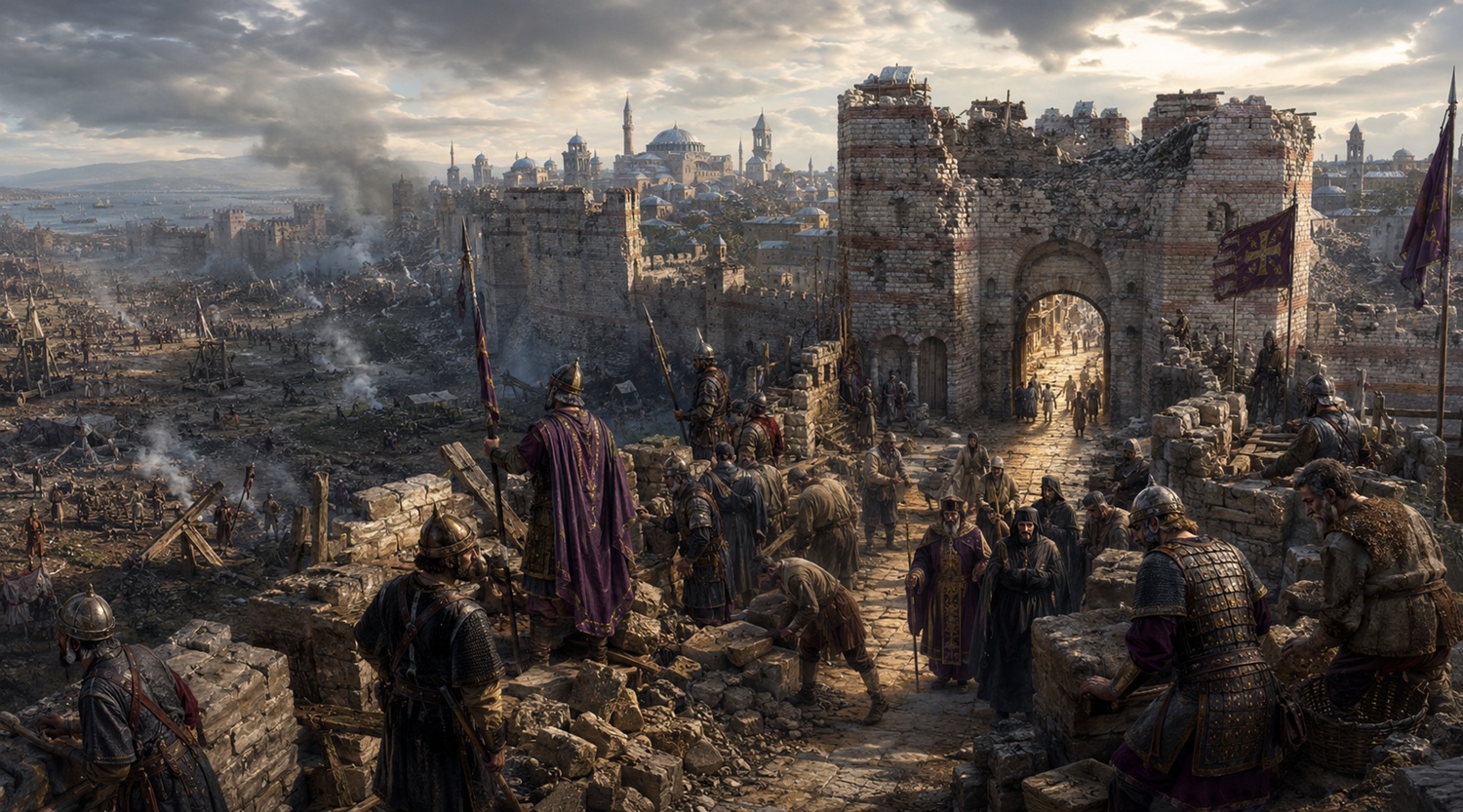
On May 29, 1453, the last capital of the Roman Empire fell to the armies of Sultan Mehmed II.
The conquest ended the Byzantine Empire as a sovereign state centered on Constantinople. It also gave the Ottoman dynasty possession of one of the most strategically valuable cities in the world: a fortified metropolis commanding the Bosporus between Europe and Asia.
The event has acquired such symbolic weight that it is easy to exaggerate what one altered siege could accomplish.
If Constantinople had survived in 1453, the Byzantine Empire would not suddenly have returned to the power of Justinian, Basil II, or the Komnenian emperors.
By the fifteenth century, Byzantium was already a remnant.
The restored Palaiologan Empire after 1261 had progressively lost territory, population, revenue, and military power. By the time of Constantine XI, imperial authority was essentially concentrated around Constantinople and scattered Greek possessions, while Ottoman territory surrounded the capital. Modern scholarship emphasizes both the severe weakness of the late Byzantine state and the fact that its final politics were shaped by desperate efforts to obtain Western support, sometimes through controversial attempts at reunion between the Orthodox and Catholic churches.
So the useful counterfactual is not:
What if the Byzantines defeated the Ottomans and rebuilt their medieval empire?
It is:
What if Constantinople survives Mehmed II's siege in 1453, allowing a tiny Byzantine state to continue existing under intense Ottoman pressure?
That is a much more plausible scenario.
And it produces a surprising conclusion.
Constantinople's survival could alter Orthodox Christianity, Ottoman strategy, Venetian and Genoese politics, the Balkans, and the symbolic geography of Europe.
But the most likely result is not a restored Byzantine Empire.
It is a fortified Byzantine city-state struggling to survive in the middle of an increasingly powerful Ottoman world.
Byzantium on the Eve of 1453
The state Constantine XI ruled was the descendant of the eastern Roman Empire, but little remained of the territory once governed from Constantinople.
The catastrophe of the Fourth Crusade had transformed Byzantine history.
In 1204, Latin crusaders captured and sacked Constantinople and established a Latin Empire. Byzantine successor states emerged elsewhere, and the Empire of Nicaea eventually recovered Constantinople in 1261.
But the restored empire never regained the resources of its earlier centuries.
Territorial fragmentation, civil wars, economic weakness, competition with Italian maritime powers, and Ottoman expansion steadily reduced Byzantine power. Cambridge scholarship stresses that the later Byzantine world was politically fragmented and increasingly absorbed by the growing Ottoman state.
By the early fifteenth century, the Ottoman Empire possessed territories on both the European and Asian sides of Constantinople.
The capital was becoming an island of Byzantine sovereignty inside an Ottoman strategic system.
Its survival depended increasingly on three things:
- its enormous defensive walls;
- diplomacy;
- and foreign assistance.
None provided a permanent solution.
Mehmed II Wanted More Than One More City
Mehmed II became sultan in 1451.
He was young, ambitious, and determined to take Constantinople.
The city's conquest would solve several problems at once.
It would eliminate a potentially hostile enclave inside Ottoman territory.
It would strengthen Ottoman control of movement between Anatolia and the Balkans.
It would give the dynasty a major imperial capital.
And it would carry enormous symbolic prestige.
Modern scholarship on Ottoman warfare emphasizes that Mehmed spent roughly two years preparing politically, economically, and militarily for the conquest.
He strengthened Ottoman control of the Bosporus through the construction of Rumeli Hisarı on the European shore.
He assembled artillery capable of battering Constantinople's walls.
He gathered a large army and fleet.
And in April 1453, he began the siege.
The Byzantines confronted him with vastly fewer men.
Why Constantinople Could Still Resist
Weak state did not mean weak fortress.
Constantinople's defenses remained formidable.
The Theodosian land walls had protected the city for roughly a thousand years. Defenders repaired damaged sections and concentrated scarce manpower at the most dangerous points. A great chain across the Golden Horn helped block Ottoman naval access, while Byzantine, Venetian, Genoese, and other ships defended the harbor.
The defense was also multinational.
Constantine XI commanded Byzantine forces, but Western Christians played an important role.
The Genoese commander Giovanni Giustiniani became particularly important in organizing the defense of the land walls. Venetians inside Constantinople also participated actively, despite the complicated commercial and political rivalries that separated Venice, Genoa, Byzantium, and the Ottomans.
That cooperation was essential because the defenders were badly outnumbered.
The city could withstand an assault.
It could not easily replace soldiers.
Ottoman Artillery Changed the Siege
The great walls remained powerful, but gunpowder warfare was changing the balance between fortification and siege.
Both sides used firearms, and much of the defenders' artillery was operated by Western Europeans. Mehmed, however, possessed a much larger siege train.
Ottoman cannon repeatedly damaged the land defenses.
The defenders repaired breaches, constructed makeshift barriers behind damaged walls, and continued holding positions that might previously have been considered untenable.
The artillery did not simply vaporize the walls.
The siege lasted for weeks.
That distinction matters for the counterfactual.
Mehmed's victory was the result of accumulating military pressure, not an unstoppable superweapon that made Byzantine resistance futile from the first shot.
The Golden Horn
The defenders also attempted to deny Ottoman ships entry into the Golden Horn.
A heavy chain protected the harbor entrance.
Mehmed responded with one of the siege's most famous operations: Ottoman ships were transported overland behind the Genoese settlement of Galata and placed into the Golden Horn, forcing Constantinople to defend another part of its perimeter. Cambridge scholarship identifies this maneuver as an extraordinary element of the campaign.
Even that did not immediately end the siege.
The decisive crisis came during the final assault.
The Historical Breaking Point: May 29
After weeks of fighting, Mehmed ordered a general assault.
The defenders were exhausted.
The walls were damaged.
Ottoman troops attacked repeatedly.
Giovanni Giustiniani, who commanded the crucial land defenses, was badly wounded and withdrew from his position.
Recent Oxford scholarship identifies his wounding and removal as a pivotal psychological and military moment. The withdrawal contributed to panic among already exhausted defenders as Ottoman troops finally broke through.
Constantine XI died during the fighting.
Mehmed entered the city.
The Byzantine Empire effectively ended.
That gives us a plausible divergence.
The Point of Divergence: The Final Assault Fails
The alternate history begins in the early hours of May 29.
Giustiniani is still wounded.
But the wound is less severe.
He refuses evacuation.
His Genoese troops remain at their positions rather than seeing their commander carried from the battlefield.
Constantine XI directs additional defenders toward the main breach.
The Ottoman assault continues.
The Janissaries reach the damaged defenses but fail to create the cascading collapse that occurred historically.
After hours of fighting, the assault is repulsed.
The Ottoman army suffers severe casualties.
This alone does not save Constantinople permanently.
But it creates a crisis for Mehmed.
Why Mehmed Might Lift the Siege
The Ottomans had enormous advantages.
Yet an unsuccessful final assault would leave Mehmed facing an unpleasant choice.
His army has already spent weeks outside the city.
His artillery has damaged the walls but not produced surrender.
The defenders know that another assault is coming and repair what they can.
Ottoman casualties are mounting.
More importantly, the longer the siege continues, the greater the chance that additional Western ships, money, troops, or diplomatic pressure arrive.
Anthony Kaldellis's recent study of the siege stresses that Mehmed's final attack came after a prolonged and costly operation that had not yet produced decisive results.
The historical Ottoman failure to capture Belgrade only three years later also demonstrates that Mehmed's armies could be forced to abandon major sieges. Cambridge's history of late medieval warfare notes that Mehmed failed at Belgrade in 1456 even while continuing to conquer other Balkan and Byzantine territories.
So suppose Mehmed concludes that another immediate general assault risks unacceptable losses.
He raises the siege.
Constantinople survives.
Across Europe, church bells ring.
Inside the city, Constantine XI has won the greatest victory of his life.
But he has not solved the Byzantine problem.
Victory Does Not Restore the Empire
The first temptation after such a spectacular survival would be to imagine Byzantine reconquest.
That is extremely unlikely.
Mehmed's army still exists.
The Ottoman state remains powerful.
Ottoman territories still surround Constantinople.
The Byzantine treasury remains weak.
The emperor still lacks a large field army.
An exhausted city cannot suddenly conquer Thrace.
Nor can it march into Anatolia and retake the lands lost over previous centuries.
What Constantinople has won is time.
That distinction defines the alternate history.
The Immediate Byzantine Strategy: Turn Survival Into a Guarantee
Constantine XI would understand that another Ottoman siege is likely.
His first priority therefore becomes transforming Constantinople from an isolated Byzantine fortress into an internationally supported position.
That requires Western help.
The emperor would likely send urgent embassies to:
- Venice;
- Genoa;
- Rome;
- Hungary;
- Naples;
- the Holy Roman Emperor;
- and other rulers.
His argument would be powerful:
Constantinople has proved it can hold if the West helps defend it.
This is a much stronger political pitch than the appeals issued before the historical siege.
Venice Suddenly Has a Strategic Decision to Make
Venice had enormous commercial interests in the eastern Mediterranean.
It also had extensive experience dealing pragmatically with Muslim powers—including the Ottomans.
Its relationship with Constantinople had never been one of simple Christian solidarity.
Venice wanted trade.
Ports.
Security.
Commercial privileges.
And limits on competing Genoese influence.
After the historical Ottoman conquest, Venice moved relatively quickly toward accommodation with Mehmed. Scholarship on Ottoman-Venetian relations emphasizes just how readily commerce resumed when political conditions allowed it.
So a surviving Constantinople creates a calculation rather than an automatic Venetian crusade.
Does Venice want to spend heavily defending the Byzantine emperor?
Or would a negotiated Ottoman commercial regime ultimately be cheaper?
How Byzantium Buys Venetian Support
The emperor has one major currency available:
privilege.
Constantine XI could offer Venice expanded commercial rights in return for permanent military assistance.
Venetian merchants might receive:
- reduced customs duties;
- warehouses;
- dock facilities;
- residential quarters;
- legal privileges;
- access to Black Sea commerce;
- rights to maintain armed galleys in the harbor.
In return, Venice maintains a permanent naval squadron and helps finance wall repairs.
This could keep Constantinople alive.
But there is a price.
The surviving Byzantine Empire increasingly resembles a protected city-state dependent on Italian maritime power.
It survives politically by surrendering part of its economic independence.
Genoa Creates an Even More Complicated Problem
Genoese merchants had their own interests around Constantinople and the Black Sea.
The Genoese settlement at Galata, across the Golden Horn, had tried to navigate a dangerous balance during the historical siege.
Some Genoese actively defended Constantinople.
Others tried to preserve neutrality and commercial relationships with the Ottomans.
After the conquest, Genoese merchants continued operating under Ottoman rule, and scholarship emphasizes the adaptability of Genoese commercial networks after 1453.
If Constantinople survives, Genoa would compete with Venice for influence.
The Byzantine government might deliberately play the two maritime republics against each other.
That was an old Byzantine diplomatic technique.
But by 1453 the balance of power had reversed.
The Italians would possess much of the leverage.
Constantinople Could Become a Christian Hong Kong of the Fifteenth Century
Not literally.
But the analogy illustrates the likely political structure.
A surviving Constantinople could be:
- formally sovereign under a Byzantine emperor;
- overwhelmingly Orthodox in religious identity;
- commercially dominated by Venetian and Genoese interests;
- protected partly by foreign naval forces;
- dependent on foreign loans;
- surrounded by Ottoman territory;
- and permanently subject to diplomatic pressure from Mehmed.
Its emperors would retain enormous prestige.
Their actual military power would be tiny.
That is a much more plausible Byzantine survival than restoration of the empire.
The Papacy Sees a Second Chance
The defense of Constantinople had been entangled with attempts to reunite the Orthodox and Catholic churches.
The Council of Florence had formally proclaimed union in 1439, but the agreement was deeply unpopular among many Orthodox Christians.
Western military assistance was one reason Byzantine emperors pursued reunion despite internal resistance.
If Constantinople survives 1453 with the help of Latin defenders, papal leaders can claim that Christian cooperation has saved the city.
Calls for a broader crusade against the Ottomans would intensify.
The historical fall of Constantinople already generated intense crusading rhetoric in the Holy Roman Empire and papal diplomacy, while Pope Pius II later made an anti-Ottoman crusade a major objective.
A successful defense could make those appeals even more urgent.
But rhetoric is not an army.
Why a Great Western Crusade Is Still Difficult
Western Europe had many competing priorities.
France and England had only recently emerged from the Hundred Years' War.
Italian states fought one another.
Venice had commercial interests that could conflict with papal strategy.
Hungary faced the Ottomans directly but had limited resources.
The Holy Roman Empire was politically fragmented.
The papacy could call a crusade.
It could not command Europe as one state.
This was a central problem in the real fifteenth century: concern about Ottoman power could be widespread while governments remained unable to create a durable military coalition.
Therefore the likely Western response is smaller and more practical:
money;
mercenaries;
galleys;
artillery;
engineers;
and diplomatic guarantees.
That could be enough to preserve Constantinople.
It would not be enough to reconquer Anatolia.
Mehmed II Does Not Stop Expanding
This is essential.
Failure at Constantinople would humiliate Mehmed.
But there is little reason to assume it destroys the Ottoman Empire.
The dynasty had become a formidable military power before 1453.
Mehmed still controls large territories in the Balkans and Anatolia.
He can redirect his army toward weaker targets.
Historically, after taking Constantinople, his armies continued expanding rapidly.
Serbia fell in 1459.
The Byzantine Despotate of the Morea fell in 1460.
Trebizond fell in 1461.
Bosnia was conquered in 1463.
Many of these campaigns remain plausible even if Constantinople survives.
Indeed, Mehmed may become more determined to eliminate every potential supporter of the city before trying again.
The Ottoman Ring Around Constantinople Tightens
This produces a grim strategic picture.
Suppose Serbia still falls.
Suppose the Morea still falls.
Suppose Trebizond still falls.
Constantinople survives while nearly every remaining independent Byzantine or Orthodox ally disappears.
The empire becomes smaller politically even though its capital survived.
By 1465, Constantine or his successor could rule almost nothing outside the immediate metropolitan area.
The city may be harder to take militarily.
It is easier to isolate diplomatically.
That makes a second Ottoman siege highly likely.
When Does Mehmed Try Again?
Probably within years rather than decades.
The exact date cannot be known.
Mehmed would first want to understand why the 1453 assault failed.
He could improve artillery.
Increase naval strength.
Strengthen Bosporus control.
Cut food supplies.
Pressure Genoa and Venice diplomatically.
Conquer territories that might provide relief forces.
Then he could return.
A second siege in the later 1450s or 1460s is therefore one of the strongest counterfactual predictions.
The survival scenario becomes sustainable only if foreign powers establish a defensive structure strong enough to make another siege disproportionately expensive.
The Model for Survival: A Permanent Western Naval Umbrella
The city does not need an enormous field army if it retains:
- repaired walls;
- artillery;
- several thousand professional defenders;
- a secure food stockpile;
- control of the Golden Horn;
- and regular access to Venetian or Genoese naval support.
This turns Constantinople into a strategic fortress rather than an empire.
Mehmed could still capture it.
But the operation becomes riskier.
If a siege also risks war with Venice, Hungary, and the papacy, he may decide that other targets are temporarily more attractive.
This does not save Byzantium through strength.
It saves Byzantium through deterrence.
What Happens in the Balkans?
Constantinople's survival would be symbolically important to Balkan Christians.
Politically, however, symbolism cannot substitute for armies.
Serbia still faces overwhelming Ottoman pressure.
Bosnia still faces Ottoman expansion.
Albanian resistance under Skanderbeg still matters.
Hungary remains the strongest major Christian land power directly opposing Ottoman movement northward.
The most plausible difference is psychological and diplomatic.
Constantinople becomes a permanent rallying point.
Anti-Ottoman rebels can claim that the Roman emperor still exists.
The papacy can direct crusading propaganda toward defending a living Christian capital rather than recovering a lost one.
Hungary can coordinate with an actual Byzantine government.
But none of that guarantees Balkan independence.
Ottoman expansion after 1453 had military foundations much broader than possession of one city.
Belgrade Becomes Even More Important
Historically, Mehmed attacked Belgrade in 1456 and failed.
That defeat mattered because Belgrade guarded the approaches into Hungary.
In our alternate timeline, the stakes are even larger.
A surviving Constantinople and an undefeated Belgrade could appear briefly to demonstrate that Ottoman expansion had reached its limits.
European rulers might imagine a coordinated reversal.
But two successful defensive battles do not equal Ottoman collapse.
Mehmed could continue conquering weaker states while avoiding the strongest fortresses.
The most realistic result is an unstable frontier.
The Morea Probably Still Falls
The Byzantine Despotate of the Morea in the Peloponnese was ruled by members of the Palaiologos dynasty.
It survived Constantinople historically only until 1460.
Could Constantinople's survival save it?
Perhaps temporarily.
But the Morea suffered from internal political problems and could not match Ottoman strength alone.
Venetian intervention could preserve selected ports.
A broader crusade might create a protected southern Greek state.
Yet the strongest scenario still has Mehmed conquering most or all of the Morea.
That leaves Constantinople without a substantial Byzantine territorial hinterland.
Trebizond Probably Still Falls Too
The Empire of Trebizond was another Greek Christian state on the Black Sea coast.
Historically Mehmed conquered it in 1461.
Its survival depended upon alliances and geography rather than the military strength of Constantinople.
A surviving Byzantine emperor could appeal for aid.
But an isolated Trebizond would remain vulnerable.
Thus one of the counterfactual's great ironies appears again:
the Byzantine emperor may survive in Constantinople while other Byzantine successor states still disappear.
Orthodox Christianity Changes More Than Byzantine Territory
The religious consequences could be larger than the territorial ones.
Historically, Mehmed reorganized Orthodox leadership after the conquest and appointed Gennadios Scholarios as patriarch.
The Patriarchate of Constantinople continued under Ottoman rule and became an important institution governing Orthodox Christian affairs inside the empire.
If the city remains Byzantine, that arrangement never occurs.
The Ecumenical Patriarch remains inside a Christian Roman state.
That profoundly changes the symbolic relationship between Orthodoxy and political power.
The Union With Rome Becomes a Crisis
The most immediate religious problem would be the controversial Union of Florence.
Constantine XI had supported church union partly because Western military assistance appeared essential.
Many Orthodox Christians rejected it.
If Latin soldiers help save Constantinople, supporters of union can argue:
The West came when the city needed it.
Opponents can respond:
The emperor compromised Orthodoxy for mercenaries and foreign merchants.
The religious dispute therefore does not disappear after the victory.
It may become even more politically important.
A Byzantine emperor dependent upon Venice and Rome might enforce at least formal union.
The patriarchal establishment could split.
Some Orthodox clergy might appeal increasingly toward independent centers in the Balkans or Russia.
Survival could therefore save Byzantine sovereignty while creating a deeper Orthodox constitutional crisis.
Russia's Religious Position Changes
The relationship with Moscow is especially important.
The common story says that after Constantinople fell, Moscow simply became the “Third Rome.”
The real development was more gradual.
Moscow had already taken a major step toward ecclesiastical independence before 1453.
In 1448, Russian bishops elevated Iona as metropolitan without the normal confirmation from Constantinople, partly because Moscow opposed the church union agreed at Florence.
So Constantinople's survival does not return the Russian church to unquestioned Byzantine control.
That process had already changed.
But the symbolism changes enormously.
No Immediate Vacuum for a “Third Rome”
The fall of Constantinople later helped Russian churchmen and rulers conceptualize Moscow as a uniquely sovereign Orthodox center.
Cambridge scholarship notes that after the disappearance of the eastern Roman Empire, Russia became the only major sovereign Orthodox power and later writers developed arguments presenting Moscow as the “Third Rome.”
If a Byzantine emperor and Ecumenical Patriarch still reside in Constantinople, that ideological space is harder to occupy.
Moscow can claim independence.
It can claim political strength.
It can criticize Constantinople's union with Rome.
But claiming to have replaced Constantinople becomes much harder while Constantinople is still Christian and Byzantine.
The Third Rome idea is therefore likely delayed, weakened, or reformulated.
Russia Could Present Itself as the Defender of “True” Orthodoxy Instead
There is another possibility.
Suppose Constantinople remains formally united with Rome because Catholic aid is essential for survival.
Moscow could then argue that the Byzantine emperor has betrayed Orthodoxy.
Russia does not need Constantinople to fall to claim superior religious legitimacy.
It could say:
Constantinople still exists, but Moscow has preserved the faith more faithfully.
That could produce an entirely different Russian ideology.
Instead of replacing a dead Byzantium, Moscow becomes the rival of a living but Latin-dependent Byzantium.
That might be even more politically interesting.
The Palaiologan Marriage Question
In actual history, Ivan III of Moscow married Sophia Palaiologina, niece of the last Byzantine emperor, in 1472.
The marriage later became part of the larger symbolic relationship between Moscow and Byzantine imperial heritage.
If the Palaiologan dynasty still rules Constantinople, the dynastic calculation changes.
Sophia might marry elsewhere.
A marriage with Moscow could still occur as part of an alliance.
But the symbolism would no longer involve marriage into an extinguished imperial house.
Instead, it could create a direct political alliance between two living Orthodox monarchies.
That might produce Russian financial or military support for Constantinople.
Or rivalry.
Both are plausible.
Venice and Genoa Become Gatekeepers of the City
A surviving city remains valuable because of geography.
It commands the Bosporus.
It sits at the intersection of Black Sea and Mediterranean commerce.
Yet control of Constantinople does not mean control of all Eurasian trade.
Venetian and Genoese merchants had participated in complex commercial systems throughout the eastern Mediterranean and Black Sea for centuries.
If Constantinople stays Byzantine, Italian merchants probably increase rather than decrease their influence there.
The emperor needs them.
They need the harbor.
The city could become wealthier through transit commerce.
But much of that wealth may flow through Italian networks.
Ottoman Trade Does Not Vanish
The Ottomans could simply reroute commerce.
They already controlled large territories around the city.
They could develop alternative ports.
They could tax land routes.
They could pressure merchants using the Straits.
They could make commercial agreements with Genoa or Venice independently of Constantinople.
After 1453, Ottoman rulers historically encouraged commerce rather than simply “closing” trade between Europe and Asia. Research on Genoese and Venetian networks emphasizes substantial commercial continuity after the conquest.
That historical reality is vital when discussing the Age of Exploration.
Did the Fall of Constantinople Cause Columbus?
A common story runs like this:
Constantinople fell in 1453.
The Ottomans blocked European trade with Asia.
Europe needed a new route to the spices of the East.
Portugal sailed around Africa.
Columbus sailed west.
Therefore the fall of Constantinople caused the discovery of America.
The story is attractive.
It is much too simple.
Portuguese Atlantic Expansion Had Already Begun
Portugal's overseas expansion began decades before Constantinople fell.
The Portuguese captured Ceuta in North Africa in 1415.
They then expanded Atlantic exploration.
Madeira was reached and settled in the early fifteenth century.
The Azores followed.
Portuguese sailors progressively explored farther down the west coast of Africa. Cambridge scholarship places the origins of Portuguese Atlantic expansion clearly before 1453.
These voyages had multiple motivations:
- commerce;
- gold;
- access to African markets;
- crusading ambitions;
- political competition;
- fishing;
- settlement;
- maritime knowledge;
- and interest in reaching Asian trade networks.
Constantinople had not fallen when those processes began.
European Trade With the East Was Not Simply Shut Off in 1453
The second problem with the familiar story is the idea that Ottoman conquest created an impenetrable barrier.
It did not.
Ottoman rulers understood the value of commerce.
Venetian and Genoese merchants continued trading with the Ottoman world.
Research on post-1453 commerce emphasizes both the persistence of Italian commercial activity and Ottoman interest in collecting revenue from international trade.
The political environment changed.
Costs and routes could change.
Wars could interrupt commerce.
Privileges had to be negotiated.
But Asian goods did not suddenly vanish from Europe on May 30, 1453.
Portugal Still Reaches the Indian Ocean
By the late fifteenth century, Portuguese exploration was already driven by a long-running Atlantic and African strategy.
Bartolomeu Dias rounded the southern tip of Africa in 1488.
Vasco da Gama reached India by sea in 1498.
Those achievements depended on decades of accumulated navigational experience and state investment.
A surviving Constantinople does not remove:
- Portuguese interest in African gold;
- competition with Muslim commercial networks;
- the desire for direct maritime access to Asian markets;
- Atlantic island settlement;
- improvements in navigation and ship design;
- or Portuguese royal ambition.
Therefore a Portuguese route around Africa remains highly likely.
Its timing could change modestly.
Its existence probably does not.
Columbus Still Has a Reason to Sail West
Christopher Columbus's proposal was based on a different geographical idea: reaching Asia by sailing west across the Atlantic.
He sought patronage from more than one court before the Spanish monarchs finally supported him.
The broader Iberian maritime environment, competition between Spain and Portugal, the completion of the Granada campaign, geographical speculation, commercial ambition, and expectations concerning Asian wealth all contributed to the voyage. The Library of Congress's bibliographic material on Columbus situates his 1492 voyage within a larger Iberian world in which Portugal was already pursuing the African route and Dias had rounded the Cape in 1488.
Constantinople's survival does not remove those incentives.
Columbus could still sail in 1492.
Or 1495.
Or never, if a different political decision is made.
But the continued existence of Byzantium is not enough by itself to stop Atlantic exploration.
The Better Exploration Counterfactual
A surviving Constantinople might slightly reduce one psychological symbol of the changing eastern Mediterranean world.
It could preserve an important Christian trading center.
It could give Venice and Genoa another commercial intermediary.
But it does not restore Europe's medieval trade system to an imaginary frictionless state.
Portuguese exploration had begun before 1453.
Asian trade remained profitable after 1453.
The Ottoman Empire itself became deeply involved in Mediterranean, Red Sea, and Indian Ocean commercial competition.
So the best conclusion is:
Constantinople's survival might alter the economics and politics of Mediterranean trade at the margin. It probably does not prevent the Age of Exploration.
The Most Likely First Decade: 1453–1463
The first ten years determine whether Byzantium has truly survived or merely postponed extinction.
A plausible sequence looks like this:
1453
The final Ottoman assault fails.
Mehmed lifts the siege.
Constantine XI survives.
Venice, Genoa, Hungary, and the papacy debate how much support to provide.
1454–1455
Constantinople rebuilds damaged walls.
Venetian and Genoese military engineers strengthen defenses.
Italian merchant privileges expand dramatically.
The emperor seeks permanent naval guarantees.
1456
Mehmed attacks Belgrade and again suffers a setback, as he did historically.
Two highly visible Ottoman failures encourage European crusading optimism.
1457–1460
Mehmed avoids another immediate assault on Constantinople and concentrates on Serbia and the Morea.
Serbia probably still falls.
The Morea probably still falls or becomes partly Venetian.
1461–1463
Trebizond remains vulnerable and may still be conquered.
Bosnia faces the same Ottoman pressure as in real history.
Constantinople increasingly becomes an isolated fortress supported by Italian sea power.
By the end of the decade, Byzantium has survived.
But the “empire” may consist of little more than the city and its immediate territory.
The Three Main Byzantine Futures
From this point, three serious scenarios emerge.
Scenario One: The Short Reprieve
Constantinople survives in 1453 but receives insufficient permanent assistance.
Mehmed isolates the city.
A second siege follows within a decade.
The improved Ottoman attack succeeds.
Byzantine survival:
Perhaps 5–15 additional years.
Plausibility:
High.
This may be the single most realistic outcome.
Scenario Two: The Tributary Byzantine City-State
Foreign intervention makes conquest costly.
The emperor negotiates with Mehmed.
Constantinople pays tribute and accepts restrictions on foreign policy.
The Ottoman sultan recognizes a Palaiologan ruler as a dependent Christian prince.
The city remains internally Orthodox and nominally Roman while Ottoman authorities dominate the surrounding region.
Byzantine survival:
Several decades or longer.
Plausibility:
Moderate.
The difficulty is Constantinople's extraordinary strategic importance. Mehmed wanted the city itself, making long-term Ottoman tolerance less likely than in less important tributary states.
Scenario Three: The Western-Protected Constantinople
Venice, the papacy, Hungary, and perhaps Naples create a lasting defense arrangement.
A permanent Venetian-led fleet maintains access to the city.
The emperor grants extensive commercial and ecclesiastical concessions.
Constantinople becomes a heavily fortified Christian enclave embedded inside the Ottoman sphere.
Byzantine survival:
Potentially a century or more.
Plausibility:
Possible but demanding.
This requires sustained Western cooperation—a resource historically in short supply.
Timeline to 1500
| Date | Real History | Plausible Survival Timeline |
|---|---|---|
| 1453 | Mehmed II captures Constantinople; Byzantine Empire ends. | Ottoman final assault fails; Mehmed lifts siege; Constantine XI survives. |
| 1454–1456 | Mehmed consolidates Constantinople as Ottoman capital; Ottoman expansion continues. | Byzantines repair defenses and purchase Western support through extensive commercial concessions. |
| 1456 | Mehmed fails to capture Belgrade. | Same failure becomes politically more significant because Constantinople has also resisted him. |
| 1459 | Serbia falls to Ottomans. | Serbia probably still falls. |
| 1460 | Ottoman conquest of Byzantine Morea. | Morea remains extremely vulnerable; likely mostly conquered, perhaps with greater Venetian intervention. |
| 1461 | Trebizond falls. | Trebizond probably still falls unless a new coalition intervenes. |
| 1463 onward | Ottoman expansion and wars with Venice continue. | Constantinople becomes a central issue in repeated Ottoman-Venetian diplomacy and warfare. |
| 1470s | Mehmed's empire dominates much of Balkans and Anatolia. | Ottoman Empire remains dominant, but Byzantine Constantinople survives as enclave, tributary, or Western protectorate in the medium scenario. |
| 1481 | Mehmed II dies. | His death may become Constantinople's best opportunity to secure a longer settlement. |
| 1488 | Dias rounds southern Africa. | Portuguese exploration remains likely despite Byzantine survival. |
| 1492 | Columbus reaches Caribbean. | Atlantic voyage remains plausible; survival of Constantinople does not remove Iberian maritime incentives. |
| 1500 | Ottoman Constantinople is major imperial capital. | If Byzantium has survived, it is a small, highly fortified, economically internationalized city-state—not a restored empire. |
Mehmed's Death in 1481 Could Be the Real Turning Point
If Constantinople survives until Mehmed II dies, its prospects improve.
Not because the Ottoman threat disappears.
But because Mehmed's personal determination to conquer the city disappears with him.
A successor might decide that a tributary Constantinople is more valuable than another expensive siege.
The Ottoman state could demand:
- annual tribute;
- limits on foreign garrisons;
- commercial privileges;
- recognition of Ottoman strategic supremacy;
- guarantees that the city will not support rebellions.
The Byzantine emperor would dislike all of this.
But survival often requires unpleasant compromises.
A 1481 settlement could transform temporary survival into an institutional arrangement.
Could Constantinople Remain the Ottoman Empire's Missing Center?
Historically, Mehmed transformed conquered Constantinople into his imperial capital.
Without it, Edirne likely remains the principal Ottoman European capital for longer.
That matters.
Constantinople offered unmatched symbolic prestige, strategic geography, population potential, commercial infrastructure, and access to both the Mediterranean and Black Sea worlds.
Cambridge's history of Ottoman expansion treats the conquest as a major enhancement of Ottoman military and imperial status.
Without Constantinople, the Ottoman Empire is still powerful.
But its geography remains awkward.
Its European and Asian territories surround a foreign enclave controlling one of the world's most famous cities.
That is a continuing strategic embarrassment.
Ottoman Control of the Straits Is Weaker—but Not Eliminated
Constantinople's defenders do not control the entire Bosporus simply because the city survives.
Mehmed already possesses powerful fortifications on the strait.
Ottoman territory lies on both shores.
The dynasty can transfer armies by alternative crossings and through the Dardanelles.
Therefore a surviving Byzantium cannot simply “close” Ottoman movement between Europe and Asia.
But hostile control of the city complicates matters.
Merchant traffic becomes politically sensitive.
Foreign fleets could potentially use Constantinople as a base.
Ottoman commanders must keep substantial forces nearby.
The city remains a strategic splinter that cannot be ignored.
1500: Could Byzantium Still Exist?
Yes.
But only in drastically transformed form.
A plausible Constantinople in 1500 has:
- perhaps a Palaiologan or successor emperor;
- an Orthodox patriarch;
- a heavily repaired fortification system;
- a substantial Venetian and Genoese commercial population;
- Latin mercenaries;
- Byzantine and Italian artillery;
- a small hinterland;
- extensive foreign debt;
- and either formal or informal Ottoman tribute obligations.
The emperor's title may sound grander than his state.
He can still call himself Roman emperor.
Foreign diplomats may treat him more like the ruler of a fortified maritime republic.
This is not the Byzantine restoration imagined in romantic alternate history.
It is Byzantine survival through strategic irrelevance and foreign protection.
What Happens in the Sixteenth Century?
If the city survives beyond 1500, the counterfactual becomes more difficult because Ottoman history itself begins changing.
Historically, the sixteenth-century empire expanded dramatically.
Selim I conquered the Mamluk Sultanate in 1516–1517, adding Syria and Egypt.
Suleiman I expanded in Hungary and fought the Habsburgs.
Ottoman naval power became a major Mediterranean force.
Expansion after 1453 was neither brief nor accidental.
Constantinople's survival would complicate that rise.
It probably would not prevent it.
Could the Ottomans Still Conquer Egypt?
Very likely.
The Ottoman-Mamluk struggle had its own geopolitical logic.
Control of Anatolia, Syria, trade routes, frontier states, and regional power mattered independently of Constantinople.
A government operating from Edirne and major Anatolian cities could still wage campaigns against the Mamluks.
The absence of Constantinople as capital makes logistics and administration somewhat different.
It does not eliminate the army that Selim inherited.
So an Ottoman conquest of Syria and Egypt remains plausible.
The exact date may change.
Could Suleiman Still Attack Hungary?
Also plausible.
Ottoman pressure on Hungary existed before and after 1453.
Belgrade's strategic importance demonstrates that the Balkan frontier had its own logic.
If Serbia and Bosnia still fall, Ottoman armies remain capable of moving northwest.
A campaign resembling Mohács in 1526 could therefore still occur.
But the Ottoman high command would have a permanent concern behind its European front:
Constantinople.
If the city houses Venetian ships or Western soldiers, any major Ottoman campaign in Hungary risks leaving an important strategic point exposed.
That could reduce the scale or frequency of campaigns farther north.
The Habsburgs Could Become Constantinople's Later Protector
By the sixteenth century, the Habsburg monarchy becomes one of the Ottoman Empire's principal European rivals.
That creates a possible transition.
Venice may initially be the city's main protector.
But as Habsburg-Ottoman rivalry intensifies, Constantinople could become a useful Habsburg strategic asset.
Money, artillery specialists, and mercenaries could arrive through Italian intermediaries.
This would make Byzantine independence even more conditional.
The city becomes part of the great-power balance between Habsburg and Ottoman Europe.
Its emperor survives because stronger states find the fortress useful.
1600: Three Possible Constantinoples
By 1600, the branches have diverged dramatically.
Most likely
The Ottomans captured the city sometime after 1453.
Byzantium merely survived a few additional decades.
Medium scenario
Constantinople exists as an autonomous Christian city under Ottoman suzerainty.
It pays tribute and accepts restrictions but retains its emperor or another Greek governing dynasty and the Ecumenical Patriarchate.
Dramatic but plausible scenario
Constantinople remains formally independent under Venetian-Habsburg naval protection.
It resembles a hybrid of fortified city-state, Orthodox monarchy, and commercial protectorate.
Its territory is tiny.
Its diplomatic importance is enormous.
Timeline to 1600
| Date | Likely Alternate Development |
|---|---|
| 1500 | Byzantine Constantinople survives only if protected by treaty, tribute, or foreign naval power. |
| 1517 | Ottoman conquest of the Mamluk lands remains plausible; Ottoman state becomes a major Middle Eastern empire even without Constantinople. |
| 1520s | Ottoman-Habsburg rivalry develops; Constantinople becomes either a vulnerability for the Ottomans or a bargaining chip between powers. |
| 1526 | A major Ottoman victory over Hungary remains plausible, though exact campaigns could change. |
| Mid-1500s | The city becomes economically dominated by international merchants and increasingly dependent on outside military guarantees. |
| Late 1500s | If still independent, the emperor possesses immense ceremonial prestige but little territorial power. |
| 1600 | Sustainable survival is possible only as a protected or tributary microstate. Restoration of a territorial Byzantine Empire remains extremely unlikely. |
What Happens to Mediterranean Trade?
A surviving Constantinople does not stop the shift toward Atlantic commerce.
The rise of Portuguese, Spanish, Dutch, and eventually English oceanic trade networks has causes far beyond the Ottoman conquest of one city.
What Constantinople could do is preserve a somewhat stronger Italian commercial position in the eastern Mediterranean.
Venetian and Genoese merchants could use the city as:
- a protected warehouse;
- financial center;
- Black Sea gateway;
- diplomatic exchange point;
- and market connecting Ottoman, Christian, and Black Sea commerce.
Yet Ottoman trade itself would remain substantial.
The actual post-1453 Ottoman system accommodated Venetian and Genoese merchants because the state valued customs revenue and access to international commerce.
So Mediterranean trade changes.
It does not cease.
The City's Population Could Recover Differently
Historical Mehmed actively repopulated conquered Constantinople and transformed it into a large Ottoman imperial metropolis.
A surviving Byzantine government would lack equivalent resources.
Population recovery would therefore be slower.
The emperor could encourage immigration by offering privileges to:
- Greek refugees;
- Armenians;
- Italians;
- Slavs;
- Jews;
- merchants from Black Sea communities.
The result could be a highly cosmopolitan Christian trading city.
But without the territorial tax base of the Ottoman Empire, it would probably never grow on the same scale as Ottoman Istanbul.
This is another counterintuitive outcome:
saving Byzantine Constantinople might produce a smaller city than the Ottoman conquest historically produced.
Would Hagia Sophia Remain Orthodox?
Almost certainly, as long as Byzantine sovereignty survives.
Hagia Sophia remains the principal imperial and Orthodox cathedral.
That preserves a powerful continuity in Christian religious geography.
But the church-union question creates complications.
If the emperor depends heavily on Catholic assistance, Latin rites or symbols associated with reunion could remain controversial.
Hagia Sophia could become the physical center of a bitter argument over whether Byzantium's survival was purchased at the price of ecclesiastical compromise.
That dispute could define Byzantine politics for generations.
The Ecumenical Patriarchate Might Be Weaker Internationally
This sounds paradoxical.
One might assume that remaining under a Christian emperor makes the patriarch stronger.
But historically, Ottoman rule gave the Patriarchate of Constantinople a new political role within an enormous multiethnic empire.
If the Ottomans rule most Orthodox Christians while the patriarch remains in a tiny independent Constantinople, Ottoman rulers may promote alternative Orthodox authorities inside their own territory.
A patriarch living outside the Ottoman Empire cannot easily administer millions of Orthodox subjects within it.
Therefore Ottoman authorities might encourage:
- Serbian church institutions;
- Bulgarian hierarchies;
- Greek bishops loyal to the sultan;
- or a rival patriarch under Ottoman protection.
A surviving Byzantine state could actually fragment Orthodox administration more sharply.
Russia Benefits From That Fragmentation
Moscow could claim that Constantinople's patriarch is compromised by Latin politics while Ottoman Orthodox bishops are compromised by Muslim rulers.
Russia then presents itself as the only major Orthodox monarchy free from both.
That does not create the same historical “Third Rome.”
It could create something politically similar through a different argument.
Russian rulers may become protectors and patrons of Orthodox communities abroad earlier.
Constantinople survives.
Yet Moscow's influence still expands.
1700: Could a Byzantine State Really Still Exist?
By 1700, survival becomes highly speculative.
But it is not inconceivable.
Small states did survive for centuries beside much larger empires when geography, commerce, diplomacy, and great-power rivalries protected them.
A surviving Constantinople would possess exceptional fortifications and strategic value.
But those same qualities make it a tempting prize.
A plausible 1700 Byzantine state would therefore bear almost no resemblance to the medieval empire.
It might be:
The Roman State of Constantinople
A small hereditary monarchy.
Orthodox in identity.
Economically dominated by maritime trade.
Protected by treaties with Venice and the Habsburgs.
Perhaps paying tribute to the Ottoman sultan.
Possessing only Constantinople, nearby territory, and perhaps a few islands or coastal dependencies.
Its emperor would be politically weak but symbolically extraordinary.
Timeline to 1700
| Date | Plausible Long-Survival Scenario |
|---|---|
| 1600 | Constantinople survives as protected or tributary city-state rather than territorial empire. |
| 1600s | Ottoman-Habsburg and Venetian-Ottoman conflicts repeatedly threaten the city's status. |
| 1640s–1680s | Western naval power could increasingly matter to the city's survival as Ottoman naval dominance becomes more contested. |
| 1683 | A major Ottoman-Habsburg confrontation still remains possible, although its exact form changes. |
| 1690s | A surviving Constantinople could benefit from broader European coalitions fighting the Ottoman Empire. |
| 1700 | Byzantine sovereignty, if still present, is likely protected by international treaty rather than military strength. |
At this point, however, confidence must be low.
Two and a half centuries of altered wars, marriages, dynasties, epidemics, trade shifts, and political decisions make detailed prediction unreliable.
Could Byzantium Really Recover?
This depends on what recover means.
Recover Constantinople's population and economy?
Yes.
A secure city with Venetian and Genoese commerce could gradually rebuild.
Recover a small hinterland?
Possible.
Ottoman civil war or succession crises could allow Byzantium to regain nearby territory.
Recover parts of Greece?
Much less likely.
That requires major Ottoman weakness and substantial foreign military intervention.
Recover western Anatolia?
Very unlikely.
Ottoman power there is already deeply established.
Restore the empire of Basil II?
Not a serious counterfactual.
By 1453, the demographic, military, fiscal, and geopolitical conditions supporting the medieval Byzantine Empire no longer existed.
Saving the capital does not recreate them.
The Best Opportunity for Real Recovery: An Ottoman Civil War
Byzantium's one genuine path toward territorial revival would be an internal Ottoman crisis.
The Ottoman interregnum after the defeat of Bayezid I by Timur in 1402 had already demonstrated that dynastic warfare could temporarily weaken Ottoman control.
If a similar conflict occurs after Mehmed's death, Constantinople could exploit it.
A Byzantine emperor might:
- support one Ottoman claimant against another;
- recover coastal fortresses;
- regain nearby Thracian territory;
- negotiate cancellation of tribute;
- obtain islands through alliance with Venice.
This could turn a microstate into a small regional state.
But its fortunes would then depend on continuing Ottoman fragmentation.
Once a strong sultan reunifies the empire, the strategic imbalance returns.
What Happens to the Ottoman Empire?
The most defensible answer is:
It remains one of the great powers of the early modern world.
Constantinople mattered greatly.
Its conquest increased Mehmed's prestige.
It became an extraordinary imperial capital.
It strengthened Ottoman command of the Straits.
It provided a center from which Mehmed and his successors could present themselves as universal rulers.
The conquest also marked a major new phase of Ottoman expansion.
But the Ottoman Empire did not originate in Constantinople.
Its army did not disappear because the walls held for another year.
Its Anatolian resources remained.
Its Balkan provinces remained.
Its dynasty remained.
Its administrative traditions remained.
Its enemies remained divided.
The empire therefore continues expanding.
Just somewhat differently.
What the Ottomans Lose Without the City
Several things matter.
Imperial legitimacy
Mehmed cannot present himself as conqueror of the ancient Roman capital.
Strategic convenience
A foreign Constantinople complicates Bosporus security.
Commercial revenue
Customs and urban commerce remain partly outside Ottoman control.
Population
The Ottoman state cannot repopulate and develop the city as its great imperial metropolis.
Naval development
The conquest historically strengthened the Ottoman position as a Mediterranean and Black Sea power. Cambridge's history of warfare describes 1453 as an important boost to Ottoman naval status.
Symbolism
Every year Byzantine banners remain over Constantinople is a reminder that Mehmed failed in one of his greatest ambitions.
These are meaningful losses.
They do not equal Ottoman collapse.
A Different Ottoman Capital
Edirne likely remains the main European imperial residence for longer.
Bursa remains significant in Anatolia.
Other cities gain administrative functions.
Eventually a successful Ottoman conquest of Constantinople could still occur and restore much of the historical trajectory.
If it never occurs, the empire becomes more visibly polycentric.
That might actually fit Ottoman administration reasonably well.
Empires do not require one exact capital to exist.
Yet they lose the extraordinary advantages that historical Istanbul provided.
Could Constantinople Eventually Join the Ottoman Empire Peacefully?
Possibly.
After generations of survival, the Byzantine dynasty could fail.
A succession dispute could invite Ottoman arbitration.
A pro-Ottoman faction might accept the sultan's protection.
The emperor might die without a viable heir.
The city could exchange sovereignty for extensive religious and commercial privileges.
Such an outcome would be less dramatic than another siege.
It might also be more likely if the military balance becomes hopeless.
A Byzantine state surviving 1453 does not necessarily die in battle.
It could eventually disappear through diplomacy.
What About the Age of Exploration?
The strongest conclusion deserves repeating because the popular causal claim is so persistent.
Constantinople surviving does not stop European oceanic exploration.
Portugal's expansion along the African coast began before 1453.
Mediterranean-Asian commerce continued after the historical Ottoman conquest.
Portuguese exploration reflected commercial, religious, strategic, technological, and political forces larger than access through Constantinople.
Columbus's westward project likewise emerged in an Iberian Atlantic environment shaped by competition with Portugal and ideas about reaching Asia by sea.
The fall of Constantinople was important.
It was not a switch that turned on the Age of Exploration.
Therefore:
- Dias can still round Africa in 1488.
- Columbus can still sail in 1492.
- Vasco da Gama can still reach India in 1498.
- Atlantic empires can still develop.
The exact dates could move.
The structural incentives remain.
Strong, Moderate, and Weak Counterfactual Claims
| Claim | Assessment | Why |
|---|---|---|
| The 1453 siege could conceivably have failed | Plausible | The siege remained contested until the final assault, and Giustiniani's wounding contributed materially to the collapse. |
| Giustiniani remaining in command could help the defenders survive the final assault | Plausible but not sufficient by itself | His role was important, but Ottoman artillery, numbers, exhaustion, and lack of reinforcements remain. |
| Mehmed might abandon the siege after a disastrous failed general assault | Plausible | He later failed to take Belgrade, showing that major Ottoman sieges could be abandoned. |
| Byzantium would immediately recover Greece and Anatolia | Very weak | The state lacked the manpower, treasury, and field army required. |
| Constantinople could survive as a protected city-state | Plausible | Strong walls, naval supply, commercial privileges, and foreign garrisons could make conquest costly. |
| Venice would permanently defend Byzantium solely from Christian solidarity | Weak | Venetian policy was highly pragmatic and commercial, including accommodation with the Ottomans. |
| Venice might defend Constantinople in exchange for major commercial privileges | Strongly plausible | This fits long-established Venetian political and commercial behavior in the eastern Mediterranean. |
| Mehmed's Ottoman Empire collapses because Constantinople survives | Very weak | Ottoman military expansion had much deeper Balkan and Anatolian foundations. |
| Serbia and the Morea could still fall | Strong | Both remained militarily vulnerable independently of Constantinople's fate. |
| Another Ottoman attempt to capture Constantinople occurs | Very strong | The city's strategic and symbolic importance remains enormous. |
| The Ecumenical Patriarch remains under Byzantine rather than Ottoman rule | Very strong while the city remains sovereign | The historical Ottoman patriarchal arrangement depended on the conquest. |
| Moscow's Third Rome ideology develops identically | Weak | The survival of a Christian Byzantine emperor removes a major component of the historical symbolic vacuum. |
| Russian ecclesiastical independence disappears | Weak | Moscow had already appointed its own metropolitan in 1448, before the fall. |
| Portuguese exploration stops | Very weak | Portuguese Atlantic expansion began decades before 1453. |
| Columbus never sails because Constantinople remains Christian | Weak | Iberian Atlantic expansion had many independent causes. |
| Ottoman trade no longer connects Europe and Asia | False | Ottoman governments historically encouraged and taxed trade with European merchants. |
| Byzantium could still exist in 1500 | Plausible with sustained foreign protection or tribute | Only a few decades of survival are required. |
| Byzantium could still exist in 1600 | Possible but much more speculative | Long-term survival requires stable treaty guarantees and repeated avoidance of Ottoman conquest. |
| Byzantium survives to 1700 as a major empire | Extremely weak | The resources required for territorial restoration are absent. |
| A tiny Constantinopolitan state survives to 1700 | Possible but highly speculative | It would require great-power protection rather than Byzantine military strength. |
A Surviving Constantinople Could Actually Become Less Byzantine
This is one of the counterfactual's most interesting paradoxes.
The purpose of saving Constantinople is to preserve Byzantium.
But the mechanisms required to save it could transform the city.
Venetians receive commercial quarters.
Genoese bankers gain influence.
Latin soldiers garrison walls.
The pope demands church union.
Hungarian or later Habsburg rulers demand military access.
Ottoman sultans demand tribute.
Russian rulers offer protection in return for religious influence.
The emperor becomes dependent on all of them.
The city survives.
Its sovereignty becomes thinner.
A Byzantine Constantinople in 1600 might therefore look politically less like the old Roman capital than Ottoman Istanbul historically did in some institutional respects.
Survival is not preservation unchanged.
The Emperor Becomes a Symbolic Prize
The longer the state survives, the more valuable its imperial title becomes relative to its actual territory.
The ruler still claims continuity from Roman emperors.
That could matter enormously to:
- papal diplomacy;
- Russian legitimacy;
- Habsburg ideology;
- Greek Orthodox communities;
- anti-Ottoman rebels.
Foreign rulers might compete for marriage alliances with the Palaiologoi.
A weak emperor could become diplomatically useful precisely because his title is so prestigious.
The Byzantine state might possess only one city.
Its dynasty could still influence political symbolism across eastern Europe.
The Most Plausible Long-Term Byzantium Is Not an Empire
By 1600, calling it the “Byzantine Empire” would be historically traditional but politically misleading.
It would more closely resemble:
- a fortified republic with an emperor;
- a protected principality;
- a tributary Christian state;
- or an internationalized commercial enclave.
Its importance would come from:
where it is, what it represents, and who guarantees it.
Not from the number of provinces it governs.
That distinction is central to keeping the alternate history grounded.
Could Byzantium Really Recover?
The answer is only modestly, unless the Ottoman Empire suffers a much larger crisis unrelated to the failed 1453 siege.
The city itself could recover.
Its population could grow.
Its port could prosper.
Its walls could be modernized for gunpowder warfare.
Its scholars and church institutions could flourish.
A small zone around the city might be regained.
An Ottoman succession crisis could allow opportunistic territorial expansion.
But the conditions that produced the great medieval Byzantine Empire were gone.
The empire had lost most of Anatolia generations earlier.
Its fiscal system had shrunk.
Its military manpower had collapsed.
Italian maritime states dominated much of its commerce.
The Ottomans possessed a large, organized military state on both sides of the Bosporus.
Saving Constantinople changes the date of Byzantine extinction.
It does not reverse four centuries of geopolitical transformation.
The strongest recovery scenario is therefore not:
Constantinople reconquers the empire.
It is:
Constantinople turns military survival into a sustainable small state.
That alone would be historically remarkable.
What Happens to the Ottoman Empire?
The Ottoman Empire almost certainly continues to expand.
Mehmed II's prestige would be damaged by defeat.
But he would still rule one of the strongest military powers in southeastern Europe and Anatolia.
Serbia remains vulnerable.
Bosnia remains vulnerable.
The Morea remains vulnerable.
Trebizond remains vulnerable.
Albanian resistance continues but remains under enormous pressure.
Hungary continues fighting for control of the central Balkan frontier.
Ottoman expansion into these regions had causes and military foundations independent of the possession of Constantinople.
The missing city does create problems.
The empire lacks its most prestigious future capital.
Control of the Bosporus is less complete.
Foreign fleets have a possible base inside Ottoman strategic territory.
Ottoman rulers must divert resources toward containing the city.
Mehmed cannot claim the same Roman imperial symbolism derived from possessing Constantinople.
Ottoman naval development may proceed differently.
But the empire remains formidable.
The most likely change is therefore not no Ottoman Empire.
It is an Ottoman Empire with a Byzantine thorn permanently embedded near its geographic center.
That situation could not remain comfortable indefinitely.
Either Constantinople eventually falls—
or both sides develop a political arrangement allowing the city to survive without threatening Ottoman security.
The AltHistAI Verdict
If Constantinople had survived the siege of 1453, the Byzantine Empire would have won one of history's most famous defensive victories.
It would not have regained its old power.
The distinction is fundamental.
By May 1453, Constantine XI did not rule a hidden reserve of armies and provinces waiting to be liberated.
He ruled the remnant of an empire whose territory had been steadily absorbed by stronger neighbors.
Constantinople's walls were still extraordinary.
The Byzantine state behind them was not.
The most plausible divergence comes during Mehmed's final assault.
Giovanni Giustiniani's historical wounding and withdrawal helped trigger the collapse of the defense. Recent scholarship treats that moment as an important part of the final military and psychological breakdown.
If he remains at his post and the exhausted defenders repel Mehmed's last great assault, the sultan could plausibly decide to end the siege rather than immediately expend another wave of men against repaired defenses.
Mehmed had no guarantee that every siege would succeed.
His failure at Belgrade in 1456 demonstrates that even his powerful army could be forced to withdraw.
That buys Byzantium time.
And time is what Constantinople desperately needed.
The emperor's next move would almost certainly be diplomatic rather than imperial.
Constantine would appeal to Venice, Genoa, the papacy, Hungary, and other Western powers.
The failed siege would give those appeals new force.
Before 1453, Western governments could tell themselves that Constantinople was probably doomed and that intervention would merely waste money and soldiers.
After a successful defense, the calculation changes.
The city has demonstrated that it can survive if reinforced.
Venice becomes particularly important.
But Venice would not defend Constantinople simply because both were Christian.
Its policy was commercial and strategic.
The republic historically reached accommodations with the Ottomans when trade required it, and commercial life between Italians and Ottomans continued after 1453.
The Byzantine emperor therefore buys Venetian assistance.
Customs privileges.
Warehouses.
Dock rights.
Legal autonomy.
Perhaps a permanent Venetian naval presence.
Genoa demands similar concessions.
Byzantium survives by becoming more economically dependent on the very foreign powers whose influence generations of Byzantine rulers had often tried to constrain.
The resulting state would be strange.
Formally, it remains the Roman Empire.
Its ruler is still emperor.
Hagia Sophia remains an Orthodox cathedral.
The Ecumenical Patriarch still resides under a Christian sovereign.
Imperial ceremonies still invoke a thousand years of Roman continuity.
But beyond the walls, Ottoman territory dominates the landscape.
Inside the harbor, Venetian and Genoese ships help guarantee survival.
The emperor has enormous prestige and very little independent power.
That is the strongest alternate Byzantium:
not an empire reborn, but an imperial city-state.
Mehmed, meanwhile, would not abandon his larger ambitions.
He could still conquer Serbia.
The Morea could still fall.
Trebizond could still fall.
Bosnia could still fall.
Ottoman expansion was already too deeply established to disappear because one siege failed.
Indeed, the survival of Constantinople might make Mehmed more systematic.
Before attacking the city again, he could eliminate every nearby state capable of helping it.
The Byzantine emperor could therefore watch his capital survive while the remaining pieces of the Byzantine world disappear around him.
A second siege would be likely.
Perhaps Mehmed returns in five years.
Perhaps ten.
If Western enthusiasm fades, the city probably falls.
That is the short-reprieve scenario, and it may be the most probable.
Constantinople survives 1453 only to fall in the 1460s.
The historical consequences remain interesting, but limited.
A more consequential branch requires the defenders to institutionalize their victory.
Permanent Venetian naval support.
Western artillery and engineers.
Money from Rome.
Hungarian strategic pressure in the Balkans.
A willingness by the Byzantine government to pay tribute or accept limits on its foreign policy.
Under those conditions, Constantinople could survive until Mehmed's death in 1481.
At that point the counterfactual changes again.
A later Ottoman sultan might decide that an autonomous but harmless Constantinople is preferable to another expensive siege.
The Byzantine state could become tributary.
Its independence would be compromised.
Its survival would become more secure.
By 1500, a living Byzantine state is therefore plausible.
But it would consist mostly of the city itself.
By 1600, survival requires still more compromise.
The city might become a Venetian-Habsburg protectorate or an Ottoman tributary with extensive autonomy.
By 1700, any remaining Byzantine sovereignty would probably depend almost entirely upon international guarantees.
An emperor might still sit in Constantinople.
He would rule more like the hereditary prince of a fortified commercial enclave than the successor of Justinian.
The religious consequences could be larger.
The historical conquest placed the Ecumenical Patriarch inside the Ottoman system.
Without that conquest, the patriarch remains attached to a Christian Byzantine emperor.
But the emperor's dependence upon Catholic assistance creates another problem.
The controversial Union of Florence remains politically relevant.
Moscow had already asserted significant ecclesiastical independence in 1448, before Constantinople fell.
So Russian Orthodoxy does not simply return to Byzantine obedience.
Instead, Moscow gains a different argument.
If Constantinople remains dependent upon Rome and Venice, Russian churchmen can portray themselves as the defenders of uncompromised Orthodoxy.
The later ideology of Moscow as a “Third Rome” would probably not develop in its historical form while a Christian Roman emperor still sat in Constantinople. The historical disappearance of Byzantine sovereignty helped create the symbolic space in which that claim developed.
But Russian religious ambition would not disappear.
It would take another form.
Moscow might become the rival of a living Byzantium instead of the heir of a dead one.
Mediterranean commerce would also change, but not as dramatically as another famous myth suggests.
The fall of Constantinople did not simply shut down Europe's trade with Asia.
Ottoman rulers valued commerce.
Venetian and Genoese merchants continued trading in Ottoman territories.
Nor did the conquest suddenly cause Portuguese exploration.
Portugal had captured Ceuta in 1415 and begun systematic Atlantic and African expansion decades before Constantinople fell.
Therefore the great voyages probably still happen.
Portuguese sailors still move down the African coast.
Dias can still round the Cape.
Columbus can still seek a western route to Asia.
Vasco da Gama can still enter the Indian Ocean.
The incentives include direct access to trade, state competition, crusading ambition, Atlantic experience, African commerce, navigation, geography, and royal patronage.
A surviving Constantinople changes one element in this system.
It does not erase the system.
That leads to the central verdict.
If Constantinople had not fallen in 1453, the greatest consequences would probably be regional and symbolic rather than globally technological.
A Byzantine emperor could survive for decades.
The Orthodox patriarchate could remain under Christian rule.
Moscow's relationship with Byzantine inheritance could change.
Venice and Genoa could compete for influence over the city.
Ottoman armies might have to devote repeated campaigns to isolating it.
The imperial capital of the Ottoman state might remain elsewhere.
The political map of the Balkans could shift at the margins.
And one of history's most extraordinary political continuities—the Roman imperial office in Constantinople—might extend into the age of Columbus, Luther, or even beyond.
But the Ottoman Empire would probably still become a major power.
Atlantic exploration would probably still occur.
The Renaissance would still develop.
European states would still compete.
Mediterranean commerce would still connect Christian and Muslim markets.
And Byzantium would still confront the problem that no wall, however magnificent, could permanently substitute for population, revenue, territory, and military power.
So the strongest answer to What If Constantinople Had Not Fallen in 1453? is not:
The Byzantine Empire returns.
It is:
The Byzantine Empire refuses to die on schedule.
Perhaps for ten years.
Perhaps for fifty.
Perhaps—under an extraordinary combination of diplomacy, foreign protection, tribute, and luck—for centuries.
That smaller survival would be far less spectacular than reconquering the eastern Mediterranean.
It would also be far more historically believable.
And the sight of a Byzantine emperor still ruling beside the Bosporus in 1500 would by itself be enough to reshape the political imagination of Europe.
Key Takeaways
- By 1453, the Byzantine Empire was already a severely weakened remnant surrounded by Ottoman territory; saving Constantinople would not restore its medieval resources or borders.
- Mehmed II deliberately prepared for the siege as part of a larger Ottoman imperial strategy.
- Constantinople nevertheless possessed formidable defenses, including the Theodosian walls, the Golden Horn chain, and Byzantine, Venetian, Genoese, and other defenders.
- Giovanni Giustiniani's wounding and withdrawal during the final assault contributed to the historical collapse of the defense.
- A plausible divergence has Giustiniani remaining in command and the exhausted defenders repelling Mehmed's final assault.
- Ottoman withdrawal after such a defeat is plausible; Mehmed later failed in his siege of Belgrade in 1456.
- A failed siege gives Byzantium time, not enough military strength to reconquer Greece or Anatolia.
- Constantinople's best chance for long-term survival would be permanent foreign naval and financial support.
- Venice would likely demand extensive commercial privileges in exchange rather than defending Byzantium solely from religious solidarity.
- Genoa would remain another major commercial actor, creating opportunities and difficulties for Byzantine diplomacy.
- The surviving state would probably become a fortified, economically internationalized city-state rather than a territorial empire.
- Papal calls for anti-Ottoman cooperation could become stronger after a successful defense, but fifteenth-century European rivalries would continue making a unified crusade difficult.
- Ottoman expansion would continue despite failure at Constantinople.
- Serbia, the Morea, Trebizond, and Bosnia would remain highly vulnerable; all were conquered by Mehmed historically after 1453.
- Another Ottoman attempt to capture Constantinople would be highly likely.
- The most plausible outcome may therefore be only a delay of Byzantine extinction by several years or decades.
- If Constantinople survives until Mehmed II's death in 1481, a tributary or negotiated arrangement becomes more plausible.
- Orthodox religious history would change substantially because the Ecumenical Patriarchate would remain under a Christian emperor rather than being reorganized inside the Ottoman system.
- Moscow had already asserted ecclesiastical independence in 1448, so Constantinople's survival would not simply restore Byzantine control over the Russian church.
- The historical “Third Rome” ideology would probably develop differently because a sovereign Byzantine emperor would still exist.
- Russia might instead present itself as the defender of uncompromised Orthodoxy against a Constantinople dependent on Catholic military aid.
- Mediterranean trade would remain active whether Constantinople were Byzantine or Ottoman; the historical Ottoman conquest did not permanently close European trade with Asia.
- Portuguese Atlantic expansion had begun well before 1453, notably with Ceuta in 1415 and subsequent exploration of Atlantic islands and the African coast.
- The fall of Constantinople therefore should not be treated as the single cause of Columbus or the Age of Exploration.
- Portuguese exploration around Africa remains highly likely even if Byzantium survives.
- Columbus's westward voyage also remains plausible because Iberian maritime competition and commercial incentives continue.
- By 1500, a surviving Byzantium could plausibly exist as a tiny protected or tributary state.
- Survival to 1600 is possible but increasingly dependent on Venetian, Habsburg, or Ottoman guarantees.
- Survival to 1700 is highly speculative and would almost certainly involve a microstate rather than a restored empire.
- The Ottoman Empire would remain a major power even without Constantinople, though it would lose an extraordinarily valuable imperial capital, some strategic control of the Straits, and important political prestige.
- The strongest counterfactual is therefore a Constantinople that survives by transforming itself into a small protected state—not a Byzantine Empire that suddenly reconquers the eastern Mediterranean.
Sources and Further Reading
Anthony Kaldellis, 1453: The Conquest and Tragedy of Constantinople, Oxford University Press, 2026.
A major recent scholarly reconstruction of the siege. Particularly useful are the chapters on the defenders' strategy and the final assault, including the importance of Giustiniani's wounding, Ottoman artillery, exhaustion, Western assistance, and the final collapse.
Jonathan Shepard, ed., The Cambridge History of the Byzantine Empire c. 500–1492.
Provides the broader political context of the Palaiologan state, late Byzantine fragmentation, the surrounding Balkan and Ottoman worlds, and the survival of Byzantine political and religious traditions.
John Haldon et al., The Cambridge History of War, chapters on Byzantium, the Balkans, and Ottoman expansion.
Useful for understanding both the military weakness of late Byzantium and the much broader foundations of Ottoman military expansion before and after 1453.
Marios Philippides and Walter K. Hanak, The Siege and the Fall of Constantinople in 1453: Historiography, Topography, and Military Studies.
Detailed modern study of the siege's sources, fortifications, operations, and historical controversies; also recommended in Cambridge's recent scholarship on Constantinople's defenses.
Averil Cameron, Byzantium.
A modern reassessment of Byzantine history that stresses the need to avoid treating the final centuries as nothing more than an inevitable march toward 1453. It also describes the territorial and economic weakness of the restored Palaiologan Empire and the final importance of Giustiniani and Western aid.
Daniel Goffman, The Ottoman Empire and Early Modern Europe.
Important for understanding the pragmatic commercial relationship between Venice and the Ottoman Empire and why Christian-Muslim political relations cannot be reduced to continuous religious warfare.
Céline Dauverd, Imperial Ambition in the Early Modern Mediterranean: Genoese Merchants and the Spanish Crown.
Shows the flexibility of Genoese commercial networks after the historical conquest and the ability of Italian merchants to accommodate changing Ottoman power structures.
Maria Fusaro, Political Economies of Empire in the Early Modern Mediterranean.
Useful for understanding Venetian commercial privileges and the persistence of Mediterranean trade under Ottoman rule.
Daniel Hardy, “There Can Be No Agreement to Take up Arms against the Turks Unless We First Restore the Empire,” Austrian History Yearbook (2024).
Demonstrates how the fall of Constantinople immediately generated anti-Ottoman crusading rhetoric within the Holy Roman Empire while also revealing the political divisions that prevented rhetoric from easily becoming collective military action.
Norman Housley, scholarship on the papacy, crusading, and the Ottoman threat after 1453.
Provides context for papal attempts to organize renewed crusades and the persistent difficulty of coordinating European rulers against the Ottoman Empire.
The Cambridge History of Russia, chapter on the Orthodox Church.
Important corrective to simple Third Rome narratives: Moscow had already selected Metropolitan Iona independently in 1448, before the Ottoman conquest of Constantinople.
The Cambridge Intellectual History of Byzantium, chapters on Byzantine political legacy.
Examines the consequences of Byzantine political extinction for Russia and the later ideological development of Moscow's relationship to the Roman and Byzantine inheritance.
The Cambridge World History, chapters on Mediterranean trade and early global exchange.
Important for correcting the claim that the Ottoman conquest simply blocked Europe's trade with Asia or single-handedly produced Atlantic exploration.
The Worlds of the Indian Ocean, Cambridge University Press.
Places Portuguese expansion in its proper chronology: the capture of Ceuta in 1415 and subsequent exploration of Madeira, the Azores, and the African coast began decades before Constantinople fell.
A. R. Disney, A History of Portugal and the Portuguese Empire.
A standard scholarly account of the Portuguese Atlantic and African expansion whose origins preceded 1453 and arose from a combination of commercial, political, strategic, religious, and maritime developments. The work is cited in Cambridge's broader treatment of Portuguese Atlantic expansion.