 Alternate History AI
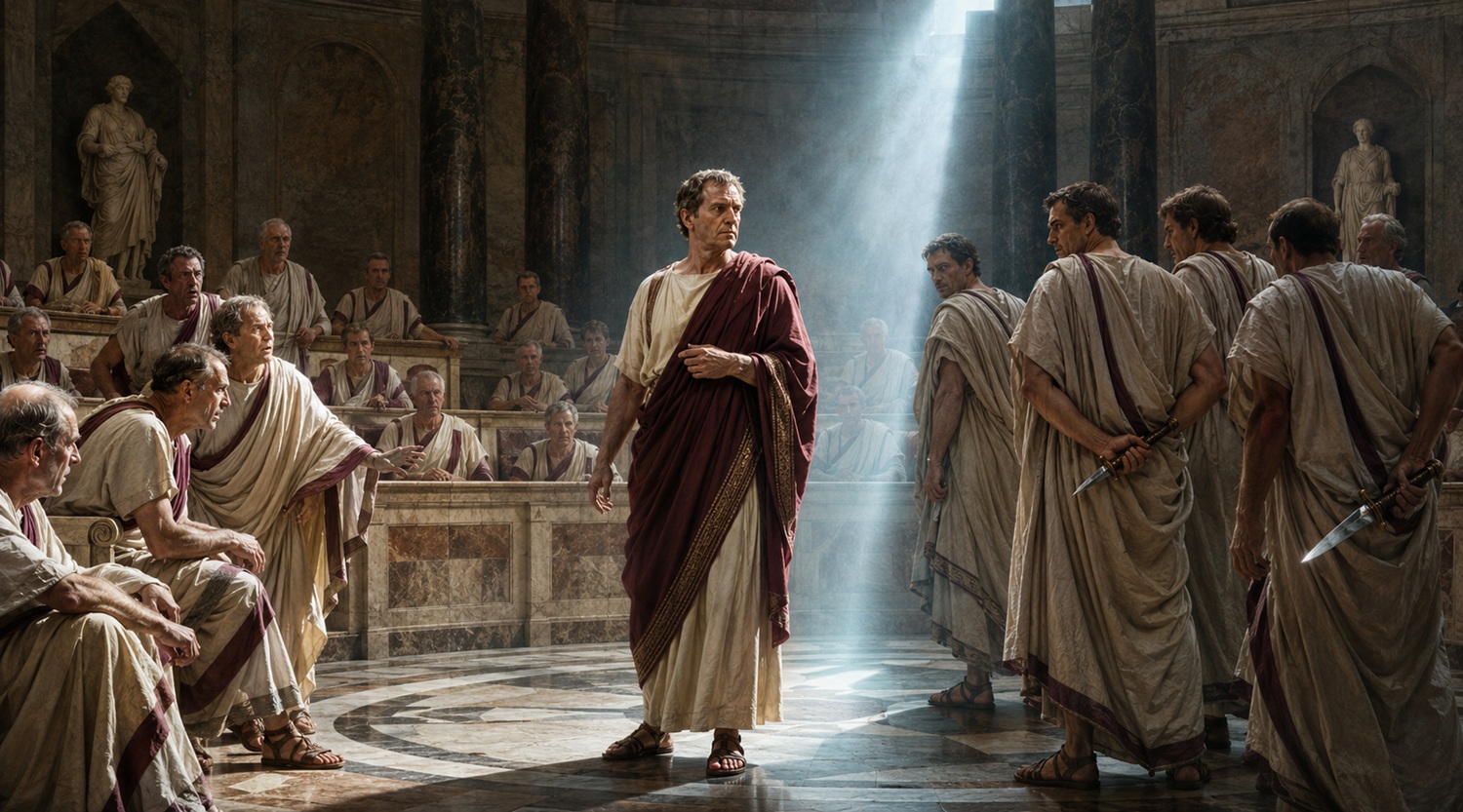
On March 15, 44 BCE, a small decision changed the history of Rome.
Julius Caesar entered a meeting of the Roman Senate in the complex attached to Pompey's Theatre. A group of senators surrounded him. They drew concealed daggers. Within minutes, the most powerful man in the Roman world was dead.
The assassination did not restore the Roman Republic as the conspirators hoped. Instead, it opened another round of civil wars. Caesar's nineteen-year-old great-nephew and adopted heir, Octavian, eventually defeated every major rival, became Augustus, and created the political system historians call the Roman Principate.
But Caesar's death was not inevitable.
Ancient accounts describe multiple warnings reaching him immediately before the Senate meeting. Appian reports that information about the conspiracy reached Caesar's household and that a written warning was placed in Caesar's hand before he entered the Senate chamber but remained unread when he went inside. The exact details differ among the surviving ancient narratives, but they provide an unusually small and plausible point of divergence.
Suppose Caesar reads the warning.
Suppose he believes it.
And suppose the Ides of March ends not with Caesar's assassination, but with the discovery of the conspiracy.
What happens to Rome?
The answer is more complicated than “Caesar becomes emperor.”
Caesar already possessed extraordinary power. Yet he had not created a clear constitutional system to survive him. He was about to leave Rome for an enormous eastern campaign. His relationship with the Senate was increasingly strained. His alliance with Mark Antony was not necessarily as stable as later events make it appear. And although Octavian was named as Caesar's principal heir in his will, Caesar's survival would mean that inheritance never takes effect in 44 BCE. Modern scholarship emphasizes just how unsettled Caesar's political arrangements remained on the eve of his assassination.
The most consequential result of Caesar surviving might therefore not be the preservation of his dictatorship.
It might be an entirely different struggle over what came after him.
Rome on the Eve of the Ides
By March 44 BCE, the Roman Republic still possessed consuls, praetors, tribunes, senators, assemblies, and other traditional institutions.
But political reality had changed dramatically.
Years of civil war had destroyed or marginalized many of Caesar's principal opponents. Pompey the Great was dead. Cato had committed suicide after Caesar's victory. Pompeian resistance had been defeated in Africa and Spain.
Caesar returned to Rome as the dominant military and political figure in the Mediterranean world.
Ancient sources describe an extraordinary accumulation of honors around him. Appian reports that he was proclaimed pater patriae, “Father of the Country,” and made dictator for life. His person was declared inviolable, and senators and magistrates faced a political environment in which opposition to Caesar had become increasingly difficult.
This was not an ordinary republican magistracy.
Yet it was not quite the later Roman imperial system either.
That distinction is essential to understanding the counterfactual.
Caesar's Dictatorship
The Roman dictatorship was traditionally an emergency office held for a limited period.
Caesar transformed it.
He had held successive dictatorships during the civil wars, and in early 44 BCE he received the title usually rendered dictator perpetuo—dictator continuously or for life.
Whatever technical interpretation Romans placed upon the wording, the political implication was unmistakable: there was no scheduled return to ordinary republican competition in which Caesar would simply become another senator.
Appian's account reflects the unease this produced. Caesar received honors that blurred traditional distinctions between an exceptionally successful magistrate, a military ruler, and something approaching monarchy.
At the same time, Caesar did not abolish the Senate or eliminate republican offices.
Instead, he dominated them.
That created an unstable hybrid.
Rome still possessed the machinery of a republic, but its most important decisions operated under the shadow of one man's military prestige and authority.
Caesar Was More Than a General
It is easy to reduce Caesar's dictatorship to personal power, but his final years also contained substantial administrative reform.
His most enduring reform was the calendar.
Working from a solar calendar system, Caesar reorganized the badly disordered Roman calendar. The resulting Julian calendar came into force in 45 BCE and, with later modification, became the basis of the calendar system still used across much of the world. Modern scholarship identifies calendar reform as one of the major administrative projects of Caesar's dictatorship.
Caesar also pursued colonization and citizenship policies, reorganized aspects of provincial and municipal administration, addressed debt and economic disruptions left by civil war, and expanded opportunities for some people outside the traditional Roman aristocratic elite. Suetonius records, among other measures, that Caesar extended Roman citizenship to physicians and teachers of the liberal arts residing at Rome.
He settled veterans and other citizens in colonies.
He expanded the Senate, bringing in new men, including provincial elites.
He increased the number of magistrates.
He undertook building programs.
Some measures addressed practical problems produced by decades of territorial expansion. Others increased Caesar's ability to reward supporters and shape Rome's governing class.
Those two interpretations are not mutually exclusive.
Caesar was simultaneously reforming an increasingly unmanageable state and concentrating political authority around himself.
Why Senators Feared Him
The conspirators did not simply object to Caesar being popular or successful.
They feared that the political order in which senators competed for prestige and office was becoming permanently subordinate to a single ruler.
Ancient sources repeatedly connect the conspiracy to anxiety about kingship.
The Roman political tradition was intensely hostile to the title rex—king. Rome's legendary foundation as a republic centered on the expulsion of its kings centuries earlier.
Caesar repeatedly rejected the actual title.
At the Lupercalia festival in February 44 BCE, Mark Antony publicly presented Caesar with a diadem. According to Appian, Caesar rejected it, and the crowd applauded his refusal.
That did not end suspicion.
The problem was that Caesar did not need to call himself king to possess powers that looked increasingly monarchical to opponents.
Appian himself, writing centuries later, explicitly frames the conspirators' fear around the possibility that Caesar's power would become indistinguishable from kingship.
Modern historians are more cautious.
Robert Morstein-Marx argues that concentrating exclusively on whether Caesar secretly “wanted to be king” risks accepting the assassins' framing of events. Caesar's final months were also dominated by enormous preparations for an eastern war, and there is little evidence that he had finished designing—or perhaps even decided upon—a permanent constitutional system for Rome.
That uncertainty matters greatly.
Caesar had accumulated extraordinary power.
What he intended to do with it over the next decade remains unknowable.
The Conspiracy
Marcus Junius Brutus and Gaius Cassius Longinus became the most famous leaders of the conspiracy, but they were not alone.
The plot included senators who had once fought against Caesar as well as men whom Caesar had trusted and promoted.
Decimus Junius Brutus Albinus is particularly important. He had served Caesar and held his confidence, yet joined the assassins. Appian lists Decimus alongside Brutus, Cassius, Casca, Trebonius, Tillius Cimber, and others among the conspirators.
Caesar's policy of clementia—his celebrated leniency toward defeated Roman opponents—had allowed many former enemies to return to political life.
Some of those men eventually participated in his murder.
Modern scholarship cautions against treating Caesar's clemency as simple generosity. It was also a political relationship: Caesar possessed the authority to pardon, and the pardoned senator necessarily occupied a subordinate position to the man who had spared him.
For aristocrats raised in a political culture built around status and competition among supposed equals, this could itself be humiliating.
The conspiracy therefore grew from several overlapping motives:
- opposition to Caesar's concentration of power;
- fear of permanent dictatorship;
- anxiety about monarchy;
- personal resentment;
- political rivalry;
- concern for aristocratic status;
- genuine republican ideology.
Different conspirators probably emphasized different motives.
Caesar Was About to Leave Rome
Time was running out for the conspirators.
Caesar was preparing for a major eastern military expedition.
Ancient sources describe enormous preparations for campaigns involving the Getae or Dacians and especially the Parthian Empire. Appian states that sixteen legions and 10,000 cavalry had already been sent across the Adriatic in preparation.
The objective against Parthia carried enormous symbolic importance.
In 53 BCE, Marcus Licinius Crassus had led a Roman invasion of Parthian territory and suffered a catastrophic defeat at Carrhae. Crassus was killed and Roman legionary standards were captured.
A successful Caesarian campaign could avenge one of Rome's great military humiliations.
It could also add another spectacular conquest to Caesar's reputation.
Modern scholarship stresses the scale of the preparations and estimates that the expedition could have kept Caesar outside Rome for several years.
That created an extraordinary political problem.
Caesar had made himself indispensable to the system—
and then was preparing to leave it.
The Point of Divergence
The most economical alternate history requires no invented character and no impossible stroke of luck.
It requires Caesar to perform one simple action:
he reads the warning.
Ancient accounts differ in detail, but several describe information reaching Caesar immediately before the assassination.
Appian reports that one person hurried to Caesar's house with information about the conspiracy but arrived after Caesar had departed. He also records that a written warning was placed in Caesar's hand near the Senate meeting and was later found still with him after his death.
In the alternate timeline, Caesar opens the message before entering.
The names are there.
Brutus.
Cassius.
Decimus Brutus.
Casca.
Trebonius.
Others.
Caesar stops.
Antony and Caesar's attendants are summoned.
The Senate meeting is postponed.
Several conspirators realize almost immediately that the plot has been exposed.
The Ides of March becomes famous for a failed assassination rather than a successful one.
The First 24 Hours
This is the period where counterfactual analysis can remain relatively close to known political conditions.
Caesar would almost certainly take immediate security measures.
The conspirators would have very little time to organize open resistance.
Their plan depended heavily on killing Caesar suddenly and then presenting the assassination as a completed act of liberation.
Once Caesar remains alive, the political equation reverses.
He controls the state.
He has loyal military commanders.
He possesses unmatched prestige among veterans.
He can characterize the conspiracy not as tyrannicide but as an attempted murder of Rome's legally appointed dictator and consul.
Brutus and Cassius
Their most realistic choices are:
- flee Rome immediately;
- surrender and appeal to Caesar's previous policy of clemency;
- attempt to rally senators and provincial forces;
- be arrested before they can act.
The fourth or first possibilities are probably the strongest.
Caesar had forgiven both men after earlier civil conflict. A second act of clemency after discovering that they intended to murder him would be politically much harder.
Would Caesar Execute the Conspirators?
This is uncertain.
A popular alternate-history version has Caesar instantly execute every conspirator.
That is possible.
It is not inevitable.
Caesar had repeatedly cultivated a reputation for clemency toward Roman enemies. Executing dozens of senators could damage that political identity and make him appear to confirm exactly what the conspirators claimed—that Rome was now ruled by a tyrant.
Yet this conspiracy differs from earlier battlefield opposition.
These were men Caesar had pardoned, trusted, promoted, or tolerated who then planned to kill him inside a Senate meeting.
A plausible response would combine punishment and selective clemency.
Likely measures might include:
- arrest of principal organizers;
- removal from magistracies;
- confiscation of political commands;
- exile;
- trials under Caesar's political control;
- execution of a smaller number deemed especially dangerous;
- public pardons for marginal conspirators who cooperate.
Brutus poses the greatest symbolic problem.
Executing him might turn him into a republican martyr.
Pardoning him again could make Caesar look dangerously weak.
Exile is therefore a particularly plausible compromise.
Cassius, a highly capable military figure and arguably a more dangerous political organizer, might receive harsher treatment.
Decimus Brutus could be treated most severely of all because of his close personal and military relationship with Caesar.
But these outcomes remain counterfactual inference rather than evidence.
What Happens to the Senate?
The assassination attempt would strengthen Caesar's argument that traditional aristocratic politics could not be trusted to stabilize Rome.
This may be the single greatest unintended consequence for the conspirators.
They wanted to prevent permanent one-man rule.
By failing, they could make permanent one-man rule easier to justify.
Caesar could tell Romans:
I spared my enemies. I restored them to office. I entered the Senate without military guards. They answered by plotting my murder.
That is an extremely powerful political narrative.
The result could be another purge of the senatorial aristocracy—not necessarily a bloody purge, but a restructuring of political power.
Caesar had already expanded the Senate and promoted new men.
After the failed assassination, he could accelerate this process.
Traditional republican offices might survive formally while becoming increasingly dependent upon the dictator.
This would move Rome closer to monarchy in substance even if Caesar continued rejecting the title of king.
Mark Antony: The Obvious Successor Who Might Not Be
Mark Antony was Caesar's fellow consul in 44 BCE and one of his most prominent supporters.
After Caesar's actual assassination, Antony quickly became one of the central political actors in Rome.
But it is dangerous to project the Antony of 43 or 32 BCE backward into a timeline in which Caesar remains alive.
Modern scholarship notes signs of significant tensions inside the Caesarian political coalition before the assassination, including the conflict involving Antony and Publius Cornelius Dolabella. Morstein-Marx describes the Caesarian coalition as already showing signs of coming apart just before Caesar's planned departure.
Caesar therefore might not leave Antony completely free to govern Rome during a multi-year absence.
He could divide authority among several trusted figures.
Lepidus might receive important responsibilities.
Hirtius, Pansa, Balbus, Oppius, Dolabella, and other Caesarians could become important depending on circumstances.
Antony remains powerful.
But Caesar's survival prevents Antony from immediately inheriting Caesar's political network.
As long as Caesar lives, there is only one Caesar.
And What Happens to Octavian?
Here the alternate history becomes especially interesting.
In March 44 BCE, Gaius Octavius—the future Augustus—was only eighteen years old.
He was in Apollonia, across the Adriatic, where he was studying and preparing for Caesar's upcoming eastern expedition.
Suetonius records that Octavius had been sent ahead while Caesar prepared campaigns involving the Dacians and Parthians.
In real history, Caesar's assassination transformed the young man's position overnight.
Caesar's will named Octavian his principal heir and posthumously adopted him into the Julian family. Modern scholarship likewise identifies Octavian as Caesar's adopted heir under the will.
But if Caesar survives, the will does not come into force.
Octavian does not suddenly become:
Gaius Julius Caesar.
He does not immediately acquire Caesar's name, inheritance, clients, and extraordinary symbolic position.
He remains the promising young relative Caesar favored.
That could actually give him a very different path to power.
Octavian Goes East
The most plausible next step is that Octavian joins Caesar's campaign.
This matters because the future Augustus would receive something he never had in real history:
years of direct apprenticeship under Julius Caesar.
Instead of learning politics while fighting Antony, the Senate, Brutus, and Cassius, Octavian could learn military command and administration from Caesar himself.
If he performs well, Caesar's confidence in him could deepen.
If he performs poorly, Caesar might replace him as preferred heir.
Nothing guarantees the young Octavian's future.
Caesar could live another decade.
He could rewrite his will.
He could adopt someone else.
He could father another child.
He could elevate a successful general.
Octavian's historical rise was astonishing precisely because Caesar died when he did.
A surviving Caesar gives history time to produce alternatives.
The Parthian Campaign
Caesar's planned eastern campaign is the largest immediate uncertainty.
He intended an expedition on an enormous scale. Ancient accounts connect it to revenge for Crassus's disaster and describe extensive preparations. Modern scholarship emphasizes that Caesar was preparing to remain away from Rome for years.
But a Roman victory should not be assumed.
Parthia was a formidable military power.
Roman armies had already learned at Carrhae how devastating Parthian cavalry tactics could be.
Caesar was an exceptional commander, but exceptional commanders lose battles.
Three broad outcomes are plausible.
Scenario A: Caesar Wins
Caesar achieves major victories against Parthian forces, perhaps restores Roman prestige in the East, establishes client rulers or territorial settlements, and returns to Rome with another extraordinary military reputation.
Politically, this is the scenario most dangerous to republican restoration.
A Caesar returning victorious from Parthia would possess even greater prestige.
The failed assassination could then be remembered as proof that his senatorial enemies were both treacherous and ineffective.
A victorious Caesar might face far fewer practical restraints on reorganizing Roman government around his permanent supremacy.
Scenario B: Caesar Wins, But Cannot Conquer Parthia
This is arguably more realistic than total conquest.
Caesar could win important battles and claim strategic success without permanently occupying the vast Parthian realm.
Rome repeatedly discovered that defeating eastern opponents and permanently administering their territories were different problems.
Caesar might recover symbols of Roman honor, impose settlements in Armenia or neighboring regions, and declare victory.
His prestige still rises.
But Rome avoids the logistical burden of attempting permanent conquest deep into the Iranian plateau.
Scenario C: Caesar Suffers Disaster
This possibility cannot be ignored.
Caesar could be defeated.
He could become ill.
He could be wounded.
He could die on campaign.
If Caesar dies in 43, 42, or 41 BCE without establishing a political succession system, Rome faces many of the same underlying problems as it did historically—but with completely different players and circumstances.
Brutus and Cassius may be exiles, prisoners, or dead.
Antony may command major forces.
Octavian may be serving inside Caesar's army.
Lepidus may control important provinces.
The struggle for Caesar's succession could still produce civil war.
It would simply be a different civil war.
Five Years Later: 39 BCE
Assume the strongest middle-ground scenario:
- the conspiracy fails;
- Caesar suppresses it without mass executions;
- the Parthian campaign achieves significant but incomplete success;
- Caesar survives;
- he returns to Rome.
By 39 BCE, Caesar would be in his early sixties.
Rome might look recognizably republican on the surface.
There are still consuls.
There are still senators.
There are still assemblies.
There are still provincial governors.
But the central political question has changed.
No serious politician can expect to govern Rome independently of Caesar.
His authority may increasingly resemble a personal supremacy layered over republican institutions.
This does not necessarily mean Caesar declares himself king.
Indeed, the Roman hostility to kingship provides a strong reason for him not to use the title.
Instead he could retain republican terminology while ensuring that the most important military, provincial, electoral, and legislative decisions remain subject to his authority.
In substance, Rome might begin resembling the later Principate.
In style, however, it could look very different.
Caesar Is Not Augustus
This distinction is critical.
Augustus eventually built a system designed to obscure monarchy behind republican forms.
His political settlement emphasized the idea that traditional institutions had been restored even while Augustus retained overwhelming practical authority.
Caesar had behaved much more openly.
He accepted permanent dictatorship.
He accumulated conspicuous honors.
He allowed politics to revolve visibly around himself.
Whether experience would eventually teach him greater restraint is unknown.
A failed assassination could push him in either direction.
Caesar might conclude:
I must make my supremacy less provocative.
Or he might conclude:
My enemies tried to murder me because I was too lenient.
The first path moves toward something resembling Augustus's later settlement.
The second moves toward a more explicit autocracy.
Both are plausible.
Did Caesar Intend to Become King?
We cannot answer this confidently.
Ancient authors reported persistent rumors of kingship and described incidents such as Antony offering Caesar a diadem at the Lupercalia. Appian believed fear of monarchy helped motivate the conspiracy.
But ancient narratives were written with knowledge of what came later.
The Roman Republic did ultimately give way to imperial government.
That hindsight can make every action of Caesar look like a deliberate step toward a predetermined monarchy.
Modern scholarship is more skeptical of that teleology.
Morstein-Marx argues that Caesar had made surprisingly little progress toward constructing a permanent new constitutional order immediately before his planned Parthian expedition.
A reasonable conclusion is therefore:
Caesar clearly intended to remain politically supreme in the immediate future.
But:
we cannot confidently reconstruct the permanent constitutional system he intended Rome to have decades later.
The Succession Problem
This is the central weakness of the surviving-Caesar timeline.
A government centered on Caesar can function while Caesar is alive.
What happens when he dies?
The Roman Republic had no established constitutional mechanism for inheriting a permanent dictatorship.
Caesar had no unquestionably legitimate adult biological son capable of stepping into his political position.
His will favored Octavian, but a will could transfer property and provide adoption; it could not automatically transfer control of the Roman state.
Military loyalty mattered.
Senatorial acceptance mattered.
Popular support mattered.
Provincial commands mattered.
Money mattered.
Personal prestige mattered.
A surviving Caesar therefore needs to solve something much larger than estate planning.
He needs to make political succession predictable.
If he does not, civil war remains an enormous risk.
Could Octavian Still Become Augustus?
Possibly.
But probably not in the same way.
If Caesar lives another ten years, Octavian would be around twenty-nine when Caesar dies.
That is a radically different political figure from the nineteen-year-old who entered Roman politics after the historical assassination.
He might by then possess:
- military experience;
- provincial administration experience;
- consulships or other offices;
- direct association with Caesar's victories;
- relationships with veteran officers;
- Caesar's formal adoption while Caesar is still alive.
Such an Octavian could be an exceptionally formidable successor.
Ironically, Caesar's survival might eventually make Octavian's succession easier.
Rather than claiming the inheritance of a murdered dictator while still a teenager, he could emerge after a decade as Caesar's publicly designated and politically experienced deputy.
But that assumes Caesar continues favoring him.
That is far from guaranteed.
Antony Versus Octavian—But Under Caesar
One of the defining conflicts of real Roman history was the eventual struggle between Antony and Octavian.
Caesar's survival changes the timing completely.
Instead of two men competing for the dead dictator's political inheritance, they compete for influence under the living dictator.
Caesar becomes the arbiter.
That could suppress their rivalry.
It could also intensify it.
Antony possesses military prestige, age, and political experience.
Octavian possesses family connection and perhaps Caesar's long-term favor.
If Caesar increasingly presents Octavian as his successor, Antony could resent the younger man's rise.
If Antony remains Caesar's chief lieutenant, Octavian might find his inheritance blocked.
A Caesar who lives into old age could therefore create something resembling a royal court without ever calling it one: ambitious commanders and relatives maneuvering around the aging ruler.
Cleopatra and Egypt
Cleopatra VII was in Rome during part of Caesar's final period, and Caesar had publicly honored her in remarkable ways. Appian records that an image of Cleopatra stood beside Venus in Caesar's temple complex.
Cleopatra also had a son, Ptolemy XV Caesar, commonly called Caesarion.
Ancient sources debated Caesarion's paternity, and modern historians should not treat every ancient claim about Caesar's private life as certain.
Even if Caesar was Caesarion's biological father, however, that does not mean Caesarion was positioned to inherit Rome.
Modern scholarship notes that Caesarion was foreign-born, part of the Ptolemaic royal house, and absent from Caesar's Roman testamentary succession. Caesar's will instead favored Octavian.
That makes a common alternate-history scenario—Caesar openly founding a Roman-Egyptian dynasty through Cleopatra and Caesarion—much less straightforward than fiction often suggests.
What Happens to Cleopatra If Caesar Lives?
Cleopatra's political position probably becomes stronger in the short term.
Her primary objective was Egypt.
A close relationship with the dominant Roman ruler offered enormous protection for the Ptolemaic monarchy.
If Caesar survives and succeeds in the East, Cleopatra could remain an important allied monarch.
Egypt's grain, wealth, fleet, and strategic location would make it valuable to Roman eastern policy.
Caesar might visit Egypt again.
Cleopatra might remain personally important to him.
Caesarion could receive increased status in Egypt.
But several limits remain.
Rome was profoundly sensitive to monarchy.
Cleopatra was a foreign queen.
Caesar already faced accusations of royal ambition.
Making Caesarion his explicit political heir in Rome would intensify precisely the fears that helped produce the assassination conspiracy.
A more plausible arrangement is therefore:
Caesarion inherits Egypt while a Roman heir inherits Caesar's Roman political position.
That separation could keep Cleopatra influential without making her son ruler of Rome.
Could Caesar Annex Egypt?
Possibly, but it is not the most obvious immediate outcome.
A cooperative Cleopatra gave Rome many of the strategic benefits of controlling Egypt without the complications of direct annexation.
As long as Cleopatra remained loyal, maintaining the Ptolemaic kingdom as a dependent ally could be useful.
Egypt's eventual historical incorporation into the Roman world in 30 BCE occurred under very different circumstances, after the defeat of Antony and Cleopatra by Octavian.
Without that war, Egypt's formal annexation could be delayed.
A surviving Caesar may therefore allow the Ptolemaic monarchy to survive longer.
Twenty Years Later: 24 BCE
Now the scenario becomes much less certain.
Caesar would be approximately seventy-six years old if still alive—possible, but ancient longevity and military campaigning make survival to that age far from guaranteed.
The more useful question is not whether Caesar personally survives until 24 BCE.
It is whether he has created a system that survives him.
There are three broad possibilities.
Scenario 1: The Caesarian Principate
Caesar eventually recognizes that permanent dictatorship is too provocative.
He retains overwhelming authority but distributes it across traditional Roman offices and commands.
The Senate continues.
Elections continue in restricted form.
Consuls continue.
Caesar presents himself as the republic's protector rather than its monarch.
Octavian or another chosen successor is gradually integrated into the arrangement.
This resembles the system Augustus later created, though the terminology and institutions might develop differently.
Likelihood: Moderately plausible
The political pressures that later encouraged Augustus to disguise autocracy behind republican forms would also affect Caesar.
The failed assassination would provide an especially powerful lesson about the danger of overtly humiliating the aristocracy.
Scenario 2: Open Caesarian Autocracy
Caesar draws the opposite lesson.
The conspiracy proves that aristocratic opposition cannot be reconciled.
He strengthens security.
Opposition senators are marginalized.
Magistracies become increasingly ceremonial.
Governors are appointed according to Caesar's wishes.
His chosen successor receives formal authority while Caesar is still alive.
Rome retains republican vocabulary but becomes unmistakably dynastic.
Likelihood: Plausible
Caesar already possessed extraordinary authority, and surviving an assassination attempt could justify further concentration.
The chief difficulty remains succession.
Scenario 3: Caesar Dies and Civil War Returns
Caesar never builds a durable succession mechanism.
He dies unexpectedly during campaign or later in Rome.
Antony controls troops.
Octavian claims family legitimacy.
Lepidus commands forces.
Other generals and provincial governors choose sides.
Republican exiles attempt to return.
A new civil war begins.
Likelihood: Very plausible
Rome's underlying political problems did not disappear merely because Caesar survived one assassination attempt.
The state had endured decades of political violence, extraordinary commands, armed rivalry, and civil war.
One man's survival does not automatically repair those institutions.
Competing Alternate Outcomes
| Scenario | Political Direction | Octavian | Antony | Senate | Civil War Risk |
|---|---|---|---|---|---|
| Caesar moderates his rule | Proto-Principate preserving republican forms | Groomed as possible successor | Senior lieutenant | Retains prestige but less real independence | Medium |
| Caesar creates stronger autocracy | More explicit personal rule | Possible dynastic heir | Powerful but subordinate | Further marginalized | Medium to high after Caesar's death |
| Caesar dies during eastern campaign | Immediate succession crisis | Military protégé and possible heir | Major contender | Attempts to regain influence | Very high |
| Parthian victory transforms Caesar's prestige | Stronger Caesarian supremacy | Benefits from association | Benefits but may become rival | Weak | High after Caesar's death unless succession solved |
| Caesar replaces Octavian as preferred heir | Depends on replacement | Becomes secondary figure | May benefit | Limited | High |
| Caesar successfully institutionalizes succession | Stable one-man regime | Could become successor | Integrated or marginalized | Ceremonial but continuing | Lower initially |
None of these outcomes requires Rome to return to the pre-civil-war Republic.
That is important.
What Probably Does Not Change
Counterfactual history becomes misleading when every event after a divergence is assumed to change.
Several major conditions would remain.
Rome remains the dominant Mediterranean power
Caesar's survival does not suddenly reverse Roman territorial expansion.
Rome already controls enormous territories across Italy, Gaul, Hispania, North Africa, Greece, Asia Minor, and much of the Mediterranean.
Republican political culture does not disappear overnight
Romans continue using republican titles, institutions, traditions, and ideas.
Even Augustus later found it politically useful to frame his government within republican forms.
Aristocratic competition continues
Senators do not stop seeking prestige merely because Caesar is alive.
Competition shifts from independent republican politics toward competition for Caesar's favor and commands.
The army remains politically decisive
The late Republic had already demonstrated the danger of armies developing personal loyalty toward successful generals.
Caesar's survival does not solve that problem.
Parthia remains formidable
A brilliant Roman commander does not automatically destroy the Parthian state.
Succession remains dangerous
Unless Caesar deliberately creates a workable succession mechanism, his eventual death still threatens political crisis.
What Almost Certainly Changes
Other developments are much more directly tied to the assassination.
There is no immediate liberation of Caesar's killers
Brutus and Cassius do not gain eastern armies in the same circumstances.
There is no historical Second Triumvirate in 43 BCE
The alliance of Octavian, Antony, and Lepidus arose from political circumstances created by Caesar's death.
Those exact circumstances disappear.
There are no historical proscriptions of 43 BCE
The mass political killings and confiscations associated with the Second Triumvirate would not occur in the same form.
Other purges remain possible.
Cicero's final political career changes dramatically
Cicero's campaign against Antony depended upon the post-assassination struggle.
That political sequence disappears.
Philippi does not happen as we know it
Brutus and Cassius cannot fight Antony and Octavian at Philippi in 42 BCE under the historical circumstances.
Antony and Cleopatra's famous alliance is not inevitable
Their relationship became politically decisive after Caesar's death.
A living Caesar radically changes Cleopatra's relationship with Roman politics.
Actium almost certainly does not happen as it did
The 31 BCE confrontation between Octavian and the forces of Antony and Cleopatra depended upon years of post-Caesarian political development.
Remove the assassination and the chain leading to Actium is broken.
The Real History Baseline
| Year | What Actually Happened |
|---|---|
| 44 BCE | Caesar assassinated on March 15. Antony initially dominates Roman politics; Caesar's will elevates Octavian. |
| 43 BCE | Octavian, Antony, and Lepidus form the Second Triumvirate. Political proscriptions follow. |
| 42 BCE | Brutus and Cassius are defeated at Philippi. |
| 40s–30s BCE | The Roman world is increasingly divided between major Caesarian leaders. |
| 31 BCE | Octavian defeats Antony and Cleopatra at Actium. |
| 30 BCE | Antony and Cleopatra die; Egypt comes under Octavian's control. |
| 27 BCE | Octavian receives the title Augustus, conventionally marking the beginning of the Roman Principate. |
These events were not predetermined stages of an inevitable Roman Empire.
They were products of the particular political struggle unleashed by Caesar's death.
Ancient narratives such as Appian's Civil Wars preserve extensive accounts of this sequence, while modern scholarship emphasizes the contingency of the Republic's final collapse rather than treating Augustus's eventual victory as inevitable.
A Plausible Five-Year Alternate Timeline
| Date | Alternate Development |
|---|---|
| March 15, 44 BCE | Caesar reads a warning before entering the Senate. The meeting is canceled and the conspiracy exposed. |
| March–April 44 BCE | Brutus, Cassius, Decimus Brutus, and principal conspirators are arrested, exiled, or flee. Caesar increases personal security. |
| 44 BCE | Caesar reorganizes key political and military appointments before leaving Italy. Octavian remains a favored young relative rather than immediately becoming Caesar's adopted political heir. |
| 44–43 BCE | Caesar begins his eastern campaign. Octavian likely joins or remains associated with preparations and military training. |
| 43–42 BCE | Caesar campaigns against eastern opponents. Rome is governed through several Caesarian deputies rather than the historical Second Triumvirate. |
| 41–40 BCE | Assuming military success, Caesar returns with increased prestige. Political debate shifts from whether his supremacy will survive to how succession should work. |
| 39 BCE | Rome operates as a republican-looking state under permanent Caesarian predominance. Antony and Octavian compete for position within Caesar's system rather than over his corpse. |
The early stages are plausible extrapolations.
Each later step becomes progressively more uncertain.
A Plausible Twenty-Year Alternate Timeline
Beyond several years, no single forecast should be presented as “what would happen.”
One plausible pathway might look like this:
| Approximate Date | Possible Development |
|---|---|
| 39 BCE | Caesar returns from a limited but prestigious eastern victory. |
| 38–35 BCE | Caesar reduces overt reliance on dictatorship while retaining decisive military and political powers. |
| Mid-30s BCE | Octavian receives increasingly important offices and commands. |
| Early 30s BCE | Antony remains influential but becomes increasingly secondary to Caesar's designated succession plans. |
| c. 32–28 BCE | Aging Caesar formally adopts or elevates a successor while alive. |
| After Caesar's death | The transition either succeeds, creating a Caesarian dynasty, or produces a new civil war. |
| 24 BCE | Rome may possess a form of one-man government recognizable as imperial in substance even though its institutions and ideology differ considerably from Augustus's historical Principate. |
This is not a prediction.
It is one internally consistent political pathway.
How Plausible Is This Scenario?
The initial divergence is extremely plausible.
Caesar was reportedly warned.
All that changes is whether he acts upon information already available to him.
Caesar survives March 15
Very plausible as a counterfactual divergence.
A small change in timing or attention could plausibly expose the conspiracy.
The conspiracy collapses once exposed
Very plausible.
The conspirators depended heavily upon surprise.
Caesar punishes the conspirators
Highly plausible.
The exact punishments are uncertain.
Caesar proceeds with the eastern campaign
Very plausible.
Preparations were already extensive.
Caesar defeats Parthia completely
Uncertain.
A major Roman victory is possible. Permanent conquest should not be assumed.
Caesar becomes formal king
Uncertain and probably unnecessary.
He already possessed extraordinary powers without the hated title.
Caesar creates an imperial system
Plausible in substance.
Whether it resembles Augustus's Principate is much less certain.
Octavian eventually succeeds Caesar
Plausible but far from guaranteed.
Caesar's historical will strongly favored Octavian, but additional years could change the succession.
Caesarion becomes ruler of Rome
Weak.
His position in Egypt and uncertain Roman legitimacy make this much less plausible than popular fiction often suggests. Caesar's actual testament favored Octavian rather than Caesarion.
The Roman Republic returns to its earlier form
Unlikely.
The political and military forces destabilizing republican government preceded the Ides of March.
The Great Irony of the Failed Assassination
Brutus and Cassius believed Caesar's death could restore liberty.
Historically, it did the opposite.
Their assassination triggered wars that eventually produced an even more durable system of one-man rule.
A failed assassination could produce an equally bitter irony.
It could give Caesar the justification he lacked for strengthening his dictatorship.
Before March 15, Caesar could still be accused of accumulating excessive power.
After surviving an assassination attempt by senators whom he had pardoned and promoted, Caesar could present additional security and institutional control as matters of state survival.
The conspirators might therefore accomplish precisely what they intended to prevent:
the normalization of permanent Caesarian rule.
But Caesar Still Has to Die
This is the point where many alternate histories stop too early.
Caesar surviving the Ides does not solve Rome's political crisis.
It postpones the most important question.
Every personal regime eventually confronts mortality.
Caesar was fifty-five years old in March 44 BCE.
He could die on campaign.
He could die from illness.
He could live another five years.
He could live another twenty.
Eventually, however, Rome has to answer:
Who possesses Caesar's authority when Caesar no longer exists?
If Caesar successfully converts personal supremacy into an institution, Rome could transition into imperial government earlier and through a less violent process than occurred historically.
If he fails, Rome could experience another round of civil wars.
The actors would be different.
The alliances would be different.
The battles would be different.
But the structural danger would remain.
The AltHistAI Verdict
If Julius Caesar had survived the Ides of March, the most immediate result would probably not have been the restoration of normal republican politics.
It would likely have been the opposite.
A failed assassination would expose many of Caesar's most dangerous senatorial opponents, weaken the credibility of organized resistance, and give Caesar a powerful justification for tightening political security.
His planned eastern expedition would probably still proceed. Preparations were already on an extraordinary scale, and modern scholarship emphasizes that Caesar expected to spend years away from Rome.
That campaign becomes the first major uncertainty.
Success could return Caesar to Rome with even greater prestige.
Failure—or Caesar's death abroad—could create an early succession crisis.
Octavian is the greatest wildcard.
Historically, Caesar's death instantly transformed an eighteen-year-old relative into his adopted son and principal heir. With Caesar alive, that transformation never occurs in 44 BCE. Octavian instead has time either to develop under Caesar's protection or to be replaced by another favorite.
Mark Antony remains powerful but does not automatically become the chief political inheritor of Caesar's movement.
Cleopatra probably benefits from Caesar's continued protection, and the Ptolemaic kingdom could survive longer as a Roman-aligned monarchy. Caesarion's position in Egypt could strengthen, but there is little basis for assuming Caesar would make him ruler of Rome. Caesar's actual will pointed elsewhere.
The largest question is constitutional.
Caesar had achieved supremacy without establishing a clear permanent system for what came next. Modern scholarship specifically cautions against assuming that, by March 44 BCE, he had already designed the monarchy that later emperors would inherit.
Surviving the assassination would give him time to answer that question.
He might learn to cloak personal power in republican forms, anticipating something like Augustus's Principate.
He might create a more explicit autocracy.
Or he might never solve succession at all, leaving Rome to another civil war after his death.
The strongest counterfactual conclusion is therefore not:
Caesar would have ruled the Roman Empire for decades.
It is:
Caesar's survival would have prevented the exact political sequence that produced Augustus.
No historical Second Triumvirate.
No Brutus and Cassius at Philippi in the same circumstances.
No Antony and Octavian dividing Caesar's inheritance in the same way.
Probably no historical Actium.
And no guarantee that the Roman imperial system would take the form eventually designed by Augustus.
Rome was already moving toward some kind of settlement after decades of civil conflict.
But the empire that emerged was not inevitable.
Julius Caesar's death helped determine who would build it.
Had he walked away from the Senate alive on March 15, 44 BCE, he might have had the opportunity to build it himself.
Key Takeaways
- By March 44 BCE, Caesar possessed extraordinary political power and held a continuing dictatorship, but traditional republican institutions still formally existed.
- Caesar had implemented important administrative reforms, including the Julian calendar, while also concentrating political authority around himself.
- Ancient sources connect the conspiracy with fears that Caesar's supremacy was becoming monarchical, although modern historians caution against assuming his ultimate constitutional intentions are known.
- Caesar was preparing a major eastern campaign and expected to leave Rome for an extended period.
- A particularly plausible divergence is that Caesar reads one of the warnings reportedly delivered shortly before the Senate meeting.
- A failed conspiracy would probably strengthen Caesar politically and weaken senatorial opposition.
- Brutus, Cassius, and other conspirators would probably face arrest, exile, removal from office, or execution, although Caesar's previous policy of clemency makes the exact outcome uncertain.
- Octavian would not immediately inherit Caesar's name and political position because Caesar would still be alive.
- Caesar's will favored Octavian, but years of additional life could have changed the eventual succession.
- Caesarion's existence does not mean he was positioned to inherit Roman political authority; surviving evidence points instead to Octavian as Caesar's testamentary heir.
- Caesar surviving does not eliminate the danger of Roman civil war. It shifts the crisis from the assassination itself to the eventual question of succession.
- The Roman Empire could still emerge, but its institutions, ideology, rulers, and timing might differ substantially from the Augustan system known from real history.
Sources and Further Reading
Ancient Sources
Appian, The Civil Wars, Book II.
A major ancient narrative for Caesar's dictatorship, extraordinary honors, fears surrounding kingship, preparations for the Parthian campaign, the conspiracy, warnings before the assassination, and the political consequences of Caesar's death. Appian wrote centuries after Caesar and must therefore be read critically rather than as an eyewitness.
Plutarch, Life of Caesar.
One of the principal ancient biographies of Caesar, including the civil wars, Caesar's dictatorship, the conspiracy, and traditions surrounding the Ides of March. Plutarch wrote in the early imperial era and often emphasized character and moral interpretation as well as political history.
Plutarch, Life of Brutus.
An important ancient source for Brutus, the conspiracy, the assassins' political motivations, and events surrounding Caesar's death.
Plutarch, Life of Antony.
Useful for Caesar's relationship with Antony and for understanding Antony's position before and after the assassination.
Suetonius, The Deified Julius.
A major Roman biographical source for Caesar's reforms, honors, personal life, alleged monarchical ambitions, and assassination. Suetonius preserves valuable information but also records rumors and anecdotes whose reliability varies.
Suetonius, Life of Augustus.
Important for the young Octavian, Caesar's planned eastern expedition, and Octavian's position before becoming Caesar's heir.
Modern Scholarship
Robert Morstein-Marx, Julius Caesar and the Roman People. Cambridge University Press, 2021.
Especially important for reassessing Caesar's final months, popular politics, the Parthian preparations, the political coalition around Caesar, and the disputed assumption that Caesar had already designed a permanent monarchy before his death.
“Caesar: Civil War and Dictatorship,” The Cambridge Ancient History.
Provides a scholarly overview of Caesar's dictatorship, political reforms, succession problem, and relationship with Cleopatra and Caesarion.
Josiah Osgood, Rome and the Making of a World State, 150 BCE–20 CE. Cambridge University Press, 2018.
Places Caesar, Octavian, Antony, and the final civil wars within Rome's broader transformation from republican world power to imperial state.
M. Gray-Fow, “What to Do with Caesarion.” Greece & Rome.
Examines Caesarion's political position and the difficult historical evidence surrounding Cleopatra's son in the age of Caesar, Antony, and Octavian.
Susan A. Ashton, Profiling Cleopatra. Cambridge University Press, 2026.
Modern treatment of Cleopatra and her political world, including Caesar, Caesarion, and Octavian's position as Caesar's testamentary adopted heir.