 Alternate History AI
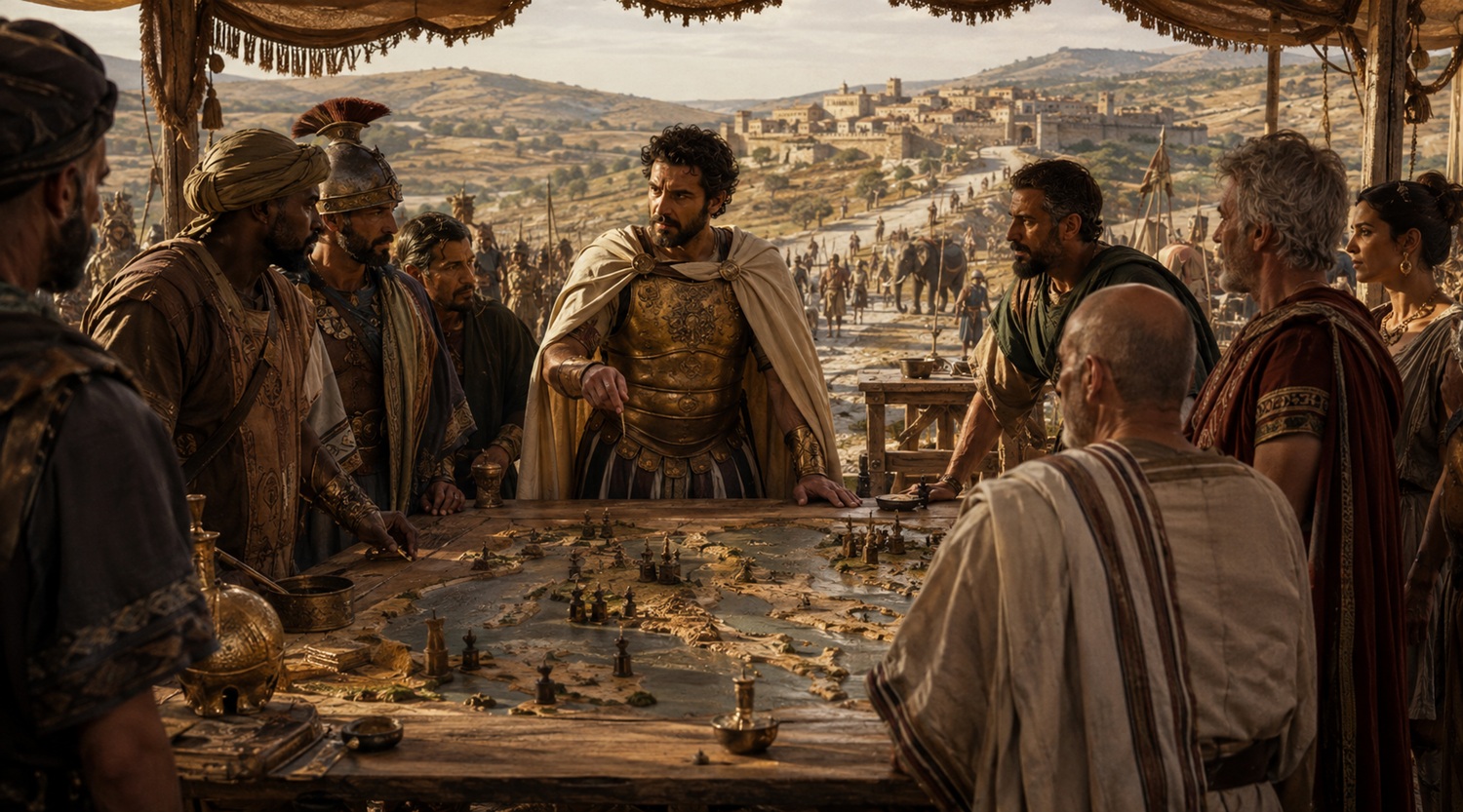
In 216 BCE, Rome suffered one of the worst military defeats in its history.
At Cannae in southeastern Italy, Hannibal Barca used a smaller Carthaginian-led army to envelop and destroy a much larger Roman force. Tens of thousands of Roman and allied soldiers were killed or captured, including a consul and many members of Rome's political elite. Modern scholarship still treats Cannae as the culmination of an extraordinary sequence in which Hannibal defeated Roman forces at the Ticinus, Trebia, Lake Trasimene, and finally Cannae between 218 and 216 BCE. (Cambridge University Press)
Yet Rome did not surrender.
That fact is the starting point for any serious counterfactual.
The famous question—What if Hannibal had defeated Rome?—is often framed as though Cannae were one tactical decision away from Hannibal marching into Rome, destroying the Republic, and replacing it with a Carthaginian Empire.
That is too simple.
Hannibal's strategy in Italy was not primarily based on occupying every Roman city with Carthaginian administrators. He needed to break the political system that gave Rome its extraordinary military resilience: its network of colonies, Latin communities, and allied Italian states. Rome could repeatedly rebuild armies because that alliance system supplied a manpower pool few Mediterranean rivals could match. Modern work on the Italian allies emphasizes that Hannibal needed widespread, rapid defections to destroy that advantage. He won important communities after Cannae, including Capua and much of southern Italy, but the revolt never became broad or coordinated enough to break Rome's system. (Cambridge University Press)
So the strongest counterfactual is not:
Hannibal captures Rome immediately after Cannae.
It is:
Hannibal's victory at Cannae triggers a larger cascade of allied defections than occurred historically, depriving Rome of enough soldiers, revenue, bases, and political legitimacy that the Roman Senate eventually accepts a peace settlement favorable to Carthage.
Rome survives.
Carthage survives.
Italy fragments.
And the western Mediterranean develops without a single Roman superstate dominating it.
That outcome is much more plausible—and potentially more consequential—than a Carthaginian army occupying Rome permanently.
---
The Second Punic War Before Cannae
The Second Punic War grew from the unfinished rivalry created by the First Punic War.
Rome had defeated Carthage in 241 BCE and taken Sicily. During Carthage's subsequent Mercenary War, Rome also seized Sardinia and demanded additional compensation, an action Polybius regarded as unjust and which contributed significantly to Carthaginian resentment. Carthage then rebuilt its position through expansion in Iberia under Hamilcar Barca, Hasdrubal, and eventually Hannibal. (Cambridge University Press)
Carthaginian power in Iberia gave the state access to manpower, wealth, ports, and military resources. Hannibal inherited this western base and attacked Saguntum, a city friendly to Rome, setting off the crisis that became the Second Punic War. (Cambridge University Press)
Instead of waiting for Rome to attack Carthaginian territories, Hannibal took the war into Italy.
He crossed the Pyrenees.
He crossed the Alps.
He entered northern Italy and repeatedly defeated Roman armies.
At Trebia in 218 BCE, he defeated a major Roman force.
At Lake Trasimene in 217 BCE, he ambushed another.
Then came Cannae.
Hannibal had succeeded militarily beyond almost anything Carthage could reasonably have expected.
The political question was whether those victories could break Roman control of Italy.
---
What Hannibal Was Trying to Break
Rome in the third century BCE was not merely a city commanding its own citizens.
It sat at the center of a complicated Italian alliance system built during centuries of warfare.
Different communities possessed different legal relationships with Rome.
There were Roman citizens.
Latin colonies.
Municipal communities with varying rights.
Treaty allies.
Other subordinate states required to provide troops.
The details varied, but the combined system allowed Rome to mobilize extraordinary numbers of soldiers. Scholarship on Rome's Italian alliances emphasizes that this reservoir of allied manpower was fundamental to Roman expansion. (Cambridge University Press)
Hannibal understood the weakness inside that strength.
If Italian communities concluded that Rome could no longer protect them, they might defect.
He therefore frequently distinguished between Romans and their allies.
Polybius records that after victories Hannibal treated allied prisoners differently from Roman citizens and presented himself as fighting Rome rather than Italy as a whole. Modern analysis of this policy emphasizes that encouraging allied defection was central to his strategy. (Cambridge University Press)
This worked—to a point.
After Cannae, many southern communities did change sides.
Capua, one of Italy's wealthiest and most important cities, defected.
Communities in Apulia, Bruttium, Lucania, and Samnium also joined Hannibal.
But many others remained loyal.
Rome's Latin colonies generally held.
Important cities such as Nola and Naples did not become reliable Carthaginian bases.
The alliance system bent.
It did not break. (Cambridge Resolve)
That is where the alternate history begins.
---
The Point of Divergence: The Revolt After Cannae Spreads
The divergence does not change the battle of Cannae.
Hannibal wins exactly as he did historically.
The change comes during the weeks that follow.
Historically, Capua defected, but Hannibal struggled to turn the Campanian revolt into a complete regional collapse of Roman authority. Nola remained contested, and Naples stayed aligned with Rome; Hannibal also lacked a secure major maritime base through which Carthage could easily reinforce him. (Cambridge University Press)
In the alternate timeline, the pro-Hannibal faction at Nola gains control before Roman commander Marcus Claudius Marcellus can secure the city.
That single political change matters because it tells neighboring elites that Capua is not isolated.
Then another domino falls.
Faced with Capua and Nola already in Hannibal's camp and believing Roman military power shattered at Cannae, additional Campanian and Samnite communities defect.
Naples becomes politically divided and eventually declares neutrality rather than remaining firmly Roman.
More Greek communities in southern Italy begin negotiating with Hannibal.
Tarentum, which historically did not substantially fall into Hannibal's hands until years later, joins him much earlier and its harbor becomes a major Carthaginian supply base.
The difference is not that every Italian community suddenly loves Carthage.
They do not.
They are pursuing local interests.
That is consistent with Michael Fronda's research, which stresses that Italian communities made choices based on their own political rivalries, interests, and regional relationships rather than simply choosing between two monolithic camps. (Cambridge University Press)
But the choices now begin reinforcing one another.
A town that remained loyal historically because nearby towns remained Roman faces a different calculation once those neighbors defect.
Rome's greatest strategic asset begins to unravel.
---
Rome's Response Still Matters
Even after Cannae, Rome historically responded with remarkable institutional resilience.
The Senate refused to concede defeat.
New troops were raised.
Unconventional recruitment measures were adopted.
The Roman state continued fighting in multiple theaters.
It gradually avoided giving Hannibal the kind of enormous set-piece battle in which he excelled and instead forced him to defend a scattered network of allied cities. (Penelope)
That resilience must remain in the alternate timeline.
Rome does not surrender the day after Cannae.
The Senate raises another army.
Fabius Maximus argues for continued resistance.
Marcellus attempts to recover Campania.
Roman commanders in Iberia continue attacking Carthaginian positions.
The navy remains an important Roman advantage.
But this time Rome is trying to rebuild while losing a much larger portion of the manpower system that made rebuilding possible.
Every new defection has three effects.
Rome loses troops it would otherwise receive.
Hannibal potentially gains troops, bases, or supplies.
And undecided communities become less confident that Rome will win.
The crisis becomes political as well as military.
---
The Critical Difference: Rome Loses the Ability to Replace Armies
This is the threshold Hannibal historically failed to cross.
Rome's ability to recover from Cannae was possible because the majority of its Italian alliance network remained intact. Cambridge scholarship explicitly identifies the loyalty of most allies as one of the central reasons Hannibal's invasion ultimately failed. (Cambridge University Press)
In the alternate timeline, suppose Rome can still field armies—but no longer enough to do everything required.
It must defend Latium.
Watch Capua.
Hold the roads south.
Maintain garrisons.
Fight in Iberia.
Protect Sicily.
Guard against Macedonian intervention.
Replace Cannae's dead.
And suppress additional revolts.
The Republic faces a choice it historically avoided:
continue a war that could destroy the Roman state itself—
or negotiate while Rome still has enough military strength to demand survival.
By 215 BCE, the peace faction gains ground.
---
Hannibal Did Not Need to Destroy Rome
This is one of the most important corrections to the popular scenario.
Evidence from Hannibal's alliance with Philip V of Macedon suggests that a Carthaginian victory did not necessarily mean Rome's physical destruction.
Polybius preserves the treaty between Hannibal and Philip. It explicitly contemplated a future peace with Rome after Carthaginian victory and imposed conditions restricting Roman power in areas of interest to Philip. That makes much more sense as a settlement reducing Rome than as a plan to erase Rome from the map. (Penelope)
Livy's version of the treaty portrays much more extreme Carthaginian ambitions and should be treated cautiously because Polybius's preserved treaty text is generally considered more useful evidence for the actual agreement. (Perseus Digital Library)
Hannibal's strategic goal in Italy can therefore be modeled as:
dismantle Roman hegemony rather than administer every Italian community from Carthage.
That distinction shapes the peace.
---
The Peace of 215 BCE
There is no historical treaty from which exact alternate terms can be copied.
Any detailed settlement is necessarily speculative.
But a plausible Carthaginian peace would target the sources of Roman power.
Rome survives
Carthage does not attempt to destroy the city.
Rome retains Latium and much of its central Italian core.
Its Senate, magistrates, assemblies, and religious institutions continue functioning.
Rome's southern alliance network is dismantled
Communities that joined Hannibal are recognized as independent of Roman control.
Capua becomes a major autonomous power in Campania.
Samnite and Lucanian communities recover greater political independence.
Greek cities in southern Italy receive guarantees against renewed Roman domination.
Carthage regains Sicily or a dominant position there
Carthage had lost Sicily after the First Punic War. A victorious Carthaginian government would have powerful reasons to reverse that settlement. Western Sicily could return directly to Carthaginian control while Syracuse or other Greek communities retain varying degrees of autonomy.
Sardinia returns to the Carthaginian sphere
Rome's seizure of Sardinia after the First Punic War had become a major source of grievance. A victorious Carthage would probably demand its return. (Cambridge University Press)
Rome recognizes Carthaginian dominance in Iberia
Roman forces withdraw.
The Barcid territorial system remains intact.
Philip V receives concessions in the Adriatic
The actual Hannibal-Philip treaty anticipated restrictions on Roman power in areas such as Corcyra and the Illyrian coast. A negotiated Roman defeat would probably include those interests. (Penelope)
Rome pays an indemnity
This would be a conventional way to weaken Roman military recovery while compensating Carthage.
Rome's navy is limited
Carthage would have strong incentives to prevent Rome from rapidly rebuilding the maritime position that had helped it win the First Punic War.
The settlement would not be kind.
But it would leave Rome alive.
And that would matter greatly later.
---
Italy After the Roman Defeat
Italy would not suddenly become a Carthaginian province.
It would probably become politically fragmented.
Instead of one expanding Roman alliance system, the peninsula might contain several competing blocs.
Rome
Still the strongest power in central Italy, but defeated and constrained.
Capua
An important Campanian state with new prestige gained by helping break Roman supremacy.
Samnite states or leagues
Communities that had fought Rome repeatedly before the Punic Wars could regain greater autonomy.
Greek cities
Tarentum, Naples, and other communities could preserve or restore a greater degree of Greek political and cultural identity.
Carthaginian allies
Some southern states would maintain formal alliances with Carthage to protect themselves from Roman revenge.
Latin communities
Many may remain tied to Rome because their legal and political relationships had become closely integrated with the Roman system.
Italy becomes less unified.
And that is probably the single largest immediate consequence of Hannibal's victory.
---
Could Carthage Govern Italy Directly?
Probably not effectively—and there is little reason to think it would want to.
Carthage was a powerful republic with sophisticated political institutions, not merely a military camp run by Hannibal.
Ancient and modern accounts describe a government including annually elected suffetes, powerful councils, magistrates, and some role for a popular assembly. Aristotle famously treated Carthage as an unusually successful constitution, while modern scholarship generally characterizes it as strongly oligarchic. (Cambridge University Press)
But Carthage's political system was not designed to turn dozens of Italian cities into a uniform centralized territorial bureaucracy.
Its imperial relationships varied.
Carthage controlled territory directly in North Africa.
It built strong positions in Sardinia and Sicily.
It relied on allied communities, subject populations, local elites, tribute relationships, military commanders, and commercial networks in different places. Recent scholarship emphasizes that Carthaginian imperial organization and military command operated differently from Rome's system. (Cambridge University Press)
The most plausible Carthaginian order in Italy is therefore hegemonic rather than provincial.
Carthage would enforce a strategic settlement.
It would protect allies.
It might station troops at key ports.
It would demand commercial access.
It would intervene if Rome tried to reconquer defectors.
But Capua would still be ruled from Capua.
Tarentum from Tarentum.
Samnite communities by their own elites.
That is much easier for Carthage than attempting to govern millions of Italians directly from North Africa.
---
Hannibal's Victory Might Make Italy More, Not Less, Politically Diverse
Roman expansion historically moved Italy toward an increasingly integrated political system.
That integration did not initially mean equal citizenship, and tensions over political rights eventually contributed to the Social War in the first century BCE.
A Roman defeat in 215 would interrupt that process.
Latin remains strong around Rome.
Oscan-speaking communities retain more political independence.
Greek continues in the south.
Etruscan remains important farther north.
Punic influence expands around ports and commercial centers aligned with Carthage.
This does not mean each language remains unchanged for centuries.
Ancient languages spread and disappear for many reasons.
But the Romanization of the peninsula would be slower and less uniform.
---
Rome After Defeat
The most dangerous mistake would be assuming Rome becomes irrelevant.
It would still possess several enormous advantages.
A large population.
A deeply entrenched political system.
Powerful aristocratic families.
Military traditions.
Important Latin colonies.
Central geographic position.
A strong sense among Roman elites that defeat was temporary.
Carthage would therefore face the same strategic problem Rome later faced with defeated Carthage:
How do you stop a wealthy and resilient rival from recovering?
The answer is not obvious.
---
The Roman Political Reaction Could Be Transformative
Defeat would produce an internal debate about why the alliance system failed.
Some Roman politicians might blame excessive demands placed upon Italian allies.
Others would blame insufficient military integration.
Still others would argue that Rome had been too generous.
The most interesting possibility is that defeat accelerates political inclusion.
If Rome concludes that its allies defected because they lacked sufficient stake in Roman government, the Republic might begin offering broader citizenship or legal privileges to loyal communities generations earlier than it historically did.
That is speculative.
The opposite is also possible.
A defeated Rome could become more defensive and oligarchic.
But some reform of the alliance system would be highly likely because the old system had just failed catastrophically.
---
Rome Could Become Hannibal's Prussia
A useful analogy—without treating ancient and modern states as equivalent—is a defeated but highly militarized regional power that regards the settlement as temporary.
Rome might spend the next generation preparing for a second contest.
Children growing up after Cannae would be taught that Capua betrayed Rome.
That Carthage stole Sicily.
That Roman honor demands reversal.
A Roman statesman born in 215 BCE could build an entire career around overturning the Carthaginian peace.
Carthage has won the war.
It may not have ended the rivalry.
---
What Happens to Hannibal?
Hannibal returns to Carthage as one of the most successful generals in Mediterranean history.
His political influence would almost certainly be enormous.
But that does not mean he becomes king or dictator.
Carthage had its own political institutions and powerful elite factions.
Recent scholarship on Carthaginian command stresses the tensions between successful generals and the structures that supervised them. The state could support commanders while also limiting or holding them accountable. (Cambridge University Press)
A victorious Hannibal might become:
the leading military statesman of his generation;
architect of Carthage's Italian settlement;
dominant figure in Iberian affairs;
or eventually an important domestic reformer.
But Carthaginian oligarchs could also become wary of his prestige.
Victory creates political opportunity.
It also creates rivals.
---
Would the Barcids Become a Dynasty?
Possible, but far from certain.
The Barca family had exercised extraordinary influence in Iberia through Hamilcar, Hasdrubal, and Hannibal.
Some scholars have debated how independent the Barcid sphere in Spain was from Carthaginian central institutions, although it remained fundamentally connected to the Carthaginian state. (Cambridge Resolve)
A victorious Hannibal could turn the Barcid family into the dominant political house of the western Mediterranean.
His relatives might retain important commands.
Iberia could remain closely associated with their network.
But hereditary monarchy would face serious institutional resistance in Carthage.
The more plausible outcome is not a “Barcid Empire.”
It is a Carthaginian republic in which the Barcids become extraordinarily powerful aristocrats.
---
Spain Becomes One of the Greatest Changes
Roman victory in the Second Punic War began a long Roman conquest and political transformation of the Iberian Peninsula.
Scipio captured New Carthage in 209 BCE, defeated Carthaginian forces, and helped remove Carthaginian power from Iberia by the end of the war. Roman expansion there continued for generations afterward. (Cambridge University Press)
None of that happens after a Carthaginian victory.
Carthage retains its major southern and eastern Iberian territories.
New Carthage remains one of the great Punic centers.
Mining resources continue strengthening Carthaginian finances.
Iberian soldiers remain important to Carthaginian military power.
But it would be misleading to treat the whole peninsula as peacefully Carthaginian.
Iberian communities had their own political interests and could rebel.
The Barcid system depended heavily on negotiation, military alliances, local leaders, and coercion.
So Iberia becomes a major Carthaginian sphere—
not necessarily a fully integrated Punic nation.
---
Latin Does Not Become the Language of Spain on the Historical Path
This is one of the clearest cultural divergences.
Roman conquest historically introduced and eventually expanded Latin across Iberia over centuries.
Without Roman conquest beginning during the Second Punic War, that linguistic history changes fundamentally. Even scholarship on historical Romanization stresses that linguistic transformation was gradual rather than an overnight replacement. (Cambridge Assets)
In the alternate timeline:
Punic remains important in Carthaginian-controlled coastal and commercial centers.
Iberian languages persist.
Celtiberian and other languages remain important.
Greek continues in maritime trading networks.
Latin may appear through commerce and diplomacy but lacks Roman state power behind it.
That means the later linguistic ancestry of Spanish, Portuguese, Catalan, and other Romance languages cannot simply be assumed.
But it would be equally irresponsible to invent modern Punic-speaking Spain.
Two thousand years of later history remain unknowable.
The defensible conclusion is narrower:
the Latinization of Iberia is delayed, reduced, or prevented in its historical form.
---
Sicily Becomes a Contested Punic-Greek Island Again
Sicily had been the central theater of the First Punic War.
Rome's victory turned much of the island into its first overseas province.
But Greek cities remained powerful, particularly Syracuse.
During the Second Punic War, Syracuse's political alignment shifted after the death of Hiero II, and Rome eventually captured the city after a long siege. (Cambridge University Press)
A Roman defeat changes this dramatically.
Syracuse is unlikely to become a Roman possession.
Carthage would almost certainly reclaim substantial influence in western Sicily.
But Carthage might not want to annex every Greek city.
A settlement could create:
direct Carthaginian territories in western Sicily;
an autonomous or allied Syracuse in the east;
smaller Greek cities balancing between the two;
perhaps Carthaginian military guarantees against renewed Roman invasion.
Sicily remains culturally mixed.
Greek language and institutions remain powerful.
Punic influence grows.
The island becomes a frontier between allied systems rather than a Roman province.
---
Sardinia Returns to the Punic World
Sardinia is a simpler case.
Rome had taken it from Carthage after the First Punic War under circumstances that generated deep resentment.
A victorious Carthaginian government would have obvious reasons to demand its return. (Cambridge University Press)
Carthaginian political and cultural influence on Sardinia had deep roots.
The island would therefore likely become one of the clearest parts of the restored Carthaginian maritime sphere.
Rome's access to the western Mediterranean would shrink accordingly.
---
North Africa Without Zama
The historical Battle of Zama in 202 BCE transformed North African politics.
Scipio Africanus defeated Hannibal, Carthage lost its overseas position, and Rome's alliance with the Numidian ruler Massinissa helped create a new balance in which Carthage became increasingly constrained. (Cambridge Resolve)
In the alternate timeline, there is no Zama.
There is no victorious Scipio invading Africa.
Carthage does not become a restricted Roman client.
That does not mean Carthage controls all North Africa.
Numidian kingdoms remain major political actors.
Carthage still has to negotiate, fight, and compete with them.
But it approaches those relationships from strength rather than postwar weakness.
Massinissa's historical rise would be altered substantially because Roman military sponsorship was critical to the political order created after Carthage's defeat.
A stronger Carthage could therefore dominate more of the North African coastline and agricultural hinterland.
---
Carthage Was More Than a Trading City
Another common stereotype portrays Carthage as essentially a merchant port with little territorial or agricultural foundation.
That is misleading.
Carthage was certainly one of the major commercial powers of the western Mediterranean, but it also possessed extensive agricultural interests and controlled important North African territory. Scholarship on North African economic history documents intensive agriculture, surplus production, and the enduring importance of Carthaginian agronomy; Rome itself famously preserved the agricultural work associated with the Carthaginian writer Mago after destroying the city in 146 BCE. (Cambridge University Press)
Victory therefore gives Carthage a powerful combination:
North African agricultural resources.
Iberian metals and manpower.
Western Mediterranean ports.
Sardinia.
Renewed Sicilian influence.
Italian allies.
This could make Carthage the strongest state in the western Mediterranean for at least a generation.
---
But a Carthaginian Mediterranean Would Not Be a Roman Mediterranean With Different Flags
Rome eventually built a territorial empire of enormous scale.
It imposed provincial administrations.
It expanded citizenship.
It spread Latin.
It developed legal and political institutions that connected territories across the Mediterranean.
A victorious Carthage would not automatically copy that model.
Its western system would likely look more decentralized.
Direct Punic territory in North Africa.
Strong Carthaginian positions in Iberia, Sicily, and Sardinia.
Client relationships.
Trading cities.
Treaty allies.
Independent Italian states guaranteed against Rome.
Local dynasts.
Naval bases.
Tribute arrangements.
The result is a network of hegemonies rather than a single politically uniform western empire.
---
Mediterranean Trade Could Become More Multipolar
Roman victory eventually created a Mediterranean political environment increasingly dominated by Rome.
A Carthaginian victory preserves several competing centers.
Carthage controls major western trade routes.
Greek cities continue operating in Sicily and southern Italy.
Massalia remains important in southern Gaul.
Macedon and other Greek kingdoms remain powerful farther east.
Egypt under the Ptolemies remains a major economic state.
The Seleucid Empire continues dominating large parts of the eastern Mediterranean and western Asia.
Rome remains an important Italian commercial power.
Instead of a Mediterranean progressively becoming mare nostrum under Rome, the sea remains a contested economic system among multiple powers.
That is probably one of the most durable effects.
---
The Greek World Gains Time
The historical consequences of Roman victory over Carthage did not end in the west.
Once Hannibal was defeated, Rome increasingly intervened in the Greek east.
It fought Philip V of Macedon.
It fought the Seleucid king Antiochus III.
It later destroyed the independent Macedonian monarchy and became dominant throughout Greece.
The Second Punic War was therefore a crucial step in Rome's transition from an Italian power into a Mediterranean hegemon. (Cambridge Resolve)
If Rome loses to Hannibal, that expansion cannot proceed on the same timetable.
Philip V is one of the first beneficiaries.
---
Philip V of Macedon
Philip had allied himself with Hannibal after Cannae.
The treaty linked his interests to a Carthaginian victory and sought to limit Roman power along the Adriatic. (Penelope)
If Rome accepts peace in 215 BCE, Philip gains much of what he wanted without facing a later triumphant Roman Republic.
Roman influence east of the Adriatic shrinks.
The First Macedonian War ends rapidly or never develops into the same conflict.
Philip gains room to pursue Macedonian ambitions in Greece and Illyria.
That does not mean Macedon becomes an uncontested empire.
The Greek world had its own rivalries.
The Aetolian League.
Achaean League.
Pergamon.
Sparta.
Rhodes.
The Ptolemies.
Seleucids.
All continue competing.
What disappears is the increasingly dominant Roman referee.
---
The Hellenistic Kingdoms Probably Survive Longer
Rome's victories in the second century BCE profoundly altered the Hellenistic political system.
Without a victorious Rome, Macedon is unlikely to be dismantled on the historical timetable.
The Seleucid kingdom avoids the same Roman military confrontation.
Greek leagues have fewer incentives to appeal to Rome against one another.
Egypt remains subject to its own dynastic and economic problems, but Roman political intervention develops differently.
This could preserve a genuinely multipolar Hellenistic Mediterranean for generations longer.
But again, this does not create permanent stability.
Macedon and the Seleucids had their own structural problems.
Dynastic wars continue.
Regional revolts continue.
Greek interstate conflict continues.
Removing Rome does not remove ancient geopolitics.
---
Would Carthage Invade Greece?
Probably not as a central policy.
The actual treaty with Philip V divided strategic concerns rather than making Carthage the ruler of Greece.
Hannibal wanted Philip to pressure Rome and protect Macedonian interests. Philip wanted Rome removed from the Adriatic. (Penelope)
A victorious Carthage has much more reason to consolidate:
Italy.
Sicily.
Iberia.
Sardinia.
North Africa.
Its political system would already be managing an enormous western network.
Direct conquest of Greece adds little value and creates unnecessary enemies.
Carthage is therefore more likely to cultivate alliances with eastern Greek powers than to become their ruler.
---
The Carthaginian Military System
Popular accounts sometimes contrast “Roman citizen soldiers” with a Carthaginian army made entirely of mercenaries.
That is too crude.
Carthaginian armies could include Libyans, Iberians, Numidians, Gauls, Ligurians, Phoenicians, Greeks, and other forces operating under different forms of recruitment and obligation. Carthage did rely heavily on noncitizen and mercenary manpower, while Rome's citizen-and-allied system produced different political relationships between army and state. (Cambridge Resolve)
Hannibal's own army demonstrated how effective this multinational system could be under exceptional leadership.
Victory might reinforce that model.
Carthage would continue depending upon regional soldiers:
Numidian cavalry.
Iberian infantry.
North African troops.
Allied Italian forces.
Gauls.
Professional soldiers.
But the victory could also trigger reforms aimed at making reinforcement and logistical support more reliable.
Hannibal had historically struggled to obtain adequate support from Carthage during his Italian campaign. (Cambridge University Press)
A victorious political faction might conclude that the state nearly squandered its best general through insufficient coordination.
---
Rome Would Also Learn
Roman military evolution would not stop because Rome lost.
If anything, defeat could accelerate it.
Cannae had already demonstrated the danger of allowing a larger infantry force to be enveloped.
Roman commanders historically responded by becoming more cautious around Hannibal and increasingly refusing the kind of battle he wanted. (Cambridge University Press)
A defeated Rome would spend decades studying Hannibal.
Cavalry becomes a larger concern.
Flexible command becomes more important.
Allied loyalty becomes part of military planning.
Roman generals might eventually rebuild an army better adapted to fighting Carthage.
That is one reason Roman resurgence remains plausible.
---
Religion in a Carthaginian-Dominated West
The Mediterranean was already religiously plural.
Roman victory did not create polytheism, and Carthaginian victory would not create one uniform Punic religion.
In North Africa and Punic communities, cults associated with deities such as Baal Hammon and Tanit remain prominent. Carthage itself also participated in wider Mediterranean religious exchange, including the adoption and reinterpretation of Greek divine figures such as Demeter and Kore. (Cambridge Resolve)
Greek cities continue practicing Greek cults.
Italian communities retain local religious traditions.
Rome maintains its civic religion.
Religious borrowing and identification among deities probably continue.
A Carthaginian victory therefore produces a different balance of cultural prestige—
not religious uniformity.
---
Could Punic Culture Spread Through Italy?
Somewhat.
But probably much less than Latin later spread through Roman provinces.
Punic language could become more common among merchants, diplomats, soldiers, and elites in allied ports.
Carthaginian religious practices could gain visibility.
Punic inscriptions might become more common in southern Italy.
But Carthage has no obvious reason to require Capuans, Samnites, or Greeks to abandon their own languages.
The western Mediterranean is therefore likely to remain more linguistically diverse for longer.
Before Roman political dominance, Punic and Libyan languages remained major languages in North Africa, and Punic persisted even after the historical Roman conquest. (Cambridge University Press)
A victorious Carthage strengthens that survival dramatically.
---
No Straight Line to Modern Languages
This is where alternate history must stop pretending to know too much.
If Rome does not conquer Iberia on the historical schedule, then Spanish and Portuguese cannot simply be projected backward as inevitable.
If Rome remains a central Italian state, Latin does not disappear either.
If Greek cities remain politically independent, Greek remains stronger in southern Italy.
Punic may survive much longer.
Celtic and Iberian languages may survive differently.
But wars, migrations, new religions, climate, economic changes, and states not yet created would reshape those languages for two thousand years.
We can responsibly say:
the Roman linguistic map changes dramatically.
We cannot responsibly draw a Punic-language map of modern Europe.
---
Citizenship Develops Differently
Roman citizenship later became one of the great instruments of Roman political integration.
Its expansion throughout Italy—and eventually far beyond Italy—was not predetermined in 216 BCE.
A Carthaginian victory changes the pressures producing that development.
Rome could respond by broadening citizenship earlier to retain allies.
Or it could become a narrower Latin-centered republic.
Italian communities outside Roman control might develop their own federations and citizenship systems.
Carthage itself would not necessarily offer Carthaginian citizenship widely to allied Italians.
So instead of one expanding Roman civic framework, Italy could retain several competing political identities.
That may be among the most important institutional changes.
---
The Scenario Table
| Scenario | What Changes After Cannae | Roman Position | Carthaginian Position | Long-Term Plausibility |
| ------------------------------------------------- | --------------------------------------------------------------------------------------------------------------- | ---------------------------------------------------------- | ------------------------------------------------------------------------------- | ----------------------------------- |
| Limited Carthaginian victory | More southern allies defect; Rome accepts peace but retains central Italy and core Latin alliances. | Weakened regional power with strong recovery potential. | Dominant western Mediterranean power; regains Sicily/Sardinia and keeps Iberia. | Strongest scenario |
| Roman political collapse | Defections spread into Latin colonies and central Italy; Roman alliance system disintegrates almost completely. | Reduced to Latium or fragmented by civil political crisis. | Able to dictate a sweeping settlement and sponsor multiple Italian states. | Possible but difficult |
| Temporary Roman defeat followed by resurgence | Rome accepts harsh peace but reforms military and alliance system over the next generation. | Rebuilds and eventually challenges Carthage again. | Initially dominant but must defend a decentralized alliance network. | Very plausible long-term branch |
The third scenario may ultimately be the most important.
Carthage could win the Second Punic War and still face another Roman war twenty or forty years later.
---
Scenario One: Limited Carthaginian Victory
This is the most conservative counterfactual.
Enough southern allies defect after Cannae to make continued Roman warfare dangerous.
Rome accepts peace around 215 BCE.
Carthage regains Sicily and Sardinia.
Its position in Iberia is recognized.
Capua and other Italian allies receive independence.
Philip V receives advantages in the Adriatic.
Rome retains Latium and substantial central Italian influence.
For the next generation, Carthage is clearly the strongest western Mediterranean power.
But Rome survives as a resentful rival.
Most likely consequence
A prolonged Carthaginian-Roman cold peace followed eventually by another crisis.
---
Scenario Two: Roman Political Collapse
This requires a larger cascade.
Some Latin colonies defect.
Roman elite unity breaks.
Italian allies begin renegotiating independently.
The Senate loses confidence that it can protect communities outside Latium.
Hannibal can demand a much harsher peace.
Rome may lose most external alliances.
Capua becomes perhaps the leading Italian state outside Latium.
Samnite and Etruscan politics revive.
Carthage becomes guarantor of a fragmented Italian order.
This would create the greatest immediate transformation.
But it is also harder to produce because Rome's central institutions proved extraordinarily resilient historically.
Plausibility
Lower than a limited defeat, but not impossible after a sufficiently large alliance collapse.
---
Scenario Three: Rome Returns
This may be the most historically interesting branch.
Rome signs peace.
One generation passes.
The Republic reforms.
Loyal allies receive more favorable treatment.
Citizenship expands.
The army is reorganized.
Rome rebuilds its navy gradually in violation or reinterpretation of the settlement.
Carthaginian influence in Italy becomes unpopular among some communities.
Capua and Samnite states quarrel.
Carthage becomes distracted by Iberian revolts or North African politics.
Then Rome strikes.
Perhaps in 190 BCE.
Perhaps 180.
Perhaps much later.
The new war would not be the same Third Punic War history remembers.
It could become a Roman war of national restoration.
And Carthage might discover that defeating Rome once was easier than permanently preventing its recovery.
---
Why Carthage Might Struggle to Preserve the Peace
Carthage's decentralized advantage could become a long-term weakness.
Its Italian settlement depends upon many autonomous states remaining committed to the Carthaginian order.
Capua has its own interests.
Tarentum has its own.
Samnite communities have theirs.
Syracuse has its own ambitions.
Philip V has Macedonian priorities.
None exists simply to serve Carthage.
Rome can exploit those disagreements.
Carthage would therefore need continual diplomacy.
Subsidies.
Naval power.
Selective garrisons.
Marriage alliances.
Commercial privileges.
Occasional military intervention.
Rome historically had struggled to keep all these communities loyal before Hannibal arrived.
Carthage could discover the same problem from the other side.
---
Hannibal's Greatest Victory Could Become His Successors' Greatest Burden
Hannibal's personal leadership could hold much of the alliance together while he remains active.
But Hannibal eventually dies.
Who then manages the Italian settlement?
A less talented commander could alienate allies.
A Carthaginian council might refuse expensive intervention.
Capua could begin acting like a regional hegemon.
Syracuse could seek more influence in Sicily.
Macedon could clash with Carthaginian interests in the Adriatic.
The settlement therefore depends upon institutions, not just Hannibal.
That is exactly where Carthage's less centralized hegemonic model could face difficulties.
---
What Happens to Roman Expansion?
Immediately, it stops.
No historical Roman conquest of Iberia.
No rapid expansion into the Greek east.
No destruction of Macedonian independence on the historical timetable.
No Roman annexation of Carthage in 146 BCE following the familiar sequence.
No Roman Mediterranean empire emerging in the second century BCE as it actually did.
That does not mean Rome never expands again.
Northern Italy remains available.
Etruscan and Gallic territories remain areas of interest.
A recovering Rome could consolidate closer to home before challenging Carthage again.
Roman expansion might become continental before becoming Mediterranean.
Or it could remain permanently limited.
Both are plausible.
---
Would There Still Be a Roman Empire?
Not the historical one.
That answer is relatively strong.
The Roman Empire known from later centuries depended upon a sequence of victories that begins with Rome surviving Hannibal.
Without victory in the Second Punic War, the chronology leading to Scipio, Roman Spain, Macedonian conquest, the destruction of Carthage, Caesar's Mediterranean world, Augustus, and imperial expansion is broken.
But the concept of some later Roman empire cannot be ruled out.
Rome could recover.
A second Roman expansion could begin generations later.
Its institutions would already have changed because of defeat.
Its enemies would be stronger.
Its Mediterranean environment would be different.
So even a later Roman imperial system would not simply recreate Augustus two centuries late.
---
What Happens to Carthage?
Carthage becomes the greatest immediate winner.
It avoids the crippling peace imposed after Zama.
It preserves Iberia.
It recovers lost islands.
Its commercial networks strengthen.
Its prestige rises throughout North Africa and the western Mediterranean.
Its political elite can claim revenge for the losses of the First Punic War.
Its agricultural and commercial resources remain intact. (UNESCO World Heritage Centre)
But victory creates new obligations.
Carthage must defend Iberia.
Police Sardinia.
Influence Sicily.
Support Italian allies.
Watch Rome.
Manage Numidian politics.
Maintain fleets.
Protect long-distance trade.
What was once a commercial and military network becomes something closer to a system of great-power hegemony.
That could strengthen Carthage.
It could also overstretch it.
---
What Happens to North Africa?
Carthage avoids becoming the defeated state hemmed in by Rome and Massinissa.
Its influence over neighboring communities strengthens.
But North Africa should not be imagined as empty territory waiting for Carthaginian annexation.
Numidian political formations remain significant actors. Cambridge's history of North Africa describes a landscape of multiple chiefdoms and kingdoms during the Punic wars. (Cambridge Resolve)
Carthage could:
expand inland;
build stronger alliances;
increase agricultural development;
or encounter powerful Numidian resistance.
A stronger North African political balance could develop in which Carthage and one or more Numidian kingdoms compete without Rome deciding the outcome.
That alone would profoundly change later Mediterranean history.
---
Could Carthage Become More Democratic?
Possibly, but there is no direct reason Hannibal's victory requires it.
Carthage's political system already contained oligarchic, magisterial, and participatory elements.
The postwar question would be whether successful military commanders gain more power relative to established elite councils.
A triumphant Hannibal could promote reforms.
His historical later career did include significant political reform after the war, although that occurred under very different circumstances after Carthaginian defeat.
In the victory timeline, he might use prestige to reduce corruption or reorganize finances.
Or elite opponents might deliberately block him.
The result is genuinely uncertain.
---
What Happens to Government in Italy?
There is no single answer.
Rome remains republican.
Capua maintains its own oligarchic institutions.
Greek cities maintain Greek constitutional traditions.
Samnite political organization continues in regional forms.
Carthage does not export one standardized government.
The Italian peninsula therefore becomes politically plural.
This could produce greater experimentation.
Or simply more warfare.
Political fragmentation is not inherently freer or more peaceful.
---
What Happens to Greek Culture?
Greek cultural influence remains immense regardless of who wins.
Rome itself had already been deeply exposed to Greek culture.
Carthage also participated in Greek cultural and religious exchange.
Southern Italy and Sicily contained major Greek communities.
The Hellenistic kingdoms remain powerful.
Therefore a Carthaginian victory does not produce a Mediterranean divided neatly into “Punic west” and “Greek east.”
Cultures overlap.
Greek becomes perhaps even more important as a diplomatic and intellectual language because there is no rapidly expanding Latin-speaking Roman state dominating both halves of the sea.
A Punic-Greek commercial and political world could become more prominent.
---
Would Carthage Eventually Conquer the Whole Mediterranean?
There is little reason to assume so.
Carthage would have formidable competitors.
Macedon.
The Seleucids.
Ptolemaic Egypt.
Numidian kingdoms.
Independent Italian states.
Perhaps eventually a recovering Rome.
The distances and administrative demands of conquering the eastern Mediterranean would be enormous.
Carthaginian political and commercial interests were strongest in the western Mediterranean and North Africa.
Winning against Rome gives Carthage security and hegemony.
It does not automatically create a desire or capacity to conquer Alexandria, Athens, Syria, and Anatolia.
---
The World Around 200 BCE
A generation after the alternate peace, the Mediterranean could look roughly like this:
Carthage
Dominant western maritime power controlling or strongly influencing North Africa, Iberia, Sardinia, and parts of Sicily.
Rome
Powerful but constrained central Italian republic rebuilding after defeat.
Capua and southern Italian states
Independent or semi-independent, often protected by Carthage.
Syracuse
Potentially restored as an important Greek power in eastern Sicily.
Macedon
Stronger because Rome has been pushed away from the Adriatic.
Seleucid Empire
Not subjected to the same Roman defeat of the early second century BCE.
Ptolemaic Egypt
Still an independent Hellenistic kingdom with its own internal difficulties.
The Mediterranean remains genuinely multipolar.
---
Around 150 BCE: The Real Point of Uncertainty
By 150 BCE, nearly everything depends on whether Rome has recovered.
If not, Carthage could have enjoyed more than sixty years of western supremacy.
Punic influence in Iberia and North Africa would be deeply entrenched.
Italian fragmentation might have become institutionalized.
Greek kingdoms could still dominate eastern politics.
But if Rome has recovered, another Punic-Roman confrontation may already have occurred.
The Second Punic War might then be remembered not as the decisive victory that ended Roman expansion—
but as only one round in a much longer struggle.
That is why claiming a permanent Carthaginian Mediterranean is too strong.
---
A Plausible Alternate Timeline
| Date | Real History | Hannibal-Victory Timeline |
| ------------ | --------------------------------------------------------------------------------------------------------- | --------------------------------------------------------------------------------------------------------------------------------------------- |
| 218 BCE | Hannibal crosses Alps and begins Italian campaign. | Same. |
| 217 BCE | Hannibal destroys Roman army at Lake Trasimene. | Same. |
| 216 BCE | Hannibal wins at Cannae; Capua and other southern communities defect, but most Roman allies remain loyal. | Cannae occurs as historical; Nola defects, Campanian and Samnite revolt spreads, and Rome loses a much larger portion of its alliance system. |
| 215 BCE | Rome continues war; Hannibal allies with Philip V. | Roman Senate accepts negotiations. Peace dismantles much of Roman southern hegemony and restores Carthaginian western possessions. |
| 210s BCE | Rome fights Hannibal in Italy, Carthage in Spain, and Macedon. | Carthage consolidates Sicily, Sardinia, and Iberia; autonomous Italian allies establish new regional balance. |
| 209 BCE | Scipio captures New Carthage. | New Carthage remains a major Punic center. |
| 206 BCE | Roman victory effectively ends Carthaginian position in Spain. | Carthaginian Iberian position survives, though local rebellions remain possible. |
| 202 BCE | Scipio defeats Hannibal at Zama. | No Zama; Rome lacks ability to invade North Africa. |
| 201 BCE | Carthage accepts harsh peace and loses military independence. | Carthage is dominant western Mediterranean power. |
| 190s BCE | Rome defeats Antiochus III and expands eastern influence. | Rome remains largely excluded from Greek eastern politics; Hellenistic states balance one another. |
| 168 BCE | Rome destroys Macedonian monarchy after Pydna. | Macedon may still exist as a major kingdom. |
| 146 BCE | Rome destroys Carthage and Corinth. | Neither event occurs on the historical path. Carthage may still be dominant—or a revived Rome may already have challenged it again. |
The further the chronology moves past 200 BCE, the less reliable any precise prediction becomes.
---
What Changes Most?
Rome does not become Mediterranean hegemon on the historical schedule
This is the largest direct consequence.
Carthage preserves Iberia
No Roman Spain emerges in the second century BCE.
Sicily and Sardinia move back into the Carthaginian sphere
Rome loses the island possessions that made it a western maritime power.
Italy fragments
The Roman system is replaced by competing Italian states and alliances.
The Greek kingdoms survive without immediate Roman domination
Macedon in particular benefits.
Latin spreads less widely
There is no historical Romanization of Iberia or the western Mediterranean.
Punic culture remains far stronger
Carthage survives as one of the great centers of Mediterranean civilization rather than being destroyed in 146 BCE.
North African politics remain independent of Roman imperial control
Numidian and Carthaginian relations evolve on their own terms.
---
What Changes Less Than People Might Assume?
Rome does not vanish
The city remains large, organized, militarily experienced, and potentially dangerous.
Carthage does not automatically annex Italy
Its strategic objective is better served by independent anti-Roman allies than expensive direct administration.
Greek culture remains enormously influential
A Carthaginian victory does not produce a purely Phoenician Mediterranean.
Italy does not necessarily become peaceful
Removing Roman hegemony creates opportunities for renewed interstate warfare.
Carthage does not automatically conquer the Greek east
Its strongest strategic interests remain western.
Latin does not disappear
Rome and Latin communities remain.
There is no defensible direct prediction of modern Europe
Modern France, Spain, Italy, Britain, Christianity, Islam, colonialism, and modern nation-states all lie behind too many later divergences to forecast confidently from 216 BCE.
---
Could Rome Recover Decades Later?
Yes.
That may be one of the strongest long-term possibilities.
Rome's historical response to military catastrophe was unusually resilient.
Its institutions survived Cannae.
Its Senate maintained political coherence.
Its population and central Italian position remained substantial.
Its elite culture emphasized persistence in war.
A peace treaty removes immediate military pressure but does not remove these underlying characteristics. (Penelope)
A defeated Rome could spend a generation rebuilding.
If Carthage's Italian allies become divided, Rome gains opportunities.
One city at a time.
One treaty at a time.
One citizenship concession at a time.
Rome could reconstruct an alliance network much as it had built the first.
The lesson of Hannibal might even produce a stronger second Roman system, one that integrates allied communities more deeply to prevent another mass defection.
So Rome's defeat may delay expansion rather than end it forever.
---
What Would Determine a Roman Comeback?
Several factors.
Carthaginian unity
If Hannibal and the Carthaginian government remain coordinated, Rome faces a formidable opponent.
If elite rivalries weaken Carthaginian policy, Rome gets room to maneuver.
Italian dissatisfaction
If Capua attempts to dominate neighbors, former Roman allies may reconsider their allegiance.
Iberian instability
Carthage would still need substantial military resources to maintain its position in Spain.
Numidian politics
Conflict in North Africa could distract Carthage.
Macedonian ambitions
Philip or his successors could eventually clash with Carthage over Adriatic interests.
Roman reform
An enlarged Roman citizenship system could make the Republic more attractive to Italians than it had been before Hannibal.
None guarantees resurgence.
Together they make it entirely plausible.
---
Would There Be a Carthaginian Empire Instead of Rome?
Probably not in the sense usually imagined.
There could certainly be a larger and more durable Carthaginian sphere of power.
Carthage might control:
substantial North African territory;
Sardinia;
parts of Sicily;
southeastern Iberia;
Balearic routes and other western maritime positions;
commercial and military alliances with Italian states.
That is already an impressive empire.
But the political structure would probably differ greatly from the later Roman Empire.
Carthage would not need to replace local governments throughout Italy.
It would not automatically create universal Punic citizenship.
It would not necessarily establish standardized provinces everywhere.
It could dominate by controlling ports, trade, military alliances, tributary relationships, and strategic territory.
This may be called an empire.
But it would be a Carthaginian empire, not Rome painted purple.
Its institutional logic would be different.
And that difference matters.
---
Would Hannibal Become the Founder of That Empire?
He would become its greatest architect.
But Carthage itself would remain larger than Hannibal.
The popular image of the Second Punic War sometimes turns it into a personal duel between Hannibal and Rome.
The reality involved governments, allied communities, Carthaginian political factions, Iberian leaders, Numidian rulers, Italian cities, Macedon, Syracuse, and thousands of local decisions.
Hannibal could win the war.
He could not personally manage every consequence of victory.
His achievement would be opening a new political order.
Whether that order survives him would depend on Carthage's institutions.
---
The AltHistAI Verdict
What if Hannibal had defeated Rome?
The strongest answer begins by rejecting the easiest image:
Hannibal probably did not need to capture and destroy Rome.
His path to victory ran through Rome's allies.
The Roman Republic's extraordinary military resilience depended heavily on an Italian alliance system capable of providing huge reserves of manpower. Hannibal understood that system and deliberately tried to fracture it. (Cambridge University Press)
After Cannae, he came closer than at any other point.
Capua defected.
Many southern Italian communities changed sides.
Philip V of Macedon sought alliance with him.
The Roman political system faced one of the greatest crises in its existence. (Cambridge Resolve)
But most of Rome's allies stayed loyal.
That was the difference between catastrophe and political collapse.
The most plausible divergence is therefore not another battlefield miracle.
It is a diplomatic one.
Nola falls to Hannibal's supporters.
The Campanian revolt becomes broader.
Samnite and southern communities defect more quickly.
Tarentum gives Hannibal an effective major port earlier.
Neutral and wavering elites decide that Rome is finished.
The alliance system begins collapsing faster than Rome can rebuild it.
At that point, the Senate would face a question it historically refused to entertain:
Is preserving Roman independence more important than preserving Roman supremacy?
If the answer becomes yes, negotiations begin.
A Carthaginian peace would probably leave Rome alive.
The treaty between Hannibal and Philip V actually contemplated a postwar Rome existing under restrictions, which is strong evidence against assuming annihilation as the only plausible Carthaginian objective. (Penelope)
Rome would lose much of what had made it dominant.
Carthage would recover its position in Sicily and likely Sardinia.
Its control of Iberia would be recognized.
Capua, Samnite communities, Greek cities, and other defectors would receive guarantees of independence.
Philip V would gain advantages around the Adriatic.
Rome itself would retreat toward a central Italian core.
For perhaps the first time since the Roman conquest of Italy, the peninsula would again contain several genuinely independent major powers.
That would be Hannibal's real victory:
not taking Rome, but breaking the political machine that allowed Rome to dominate Italy.
Carthage would emerge as the strongest western Mediterranean state.
Its North African agricultural base remains intact.
Its Iberian territories provide military and economic resources.
Sardinia and western Sicily strengthen its maritime network.
Its Italian allies give it strategic influence without requiring direct annexation.
But this should not be mistaken for the beginning of a Punic version of the Roman Empire.
Carthage did not possess the same political relationship with its territories that Rome later created.
Its government was a sophisticated oligarchic republic with magistrates, councils, generals, and participatory institutions, but its overseas power operated through varied relationships rather than one standardized territorial system. (Cambridge University Press)
So Hannibal's western Mediterranean would probably remain more decentralized.
Capua governs Capua.
Syracuse governs Syracuse.
Samnite communities remain Samnite.
Greek cities retain Greek institutions.
Carthage guarantees the settlement and intervenes when necessary.
That gives the western Mediterranean a very different political structure.
The cultural consequences follow.
There is no Roman Spain on the historical timetable.
Latin does not spread across Iberia through centuries of Roman government.
Punic remains stronger along western Mediterranean trade networks.
Iberian and Celtic languages survive under different conditions.
Greek remains politically important in Sicily and southern Italy.
Latin remains powerful around Rome and the Latin communities but lacks the empire that historically spread it from Iberia to Gaul, North Africa, and beyond.
This does not let us say that modern Spaniards would speak Punic or that modern France would never exist.
Those claims travel far beyond responsible counterfactual history.
It does let us say that the linguistic foundations from which later western Europe developed would be profoundly different.
The Greek world changes too.
A defeated Rome cannot launch the same sequence of eastern wars.
Philip V of Macedon gains time.
The Macedonian monarchy is not destroyed at Pydna on the historical schedule.
The Seleucid Empire does not face the same Roman intervention.
The Greek leagues continue navigating a Hellenistic world in which Rome is one power among several rather than the approaching Mediterranean hegemon.
The Mediterranean of 180 BCE could therefore remain genuinely multipolar:
Carthage in the west.
Rome recovering in central Italy.
Macedon in Greece.
Ptolemaic Egypt.
The Seleucid realm in the east.
Numidian kingdoms in North Africa.
Independent Greek and Italian cities navigating among them.
And then comes the question that determines whether Hannibal's victory lasts:
What does Rome do next?
A Roman defeat in 215 BCE would not remove Roman institutions.
The Senate remains.
Roman political culture remains.
Latin colonies remain.
A substantial population remains.
Military experience remains.
And the memory of humiliation remains.
Carthage might have solved its immediate Roman problem while creating a revanchist Roman state determined to overturn the peace.
Twenty years later, Rome could be stronger.
It might offer citizenship more generously to Italian allies.
It might reorganize military obligations.
It might exploit disagreements between Capua and its neighbors.
It might support rebels against Carthage in Iberia.
It might ally with Numidian rulers hostile to Carthaginian power.
It might build a new fleet.
Hannibal could therefore win the Second Punic War without resolving the Punic-Roman struggle permanently.
This produces three credible long-term outcomes.
In the first, Carthage's victory lasts.
Rome remains a regional Italian power while Carthage dominates the western Mediterranean.
In the second, Rome's defeat is so profound that the Republic never reconstructs its wider alliance system and the Italian peninsula remains fragmented for generations.
In the third—and perhaps most historically compelling—Rome accepts defeat, reforms, and returns.
A new Punic war erupts decades later.
But it is fought between two states shaped by Hannibal's victory rather than by Scipio's.
That war could end either way.
The larger lesson is that Cannae itself was not enough.
Hannibal had already achieved the battlefield victory that seems impossible to improve upon.
What he lacked was political conversion of that victory into the collapse of Rome's alliance network.
That is the real hinge.
If enough communities had decided that Rome could no longer protect them, Rome might have been forced to make peace.
And if Rome made peace in 215 BCE, the rise of Roman Mediterranean hegemony would have been interrupted before it truly began.
There would be no historical Roman conquest of Spain.
No historical Roman destruction of Carthage.
No Roman domination of Greece on the same schedule.
No Roman Mediterranean political system developing as we know it.
Perhaps Rome eventually returns.
Perhaps Carthage becomes the enduring western hegemon.
Perhaps neither does, and a multipolar Mediterranean persists much longer.
All are more plausible than imagining Hannibal replacing the Roman Senate with a Carthaginian governor and ruling Italy directly.
So the strongest AltHistAI conclusion is:
Hannibal's greatest possible victory was not conquering Rome. It was convincing Italy that Rome had already been conquered politically.
If Cannae had produced that collapse, Carthage could have won the Second Punic War.
But even then, it might only have won the right to face Rome again another generation later.
Key Takeaways
Hannibal's victories at Trebia, Lake Trasimene, and especially Cannae brought Rome close to catastrophe, but battlefield success alone did not destroy the Republic. (Cambridge University Press)
Rome's alliance system provided an extraordinary pool of Italian manpower that allowed it to rebuild armies after enormous losses. (Cambridge University Press)
Hannibal deliberately tried to break that system by encouraging Rome's allies to defect. (Cambridge University Press)
Capua and many southern Italian communities did join Hannibal after Cannae, but most Roman allies remained loyal. (Cambridge Resolve)
The strongest divergence is therefore a larger post-Cannae political cascade rather than Hannibal immediately attacking Rome.
An early defection of Nola, a wider Campanian and Samnite revolt, and earlier access to a major southern port could plausibly make Rome's military recovery much harder.
Rome would probably resist for some time before negotiating.
Hannibal did not necessarily need to destroy Rome; his treaty with Philip V contemplated a future peace settlement with a surviving but restricted Roman state. (Penelope)
A plausible peace would dismantle much of Rome's Italian hegemony, recognize Carthaginian control in Iberia, return Sicily and probably Sardinia to the Carthaginian sphere, and grant independence to important Roman defectors.
Italy would likely become politically fragmented rather than a Carthaginian province.
Carthage had sophisticated republican institutions but did not possess or necessarily want a Roman-style system for directly administering all Italy. (Cambridge University Press)
Carthaginian rule would probably operate through strategic territories, allied cities, local elites, tribute relationships, and commercial influence.
Capua could become an important regional Italian state.
Samnite and Greek communities would probably regain greater political independence.
Roman expansion into Iberia would not occur on the historical timetable.
Punic and indigenous Iberian languages would consequently remain stronger, while the later Latinization of the peninsula would be disrupted. (Cambridge Assets)
Sicily would likely return to a mixed Punic-Greek political system rather than becoming a stable Roman province.
Sardinia would probably return to the Carthaginian sphere.
There would be no Battle of Zama on the historical path and no postwar Roman domination of Carthage.
North African politics would therefore develop without Rome elevating the same Numidian balance that followed Carthage's historical defeat. (Cambridge Resolve)
Carthage would emerge as the strongest western Mediterranean state, supported by North African agriculture, Iberian resources, maritime trade, and its island possessions. (Cambridge University Press)
Philip V of Macedon would benefit directly because Rome could no longer intervene in the Greek east on the same scale. (Penelope)
The Macedonian and Seleucid kingdoms would likely survive longer without the historical sequence of Roman victories.
Greek culture would remain highly influential; a Carthaginian victory would not create a culturally uniform Punic Mediterranean.
Latin would remain important in central Italy but would lack the historical imperial mechanism that spread it across much of western Europe.
Carthaginian religion would coexist with Greek, Italic, Iberian, and North African traditions rather than replacing them uniformly.
Carthage's armies were multinational and relied heavily on noncitizen forces; Hannibal's victory might strengthen this military model rather than replacing it with a Roman citizen-army system. (Cambridge Resolve)
Rome would remain capable of recovery.
A defeated Rome could respond by reforming its army and offering deeper political integration or citizenship to loyal Italian communities.
A later Roman attempt to overturn the Carthaginian settlement is highly plausible.
The strongest long-term possibilities are therefore a durable Carthaginian hegemony, a fragmented Italy, or a Roman resurgence leading to another Punic war.
A Carthaginian victory would profoundly change ancient Mediterranean history, but it does not allow reliable predictions about modern European nations, languages, or religions.
The most defensible conclusion is a multipolar western Mediterranean dominated initially by Carthage—not a single Carthaginian replacement for the later Roman Empire.
Sources and Further Reading
Dexter Hoyos, Hannibal and Scipio: The War of the Titans, Cambridge University Press, 2024.
A recent comprehensive treatment of Hannibal, Scipio, Cannae, Roman recovery, Hannibal's difficulty maintaining allied support, Carthaginian reinforcement problems, and the wider military course of the war.
John F. Lazenby, “Rome and Carthage,” in The Cambridge Companion to the Roman Republic. DOI: 10.1017/CCO9781139424783.018.
Concise scholarly analysis of the Punic rivalry, Hannibal's invasion, Cannae, Rome's survival, and the strategic significance of the Second Punic War.
John Briscoe, “The Second Punic War,” in The Cambridge Ancient History.
Detailed scholarly narrative of the origins and course of the war, including the First Punic War settlement, Carthaginian Iberia, Cannae, Roman resilience, Sicily, and the wider Mediterranean conflict.
Michael P. Fronda, Between Rome and Carthage: Southern Italy during the Second Punic War, Cambridge University Press, 2010.
Essential modern study of the Italian communities that chose between Rome and Hannibal. Fronda emphasizes that local political, economic, military, and regional circumstances shaped defections and that Hannibal needed much broader allied revolts than he actually achieved.
Michael J. Taylor, “Generals and Judges: Command, Constitution and the Fate of Carthage,” Libyan Studies 54 (2023).
Important recent examination of Carthaginian political institutions, military command, state priorities, and the structural differences between Carthaginian and Roman imperial systems.
Kathryn Lomas, “Italy during the Roman Republic, 338–31 BC,” in The Cambridge Companion to the Roman Republic.
Useful for understanding Rome's alliance network, Italian political diversity, allied loyalty during Hannibal's invasion, and the political structures that made Roman Italy unusually resilient.
J. W. Rich, “Treaties, Allies and the Roman Conquest of Italy,” in War and Peace in Ancient and Medieval History.
Detailed analysis of Roman treaty relationships and alliances in Italy, including the importance of allied military obligations and the pattern of southern defections to Hannibal.
Polybius, Histories, Book 3.
Major ancient source for Hannibal's invasion, the early battles of the Second Punic War, Cannae, Roman and Carthaginian strategy, and Hannibal's treatment of Roman allies. Polybius wrote closer to the events than Livy and had important connections to Roman political circles, though his work still requires critical reading.
LacusCurtius / University of Chicago
Polybius, Histories, Book 7, section 9.
Preserves the treaty between Hannibal and Philip V of Macedon, particularly important because it shows the allies contemplating a future peace with Rome rather than necessarily the physical destruction of the Roman state.
LacusCurtius / University of Chicago
Livy, History of Rome, Books 22–23.
The fullest surviving ancient narrative of Cannae and its aftermath, including Capua, Nola, Roman mobilization, Hannibal's Italian diplomacy, and Philip V. Livy wrote roughly two centuries after the events and often shaped his material for literary and moral purposes, so his details should be compared carefully with Polybius and modern scholarship.
Harriet I. Flower, ed., The Cambridge Companion to the Roman Republic, chapters on Rome's empire and western expansion.
Provides the broader context for Rome's Italian alliance system and explains how victory in the Second Punic War opened the path to Roman expansion in Iberia, the Greek world, and the wider Mediterranean.
J. W. Rich, “Roman Aims in the First Macedonian War,” Proceedings of the Cambridge Philological Society 30 (1984), pp. 126–180.
Important analysis of Rome, Philip V, Hannibal, and the strategic consequences of the Macedonian-Carthaginian alliance.
Josephine Crawley Quinn and Nicholas C. Vella, eds., The Punic Mediterranean: Identities and Identification from Phoenician Settlement to Roman Rule, Cambridge University Press, 2014.
Important corrective to simplistic models of a culturally uniform “Carthaginian Empire,” emphasizing the varied Punic, local, Iberian, North African, and Mediterranean identities within Carthage's sphere.
UNESCO, Archaeological Site of Carthage.
Concise authoritative overview of Carthage's importance as the center of Punic civilization and a major commercial power of the ancient Mediterranean.