 Alternate History AI
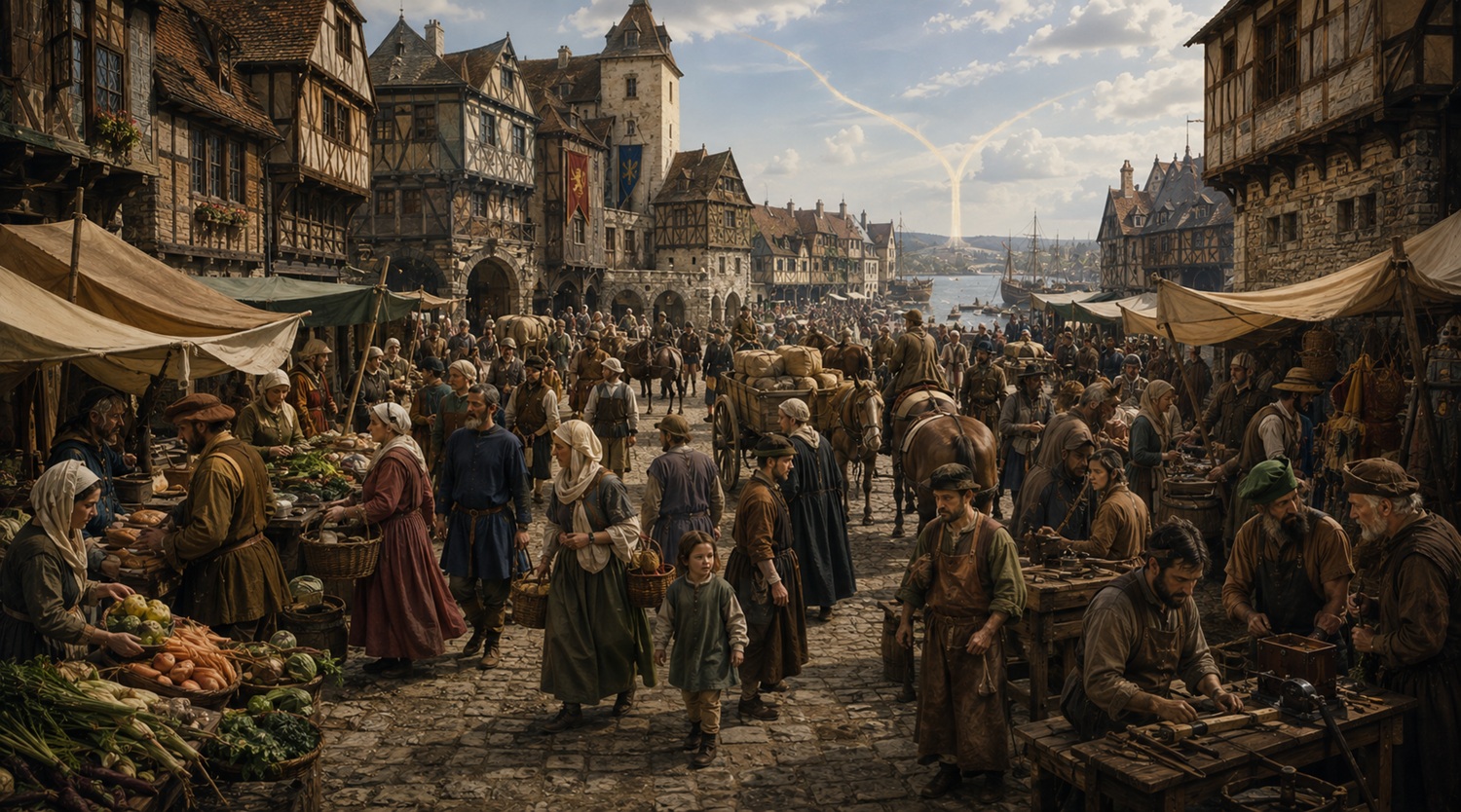
In the middle of the fourteenth century, a pandemic transformed much of Eurasia and North Africa.
Beginning in the late 1340s, plague swept through the Mediterranean, western Asia, North Africa, and Europe. Ancient-DNA research has established that the disease was caused by Yersinia pestis, the bacterium responsible for plague. Genetic evidence from medieval victims near Lake Issyk-Kul in present-day Kyrgyzstan has connected strains circulating there in 1338–1339 to the lineage that subsequently produced the Black Death.
Its mortality was enormous.
For Europe as a whole, estimates commonly fall around 30–50 percent of the population, although exact numbers remain uncertain and regional differences were substantial. Some communities suffered catastrophic losses while others experienced considerably lower mortality. Large-scale pollen research covering hundreds of European sites has reinforced the conclusion that demographic impact varied dramatically from region to region rather than following one uniform continental pattern.
The catastrophe was not exclusively European.
The Second Plague Pandemic affected the Near East and North Africa as well as Europe, and plague continued recurring across these regions for centuries. Egypt, Syria, Anatolia, Mediterranean islands, and other areas endured repeated outbreaks after the initial pandemic.
The Black Death therefore did far more than kill millions of people.
It changed the ratio between workers and land.
It altered wages.
It disrupted farms and cities.
It affected rents, inheritance, consumption, migration, religion, political conflict, and social mobility.
It intensified some forms of persecution.
It changed the bargaining position of peasants and laborers.
And it became one of the shocks through which historians have tried to understand Europe's later economic transformation.
But there is a danger in going too far.
The Black Death did not single-handedly end feudalism.
It did not invent capitalism.
It did not create cities.
It did not cause the Renaissance by itself.
It did not automatically produce modern technology.
Many of the commercial, institutional, intellectual, and political developments associated with late medieval Europe had begun long before 1347. Markets for land and labor, for example, were already well established in parts of western Europe before the plague.
So what happens if the pandemic never spreads on anything resembling its historical scale?
Not a world without disease.
Not a medieval utopia.
But a much more crowded fourteenth-century Eurasia in which one of history's greatest demographic shocks never occurs.
First: What Was the Black Death?
The Black Death was the opening, extraordinarily destructive phase of what historians and scientists call the Second Plague Pandemic.
Genomic evidence confirms Yersinia pestis as the pathogen, and recent paleogenetic research has pushed understanding of its emergence toward central Eurasia in the years immediately preceding the great pandemic. Researchers studying plague genomes from individuals buried near Lake Issyk-Kul in 1338–1339 found strains positioned close to the major genetic diversification associated with the later pandemic.
From Eurasian networks, plague eventually reached the Black Sea and Mediterranean worlds.
By 1347–1348 it was spreading through Mediterranean ports and inland routes. Over the following years it devastated vast areas of Europe while also striking western Asian and North African societies. Genetic research on later medieval plague has demonstrated the extraordinary geographic reach of the Second Pandemic across Europe and neighboring regions.
The disease then became recurrent.
The Black Death was not a one-time epidemic that disappeared after 1352.
Plague returned repeatedly to European, Middle Eastern, and North African communities for generations. Egypt in particular experienced repeated outbreaks under Mamluk rule, while the broader Mediterranean remained part of a continuing plague environment.
That distinction matters for our counterfactual.
To remove the historical consequences of the Black Death, it is not enough for one infected ship to miss Sicily.
The transmission network itself must fail to become an explosive, self-reinforcing transregional pandemic.
The Point of Divergence: The Plague Remains a Regional Eurasian Outbreak
The safest counterfactual does not pretend that Yersinia pestis disappears from nature.
Plague bacteria can persist in animal reservoirs, and plague had a history before the fourteenth century.
Instead, suppose the outbreak associated with the fourteenth-century plague lineage remains geographically constrained.
The divergence occurs in the 1340s.
Political conflict, interruptions to caravan traffic, changing patterns of commerce, and disruption around Black Sea routes greatly reduce the movement of people and goods through the crucial transmission corridors connecting central Eurasia with Mediterranean shipping.
Regional outbreaks still occur.
People still die.
But the plague does not establish itself simultaneously across multiple Black Sea and Mediterranean transport networks.
There are no large waves of infected maritime traffic seeding one port after another.
Constantinople, Alexandria, Sicily, Genoa, Marseille, and other major commercial centers do not experience the same linked epidemic sequence.
The outbreak burns through several regional populations and animal reservoirs but fails to become the enormous transcontinental catastrophe known to history.
This is speculative, but it changes fewer underlying conditions than imagining a biologically different medieval world.
The bacterium still exists.
The Eurasian trade networks still exist.
The difference is that an extraordinarily successful transmission event fails.
Plague could return later.
Indeed, that remains one of the largest uncertainties in the scenario.
Europe Before the Plague Was Already Under Pressure
Preventing the Black Death does not restore Europe to effortless prosperity.
The decades before 1347 had already been difficult.
Population had grown strongly during the High Middle Ages, placing increasing pressure on available agricultural resources in many regions.
Marginal land had been brought under cultivation.
Europe had experienced serious harvest crises, including the Great Famine of the early fourteenth century.
Real wages in some places were under pressure even before plague arrived. Research on English towns notes that in 1346 grain prices were high and laborers' real wages had fallen to particularly low levels.
The European economy was also already highly commercialized in many regions.
Towns, markets, fairs, merchant networks, wage labor, credit, and land transactions all predated the Black Death. Medieval European trade connected northern Europe, the Mediterranean, the Islamic world, and regions beyond.
The alternate world therefore begins with a paradox:
Europe avoids an enormous mortality catastrophe—but also avoids the sudden economic relief that depopulation provided to many survivors.
Population: The Most Immediate Difference
This is the strongest part of the counterfactual.
If a pandemic that historically killed perhaps a third to half of Europe's population never occurs on that scale, Europe in 1355 contains tens of millions more people than it otherwise would have.
That does not mean population simply continues rising exponentially.
Food supply still matters.
Other diseases still matter.
Infant mortality remains high.
War continues.
Bad harvests continue.
Climate conditions continue changing.
Regional famines remain possible.
Population might therefore stagnate or grow only gradually during portions of the later fourteenth century.
But there is no abrupt demographic chasm.
There are fewer abandoned villages.
Fewer suddenly vacant farms.
Fewer empty houses.
Fewer inheritances concentrated among survivors.
And far fewer situations in which one worker discovers that three employers now compete for his labor.
Labor Becomes the Great Difference
One of the most important economic effects of the historical Black Death was straightforward:
workers became scarce relative to land and capital.
Landowners still possessed fields.
Urban employers still possessed workshops.
But enormous numbers of people who had previously worked those farms and businesses were dead.
The resulting labor shortage increased workers' bargaining power in many parts of western Europe. Real wages rose, and governments and employers attempted to resist those changes.
England provides a famous example.
The government attempted to restrain the new labor market through the Ordinance of Labourers in 1349 and the Statute of Labourers in 1351. The statute sought to hold wages close to pre-plague levels, restrict worker mobility under certain circumstances, and penalize breaches of employment agreements.
The need for those extraordinary measures tells us something important.
Workers suddenly possessed leverage.
Without the Black Death, they possess much less of it.
Wages Without the Black Death
In the alternate timeline, the supply of labor remains comparatively abundant.
A landowner needing twenty harvest workers can still find them.
A master craftsman has more potential apprentices and journeymen.
A town has more migrants competing for available employment.
Employers therefore face less pressure to raise wages.
The famous post-plague rise in wages is substantially reduced or absent.
This does not mean wages never rise.
Productivity, prices, urban growth, political regulation, guild organization, wars, and changing demand can all affect labor compensation.
But the demographic shock that sharply changed the balance between employers and workers is missing.
By 1400, many ordinary laborers in western Europe would probably be worse off in income-per-worker terms than their counterparts were historically after the plague.
That sounds counterintuitive.
A world with millions fewer deaths can produce lower wages.
But the two facts are not contradictory.
What is good for population survival is not always good for the bargaining power of surviving workers.
Would Feudalism Last Longer?
Probably in some regions—but the answer is much more complicated than “yes.”
The historical argument is familiar.
The Black Death killed so many workers that lords found it increasingly difficult to enforce labor services and traditional restrictions.
Peasants could move.
Land became easier to obtain.
Employers competed for workers.
Attempts to preserve older labor obligations became more difficult.
This contributed to the erosion of serfdom in parts of western Europe.
But serfdom was already changing before plague arrived.
Research on medieval English factor markets emphasizes that labor markets had expanded well before 1348 and that the gradual decline of serfdom had pre-plague roots.
And Europe did not respond uniformly after the plague.
In parts of eastern Europe, later centuries saw stronger forms of peasant coercion rather than straightforward emancipation. That divergence demonstrates that demography alone did not determine social institutions. Landholding patterns, export markets, political organization, competition among landlords, state power, and local institutions all mattered.
So what changes?
Without the Black Death:
- western landlords have less difficulty finding labor;
- peasants have less ability to bargain collectively through simple scarcity;
- traditional dues and labor services are easier to maintain;
- rural mobility develops more slowly in some regions;
- landlords face less pressure to convert obligations into rents;
- employers have less reason to compete aggressively for workers.
Western European serfdom could therefore persist longer.
But it probably still declines over time in many commercialized areas.
The plague accelerated a transformation.
It did not invent that transformation.
Land Would Be More Valuable Relative to Labor
The plague also transformed the relationship between people and land.
When population collapses while the acreage of farmland remains roughly the same, land becomes abundant relative to workers.
Historically, some marginal farmland was abandoned.
Surviving peasants could sometimes enlarge their holdings.
Landlords shifted some land away from labor-intensive grain cultivation.
Pasture and livestock became more attractive in places where workers were expensive.
Research on post-plague Europe finds precisely these kinds of changes, although with considerable regional variation.
Without the plague, the opposite pressures remain stronger.
More mouths need food.
More rural families need land.
Marginal fields stay in cultivation longer.
Landlords have a larger pool of tenants.
Rents face less downward pressure.
Grain remains central because feeding a large population is economically important.
The countryside around 1400 therefore probably looks more intensively cultivated than it did historically in many plague-stricken areas.
Fewer Abandoned Fields, Less Forest Regrowth
Modern pollen research allows historians to see some of these changes in the physical landscape.
A major European study using more than 1,600 pollen samples from 261 sites found considerable regional variation in land-use changes around the Black Death, reinforcing the conclusion that some heavily affected areas experienced significant reductions in agricultural pressure while others did not.
In our alternate world, the strongest episodes of plague-related agricultural abandonment disappear.
Forest and scrub reclaim less farmland in severely affected regions because those regions no longer lose the same share of their farming population.
This does not mean there is no abandoned land.
Climate deterioration, warfare, local economic decline, soil exhaustion, flooding, and ordinary migration can still depopulate settlements.
But the continental-scale demographic driver is absent.
Would Europe Be More Urban?
This question has two competing answers.
In total population terms: probably
A Europe with far more surviving people could support more urban residents in absolute numbers.
Cities require people.
Merchants require customers.
Governments require administrators.
Craft industries require workers.
Markets require consumers.
In percentage terms: less obvious
The historical Black Death changed relative wages and the relationship between agriculture and other occupations.
Some workers moved into crafts and urban employment as economic opportunities changed.
By contrast, a densely populated agrarian economy can retain a larger share of its population in food production simply because land and food are under greater pressure.
European urbanization had begun long before the Black Death. The revival and growth of European towns dated back centuries, and by the fourteenth century urban institutions were already a major component of European society.
So cities such as Florence, Venice, Paris, London, Bruges, Ghent, Barcelona, Genoa, and others do not require plague in order to develop.
But their demographic and economic trajectories change.
Cities Would Be More Crowded
One likely difference is density.
Historically, plague repeatedly created vacancies in urban housing and labor markets.
Without the first massive mortality shock, surviving cities face greater demographic pressure.
That could mean:
- higher rents;
- more overcrowding;
- stronger competition for work;
- heavier pressure on food supplies;
- larger suburban settlements;
- greater sanitation problems;
- greater vulnerability to other epidemic diseases.
Urban governments would have strong incentives to regulate markets, food supplies, housing, waste, and migration.
Ironically, removing plague does not necessarily make medieval cities healthier.
It may simply replace one catastrophic disease with the chronic mortality pressures of dense premodern urban life.
Guilds and Crafts
Guilds already existed before the Black Death.
They were not created by labor scarcity, and their role varied substantially among European towns.
Craft guilds regulated apprenticeship, occupational entry, product standards, mutual aid, political participation, and commercial relationships in many places. The urban economic world of guilds and organized crafts developed as part of a much longer medieval history.
The plague did, however, alter labor markets within that system.
Post-plague shortages sometimes gave workers stronger bargaining positions and opened opportunities that would have been more difficult in a crowded economy. In some European settings, labor scarcity also benefited women workers, although guild access and occupational opportunities remained highly unequal and locally specific.
Without the Black Death, masters face a larger labor pool.
Apprenticeships remain easier to fill.
Employers have less incentive to relax occupational restrictions.
Guild hierarchies may therefore remain somewhat more restrictive.
But commerce and crafts continue.
The medieval market economy had already developed too far for plague avoidance to send Europe back to a purely manorial economy.
Trade Does Not Need the Black Death
One of the stranger misconceptions surrounding the period is that the plague somehow cleared the way for commerce.
In reality, the Black Death initially disrupted trade.
Merchants died.
Shipping was interrupted.
Demand collapsed in some markets.
Workshops lost employees.
Agricultural production was disturbed.
Contemporary economies had to adjust to an extraordinary reduction in population.
Medieval trade was already extensive before the pandemic.
Commercial networks linked northern Europe and the Mediterranean, while Mediterranean merchants maintained connections with North Africa, the Black Sea, and Islamic trading systems. Merchants used sophisticated institutions for credit, partnerships, transport, dispute resolution, and long-distance exchange.
Without plague, therefore, Europe's commercial economy does not disappear.
In the short term it may actually be stronger because merchants, customers, sailors, artisans, and financiers are still alive.
The longer-term question is different:
Does a high-population, lower-wage economy develop the same consumption patterns and incentives as the post-plague world?
Probably not.
Per-Capita Consumption Would Likely Be Lower
The Black Death created a grim economic paradox.
Total production fell because millions of people died.
But many survivors possessed more land, higher wages, larger inheritances, and greater access to goods.
That increased consumption opportunities for some ordinary households.
Research on western Europe identifies falling land values, rising labor scarcity, and reductions in inequality in several regions after the pandemic.
Without plague, aggregate economic output might be larger simply because there are more workers and consumers.
But output per person could be lower.
That distinction is central to answering whether Europe would become richer or poorer.
Would Europe Become Richer or Poorer?
The answer depends upon what “richer” means.
Total economy
Probably larger in the fourteenth and early fifteenth centuries.
More people produce more food, cloth, tools, buildings, services, and taxes.
There are more consumers.
More cities retain their populations.
More merchants and craftsmen survive.
Income per person
Probably lower, especially for ordinary workers in parts of western Europe.
The historical plague raised the ratio of land and capital to labor, increasing the economic value of workers. Without that shock, labor remains abundant.
Landowners
Many would probably be better positioned than they were historically.
They retain more tenants.
Rents remain stronger.
Labor is cheaper.
Inequality
It could remain higher.
Research from parts of Europe shows that the Black Death compressed wealth inequality for a time because mortality and labor scarcity weakened some established economic hierarchies.
Therefore:
Europe without the Black Death might be richer in aggregate but poorer for the average wage earner.
That is one of the most plausible large-scale consequences.
The Religious World Without the Great Plague Trauma
The medieval Church remains immensely powerful.
Christian institutions do not depend upon the Black Death.
Monasteries, cathedral chapters, parish churches, universities, pilgrimage, canon law, religious orders, and papal government all predate the pandemic.
But the plague created an extraordinary spiritual crisis.
People struggled to explain mass death.
Penitential movements expanded.
Clergy died alongside laypeople.
Communities turned toward devotional practices, saints, processions, charitable foundations, and other forms of religious response.
Some movements became extreme.
The flagellant movement, in which groups publicly performed acts of penitence, expanded during the crisis.
Without the Black Death, that particular wave of apocalyptic and penitential response is greatly reduced.
The Church still faces criticism.
The Avignon Papacy still exists.
The Great Western Schism beginning in 1378 can still occur because its origins lie in papal and political conflicts independent of the plague.
Later reform movements can still emerge.
The religious history of Europe changes in tone and timing rather than simply becoming more stable.
One Horror That Becomes Much Less Severe: Plague-Era Persecution of Jews
During the historical Black Death, frightened communities searched for explanations and scapegoats.
Jewish communities were accused of poisoning wells and causing the disease.
These accusations were false.
They nevertheless contributed to massacres, expulsions, forced confessions, and the destruction of Jewish communities across parts of Europe. Cambridge scholarship on the German lands estimates devastating losses to Jewish populations during the persecutions of 1348–1351.
Without the pandemic, this particular wave of mass persecution loses its immediate trigger.
That could save many thousands of lives and preserve Jewish communities that were historically destroyed or displaced.
But medieval antisemitism does not disappear.
Earlier expulsions, discrimination, religious hostility, legal restrictions, ritual-murder accusations, and political exploitation of Jewish communities all predated the Black Death.
So the counterfactual conclusion must remain limited:
No Black Death probably means no 1348–1351 plague-driven persecution on its historical scale. It does not mean medieval European antisemitism disappears.
Popular Unrest Would Change Too
Post-plague labor relations generated political conflict.
Landlords tried to preserve older obligations.
Governments attempted to control wages.
Workers resisted.
English authorities' wage legislation became a persistent source of conflict, while later fourteenth-century unrest involved taxation, lordship, labor regulation, and political grievances. The revolt of 1381 included both rural and urban participants and cannot be reduced to one cause, but post-plague social tensions formed part of its background.
Without the Black Death, England could still experience rebellion.
The Hundred Years' War still creates taxation pressures.
Royal government still produces grievances.
Local lordship still generates disputes.
Religious and political tensions remain.
But there is no identical post-plague struggle over workers refusing to accept old wage levels and labor restrictions.
The Peasants' Revolt of 1381 therefore probably does not happen in precisely its historical form.
A different tax or political revolt remains entirely possible.
Technology: Would Innovation Slow Down?
Possibly in some sectors.
But this is another area where simple claims should be resisted.
A labor shortage makes machines and labor-saving organization relatively attractive.
If workers become expensive, employers have stronger incentives to find ways of producing the same output with fewer workers.
Some economic historians therefore connect post-plague wage increases with stronger incentives for labor-saving technological development.
Without the demographic shock:
- labor stays cheaper;
- mechanization saves less money;
- labor-intensive production remains more competitive;
- some substitutions from people toward machines happen more slowly.
That is a reasonable economic inference.
It does not follow that technological innovation stops.
Medieval Europe had experienced substantial technological development before 1347.
Watermills, windmills, mechanical clocks, improved shipbuilding, mining technology, metallurgy, military innovations, and complex construction techniques had long histories independent of plague.
So the effect is most likely one of incentives and pace, not the presence or absence of invention itself.
Would Gutenberg Still Invent the Printing Press?
Probably some form of European movable-type printing still appears.
The historical printing revolution of the fifteenth century depended upon developments in metallurgy, paper supply, ink, literacy, urban markets, investment, and existing demand for texts.
Some historians have suggested that the high-wage environment created after the plague could encourage labor-saving technologies such as printing.
But that does not make Gutenberg's press a direct consequence of plague.
Demand for books was already growing through universities, religious institutions, administration, commerce, and lay literacy.
Paper manufacturing was expanding.
Metalworking skills existed.
If Gutenberg himself never develops the same system around the 1440s, another printing technology could emerge.
A lower-wage world could make hand copying relatively cheaper for longer, potentially slowing adoption.
But predicting that printing is delayed by exactly ten, fifty, or one hundred years would be unjustified.
Warfare Still Happens
Preventing the Black Death does not prevent the Hundred Years' War.
That conflict between the English and French monarchies had begun in 1337, roughly a decade before the plague reached western Europe. Its origins lay in dynastic, territorial, and political disputes that long predated the pandemic.
Edward III does not suddenly abandon his claims because plague never arrives.
French political conflicts continue.
Armies still campaign.
Castles still matter.
Gunpowder weapons continue developing.
Mercenary warfare continues.
Italian city-states still fight.
Iberian kingdoms still compete.
The eastern Mediterranean remains politically contested.
In one sense, war could become larger.
A higher population provides rulers with:
- more potential soldiers;
- more taxpayers;
- more agricultural producers;
- more towns from which to extract resources.
But it also creates more mouths to feed, and medieval armies remain constrained by logistics.
The plague historically killed soldiers and taxpayers alike.
Without it, governments have a larger demographic base from which to wage war.
State Formation Becomes Different, Not Absent
European states were already becoming more sophisticated before the Black Death.
Kings were expanding taxation.
Law courts were developing.
Bureaucracies were growing.
Representative institutions were being used to negotiate taxation.
War repeatedly pressured rulers to improve revenue collection and administration. Historians continue to emphasize the close relationship between warfare and European state development.
Plague changed this process by shrinking populations and tax bases.
A government suddenly ruling 30 or 40 percent fewer taxpayers faced very different fiscal problems.
Without the plague, monarchies in France, England, Iberia, and elsewhere possess larger revenue bases.
That could strengthen central government.
Yet elite landholders also retain more economic power because land rents and access to labor remain favorable.
The result could therefore be contradictory:
richer states governing societies in which traditional landlords remain stronger.
There is no reason to assume that no plague automatically produces either centralized monarchy or feudal fragmentation.
Political institutions would still vary by region.
The Mediterranean World Matters
A European-only alternate history misses half the story.
Plague also affected the Islamic Mediterranean and western Asian worlds.
Mamluk Egypt suffered severe and recurrent demographic losses. Research on Egypt has linked plague-related population decline to rural disruption, migration, weakening of irrigation systems, and longer-term economic problems.
Without repeated fourteenth-century plague at comparable scale:
Egypt retains more farmers.
Irrigation infrastructure has a larger labor force.
Cairo retains more inhabitants and specialists.
Tax revenues are less damaged by demographic collapse.
Agricultural production may remain stronger.
That could strengthen the Mamluk state economically.
But the Mamluks still face political competition, military change, internal factionalism, and eventually Ottoman expansion.
Would the Ottoman Empire Still Rise?
Probably.
The Ottoman state was already expanding during the fourteenth century.
Its rise cannot be explained simply by plague.
Military organization, frontier politics, Byzantine weakness, Balkan divisions, dynastic leadership, geography, and political alliances all contributed.
Some scholarship has explored the relationship between plague and Ottoman expansion, including the possibility that differential demographic and economic impacts altered the regional balance of power.
Without the Black Death, however, the states facing Ottoman expansion may be stronger demographically.
Byzantine territories, Balkan states, Mediterranean rivals, and the Mamluk world retain more population.
That could make Ottoman expansion:
- slower;
- more expensive;
- geographically different;
- or dependent on different alliances.
It does not make Ottoman success impossible.
By 1500, the Ottoman state could still be a major imperial power.
Whether Constantinople falls in exactly 1453 is much less certain once a century of population, finance, and warfare has diverged.
A More Populous Middle East
The economic consequences outside Europe could differ from western Europe because institutions were different.
Research on medieval and early-modern Middle Eastern economies suggests that the initial plague shock could also raise real wages and per-capita incomes where labor became scarce, much as it did in parts of Europe.
Without that shock:
- wages remain lower;
- agricultural labor remains more abundant;
- state tax bases remain larger;
- urban populations remain denser;
- irrigation systems potentially retain more maintenance labor.
Again, aggregate output could be larger while individual laborers possess less bargaining power.
The fundamental demographic economics operate beyond Christian Europe.
Does the Renaissance Still Happen?
Yes—although even the word “happen” can be misleading.
The Renaissance was not a single event that began because plague killed medieval society.
Italian humanism already had important roots before the Black Death.
Petrarch, born in 1304, was already pursuing literary and classical interests before the great epidemic.
Italian cities had developed extensive commercial, artistic, political, and intellectual cultures over centuries.
Universities predated the pandemic.
Classical texts had never vanished completely.
Contact with Byzantine and Islamic scholarship continued independently.
The Black Death certainly affected Renaissance societies. It changed wealth distribution, patronage, inheritance, labor markets, urban populations, and cultural responses to mortality. Research on Renaissance Italy identifies important post-plague reductions in economic inequality followed by new strategies among elites seeking to preserve social distinction.
But saying “the Black Death caused the Renaissance” reverses a much more complicated history.
A Different Renaissance Economy
Without the plague, Florence, Venice, Genoa, Milan, and other Italian centers continue developing.
Bankers still lend.
Merchants still trade.
Artists still receive commissions.
Humanists still study classical texts.
Printers may eventually publish them.
But the social environment changes.
There are more workers.
Wages are lower.
Land and housing are more expensive.
Inheritance is divided among more surviving relatives.
Wealth remains less redistributed by mass mortality.
That could mean greater inequality and stronger established elites.
On the other hand, larger populations also create larger markets.
More consumers buy cloth.
More merchants conduct business.
More urban residents support services.
More taxpayers fund governments and public works.
The alternate Renaissance could therefore be larger in population and total production but less prosperous per capita.
Does Capitalism Still Develop?
Yes, if by capitalism we mean the long-term growth of markets, wage labor, commercial investment, finance, private enterprise, and eventually industrial economic systems.
Those trends were not born in 1348.
Markets and wage labor had been expanding in medieval Europe for centuries before plague arrived.
The Black Death could accelerate certain elements of that transformation:
- labor mobility;
- wage bargaining;
- changing land use;
- declining serfdom in parts of western Europe;
- greater consumption by surviving workers;
- labor-saving investment.
But there was no straight road from plague to capitalism.
Different regions experienced similar disease shocks and followed different institutional paths.
The Middle East, eastern Europe, Italy, England, the Low Countries, Iberia, and other regions did not all respond identically.
Without plague, commercial capitalism probably still expands.
Its geography and timetable change.
1350: The First Alternate Snapshot
Real history
Plague has swept across much of Europe and the Mediterranean.
Communities have lost extraordinary portions of their populations.
Farms are short of workers.
Urban workshops have lost craftsmen.
Clergy have died.
Trade has been disrupted.
Governments begin reacting to labor shortages and social dislocation.
Alternate 1350
The central Eurasian outbreak has failed to become a Mediterranean-wide pandemic.
Europe remains crowded.
The Hundred Years' War continues.
Food prices and access to land remain pressing concerns.
Landlords still have large tenant populations.
Urban employers have no sudden shortage of workers.
England has no reason to enact the Statute of Labourers in response to plague-induced wage pressure.
There are no plague-driven massacres of Jewish communities on the scale of 1348–1351.
Cairo, Constantinople, Mediterranean ports, and western Asian cities avoid the same catastrophic epidemic cycle.
Europe and the Mediterranean have escaped mass death.
But ordinary workers have not received the bargaining-power windfall that historical survivors experienced.
1400: A Crowded Late Medieval World
Real history
Europe remains far below its early-fourteenth-century population in many regions.
Plague has returned repeatedly.
Wages are relatively high in parts of western Europe.
Some abandoned farmland has shifted toward pasture or woodland.
Serfdom has weakened substantially in parts of the West.
Social conflict over labor, taxes, and lordship has occurred.
Alternate 1400
Population remains high, although famine, war, and ordinary disease have slowed growth.
Marginal farmland remains under heavier cultivation.
Land is expensive.
Labor is relatively cheap.
Peasants have less leverage against landlords.
Some western forms of serfdom remain stronger.
Towns contain larger populations but also greater overcrowding.
Long-distance commerce continues developing.
England and France are still fighting their dynastic war.
Italian cities remain commercial and cultural centers.
Ottoman expansion in southeastern Europe continues, but it encounters Balkan and Byzantine societies that have not suffered the same demographic shock.
The world looks recognizably medieval.
It is simply much more densely inhabited.
1500: The Divergence Widens
By 1500, predictions become less certain.
Real history
Western European wages have experienced long post-plague changes.
Serfdom has declined substantially in several western regions.
Renaissance culture flourishes in Italy.
Printing has spread.
Portugal is pushing into the Indian Ocean.
Columbus has crossed the Atlantic.
The Ottoman Empire controls Constantinople.
European demographic recovery is underway.
Alternate 1500
Europe may only now be approaching levels of population pressure that historically existed before the Black Death.
If the demographic system repeatedly presses against food supply, wages remain comparatively low.
Large landlords retain greater influence in some regions.
Commercial towns still flourish because trade did not depend on plague.
Printing probably exists, although its timing and rate of adoption could differ.
Italian humanism and Renaissance art still develop.
Portuguese maritime expansion remains plausible because its causes include trade, navigation, state competition, and access to African and Asian markets.
Atlantic exploration remains plausible.
The Ottoman state may still dominate much of southeastern Europe, though its exact borders and the timing of major conquests could differ.
The most visible difference might be social rather than technological:
a more crowded Europe with cheaper labor and more persistent rural hierarchy.
1600: Would the Difference Still Matter?
Absolutely.
But by 1600 the alternate world has accumulated 250 years of divergence.
Specific predictions become increasingly unreliable.
One broad distinction remains plausible.
Historically, parts of western Europe enjoyed a long period in which population was relatively low compared with available land after the Black Death, contributing to comparatively high real wages. Later population recovery eroded some of that advantage. Economic research finds that some post-plague efficiency and wage gains diminished again as populations rose in the early modern period.
Without the original collapse, western Europe may never experience that prolonged high-wage window.
That could influence:
- labor-saving investment;
- household consumption;
- inequality;
- urban migration;
- marriage patterns;
- agricultural specialization;
- colonial labor demand;
- migration overseas.
But by 1600, the Reformation, Atlantic colonization, the American silver economy, gunpowder warfare, Ottoman-European competition, printing, religious conflict, and maritime empires introduce enormous new forces.
No serious counterfactual can simply extrapolate medieval wage differences indefinitely.
Real History vs. a No-Black-Death World
| Date | Real Historical Development | Plausible Alternate Development |
|---|---|---|
| c. 1350 | Massive mortality across Europe and the Mediterranean; acute labor shortages emerge. | Regional plague outbreaks remain contained; population remains high and labor comparatively abundant. |
| c. 1400 | Repeated plague has kept populations low; wages have risen in many western regions; land use has shifted in some areas. | Higher population keeps pressure on land and food; wages remain lower; traditional rural obligations are easier to maintain. |
| c. 1500 | European population is recovering; Renaissance economies and printing flourish; western serfdom has weakened considerably in several regions. | Renaissance, commerce and printing still develop, but under higher population density, lower wages and potentially stronger landlord power. |
| c. 1600 | Europe has largely recovered demographically and is entering an Atlantic, gunpowder and confessional age. | Many technological and geopolitical developments still occur, but economic institutions reflect centuries without the post-plague labor-scarcity shock. |
The alternate column becomes increasingly speculative with time.
Would Feudalism Last Longer?
The best answer is:
Yes in some western regions, but probably not forever.
The plague made labor scarce.
Scarce labor made coercion harder.
That strengthened peasants' ability to negotiate, move, rent land, or refuse obligations.
Removing the plague takes away that sudden advantage.
Yet commercialization, monetization, legal change, urban opportunities, landlord competition, and labor markets were already weakening older forms of dependency.
So a no-plague England in 1500 might contain more surviving customary obligations and a larger dependent peasantry than historical England.
It would not necessarily resemble England in 1200.
Elsewhere, outcomes could differ entirely.
There was never one uniform European “feudal system” whose expiration date the Black Death alone determined.
Would Europe Become Richer or Poorer?
This question has two answers.
Europe as an economy might initially be richer
Millions more people survive.
They work.
They produce.
They trade.
They pay taxes.
They build houses.
They buy food and cloth.
Total output is therefore likely higher.
Many Europeans individually might be poorer
Labor is less scarce.
Wages remain lower.
Land remains expensive.
Workers have less bargaining power.
Inequality may remain greater.
This distinction helps explain why historians can describe the Black Death simultaneously as a human catastrophe and as an event that improved some survivors' material living standards.
The death was catastrophic.
The scarcity that followed sometimes benefited those who lived.
What Still Changes Anyway?
Removing the Black Death does not freeze the world in 1346.
A remarkable amount of familiar history still has strong independent causes.
The Hundred Years' War continues
It began before the plague.
Italian Renaissance culture develops
Commercial wealth, classical scholarship, urban politics and patronage all predate or exist independently of plague.
European trade continues expanding
Medieval commercial networks were already highly developed.
Printing remains likely
Paper, metallurgy, literacy and demand for books continue developing even if labor costs differ.
Gunpowder warfare continues
Military innovation is already underway.
Ottoman expansion continues
The political forces behind Ottoman growth do not disappear merely because plague mortality is lower.
The Western Schism can still occur
Its immediate causes concern papal elections and European politics.
Religious reform movements still emerge
The Church still faces disputes over authority, wealth, theology and pastoral practice.
Atlantic exploration remains plausible
Portuguese and Iberian maritime expansion has economic and political causes independent of the Black Death.
Climate changes
Late medieval climatic variability continues affecting harvests and settlement.
Other epidemics happen
Medieval populations remain vulnerable to disease even without the great plague pandemic.
What Changes Most?
Several consequences are much more directly connected to the demographic shock.
1. The great western European labor shortage is absent
This is the strongest economic conclusion.
2. Real wages rise less sharply
Workers retain less bargaining power.
3. Land remains more expensive relative to labor
More people compete for farms and housing.
4. Rural social obligations probably weaken more slowly
Especially in portions of western Europe.
5. Agricultural abandonment is reduced
Marginal farmland remains economically necessary for longer.
6. Plague-era Jewish massacres are dramatically reduced
The specific well-poisoning panic associated with the epidemic lacks its trigger.
7. Post-plague labor legislation disappears
There is no identical English Statute of Labourers attempting to reverse a plague-induced wage explosion.
8. Per-capita prosperity rises less for survivors
Because there is no comparable redistribution of land, inheritance and bargaining power.
9. North African and western Asian states retain larger populations
Especially significant for agricultural and fiscal systems such as Mamluk Egypt.
10. Labor-saving incentives are weaker
But technological innovation still continues.
What Changes Less Than People Assume?
“The Renaissance never happens”
Unlikely.
Its roots are broader than plague.
“Capitalism never emerges”
Too strong.
Markets, commercial finance and wage labor had deep medieval foundations.
“Serfdom lasts forever”
Unlikely.
Its decline already had pre-plague causes.
“Europe never develops technology”
Unsupported.
Technological development was underway long before 1347.
“The Catholic Church remains permanently unchallenged”
Unsupported.
Institutional and theological disputes had many independent causes.
“Europe becomes permanently overpopulated”
Too deterministic.
Population can adjust through fertility, marriage, migration, famine and other mortality.
“No Black Death means no Ottoman Empire”
Unsupported.
Plague was only one factor in a much broader geopolitical transformation.
A World Without the Black Death Is Not Necessarily a Happier Europe by 1500
At first glance, the moral calculation seems obvious.
Tens of millions of people do not die.
Families survive.
Children keep their parents.
Communities remain intact.
Jewish communities escape a major wave of plague-inspired persecution.
Cities avoid mass burial.
That is unquestionably a less catastrophic fourteenth century.
But history after the survivors is more complicated.
The Europe of 1400 would be more crowded.
Workers could earn less.
Landless peasants might face greater difficulty obtaining farms.
Lords could preserve coercive obligations longer.
Urban housing might be more expensive.
Food scarcity could remain more acute.
Inequality might remain stronger.
Land-intensive elites lose less power.
A larger population could also allow rulers to field larger armies and raise more taxes.
Avoiding one kind of suffering does not automatically create prosperity.
It creates a different demographic world.
The Black Death Did Not “Create the Modern World”
It is tempting to turn catastrophes into simple origin stories.
The Black Death killed so many people that workers became scarce.
Workers demanded more money.
Feudalism collapsed.
Machines replaced labor.
Capitalism emerged.
The Renaissance followed.
Then Europe became modern.
That narrative is clean.
It is also much too clean.
Historical development is rarely a row of dominoes.
Labor markets already existed before the plague.
Commercial networks already spanned Europe and the Mediterranean.
Serfdom was already changing in parts of western Europe.
Urban culture already flourished.
States were already expanding taxation.
Universities already existed.
Italian humanism was already developing.
Technological innovation already occurred.
The Black Death altered the speed, balance, profitability and political consequences of many of these processes.
That is significant enough.
It does not need to be turned into the sole cause of everything that followed.
How Plausible Is the Scenario?
The Black Death fails to become a transcontinental pandemic
Plausible as a counterfactual, but requiring several transmission chains to fail.
Plague had to move through interconnected human, animal and commercial environments. Interrupting major transmission pathways could plausibly reduce its geographic reach, although the exact mechanisms of medieval spread remain an active field of research.
Europe avoids the plague indefinitely
Much less plausible.
As long as Yersinia pestis reservoirs persist and Eurasian trade continues, later introductions remain possible.
Europe has a much larger population in 1400
Very strong.
Removing a catastrophe that historically killed an enormous fraction of the population directly produces this outcome.
Western European wages remain lower
Strong.
The historical labor shortage was a major driver of wage pressure.
Serfdom survives longer
Reasonable in some areas, but not universal.
Its decline had begun before the plague and varied widely among regions.
Capitalism fails to emerge
Weak.
Commercialization and factor markets had significant pre-plague foundations.
Labor-saving technology develops more slowly
Plausible in selected sectors.
Cheaper labor reduces some incentives to substitute capital for workers.
The Renaissance never happens
Very weak.
The Renaissance cannot responsibly be reduced to one demographic catastrophe.
The plague-era massacres of Jews are avoided
Strong for the specific 1348–1351 persecution wave.
Those massacres were directly connected to false accusations surrounding plague.
Mamluk Egypt remains stronger
Plausible, but uncertain.
Avoiding repeated demographic losses would improve its labor and tax base, but many other political and economic forces affected Mamluk history.
The AltHistAI Verdict
If the Black Death had never spread across Europe, North Africa, and western Asia on its historical scale, the most immediate consequence would be obvious:
tens of millions more people would survive the fourteenth century.
That alone would transform late medieval history.
But the economic consequences would produce a strange reversal.
The historical plague created an enormous shortage of workers. In much of western Europe, that shortage raised wages, weakened landowners' ability to enforce older labor arrangements, lowered the relative value of land, and gave many surviving peasants and workers greater economic leverage. Governments tried to resist the change—the English Statute of Labourers of 1351 is one of the clearest examples—but demographic reality was difficult to legislate away.
Without the plague, that revolution in bargaining power does not occur.
Europe around 1400 would probably be much more densely populated.
Farm workers would be easier to find.
Wages would be lower.
Land would be more expensive.
Marginal farmland would remain under cultivation.
Landlords would be better positioned to preserve rents, dues, and labor obligations.
Western serfdom could therefore last longer in some regions.
But it would not last forever merely because plague was absent.
Commercialization, urban growth, monetization, labor markets, landlord competition, and legal change had all begun transforming medieval society before 1348.
The same caution applies to capitalism.
The Black Death did not create markets.
It did not invent wage labor.
It did not invent banking or long-distance commerce.
Those systems already existed.
What the plague did was radically change relative prices—especially the price of labor—and thereby accelerate some changes while disrupting others.
Remove the catastrophe and commercial development continues.
It simply proceeds under a different balance of land, labor, wealth, and political power.
Cities would probably contain more people.
Trade would avoid the immediate shock of mass mortality.
Guilds and masters would have access to more workers.
Established elites might retain more wealth because inheritance and property would not be redistributed through mass death.
Aggregate European output could actually be greater.
Yet many ordinary Europeans might have lower living standards than historical plague survivors because they would compete with many more people for employment and land.
The religious consequences would be profound but not revolutionary in a simple direction.
Christianity remains central.
The papacy still faces institutional crises.
Later reform movements remain possible.
But the extraordinary plague-era culture of mass penitence and apocalyptic fear is weaker.
Most importantly, the false accusations that Jews had poisoned wells lose their immediate context. The devastating persecutions that destroyed Jewish communities in parts of Europe during 1348–1351 would probably be greatly reduced or avoided, even though medieval antisemitism itself would remain.
Outside western Europe, the consequences are equally important.
Mamluk Egypt and other Mediterranean societies would retain much larger agricultural and urban populations.
Irrigation systems would have more labor available for maintenance.
Tax revenues would suffer less demographic damage.
Cairo and other cities would avoid repeated plague losses on the same scale.
That could alter the political balance of the eastern Mediterranean.
Ottoman expansion could become harder.
But it would not necessarily stop.
The Ottoman rise had military, political, geographic, and dynastic causes far larger than plague alone.
The Hundred Years' War continues because it had already begun.
Italian humanism continues.
Mediterranean commerce continues.
European monarchies continue trying to raise taxes.
Gunpowder continues spreading.
Printing remains likely.
Portuguese maritime exploration remains plausible.
The Renaissance still develops.
Europe does not remain frozen in the Middle Ages simply because one pandemic never arrives.
And that leads to the strongest conclusion.
The Black Death was neither a meaningless interruption nor the single event that invented modern Europe.
It was an enormous accelerator and redistributor.
It redistributed land.
It redistributed wealth.
It redistributed bargaining power.
It changed the relative economic value of workers.
It destroyed communities and created openings for survivors.
It weakened some traditional institutions while strengthening others.
It intensified persecution and social fear while simultaneously disrupting established hierarchies.
Without it, Europe would probably enter the fifteenth century with more people, cheaper labor, stronger landlords, greater pressure on land, less per-capita wealth, and fewer incentives for some kinds of labor-saving change.
North Africa and western Asia would likewise retain larger populations and stronger tax bases.
But the broad transition from medieval to early-modern societies would continue.
The Renaissance would not disappear.
Commerce would not disappear.
Technology would not disappear.
Political centralization would not disappear.
History would simply travel toward them along a different road.
Perhaps the deepest irony is that a world spared one of humanity's worst pandemics could be simultaneously more populous and less prosperous for many ordinary workers.
That does not make the plague beneficial.
Millions of deaths are not an economic policy.
It demonstrates something more uncomfortable about demographic history:
catastrophe can destroy societies while also changing the balance of power among the survivors.
Without the Black Death, late medieval civilization would be healthier in the most basic sense—millions of human beings would still be alive.
But it would also be more crowded.
More competitive for land.
More favorable to employers.
More favorable to landlords.
And perhaps slower to dismantle some of the social hierarchies that plague survivors discovered they suddenly had the leverage to challenge.
The Black Death did not create the modern world.
But removing it would still create a profoundly different one.
Key Takeaways
- Ancient DNA confirms that the Black Death was caused by Yersinia pestis, and genomic evidence links the pandemic lineage to plague circulating in central Eurasia in the 1330s.
- The Black Death killed an extraordinary share of Europe's population, commonly estimated around 30–50 percent, although mortality varied considerably by region.
- The pandemic also devastated parts of western Asia, North Africa and the Mediterranean and was not exclusively a European event.
- A plausible counterfactual has the fourteenth-century outbreak remaining regionally constrained rather than eliminating Yersinia pestis altogether.
- Without mass mortality, Europe in 1400 would probably contain a dramatically larger population.
- The historical shortage of labor raised wages and increased workers' bargaining power in many western European economies.
- Without that shortage, wages would likely remain lower and land relatively more expensive.
- Serfdom could survive longer in parts of western Europe, but its decline had important pre-plague causes and should not be attributed to the Black Death alone.
- More farmland would probably remain under cultivation because a larger population would continue needing food and land.
- Guilds, markets and long-distance commerce would continue because all existed before the pandemic.
- Europe might have a larger aggregate economy but lower wages and lower per-capita consumption among many workers.
- Plague-era massacres of Jewish communities would probably be greatly reduced because the false accusations of well poisoning would lack their specific epidemic trigger.
- Medieval antisemitism itself would not disappear.
- The absence of labor scarcity could reduce incentives for certain labor-saving technologies, but technological development would continue.
- The Hundred Years' War would still occur because it began before the Black Death.
- Mamluk Egypt and other Mediterranean societies could retain larger agricultural populations, tax bases and stronger infrastructure.
- Ottoman expansion remains plausible but could proceed differently against more populous regional rivals.
- The Renaissance would still develop because its commercial, artistic, intellectual and institutional roots cannot be reduced to the plague.
- Capitalism would not simply disappear; medieval markets, wage labor and commercialization had developed substantially before 1348.
- The strongest overall counterfactual is a fifteenth-century Europe that is more populous, lower-wage, more land-constrained and socially more hierarchical than the Europe that actually emerged from the Black Death.
Sources and Further Reading
Monica H. Green and the growing paleogenetic literature on the Second Plague Pandemic.
Recent scholarship combines documentary history with pathogen genomics to reconstruct plague's movement across medieval Eurasia and to reassess older assumptions about where and when the pandemic emerged.
Maria A. Spyrou et al., “The source of the Black Death in fourteenth-century central Eurasia,” Nature (2022).
Ancient-DNA study linking Yersinia pestis found in 1338–1339 burials near Lake Issyk-Kul to the lineage associated with the Black Death.
Kirsten I. Bos et al., “A draft genome of Yersinia pestis from victims of the Black Death,” Nature (2011).
Landmark genomic confirmation of Y. pestis in Black Death victims and discussion of estimated European mortality.
Maria A. Spyrou et al., “Phylogeography of the second plague pandemic revealed through analysis of historical Yersinia pestis genomes,” Nature Communications (2019).
Reconstructs plague genomes across Europe during the Second Pandemic and discusses its wider European, Near Eastern and North African range.
Adam Izdebski et al., “Palaeoecological data indicates land-use changes across Europe linked to spatial heterogeneity in mortality during the Black Death pandemic,” Nature Ecology & Evolution (2022).
Uses large-scale pollen data to demonstrate that the Black Death's demographic and land-use impact varied considerably across Europe.
Mark Bailey, research on medieval English labor markets and After the Black Death.
Important for understanding how labor scarcity changed wages, mobility and government intervention—and for avoiding overly simple narratives about the transition from serfdom to free labor.
Bruce M. S. Campbell, “Factor Markets in England before the Black Death,” Continuity and Change.
Demonstrates the substantial development of labor, land and capital markets before 1348, an important corrective to claims that the plague created market society.
The Cambridge History of Capitalism, “Markets and Coercion in Medieval Europe.”
Surveys the long development of markets, wage labor and the decline of unfreedom while examining how the plague altered, rather than originated, those trends.
Guido Alfani, “Plague and Lethal Epidemics in the Pre-Industrial World,” Journal of Economic History.
Comparative discussion of plague's economic, demographic, cultural and institutional consequences in preindustrial societies.
Gregory Clark, “Microbes and Markets: Was the Black Death an Economic Revolution?” Journal of Demographic Economics.
Examines wages, productivity and economic efficiency after the Black Death and cautions against assuming that all post-plague economic gains were permanent.
Nükhet Varlık, Plague and Empire in the Early Modern Mediterranean World. Cambridge University Press.
Essential for moving the history of plague beyond a purely western European narrative and understanding its impact on Ottoman and Mediterranean societies.
Stuart J. Borsch, research on plague, population and irrigation in medieval Egypt.
Shows how demographic decline in Egypt could affect irrigation, agriculture and political economy, illustrating why the Black Death's consequences need to be considered across the Mediterranean rather than only in Europe.
The Cambridge History of Judaism, medieval European volumes.
Provides scholarship on the catastrophic persecution of Jewish communities during the Black Death years, including the false accusations that Jews had caused the plague.
Samuel K. Cohn Jr., research on late-medieval protest and plague.
Examines urban unrest, labor disputes and social conflict after the Black Death and helps distinguish plague-related tensions from broader political and fiscal grievances.
The Cambridge World History, studies of medieval technology and exchange.
Useful for placing medieval technological change within longer Eurasian histories rather than treating invention as a direct product of plague-induced labor scarcity.