 Alternate History AI
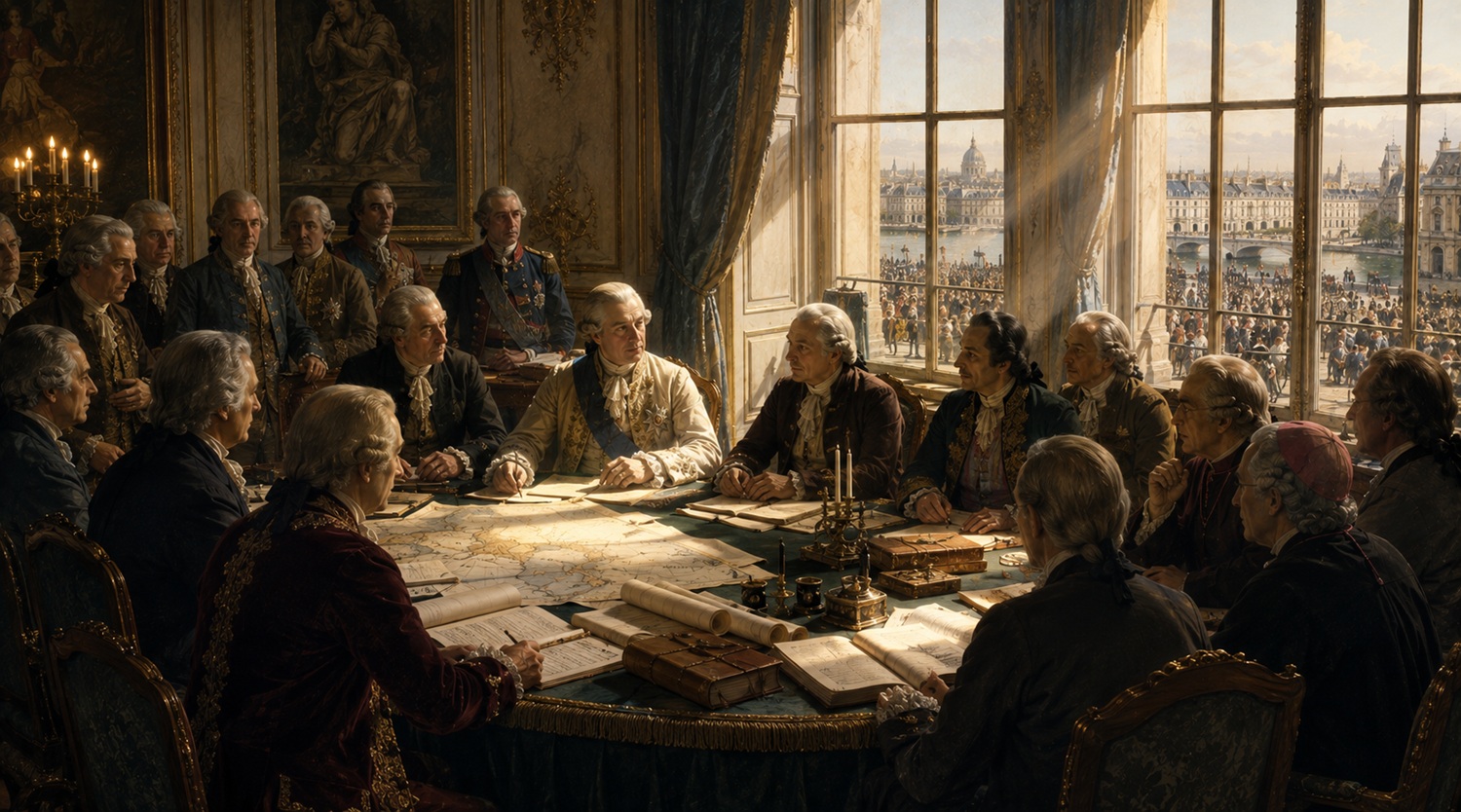
In 1789, France was not a country in which everyone expected the monarchy to disappear.
Louis XVI was still king. Most critics of the government initially sought reform rather than a republic. The monarchy possessed enormous prestige, France remained one of Europe's most powerful states, and even many representatives arriving for the Estates-General expected some form of negotiated constitutional settlement rather than the execution of the king, the Terror, mass conscription, or a European empire ruled by Napoleon Bonaparte.
What made the situation explosive was the collision of several crises.
The French state had accumulated a massive public debt after decades of warfare, including costly participation in the American War of Independence. Its tax system was fragmented and burdened by privileges, exemptions, inefficient collection, and political obstacles that made increasing revenue extraordinarily difficult. France itself was not simply an impoverished country: the deeper problem was the state's ability to tax its resources credibly and equitably enough to service its obligations. (Cambridge University Press)
At the same time, political expectations were rising.
Many nobles wanted constitutional limits on arbitrary monarchy.
Members of the Third Estate demanded political representation commensurate with their economic and demographic importance.
Enlightenment arguments about law, rights, sovereignty, taxation, and representation circulated widely.
Peasants resented various seigneurial obligations.
Urban workers faced high food prices and economic insecurity.
The crown's attempt to solve its fiscal crisis therefore opened a much broader debate about who had the right to govern France. (Cambridge University Press)
The French Revolution was not inevitable in every detail.
But by 1789, substantial reform probably was.
That distinction is essential for this counterfactual.
The plausible alternative is not:
Louis XVI refuses all reform and peacefully continues absolute monarchy for another century.
It is:
Louis XVI accepts a constitutional and fiscal transformation early enough that France reforms without the monarchy, political order, and state collapsing into revolutionary conflict.
France still changes dramatically.
Tax privilege weakens.
Representative government becomes permanent.
Royal authority becomes constitutional.
Some aristocratic privileges disappear.
Legal reform continues.
Republican ideas survive.
Colonial slavery becomes increasingly contested.
But there is no storming of the Bastille as the founding act of a revolutionary regime, no execution of Louis XVI, no Jacobin Terror, no French revolutionary armies remaking Europe, and—most consequentially—no Napoleon rising through those wars to become emperor.
The result could be a constitutional France that looks less like an untouched ancien régime and more like a continental cousin of Britain's evolving monarchy.
Whether it could remain stable is another matter.
---
France's Fiscal Crisis
The monarchy's financial problems were not simply the result of extravagance at Versailles.
France had repeatedly financed great-power warfare through borrowing. The War of the Austrian Succession, Seven Years' War, and French intervention in the American Revolution all added to the debt burden. The American war helped weaken the monarchy fiscally even though France achieved the geopolitical satisfaction of contributing to Britain's loss of thirteen colonies. (Cambridge University Press)
The problem was intensified by the structure of taxation.
The French monarchy could tax, but taxation was tangled in legal status, local privileges, exemptions, tax farming, indirect levies, and distinctions among regions and social groups. Privilege limited the state's ability to distribute taxes according to wealth in a straightforward way. Modern fiscal scholarship consequently treats the Revolution partly as the culmination of a deep crisis in the structure of the French fiscal state. (Cambridge University Press)
Finance ministers understood the problem.
Charles Alexandre de Calonne proposed an ambitious reform package in 1787 that included a broadly based territorial land tax intended to reach privileged landowners as well as the traditionally taxed population. He also supported representative provincial assemblies and other administrative changes. His attempt to secure approval from an Assembly of Notables failed, however, and the political struggle over reform widened rather than closed. (Cambridge University Press)
That failure was critical.
The monarchy had effectively admitted that major fiscal reform required political consent.
But the institutions capable of providing that consent immediately began asking what authority they possessed in return.
---
The Three Estates
French society was conventionally organized through three orders or estates.
The First Estate was the clergy.
The Second Estate was the nobility.
The Third Estate formally encompassed everyone else, from wealthy merchants, professionals, officeholders, and lawyers to artisans, laborers, and peasants.
These categories should not be mistaken for three internally unified political blocs.
Some clergy were wealthy bishops; others were modest parish priests.
Some nobles possessed enormous estates and court influence; others had limited incomes.
The Third Estate contained people whose economic positions and political aspirations differed radically.
Yet legal privilege mattered.
One of the major issues of 1789 was whether citizenship and taxation should continue to depend upon inherited corporate status or whether French subjects should increasingly be treated as politically and fiscally equal individuals.
The revolutionary Declaration of the Rights of Man and of the Citizen later stated that people were free and equal in rights, that sovereignty resided fundamentally in the nation, and that taxation should be distributed according to ability to pay. Those principles did not appear from nowhere in August 1789; they crystallized arguments already circulating during the political crisis. (Conseil Constitutionnel)
---
Why the Estates-General Was So Dangerous
Louis XVI eventually agreed to summon the Estates-General, an institution that had not met since 1614.
Its meeting was scheduled for May 1789.
The decision seemed like a way out of the fiscal crisis.
Instead, it raised fundamental constitutional questions.
Would the three estates deliberate separately?
Would each estate cast one collective vote?
Or would the deputies sit together and vote individually?
The distinction was enormous.
The Third Estate had been granted roughly twice the representation it had possessed under older arrangements, but doubling its deputies meant relatively little if each estate still cast only one vote. The noble and clerical orders could combine to outvote the Third Estate two to one.
Third Estate deputies therefore pushed for joint deliberation and voting by head.
Many nobles saw that demand as an existential threat to the legal distinctions among the orders. The deadlock over verification of credentials and voting procedures became one of the mechanisms through which a fiscal assembly turned into a struggle over national sovereignty. (Cambridge University Press)
On June 17, the Third Estate declared itself the National Assembly.
The political question had changed.
Who represented France?
The three historical orders?
Or representatives of the nation as a whole?
---
The Point of Divergence: Louis XVI Compromises in June 1789
The strongest divergence occurs at the royal session of June 23, 1789.
Historically, Louis attempted to invalidate important actions taken by the Third Estate and defended significant elements of separate deliberation by order. His government failed to resolve the confrontation, and the struggle over who would establish France's constitutional order continued. (Cambridge University Press)
In the alternate timeline, Louis chooses differently.
He recognizes the National Assembly.
He publicly accepts voting by head on taxation and constitutional legislation.
He orders the three estates to deliberate jointly on the fiscal settlement.
He announces that no new permanent national tax or major public borrowing will occur without representative consent.
And he accepts the principle that land should be taxed regardless of the owner's estate.
In exchange, the Assembly recognizes Louis as hereditary king with substantial executive authority.
Titles of nobility are not abolished.
The church is not immediately dispossessed.
Private property is guaranteed.
And seigneurial rights are placed under a negotiated process of conversion or redemption rather than being swept away overnight.
The monarchy survives because it agrees to stop being the monarchy of 1788.
---
Why Louis Might Conceivably Do This
This requires a more politically decisive Louis XVI, not a completely different France.
There was already broad recognition that fiscal reform was necessary.
Calonne's proposals had attacked privilege before 1789.
The Estates-General's deputies arrived carrying cahiers de doléances—lists of grievances and proposed reforms—whose demands frequently included constitutional and administrative changes rather than simple restoration of unrestricted royal power. (Cambridge University Press)
The alternate king concludes that preserving the crown matters more than preserving every inherited mechanism of privilege.
That is not an impossible calculation.
European monarchies had already shown that rulers could adopt administrative and legal reforms without abolishing monarchy.
The critical difference is timing.
Louis must compromise before political distrust convinces large portions of the population that the court intends to crush representative government by force.
---
No Royal Showdown in Paris
A constitutional agreement in June also changes the atmosphere surrounding Paris.
Historically, troop concentrations around Paris and Versailles, combined with the dismissal of Jacques Necker in July, contributed to fears of a royal counterattack against the Assembly. Political anxiety, economic hardship, and popular mobilization culminated in the storming of the Bastille on July 14.
In this alternate timeline, Necker remains in government temporarily and the king avoids a threatening military concentration around the capital.
Paris is still volatile.
Bread prices remain high.
Crowds still demonstrate.
Political clubs and newspapers still flourish.
But there is no obvious royal attempt to overturn the Assembly.
The Bastille therefore never acquires its historical role as the fortress whose capture becomes the symbolic birth of revolutionary popular power.
That is a counterfactual inference rather than a certainty. Economic and social unrest could still produce serious violence. The difference is that the constitutional dispute no longer supplies the same immediate trigger for an armed confrontation between Paris and the crown. (Cambridge Assets)
---
The Constitution of 1790
By early 1790, France adopts a written constitutional settlement.
It does not have to be identical to the Constitution of 1791.
A plausible arrangement includes:
Louis XVI as hereditary King of the French;
a national representative assembly meeting regularly;
legislative consent for taxation and major borrowing;
a royal suspensive veto;
ministers appointed by the king but increasingly dependent upon legislative confidence;
equality in national taxation;
standardized public accounts;
legal protection for property;
greater freedom of publication;
reformed provincial and municipal government;
periodic elections under a property-based franchise.
This would still be a revolution in government in the older meaning of the word.
It would simply not be the French Revolution as history remembers it.
---
Aristocratic Privilege Does Not Survive Unchanged
A stable settlement cannot preserve all Second Estate privilege.
The fiscal crisis exists partly because privileged property has been politically difficult to tax.
Therefore tax exemption has to go.
Nobles pay the national land tax.
Nobility remains a legal title and social distinction, but its fiscal advantages shrink substantially.
Access to high office gradually opens.
Special privileges attached to particular provinces, offices, or noble status are reviewed and rationalized.
The reform resembles an elite compromise: the nobility preserves property and titles by surrendering much of its special fiscal status.
That would be painful.
But it is much less threatening to aristocratic property than the revolutionary abolition of privilege followed by years of political upheaval.
---
What Happens to Feudal and Seigneurial Rights?
The famous night of August 4, 1789 historically produced sweeping declarations against feudal and corporate privilege.
In the alternate timeline, there is no identical August 4.
But peasant grievances do not disappear.
Many rural communities resent seigneurial payments, dues, monopolies, and obligations.
A government that refuses all reform risks creating the rural revolt it is trying to prevent.
The constitutional monarchy therefore establishes a commission to distinguish among:
personal obligations;
property rents;
judicial privileges;
seigneurial monopolies;
communal rights;
and dues that can be redeemed.
Personal and especially burdensome remnants of status are abolished first.
Other rights are converted into monetary claims or bought out over time.
Landowners receive compensation in some cases.
Peasants gain increasing security of property.
This is slower and less egalitarian than the revolutionary settlement.
It may also generate decades of lawsuits and resentment.
---
France Remains More Aristocratic
The result by 1800 would probably be a society that is legally more equal than France in 1788 but socially more aristocratic than post-revolutionary France.
Great noble families retain much of their land.
There is no mass émigré crisis on the historical scale.
Large aristocratic estates are less likely to be confiscated and redistributed.
Titles remain socially meaningful.
Court culture survives in reduced form.
The monarchy continues providing an institutional center for aristocratic status.
Yet the old claim that nobles belong to a fundamentally different fiscal order has been weakened.
France is evolving toward a constitutional elite society, not preserving the intact ancien régime.
---
What Happens to Church Property?
The church becomes one of the hardest problems.
Historically, the National Assembly nationalized church property in November 1789 partly as a response to the fiscal emergency. Sales of church land then became deeply connected with revolutionary finance. The Civil Constitution of the Clergy reorganized the church in 1790 and demanded oaths that helped create a profound religious and political divide. (Cambridge University Press)
The alternate constitutional government has strong reasons to avoid that confrontation.
It needs revenue.
But it also needs legitimacy.
A large-scale confiscation of church property risks turning priests and religious populations against a still-fragile constitutional system.
The compromise might therefore require the church to surrender tax exemptions and make a large negotiated contribution to the state.
Some underused ecclesiastical lands are sold.
Monasteries may be consolidated.
Bishops' revenues could be capped or taxed.
But the state does not nationalize the entire institutional wealth of the French church.
---
No Civil Constitution of the Clergy
This may be one of the most stabilizing consequences.
There is no revolutionary reorganization forcing clergy to choose between loyalty to Rome and an oath to a radically reconstructed church-state system.
The king negotiates reforms with bishops and the papacy instead.
Parish boundaries may be rationalized.
Some benefices disappear.
The state demands greater financial transparency.
But priests are not divided into constitutional and refractory camps in the same way.
Religious opposition to the new regime is therefore substantially weaker. Historically, the oath controversy helped transform religious disagreement into organized counterrevolution. (Cambridge University Press)
This does not make church-state relations peaceful.
It removes one of the historical Revolution's most polarizing conflicts.
---
Would There Still Be a Declaration of Rights?
Probably something similar.
The precise Declaration of the Rights of Man and of the Citizen adopted on August 26, 1789 was a product of the revolutionary National Assembly.
Without that political sequence, the exact document might not exist.
But ideas embodied in it—legal equality, national sovereignty, freedom of expression, property rights, equal taxation, representative consent to taxes—were already central to constitutional debate. (Conseil Constitutionnel)
A constitutional charter could therefore include many similar principles while presenting them as a compact among crown, nation, and representatives rather than as the philosophical foundation of a new revolutionary sovereignty.
One important difference might be the language of monarchy.
Instead of sovereignty residing exclusively in “the Nation,” the constitution could deliberately leave some ambiguity between the nation, crown, and legislature.
That ambiguity could preserve compromise.
It could also create the next crisis.
---
Louis XVI's New Role
Louis survives politically only if he accepts that the settlement is permanent.
This is not guaranteed.
Historically, the constitutional monarchy of 1789–1792 collapsed partly because trust between king and revolutionaries deteriorated catastrophically. Louis's attempted flight in June 1791 intensified suspicions that he was fundamentally opposed to the new political order.
In the alternate timeline, a king who had voluntarily recognized representative government in June 1789 has less reason to flee.
He retains significant executive authority.
His family's property and status are protected.
Most nobles have not fled France.
The church remains intact enough to support monarchy.
And France is not yet at war with most of Europe.
The political incentives surrounding the royal family are therefore radically different.
A flight to Varennes becomes much less likely.
---
Louis Still Might Fail
Yet Louis's personality and beliefs remain constraints.
If he repeatedly vetoes popular legislation, supports aristocratic obstruction, conspires with foreign monarchs, or tries later to restore royal authority, the compromise can collapse.
Constitutional monarchy works only if enough people on both sides accept losing something permanently.
The Assembly must accept a genuine executive.
The crown must accept genuine representative sovereignty.
The nobility must accept taxation.
Political reformers must accept that aristocratic titles and major estates remain.
This is not an easy bargain.
It is simply easier in June 1789 than after several years of bloodshed.
---
Republicanism Does Not Disappear
France had republican political thought before it became a republic.
The American Revolution had demonstrated that republican government could exist on a large scale.
Political journalism and Enlightenment thought had opened arguments about citizenship, representation, liberty, and sovereignty.
Therefore a successful French constitutional monarchy does not eliminate republicanism.
It makes republicanism the opposition.
Radical clubs might demand a wider franchise.
Journalists could attack royal vetoes.
Urban political societies might advocate abolition of hereditary privilege.
Some intellectuals would compare France unfavorably with the United States.
The constitutional monarchy's survival would depend partly on whether it could absorb reform gradually enough to prevent republicanism from becoming the only credible language of change.
---
There Is Probably No Reign of Terror
Without monarchical collapse, foreign invasion, civil war, political purges, and the radicalization created by revolutionary warfare, the specific conditions that produced the Terror do not exist.
There is no Committee of Public Safety exercising emergency revolutionary power on the historical path.
No execution of Louis XVI in January 1793.
No mass revolutionary political executions organized through the same institutions.
No Vendée war in its historical form.
That does not mean political violence disappears.
Food riots, peasant disturbances, assassinations, military mutinies, and repression remain possible.
The claim is narrower:
the particular revolutionary emergency state of 1793–1794 becomes highly unlikely.
---
What Happens to Napoleon Bonaparte?
Napoleon Bonaparte probably still becomes an artillery officer.
He was born in Corsica in 1769 and entered the French military system before the Revolution.
But the Revolution transformed his opportunities.
War expanded the army dramatically.
Old hierarchies were disrupted.
Emigration and political purges opened positions.
Talented young officers could rise at extraordinary speed.
Napoleon's political ascent then depended on the revolutionary and post-revolutionary crises that culminated in his coup of 1799. The historical Napoleon seized power after a decade of revolutionary upheaval and war. (Office of the Historian)
Remove those conditions and his career looks very different.
---
Colonel Bonaparte Rather Than Emperor Napoleon
Napoleon could still distinguish himself.
He was talented.
France would still possess artillery.
European wars would still occur.
A constitutional monarchy might eventually fight Austria, Britain, Prussia, or another rival.
Bonaparte could become a general.
Perhaps a famous one.
But there is no obvious path from artillery officer to ruler of France.
No revolutionary siege of Toulon in the same political context.
No Italian campaign launched by the Directory.
No coup of 18 Brumaire.
No Consulate.
No coronation as emperor in 1804.
Napoleon becomes one possible French military figure among many instead of the central political force of Europe.
---
Could There Still Be a Military Dictatorship?
Yes.
That is one of the alternate paths the scenario must preserve.
Suppose constitutional reform fails in the 1790s.
The king and Assembly deadlock.
Food crises recur.
Republican unrest intensifies.
Royalists organize resistance.
The army is used repeatedly to restore order.
A successful general could eventually emerge as an arbiter.
That general might be Napoleon.
Or someone entirely different.
So “no French Revolution in 1789” does not mean France cannot later experience a coup.
It means the chain producing Napoleon's specific dictatorship and empire has been broken.
---
No Revolutionary War in 1792
Historically, revolutionary France declared war on Austria in April 1792, beginning a conflict that expanded into more than two decades of almost continuous European warfare.
The French Revolution and the subsequent wars became deeply intertwined. The conflict radicalized French politics while revolutionary and Napoleonic armies transformed the rest of Europe. (Office of the Historian)
A stable constitutional monarchy has no comparable reason to launch an ideological revolutionary war in 1792.
Austria and Prussia also have less reason to contemplate intervention to restore Louis XVI because Louis remains on the throne.
This removes one of the great accelerants of European political transformation.
---
Europe Does Not Become Peaceful
France and Britain remain strategic rivals.
Austria, Prussia, and Russia continue competing in eastern and central Europe.
The Ottoman Empire remains part of the great-power balance.
Colonial conflicts continue.
The Polish question remains.
Wars are therefore inevitable at some point.
What disappears is the particular Revolutionary and Napoleonic cycle of mass mobilization, ideological war, conquest, coalition warfare, and political reconstruction between 1792 and 1815. (Cambridge University Press)
That difference is enormous.
---
Mass Politics Develops More Slowly
The Revolutionary and Napoleonic Wars helped connect national political identity with mass military mobilization.
France's levée en masse and later conscription systems demonstrated the military potential of mobilizing populations on a scale different from the dynastic armies of the eighteenth century.
Napoleon then used enormous state resources and conscript armies throughout Europe. Scholarship on nationalism and warfare identifies the revolutionary era as a major transformation in the relationship among states, nations, and military mobilization. (Cambridge University Press)
Without that shock, European armies still modernize.
States still expand bureaucracies.
Patriotism still exists.
But the fusion of nationalism, citizenship, and mass warfare may develop more gradually.
---
What Happens to Nationalism?
Nationalism does not disappear.
Language, history, political identity, dynastic rivalry, religious division, and Enlightenment ideas all predated Napoleon.
But French conquest and anti-French resistance strongly accelerated nationalist politics in several regions.
German nationalism, for example, was shaped by the experience of French domination and the Wars of Liberation, though historians warn against treating Napoleon as its single cause. (Cambridge University Press)
Without Napoleon, nationalism develops along a different timetable.
It may remain more cultural and intellectual for longer before becoming a mass political program.
---
Germany Without Napoleon
In 1789 there was no unified German nation-state.
Most German-speaking territories existed within the Holy Roman Empire, a complex political order containing large monarchies such as Austria and Prussia alongside hundreds of smaller principalities, bishoprics, free cities, and other jurisdictions.
The Empire was not simply politically dead before Napoleon. Modern scholarship stresses its continuing capacity for adaptation and the existence of reform movements within the German world before the French Revolution. (Cambridge University Press)
Napoleonic warfare historically destroyed that order.
The Holy Roman Empire was dissolved in 1806, and French power reorganized much of Germany into larger territorial states. (Cambridge University Press)
Without the revolutionary wars, that does not happen on schedule.
---
The Holy Roman Empire Survives Beyond 1806
The Empire may still reform.
Austria and Prussia remain competitors.
Smaller states continue consolidating through dynastic inheritance and diplomacy.
Ecclesiastical territories face pressure from secular rulers.
Administrative modernization continues.
But there is no Napoleon imposing the Confederation of the Rhine.
Hundreds of German jurisdictions are not suddenly reorganized through the same French-driven process.
A more gradual German consolidation is therefore likely.
German unification could still happen eventually.
But there is no reason to assume either the date 1871 or the same Prussian route.
---
German Nationalism Is Different
The wars against Napoleon historically produced powerful symbols of German liberation and encouraged political writers to present resistance to French domination in national terms. The process was neither instantaneous nor universal, but French rule mattered. (Cambridge University Press)
Without Napoleon, German nationalism has less of an obvious foreign enemy around which to mobilize.
It could develop through literature, universities, language, economic integration, and rivalry between Austria and Prussia.
That may make political nationalism slower.
It may also make it less militarized at first.
---
Italy Without the French Invasions
Italy in 1789 was divided among multiple states.
Napoleon's campaigns and French-backed republics profoundly disrupted this political order. French rule created new states, introduced constitutions and legal reforms, changed property structures, and exposed Italians to both revolutionary ideals and foreign domination. Italian nationalism later drew partly upon this contradictory legacy. (Cambridge University Press)
Without Napoleon, there are no Cisalpine, Ligurian, Roman, or Parthenopean revolutionary republics on the historical schedule.
There is no Kingdom of Italy ruled by Napoleon.
No sweeping Napoleonic political reorganization.
---
Italian Reform Still Happens
Several Italian governments had already encountered Enlightenment reform ideas.
Austria remained deeply involved in northern Italy.
Piedmont-Sardinia had its own state-building traditions.
Economic modernization, legal reform, and intellectual debate do not depend entirely on France.
The likely result is slower political consolidation.
Italian nationalism develops without the shared experience of Napoleon simultaneously destroying old boundaries and ruling Italians as foreigners.
A unified Italy might therefore emerge later, differently, or perhaps through a stronger Piedmontese or Austrian-centered political structure.
Specific nineteenth-century outcomes quickly become too speculative.
---
Spain Avoids the Peninsular War
This may be one of the largest changes.
Historically, Napoleon's intervention in Iberia culminated in the displacement of the Spanish Bourbons and installation of his brother Joseph Bonaparte. The resulting Peninsular War devastated Spain and Portugal between 1808 and 1814. (Cambridge University Press)
Without Napoleon, Charles IV's and later Ferdinand VII's monarchy still faces serious problems.
Spain still has colonial tensions.
Reform debates continue.
Britain remains a maritime rival.
But there is no French occupation of Madrid in 1808 and no Joseph Bonaparte as king.
---
No Cádiz Constitution of 1812 in the Same Form
The Spanish constitutional revolution at Cádiz grew directly out of the crisis created by French occupation and the absence of the legitimate monarch.
Without the Napoleonic invasion, that precise constitutional opening disappears.
Spanish liberalism still exists.
A later dynastic or fiscal crisis could produce reform.
But the famous 1812 constitution does not arise on the same timetable.
This matters far beyond Spain because the political crisis in metropolitan Spain also created opportunities for independence movements throughout Spanish America.
---
Spanish America May Remain Imperial Longer
The collapse of legitimate royal authority in Spain after Napoleon's intervention helped trigger the creation of juntas and sovereignty crises throughout the Americas.
Without that shock, movements for local autonomy and independence still have powerful causes:
colonial social hierarchy;
trade restrictions;
Creole political ambitions;
Enlightenment ideas;
the examples of the United States and possibly later Haiti;
and tensions with metropolitan government.
But the imperial constitutional crisis is delayed.
Spanish American independence could therefore occur later and in a more fragmented sequence.
It should not be assumed that Spain could preserve its empire indefinitely.
---
Poland Remains a European Crisis
No French Revolution does not mean Poland is saved.
The Polish-Lithuanian Commonwealth was already caught between Russia, Prussia, and Austria.
The first partition had occurred in 1772.
The constitutional reforms of 1791 generated further regional conflict.
The Second Partition occurred in 1793 and the Third in 1795 after the Kościuszko uprising.
These events were connected to broader European politics but cannot be reduced to Napoleon, who had not yet risen when Poland disappeared as an independent state.
So Poland could still be partitioned.
The main later difference is that there is no Napoleonic Duchy of Warsaw restoring a semi-independent Polish state in 1807. The historical duchy existed because Napoleon defeated Prussia and established a new Polish political entity as part of his strategic system. (napoleon.org)
Polish nationalism survives.
But it lacks the same Napoleonic episode of partial restoration.
---
Russia Avoids 1812
There is no Napoleon ruling France.
Therefore there is no French Grand Army invading Russia in 1812.
No burning of Moscow in the same wartime context.
No catastrophic retreat destroying Napoleon's army.
Russia avoids one of the defining military struggles of its nineteenth-century political memory.
That does not necessarily make Russia weaker.
It also does not necessarily make it stronger.
---
Russia's Western Political Experience Changes
Russian officers who historically campaigned across Europe during the Napoleonic Wars encountered different political institutions and ideas, experiences that later contributed to debates among parts of the Russian elite.
Without the great coalition campaigns and occupation of Paris, those networks develop differently.
Alexander I also lacks the enormous prestige gained from participating in Napoleon's defeat.
Russia remains a major continental power, particularly in Poland and eastern Europe, but the diplomatic order built after 1815 does not exist in the same form.
There is no Congress of Vienna ending a Napoleonic system that never arose.
---
Britain Without Twenty Years of French War
Britain remains France's most important strategic rival.
Even a constitutional France could eventually fight Britain over colonial possessions, trade, naval power, or another European dispute.
But there is no reason for a war beginning in 1793 to expand into the same enormous Revolutionary and Napoleonic struggle.
Historically, those wars placed extraordinary fiscal and military demands on Britain and helped produce a global struggle stretching across Europe, the Mediterranean, the Atlantic, and colonial possessions. (Cambridge University Press)
Without them, British public debt grows less rapidly from wartime borrowing.
Taxes follow a different path.
There is no Continental System imposed by Napoleon.
No Trafalgar in its historical context.
No Waterloo.
---
Britain's Industrial Revolution Still Continues
Industrialization had begun before 1789.
The technological, demographic, commercial, financial, and energy transformations underlying Britain's industrial development do not depend upon Napoleon.
So there is no credible reason to imagine British industrialization simply stops.
The precise pace could change.
Wartime demand historically stimulated some industries while disrupting others.
Trade routes would differ.
But Britain's transition toward an industrial economy remains one of the stronger continuities in the alternate timeline.
The more uncertain question is geopolitical.
Without crushing Napoleonic France and emerging from 1815 with enormous naval prestige, Britain's nineteenth-century international predominance may develop less dramatically.
---
Legal Reform Without Napoleon
Another common misconception is that without Napoleon Europe remains legally medieval.
European rulers were already pursuing legal and administrative reforms before Napoleon.
The late eighteenth century was an age of codification and enlightened reform across multiple monarchies. (Cambridge University Press)
The French Revolution nevertheless accelerated radical principles such as equality before the law and the abolition of corporate privilege. Napoleon subsequently consolidated some revolutionary changes in the Civil Code of 1804 and spread French-style legal institutions into conquered territories. (Cambridge University Press)
Without Napoleon, legal modernization continues.
It is simply less uniform and less rapidly exported by French armies.
---
France Could Still Produce a Civil Code
A constitutional monarchy would have strong incentives to standardize French law.
France contained overlapping customary-law traditions, Roman-law influences, local privileges, seigneurial jurisdictions, and royal legislation.
A national representative government committed to equal taxation and administrative rationalization could eventually demand legal codification as well.
The resulting code might resemble some aspects of the later Napoleonic Code while differing on inheritance, family law, aristocratic status, and church relations.
So “no Napoleon” does not necessarily mean “no French civil code.”
It means no Napoleonic code imposed across a French continental empire.
---
Slavery Is the Most Difficult Counterfactual
The French Caribbean prevents any easy claim that the non-revolutionary timeline is necessarily more peaceful or humane.
Saint-Domingue—modern Haiti—was one of the richest plantation colonies in the Atlantic world.
Its prosperity rested on a brutal slave system in which an enslaved majority lived under coercion and extreme violence.
The Haitian Revolution that began in 1791 became inseparable from the political crisis in revolutionary France, arguments over citizenship and rights, struggles among whites and free people of color, international warfare, and mass slave rebellion. Broad emancipation was won through conflict and ratified by French emancipation decrees in 1793–1794. (Cambridge University Press)
Remove the French Revolution and the exact Haitian Revolution cannot simply be assumed.
But neither can permanent colonial stability.
---
Would France Abolish Slavery Without the Revolution?
Probably not in 1794.
The National Convention historically abolished slavery throughout the French colonies in February 1794 amid revolutionary war and rebellion. (Cambridge University Press)
A moderate constitutional monarchy containing influential colonial property interests would face much stronger political barriers to immediate emancipation.
Abolitionists would continue campaigning.
Free people of color would continue demanding rights.
Enslaved people would continue resisting.
Britain's abolitionist movement would continue developing independently.
But a French parliamentary abolition of colonial slavery might be postponed by years or decades.
This is one area in which avoiding revolutionary upheaval could plausibly produce a worse immediate outcome.
---
Saint-Domingue Remains Unstable
The underlying plantation system remains extraordinarily coercive.
Demographic imbalance remains.
Racial hierarchy remains.
Conflicts among wealthy white planters, poorer whites, free people of color, enslaved populations, and metropolitan authorities remain.
A major uprising is therefore still possible without Paris becoming revolutionary.
The exact date and coalition would differ.
The rebellion might begin as a struggle over rights for free people of color.
It might become a mass slave revolt.
It might occur during a later Anglo-French war.
Or France could attempt gradual reform and provoke resistance from colonial slaveholders.
“No French Revolution” does not remove the social structure capable of generating a Haitian revolution.
---
Haiti Might Not Become Independent in 1804
Historically, revolutionary emancipation, Toussaint Louverture's rise, Napoleon's later attempt to restore direct French control, and renewed warfare led eventually to the defeat of the French expedition and Haiti's declaration of independence in 1804. Napoleon's 1802 policy restored slavery in some French colonies and threatened emancipation in Saint-Domingue, helping reignite the struggle that ended French rule. (Cambridge University Press)
None of that sequence survives intact.
Three outcomes become plausible.
Gradual French emancipation
A constitutional parliament eventually abolishes slavery under abolitionist and economic pressure, perhaps after Britain moves against the slave trade.
Saint-Domingue remains French longer under a new free-labor system.
Delayed slave revolution
The plantation regime resists reform until a later rebellion creates a conflict resembling the Haitian Revolution under different political conditions.
Colonial independence without revolutionary France
Local elites, free people of color, and formerly enslaved armies eventually create an independent state during a later European war.
The historical Republic of Haiti in 1804 is therefore not inevitable.
The forces making plantation slavery unstable remain.
---
France May Keep a Larger Colonial Empire
No Haitian independence on the historical timetable could affect French strategy in North America.
Historically Napoleon hoped to revive France's Atlantic empire, including Saint-Domingue and Louisiana. The collapse of his Saint-Domingue expedition contributed to the context in which he sold Louisiana to the United States in 1803. (Office of the Historian)
Without Napoleon and without the same Haitian conflict, Louisiana's future changes sharply.
France might never reacquire it from Spain.
Or it might do so under different diplomacy.
The United States therefore does not automatically make the Louisiana Purchase in 1803.
This demonstrates how quickly the counterfactual spreads beyond Europe.
Specific North American borders become increasingly impossible to predict.
---
No French Revolution Does Not Mean No Political Revolution
This is the central limitation on the entire scenario.
France's problems were not imaginary.
A successful constitutional monarchy must actually solve them.
It must collect enough revenue to service state debt.
It must persuade wealthy landowners to pay taxes.
It must allow meaningful political representation.
It must address peasant grievances.
It must manage the church.
It must handle food crises.
It must decide how widely the franchise extends.
It must reconcile royal executive authority with representative sovereignty.
It must determine whether political equality extends to religious minorities, colonial subjects, free people of color, women, and enslaved people.
One compromise in June 1789 cannot settle all those questions forever.
It can only change the arena in which they are fought.
---
Path One: Successful Constitutional Monarchy
This is the most optimistic branch.
Louis XVI honors the constitutional compromise.
The Assembly establishes reliable taxation and restructures state finance.
The nobility accepts taxation in exchange for protection of property and titles.
Church reform proceeds through negotiation.
Political participation expands gradually.
Louis dies naturally, and the crown passes to his son under an established constitution.
By 1820, France resembles a more aristocratic version of a parliamentary monarchy.
Republicans remain influential but do not dominate.
The franchise gradually broadens.
Likelihood within the divergence
Plausible but demanding.
Every major faction has to continue accepting compromise after the immediate crisis has passed.
---
Path Two: The Revolution Is Delayed
The 1789 compromise works temporarily.
The fiscal crisis eases.
But aristocratic resistance blocks further reform.
The king begins trying to restore lost authority.
Urban radicals demand broader suffrage.
Another economic crisis strikes in the late 1790s.
By then, political organization is more sophisticated and representative government has created expectations that cannot easily be reversed.
A new confrontation produces revolution around 1798 or 1805.
This revolution might be less explosive because some privileges have already disappeared.
Or it might be more violent because both sides have spent a decade organizing.
Likelihood
Very plausible.
A constitutional settlement may postpone rather than eliminate France's struggle over sovereignty.
---
Path Three: Republican Crisis and Military Rule
The monarchy survives 1789 but later loses legitimacy.
Perhaps Louis is caught conspiring against the constitution.
Perhaps his successor is unpopular.
Perhaps France loses a foreign war.
Republican uprisings spread through Paris and provincial cities.
The army is called in.
A charismatic general emerges promising to protect property, preserve constitutional reforms, restore order, and defend France.
The monarchy falls.
A republic briefly follows.
The general eventually dominates it.
This could produce something structurally reminiscent of Bonapartism without reproducing Napoleon's biography.
Likelihood
Possible.
Modernizing monarchies could still generate political crises severe enough to invite military intervention.
---
Comparing the Three Paths
| Path | Monarchy | Political Reform | Revolution | European War | Long-Term Outcome |
| -------------------------------------- | ------------------ | --------------------------------------------- | ------------------------------------------------ | -------------------------------------------- | ----------------------------------------- |
| Successful constitutional monarchy | Survives | Gradual and negotiated | Avoided in radical form | Conventional great-power wars still possible | Parliamentary-style French monarchy |
| Delayed revolution | Survives initially | Partial reforms stall | Major uprising around 1795–1810 | Could radicalize during later war | Republic or new constitutional settlement |
| Military/republican crisis | Eventually falls | Constitutional reform followed by instability | Political revolution without exact 1789 sequence | Army gains increasing political importance | Military-backed republic or dictatorship |
None produces the unchanged monarchy of Louis XIV.
The question is not whether France changes.
It is how violently and how quickly.
---
Real History vs. the Constitutional-France Timeline
| Date | Real History | Plausible Alternate Timeline |
| --------------- | ---------------------------------------------------------------------------------- | -------------------------------------------------------------------------------------------------------------------------------------------------------------------------- |
| 1787 | Calonne's reform plan fails before the Assembly of Notables. | Same; fiscal crisis convinces political elites that broader reform is unavoidable. (Cambridge University Press) |
| 1788 | Crown agrees to summon Estates-General. | Same. |
| May 1789 | Estates-General meets; voting dispute begins. | Same initial deadlock. (Cambridge University Press) |
| June 17 | Third Estate declares itself National Assembly. | Same. |
| June 23 | Crown attempts to constrain Assembly and preserve key elements of voting by order. | Louis recognizes joint National Assembly, voting by head, universal land taxation, and legislative consent to major taxes and borrowing. (Cambridge University Press) |
| July 1789 | Bastille stormed; revolutionary popular politics accelerates. | No perceived royal constitutional coup; Paris remains turbulent but Bastille does not become center of national insurrection. |
| August 1789 | Feudal privileges attacked; Declaration of Rights adopted. | Gradual abolition/redemption of seigneurial privileges; constitutional charter includes tax equality and civil rights but preserves monarchy and titles. |
| Nov. 1789 | Church property nationalized. | Church accepts taxation and limited land sales; wholesale nationalization avoided. (Cambridge University Press) |
| 1790–91 | Civil Constitution of Clergy polarizes France. | Negotiated ecclesiastical reform avoids compulsory revolutionary church settlement. (Cambridge Resolve) |
| 1791 | Flight to Varennes cripples royal legitimacy. | Louis remains politically invested in constitutional system; no comparable flight in strongest scenario. |
| 1792 | France enters war against Austria; monarchy falls. | No revolutionary war; France remains constitutional monarchy. |
| 1793 | Louis XVI executed; Terror intensifies. | Louis remains king; republican opposition remains legal or semi-legal. |
| 1794 | France abolishes colonial slavery. | Immediate colonial abolition less likely; slavery becomes a major unresolved parliamentary issue. (Cambridge University Press) |
| 1799 | Napoleon seizes power. | Bonaparte is an officer or general; no revolutionary regime exists for him to overthrow. |
| 1804 | Napoleon becomes emperor; Haiti becomes independent. | No Napoleonic Empire; status of Saint-Domingue remains uncertain. (Cambridge University Press) |
| 1806 | Holy Roman Empire abolished under Napoleonic pressure. | Empire survives or reforms; German consolidation proceeds gradually. (Cambridge University Press) |
| 1808 | Napoleon invades Spain; Peninsular War begins. | Spanish Bourbon monarchy remains intact unless challenged by an independent domestic crisis. (Cambridge University Press) |
| 1812 | Napoleon invades Russia. | No Franco-Russian campaign of this type. |
| 1815 | Napoleon defeated; Congress of Vienna creates postwar settlement. | No Waterloo and no Vienna settlement designed to reconstruct Europe after Napoleon. |
---
What Europe Might Look Like in 1815
By 1815, the strongest constitutional-monarchy scenario could leave Europe simultaneously more familiar and more alien than the historical continent.
France remains a great monarchy with an elected national legislature.
Britain remains constitutional and increasingly industrial.
Austria and Prussia compete inside a surviving or reformed Holy Roman Empire.
Russia dominates much of eastern European diplomacy.
Poland may still have been partitioned but has no Duchy of Warsaw episode.
Italy remains divided among dynastic states.
Spain has avoided French occupation.
The Ottoman Empire continues confronting Austria and Russia.
There is no French Empire stretching across continental Europe.
No Confederation of the Rhine.
No Kingdom of Italy created by Napoleon.
No Napoleonic Spain.
No Grand Duchy of Warsaw.
No Continental System.
No Waterloo.
No Congress of Vienna restoring a Europe Napoleon had overturned. The historical post-1815 order was designed specifically in response to the wars and territorial transformations of the preceding decades. (Cambridge University Press)
Europe changes more gradually.
Whether that makes it more stable is uncertain.
---
Is Europe More Peaceful?
Probably during the 1790s and 1800s.
The historical Revolutionary and Napoleonic Wars killed enormous numbers of soldiers and civilians and devastated large regions, including Spain, Germany, and Russia. (Cambridge University Press)
Avoiding those wars prevents immense suffering.
But a Europe without them retains many unresolved tensions.
Austria versus Prussia.
Russia versus the Ottoman Empire.
Britain versus France.
European competition overseas.
The Polish question.
Italian rivalry.
German constitutional conflict.
Dynastic succession disputes.
Later wars still occur.
The alternate Europe is not peaceful by nature.
It merely avoids one exceptionally destructive sequence.
---
Is Europe More Conservative?
In the short term, probably.
The French Revolution gave reformers and radicals across Europe an extraordinarily powerful demonstration that inherited privilege and monarchy could be overturned.
French armies then exported some revolutionary reforms directly.
Without those events, rulers face less immediate pressure.
Nobility retains greater institutional power.
Church establishments remain stronger.
Serfdom and seigneurial structures may disappear more slowly in some regions.
Legal equality spreads less uniformly.
Yet reform was already occurring before 1789, and some scholarship cautions against crediting French rule for every later modernization. In parts of Germany, for example, significant property and economic changes predated Napoleonic intervention. (Cambridge University Press)
So Europe modernizes.
It does so less through conquest from Paris.
---
Is Nationalism Weaker?
Initially, probably.
But it is not absent.
Napoleonic occupation and resistance provided powerful political experiences through which German, Italian, Spanish, Polish, and other national movements could define themselves.
Remove Napoleon and nationalism develops through different channels.
Language.
Historical scholarship.
Religion.
Dynastic rivalry.
Economic integration.
Local constitutional movements.
Colonial resistance.
Nationalism might become a mass force twenty or thirty years later.
Or a different great war could accelerate it suddenly.
---
Does Republicanism Fail?
No.
The United States already exists.
Dutch republican traditions exist.
Classical republican thought remains influential.
France itself would contain republicans.
The constitutional monarchy could even normalize political opposition sufficiently that republican parties become an accepted part of parliamentary politics.
If the monarchy later proves ineffective, the existence of decades of representative institutions could make a peaceful or semi-peaceful republican transition more plausible.
Ironically, successfully avoiding revolution in 1789 might eventually make a less violent French republic possible.
---
What Happens to the Idea of Equality?
The historical Revolution gave the principle of legal equality extraordinary symbolic power. Its Declaration proclaimed equality in rights and equal distribution of taxation according to ability. (Conseil Constitutionnel)
The alternate constitution still requires fiscal equality to solve the crisis.
But social equality proceeds more slowly.
Noble titles survive.
Elite property remains concentrated.
Political voting rights likely depend on wealth.
Women remain excluded from national suffrage.
Colonial slavery persists longer.
France therefore becomes constitutionally liberal before it becomes democratically or socially egalitarian.
That is not unusual for eighteenth- and nineteenth-century constitutional systems.
---
What Would Be Lost Along With the Revolution?
Avoiding the French Revolution prevents extraordinary violence.
But history rarely offers benefits without costs.
Several transformative developments could be delayed:
broad legal attacks on hereditary privilege;
radical assertions of popular sovereignty;
rapid secularization of state institutions;
abolition of slavery in the French colonies in 1794;
widespread redistribution of church and émigré property;
some forms of legal equality;
political mobilization of ordinary citizens;
accelerated codification and administrative reform across conquered Europe.
The Revolution was both destructive and transformative.
A counterfactual that removes its violence must also account for reforms that may arrive more slowly.
---
What Would Be Preserved?
At the same time, the alternate path preserves much that the revolutionary and Napoleonic period destroyed or destabilized.
Louis XVI lives.
The Bourbon succession continues.
Many aristocratic families retain their property.
The French church avoids revolutionary confiscation.
France avoids the Terror.
Hundreds of thousands of people avoid death in decades of European warfare.
Spain avoids the Peninsular War.
Russia avoids Napoleon's invasion.
The Holy Roman Empire survives longer.
Numerous small German and Italian states survive.
Traditional institutions therefore receive more time to adapt.
Some might reform successfully.
Others might merely postpone collapse.
---
Strong, Moderate, and Weak Counterfactual Claims
| Claim | Assessment | Why |
| -------------------------------------------------------------------------------------- | --------------------------- | -------------------------------------------------------------------------------------------------------------------------------------------------------------------------------------------------- |
| Major French reform was necessary by 1789 | Very strong | Fiscal failure had already forced the monarchy to seek political consent for structural changes. (Cambridge University Press) |
| Louis XVI could conceivably have accepted a stronger compromise in June 1789 | Plausible | The key disputes involved concrete choices over joint deliberation, voting, taxation, and authority; the king's historical response helped prolong the deadlock. (Cambridge University Press) |
| France could simply continue unchanged absolute monarchy | Very weak | The fiscal and constitutional crisis had already made significant change unavoidable. |
| A constitutional monarchy could prevent the historical revolutionary collapse | Plausible but difficult | It requires sustained compromise among crown, privileged elites, and representatives rather than one single decision. |
| Noble tax privilege would have to weaken | Very strong | Broadening taxation was central to pre-revolutionary fiscal reform proposals. (Cambridge University Press) |
| Nobility itself must disappear | Weak | Titles and property could survive while fiscal privilege was reduced. |
| Church property would necessarily be nationalized | Weak | Nationalization was a revolutionary response to fiscal crisis, not the only imaginable mechanism for raising revenue. (Cambridge University Press) |
| Avoiding the Civil Constitution of the Clergy would reduce religious counterrevolution | Strongly plausible | The oath and reorganization of the church historically produced severe religious polarization. (Cambridge Resolve) |
| Republicanism disappears | Very weak | Republican political ideas existed independently of the overthrow of Louis XVI. |
| Napoleon still becomes emperor | Very weak | His political rise depended heavily on revolutionary warfare and regime instability. (Office of the Historian) |
| Napoleon could still become a successful officer or general | Plausible | His military education and early army career predated the revolutionary dictatorship. |
| No Napoleon means no European warfare | False | Great-power rivalries existed independently of the French Revolution. |
| No Napoleonic Wars means the Holy Roman Empire survives beyond 1806 | Strongly plausible | Its historical abolition occurred directly within Napoleon's restructuring of Germany. (Cambridge University Press) |
| Germany never unifies | Weak | German political and economic consolidation had multiple causes. |
| Italian nationalism disappears | Weak | Napoleon accelerated and reshaped Italian politics but did not create every source of Italian identity. (Cambridge University Press) |
| Spain avoids the historical Peninsular War | Very strong | The war resulted directly from Napoleon's intervention. (Cambridge University Press) |
| Spanish American independence never occurs | Weak | Colonial tensions had causes independent of Napoleon, although the 1808 Spanish crisis accelerated independence. |
| Poland avoids partition | Weak | partitions began before Napoleon and resulted largely from Russian, Prussian, Austrian, and Polish political dynamics. |
| There is no Duchy of Warsaw | Very strong | Napoleon created it after defeating Prussia. (napoleon.org) |
| Britain does not industrialize | Very weak | Industrialization had begun before the revolutionary wars. |
| France abolishes slavery in 1794 anyway | Weak | Historical abolition occurred under revolutionary wartime conditions. (Cambridge University Press) |
| Slavery in Saint-Domingue remains permanently stable | Very weak | The colony contained profound racial, political, demographic, and labor conflicts capable of producing rebellion. (Cambridge University Press) |
| Haiti becomes independent in exactly 1804 | Weak | That date followed a specific sequence of revolutionary emancipation and Napoleon's failed reconquest. (Cambridge University Press) |
| Revolutionary pressures could return later | Very strong | The constitutional compromise manages social and political conflict; it does not abolish its underlying causes. |
---
The Largest Difference May Be the Pace of Change
The most credible alternate France is not dramatically different because it rejects modernity.
It is different because it slows the sequence.
1789 becomes constitutional reform rather than revolutionary rupture.
Aristocratic privilege erodes over decades instead of collapsing in months.
Church power declines through taxation and negotiation rather than confiscation.
The franchise expands gradually.
Republicanism grows through parliamentary opposition.
Legal reform is codified by committees rather than armies.
Nationalism develops without Napoleonic conquest.
European states reform without being forcibly reorganized by France.
Colonial slavery, tragically, may survive longer.
The political world of 1820 could therefore contain many of the same debates that historical Europe experienced—
but with different institutions still standing when those debates occur.
---
No French Revolution Does Not Mean No Political Revolution
France in 1789 had reached a point at which the fiscal system, political structure, and expectations of representation could no longer easily coexist.
That is why the strongest alternate history requires the monarchy to change.
If Louis XVI refuses universal taxation, the fiscal problem returns.
If he refuses representative government, the constitutional conflict returns.
If noble privilege remains immune from law, political resentment returns.
If the monarchy blocks public discussion, opposition radicalizes outside formal institutions.
If rural obligations remain untouched, peasant unrest continues.
If colonial slavery remains untouched, resistance continues in the Caribbean.
A successful constitutional monarchy therefore has to keep reforming.
The crown survives only by accepting that every successful reform creates demands for the next one.
That is the paradox of the scenario.
Preventing the French Revolution requires Louis XVI to begin a quieter revolution himself.
---
The AltHistAI Verdict
Could the French Revolution have been avoided?
The exact revolutionary collapse beginning in 1789 probably could have been.
France's fiscal problems were severe, but bankruptcy did not mechanically require the abolition of monarchy.
Political representation did not mechanically require a republic.
Equality in taxation did not mechanically require the execution of the king.
Church reform did not mechanically require confiscating nearly all church property.
And reducing noble privilege did not necessarily require abolishing nobility itself.
The most plausible divergence occurs in June 1789.
Louis XVI had a choice about how to respond to the Third Estate's claim to represent the nation.
Historically, the crown failed to create a workable constitutional compromise and attempted to preserve critical aspects of the old ordering of the Estates even as that political system was breaking down. (Cambridge University Press)
In the alternate timeline, Louis recognizes the National Assembly.
He accepts voting by head.
He accepts a national land tax applying to noble and common property alike.
He agrees that representative consent will be required for taxation and major state borrowing.
In return, representatives recognize hereditary monarchy, protect private property, preserve noble titles, and pursue gradual rather than confiscatory social reform.
That is a radical bargain.
It is also less radical than what actually followed.
The strongest immediate consequence is that the monarchy gains a chance to become constitutional before it becomes discredited beyond repair.
Without a perceived royal attempt to overturn the representative settlement, the political dynamics leading to the storming of the Bastille weaken.
Without the Bastille and the subsequent revolutionary escalation, aristocratic emigration is smaller.
Without mass emigration and royal collapse, France is less polarized.
Without wholesale confiscation of church property and the Civil Constitution of the Clergy, religious opposition is less severe. The historical revolutionary restructuring of the church created a major division among clergy and believers. (Cambridge Resolve)
Louis XVI remains king.
But he is no longer an absolute monarch in any meaningful sense.
France becomes a constitutional state.
Its legislature controls taxation.
Public accounts become politically important.
Noble land is taxed.
Representative politics becomes permanent.
The monarchy survives by surrendering the political tools required to return fully to the old system.
The French aristocracy survives too.
That means post-1789 France remains more hierarchical than the France produced by revolution.
Titles endure.
Large estates remain concentrated.
The church retains more property.
Peasants obtain relief more gradually.
Legal equality develops unevenly.
The constitution probably restricts voting according to property.
France becomes liberal before it becomes democratic.
Republicanism nevertheless survives.
It grows in newspapers, clubs, cities, and elections.
A successful constitutional regime could eventually absorb those pressures by expanding political participation.
A failed one could face another revolution ten or twenty years later.
That is why no French Revolution in 1789 does not mean no French revolution ever.
The international consequences are even larger.
Without the fall of the monarchy, there is no historical revolutionary war beginning in 1792.
Without that war, political radicalization in France proceeds differently.
There is no Terror in its historical form.
No revolutionary mass mobilization on the same scale.
And no military environment in which an obscure Corsican artillery officer can rise at extraordinary speed.
Napoleon Bonaparte may still become a capable officer.
He may become a general.
But Napoleon the emperor is an artifact of the revolutionary age.
No revolutionary France means no historical Italian campaigns, no coup of 1799, no Consulate, no coronation in 1804, and no Napoleonic Empire. (Office of the Historian)
That removes one of the most powerful engines of European political reorganization.
The Holy Roman Empire probably survives past 1806 because Napoleon is not present to destroy and reorganize its political structure. (Cambridge University Press)
Germany remains fragmented longer.
Prussia and Austria still compete.
German nationalism still develops, but it does so without French occupation and the Wars of Liberation providing the same mobilizing experience. (Cambridge University Press)
Italy remains divided.
French armies do not create revolutionary republics or impose the Napoleonic political order that helped expose Italians simultaneously to modern reform and foreign domination. Italian nationalism does not vanish, but its development is slower and follows a different political route. (Cambridge University Press)
Spain escapes one of the great catastrophes of its modern history.
Napoleon never places Joseph Bonaparte on the Spanish throne.
The Peninsular War does not devastate Iberia between 1808 and 1814. (Cambridge University Press)
That also weakens one of the main triggers for the crisis of authority that accelerated Spanish American independence.
The Spanish Empire may therefore survive longer.
Not forever.
Longer.
Poland presents a different lesson.
Its partitions cannot simply be blamed on Napoleon or the French Revolution.
The Commonwealth had already been partitioned in 1772, and Russia, Prussia, and Austria had their own interests in preventing a strong independent Polish state.
Poland could therefore still disappear from the map by the end of the eighteenth century.
What disappears is Napoleon's later Duchy of Warsaw, which offered Poles a partial restoration and became a focus of Polish political hopes. (napoleon.org)
Russia avoids Napoleon's invasion of 1812.
Britain avoids two decades of almost continuous war with revolutionary and Napoleonic France.
European state debt, military mobilization, nationalism, and diplomacy consequently develop differently.
There is no Waterloo.
No Congress of Vienna designed to reconstruct the continent after Napoleon.
No familiar post-1815 balance emerging from victory over France.
Yet none of this freezes Europe in 1788.
Legal reform continues.
Industrialization continues.
Nationalism continues.
Constitutional politics continue.
Anti-slavery activism continues.
Representative government continues expanding in some states.
The French Revolution accelerated many of those developments.
It did not create every one of them.
The darkest part of the alternate timeline concerns slavery.
The French Convention abolished colonial slavery in 1794 under extraordinary revolutionary and wartime conditions. (Cambridge University Press)
A moderate constitutional monarchy dominated partly by wealthy property interests is much less likely to do so that early.
Saint-Domingue therefore remains a gigantic moral and political crisis.
The absence of the French Revolution does not make plantation slavery stable.
Enslaved people still resist.
Free people of color still contest racial exclusion.
Colonial elites still resist metropolitan interference.
A later slave revolt remains highly plausible.
But there is no reason to assume Haiti becomes independent on January 1, 1804.
That outcome followed a specific chain involving French revolutionary ideology, civil war, emancipation, Toussaint Louverture, Napoleon's attempt to restore direct French authority, and the final defeat of French forces. (Cambridge University Press)
Haiti could emerge later.
Saint-Domingue could remain French under gradual emancipation.
Or an entirely different colonial war could produce independence.
This is an important reminder that avoiding political violence in Europe may prolong oppression elsewhere.
So was a peaceful constitutional France possible?
Yes.
But only if “peaceful” is understood relatively.
France would still experience demonstrations.
Peasant disputes.
Constitutional crises.
Elections.
Church controversies.
Colonial revolt.
Strikes.
Press wars.
Royal confrontations.
Perhaps eventually another revolution.
The monarchy does not solve its problems by escaping history.
It survives by agreeing to participate in history differently.
That makes the strongest answer to What If the French Revolution Never Happened? more subtle than a Europe where Louis XVI simply stays on his throne and nothing else changes.
The ancien régime could not survive intact.
What might have survived was the monarchy itself.
Louis XVI becomes France's first constitutional monarch rather than its last absolute king.
The nobility becomes a taxed social elite rather than an abolished legal order.
The church becomes a reformed institution rather than a central enemy of revolutionary government.
France becomes representative without becoming immediately republican.
Napoleon remains a soldier rather than becoming an emperor.
Europe avoids the Revolutionary and Napoleonic Wars.
Germany and Italy consolidate more slowly.
Spain avoids French occupation.
Russia avoids 1812.
Britain's rise follows a different route.
Haiti's future becomes more uncertain—and potentially more tragic in the short term.
And underneath all of it, the same political forces continue moving.
Equality before taxation.
Representation.
National sovereignty.
Religious liberty.
Property.
Citizenship.
Political participation.
Abolition.
National identity.
None depended on one Parisian crowd or one French general.
The French Revolution gave those forces extraordinary speed and destructive power.
Without it, they would still reshape the nineteenth century.
Just more slowly, through different institutions, and at different times.
The most defensible AltHistAI conclusion is therefore:
France could plausibly have avoided the revolutionary collapse of 1789–1799. It could not plausibly have avoided profound political transformation.
The monarchy's best chance of survival was not defeating the revolution.
It was becoming the institution that led reform before someone else did.
Sources and Further Reading
The Cambridge History of the Age of Atlantic Revolutions, “Overview of the French Revolution.”
A modern overview emphasizing that the revolutionary crisis began partly as a dispute over temporary taxation, borrowing, and the French monarchy's fiscal predicament. (Cambridge University Press)
The Cambridge History of the Fiscal State, “The Rise of the Fiscal State in France, 1500–1914.”
Useful for understanding why the Revolution was also a transformation of taxation and state finance rather than simply a political uprising. (Cambridge University Press)
The Cambridge Modern History, “The Breakdown of the Old Regime in France.”
Important background on Calonne's reform proposals, taxation, privilege, and the constitutional crisis that made successful fiscal reform increasingly difficult. (Cambridge Resolve)
The Physiocrats and the World of the Enlightenment, “Changing the World.”
Discusses Calonne's reform program, the Assembly of Notables, provincial assemblies, voting by head, and the failure to gain approval for the new tax system. (Cambridge University Press)
Timothy Tackett, 1789: The French Revolution Begins, chapters on the Estates-General and royal response.
Especially useful for the political deadlock surrounding joint deliberation, verification of credentials, voting by order versus voting by head, and Louis XVI's decisions in June 1789. (cambridge.org)
David Andress, research on the cahiers de doléances and political trust in 1789.
Shows the scope of constitutional expectations already attached to the Estates-General and the importance of the collapse of trust between monarchy and political nation. (Cambridge University Press)
French Constitutional Council, Declaration of the Rights of Man and of the Citizen, 26 August 1789.
Primary official text for revolutionary principles concerning legal equality, national sovereignty, freedom of expression, property, and equal taxation. (Conseil Constitutionnel)
Ambrogio A. Caiani, Louis XVI and the French Revolution, 1789–1792.
Useful study of the actual attempt to construct a constitutional monarchy around Louis XVI and of the institutional, religious, and political problems that eventually undermined it. (Cambridge University Press)
Cambridge scholarship on revolutionary religion and the Civil Constitution of the Clergy.
Documents the nationalization and sale of church lands, the reorganization of the clergy, and the oath controversy that contributed greatly to religious polarization. (Cambridge Resolve)
A History of Law in Europe, chapters on the French Revolution and codification.
Provides context for revolutionary legal reform and for Napoleon's later codification of civil, criminal, and procedural law, while placing both within a wider European age of reform. (Cambridge University Press)
The Cambridge History of the Napoleonic Wars.
Major scholarly resource for the transformation of Germany, Italy, Spain, Austria, Russia, nationalism, and warfare during the Napoleonic period. Particularly useful for distinguishing developments accelerated by Napoleon from longer-term trends that predated him. (Cambridge University Press)
The Cambridge History of the Age of Atlantic Revolutions, “Germany and the French Revolution” and “Italy: Revolution and Counterrevolution.”
Useful for showing that German and Italian political reform had pre-revolutionary roots while also documenting the extraordinary impact of revolutionary France on both regions. (Cambridge University Press)
The Cambridge History of the Napoleonic Wars, “Haiti, Slavery and the War in the Caribbean.”
Documents revolutionary emancipation in the French colonies and the National Convention's general abolition of slavery in February 1794. (Cambridge University Press)
The Cambridge History of the Age of Atlantic Revolutions, “Overview of the Haitian Revolution.”
Places emancipation, armed struggle, and Haitian independence in the wider political history of the Atlantic revolutions. (Cambridge University Press)
The Cambridge World History of Slavery, “Slavery and the Haitian Revolution.”
Provides broader scholarly context for Saint-Domingue's plantation system, racial politics, revolution, emancipation, and independence. (Cambridge University Press)
U.S. Department of State, Office of the Historian, “The United States and the Haitian Revolution, 1791–1804.”
Useful overview of the international consequences of the Haitian Revolution and the creation of independent Haiti. (Office of the Historian)
U.S. Department of State, Office of the Historian, “Napoleonic Wars and the United States, 1803–1815” and “Louisiana Purchase, 1803.”
Useful for Napoleon's attempt to restore French power in Saint-Domingue and the relationship between the collapse of those ambitions and the later sale of Louisiana. (Office of the Historian)