 Alternate History AI
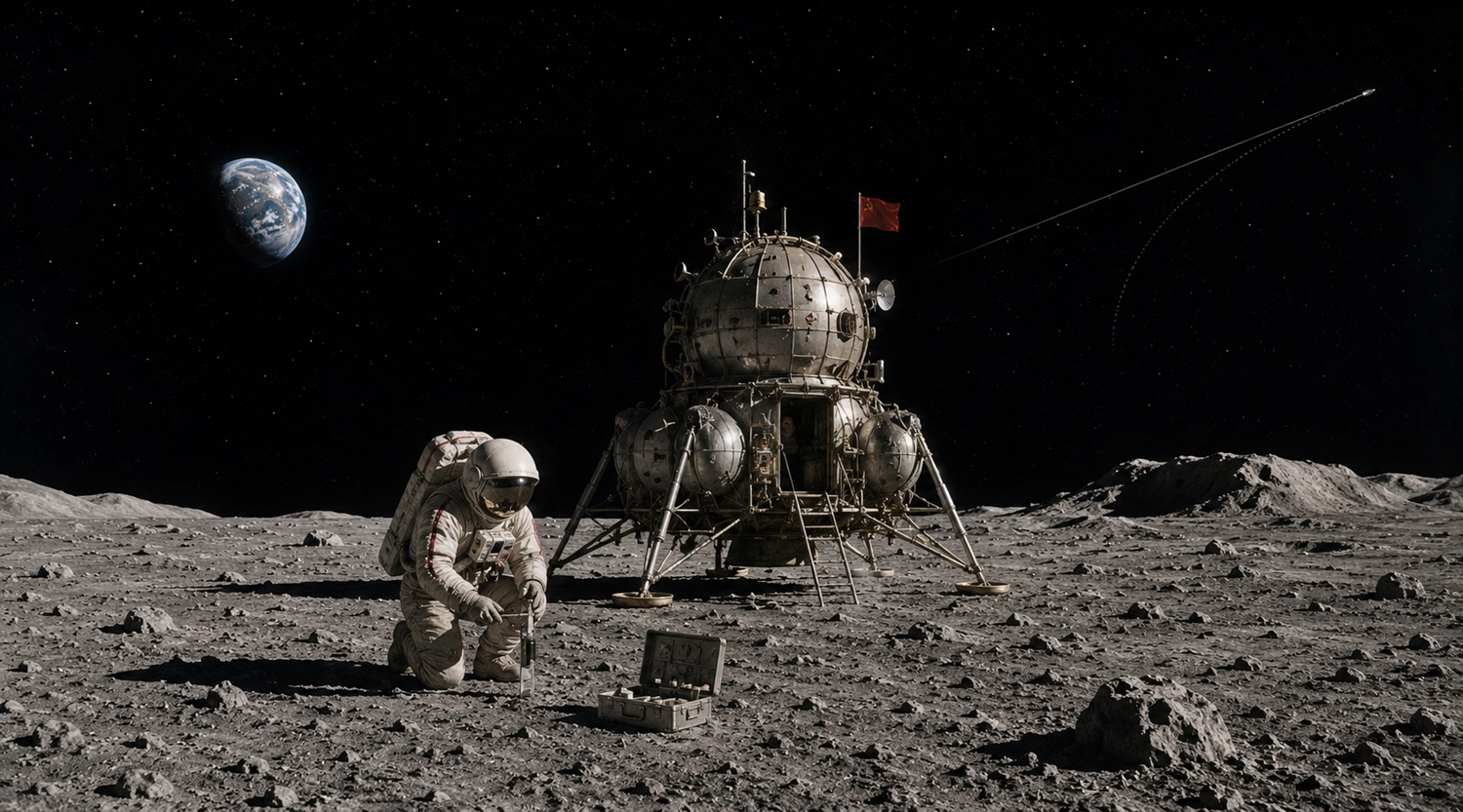
On July 20, 1969, Neil Armstrong and Buzz Aldrin landed Apollo 11's lunar module Eagle on the Moon while Michael Collins remained in lunar orbit.
That moment has become so firmly embedded in history that the outcome can seem inevitable.
It was not.
The Soviet Union had a genuine human lunar program built around the enormous N1 rocket and the L3 lunar expedition complex. The planned Soviet mission would have sent two cosmonauts into lunar orbit, transferred one of them by spacewalk into a small lunar lander, placed that single cosmonaut on the surface, and then reunited the crew in lunar orbit for the return to Earth. NASA's historical documentation confirms that the N1-L3 program was intended to land one cosmonaut on the Moon and that the Soviet government formally approved its human lunar programs in 1964. (NASA)
The Soviet system was real.
It was also badly behind.
The N1 did not make its first flight until February 1969. That launch failed. A second N1, launched on July 3—less than two weeks before Apollo 11—suffered a catastrophic first-stage failure and fell back onto its launch complex. Two additional N1 flights in 1971 and 1972 also failed. No N1 ever completed a successful flight. (NASA)
So a Soviet first landing requires more than changing the result of one launch.
It requires the Soviet lunar program to become better organized and better tested several years earlier, while still using hardware the USSR was genuinely developing.
That is the divergence explored here.
Beginning in 1964, the Soviet leadership gives the N1-L3 program clear national priority, reduces competition among rival lunar projects, funds much more comprehensive propulsion and integrated-stage testing, and establishes an aggressive sequence of uncrewed N1-L3 flights beginning roughly eighteen months earlier than happened historically.
The architecture remains recognizably Soviet.
There is no fictional fusion engine.
No magically enlarged Proton.
No spacecraft technology from the 1980s.
The USSR still has to make the N1, the lunar-orbit spacecraft, the LK lander, the Blok D propulsion stage, rendezvous procedures, navigation systems, and reentry hardware actually work.
In this alternate timeline, it barely succeeds.
An uncrewed N1-L3 test reaches lunar orbit in 1968. Another mission validates the critical propulsion and rendezvous sequence. Early in 1969, a crewed Soviet mission circles the Moon. Then, in June 1969, only weeks before Apollo 11 is scheduled to fly, a Soviet N1 rises from Baikonur carrying two cosmonauts.
One remains in orbit.
One descends alone.
The Soviet Union lands the first human on the Moon.
The red flag reaches the lunar surface first.
And the United States suddenly faces an uncomfortable question:
What does Apollo mean if America finishes second?
---
The Moon Race Was Already a Response to Soviet Firsts
The lunar race cannot be understood without remembering how the competition began.
The Soviet Union launched Sputnik in 1957. Yuri Gagarin became the first human to orbit Earth on April 12, 1961. American policymakers understood these achievements not merely as scientific accomplishments but as demonstrations of technological capacity and international prestige. NASA historical material describes Gagarin's flight as a serious blow to U.S. prestige, while contemporary American foreign-policy documents explicitly discussed Soviet space achievements as instruments for building an image of technical and military competence abroad. (NASA)
Only weeks after Gagarin's flight, President John F. Kennedy committed the United States to landing a person on the Moon and returning that astronaut safely before the end of the decade. Apollo thus became both an engineering program and a geopolitical demonstration. (NASA)
The choice of the Moon was important because it offered the United States a target far enough in the future that the country's industrial and technological resources might overcome the Soviet Union's early lead.
A Soviet lunar victory would therefore strike directly at Apollo's original political purpose.
The USSR would have won Sputnik.
It would have put the first person in orbit.
And now it would have placed the first person on another world.
---
The Real Soviet Lunar Program
The popular idea that the USSR never seriously intended to send people to the Moon survived partly because the Soviet lunar effort remained secret for decades.
It was nevertheless substantial.
NASA's later historical reconstruction describes two major Soviet human lunar approaches. The L1/Zond program was intended to send two cosmonauts around the Moon without entering lunar orbit. The more ambitious N1-L3 program was intended to perform the landing itself. (NASA)
Zond was essentially a modified Soyuz-derived spacecraft optimized for circumlunar missions. Zond 5 flew around the Moon in September 1968 carrying biological specimens, and Zond 7 completed a fully successful robotic circumlunar mission in August 1969. The fact that the Soviets appeared close to a human circumlunar flight influenced American perceptions of the race and contributed to the decision to send Apollo 8 around the Moon in December 1968. (NASA)
The landing mission was considerably harder.
That required the N1.
---
The N1: The Soviet Moon Rocket
The N1 was the Soviet answer to the heavy-lift problem that NASA solved with the Saturn V.
It was an enormous multistage launch vehicle intended to send the Soviet lunar spacecraft toward the Moon. The first stage used 30 NK-15 engines, a dramatically different approach from the Saturn V's five enormous F-1 first-stage engines. NASA's technical history of Soviet hardware documents the 30-engine arrangement and the difficulties encountered during the N1 flight program. (NASA)
Thirty engines were not inherently impossible to control.
But coordinating such a large propulsion cluster introduced formidable engineering problems involving plumbing, vibration, engine control, failures, and interactions among engines.
The actual program never demonstrated a successful N1 flight.
The first test on February 21, 1969 failed shortly after launch. The second, on July 3, suffered an engine-related catastrophe and fell back near the pad, causing enormous damage. A third N1 failed in June 1971, and a fourth failed in November 1972 only seconds before planned first-stage cutoff. (NASA)
The fourth flight is especially revealing.
By late 1972 the rocket had progressed far enough to fly for roughly 107 seconds before a destructive first-stage explosion. NASA's chronology notes that this vehicle was intended to carry a fully equipped lunar-orbit spacecraft on an automated lunar mission. (NASA)
The Soviet lunar program was therefore not imaginary.
It was a real program that never overcame its launch vehicle problems in time.
---
The Soviet Lunar Mission Was Smaller Than Apollo
The N1-L3 mission architecture imposed severe weight restrictions.
Apollo sent three astronauts toward the Moon.
Two descended together in the lunar module while a third remained in orbit.
The Soviet L3 plan used two cosmonauts.
Only one would land.
The landing cosmonaut would leave the lunar-orbit spacecraft by EVA, transfer externally into the small LK lunar lander, descend to the Moon, lift off again, rendezvous in lunar orbit, dock, and then conduct another EVA to return to the orbital spacecraft. There was no Apollo-style internal docking tunnel between the lunar vehicles. (NASA)
This was ingenious engineering under strict mass limitations.
It was also operationally demanding.
A Soviet lunar victory could therefore occur while Apollo remained technologically more capable in several respects.
That becomes extremely important politically after the first landing.
---
Apollo Was Much Closer to Readiness in 1969
By March 1969, Apollo 9 had successfully tested the lunar module in Earth orbit. Apollo 10 followed in May as essentially a full lunar-landing dress rehearsal, taking the lunar module into lunar orbit and descending close to the surface without landing. NASA was already planning Apollo 11 for July. (NASA)
The Soviet program, by contrast, had not successfully flown the N1 at all.
So simply declaring that the first historical N1 works and sends a cosmonaut to the Moon in February 1969 would not be technically credible.
Too much remained untested.
A believable Soviet victory must begin earlier.
---
The Point of Divergence: Moscow Chooses One Moon Program
The divergence begins in 1964.
Historically, the Soviet human lunar landing effort received formal governmental approval that year—three years after Kennedy publicly committed the United States to Apollo. (NASA)
In the alternate timeline, approval is accompanied by something the real program badly needs:
clear central priority.
The Kremlin treats the lunar landing not as one prestigious project competing with numerous design bureaus and military programs, but as a national strategic program comparable in political importance to Apollo.
Resources are concentrated behind N1-L3.
Ground testing receives greater priority.
Production quality control improves.
Integrated propulsion testing begins earlier.
The first N1 flight is targeted for 1967 rather than slipping to 1969.
Zond remains available as a stepping stone for navigation, reentry, and deep-space human-flight experience.
The USSR is not suddenly richer.
It simply spends more of its existing space resources on one goal.
That has costs elsewhere.
Military spacecraft, planetary probes, and other projects experience delays.
But the Moon program finally receives the focused development schedule needed to compete seriously with Apollo.
---
Why Better Testing Matters More Than a Better Rocket
The alternate Soviet Union does not need to invent a new launch vehicle.
It needs to discover its N1 problems before cosmonauts depend on it.
The actual four N1 flights exposed different failures and control problems between 1969 and 1972. In effect, the flight program was performing development work at extraordinary cost and risk. (NASA)
In the alternate program, additional component and integrated-stage testing during 1965–1967 identifies more of these problems on the ground.
The N1 still experiences failures.
A 1967 vehicle fails.
Another flight in early 1968 reaches farther but does not complete its mission.
That is not a setback to the scenario.
It is what makes the eventual victory believable.
Rocket development is allowed to fail before 1969.
By late 1968, the Soviets achieve a successful N1 flight carrying an uncrewed approximation of the lunar complex.
The hardware is still riskier than Apollo.
It is simply no longer unproven.
---
The Soviet Union Also Needs the Lander to Work
Making the N1 reliable is only half the problem.
The small Soviet lunar lander also needs testing.
The planned L3 mission involved a complex sequence: translunar injection, lunar-orbit insertion, EVA transfer, descent, lunar ascent, rendezvous, docking, another EVA transfer, and trans-Earth return. NASA's technical reconstruction documents this full mission architecture. (NASA)
Historically, versions of the Soviet lunar lander eventually underwent successful Earth-orbit testing, but too late to challenge Apollo.
In the alternate program, those tests are advanced into 1967–1968.
The USSR does not need to prove that its lander is as comfortable or capable as Apollo's.
It needs evidence that:
the descent propulsion works;
the ascent propulsion works;
navigation works;
the cosmonaut can transfer between vehicles;
and lunar-orbit rendezvous is dependable enough to risk a mission.
That remains dangerous.
Apollo was dangerous too.
A Cold War prestige race did not require zero risk.
---
An Alternate Soviet Flight Sequence
A plausible accelerated program might look like this.
1967: First N1 flight
The booster fails during an uncrewed test.
The failure is politically embarrassing inside the classified program but provides valuable engineering data.
Early 1968: Second N1
The vehicle survives much longer and validates most first-stage operation before an upper-stage problem ends the mission.
Late 1968: Third N1
An uncrewed lunar complex reaches lunar orbit and returns its Soyuz-derived orbital spacecraft successfully.
Early 1969: Crewed circumlunar or lunar-orbit mission
Two Soviet cosmonauts fly around or orbit the Moon and return.
This gives Moscow a crewed deep-space milestone after Apollo 8 has already orbited the Moon.
June 1969: Soviet lunar landing
The N1 launches the full L3 complex.
One cosmonaut remains aboard the lunar-orbit vehicle.
The second transfers to the LK lander.
He descends.
He walks on the Moon.
He plants a Soviet flag.
After a brief surface stay, he launches, rendezvouses with his companion, and returns to Earth.
The mission is substantially more austere than Apollo 11.
But for one fact, none of that matters.
He was first.
---
How Close Could This Really Be?
This is a demanding counterfactual, not an easy one.
The real N1 did not fly successfully even by 1972. Advancing an entire successful development sequence by several years requires stronger funding, program integration, testing infrastructure, and political discipline than the Soviet effort historically received. (NASA)
But the scenario does not require technology outside the Soviet engineering world.
The L3 architecture existed.
The N1 existed.
Soyuz-derived lunar spacecraft existed as designs and test hardware.
The USSR demonstrated circumlunar Zond flights and would shortly achieve sophisticated robotic lunar sample return and rover missions. Zond 7 completed a successful circumlunar mission in August 1969, Luna 16 returned lunar material robotically in 1970, and Lunokhod 1 became the first robotic rover to explore another world's surface later that year. (NASA)
The technological pieces were real.
The missing element was getting all of them ready soon enough and reliably enough.
---
The Soviet Landing: June 1969
The alternate first landing would probably be short.
The Soviet LK was designed for a single lunar explorer, not a two-person surface expedition comparable with Apollo. (NASA)
The cosmonaut's priorities would therefore be political and operational.
Land safely.
Establish communications.
Step onto the surface.
Deploy the Soviet flag and commemorative material.
Photograph the site.
Collect a limited quantity of lunar material if the mission plan permits.
Conduct basic observations.
Return to the lander.
Launch before unnecessary exposure creates additional risk.
The Soviet government would maximize every second for propaganda.
The event would be transmitted internationally if communications allowed it.
Moscow would portray the landing as the culmination of Sputnik and Gagarin—a demonstration that socialist science had led humanity from the first artificial satellite to the first human footprint on another celestial body.
The United States itself had long understood how powerful such a Soviet success could be. A 1963 U.S. policy assessment explicitly warned that if the USSR put the first person on the Moon, the resulting Soviet prestige would be substantial. (Office of the Historian)
---
Washington's Reaction Would Be Immediate
Richard Nixon had entered the White House in January 1969.
Historically, he inherited an Apollo program already approaching Kennedy's goal while also confronting Vietnam, domestic spending pressures, inflation, and questions about what should follow Apollo. He created a Space Task Group to evaluate the post-Apollo future. (NASA)
A Soviet lunar landing changes the political atmosphere overnight.
The Nixon administration cannot claim victory in the Moon race.
Congress cannot describe Apollo merely as the program that proved America had overcome the Soviet lead.
Instead, Apollo becomes a recovery mission.
The new message is simple:
The Soviets landed first. America must demonstrate that it can do more.
---
Apollo 11 Probably Still Flies
The most likely American reaction is not cancellation.
Nor is it a reckless crash program to beat the Soviets by a few days.
Apollo 11 is already nearly ready.
Apollo 10 completed its lunar dress rehearsal in May 1969, and NASA was preparing Apollo 11 for its July mission. (NASA)
A Soviet landing in June therefore leaves little time for a meaningful schedule change.
NASA leadership would have powerful safety reasons not to advance the flight merely for symbolism.
Apollo 11 probably launches on or near its historical July schedule.
But its political meaning changes completely.
Neil Armstrong is no longer the first human to walk on the Moon.
Armstrong and Aldrin instead become the first American lunar explorers—and potentially the first two-person team on the lunar surface.
NASA emphasizes capabilities the smaller Soviet expedition cannot easily match:
two surface astronauts;
longer EVA time;
larger scientific payload;
substantial sample return;
more sophisticated surface operations;
and a spacecraft architecture capable of increasingly ambitious follow-on missions.
The United States loses the first landing.
It immediately begins arguing that it possesses the better lunar system.
---
Apollo Becomes a Series, Not a Finish Line
Historically, Apollo 11's success weakened one of the political arguments for maintaining extraordinary lunar spending.
The race had been won.
NASA's budget had already peaked years earlier, and subsequent budget pressure contributed to the cancellation of Apollo 20 and later Apollo 18 and 19. NASA's own history notes that the agency's budget began declining before Apollo 11 and that planned post-Apollo programs faced severe fiscal constraints. (NASA)
A Soviet first landing changes that logic.
Apollo 11 no longer ends the race.
It prevents an uncontested Soviet victory.
Congressional supporters of NASA can argue that terminating lunar exploration after several missions would concede long-term lunar prestige to Moscow.
The strongest alternate consequence is therefore not an immediate American Mars mission.
It is much simpler:
Apollo 18, 19, and perhaps 20 are much harder to cancel.
---
Apollo 18, 19, and 20 Probably Fly
NASA historically possessed plans extending through Apollo 20 before budget reductions and hardware decisions eliminated the final missions. Apollo 20 was canceled in 1970 partly because its Saturn V was needed for the space station that became Skylab, and later budget reductions eliminated Apollo 18 and 19. (NASA)
In the alternate timeline, political pressure produces additional Saturn V funding or preserves hardware that would otherwise be reassigned.
Apollo 18 and 19 are strong possibilities.
Apollo 20 becomes plausible.
The later landings would emphasize increasingly sophisticated science, geology, longer surface stays, rovers, instruments, and perhaps technology demonstrations for sustained lunar operations.
America's answer to being second would be:
If Moscow got there first, Washington will stay longer.
---
Could Nixon Approve a Lunar Base?
This is where the counterfactual becomes more uncertain.
Nixon's Space Task Group historically considered a broad menu of post-Apollo options, including an Earth-orbiting space station, reusable transportation, a lunar-orbiting station, a lunar surface base, and eventually human expeditions to Mars. Nixon rejected the more expensive versions because of their cost. (NASA)
A Soviet first landing dramatically improves the political case for choosing something more ambitious.
But it does not eliminate the budget.
Vietnam still exists.
Domestic programs still compete for money.
Congress still has priorities unrelated to space.
The strongest alternative is therefore not a giant permanent Moon city in 1975.
A smaller American lunar outpost becomes much more plausible.
---
The Apollo Applications Program Could Become Lunar Again
NASA had already studied ways of using Apollo and Saturn hardware after the initial landing program.
The Apollo Applications Program eventually produced Skylab, America's first space station. (NASA)
In the alternate timeline, Apollo Applications may divide into two branches:
an Earth-orbiting station;
and a modest extended lunar program.
Possible missions could include:
long-duration lunar modules;
surface shelters;
larger science packages;
uncrewed cargo landers;
improved lunar rovers;
and repeated visits to one selected landing region.
Rather than committing immediately to a continuously occupied base, NASA could gradually build a semi-permanent lunar research site visited periodically by Apollo crews.
That would require significant money.
A Soviet first provides the missing political argument.
---
Or Washington Could Choose Mars
There was another option.
The 1969 Space Task Group explicitly discussed human planetary exploration and NASA planning that included the possibility of a human Mars mission as early as 1981 if the nation committed the necessary resources. The report also acknowledged that such a goal would require extensive precursor work and substantial budget support. (NASA)
A Soviet first landing would make a Mars commitment politically imaginable.
The slogan almost writes itself:
The Soviets were first on the Moon. America will be first on Mars.
But this would still be enormously expensive.
The likelier Nixon strategy is to authorize studies, advanced propulsion work, station development, and a longer Apollo program without immediately promising a Mars landing date.
A dramatic Mars commitment remains the high-cost branch.
---
Three Possible American Responses
| U.S. response | Likely policy | Plausibility |
| -------------------------------- | ------------------------------------------------------------------------------------------------------------ | ----------------------------------- |
| Beat them through repetition | Apollo 11 flies quickly; Apollo 18–20 survive; longer and more scientifically capable lunar missions follow. | Strongest |
| Build a lunar foothold | Apollo Applications expands into cargo missions and a small periodically occupied lunar outpost. | Plausible |
| Choose a bigger prize | Nixon announces a long-term human Mars objective for the 1980s. | Possible but fiscally difficult |
These approaches could overlap.
The United States might preserve Apollo while simultaneously declaring Mars a long-range goal.
---
Soviet Propaganda Would Have Its Greatest Space Victory
The Soviet government had already demonstrated exceptional ability to use space achievements for international prestige. Contemporary American assessments emphasized how Soviet space accomplishments were presented as evidence of technical strength and the effectiveness of the Soviet system. (Office of the Historian)
A first lunar landing would become the largest example yet.
Sputnik had shown that the USSR could orbit the first satellite.
Gagarin had shown that it could send the first person into orbit.
The Moon would allow Moscow to claim that when humanity took its greatest technological steps, socialism repeatedly arrived first.
The visual symbolism would be extraordinarily powerful.
A Soviet cosmonaut standing beside a flag on the Moon would appear on posters, stamps, documentaries, textbooks, public buildings, and diplomatic exhibitions for decades.
---
The Effect in Developing Nations Could Be Significant
During the Cold War, the space race was partly a contest over political reputation beyond NATO and the Warsaw Pact.
American policymakers explicitly worried about the effects of Soviet technological accomplishments on international prestige and about the image of relative scientific and industrial strength presented to other countries. (Office of the Historian)
A Soviet first landing could therefore have particular symbolic value in newly independent states across Africa, Asia, and elsewhere.
Moscow could argue:
the supposedly economically backward socialist state had defeated the wealthiest capitalist country in humanity's most visible technological contest.
That message might strengthen Soviet educational exchanges, scientific diplomacy, technical-assistance programs, and cultural influence.
But prestige is not the same thing as alliance.
Governments would continue choosing relationships according to security, economics, regional politics, ideology, and domestic interests.
A lunar flag would not automatically turn neutral countries into Soviet clients.
---
NATO Would Not Collapse
The same caution applies to Western Europe.
A Soviet lunar victory would be embarrassing for the United States.
It would not change the fundamental military structure of NATO.
Nuclear deterrence does not depend on Moon landings.
American forces remain in Europe.
The Soviet Union remains on the opposite side of a heavily armed continental confrontation.
European governments might question U.S. technological leadership more sharply, but they would not conclude that Soviet lunar engineering had rendered the Atlantic alliance irrelevant.
The psychological effect would be real.
The strategic effect would be much smaller.
---
Warsaw Pact Propaganda Gets a Major Boost
Eastern European communist governments would celebrate the landing as a victory of the socialist world.
Schools would teach it.
Party newspapers would connect it to Soviet scientific education and industrial achievement.
A successful N1 would also provide a visible demonstration that Soviet engineering could compete at the largest technological scale.
But the achievement would not remove political problems within the Soviet bloc.
Space prestige could strengthen confidence.
It could not substitute indefinitely for economic performance or political legitimacy.
---
Would the Soviet Union Keep Landing Cosmonauts?
Probably.
Winning once and stopping immediately would be dangerous politically.
If Apollo 11 lands only weeks later, Soviet leaders would want to demonstrate that their achievement was not a one-time gamble.
A second N1-L3 expedition could therefore follow in 1970.
A third might carry improved surface equipment.
The USSR might attempt longer stays or add a rover derived from technology already being developed for the Luna program.
Historically, Soviet robotic lunar capabilities became impressive shortly after Apollo 11: Luna 16 successfully returned lunar soil in September 1970, and Luna 17 delivered Lunokhod 1 two months later. (NASA Science)
A victorious human lunar program could combine these robotic and crewed systems more closely.
---
The USSR Could Put a Lunokhod Near a Cosmonaut
This is one of the more technically credible extensions.
Lunokhod hardware actually existed.
The Soviet Union successfully operated Lunokhod 1 on the Moon beginning in November 1970. (NASA Science)
Instead of inventing a large crewed lunar rover, Moscow could land robotic rovers near planned cosmonaut sites.
They could scout routes.
Survey terrain.
Carry instruments.
Perhaps transport supplies or provide communications support after modification.
This would fit Soviet strengths in robotic lunar exploration.
A Soviet surface strategy might therefore evolve differently from Apollo's.
The Americans send increasingly capable crews and eventually the Lunar Roving Vehicle.
The Soviets integrate small crewed sorties with pre-landed robotic machines.
---
Soviet Lunar Science Would Still Face Mass Limits
The political victory should not obscure the weakness of the L3 architecture.
One cosmonaut on the surface means less labor.
The lander has strict mass constraints.
The mission has less redundancy.
The EVA transfer between lunar vehicles is operationally awkward.
Apollo's larger architecture can return more samples and support more extensive surface science.
The United States could exploit these differences immediately.
American propaganda after Apollo 11 would emphasize that the United States was not merely repeating the Soviet achievement.
Apollo was demonstrating a larger and more capable system.
The contest changes from who was first to who can do more.
---
A Strange Outcome: Both Superpowers Claim Victory
By late 1969, the competing narratives would be obvious.
Moscow
The Soviet Union put the first human on the Moon.
Nothing can change that.
Washington
The United States has demonstrated the more sophisticated lunar transportation system, placed two astronauts on the surface, returned larger scientific payloads, and is preparing repeated expeditions.
Both claims contain truth.
The Moon race no longer has the clean ending remembered from actual history.
Instead, it continues.
---
Nixon Has Less Ability to Declare the Race Finished
Historically, Apollo's success made it politically easier to reduce NASA's extraordinary Cold War funding.
NASA's budget had peaked in the mid-1960s, and by the early 1970s the political coalition that had supported Apollo-level spending had substantially weakened. (NASA)
A Soviet first would keep the competitive argument alive.
Congressional critics could still attack costs.
But NASA supporters could answer with a simple photograph:
the Soviet flag on the Moon.
That is likely sufficient to preserve several programs that historically disappeared.
It is not necessarily sufficient to maintain Apollo-era spending indefinitely.
---
The Space Shuttle Could Change
Historically, Nixon approved development of the Space Shuttle in 1972 as the principal reusable U.S. human-spaceflight system for the post-Apollo period. NASA's more expansive proposals for stations, lunar operations, and Mars missions had proved too expensive for the administration. (NASA)
If lunar competition remains active, the Shuttle decision becomes less straightforward.
One possibility is that the Shuttle is delayed because Saturn-Apollo hardware remains in production longer.
Another is that it becomes part of a more ambitious integrated system:
reusable transportation to Earth orbit;
a space station;
lunar tugs;
and continued lunar expeditions.
NASA's 1969 planning had contemplated interconnected station, reusable-transportation, lunar, and Mars systems rather than the Shuttle existing alone. (NASA)
The problem, again, is money.
Doing both extended Apollo and a full Shuttle program would be expensive.
---
A Smaller Shuttle May Become More Attractive
If lunar missions continue to depend on Saturn-class expendable launch vehicles, there is less political pressure to make one reusable spacecraft satisfy nearly every American human-spaceflight requirement.
The United States might develop a smaller crew-and-cargo shuttle for servicing an Earth-orbiting station while retaining heavy expendable boosters for lunar missions.
That could produce a very different American space architecture.
This is an engineering-policy inference, not a prediction.
But losing the Moon race would certainly reopen assumptions about what post-Apollo spaceflight was supposed to accomplish.
---
What Happens to Soviet Space Stations?
A Soviet lunar victory would not erase one of the USSR's greatest actual strengths: long-duration orbital stations.
The Soviet Union launched Salyut 1 in April 1971, the world's first space station, and later Salyut stations developed increasingly capable long-duration human-spaceflight systems. Those technologies ultimately led to Mir, whose first module launched in 1986. (NASA)
The question is whether an ongoing N1-L3 program delays that transition.
Probably somewhat.
Money, engineers, launch facilities, and political attention are finite.
A Soviet government still fighting an active lunar competition may keep more resources on the Moon during the early 1970s.
Salyut could still appear.
Its pace might slow.
Alternatively, the Kremlin could treat orbital stations and lunar missions as complementary demonstrations of superiority:
first on the Moon and longest in space.
That would be expensive but politically attractive.
---
The Soviet Long-Duration Strategy Still Makes Sense
Even after winning the first landing, repeating Apollo-style sorties indefinitely offers diminishing propaganda returns.
The USSR would eventually need a new category of achievement.
Space stations provide one.
Weeks in orbit.
Then months.
Multiple crews.
Military experiments.
Earth observation.
Astronomy.
International visiting cosmonauts.
The Salyut-Mir path therefore remains highly attractive even in a Soviet-first Moon timeline.
The difference is that it begins with the prestige of lunar victory behind it.
---
A Soviet Lunar Base Is Possible but Unlikely
Winning the Moon race would certainly encourage Soviet proposals for more ambitious lunar infrastructure.
But an operational base would require substantially more than the minimalist L3 landing architecture.
Cargo delivery.
Power.
Habitats.
Long-duration life support.
Reliable repeated N1 launches.
Surface transportation.
Communications.
A sustained national budget.
The N1 would need to mature from a barely reliable race-winning launcher into an operational heavy-lift system.
That is a much larger challenge.
A few follow-on Soviet landings are therefore much more plausible than a permanent Soviet lunar settlement during the 1970s.
---
The United States Might Be More Likely to Build the First Lunar Base
This is one of the counterfactual's ironies.
The USSR wins the first landing.
The humiliation gives the United States the political motivation to pursue a more ambitious follow-up.
If Washington decides that merely landing second does not erase the Soviet first, the next clear prestige objective is sustained presence.
A small American lunar base could therefore become the new finish line.
If established in the late 1970s, it could allow the United States to reframe the historical competition:
the Soviets reached the Moon first;
America became the first nation to live and work there for extended periods.
Whether Congress would fund this is uncertain.
But it is more plausible after a Soviet first than after an American victory that already satisfied Kennedy's goal.
---
Mars Becomes the Ultimate Prestige Prize
The same logic points outward.
If the Moon has already produced conflicting claims of victory, Mars offers an unambiguous next first.
NASA's 1969 Space Task Group planning explicitly considered human Mars exploration and outlined a possible 1981 mission if the necessary national commitment were made. (NASA)
A Soviet-first Moon landing would give advocates of Mars something they lacked historically:
a powerful geopolitical argument for maintaining Apollo-scale momentum.
Yet Mars is vastly more difficult.
A crew would be away for hundreds of days.
Life-support reliability becomes far more demanding.
Radiation becomes a larger concern.
Heavy payloads must be launched and assembled.
Mars entry, landing, surface ascent, and Earth return all require major new systems.
Even the Space Task Group acknowledged the need for extensive biomedical, propulsion, life-support, and reconnaissance work before a human expedition. (NASA)
A Mars landing in the 1980s therefore becomes more plausible, not inevitable.
---
Could the Soviets Compete for Mars?
They could announce that they intended to.
Actually executing such a program would be another matter.
The USSR's successful Moon landing would strengthen the N1 politically and technologically.
An improved N1 could support heavy orbital infrastructure.
Soviet experience with long-duration stations could address part of the human-endurance problem.
But deep-space propulsion, Mars landing systems, and the enormous mass requirements would demand another major national program.
The Soviet state could not fund every prestige project at maximum intensity indefinitely.
If Washington chooses Mars, Moscow must decide whether to follow—or claim that long-duration orbital stations, robotic planets, and lunar operations are more rational.
That is exactly the kind of strategic repositioning both sides repeatedly used when the other obtained an advantage.
---
Robotic Exploration Probably Gets More Competitive Too
The Soviet space program was already exceptionally strong in several robotic areas.
Luna 16 returned the first robotic sample from beyond Earth in 1970.
Lunokhod 1 became the first robotic rover to explore another celestial body's surface.
Soviet Venera missions achieved major Venus milestones. (NASA Science)
A victorious lunar program might make the Kremlin more willing to integrate robotic and human exploration.
The United States, meanwhile, would have an incentive not to allow Moscow to dominate planetary firsts after already losing the first human lunar landing.
Mars and Venus robotic programs could receive greater prestige attention.
The result might be a broader space race rather than one focused overwhelmingly on human lunar flight.
---
International Prestige Would Be Real but Temporary
The most important political question is how long the Soviet prestige boost lasts.
Sputnik remained historically important.
Gagarin remained historically important.
A first lunar landing would be even more memorable.
But technological prestige depreciates.
If Apollo 11 lands a month later and Apollo missions then repeatedly outperform Soviet expeditions, perceptions begin to change.
If the United States operates a lunar base while Soviet N1 launches remain expensive and unreliable, the propaganda advantage narrows further.
If American planetary probes, communications satellites, computers, aerospace industries, and commercial technologies continue advancing, the Moon cannot permanently define global technological reputation.
The Soviet first would remain an immortal historical achievement.
Its geopolitical value would not remain constant.
---
Developing Countries Would See a More Competitive Superpower System
For governments trying to avoid exclusive alignment with either superpower, a Soviet lunar victory could be useful evidence that technological modernity did not belong exclusively to the capitalist West.
That would strengthen Moscow's claims when offering engineering education, scientific cooperation, infrastructure assistance, or ideological partnerships.
Yet the same countries could watch Apollo land soon afterward.
The result would therefore not necessarily be a Soviet diplomatic sweep.
It might instead reinforce the idea that two genuinely competitive technological systems existed.
That perception could increase bargaining opportunities for non-aligned governments.
This is an inference from the documented importance both superpowers placed on international space prestige, rather than a claim that lunar accomplishment dictated foreign policy. (Office of the Historian)
---
The Moon Does Not Change Nuclear Deterrence
The Cold War's strategic balance depended overwhelmingly on terrestrial military and economic factors.
A lunar landing demonstrates engineering capacity.
It does not neutralize American nuclear forces.
It does not remove Soviet fears about U.S. military technology.
It does not change European geography.
It does not eliminate the Sino-Soviet split.
It does not resolve Vietnam.
It does not make either superpower economically invulnerable.
The prestige value could therefore be enormous while the direct military value remains modest.
This distinction was already understood by American officials during the space race: space prestige was treated as politically significant even when particular space achievements did not themselves determine the strategic balance. (Office of the Historian)
---
The Soviets Would Have a Harder Time Hiding Later Failures
There is another consequence of winning.
The real USSR kept its failed crewed lunar landing program secret for years.
A victorious program cannot disappear quietly.
Once the world has watched a Soviet cosmonaut walk on the Moon, every subsequent launch attracts attention.
A second landing failure becomes conspicuous.
A fatal accident could be politically devastating.
N1 reliability must therefore improve quickly after the first success.
The propaganda victory creates an operational commitment.
The USSR has won the right to be judged by its next mission.
---
Could the Americans Overtake the USSR Within Months?
Yes.
That is arguably the most likely short-term outcome.
Suppose the Soviet landing occurs on June 15, 1969.
Apollo 11 lands July 20.
The Soviet Union holds the most important first.
But NASA now has an operational Saturn V, command and service module, and lunar module system capable of supporting repeated missions.
Apollo 12 could follow.
Then Apollo 13, 14, 15, 16, 17, and—in this alternate world—perhaps 18, 19, and 20.
Historically, Apollo ultimately placed twelve astronauts on the lunar surface between 1969 and 1972 and returned hundreds of kilograms of lunar samples. (NASA Science)
If the Soviets cannot match that tempo, the United States could become the dominant lunar power while remaining permanently second in the history books.
---
The Soviet Union Might Emphasize “Firsts” Elsewhere
This had precedent in the broader logic of the space race.
When one side held an advantage in a particular category, the other often looked for a different dramatic objective.
A Soviet government facing superior American lunar sortie capability could pivot toward:
the first long-duration lunar stay;
the first robotic-human lunar cooperation;
the first woman on the Moon;
the first lunar rover operated by a cosmonaut;
the first space station occupied for six months;
or the first crew exchange among allied states.
The exact choices are speculative.
The incentive to redefine victory is not.
---
Space Stations Could Become the Second Great Race
Historically, the USSR launched Salyut 1 in 1971 and gradually developed a major advantage in long-duration orbital habitation. Later Salyut stations and Mir built an extensive operational tradition of prolonged human spaceflight. (NASA)
The United States launched Skylab in 1973 but did not maintain a continuously evolving national station program afterward.
A Soviet first Moon landing could change that American calculation.
Washington might decide it cannot afford another visible Soviet category of leadership.
Skylab 2 or follow-on stations become more plausible.
The United States could maintain both lunar and Earth-orbit objectives longer than it did historically.
Again, the constraint is funding.
Competition provides motivation.
It does not provide unlimited money.
---
The 1970s Could Become the Space Race's Second Act
Rather than the space race winding down after Apollo 11, the 1970s could produce several parallel competitions.
Lunar capability
Which country can conduct the most sophisticated surface operations?
Long-duration flight
Which country can keep crews in orbit longest?
Space stations
Which system can maintain and resupply permanent orbital facilities?
Reusable spacecraft
Can either country reduce the cost and increase the frequency of access to orbit?
Robotic planets
Who reaches Mars, Venus, and the outer planets most successfully?
Mars planning
Which country appears most likely to attempt the next great human expedition?
This would be a more expensive Cold War.
It would also be a much more interesting space age.
---
Does Apollo-Soyuz Still Happen?
Possibly, but its symbolism changes.
Historically, the Apollo-Soyuz Test Project brought American and Soviet crews together in orbit in 1975 and became an important symbol of détente in space. (NASA)
A more intense continuing space competition could delay that cooperation.
Or the opposite could happen.
After both states have demonstrated lunar capabilities, Nixon and Soviet leaders might see a joint docking as evidence that competition does not exclude détente.
The mission could still occur in the mid-1970s while each side continues competitive programs elsewhere.
Cold War competition and cooperation were never mutually exclusive.
---
What Happens to Reusable Spacecraft?
Historically, Nixon committed the United States to the Space Shuttle in 1972. The Soviet Union later developed Buran, which made its only orbital flight in 1988. (NASA)
In the alternate timeline, several possibilities open.
If the United States keeps Saturn production alive for lunar missions, the Shuttle may become smaller or later.
If Washington decides reusable access to a large space station is the next competition, Shuttle development could retain high priority.
If the Soviets continue the N1 while also pursuing stations, their own reusable system could be postponed because too many expensive programs are competing simultaneously.
Or an aggressive Kremlin might fund a reusable spacecraft earlier in response to American plans.
By the 1980s, exact predictions become difficult.
The strongest conclusion is merely that the architecture choices made after Apollo 11 would no longer be made in an atmosphere where the United States believed the central space race had been decisively won.
---
The Soviet Union Still Has to Choose Between the Moon and Stations
This becomes one of Moscow's biggest strategic decisions.
Maintaining N1 production and lunar hardware is expensive.
So is building increasingly capable orbital stations.
Historically, the Soviet station program proved much more sustainable than its lunar landing program. Salyut began in 1971, later stations added greater capabilities, and Mir's core module launched in 1986 as the basis of a modular, long-duration complex. (NASA)
The alternate USSR therefore probably begins withdrawing from repeated lunar landings during the mid-1970s even after winning the race.
It can declare victory and move to a field better suited to its evolving hardware.
The Moon becomes a triumph.
Space stations become policy.
---
A First Landing Could Actually Make That Pivot Easier
Historically, abandoning the N1-L3 program meant acknowledging internally that the Soviet Union had failed to beat Apollo.
In the alternate timeline, cancellation can be framed differently.
The Soviet Union has already won the first landing.
After several follow-up missions, leaders can claim that routine lunar sorties offer little additional value.
Resources move to stations, planetary probes, and military spacecraft.
The first-lunar-landing narrative remains intact.
This could make the Soviet space program more strategically rational after victory than it was while desperately trying to obtain victory.
---
A Real-vs-Alternate Space-Race Timeline
| Year | Real History | Soviet-First Timeline |
| -------------- | ---------------------------------------------------------------------------------------------------------------------- | ------------------------------------------------------------------------------------------------------------------------------------------------------------------ |
| 1957 | USSR launches Sputnik 1, the first artificial satellite. | Same. Soviet early space prestige begins. (Office of the Historian) |
| 1961 | Yuri Gagarin becomes first human to orbit Earth; Kennedy soon commits the U.S. to a lunar landing before decade's end. | Same. (NASA) |
| 1964 | Soviet human lunar program receives formal government approval. | Moscow instead gives N1-L3 consolidated national priority, stronger funding, earlier integrated testing, and a clearer management structure. (NASA) |
| 1966–67 | N1 development continues but first flight slips. | Extensive propulsion and integrated testing; first N1 flight occurs in 1967 and fails, providing earlier engineering data. |
| 1968 | Zond 5 circles Moon robotically; Apollo 8 becomes first crewed mission to orbit Moon. | Zond testing continues; a later 1968 N1 successfully sends an uncrewed L3-class payload through a lunar mission profile. (NASA) |
| Early 1969 | First N1 launches in February and fails. | Soviet crew performs a successful circumlunar or lunar-orbit mission with hardware validated by earlier tests. |
| June 1969 | No crewed Soviet lunar capability is ready. | USSR lands one cosmonaut on the Moon and returns the crew safely. |
| July 1969 | Second N1 fails July 3; Apollo 11 launches July 16 and lands July 20. | Apollo 11 still flies on roughly historical schedule and becomes the first American landing, with two astronauts on the surface. (NASA) |
| 1970 | Apollo program continues; Luna 16 returns robotic lunar sample. | Both sides conduct lunar missions; Soviet robotic and crewed programs increasingly cooperate. (NASA Science) |
| 1971 | Salyut 1 becomes first space station; Apollo 15 conducts advanced lunar exploration. | Soviet lunar flights continue while Salyut is launched on a slightly modified or similar schedule; U.S. Congress protects additional Apollo missions. (NASA) |
| 1972 | Nixon authorizes Space Shuttle; Apollo 17 becomes final lunar landing. | U.S. post-Apollo decision remains contested; Shuttle, extended Apollo, and a limited lunar outpost compete for funding. (NASA) |
| 1973–75 | Skylab and Apollo-Soyuz; U.S. leaves Moon. | Skylab or a successor station operates while Apollo 18–20 or lunar-development missions continue. Apollo-Soyuz may still occur as détente develops. |
| Late 1970s | USSR increasingly emphasizes Salyut stations; U.S. prepares Shuttle. | USSR gradually declares lunar victory complete and shifts toward stations; U.S. may pursue a small lunar outpost or an enhanced station/Shuttle architecture. |
| 1981 | First U.S. Space Shuttle flight. | Shuttle may fly on a similar schedule, somewhat later, or in a modified architecture depending on lunar spending. |
| 1986 | USSR launches Mir core module. | A Mir-like modular station remains highly plausible because long-duration stations still fit Soviet strengths. (NASA) |
| 1988 | Soviet Buran makes its only orbital flight. | Buran or another reusable program could exist, but timing becomes highly dependent on how long the Soviet lunar program consumes resources. (NASA) |
| Late 1980s | Space competition has become less central to superpower rivalry. | Soviet first-Moon prestige remains historically important, but economic and political pressures increasingly dominate both nations' space budgets. |
---
What Is Most Likely by 1975?
The most plausible middle scenario does not contain gigantic Moon bases or astronauts heading for Mars.
It looks more restrained.
The Soviet Union has completed perhaps two or three crewed lunar expeditions.
The United States has conducted a larger number of more sophisticated Apollo missions.
Apollo 18 and 19 have probably flown.
Apollo 20 is possible.
One or both countries have experimented with longer-duration lunar equipment.
Both operate or develop Earth-orbiting stations.
NASA continues studying Mars.
The Soviet Union increasingly redirects attention toward long-duration stations.
The first-lunar-landing question is settled permanently in Moscow's favor.
The question of overall space leadership remains open.
---
What Is Most Likely by 1980?
By 1980, economics begins overcoming symbolism.
Continuing lunar expeditions with 1960s-derived hardware is expensive.
Neither superpower has unlimited political appetite for repeating Moon landings.
The Soviet Union likely concentrates on long-duration orbital stations and robotic planetary missions.
The United States either transitions to a reusable spacecraft system or maintains a mixed Shuttle-heavy-lift architecture if lunar infrastructure survived the 1970s.
A continuously occupied lunar base is possible but still belongs to the ambitious branch.
A crewed Mars program remains technically conceivable but politically difficult.
The space race has lasted longer.
It has not escaped budget reality.
---
What Is Most Likely by the Mid-1980s?
A Mir-like Soviet station is still one of the strongest outcomes.
The USSR historically approved Mir in the 1970s using technology derived from Salyut and Almaz, and its first core module reached orbit in 1986. (NASA)
The Soviet first Moon landing might actually strengthen the ideological narrative surrounding such a station:
the country that opened the space age with Sputnik, sent Gagarin into orbit, and put the first person on the Moon is now establishing humanity's longest-duration orbital presence.
The United States would probably respond with stronger support for its own station plans than occurred historically.
By the 1980s, the most durable legacy of the alternate Moon race could therefore be more orbital infrastructure, not permanent lunar colonization.
---
Would the Soviet Union Build Buran Anyway?
Probably some reusable Soviet program eventually appears if the United States develops the Shuttle.
Historically, Buran development began in the 1970s and culminated in its uncrewed orbital flight in 1988. (NASA)
But a successful N1 changes Soviet launcher development.
If improved N1 derivatives remain useful heavy-lift vehicles, Soviet planners already possess an operational family capable of launching large payloads.
That could reduce some motivations for abandoning older heavy-lift concepts.
Conversely, continued U.S. Shuttle activity would still create military and technological pressure to investigate reusable systems.
So Buran might still exist.
It might simply coexist with a more mature Soviet heavy-lift rocket heritage.
---
The Biggest Technological Change Might Be Saturn V Survival
This possibility deserves special attention.
NASA's post-Apollo options became constrained partly because Saturn V production ended. NASA history notes that the Saturn V assembly line had been shut down, leaving only the vehicles already contracted. (NASA)
A Soviet first landing could reverse that political choice.
Congress might authorize another Saturn V production batch.
If that happens, the effects reach far beyond Apollo 18 or 19.
Additional Saturn V vehicles could launch:
very large space stations;
lunar cargo;
large telescopes;
deep-space propulsion stages;
or components for a human Mars architecture.
The counterfactual hinge is therefore not merely whether Apollo flies three more missions.
It is whether the United States preserves heavy-lift industrial capability after the Moon race.
That could influence American spaceflight for decades.
---
Would Winning the Moon Race Change the Cold War?
Yes—
but less than the photographs would suggest.
A Soviet first landing would strengthen Soviet prestige.
It would validate decades of Soviet space propaganda.
It would embarrass the Nixon administration.
It could strengthen perceptions of Soviet scientific and industrial capability.
It could give communist governments and Soviet diplomats one of the most powerful propaganda symbols of the twentieth century.
It would probably prolong American space spending.
It might alter the architecture of the U.S. space program.
Those are meaningful changes.
But the Cold War involved far more than prestige.
Military power.
Industrial productivity.
Energy.
Agriculture.
Trade.
Technology.
Alliance systems.
Domestic politics.
Political legitimacy.
National identities within the Soviet Union.
Relations with China.
Wars and crises in the developing world.
All would continue.
A successful N1 cannot solve those problems simply because it reaches the Moon.
---
Symbolic Power Is Not Economic Power
This distinction would become clearer with time.
The ability to construct a giant lunar rocket proves remarkable concentrations of scientific, industrial, and organizational capacity.
It does not prove that an economy efficiently supplies consumer goods.
It does not measure agricultural performance.
It does not determine productivity across ordinary industries.
It does not guarantee successful political reform.
Apollo itself demonstrates the distinction from the American side: once the specific political commitment existed, the United States could spend extraordinary resources on lunar flight, but maintaining that level of spending afterward required a separate political justification. NASA's budget peaked well before the last Apollo missions because spectacular technical capability did not automatically produce permanent fiscal commitment. (NASA)
The same logic would apply to Moscow.
---
The Soviet Victory Could Even Become Politically Awkward Later
Imagine Soviet schoolchildren in 1985 learning about the first human lunar landing.
The footage remains glorious.
The cosmonaut remains a national hero.
The achievement remains genuine.
But younger citizens also live within the economic and political conditions of the Soviet Union decades later.
A historical triumph can support legitimacy.
It cannot indefinitely substitute for present performance.
The older the lunar victory becomes, the more it resembles victory in the Second World War or Gagarin's flight:
a foundational source of national pride—
but not an answer to every contemporary problem.
---
The United States Would Eventually Recover the Prestige Loss
Apollo 11 would help almost immediately.
Then later Apollo missions could establish clear American superiority in the scale and sophistication of lunar operations.
If the United States builds a lunar outpost, launches a major station, or reaches another major destination first, international perceptions shift again.
This is how technological competition works.
There is rarely one final scoreboard.
The Soviet Union could permanently retain the first footprint while losing subsequent categories of leadership.
---
The First Footprint Still Matters Forever
Yet one thing can never be reversed.
No subsequent American achievement changes who arrived first.
In this timeline, museums around the world teach the sequence:
Sputnik — Soviet.
First human in space — Soviet.
First human in orbit — Soviet.
First human on the Moon — Soviet.
That would fundamentally alter the cultural memory of the early space age.
Apollo remains one of history's greatest engineering programs.
But it is remembered as America's extraordinary response to a Soviet lunar triumph rather than as the decisive victory that ended the first space race.
---
How the Apollo 11 Story Changes
Neil Armstrong's first words from the lunar surface would no longer carry the meaning of humanity's first step onto another world.
NASA would probably avoid pretending otherwise.
The mission would instead emphasize national achievement and greater operational capability.
Armstrong and Aldrin might be introduced as the first Americans on the Moon.
Their scientific program would receive even more attention.
The presence of two astronauts could be highlighted.
The American flag would become a symbol not of winning the race but of refusing to concede space leadership.
Apollo 11 becomes a comeback story.
That might make the subsequent missions politically more compelling rather than less.
---
What Happens to the Soviet Lunar Cosmonaut?
Who actually makes the first landing is far more speculative than whether the program could technically succeed.
The Soviet Union had real lunar-training groups and experienced cosmonauts from which crews could be drawn.
But changing the test program from 1964 onward would alter assignments, training, mission experience, medical decisions, and political choices.
Naming one particular historical cosmonaut as the inevitable first Moon walker would therefore create false precision.
The safer conclusion is that the successful L3 mission places one member of the actual Soviet lunar-trained cosmonaut corps on the surface.
He instantly becomes one of the most famous people alive.
In Soviet historical memory, his stature would rival or perhaps exceed Gagarin's.
---
Would the Soviet Union Reveal the Entire Lunar Program?
Victory would force greater openness.
The USSR could no longer plausibly obscure the existence of the N1-L3 system once photographs of a Soviet cosmonaut on the Moon existed.
It would still conceal failures, engineering details, and military connections.
But the rocket, lander, training program, and mission architecture would become public symbols.
That could have a secondary consequence:
Western engineers would understand Soviet heavy-lift capabilities earlier and more accurately.
Intelligence assessments about Soviet space technology would change.
Prestige sometimes requires revealing capabilities that secrecy would otherwise protect.
---
What If the First Soviet Landing Fails to Return?
This is the darkest branch.
The political objective required not merely reaching the Moon but returning the cosmonaut safely.
The L3 architecture contains several critical single-point operations.
The lander must launch.
Rendezvous must succeed.
Docking must succeed.
The cosmonaut must transfer by EVA back to the orbital spacecraft.
The return propulsion and reentry system must work. (NASA)
If the USSR places the first human on the Moon but loses him there, the event becomes something completely different.
Technically, Moscow could still claim the first landing.
Politically, it would be inseparable from tragedy.
NASA might face pressure to delay Apollo 11 rather than race into a similar disaster.
The entire public meaning of lunar exploration could change.
For the main scenario, however, the Soviet crew returns successfully.
Without that, “winning” becomes too ambiguous.
---
The Strongest and Weakest Counterfactual Claims
| Claim | Assessment |
| --------------------------------------------------------------------- | -------------------------------------------------------------------------------------------------------------------------------------------- |
| The USSR had a genuine crewed lunar landing program | Certain. (NASA) |
| The N1-L3 architecture intended to land one cosmonaut | Certain. (NASA) |
| The real N1 program was not ready to beat Apollo 11 | Very strong; its first two launches failed in 1969 and no N1 ever succeeded. (NASA) |
| More focused funding and earlier testing could improve N1 reliability | Technologically plausible counterfactual, but requires a major program-management divergence. |
| A Soviet landing by June 1969 is easy to achieve | No; it requires several years of earlier successful development. |
| Apollo 11 would still fly after a Soviet first | Extremely plausible, because the mission was already essentially ready. (NASA) |
| The U.S. would automatically rush Apollo 11 dangerously early | Unlikely. |
| Additional Apollo missions would become harder to cancel | Strong political inference, because actual cancellations were driven partly by declining budget and post-victory priorities. (NASA) |
| A U.S. lunar base becomes more plausible | Moderate; NASA and the Space Task Group genuinely considered lunar-base options. (NASA) |
| Nixon definitely commits to Mars | Weak; Mars plans existed, but cost was formidable. (NASA) |
| Soviet international prestige rises sharply | Strong, given the documented geopolitical importance attached to space firsts. (Office of the Historian) |
| NATO collapses because Moscow lands first | Extremely weak. |
| Developing countries automatically align with Moscow | Extremely weak; prestige is only one part of foreign policy. |
| The USSR continues several crewed lunar missions | Plausible if N1 reliability has genuinely improved. |
| The USSR establishes a permanent Moon base in the 1970s | Possible but weak because it requires capabilities well beyond a minimalist L3 landing. |
| Salyut and Mir still emerge | Strongly plausible because long-duration orbital stations became a durable Soviet specialty. (NASA) |
| The Space Shuttle follows exactly its historical development path | Uncertain, because extended Apollo would change post-Apollo budget decisions. |
| A Soviet first Moon landing determines the outcome of the Cold War | Very weak. |
---
Would Winning the Moon Race Save the Soviet Union?
No.
It could change Soviet history.
That is different from saving the Soviet state.
A first lunar landing would become perhaps the greatest technological triumph in Soviet history.
It would strengthen prestige.
It could reinforce confidence among scientists and engineers.
It could attract students toward technical fields.
It could increase international admiration.
It could give Soviet diplomacy an enduring symbol.
A successful N1 might also leave the USSR with a more capable heavy-lift rocket program and a deeper institutional base for later space projects.
Those effects are real.
But winning a symbolic competition in 1969 does not automatically solve problems that emerge over the following two decades.
Space achievements are expensive demonstrations of concentrated capability.
They do not by themselves reform an economy.
They do not eliminate political stagnation.
They do not settle tensions among Soviet republics.
They do not determine oil markets.
They do not prevent costly military commitments.
They do not guarantee that later leaders manage reform successfully.
And they do not ensure that the political institutions surrounding the space program remain legitimate forever.
The Soviet Union could therefore arrive at the late 1980s with a much more impressive space résumé while still confronting profound systemic pressures.
A flag on the Moon is powerful.
It is not a substitute for an entire political economy.
---
Could the Soviet Union Survive Slightly Longer?
That is more plausible than claiming lunar victory permanently preserves it.
The successful N1 program might strengthen high-technology sectors.
Greater prestige could marginally improve political legitimacy.
A continuing competition might sustain aerospace employment and advanced industrial investment.
A more capable heavy-lift program could support stations, science, military payloads, and perhaps commercially valuable space services.
But these would be incremental effects.
They might change particular industries.
They might alter budget allocations.
They might create different careers for scientists and officials.
Once the scenario reaches the Soviet political crises of the late 1980s, the causal connection from a 1969 Moon landing becomes extremely weak.
The USSR might dissolve in broadly similar circumstances.
It might reform differently.
It might survive somewhat longer.
Predicting much more would confuse an extraordinary national achievement with a cure for structural problems far outside the space program.
---
The More Important Long-Term Change May Be American
Paradoxically, the country most transformed by a Soviet lunar victory could be the United States.
America historically accomplished Kennedy's objective and then gradually dismantled much of the industrial system created to achieve it.
Saturn V production ended.
Apollo missions were canceled.
Grand plans for lunar bases and Mars expeditions were deferred.
The Shuttle became the central human-spaceflight project. (NASA)
A Soviet first gives Washington a reason not to disengage so quickly.
That could preserve:
heavy-lift production;
lunar engineering teams;
surface-system development;
long-duration life-support research;
nuclear propulsion research;
and institutional momentum toward destinations beyond low Earth orbit.
The Soviet Union might win the Moon race—
and inadvertently create a much larger American space program in the 1970s.
---
The Race Could Shift From First Landing to Permanent Presence
This is perhaps the most stable alternate trajectory.
June 1969:
Soviets land first.
July 1969:
Americans land.
1970–1973:
both sides conduct additional lunar missions.
Mid-1970s:
the cost of repeated sorties becomes obvious.
The competition shifts.
Who can maintain a station?
Who can remain on the Moon longest?
Who can land the largest cargo?
Who can reuse spacecraft?
Who can send crews toward Mars?
At that point the original Moon race has become a broader struggle over permanent space capability.
That might leave humanity with substantially more space infrastructure by the 1980s.
But not necessarily a Soviet Union that is politically stronger on Earth.
---
The AltHistAI Verdict
Could the Soviet Union have landed on the Moon before Apollo 11?
Yes—but only through an earlier and substantially better-run lunar program.
The real Soviet effort was too late by 1969.
Its N1 rocket first flew in February of that year and failed. Its second flight in July produced a catastrophic launch-pad accident. Later N1 tests in 1971 and 1972 also failed. (NASA)
The actual hardware therefore cannot simply be moved from July to June and declared successful.
A credible divergence has to begin years earlier.
The Soviet government must recognize around 1964 that beating Apollo requires something approaching Apollo's concentrated national priority.
The N1-L3 project receives clearer authority.
Integrated testing expands.
Failures occur earlier.
Engineering fixes arrive earlier.
The lunar lander is tested earlier.
Zond circumlunar experience is incorporated into the crewed program.
By 1968, the USSR possesses something it never possessed historically:
a successfully flown N1.
Only then does a Soviet first landing in the first half of 1969 become technologically defensible.
The mission itself would be less capable than Apollo.
The Soviet L3 architecture was designed to put only one cosmonaut on the surface, while his companion remained in orbit. Transfer between the orbital spacecraft and lander required EVA rather than an internal docking tunnel. (NASA)
None of that prevents victory.
The Moon race was about first arrival.
If a Soviet cosmonaut steps onto the surface in June 1969 and returns safely, the USSR wins that distinction permanently.
The propaganda effect would be enormous.
American policymakers already understood that Soviet firsts created global prestige and that a Soviet first lunar landing would be especially damaging to America's position in the symbolic competition. (Office of the Historian)
But Apollo does not disappear.
Apollo 11 is too close to launch.
NASA has already flown Apollo 8 around the Moon, tested the lunar module with Apollo 9, and conducted the Apollo 10 dress rehearsal. (NASA)
The American response is therefore immediate.
Land anyway.
Armstrong and Aldrin reach the Moon weeks later.
NASA emphasizes that Apollo places two astronauts on the surface and supports much more extensive operations.
The United States has lost the first.
It has not lost the capability contest.
That difference likely saves later Apollo missions.
Historically, Apollo 18, 19, and 20 disappeared as budgets declined and the political urgency of lunar exploration faded after victory. (NASA)
In the alternate timeline, those cancellations become much harder to defend.
The Soviet photograph is always available to NASA's supporters.
Congress may fund additional Saturn Vs.
The Apollo Applications Program may retain a substantial lunar component.
A small lunar research outpost becomes conceivable.
Nixon's Space Task Group had already considered lunar bases, large stations, reusable spacecraft, and eventual Mars missions. Historically, the administration rejected the expensive options. Soviet victory could move at least some of them across the political threshold. (NASA)
Mars is the dramatic possibility.
It is not the most likely one.
A human Mars mission would require an enormous additional technological and financial commitment. NASA's own 1969 planning recognized the need for long-duration biomedical research, advanced life support, propulsion, and extensive precursor missions. (NASA)
A lunar base is easier.
More Apollo flights are easier still.
So the strongest American trajectory is incremental escalation:
Apollo 11 lands.
Apollo continues.
Saturn V production survives longer.
Lunar missions become more sophisticated.
Earth-orbit stations expand.
Reusable systems are developed alongside—not immediately instead of—heavy-lift exploration hardware.
The Soviet Union also continues.
Its first landing gives the N1 political life.
A second lunar expedition follows.
Perhaps a third.
Soviet robotic technology complements human exploration. Luna 16 and Lunokhod demonstrated that the USSR possessed genuine strengths in robotic lunar operations. (NASA Science)
Eventually, however, Moscow faces a familiar economic choice.
Repeated Moon landings are expensive.
Space stations offer longer missions and new records for less than maintaining a full lunar architecture.
The Soviet Union therefore probably pivots toward the path it followed successfully in real history.
Salyut.
Long-duration flight.
Improved stations.
Eventually Mir.
The difference is that this station program develops under a national mythology in which the USSR is also the country that first placed humanity on the Moon. Salyut historically became the world's first space station in 1971, and its technological lineage ultimately produced Mir. (NASA)
By the 1980s, the alternate space history could therefore look remarkably balanced.
The Soviet Union owns many of the great firsts:
first satellite;
first human in orbit;
first human on the Moon;
first space station;
perhaps the longest crewed missions.
The United States owns another set:
larger lunar expeditions;
more astronauts on the Moon;
perhaps the first lunar outpost;
advanced planetary spacecraft;
and a large reusable space transportation system.
That would make the space race far harder to describe as an American victory followed by declining competition.
It would look like a contest lasting decades.
Yet the Cold War itself would still be decided primarily on Earth.
The Moon cannot repair Soviet economic weaknesses.
It cannot prevent political conflicts inside the USSR.
It cannot guarantee successful reforms decades later.
It cannot determine the outcome of every geopolitical competition.
It cannot turn technological prestige into permanent political legitimacy.
So winning the Moon race probably does not save the Soviet Union.
What it does change is the story the Soviet Union tells about itself—and the story the United States tells about why it must remain in space.
That second effect could be the more consequential one.
In our history, Apollo 11 allowed the United States to say:
We caught the Soviet Union and won.
In this alternate history, America can never say that.
The Soviet cosmonaut was first.
The response therefore becomes:
We were second. Now we have to go farther.
That could preserve Apollo.
It could preserve Saturn V.
It could accelerate lunar infrastructure.
It could strengthen space-station development.
It could keep Mars politically imaginable.
And it could transform the Moon from the finish line of the first space race into merely its first checkpoint.
That is the AltHistAI verdict:
A Soviet first lunar landing would have been one of the greatest propaganda victories of the Cold War, but not a geopolitical superweapon. It probably would not save the Soviet Union. Its most enduring effect might instead be preventing the United States from deciding that reaching the Moon had finished the job.
The USSR would win the first footprint.
America would lose the clean victory it remembers.
And humanity might spend the next twenty years trying to answer a new question:
If the Moon was not enough to settle the space race, what would be?
Sources and Further Reading
NASA, Mir Hardware Heritage.
A detailed technical history of Soviet human-spaceflight hardware, including the N1-L3 lunar architecture, its single-cosmonaut lander, EVA transfer system, and later Soviet station technology. (NASA)
NASA, Deep Space Chronicle: A Chronology of Deep Space and Planetary Probes, 1958–2000.
Provides detailed contemporary mission chronology for the N1 test launches, Luna 15, Zond 7, Luna 16, and other Soviet lunar and planetary missions. (NASA)
NASA, “Soviet's Moon Rocket's Rollout to Pad Affects Apollo Plans.”
Useful evidence for the seriousness of the Soviet N1 effort, its formal approval in 1964, and the effect U.S. intelligence about Soviet lunar preparations had on Apollo planning. (NASA)
NASA, “On the Way to the Moon.”
Summarizes the parallel Soviet Zond circumlunar and N1-L3 landing programs and the impact apparent Soviet progress had on America's decision to accelerate Apollo's lunar missions. (NASA)
NASA, Apollo 11 historical mission material.
Documents Apollo 11's July 1969 flight and the sequence of increasingly demanding Apollo tests that placed the United States close to landing readiness by mid-1969. (NASA)
U.S. Department of State, Foreign Relations of the United States, documents on the U.S. space program and Soviet space prestige.
Especially valuable because contemporary American policymakers explicitly assessed spaceflight in terms of international prestige and considered the consequences of a possible Soviet first lunar landing. (Office of the Historian)
NASA, Space Task Group report and post-Apollo planning documents.
Primary material showing that the Nixon administration considered an Earth-orbiting station, reusable transportation, lunar stations and bases, and eventual human Mars expeditions before rejecting the most costly options. (NASA)
NASA, histories of Apollo cancellations and post-Apollo funding.
Important for understanding why Apollo 18, 19, and 20 disappeared and why a Soviet lunar victory could plausibly have changed the political calculation surrounding additional Saturn V and lunar missions. (NASA)
NASA, “Launch of Salyut, the World's First Space Station.”
Documents the Soviet transition toward increasingly capable long-duration orbital stations and the technological lineage that eventually led to Mir. (NASA)
NASA, “Launch of Mir Space Station's First Module.”
Useful for assessing why space stations would probably remain central to Soviet strategy even after a successful lunar program. (NASA)
NASA lunar mission chronology.
Documents the Soviet Union's real achievements in robotic lunar exploration, including Luna 16's sample return and Lunokhod 1, technologies that could plausibly complement an alternate crewed lunar program. (NASA Science)