What if the Soviet Union survived?
A counterfactual analysis of the USSR's survival into the 21st century — examining why collapse was not inevitable, what the Chinese model actually required, and how a persistent superpower reshapes today's world.
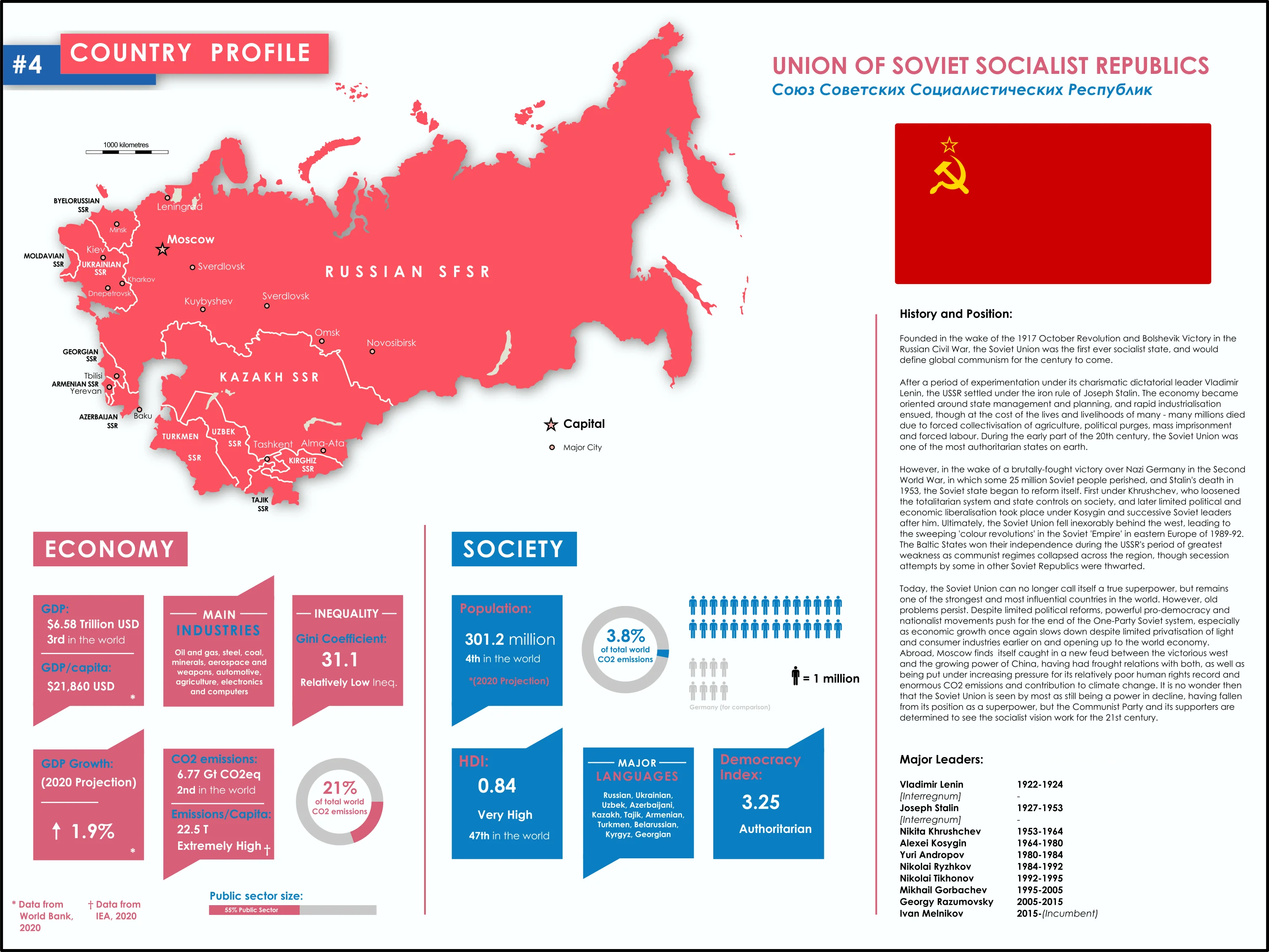
The Collapse That Wasn't Inevitable
The Soviet Union's dissolution on December 26, 1991, is often treated as a foregone conclusion — the inevitable implosion of a system too burdened by ideology, inefficiency, and imperial overstretch to survive. Historians have largely moved away from this determinism. The collapse was real and structural, but it was also a product of specific decisions made by specific people at specific moments, several of which could plausibly have gone differently.
Mikhail Gorbachev's twin reforms of perestroika (economic restructuring) and glasnost (political openness) were intended to save the Soviet system, not destroy it. His error, most analysts now agree, was sequencing: he opened political space before stabilizing the economy, creating a situation where newly empowered publics could express grievances about economic decline with no institutional means of addressing those grievances except independence movements. Had the sequence been reversed — economic liberalization first, political opening second, as China pursued after 1978 — the outcome might have been different.
This is the most commonly cited divergence for Soviet survival scenarios. But the comparison to China is more complicated than it first appears, and understanding those complications is essential to a serious counterfactual.
Why the Chinese Model Was Harder to Copy Than It Looks
The standard Soviet survival scenario runs roughly as follows: Gorbachev, or a reformer before him, implements gradual market reforms on the Chinese model — special economic zones, limited private enterprise, foreign investment — while maintaining Communist Party political control. The economy grows. Living standards improve. The legitimacy crisis that drove nationalism and the August 1991 coup never materializes. The Soviet Union survives as a hybrid socialist-market state.
This scenario is plausible, but it requires overcoming obstacles that the Chinese model did not face in the same form. China in 1978 was a rural, relatively undeveloped economy with a large agricultural sector that could be privatized quickly and productively. The Soviet economy in 1985 was an industrial economy with complex supply chains, a heavily militarized production base, and an urban population accustomed to subsidized prices for food, housing, and energy. Marketizing Soviet agriculture (which had already been collectivized for decades) and Soviet heavy industry were different and harder problems than privatizing Chinese peasant farming.
China also had a significant advantage in ethnic homogeneity relative to the USSR. China's Han majority constitutes roughly 92% of the population; nationalist separatism was a concern at the margins (Tibet, Xinjiang), not at the center. The Soviet Union was an empire of 15 formally designated republics and dozens of ethnic groups, many of which had been incorporated by conquest within living memory. The Baltic states, Ukraine, the Caucasian republics, and the Central Asian states all had distinct national identities, historical grievances against Russian domination, and, by the late 1980s, active independence movements. Economic reform could address living standards; it could not resolve the question of whether Lithuanians or Ukrainians wanted to live in a state centered on Moscow.
This is the hardest structural problem in any Soviet survival counterfactual. The nationalism was not simply a product of economic failure; it had its own logic rooted in language, culture, and historical memory. A more economically successful Soviet Union might have reduced the urgency of separatism — people are less likely to take political risks when their material situation is improving — but it would not have eliminated it. Keeping the union together over the long run would have required either genuine federalism that gave republics real autonomy, or political repression sufficient to suppress nationalist organizing. Both options carried their own costs and risks.
The Most Viable Divergence: The New Union Treaty
The single most historically grounded divergence point for Soviet survival is the New Union Treaty of 1991. Gorbachev had negotiated this agreement with most of the Soviet republics throughout 1990 and 1991; it would have transformed the USSR into a much looser federation — the Union of Sovereign States — with genuine autonomy for member republics in economic and cultural policy while preserving a common defense and foreign policy. The treaty was scheduled for signing on August 20, 1991. The hardliner coup began on August 19, one day before the signing, specifically to prevent the treaty from taking effect.
In our alternate history, the coup either does not happen or fails more quickly. The conspirators lose their nerve, or the KGB chairman who played a central role in the coup (Vladimir Kryuchkov) is removed from his position weeks earlier based on intelligence that reaches Gorbachev. The New Union Treaty is signed in late August 1991. The Baltic states, which had already declared independence, are allowed to leave — their populations were deeply opposed to remaining in any Soviet structure and a confrontation with them risked international isolation. The other twelve republics, with genuine autonomy guaranteed, choose to remain.
This union is not the Soviet Union of 1970 or even 1985. It is a radically decentralized entity in which Moscow's authority is primarily military and diplomatic. Economic policy is largely set at the republic level. The Communist Party loses its constitutional monopoly on power. What holds the structure together is inertia, shared infrastructure, and the collective security guarantee — plus, critically, oil and gas revenue from Russia and Kazakhstan distributed through the union's fiscal system.
The Economy: From Crisis to Hybrid State
The economic trajectory of a surviving Union of Sovereign States depends heavily on which reforms are implemented and when. The worst-case failure scenario for any Soviet reform program was the experience of actual post-Soviet Russia in the 1990s: "shock therapy" privatization that transferred state assets to political insiders, hyperinflation that wiped out savings, GDP collapse of roughly 40% over a decade, and the emergence of an oligarchic class with no incentive for productive investment.
A surviving union, with a functioning central government and Communist Party institutional continuity, probably avoids the most extreme form of this shock. Central bank discipline — which Russia lacked in the early 1990s when Yeltsin's government printed money to cover deficits — is more likely to be maintained under a union government with a professional bureaucracy. Privatization proceeds more slowly and with more state oversight, reducing the opportunities for insider dealing that produced the Russian oligarch phenomenon.
The oil price trajectory is crucial. Prices collapsed in the mid-1980s (partly through a deliberate Saudi strategy that hurt the Soviet economy), recovered in the 1990s, and then surged from roughly 2003 onward. A surviving union in the 2000s, with Russia and Kazakhstan's enormous hydrocarbon reserves, experiences the same oil boom that gave Vladimir Putin his mandate in actual history — but the revenue flows through a union government rather than a Russian national one. The macroeconomic picture in the 2000s is substantially better than the 1990s transition experience: enough so that political legitimacy can be maintained through improved living standards rather than nationalist mobilization.
What this union probably does not become is a technological peer competitor to the United States or China. The structural problems of the Soviet economy — poor incentives for innovation, weak property rights, bureaucratic rigidity — are not solved by oil revenue. The union remains a dominant military power and a major energy exporter, but its economic model is closer to a resource state than an innovation economy.
Geopolitics: A Bipolar 21st Century
The most significant global consequence of Soviet survival is the preservation of a genuine bipolar world order rather than the unipolar American moment of the 1990s and 2000s. The consequences of that difference are profound and wide-ranging.
NATO's expansion into Eastern Europe — which proceeded rapidly after 1991 precisely because the Soviet threat had disappeared — does not happen or happens much more slowly and cautiously in a world where the Soviet Union (in its reformed, federated form) still exists. The Baltic states leave the union and join NATO as independent countries; that much is likely. Poland, the Czech Republic, Hungary, Romania — the expansion that brought NATO to Russia's borders — is negotiated more carefully or not at all. This removes one of the primary grievances that drove Russian policy under Putin in actual history, and removes the source of the Ukraine crisis of 2014 and 2022.
Ukraine, in this scenario, remains a member of the union (under the New Union Treaty's autonomy provisions) rather than becoming an independent state in 1991. The Crimea question, which arose from Ukraine's independence, does not arise. The Donbas question, rooted in the same post-Soviet border issues, does not arise. The largest conventional land war in Europe since World War II does not happen.
The 2003 Iraq War is substantially less likely in a world where the UN Security Council has an assertive Soviet veto power — not the weakened Russian position of actual 2003, but the superpower veto of a functioning union. American unilateralism in the Middle East is constrained. The specific sequence of events that produced ISIS — the destruction of Iraqi state institutions, the power vacuum in Syria, the spread of instability across the region — is disrupted, though not necessarily eliminated.
Technology and the Internet: A Different Digital World
One of the most underexplored dimensions of a Soviet survival counterfactual is its effect on technology development. The internet as it exists today was shaped by the specific circumstances of post-Cold War American dominance: DARPA's original network became the civilian internet in a world where the United States faced no peer competitor in setting technical standards, no rival ecosystem of computing infrastructure, and no alternative model for how digital networks should be governed.
A surviving Soviet Union would have had its own parallel computing infrastructure — building on the OGAS project (a Soviet plan for a nationwide computer network proposed in the 1960s and 1970s, ultimately not implemented due to bureaucratic resistance) and the various Soviet computing traditions. Whether this produces a genuinely separate internet is uncertain; the economic integration that comes with reform might have driven convergence on American-developed standards, as happened with the actual internet globally. But a Soviet union in the 1990s and 2000s would have been a major force in negotiations over internet governance, cybersecurity norms, and data sovereignty — pushing those negotiations in a different direction and potentially producing a more fragmented digital landscape, or alternatively one with stronger international governance structures.
The space race, which effectively ended with the moon landing in 1969 and then sputtered to a close as Soviet resources dried up in the 1980s, would have continued in a more competitive form. The International Space Station might have been a genuinely competitive project rather than a post-Cold War cooperation effort. Mars exploration in the 2010s and 2020s would likely have been a superpower competition rather than a private-sector-led initiative.
Limits and Honest Uncertainties
The Soviet survival counterfactual has genuine uncertainties that any honest analysis must acknowledge. The economic reform problem was severe; even the Chinese model, for all its success, produced significant inequality, environmental damage, and political repression that a Soviet system might have struggled to manage differently. The nationality problem, as argued above, was structural and not simply resolvable by economic growth.
Perhaps most importantly, the character of whoever leads the surviving union matters enormously. Gorbachev was genuinely committed to reform and to avoiding violence against his own people — he refused to order a Tiananmen-style crackdown on Baltic independence protesters in 1991, and this restraint was one factor in the union's dissolution. A reforming union that maintains cohesion through the 1990s may produce a leader in the 2000s who is more authoritarian than Gorbachev but less chaotic than Yeltsin's Russia — a kind of managed pluralism that is stable but not democratic. Whether that is better or worse than actual history depends on your values and on which specific populations you are considering.
Historical Verdict: A Different Kind of Modernity
A surviving Soviet Union — reformed, federated, economically hybrid — produces a 21st century that is more multipolar, more contested, and in some respects more stable than the one that actually emerged from 1991. The specific pathologies of the unipolar moment — American overconfidence, the Iraq War, the rise of Putin's revanchism, the Ukraine conflict — are mitigated or absent. New pathologies replace them: sustained superpower competition, a more fragmented global economy, and the unresolved tensions of governing a multi-ethnic empire through economic incentives rather than genuine self-determination.
The people who benefit most from Soviet survival are probably the citizens of the former Soviet republics who, in actual history, suffered most severely from the 1990s economic collapse: the elderly whose savings were wiped out by hyperinflation, the populations of states like Armenia, Georgia, and Tajikistan who experienced civil wars and state failure. The people who benefit least are those in the Baltic states and Ukraine whose national aspirations were most clearly incompatible with any version of the union — and who, in actual history, built successful independent democracies out of the ruins of the USSR.
History, as always, does not distribute its costs and benefits evenly. The Soviet survival counterfactual does not produce a better world in any simple sense. It produces a different one, with different winners and losers, different crises avoided and created, and a different set of possibilities for the century ahead.
Explore This Scenario Interactively
The analysis above is our editorial interpretation. On Alternate History AI, you can shape your own Soviet survival timeline — deciding which republics accept the New Union Treaty, how economic reforms are paced, and how the union navigates the internet age and the 2008 financial crisis. Each decision produces a different simulated outcome.
Select an interactive scenario and start exploring →
References and Further Reading
- Wikipedia: Dissolution of the Soviet Union — detailed account of the 1991 collapse and its causes
- Britannica: Soviet Union — comprehensive overview of the USSR's history and structure
- World History Encyclopedia: Soviet Union — articles on Soviet politics, economy, and society
- Wikipedia: New Union Treaty — the 1991 proposal that would have transformed the USSR into a confederation
- Wikipedia: Perestroika — Gorbachev's reform program and its consequences
- AlternateHistory.com: USSR Survived threads — community-generated timelines and analysis
What if the Confederates won the Civil War? · What if Napoleon won at Waterloo? · What if Hitler succeeded in art school?