 Alternate History AI
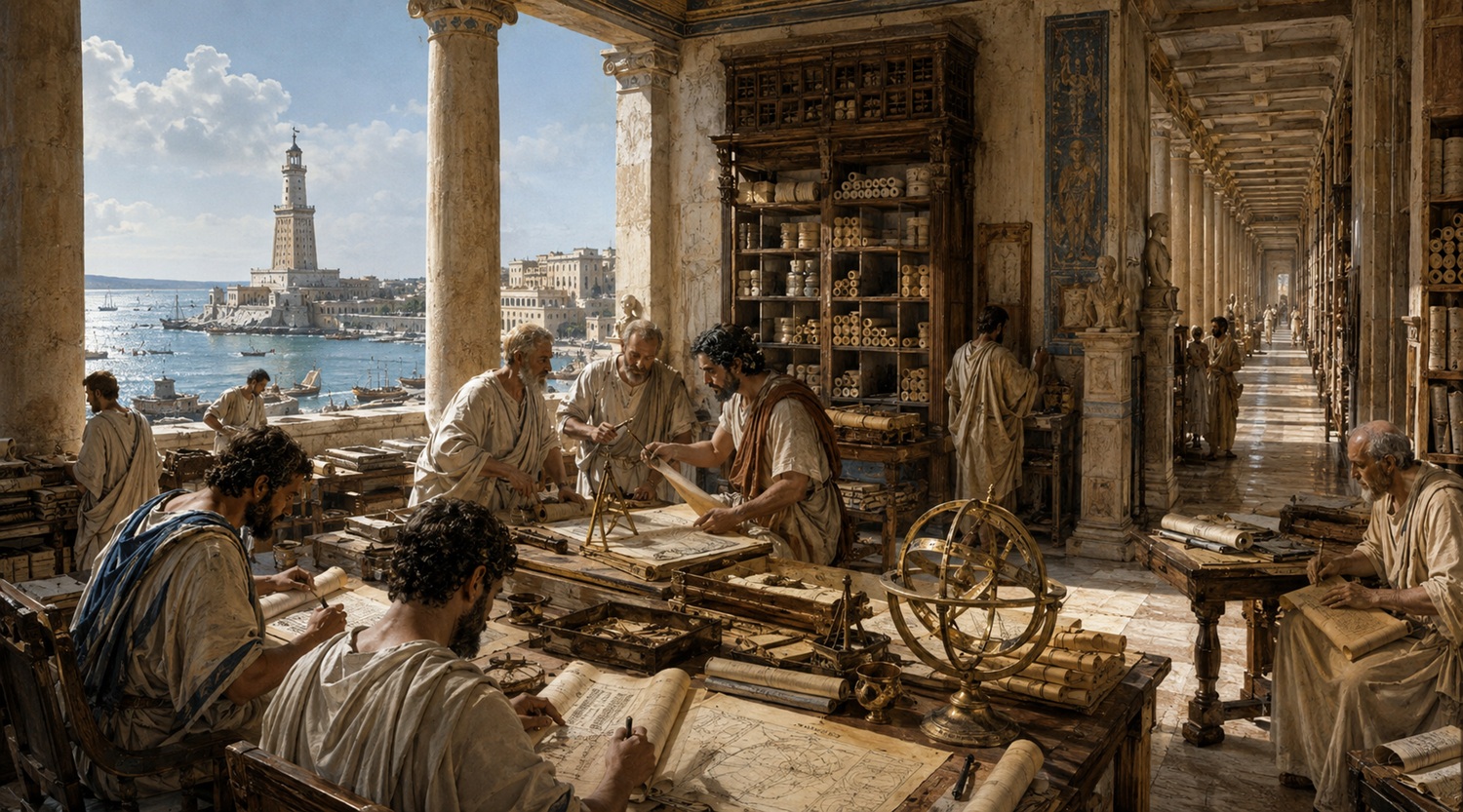
The destruction of the Library of Alexandria is one of history's most powerful stories.
In its popular form, the story is simple.
The ancient world's greatest library contained hundreds of thousands of scrolls preserving nearly everything Greek, Egyptian, Babylonian, Persian, and perhaps Indian civilization had learned. Then, on one terrible day, someone burned it. The accumulated scientific knowledge of antiquity vanished in the flames, humanity lost centuries of progress, and civilization entered an avoidable intellectual darkness.
It is a compelling story.
It is also almost certainly wrong.
There was a major scholarly institution at Alexandria. There was an extraordinary royal collection of books associated with it. Alexandrian scholars made lasting contributions to literary criticism, mathematics, astronomy, geography, medicine, and other fields. But historians cannot establish the exact size of the collection, its physical arrangement, or even a single date on which the “Great Library” ceased to exist. Roger Bagnall has argued that gradual neglect, copying failures, institutional decline, and repeated political disruption provide a more credible explanation than one spectacular act of destruction. Modern scholarship on ancient libraries likewise treats the familiar one-fire narrative with considerable skepticism. (NYU Libraries)
That makes the counterfactual more interesting.
The question should not be:
What if one building full of all ancient knowledge had escaped a fire?
A better question is:
What if Alexandria had maintained a well-funded scholarly institution, an active manuscript-copying program, and a major research library for several centuries longer than it actually did?
That outcome would not give the Roman Empire steam engines, electricity, computers, or spacecraft.
It could, however, preserve texts now known only by title or fragment, strengthen continuity between ancient and medieval scholarship, and create a more direct intellectual bridge among Greek, Egyptian, Christian, Byzantine, Syriac, and eventually Islamic traditions.
The most plausible alternate Alexandria is therefore not a miraculous warehouse of forgotten technology.
It is an institution that keeps copying, teaching, cataloguing, comparing, translating, and preserving.
And over centuries, that could matter enormously.
---
First Myth: The Library Was Probably Not One Giant Building
The name “Library of Alexandria” encourages a modern image: one monumental structure lined with shelves from floor to ceiling.
The ancient reality was more complicated.
The Library was closely associated with the Mouseion, or Museum—a term derived from the Muses and better understood as a royal scholarly institution than as a modern museum displaying artifacts.
The geographer Strabo, who knew Roman Alexandria, described the Mouseion as part of the royal palace complex. It included a covered walk, an area with seats for discussion, a large communal dining hall, shared property, and a priest appointed first by the Ptolemaic kings and later by the Roman emperor. That description makes the institution sound partly like a research institute, learned society, residential college, and royal academy combined. (Penelope)
The library collection was connected to this scholarly community.
Its purpose was not merely storage.
Books were acquired so they could be:
compared;
corrected;
catalogued;
commented upon;
copied;
studied;
used in teaching;
and incorporated into new scholarship.
This distinction is important.
The most historically important part of Alexandria was arguably not the shelves. It was the system surrounding the shelves.
A manuscript sitting untouched in a storeroom eventually decays.
A manuscript that scholars repeatedly copy has a chance to survive for millennia.
---
The Mouseion Was an Intellectual Institution
Alexandria emerged under the Ptolemies as one of the great scholarly centers of the Hellenistic world.
The royal court attracted specialists working in literature, philology, mathematics, geography, astronomy, medicine, mechanics, and other fields. The growth of institutions such as the Mouseion and Library was part of a wider Hellenistic transformation involving specialization, royal patronage, and intellectual exchange among Greek and non-Greek traditions. Cambridge's history of Hellenistic science emphasizes Alexandria in particular as a new institutional center and notes the importance of cross-cultural contact, including Greek engagement with Babylonian astronomical knowledge. (Cambridge Resolve)
Alexandrian scholarship also helped develop methods of organizing knowledge.
Callimachus' famous Pinakes, although not preserved intact, became associated with systematic bibliographic classification of authors and works. Later Alexandrian literary scholarship had enormous influence on how Greek texts were edited, organized, and transmitted. (Cambridge University Press)
This is one reason imagining the Library merely as a pile of scrolls understates its significance.
The collection supported a scholarly culture.
That culture was capable of reproducing itself.
If the institution survives, the most valuable alternate-history effect may therefore be continuity of method, not merely preservation of individual books.
---
How Many Books Were in the Library?
No one knows.
Ancient and later accounts give spectacular numbers for the Alexandrian collections, but the figures are difficult to verify and may reflect literary exaggeration, corrupted numerical traditions, different ways of counting scrolls, duplication, or confusion between individual rolls and complete works.
Roger Bagnall's influential reassessment warns against treating the enormous traditional collection figures as secure statistics. The evidence for Alexandria is far thinner than the precision of popular claims suggests. (NYU Libraries)
This also matters because an ancient “book” did not correspond neatly to a modern bound volume.
A long work might occupy several papyrus rolls.
Multiple copies of the same text might exist.
Different textual versions could be collected deliberately so scholars could compare them.
A collection of 100,000 rolls would therefore not necessarily represent 100,000 unique works.
The correct conclusion is not that Alexandria's collection was small.
It is that we cannot responsibly convert legendary numbers into a precise inventory of lost human knowledge.
---
The Library Was Not the Beginning of Libraries
Alexandria was extraordinary, but it did not invent the idea of storing written knowledge.
Egyptian and western Asian societies had maintained archives and libraries for centuries before the Ptolemies. Oxford scholarship on ancient libraries emphasizes traditions reaching back thousands of years before Alexandria. (OUP Academic)
That matters because another popular myth assumes that whatever was not in Alexandria was doomed.
Knowledge existed in many locations:
temples;
royal archives;
private collections;
schools;
administrative offices;
other libraries;
monasteries;
scholars' personal manuscripts;
and later Christian, Byzantine, Syriac, Persian, and Islamic institutions.
A text lost at Alexandria might survive elsewhere.
A text preserved at Alexandria might disappear later.
The history of ancient literature is therefore a network of copying and survival, not a single point of failure.
---
There Was Probably No Single Destruction of the Library
The history of Alexandria includes several episodes that may have damaged libraries or scholarly institutions.
The evidence does not support compressing them into one famous inferno.
---
48 BCE: Julius Caesar's Fire
The most famous early candidate occurred during Julius Caesar's Alexandrian War.
Caesar's forces set fire to ships around Alexandria's harbor in 48 BCE.
Ancient accounts later reported that nearby buildings, warehouses, or books were destroyed.
How much damage reached the Library itself is disputed.
Modern scholarship has pointed out that some sources describe books or storehouses near the harbor rather than unequivocally identifying the entire main Library. Whatever happened, Strabo described the Mouseion in the Roman period afterward, strong evidence that the scholarly institution either survived or continued in some reconstructed form. (Cambridge University Press)
Thus the popular image—
Caesar burns the Library and all ancient science vanishes in 48 BCE—
is not supported by the evidence.
The fire could still have destroyed valuable manuscripts.
But it was not the clean endpoint imagined in popular culture.
---
The Roman Period: Continuity and Decline
After Rome annexed Egypt in 30 BCE, the Mouseion continued to exist under imperial authority.
Strabo explicitly describes its priest as being appointed by Caesar rather than by the Ptolemaic kings, showing adaptation of the institution to Roman political rule. (Loeb Classics)
But institutional survival is not the same thing as uninterrupted greatness.
Royal patronage had changed.
Alexandria itself experienced political violence.
The Roman Empire developed additional libraries and intellectual centers.
Books circulated through many institutions.
The original Ptolemaic model therefore changed even when scholarly life continued.
That gradual transformation is central to understanding what was “lost.”
---
The Third-Century Crisis May Have Been More Destructive Than Caesar's Fire
Alexandria suffered severe violence during the Roman Empire's third-century crises.
The emperor Aurelian reconquered Alexandria from forces associated with the Palmyrene regime in the early 270s. Modern scholarship on Roman Egypt emphasizes that Aurelian's recovery of the city caused severe damage, while the longer period from Hadrian through Diocletian saw repeated violence capable of seriously damaging Alexandria's urban fabric. (Cambridge University Press)
Bagnall and other scholars have consequently suggested that the destruction or abandonment of the royal quarter during these disturbances may be more relevant to the disappearance of the old Library than the famous Caesarian fire. (The Open University)
By that point, however, it is uncertain how closely the institution resembled its celebrated Ptolemaic ancestor.
That uncertainty is itself significant.
The Great Library may not have died once.
It may have faded, fragmented, relocated, and lost institutional continuity.
---
The Serapeum and the “Daughter Library”
Another collection was traditionally associated with the Serapeum, Alexandria's great sanctuary of Serapis.
Archaeological and literary evidence confirms the importance of the Serapeum, and later ancient writers associated books with the site. But the scale and contents of any Serapeum library are much less securely known than popular retellings often imply. (Cambridge University Press)
The Serapeum was destroyed as a pagan cult center in 391 CE amid religious conflict in late-antique Alexandria.
That was a real episode of destruction.
But historians cannot simply say that the Christian destruction of the Serapeum was the moment when “the Library of Alexandria” and all classical knowledge disappeared.
Modern analysis of the 391 episode emphasizes the complexity of the violence and the religiously partisan nature of many surviving accounts. (Cambridge University Press)
By the late fourth century, the original Ptolemaic Great Library had almost certainly ceased to exist in its original institutional form.
---
The Arab-Conquest Story Is a Much Later Legend
A famous later story claims that when Arab forces captured Alexandria in the seventh century, Caliph Umar ordered the city's remaining books burned because texts agreeing with the Quran were unnecessary and texts disagreeing with it were dangerous.
Modern historians overwhelmingly treat this as a late legend rather than reliable evidence.
The story appears centuries after the conquest, long after the original Alexandrian Library had disappeared from contemporary accounts. Bernard Lewis famously analyzed it as the “anatomy of a myth,” and modern scholarship on Alexandria likewise lists the alleged Arab destruction among traditions that must be approached critically. (Brill)
Egypt's Arab conquest was certainly another major political transformation.
But there is no sound basis for blaming seventh-century Muslim conquerors for destroying the Ptolemaic Great Library.
By then, the real historical question was the survival and transmission of individual Greek, Coptic, Syriac, medical, philosophical, administrative, and religious textual traditions.
---
What Knowledge Was Actually Lost?
This question sounds straightforward.
It is not.
To know exactly what Alexandria lost, historians would need a complete catalogue of everything ever collected there.
No such catalogue survives.
They would also need to know which texts had copies elsewhere.
We generally do not know that either.
Then they would need to know when every lost copy disappeared.
That information is usually unavailable.
So when someone asks:
“What was lost when the Library burned?”
the most accurate response is:
We cannot isolate one fire or one inventory from the much larger loss of ancient literature.
---
We Know Vast Amounts of Ancient Literature Did Disappear
Many ancient authors are known only because later writers mention them.
Other works survive only as quotations.
Others exist as papyrus fragments.
Some authors known to have written many works survive in only a small selection.
Scientific and technical literature suffered particularly severe losses. Cambridge scholarship on Hellenistic science notes that surviving evidence depends heavily on later writers precisely because so much original Hellenistic material in science, medicine, and technology disappeared. (Cambridge Resolve)
But Alexandria cannot automatically be blamed for every missing book.
A manuscript could survive the Library for centuries and disappear in Constantinople in the Middle Ages.
Another could be lost because readers stopped copying it.
Another could disappear because its language fell out of common use.
Another could be overwritten as parchment was reused.
Another might have survived in Arabic translation even when the Greek original vanished.
And another might still be buried somewhere as an unread papyrus fragment.
---
Survival Depends on Copying
Ancient manuscripts were physical objects.
Papyrus deteriorates.
Ink fades.
Books are damaged by water, insects, handling, war, theft, neglect, and ordinary aging.
A library therefore cannot preserve knowledge indefinitely merely by locking manuscripts inside a room.
Texts survive because someone decides they are worth copying.
Then another generation copies them again.
And another.
This produces one of the most important principles for our counterfactual:
Preserving the institution is more important than preserving one particular generation of scrolls.
A functioning Alexandrian scholarly center that survives until 600 or 800 CE would repeatedly recopy its texts.
Those newer copies could then circulate outward.
That makes long-term survival much more likely.
---
The Point of Divergence: Alexandria Is Rebuilt as a Permanent Imperial Scholarly Foundation
A plausible divergence occurs not in 48 BCE but in the third century CE.
Suppose the upheavals surrounding Aurelian's reconquest damage the old royal district, just as they did historically.
But instead of allowing the Mouseion's remaining institutional structure to dissipate, the Roman imperial government deliberately reconstitutes it.
Aurelian or a successor recognizes Alexandria's importance as:
Egypt's great Mediterranean port;
a center of education;
a source of physicians and administrators;
a symbol of imperial culture;
and a repository of Greek learning.
The government establishes a new Alexandrian Imperial Mouseion.
This is not the original Ptolemaic Library preserved untouched.
It is a successor institution.
Its surviving collections are gathered from the royal district, the Serapeum, private libraries, temples, schools, and estates.
Imperial funding pays professional copyists.
Scholars are again provided salaries.
A catalogue identifies important works requiring duplicate copies.
Most importantly, the collection is distributed.
No single building contains everything.
Duplicates are deposited in several Alexandrian institutions and sent to libraries in Constantinople, Antioch, Athens, Rome, Caesarea, and other centers.
This solves the central weakness of the legendary Library:
a single disaster can no longer destroy the intellectual core.
---
Why This Divergence Is Plausible
The counterfactual does not require Alexandria to remain a pagan Ptolemaic institution forever.
Actual Alexandrian scholarship survived remarkably late.
Philosophical teaching continued in the city during the fifth and sixth centuries. Ammonius son of Hermias established a major Alexandrian tradition of Aristotelian interpretation, while Olympiodorus was still teaching in Alexandria in the sixth century. Cambridge's history of science notes that even Christian authorities could finance the teaching of pagan philosophy in late-antique Alexandria. (Cambridge University Press)
Medicine also maintained a strong Alexandrian teaching tradition whose later forms influenced the transmission of Galenic medicine into Arabic. (Cambridge University Press)
So the real world already gives us part of the alternate trajectory.
Alexandria did not cease being intellectually important when pagan temples declined.
The divergence simply gives that continuing scholarly culture a stronger library, endowment, cataloguing system, and copying infrastructure.
---
The Institution Becomes Christian Rather Than Disappearing
The fourth and fifth centuries would still transform Alexandria.
Christianity becomes politically dominant.
The Serapeum still faces pressure.
Conflicts between Christian and pagan groups still occur.
Hypatia and other intellectuals still operate in a city capable of intense political and religious violence.
But in the alternate timeline, the scholarly institution itself is legally separated from pagan cult.
The Mouseion is redefined as an imperial and civic academy.
Christian intellectuals increasingly participate.
The collection is treated as useful literature rather than temple property.
That would not require Christians to approve of every pagan philosophical or religious idea.
Late-antique Christian scholarship already demonstrates extensive engagement with Greek philosophy, medicine, literary learning, rhetoric, and systems for ordering knowledge. Alexandria itself was an important center of Christian intellectual life long before the end of pagan institutions. (Cambridge University Press)
The strongest alternate path is therefore adaptation:
the Library survives by ceasing to be exclusively Ptolemaic or pagan.
---
What Would Be Preserved?
This is where the counterfactual becomes meaningful.
Not everything survives.
No institution can copy everything forever.
Selection still occurs.
But a permanent Alexandrian foundation could preserve substantially more material in several categories.
---
Greek Literature
Greek literature would probably benefit most directly.
Alexandrian scholars had long been concerned with textual criticism, classification, grammar, and literary canon formation.
A continuing institution might preserve:
additional tragedies;
additional comedies;
lyric poetry;
local histories;
lost commentaries;
biographies;
Hellenistic poetry;
historical works;
geographical writings;
philosophical treatises.
The change would not be that every Greek text survives.
It would be that more works pass through repeated copying bottlenecks.
A work with three surviving copies has a better chance than a work with one.
A work copied in Alexandria and Constantinople has a better chance still.
---
Egyptian Texts
The effect on Egyptian textual culture is less predictable.
The Ptolemaic scholarly project was heavily Greek-oriented, and the common image of the Library systematically preserving all Egyptian literature exaggerates what the evidence can establish.
Egypt had its own far older traditions of libraries, archives, temple knowledge, and scribal culture independent of the Greek institution. (OUP Academic)
But a long-lived Mouseion could gradually become more multilingual.
Christianization increases the importance of Coptic.
Imperial administration uses Greek.
Priestly and scholarly communities preserve Egyptian traditions.
A consciously universal Alexandrian institution could acquire and translate more:
Egyptian histories;
religious texts;
medical collections;
astronomical records;
administrative documents;
mathematical and technical material.
This would be a later development, not something we should confidently project backward onto the original Ptolemaic Library.
---
Roman and Latin Texts
Roman rule would almost certainly expand Latin representation.
Alexandria never becomes primarily a Latin intellectual city, but an imperial foundation would have reason to maintain Roman historical, legal, military, and administrative works.
More reciprocal copying between eastern and western libraries could improve the survival prospects of texts that otherwise vanish during late antiquity.
The effect becomes especially important after the western Roman Empire fragments.
An eastern copy of a Latin work might survive after western copies disappear.
---
Mathematics
Alexandria's institutional environment had been deeply connected to Hellenistic mathematics.
Greek mathematics developed within networks of highly specialized scholars, and Alexandria became one of its great centers. (Cambridge University Press)
What would preservation change?
Probably not the fundamental laws of mathematics.
Lost books do not magically transform arithmetic.
But more texts could preserve:
proofs;
alternative methods;
geometrical problems;
works of commentators;
numerical techniques;
applied mathematics;
connections between mathematics and astronomy;
older sources cited only indirectly in surviving authors.
A later mathematician working in Constantinople or Baghdad might therefore have access to several ancient approaches instead of one surviving canonical text.
That can matter.
Scientific progress often depends not merely on knowing a final answer but on seeing alternative methods of reaching it.
---
Astronomy
Astronomy offers one of the strongest areas for meaningful continuity.
Hellenistic astronomy drew upon both Greek mathematical traditions and Babylonian observational data. Cambridge scholarship emphasizes this cross-cultural exchange and notes that later Greek astronomers could use long Babylonian observational traditions. (Cambridge Resolve)
A surviving Alexandrian institution could continue collecting:
eclipse observations;
planetary positions;
star catalogues;
calendar records;
astronomical tables;
commentaries on mathematical models;
Egyptian observational traditions;
Babylonian material circulating in Greek.
Long observational datasets can be particularly valuable because astronomy depends on comparing predictions against events across generations.
The result might be better medieval astronomical tables and more surviving debates about planetary models.
It would not produce modern astrophysics in antiquity.
Telescopes, precision instruments, mathematical developments, printing, and later physical theory remain missing.
But the informational foundation could be richer.
---
Would Heliocentrism Triumph Early?
Probably not.
Aristarchus of Samos had proposed a heliocentric model in antiquity, so the mere existence of the idea was not the barrier.
Other ancient scholars knew that alternatives to an Earth-centered cosmos could be imagined.
The difficulty was producing a model that matched available observations convincingly, possessed an adequate physical explanation, and outperformed competing systems.
Preserving more astronomical texts might keep debates alive.
It does not automatically give ancient astronomers Kepler's laws, Newtonian mechanics, telescopic observations, or modern instruments.
Thus:
more surviving evidence for ancient heliocentric thinking is plausible. An ancient scientific revolution identical to Copernicus, Kepler, and Newton is not.
---
Medicine
Alexandria had a particularly important association with Hellenistic and late-antique medical learning.
The city provided an environment in which Greek medical traditions developed, were commented upon, summarized, taught, and eventually became part of the textual material transmitted into Syriac and Arabic intellectual culture. (Cambridge University Press)
An enduring institution could preserve more works from:
Hippocratic traditions;
Hellenistic physicians;
anatomy;
pharmacology;
surgery;
therapeutics;
case observations;
Galenic medicine;
medical commentaries.
This could improve medieval access to ancient medical debates.
It could also preserve theories that turned out to be wrong.
Libraries conserve error as well as truth.
That is an important limitation.
More Galen does not automatically create modern medicine.
Modern medical advances depend on experimental methods, microbiology, chemistry, physiology, technologies of observation, statistics, and many developments unavailable to ancient physicians.
The alternate benefit is intellectual breadth, not immediate cure of infectious disease.
---
Philosophy
Philosophy is one area where the alternate institution has especially strong historical foundations.
Alexandria remained a major center of philosophical instruction into late antiquity.
The Alexandrian commentary tradition became particularly important for the study and interpretation of Aristotle. Ammonius and later Alexandrian teachers contributed to an instructional tradition that eventually connected Greek philosophical scholarship with Syriac and Arabic intellectual worlds. (Cambridge University Press)
A stronger library could preserve:
additional pre-Socratic material;
Hellenistic philosophical works;
Aristotelian commentaries;
Stoic works;
skeptical arguments;
Neoplatonic texts;
philosophical correspondence;
competing interpretations now known only secondhand.
This could change the balance of medieval philosophy.
Imagine medieval scholars encountering substantial original Stoic works rather than reconstructing Stoicism largely through later testimony.
Or receiving more complete works of Hellenistic skeptics.
Or having competing commentaries on Aristotle available in Arabic.
The result might be a more diverse inherited philosophical canon.
That is a meaningful but historically restrained counterfactual.
---
Engineering and Mechanics
Ancient engineering creates some of the most exaggerated Library-of-Alexandria counterfactuals.
Hellenistic and Roman engineers understood:
levers;
pumps;
gears;
pneumatics;
siege machinery;
water power;
surveying;
mechanical devices;
sophisticated construction techniques.
More technical treatises could survive if Alexandria maintained a systematic copying program. Cambridge scholarship notes both the extraordinary technical creativity of the Hellenistic era and the disproportionately heavy loss of ancient scientific and technological writing. (Cambridge Resolve)
That could give later engineers better descriptions of machines that otherwise had to be rediscovered.
It might produce incremental improvements in:
water management;
surveying;
mechanical clocks;
pumps;
mills;
construction;
navigation;
military engineering.
But this does not mean the Roman Empire experiences an Industrial Revolution.
---
Why a Surviving Library Does Not Create an Ancient Industrial Revolution
Industrialization required far more than possessing clever mechanical diagrams.
The Industrial Revolution depended on combinations of:
energy availability;
metallurgy;
mining;
machine tooling;
capital markets;
transportation systems;
labor costs;
consumer markets;
institutions;
property arrangements;
scientific culture;
precision manufacturing;
and sustained economic incentives to mechanize.
Preserving a treatise on pneumatics does not create a steam-powered factory economy.
Ancient societies could possess devices that demonstrated physical principles without possessing the economic environment needed to deploy them at industrial scale.
The counterfactual should therefore reject claims like:
“If the Library had survived, Romans would have invented steam locomotives.”
That is speculation layered upon speculation.
The stronger claim is much smaller:
some technical knowledge would require less rediscovery.
---
The Most Important Technology Might Be the Codex
Ironically, the technology most important to the Library's survival might not be a machine at all.
It would be the continuing transition from papyrus rolls to the codex, the bound-book format that became increasingly important in late antiquity.
A surviving institution would gradually recopy selected older scrolls into newer book forms.
That process itself would determine survival.
Every conversion would create a selection problem.
Which works deserve the expensive labor required for recopying?
Popular or useful texts receive new copies.
Neglected texts disappear.
A well-funded Alexandrian institution could substantially enlarge the number of works that cross that bottleneck.
This is far more plausible than the Library producing futuristic inventions.
---
Catalogues Could Be Almost as Important as Books
Suppose Alexandria preserves a catalogue even when a manuscript itself is later lost.
That still helps historians.
A reliable bibliographic tradition could record:
author;
title;
subject;
number of books;
opening words;
variant editions;
provenance;
commentaries;
translations.
Modern historians would know far more about ancient literature.
We might be able to distinguish genuine lost works from later attributions.
We might know which scientific schools existed.
We might identify missing sections of philosophical debates.
We might know which Egyptian texts had Greek translations.
Thus one of the largest alternate-history gains could be knowledge about lost knowledge.
---
Christianity Could Become a Preservation Mechanism
The traditional myth often casts Christians solely as destroyers of classical knowledge.
Late-antique history is much more complicated.
Christian authorities certainly participated in the destruction or conversion of pagan temples, including the Serapeum.
Religious conflict in Alexandria could be violent. (Cambridge University Press)
But Christian scholars also read, taught, copied, adapted, criticized, and preserved Greek philosophy and science.
Alexandria itself developed major Christian intellectual traditions, while late-antique philosophical teaching continued in a predominantly Christian political environment. (Cambridge University Press)
In the alternate timeline, the Library survives precisely because Christians incorporate it.
The institution might develop separate categories:
Scripture and theology
Greek philosophy
Medicine
Mathematics
Astronomy
History
Law
Rhetoric
Egyptian learning
Pagan religious texts might be copied less frequently than Christian authors prefer.
Some material would still disappear.
But wholesale institutional extinction becomes less likely.
---
A Christian Mouseion Could Resemble a University
By around 500 CE, the alternate Mouseion no longer looks Ptolemaic.
Its scholars do not dine under the patronage of a Hellenistic king.
Instead, it functions as a mixture of:
imperial school;
Christian scholarly institute;
medical academy;
philosophical school;
manuscript workshop;
library;
archive.
This is a far more plausible path than assuming the original institution remains unchanged for eight hundred years.
Institutions survive by changing.
Alexandria's real late-antique philosophical schools show that high-level classical learning remained possible under these altered conditions. Olympiodorus was still active there in the sixth century. (Cambridge University Press)
The alternate Mouseion simply gives these scholars better documentary continuity.
---
The Persian Invasion Becomes Another Test
The early seventh century still brings enormous political instability.
Sasanian Persian armies invade Byzantine Egypt.
Roman rule is later restored.
Only a short time afterward, Arab armies conquer Egypt.
Cambridge's history of Roman Egypt emphasizes that the Persian invasion seriously weakened Roman rule and that the Arab conquest followed soon after the Byzantine recovery. (Cambridge University Press)
A single centralized Library could be destroyed during these upheavals.
Our alternate institution survives because centuries earlier it learned the lesson of redundancy.
Its catalogue and core works exist in multiple repositories.
Copies have circulated to monasteries, schools, Constantinople, Syria, and elsewhere.
Alexandria can lose buildings without losing its entire intellectual tradition.
---
The Arab Conquest Could Become an Intellectual Transition Rather Than an Endpoint
Suppose Arab forces capture Alexandria in the seventh century much as they did historically.
The institution they encounter is no legendary Ptolemaic temple library.
It is a functioning Christian-Greek scholarly academy with physicians, philosophers, copyists, teachers, and perhaps government-supported collections.
Early Islamic Egypt often retained substantial local administrative continuity after conquest rather than replacing every institution overnight. (Cambridge University Press)
The new authorities therefore have a choice.
Destroy an economically and administratively useful scholarly center—
or tax, regulate, and exploit it.
The second path is entirely plausible.
For several generations the Mouseion could remain largely Greek and Christian under Muslim rule.
Then Arabic gradually becomes increasingly important.
---
Alexandria and the Islamic Translation Movement
In real history, Greek philosophical and scientific learning passed into the Islamic world through complicated networks.
Greek texts were translated into Syriac and Arabic.
Christian scholars played major roles.
Medical traditions associated with late-antique Alexandria influenced later Arabic medicine.
Aristotelian traditions also traveled through Syriac intermediaries before entering Arabic scholarly culture. (Cambridge University Press)
So the Islamic world's engagement with Greek science does not depend on rescuing Alexandria.
That process happened historically.
The alternate difference is quantity and directness.
If Alexandria retains a much larger corpus, eighth- and ninth-century translators could gain access to texts that were lost in our history.
Baghdad's translation movement might still become the greater center because Abbasid patronage and political power remain enormously important.
But Alexandria could become one of its principal source libraries.
---
More Greek Texts Could Enter Arabic
Imagine an Abbasid scholar requesting works on astronomy.
Instead of discovering that only a few manuscripts remain in scattered monasteries, translators can consult an Alexandrian catalogue.
Copies can be commissioned.
Different versions can be compared.
The same could occur with:
mathematics;
medicine;
Aristotle;
Plato;
lost Hellenistic philosophers;
geography;
mechanics.
The Arabic intellectual tradition would not merely preserve this material.
It would criticize, reorganize, extend, and challenge it—as Islamic scholars historically did with the Greek works they actually received. Cambridge scholarship emphasizes that Arabic translation was not passive copying but a process through which knowledge was reinterpreted and developed. (Cambridge University Press)
The alternate Library could therefore increase the input into a historical process that was already highly creative.
---
Medicine Offers a Particularly Strong Bridge
Late-antique Alexandrian medical teaching is directly relevant.
Scholarly reconstruction of the Alexandrian medical curriculum and later Arabic evidence indicates significant continuity between Alexandrian teaching practices and the organization of Greek medical knowledge received in Arabic. (Cambridge University Press)
With a stronger institutional library, translators might encounter more complete works of:
Galen;
Hippocratic writers;
earlier Alexandrian physicians;
pharmacologists;
anatomists;
commentators.
That could produce an even richer Arabic medical corpus.
Centuries later, some of those Arabic versions could enter Latin Europe.
Thus one saved Greek manuscript in Alexandria might eventually survive as:
Greek → Syriac → Arabic → Latin.
The Library's influence becomes global not because Alexandria monopolizes knowledge, but because it feeds knowledge into multiple transmission networks.
---
Europe Would Still Have Its Own Manuscript Traditions
The alternate Library does not make Byzantium, monasteries, Syriac Christians, Islamic scholars, or western European scriptoria irrelevant.
Those institutions historically did enormous work preserving ancient material.
In fact, a surviving Alexandria would probably strengthen them.
Texts copied there would disperse.
Constantinople could hold one copy.
A Syrian monastery another.
Baghdad an Arabic translation.
A Carolingian or later Latin scholar might encounter another through Italy or Iberia.
The most durable preservation system is therefore distributed knowledge.
That is a modern-sounding lesson produced by very ancient circumstances.
---
Would the Renaissance Happen Earlier?
Perhaps some intellectual developments could begin with a richer textual base.
But “the Renaissance happens five hundred years early” is too simplistic.
The Renaissance depended on far more than rediscovering old books.
It involved:
Italian urban wealth;
universities;
patronage;
political competition;
manuscript hunting;
Byzantine scholars;
humanist educational culture;
printing;
expanding literacy;
commercial institutions.
If more classical texts are already circulating in Greek, Arabic, and Latin before 1300, later humanists inherit a larger canon.
That could change Renaissance scholarship substantially.
It does not automatically move fifteenth-century Florence to the ninth century.
---
Printing Could Magnify the Difference
This is where a modest ancient divergence could become much larger.
Suppose Europe reaches the age of printing with hundreds of additional classical works still extant.
Once movable-type printing becomes established, those works can suddenly be reproduced in hundreds or thousands of copies.
A manuscript that survived precariously for 1,500 years can then become nearly impossible to erase completely.
So the Library's alternate influence may remain modest for centuries before suddenly becoming much more important.
By 1500, printers could issue works that our world never received.
The intellectual impact would then compound.
---
What Additional Books Would Matter Most?
It is tempting to choose one imaginary lost masterpiece.
Perhaps a revolutionary mathematical treatise.
Perhaps a complete work of Archimedes.
Perhaps a lost anatomical text.
But we cannot know which lost works would prove most important.
A forgotten commentary could preserve a method used nowhere else.
A seemingly minor astronomical record could contain centuries of observations.
A historical work could radically change our understanding of ancient societies.
A philosophical text might reveal that a famous argument had opponents whose writings disappeared.
A collection of Egyptian medical records might become valuable for historians without changing clinical medicine at all.
The strongest alternate history therefore avoids inventing one miraculous “book that changes everything.”
The effect would come from hundreds of marginal gains.
---
Knowledge Preservation Is Not the Same as Knowledge Acceptance
Another limitation matters.
A library can possess a correct idea without society adopting it.
Ancient scholars proposed ideas that later generations rejected, ignored, or misunderstood.
Political authorities can suppress scholarship.
Religious institutions can disagree with it.
Economic incentives can favor tradition.
Scientific theories can lack adequate evidence.
Readers can prefer authoritative texts over experimental testing.
Thus even if the alternate Library preserves an unusually advanced ancient theory, the existence of the manuscript does not guarantee that the theory becomes dominant.
Books make knowledge available.
They do not force people to believe it.
---
Could Alexandria Become the World's Oldest Continuous University?
This is one of the more attractive medium-strength scenarios.
The Mouseion was never a university in the modern institutional sense.
But if it survived through Roman, Christian, Byzantine, and Islamic rule while continuously teaching and maintaining collections, historians might later see it as something resembling a remarkably long-lived ancestor of the research university.
Its curriculum would change repeatedly.
Around 200 BCE:
Greek literary criticism, mathematics, astronomy, medicine.
Around 300 CE:
Greek literature, Roman administration, philosophy, medicine.
Around 500:
Christian theology, Aristotle, Neoplatonism, medicine, rhetoric.
Around 700:
Greek and Coptic scholarship alongside increasing Arabic administration.
Around 850:
Greek-Arabic translation, medicine, mathematics, astronomy, philosophy.
The institution would have changed identity many times.
Its continuity would lie in its scholarly function.
---
Alexandria Would Compete With Baghdad
Once Abbasid Baghdad becomes a major intellectual center, Alexandria could lose its primacy even if it survives.
That would not be failure.
Libraries do not need to remain dominant to matter.
Baghdad could become the great center of translation and original scholarship while Alexandria functions as:
source archive;
medical school;
Greek-language center;
Mediterranean port for manuscripts;
translation institute;
astronomical repository.
Scholars might travel between Alexandria, Antioch, Harran, Baghdad, Constantinople, and other cities.
Instead of one city monopolizing learning, the eastern Mediterranean and Islamic worlds could develop a denser scholarly network.
---
Could More Ancient Science Reach Western Europe?
Yes.
This is one of the stronger long-term possibilities.
Western European scholars historically recovered or received important Greek science through multiple channels, including Byzantine manuscripts and Arabic-Latin translation.
A larger corpus surviving into Islamic intellectual culture means translators in medieval Iberia, Sicily, Italy, or elsewhere could eventually encounter more works.
The result might be:
additional Aristotle;
more mathematical commentaries;
lost medical works;
additional Ptolemaic-era astronomy;
mechanical texts;
competing philosophical traditions.
The effect on medieval universities could be substantial.
But again, more books do not automatically create modern science.
They enrich the debate from which later science develops.
---
Modest, Medium, and Dramatic Outcomes
| Outcome | What Happens | Plausibility |
| ----------------- | ---------------------------------------------------------------------------------------------------------------------------------------------------------------------------------------------------------- | ----------------------------------------- |
| Modest | A successor Alexandrian institution survives several centuries longer, preserving dozens or perhaps hundreds of additional works that later circulate through Byzantine, Syriac, and Arabic scholarship. | High within the counterfactual |
| Medium | Alexandria remains a major scholarly center into early Islamic rule, significantly enlarging the Greek scientific and philosophical corpus translated into Arabic and later transmitted into Latin Europe. | Plausible |
| Dramatic | The continuous institution becomes a major Mediterranean research academy for more than a millennium, accelerating some mathematical, astronomical, medical, and technical developments by generations. | Possible but increasingly speculative |
| Very dramatic | Ancient engineers derive industrial steam power, modern experimental science, electricity, and mass manufacturing centuries early solely because the Library survives. | Weak |
| Fantasy | Alexandria preserves all ancient knowledge and humanity reaches computers or spaceflight in antiquity. | Unsupported |
The farther the prediction moves from manuscript survival toward industrial transformation, the weaker it becomes.
---
A Plausible Alternate Timeline
| Date | Real History | Surviving-Mouseion Scenario |
| ------------------- | ------------------------------------------------------------------------------------------------------------- | ------------------------------------------------------------------------------------------------------------------------------------ |
| 3rd century BCE | Ptolemaic rulers establish the Mouseion and major royal book collection at Alexandria. | Same. |
| 48 BCE | Caesar's harbor fire destroys ships and some books or book storage; scale of Library damage remains disputed. | Same fire occurs, but surviving scholars immediately begin a systematic replacement and duplication program. |
| Roman period | Mouseion continues, but its prestige and institutional form change. | Roman emperors maintain funding and establish duplicate repositories. |
| c. 270s CE | Aurelian's reconquest causes severe damage to Alexandria; old royal quarter suffers. | Core collections have already been dispersed. Aurelian's successors formally re-endow an Imperial Alexandrian Mouseion. |
| 391 | Serapeum destroyed during religious conflict. | Serapeum cult still ends, but its remaining scholarly materials have been transferred to the civic Mouseion. |
| 400s–500s | Alexandria remains intellectually active, with major Christian, philosophical, and medical traditions. | Those real traditions now operate alongside a major continuously funded research library. |
| 600s | Persian invasion and Arab conquest transform Egypt. | The Mouseion survives as a Greek-Christian civic academy because its administrative, medical, and scholarly functions remain useful. |
| 700s–800s | Greek learning enters Syriac and Arabic through multiple translation networks. | Alexandria becomes a major source center feeding additional manuscripts into these translation movements. |
| 900s–1200s | Islamic, Byzantine, and later Latin scholars preserve, translate, critique, and expand ancient knowledge. | They work from a significantly larger surviving corpus. |
| 1400s–1500s | Humanists and printers recover and mass-produce surviving classical texts. | Printing preserves hundreds of additional ancient works inherited through the Alexandrian network. |
The early stages are much easier to defend than precise predictions after a millennium of divergence.
---
What Changes Most?
More texts survive
This is the strongest conclusion.
A continuously funded copying institution increases the number of works passing from papyrus into codex traditions and from antiquity into the medieval world.
We know far more about ancient intellectual history
Even surviving catalogues could identify thousands of authors, debates, and works now unknown.
Greek science reaches later civilizations in greater depth
Mathematical, astronomical, medical, and philosophical traditions enter Byzantine, Syriac, Arabic, and eventually Latin scholarship with fewer gaps.
Alexandria remains a major intellectual crossroads
Its role changes from Ptolemaic royal academy to Roman institution, Christian school, and perhaps Islamic-era translation center.
The Greek-Arabic translation movement gains more source material
The translation movement still occurs for its own historical reasons, but translators possess a larger corpus. (Cambridge University Press)
Historians possess a richer view of Egypt itself
A more multilingual late Alexandrian collection could preserve additional Greek, Egyptian, Coptic, administrative, medical, and religious texts.
---
What Changes Less Than Popular Culture Assumes?
Rome does not industrialize
Knowledge preservation cannot substitute for the economic and technological systems required for industrialization.
Steam power does not automatically transform antiquity
Ancient mechanical experimentation existed already. The missing ingredient was not simply one lost manual.
Heliocentrism does not automatically conquer astronomy
An idea requires observational and theoretical support to become dominant.
Modern medicine does not appear in 500 CE
Ancient texts cannot supply germ theory, antibiotics, genetics, modern chemistry, or clinical statistics.
Christianity does not disappear
Christianity was already a major intellectual and political force independent of what happened to one library.
Islam does not fail to emerge
The rise of Islam had causes far removed from the survival of Alexandria's books.
Baghdad does not become unnecessary
The Abbasid intellectual world developed through powerful political, cultural, economic, Persian, Syriac, Greek, Indian, and other influences. Alexandria could contribute more material without replacing Baghdad.
The Renaissance does not simply move backward by a thousand years
Books matter, but institutions, economics, technology, politics, and social organization matter too.
---
The Real Historical Surprise: Alexandria Already Had a Long Afterlife
Perhaps the most important correction to the myth is that Alexandria's intellectual tradition did survive long after the supposed destruction of the Great Library.
The city produced major Christian thinkers.
Philosophical schools remained active.
Ammonius developed a major Alexandrian tradition of Aristotelian commentary. (Cambridge University Press)
Olympiodorus was still lecturing in Alexandria in the sixth century. (Cambridge University Press)
Medical teaching associated with Alexandria contributed to traditions eventually known through Arabic scholarship. (Cambridge University Press)
Greek classical culture was still familiar among educated people in Egypt shortly before the Muslim conquest. (Cambridge University Press)
So the alternate history is not asking us to imagine intellectual life continuing where historically nothing remained.
It is asking something subtler:
What if the surviving intellectual life had retained a much larger institutional memory?
That is a far more plausible divergence.
---
The Importance of Institutional Memory
A great scholar dies.
If the scholar's books and notes disappear, much of the work disappears too.
If students copy them, the work continues.
If a library catalogs them, later generations can find them.
If an institution compares multiple copies, errors can be corrected.
If translators reproduce them into another language, the ideas escape the decline of the original language.
This is what an enduring Alexandria would do.
Its influence would accumulate quietly.
One more Greek tragedy survives.
One more anatomical argument survives.
One more Babylonian astronomical dataset gets incorporated into a later Greek commentary.
One more philosophical school can be reconstructed from its own writings rather than from hostile opponents.
One more engineering text reaches an Arabic translator.
One more Arabic translation eventually reaches a Latin university.
No single event changes civilization.
The network becomes richer.
---
From Saving a Scroll to Saving a System
AltHistAI already includes an interactive 48 BCE Library of Alexandria scenario in which the player confronts the famous image of the Library in danger and chooses which kinds of knowledge to preserve. (Alternate History AI)
That scenario highlights an important immediate dilemma:
If only part of a collection can be saved, should priority go to mathematics?
Medicine?
Philosophy?
Historical records?
The longer counterfactual in this article reveals a second layer.
The best answer may not be choosing the “right” scroll.
It may be preserving the institution capable of making thousands of future copies.
A manuscript saved from a fire can still rot fifty years later.
A copying tradition can recreate a manuscript for centuries.
Readers exploring the interactive scenario can therefore think beyond the immediate rescue:
What decision would transform one emergency evacuation into a permanent preservation system?
That is where the alternate timeline becomes historically powerful.
---
The Myth vs. the Plausible Counterfactual
The Myth
The Library of Alexandria contained essentially all ancient knowledge.
One fire destroyed it.
Humanity lost the secrets of advanced ancient science.
Europe entered a millennium of intellectual darkness.
Had the Library survived, modern technology would have appeared centuries earlier.
The Plausible Counterfactual
Alexandria housed a major royal collection associated with an unusually important scholarly institution.
Its exact collection size is unknown.
It experienced damage, decline, relocation, institutional transformation, and perhaps loss through several separate episodes.
There was no single well-documented moment when all ancient knowledge burned.
Many ancient texts were lost across many centuries and many locations.
Some disappeared simply because later generations stopped copying them.
A surviving Alexandrian scholarly institution could have preserved more texts by maintaining professional cataloguing and copying across the transition from papyrus to codex and from pagan to Christian and Islamic intellectual cultures.
More mathematics, medicine, philosophy, history, astronomy, and literature might reach later civilizations.
That could change scholarship meaningfully.
But modern technological civilization requires far more than access to ancient books.
The strongest effect is greater intellectual continuity, not a futuristic Roman Empire.
---
How Plausible Is This?
Caesar's fire does not destroy the whole scholarly institution
Very strong.
Evidence for continued Mouseion activity after Caesar already points in this direction. (Penelope)
The Library declines through several episodes rather than one destruction
Strong.
This is compatible with major modern reassessments of the Library's history. (NYU Libraries)
Aurelian-era destruction seriously damages Alexandria
Strong.
Modern Roman-Egypt scholarship emphasizes severe third-century urban disruption. (Cambridge University Press)
An emperor could re-endow a scholarly institution afterward
Plausible counterfactual.
Imperial Rome already supported educational and cultural institutions, and the Mouseion itself had survived into Roman rule.
The institution becomes Christianized rather than remaining pagan
Strongly plausible within the divergence.
Classical philosophy and science continued to be studied in Christian Alexandria. (Cambridge University Press)
More ancient works survive into the Middle Ages
Very strong if the institution remains funded and continues copying.
That is the direct effect of maintaining more manuscript lineages.
Alexandria contributes additional works to Arabic translation
Strongly plausible.
Actual late-antique Alexandrian philosophical and medical traditions already contributed to the intellectual environment from which Greek material reached Arabic. (Cambridge University Press)
Medieval science advances somewhat faster
Plausible but difficult to quantify.
A richer corpus provides more starting material, but social and technological constraints remain.
The Renaissance starts centuries earlier
Weak.
Its causes extended far beyond textual availability.
Industrialization occurs in antiquity
Very weak.
Books alone cannot produce the economic, energy, mechanical, institutional, and manufacturing conditions of industrialization.
Ancient people develop computers or space travel
Not a serious historical counterfactual.
The chain of additional discoveries required is far too long.
---
The AltHistAI Verdict
If the Library of Alexandria had “survived,” the most important question is what survival actually means.
If survival means that one building escapes Julius Caesar's fire in 48 BCE, the consequences may be surprisingly limited.
The evidence already suggests that Caesar did not simply erase the Mouseion and all of its contents in one night. Strabo described the Mouseion decades afterward. The traditional destruction story combines several different episodes into a single mythic catastrophe. (Penelope)
If survival instead means that Alexandria preserves a continuous scholarly institution, the counterfactual becomes much more significant.
Imagine a Roman emperor re-endowing the Mouseion after the third-century destruction that historically damaged Alexandria.
The surviving manuscripts are catalogued.
Copies are made.
Important works are duplicated elsewhere.
As papyrus rolls deteriorate, copyists transfer selected works into codices.
When Christianity becomes dominant, the institution changes rather than disappears.
Christian scholars inherit the mathematical, philosophical, medical, and literary collections.
Pagan theology may lose priority.
Classical science does not.
That trajectory is not wildly disconnected from real history.
Alexandria actually remained an important center of Christian thought, philosophy, and medicine into late antiquity. Philosophers such as Ammonius and Olympiodorus continued teaching there, and Alexandrian medical traditions later left traces in the material received by Arabic scholars. (Cambridge University Press)
The great difference is that those scholars would work beside a far richer surviving manuscript tradition.
The first major effect would therefore be literary.
More Greek works survive.
Not all of them.
Not necessarily the mythical “secrets” people hope for.
But dozens or hundreds of books that disappeared in our world could remain available.
Some would be masterpieces.
Others would be mediocre.
Some would repeat ideas already known.
Others might radically change historians' understanding of ancient thought.
The second major effect would be scientific continuity.
Hellenistic mathematics and astronomy would survive through more branches.
Lost medical arguments might remain available.
Technical works could preserve machines or methods otherwise rediscovered centuries later.
Astronomers could inherit longer observational traditions.
Philosophers could read original Stoic, skeptical, or other works rather than learning about them mainly through summaries and opponents.
None of that guarantees modern science.
But intellectual traditions would suffer fewer resets.
The third major effect would come after antiquity.
A surviving Alexandrian institution would eventually exist within a Christian Roman Empire.
Then perhaps under Muslim rule.
At that point, its value could increase again.
Actual Islamic civilization mounted one of history's great translation movements, converting substantial bodies of Greek philosophy, medicine, mathematics, and science into Arabic and then extending them through original scholarship. Syriac-speaking Christian scholars frequently acted as intermediaries. (Cambridge University Press)
A surviving Alexandrian corpus would give that historical movement more material.
That is where seemingly obscure survival decisions could have very long consequences.
A Hellenistic book copied at Alexandria in 350 CE might still exist in 750.
A translator could render it into Arabic in 850.
A scholar in Baghdad could critique it in 900.
A Latin translator might encounter that Arabic version centuries later.
A printer could finally reproduce it in thousands of copies after 1450.
The knowledge would survive not because one heroic librarian ran through flames carrying a scroll.
It would survive because institutions repeatedly decided to copy it.
That is the strongest version of this alternate history.
It is also less dramatic than the popular myth.
There is no Roman electrical grid.
No ancient computer revolution.
No steam-powered Ptolemaic factories.
No Moon landing in the Middle Ages.
The actual consequences would initially be almost invisible.
A few more books copied.
A few more catalogues maintained.
A few more students trained.
A few more translations made.
But intellectual history compounds.
An idea available in one century can become the starting point for another thinker in the next.
An idea lost has to be rediscovered—or may never be rediscovered in the same form.
So the most plausible answer to What If the Library of Alexandria Had Survived? is not that humanity suddenly becomes technologically modern.
It is that humanity inherits a larger memory.
More voices from antiquity remain audible.
More scientific arguments survive.
More competing philosophical traditions can speak for themselves.
More historical evidence reaches us directly.
The intellectual exchange among the classical Mediterranean, Christian Byzantium, Syriac scholars, Islamic civilization, and later Latin Europe becomes deeper.
And by the age of printing, many works that vanished in our history become permanently embedded in the global written record.
The Great Library's greatest alternate gift would therefore not be some lost invention.
It would be something more fundamental:
continuity.
The ability of one generation to hear more clearly what earlier generations had discovered, debated, misunderstood, imagined, and left unfinished.
That may sound less spectacular than changing the date of the Industrial Revolution.
But it is a far more historically defensible consequence—and perhaps a more profound one.
Key Takeaways
The Library of Alexandria was closely associated with the Mouseion, a royal scholarly community that functioned more like a research institute or academy than a modern public library. (Loeb Classics)
The exact size of the collection is unknown, and traditional enormous scroll counts should not be treated as reliable inventory figures. (NYU Libraries)
Alexandria was not the first civilization to maintain libraries; Egyptian and western Asian archival and library traditions were far older. (OUP Academic)
There is no secure evidence for one single event that instantly destroyed the entire Great Library.
Caesar's fire in 48 BCE destroyed books or book storage near the harbor, but the extent of damage to the main Library remains disputed, and the Mouseion continued afterward. (Cambridge University Press)
Third-century warfare under Aurelian may have caused more severe structural damage to Alexandria's old royal district. (Cambridge University Press)
The Serapeum was destroyed in 391, but equating that event with the destruction of the complete Ptolemaic Great Library oversimplifies the evidence. (Cambridge University Press)
The story that Caliph Umar ordered the Library burned after the Arab conquest is a much later legend rejected by modern scholarship. (Brill)
Exactly what knowledge disappeared at Alexandria cannot be known because no complete collection catalogue survives and many works existed in copies elsewhere.
Ancient knowledge was lost across many centuries through physical decay, war, neglect, language change, and—most importantly—the failure to make new copies.
A continuously funded copying institution would therefore matter more than the survival of one building.
Alexandria remained an important center of philosophy and medicine well into late antiquity even after the original Ptolemaic Library had faded. (Cambridge University Press)
A plausible divergence is a Roman re-endowment of the Mouseion after third-century destruction, combined with distributed duplicate collections.
The institution could survive Christianization by becoming a civic and educational academy rather than remaining tied to pagan cult.
More Greek literature, mathematical texts, medical works, astronomical observations, philosophy, commentaries, and technical treatises could survive.
Egyptian textual preservation could also improve, especially if the later institution became more multilingual, but the original Ptolemaic Library should not be imagined automatically as a universal archive of all Egyptian writing.
More astronomy does not automatically produce an early Copernican revolution.
More engineering texts do not automatically produce an ancient Industrial Revolution.
The strongest scientific effect would be reducing the amount of knowledge that later generations had to rediscover.
A surviving Alexandria could strengthen the real historical transmission of Greek learning into Syriac and Arabic. (Cambridge University Press)
Actual late-antique Alexandrian medical traditions influenced material later preserved in Arabic scholarship. (Cambridge University Press)
The Islamic translation movement would still arise from its own historical conditions; Alexandria would provide more source material rather than replace Baghdad.
Printing could eventually magnify the difference by turning additional surviving ancient manuscripts into widely distributed books.
The most credible result is greater intellectual continuity and a larger surviving corpus of ancient knowledge—not futuristic technology centuries ahead of schedule.
Sources and Further Reading
Roger S. Bagnall, “Alexandria: Library of Dreams,” Proceedings of the American Philosophical Society 146, no. 4 (2002), pp. 348–362.
One of the most influential modern reassessments of the Great Library, especially valuable for questioning legendary collection sizes and the idea of one dramatic destruction event. (NYU Libraries)
Michael W. Handis, “Myth and History: Galen and the Alexandrian Library,” in Ancient Libraries, Cambridge University Press, 2013. DOI: 10.1017/CBO9780511998386.023.
Examines ancient testimony and the later construction of Library-destruction narratives, including the Caesarian fire. (Cambridge University Press)
Myrto Hatzimichali, “Encyclopaedism in the Alexandrian Library,” in Encyclopaedism from Antiquity to the Renaissance, Cambridge University Press, 2013. DOI: 10.1017/CBO9781139814683.005.
Useful for understanding Alexandrian cataloguing, organization of knowledge, and the intellectual culture surrounding the Library. (Cambridge University Press)
Andrew Erskine, “Culture and Power in Ptolemaic Egypt: The Museum and Library of Alexandria,” Greece & Rome 42, no. 1 (1995), pp. 38–48. DOI: 10.1017/S0017383500025213.
Places the Mouseion and Library within Ptolemaic court politics and royal cultural patronage. (Cambridge University Press)
Strabo, Geography, Book XVII.
Important ancient eyewitness-era description of the Mouseion under Roman rule, including its communal scholarly structure and imperial administration. (Penelope)
Judith S. McKenzie, Sheila Gibson, A. T. Reyes, and Günter Grimm, “Reconstructing the Serapeum in Alexandria from the Archaeological Evidence,” Journal of Roman Studies 94 (2004), pp. 73–121. DOI: 10.2307/4135011.
Major archaeological reassessment of Alexandria's Serapeum and the literary evidence concerning the site and its associated books. (Cambridge University Press)
Jitse H. F. Dijkstra, “Crowd Behaviour and the Destruction of the Serapeum at Alexandria in 391/392 CE,” in Religious Violence in the Ancient World, Cambridge University Press, 2020. DOI: 10.1017/9781108860215.016.
Modern treatment of the destruction of the Serapeum that stresses the complexity of late-antique religious violence and the limitations of partisan literary sources. (Cambridge University Press)
G. E. R. Lloyd, “Hellenistic Science,” in The Cambridge Ancient History. DOI: 10.1017/CHOL9780521234450.010.
Survey of Hellenistic scientific institutions, specialization, Alexandria, cross-cultural intellectual contacts, mathematics, astronomy, geography, medicine, and mechanics. (Cambridge Resolve)
Miira Tuominen, “Late Antiquity: Science in the Philosophical Schools,” in The Cambridge History of Science, 2018. DOI: 10.1017/9780511980145.017.
Important evidence for the continued vitality of classical science and philosophy in late-antique Alexandria under Christian rule. (Cambridge University Press)
The Cambridge History of Philosophy in Late Antiquity, chapters on Ammonius and Olympiodorus.
Documents the major Alexandrian philosophical school of the fifth and sixth centuries and demonstrates that high-level classical scholarship continued long after the supposed destruction of the Great Library. (Cambridge University Press)
Peter E. Pormann, “Arabo-Islamic Tradition,” in The Cambridge Companion to Hippocrates, 2018. DOI: 10.1017/9781107705784.016.
Examines the transmission and transformation of Greek medical traditions within Arabic scholarship, including the importance of late-antique Alexandrian medicine. (Cambridge University Press)
Henri Hugonnard-Roche, “L'intermédiaire syriaque dans la transmission de la philosophie grecque à l'arabe: le cas de l'Organon d'Aristote,” Arabic Sciences and Philosophy 1, no. 2 (1991), pp. 187–209. DOI: 10.1017/S095742390000148X.
Demonstrates the importance of Syriac intermediaries in the transmission of Greek philosophy into Arabic. (Cambridge University Press)
El-Hussein A. Y. Aly, The Graeco-Arabic Translation Movement, Cambridge University Press, 2023. DOI: 10.1017/9781009385626.
Modern discussion of Greek-Arabic translation as an active process of intellectual adaptation rather than simple preservation. (Cambridge University Press)
*Bernard Lewis, “The Arab Destruction of the Library of Alexandria: Anatomy of a Myth,” in Mostafa El-Abbadi and Omnia Fathallah, eds., What Happened to the Ancient Library of Alexandria?, Brill, 2008.*
Classic dismantling of the much later legend that Caliph Umar ordered the Great Library burned after the Muslim conquest. (Brill)