 Alternate History AI
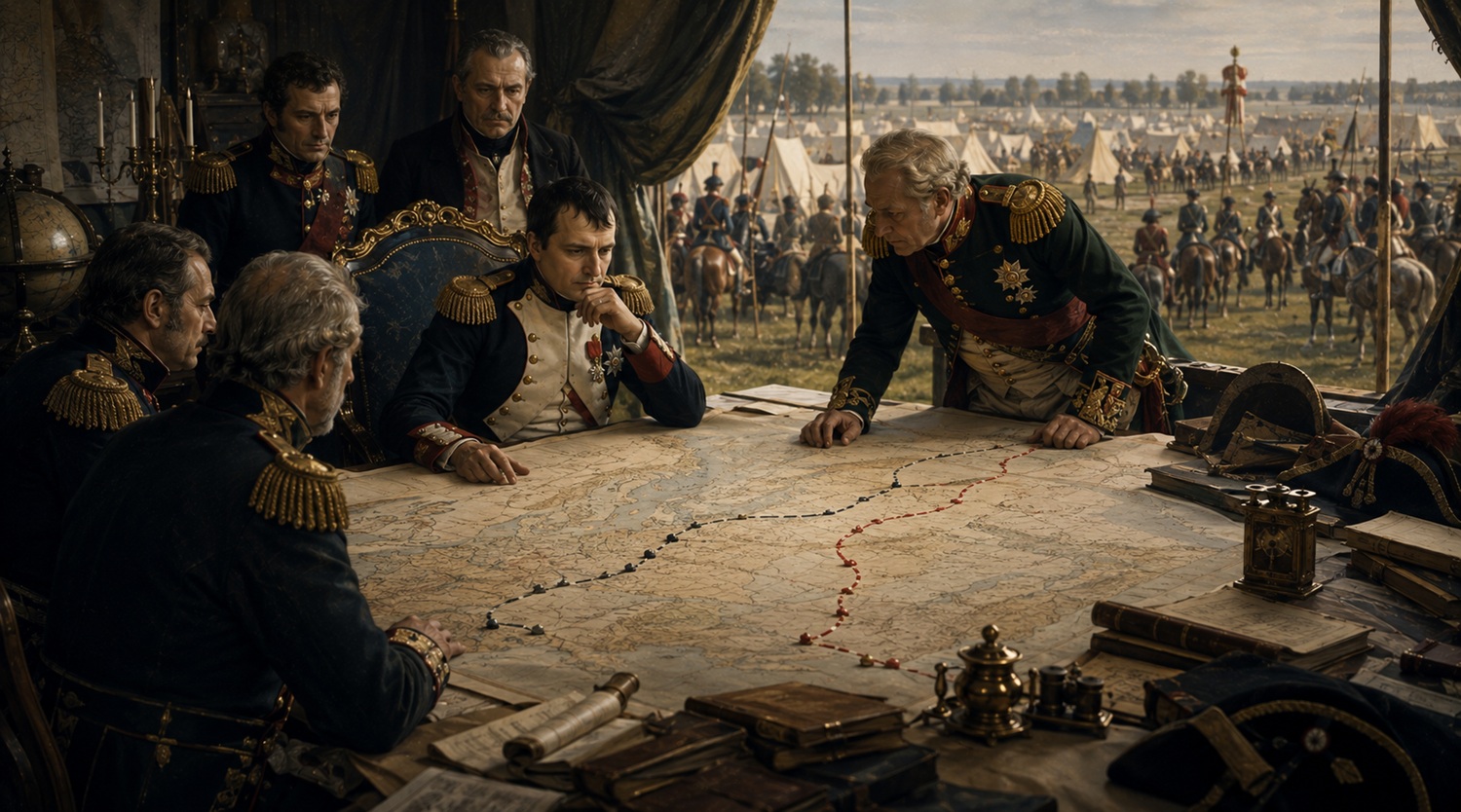
In June 1812, Napoleon Bonaparte crossed the Niemen River at the head of the largest army he had ever assembled.
The invasion of Russia was supposed to restore the political system Napoleon had constructed across continental Europe. Instead, it became the beginning of that system's catastrophic collapse.
The Grande Armée that entered Russia numbered well over half a million men when its many contingents are counted. It represented not merely France but Napoleon's wider European order: Poles, Germans, Italians, Dutch, Swiss, Croats, and soldiers from other allied or subordinate states marched alongside French troops. Russia refused the decisive early battle Napoleon wanted, the French penetrated hundreds of miles into the empire, Moscow was occupied but did not bring peace, and the retreat destroyed much of Napoleon's military strength. (napoleon.org)
That disaster created an opportunity Napoleon's enemies had repeatedly failed to obtain.
Prussia defected.
Russia carried the war westward.
Austria eventually joined the coalition.
Germany became a major battlefield.
Napoleon lost at Leipzig in 1813.
Allied armies invaded France.
He abdicated in 1814.
He returned from Elba in 1815, was defeated at Waterloo, abdicated again, and spent the remainder of his life in exile.
It is tempting, therefore, to imagine a simple alternate history:
No invasion of Russia means no disaster. No disaster means no Sixth Coalition. No Sixth Coalition means Napoleon rules Europe indefinitely.
The first part is plausible.
The last part is not.
By 1812, Napoleon's empire contained serious weaknesses independent of Russia. Britain remained undefeated. Spain had become a draining war. The Continental System was generating resentment as well as economic pressure. Prussia resented subordination. Austria had been defeated repeatedly but was still a great power. Russian hostility would not disappear merely because Napoleon declined to invade. His satellite states were expected to provide taxes, soldiers, and obedience while receiving unequal economic benefits from the French imperial system. And Napoleon's political legitimacy remained unusually dependent upon personal authority and military success. (Cambridge University Press)
So the useful counterfactual is not:
What if Napoleon discovered the secret to permanent European domination?
It is:
What if Napoleon recognized that enforcing the Continental System against Russia was less important than preserving his army and accepted a weakened economic blockade rather than invading in 1812?
That decision probably prevents his immediate downfall.
It may give the Napoleonic Empire another decade.
Perhaps considerably longer.
But survival would require Napoleon to accomplish something that had always been harder for him than winning battles:
turn a military empire into a stable political system that could function without continual victorious war.
---
The Continental System
Napoleon's central strategic problem after 1805 was Britain.
He could defeat Austria.
He could defeat Prussia.
He could defeat Russian armies in central Europe.
But he could not easily defeat the British state.
British naval power made a direct invasion extraordinarily difficult, while Britain's commercial and financial system allowed London to continue supporting continental enemies. Modern scholarship on the Royal Navy emphasizes that maritime supremacy kept Britain in the war, protected overseas commerce, and contributed substantially to Napoleon's eventual defeat. (Cambridge University Press)
Napoleon therefore attempted to attack Britain economically.
The Continental System sought to exclude British goods and British commerce from European ports.
As French influence expanded, states under Napoleon's control or pressure were expected to participate.
The system eventually stretched across much of continental Europe and became inseparable from the expansion of Napoleon's empire itself. It also provoked smuggling, disrupted established trading networks, harmed neutral and allied economies, and forced Napoleon to exercise ever greater political control merely to enforce an economic blockade that could never be airtight while Britain dominated the sea. (Cambridge University Press)
The problem was fundamental:
Napoleon needed continental Europe to stop trading with the world's strongest maritime commercial power.
Many continental economies had little enthusiasm for doing so.
Russia was one of them.
---
Tilsit and the Franco-Russian Alliance
After Napoleon defeated Russian forces at Friedland in 1807, Napoleon and Tsar Alexander I met at Tilsit.
The resulting settlement temporarily transformed Russia from Napoleon's enemy into his partner.
Russia accepted participation in the Continental System.
For a brief period, Napoleon and Alexander could imagine dividing influence across Europe rather than continually fighting one another.
But their partnership contained major contradictions from the beginning.
Russia's economy depended substantially on overseas commerce, including trade connected to Britain. Closing Russian ports deprived the government and commercial elites of valuable revenues and markets while increasing the economic cost of Napoleon's alliance. Russian compliance with the blockade was consequently inconsistent and increasingly weak. (napoleon.org)
There were geopolitical problems too.
Napoleon had created the Duchy of Warsaw out of Polish lands taken from Prussia. For many Poles, it represented the possibility of eventual restoration of a Polish state. To Russia, however, an expanding French-backed Polish entity on its frontier was a potential strategic threat. (napoleon.org)
Napoleon's annexation of territories in northern Germany, including the Duchy of Oldenburg, further offended Russian interests.
The two emperors also disagreed over the Ottoman Empire, European influence, commercial policy, and the extraordinary extent of French domination in Germany and central Europe.
By 1811, the alliance was deteriorating badly. Modern assessments emphasize that Russia could not indefinitely accept French continental supremacy or the economic costs of Napoleon's blockade, while Napoleon could not make his strategy against Britain work if major states such as Russia openly undermined it. (napoleon.org)
Something had to change.
Historically, Napoleon chose war.
---
Why Napoleon Invaded Russia
Napoleon did not invade Russia merely because Alexander permitted a few British products into Russian markets.
The Continental System was part of a much larger imperial structure.
If Russia could openly disregard Napoleon's rules, other states might follow.
Prussia might become less obedient.
German rulers might resist French demands.
Austria might recover diplomatic freedom.
Britain could claim that the continental blockade had failed.
Poles might demand stronger French protection against Russia.
Napoleon therefore viewed the confrontation partly as a question of credibility.
The 1812 campaign was, in the words of modern scholarship, a major effort to secure the French imperial system in continental Europe—not merely a punitive expedition over customs policy. (Cambridge University Press)
Napoleon expected military pressure to force Alexander back into cooperation.
He did not initially need to conquer and permanently occupy Russia from Poland to Siberia.
His strategic model came from previous campaigns.
Find the enemy's main army.
Defeat it decisively.
Threaten the political center.
Force the ruler to negotiate.
It had worked repeatedly in central Europe.
Russia was different.
Distance was different.
Logistics were different.
The Russian leadership's willingness to retreat was different.
Napoleon discovered that capturing territory was not the same thing as compelling Alexander to make peace.
Our alternate Napoleon recognizes that danger before crossing the frontier.
---
The Point of Divergence: Napoleon Accepts a Weak Continental System
In early 1812, Napoleon makes an unusual decision.
He compromises.
Russia will not be compelled to enforce the Continental System rigorously.
British-linked trade through Russian ports will continue at levels Napoleon dislikes.
In return, France and Russia negotiate a political understanding.
Napoleon promises not to enlarge the Duchy of Warsaw into a restored Polish kingdom.
Russia agrees not to join an offensive coalition against France.
Commercial enforcement becomes a diplomatic dispute rather than a casus belli.
Napoleon publicly describes the arrangement as a temporary modification of continental economic policy rather than a French retreat.
Privately, he accepts something much more important:
Britain cannot be economically defeated by coercing every European state into perfect obedience.
This is a major change in Napoleon's behavior.
It is not, however, completely impossible.
He had repeatedly demonstrated tactical pragmatism when circumstances required it.
The difficult part is psychological and political: he must accept a visible limit on his ability to command Europe.
That is the price of avoiding Russia.
---
What Napoleon Saves
The immediate consequence is enormous.
Napoleon does not lose the army assembled for Russia.
Even if he demobilizes part of it, he retains hundreds of thousands of trained soldiers, experienced officers, artillerymen, cavalrymen, horses, equipment, and logistical resources that were historically consumed by the campaign.
The French army in 1812 was not the same force Napoleon had commanded at Austerlitz, but the Napoleonic military system remained formidable. Conscription had become increasingly effective administratively, and by 1812 the French state had become substantially better at reducing draft evasion and extracting military manpower. (Cambridge University Press)
More important still, Napoleon preserves the veterans and officers he would need for future crises.
The Russia campaign did not merely kill soldiers.
It destroyed accumulated experience.
Napoleon historically rebuilt armies in 1813 with impressive speed, but many new troops lacked the training, cavalry strength, horses, and institutional cohesion of the army lost in Russia.
Without that catastrophe, his military deterrent remains immense.
---
Napoleon's Reputation Survives Too
Napoleon's empire depended heavily upon the belief that resistance was dangerous.
Austria had learned that lesson at Austerlitz and Wagram.
Prussia had learned it at Jena and Auerstedt.
Russia had learned it at Friedland.
German rulers knew that Napoleon could overthrow dynasties, redistribute territory, and install new political structures after defeating opponents.
The Russian disaster shattered that aura.
In the alternate timeline, there is no frozen retreat.
No abandoned artillery stretching across western Russia.
No ruined Grande Armée staggering back across the Niemen.
No dramatic proof that Napoleon can suffer a strategic catastrophe.
That alone makes another coalition much harder to assemble.
---
But Russia Is Not Napoleon's Ally Again
Avoiding invasion does not recreate the atmosphere of Tilsit.
Alexander remains suspicious.
Russia continues rearming.
Trade with Britain expands.
Russian diplomacy probes Austria, Prussia, Sweden, and Britain.
The Polish question remains dangerous.
The French presence in Germany remains offensive to Russian strategic interests.
The relationship becomes something closer to an armed truce.
Modern scholarship describes the Franco-Russian breakdown as arising from broad economic and geopolitical incompatibilities, not from a single misunderstanding that could easily have been forgotten. (napoleon.org)
Therefore the alternate settlement buys Napoleon time, not friendship.
---
Spain Becomes Napoleon's Largest Active War
Once Russia is removed from the immediate military agenda, the Peninsular War becomes impossible to ignore.
Napoleon had intervened in Portugal partly to enforce the Continental System. He then manipulated the Spanish dynastic crisis, removed the Spanish Bourbons, and placed his brother Joseph on the throne.
The result was disastrous.
Rebellion spread.
Spanish armies resisted.
Guerrilla warfare made French occupation expensive and dangerous.
Britain obtained a continental battlefield from which its army could fight Napoleon directly.
The Peninsular War tied down large French forces and imposed enormous human and material costs. Modern scholarship describes it as among the most destructive theaters of the Napoleonic Wars and emphasizes how prolonged guerrilla conflict and British intervention weakened French control. (Cambridge University Press)
Historically, Napoleon was simultaneously trying to dominate Iberia and preparing an enormous war against Russia.
In the alternate timeline, he can concentrate.
That changes Spain substantially.
---
Napoleon Has Three Choices in Spain
Option One: Escalate
Napoleon sends a major portion of the army originally intended for Russia into Spain.
He returns personally.
French armies attempt to destroy Wellington's Anglo-Portuguese forces and reconquer territory held by Spanish resistance.
This is militarily plausible.
But Spain's geography, guerrilla war, and local resistance mean even a major victory does not guarantee permanent pacification.
Option Two: Withdraw Gradually
Napoleon acknowledges that placing Joseph Bonaparte on the Spanish throne was a strategic mistake.
He negotiates restoration of a Bourbon monarchy under conditions favorable to France.
French garrisons withdraw.
Spain agrees to neutrality or limited commercial restrictions.
This sacrifices dynastic prestige while removing one of Britain's most important continental footholds.
Option Three: Hold the North and Negotiate
France retains strategic positions near the Pyrenees and perhaps selected territories while abandoning the attempt to control the entire peninsula.
Joseph's regime is sacrificed or reduced.
This creates a buffer without requiring endless counterinsurgency.
The strongest strategic choice would probably be some version of withdrawal or negotiated settlement.
The most characteristically Napoleonic choice might be escalation.
That distinction matters.
Avoiding Russia only saves Napoleon if he does not spend the saved army destroying itself somewhere else.
---
What Happens to Wellington?
Historically, Arthur Wellesley—later Duke of Wellington—used Portugal as a secure base and progressively increased British pressure in Spain.
By 1812, Wellington was capable of mounting major offensives, and the French were burdened by the requirement to hold enormous territory and defend against guerrillas while maintaining several separate armies. (Cambridge University Press)
Without the Russian campaign, Napoleon can reinforce Iberia heavily.
That makes Wellington's historical 1812–1813 advance much less certain.
The Battle of Salamanca might never occur in the same way.
Madrid might remain under Joseph's control longer.
British forces could be driven back toward Portugal.
But Britain's position is not hopeless.
Portugal remains defensible.
The Royal Navy maintains communications and supplies.
Spanish resistance remains widespread.
A greatly reinforced French army might defeat Wellington without politically conquering Spain.
Napoleon could win another campaign and still retain the “Spanish ulcer.”
---
The Best Napoleonic Strategy Is Probably to Leave Spain
From the perspective of preserving his continental empire, Napoleon's most valuable decision after avoiding Russia would be admitting a second limitation:
Spain is not worth the cost.
That would be politically painful.
He had installed his brother as king.
Withdrawal would acknowledge failure.
But it could transform the strategic balance.
Britain loses its major continental battlefield.
Hundreds of thousands of French and allied troops become available elsewhere.
French finances improve.
Conscription pressure decreases.
Napoleon can concentrate on Germany, Italy, and France.
The irony is that preserving the Napoleonic Empire may require Napoleon to behave less like Napoleon.
---
Could Britain Still Defeat Napoleon?
Britain alone probably could not destroy Napoleon's continental empire by land.
Britain's strongest advantages were financial, maritime, commercial, and diplomatic.
The Royal Navy could keep Britain secure from invasion.
British trade could continue globally.
British governments could subsidize continental allies.
British armies could operate on limited theaters such as Iberia.
But overthrowing Napoleon required great continental armies. Britain's strategy repeatedly depended upon building or supporting coalitions involving Austria, Prussia, Russia, and others. (napoleon.org)
This is precisely why avoiding Russia matters so much.
Napoleon does not need to defeat Britain directly in order to survive.
He needs to prevent Britain from assembling a sufficiently powerful continental coalition.
---
Britain Still Cannot Be Forced to Surrender Easily
The other half of the answer is equally important.
Napoleon probably cannot defeat Britain merely by waiting.
The Royal Navy continues controlling crucial maritime routes.
Britain retains its commercial empire.
Industrial capacity continues growing.
British diplomacy continues financing Napoleon's enemies.
The Continental System can hurt British firms and particular sectors without reliably collapsing the British state. Contemporary Britain experienced economic strain, but Napoleon's blockade never produced the decisive political breakdown he wanted. (napoleon.org)
So the alternate Europe could settle into a prolonged strategic stalemate:
Napoleon dominates much of the continent. Britain dominates the sea. Neither can easily destroy the other.
That is a very different world from permanent French victory.
---
A Napoleonic Cold War
By 1813 or 1814, the situation might begin resembling a nineteenth-century cold war.
Britain supports smugglers, opposition networks, exiles, Spain, Portugal, Russia, and disaffected German rulers.
France monitors satellite governments, maintains major armies in Germany and Italy, and tries to discourage defections.
Russia builds military strength in Poland and along its western frontier.
Austria officially cooperates with France while exploring every opportunity to regain independence.
Prussia reforms its army while publicly remaining subordinate.
The question becomes:
Can Napoleon maintain this system without periodically fighting another war to remind everyone why they should obey him?
Modern scholarship identifies this as one of the central contradictions of Napoleonic rule. The legitimacy of a regime created through military victory remained deeply entangled with continuing victorious campaigns. (Cambridge University Press)
Peace might actually expose weaknesses victory had concealed.
---
Austria Waits
Austria had been defeated repeatedly by Napoleon, most recently in 1809.
Napoleon then married Archduchess Marie-Louise, daughter of Emperor Francis I, in 1810.
The marriage represented more than romance or dynastic theater.
It was meant to incorporate Napoleon into Europe's legitimate dynastic system.
Their son, Napoleon François, was born in March 1811 and immediately received the title King of Rome. (Cambridge University Press)
Austria therefore has reasons to avoid immediate confrontation.
The French emperor is now the husband of an Austrian archduchess.
His heir is Francis I's grandson.
A strong Napoleonic regime could perhaps be tolerated if it behaved predictably.
But Austria also has enormous reasons to weaken French domination in Germany and Italy.
In the alternate timeline, Vienna becomes patient.
It does not need to fight Napoleon in 1813 because Napoleon has not lost his army.
Austria waits for a safer opportunity.
---
Prussia Has Even More Reason to Wait
Prussia had been humiliated in 1806–1807.
Its territories were reduced.
French influence constrained its sovereignty.
The Prussian military and administration subsequently underwent important reforms.
Historically, the Russian disaster gave Prussia the opportunity to escape Napoleon's system.
Without that disaster, open rebellion is much riskier.
A French army hundreds of thousands strong remains nearby.
Napoleon still dominates the Confederation of the Rhine.
Russia is unwilling to attack alone.
Therefore Prussian leaders probably continue rebuilding quietly while maintaining formal cooperation with France.
Prussian nationalism and anti-French sentiment do not disappear.
They lose their immediate military opening.
---
Nationalism Without the 1813 Wars of Liberation
Napoleon's rule had contradictory political effects.
French domination introduced administrative and legal reforms in many territories while conscription, taxation, economic restrictions, and foreign rule generated resentment. Napoleon's client states were expected to modernize and to serve French strategic interests simultaneously. (Cambridge University Press)
In German lands, resistance to Napoleon later became deeply connected to nationalist narratives of liberation.
Without the Russian disaster and the campaigns of 1813, there is no historical “War of Liberation” on the same timetable.
German nationalism still grows.
Universities, writers, reformers, military officers, and political networks continue debating German identity.
But there is no Leipzig victory around which to construct the same immediate national mythology.
French dominance may therefore suppress political nationalism temporarily while continuing to create the resentments that sustain it.
---
The Confederation of the Rhine Survives
Napoleon created the Confederation of the Rhine in 1806 and used it as a political and military framework for French influence across much of Germany.
Its members supplied soldiers and strategic cooperation.
It also helped destroy the old Holy Roman imperial structure and consolidate numerous German territories. (Cambridge University Press)
Without Napoleon's collapse, the Confederation survives beyond 1813.
Bavaria, Württemberg, Saxony, Baden, and other rulers have complicated incentives.
They resent French demands.
But Napoleon has also enhanced many of their territories and political status.
Defecting risks losing those gains.
The Confederation could therefore become more institutionalized if Napoleon stops demanding catastrophic levels of military service.
Or it could remain a brittle alliance waiting for French weakness.
---
Napoleon's Empire in Italy
French influence in Italy was even more direct.
Napoleon ruled the Kingdom of Italy himself and placed relatives or trusted figures in other Italian states. French institutions brought administrative and legal changes while French economic policies subordinated local interests to the imperial system. (Cambridge University Press)
Without the Russian catastrophe, French-dominated Italy survives.
The Napoleonic Code and related legal reforms remain.
Administrative centralization continues.
Traditional privileges continue eroding.
Italian elites gain experience serving modernized governments.
But French rule also continues generating resentment.
Italian nationalism therefore develops in an unusual environment:
Napoleon remains simultaneously the ruler who consolidated much of Italy politically and the foreign emperor preventing independent Italian government.
---
Can Napoleon Make His Satellite States Loyal?
This may be the most important political problem of the alternate empire.
His client states supplied resources.
Troops.
Taxes.
Strategic depth.
Administrative cooperation.
But many were expected to serve French requirements above their own.
Research on Napoleon's client states stresses the contradiction between reforms such as legal modernization and the heavy burdens of conscription, taxation, and economic subordination. (Cambridge University Press)
If Napoleon wants the system to survive peacefully, he must reduce those burdens.
That means:
fewer compulsory troop levies;
greater commercial flexibility;
more genuine autonomy;
fewer arbitrary territorial rearrangements;
predictable succession;
less exploitation for French financial needs.
But each concession reduces direct French control.
Napoleon must decide whether he wants an empire of obedient dependents or a federation of allies.
The first requires coercion.
The second requires compromise.
---
French Finances
Avoiding Russia immediately improves Napoleon's financial position.
Wars were expensive, but Napoleon had developed a system in which defeated and occupied territories shouldered substantial portions of the burden. Modern fiscal scholarship emphasizes that the regime relied heavily on resources extracted from conquered territories while maintaining a cautious approach to domestic public credit after the financial collapse of the revolutionary period. (Cambridge University Press)
That model works best while Napoleon keeps winning.
Peace creates a different problem.
Satellite states become less willing to pay extraordinary contributions.
France must increasingly finance its own permanent military establishment.
The Continental System also disrupts economic activity.
Napoleon could therefore gain fiscal stability by reducing both warfare and economic coercion.
Again, the solution requires moderation.
---
France Itself Is More Stable Than the Empire
Inside France, Napoleon possesses substantial advantages.
He has created or consolidated durable administrative structures.
Prefects represent the central state.
Tax collection is stronger.
Police institutions are extensive.
The Civil Code has reorganized important parts of private law.
The Concordat had stabilized relations with much of the Catholic population despite later tensions with the papacy.
Elites created by the Revolution have powerful reasons to fear Bourbon restoration and the possible reopening of property settlements.
Napoleon therefore has a real domestic political foundation.
His government is authoritarian, but it is not merely an occupying army sitting on France.
The more difficult task is persuading Europe to accept permanent French supremacy.
---
Can Napoleon Preserve the Empire Without Another Decisive War?
This is the central question.
Possibly—but only by reducing the degree of supremacy he demands.
If Napoleon insists that Russia obey his economic rules, Prussia supply troops indefinitely, Austria accept permanent exclusion from Germany and Italy, satellite states sacrifice their economies for France, and Britain remain permanently barred from continental commerce, another major war is almost inevitable.
If he instead accepts a more limited system, survival becomes more plausible.
Imagine a settlement by 1814:
France retains its expanded borders.
Belgium remains integrated into France.
Napoleon remains dominant in northern Italy.
The Confederation of the Rhine continues.
The Duchy of Warsaw survives but is explicitly prevented from becoming a restored Polish kingdom.
Russia resumes substantial commercial relations with Britain.
The Continental System becomes largely symbolic.
Spain receives a negotiated settlement.
Britain and France remain officially at war or enter an uneasy peace.
Austria accepts the status quo in return for diplomatic influence.
This would still represent an extraordinary French victory compared with the Europe that existed before the Revolution.
What Napoleon must abandon is the ambition to make every major European state function as an instrument of French strategy.
---
Would Napoleon Accept Such a Settlement?
That is the counterfactual's greatest weakness.
Napoleon had repeatedly interpreted compromise through the lens of power.
His empire grew partly because each military victory created opportunities for new annexations, new satellite states, or new economic controls.
The Continental System itself pushed France toward further intervention because loopholes in one territory encouraged Napoleon to control that territory more directly.
Portugal is one example.
The Netherlands is another.
The North Sea coast is another.
Russia ultimately became another.
Thus preventing the Russian campaign requires more than one decision.
It requires Napoleon to learn a strategic lesson:
some unenforced rules are cheaper than enforced rules.
If he learns it, his empire could survive.
If he does not, another crisis replaces Russia.
---
Succession: The King of Rome
Napoleon's son is one of the greatest differences between the empire of 1812 and the regime of a decade earlier.
Napoleon François Charles Joseph was born on March 20, 1811.
He was immediately styled King of Rome.
Napoleon now possessed a biological heir born to an Austrian Habsburg princess.
The marriage and birth were intended to transform the Bonapartes from revolutionary newcomers into an established European dynasty. (napoleon.org)
If Napoleon avoids catastrophic defeat, the boy grows up at the center of the imperial court.
He receives military, administrative, diplomatic, and dynastic training.
By the 1820s, Napoleon could plausibly begin assigning him ceremonial or governmental responsibilities.
This substantially increases the possibility that the empire survives Napoleon personally.
But it does not guarantee it.
---
The Dynasty Was Still Fragile
The birth of an heir solved the biological problem.
It did not solve the legitimacy problem.
One revealing historical event occurred during the Russian campaign itself.
In October 1812, General Claude François de Malet attempted a coup in Paris by falsely announcing Napoleon's death.
The episode exposed how little automatic political instinct existed to transfer allegiance immediately to the infant Napoleon II. Contemporary observers and later historians have treated the affair as evidence that the dynasty remained far less entrenched than Napoleon wanted to believe. (napoleon.org)
In the alternate timeline, Napoleon has years to correct this weakness.
He can associate his son publicly with government.
Require oaths to the dynasty rather than merely to himself.
Create a regency structure.
Integrate the Senate, army, nobility, and bureaucracy into succession planning.
Arrange dynastic marriages.
Transform “Napoleon's regime” into “the Bonaparte monarchy.”
That could work.
But dynasties usually acquire legitimacy through time.
Napoleon needs enough of it.
---
What If Napoleon Dies Early?
This is the most dangerous test.
Suppose Napoleon dies unexpectedly in 1820.
His son is nine.
Who rules?
Marie-Louise could serve as regent.
A council of senior French statesmen and marshals could govern.
Austria would exert enormous influence through the empress.
Napoleon's brothers might seek power.
Army commanders could intervene.
Republicans could challenge the dynasty.
Bourbon supporters could argue that the experiment had ended with its founder.
Russia, Britain, Austria, and Prussia would immediately reassess the European balance.
A child emperor could therefore trigger precisely the coalition Napoleon spent his life preventing.
Avoiding Russia postpones the regime's existential crisis.
Succession may recreate it.
---
A More Plausible Bonaparte Succession
Suppose instead Napoleon lives into his late fifties or sixties.
Napoleon II reaches adulthood under his father's supervision.
He commands troops ceremonially, then genuinely.
He attends councils.
He marries into another major dynasty.
The imperial constitution is revised to specify regency and succession clearly.
By the time Napoleon I dies, the bureaucracy has served the dynasty for thirty years rather than ten.
That produces a far more credible Bonapartist monarchy.
The regime could survive.
Its long-term character, however, would probably become less revolutionary and less personal.
A second Bonaparte emperor might resemble a conventional authoritarian constitutional monarch more than his father.
---
Napoleon's Administrative Legacy Becomes Permanent
Even in real history, many Napoleonic reforms outlived Napoleon.
Administrative centralization, legal codification, fiscal institutions, new elite structures, and reorganized state machinery did not simply disappear with the Bourbons.
Napoleonic systems also influenced governments beyond France. French administrative and taxation practices affected territories across Germany, Italy, and the Low Countries. (Cambridge University Press)
If Napoleon remains in power another decade or two, those institutions become even harder to reverse.
Officials spend entire careers inside them.
A generation of lawyers learns Napoleonic law.
Local elites build fortunes within the system.
German and Italian governments adapt French-derived administrative practices to their own needs.
The longer Napoleon survives, the less meaningful it becomes to imagine Europe simply “restoring” the pre-1789 world after his death.
---
But French Dominance Could Become Less French
There is another possibility.
Napoleon's reforms succeed so well in satellite states that those states become better able to resist France.
Bavaria acquires stronger administration.
Italian states develop modern bureaucracies.
German armies become more efficient.
Local elites gain political experience.
Legal equality weakens older privileges that had tied subjects to dynastic hierarchies.
The empire could therefore modernize the societies that eventually dismantle it.
Napoleon's Europe might contain the seeds of its own post-Napoleonic order even if Waterloo never occurs.
---
What Happens to Poland?
The Duchy of Warsaw becomes a permanent source of tension.
Poles naturally hope Napoleon will restore a larger Polish state.
Russia fears exactly that.
Prussia and Austria also possess Polish territories they have no desire to surrender.
A Franco-Russian settlement therefore almost certainly requires Napoleon to restrain Polish ambitions.
The Duchy may survive, but its borders remain limited.
That would disappoint many Polish supporters of Napoleon.
It could also weaken one of his most loyal political constituencies.
If Napoleon later needs Polish troops against Russia, he may once again face pressure to promise restoration.
The Polish question remains a fuse beside the Franco-Russian powder magazine.
---
What Happens to Sweden?
Sweden had already undergone a remarkable political change.
Former French marshal Jean-Baptiste Bernadotte became Swedish crown prince.
His interests increasingly diverged from Napoleon's.
Historically, Sweden eventually joined the coalition against France.
Without the Russian campaign, Bernadotte would have less reason and less opportunity to oppose Napoleon openly.
Sweden could remain neutral longer while seeking territorial gains elsewhere.
Yet Bernadotte's existence demonstrates another weakness of Napoleonic personal politics:
even men elevated through the French military system could develop independent dynastic interests.
---
1813 Without the Russian Disaster
This is the first major alternate checkpoint.
Historically, 1813 became the year of the German campaign and the Battle of Leipzig.
In the alternate timeline:
Russia has not invaded central Europe.
Prussia has not openly defected.
Austria remains formally aligned or neutral.
Napoleon still possesses the army he assembled in 1812.
The Confederation of the Rhine remains intact.
There is therefore no Sixth Coalition capable of fighting the historical German campaign.
Britain may continue the Peninsular War.
Russia and France remain hostile.
But the military balance discourages general war.
The famous Battle of Leipzig almost certainly does not occur in 1813.
---
Possible Outcome for 1815: Napoleonic Hegemony Stabilizes
By 1815, the strongest survival scenario looks something like this:
France
Napoleon remains emperor with the King of Rome as recognized heir.
Spain
A negotiated settlement has reduced or ended the French occupation, perhaps restoring a Spanish dynasty that agrees to neutrality.
Britain
Still independent, commercially powerful, and dominant at sea.
Russia
Hostile but not at war with France.
Austria
Formally connected to Napoleon through Marie-Louise but increasingly independent diplomatically.
Prussia
Reformed and resentful but cautious.
Germany
The Confederation of the Rhine remains the principal framework of French influence.
Italy
French and Bonapartist states remain dominant.
Poland
The Duchy of Warsaw survives under strict limits.
Europe has not reached peace in the emotional sense.
It has reached armed equilibrium.
Napoleon's empire is stronger than any single continental opponent.
His opponents collectively could defeat it—but only if they trust one another enough to act simultaneously.
---
Would There Still Be a Waterloo?
Almost certainly not in the historical sense.
Waterloo occurred because Napoleon had already abdicated in 1814, been sent to Elba, returned to France in March 1815, restored his empire during the Hundred Days, and faced a rapidly assembled coalition determined to remove him before his regime could stabilize.
Without the Russian disaster, there is no historical chain leading to the 1814 invasion of France.
No first abdication.
No Elba.
No Bourbon restoration in 1814.
No return from Elba.
No Hundred Days.
Therefore no Battle of Waterloo on June 18, 1815.
That conclusion is among the strongest in the entire counterfactual.
There could still be a great Anglo-French or coalition battle later.
Wellington could conceivably command it.
Napoleon could conceivably command France.
It would not be Waterloo as history knows it.
---
Could Britain Still Defeat Napoleon?
The answer depends on the meaning of defeat.
Could Britain prevent Napoleon from conquering Britain?
Very likely.
The Royal Navy remains a formidable barrier, and Britain maintains global maritime resources. (Cambridge University Press)
Could Britain damage the French imperial economy?
Yes.
Maritime trade, blockade, colonial warfare, smuggling, and financial pressure remain important.
Could Britain support resistance in Spain and elsewhere?
Yes.
That was already central to British strategy. (napoleon.org)
Could Britain overthrow Napoleon without continental allies?
Much less likely.
Britain does not possess the land army required to march alone across Europe and destroy the French system.
Could Britain eventually organize another coalition?
Absolutely.
Russia, Austria, and Prussia continue possessing powerful grievances.
Britain's real strategic weapon is patience.
It does not need to defeat Napoleon next year.
It needs to wait until Napoleon gives his continental opponents another reason—and another opportunity—to fight.
---
Napoleon's Greatest Enemy Could Become Time
The emperor is forty-two in 1812.
He is not an old man.
If he avoids Russia, he could plausibly dominate European affairs for another fifteen or twenty years.
But military empires face problems that battlefield victories cannot solve indefinitely.
Allied rulers die.
New rulers emerge.
Economic interests change.
National movements mature.
Debt accumulates.
Generals become ambitious.
Succession approaches.
Colonies revolt.
Britain becomes wealthier.
Russia's population and military resources remain enormous.
Prussia continues reforming.
Austria continues maneuvering.
Every year Napoleon avoids catastrophe helps institutionalize his empire.
Every year also gives his opponents time to prepare for the moment he weakens.
---
Possible Outcome for 1825: Three Napoleonic Europes
By 1825, predictions become less certain.
Three broad paths are useful.
| Scenario | Napoleon | European System | Probability Within the Counterfactual |
| -------------------------- | ----------------------------------------------------------------------------------- | --------------------------------------------------------------------------------------- | ---------------------------------------------------- |
| Imperial stabilization | Still rules or has begun transferring responsibility to adult heir | France dominates Germany and northern Italy; Britain and Russia balance it from outside | Plausible |
| Limited retreat | Still emperor but has traded direct control for durable alliances | French borders remain enlarged, but German and Italian client states gain autonomy | Strongly plausible if Napoleon becomes pragmatic |
| Delayed coalition war | Faces Russia, Prussia, Austria and Britain in another major conflict during 1815–25 | Outcome uncertain; Napoleonic system could still collapse | Also highly plausible |
The key insight is that avoiding Russia does not eliminate the coalition problem.
It changes the odds.
Napoleon would enter the next coalition war with his best army intact rather than trying desperately to replace it.
---
The 1825 Stable-Empire Scenario
Suppose Napoleon learns restraint.
By 1825 he is fifty-five.
France remains the strongest continental military state.
The Continental System has effectively disappeared.
Commercial relations with Britain have partially normalized, perhaps after a peace treaty.
Spain is independent of direct French control.
The Confederation of the Rhine has evolved into a looser French-aligned German federation.
Napoleonic Italy remains divided but administratively integrated.
Napoleon II, now fourteen, is publicly treated as the future emperor.
Austria participates in the system instead of trying to destroy it.
Russia remains outside it.
This is not Napoleon's maximum empire.
It may be a more survivable one.
---
The 1825 Delayed-War Scenario
Now suppose Napoleon cannot stop pushing.
The Polish issue escalates.
France interferes with Russian trade.
Prussia is pressured for more troops.
Napoleon redraws another German frontier without consultation.
Britain offers subsidies.
Russia mobilizes.
Austria calculates that French defeat is finally possible.
A coalition forms around 1818 or 1820.
This time Napoleon possesses a veteran army and better cavalry.
The war therefore resembles Austerlitz or Wagram more than the desperate 1813 campaign.
He could win.
But if he loses one genuinely decisive campaign, the political structure may unravel rapidly.
Bavaria changes sides.
Prussia declares national liberation.
Italian revolts begin.
The empire's apparent stability proves conditional on French military superiority.
Avoiding Russia delays the test.
It cannot abolish it.
---
Could Napoleon Make Peace With Britain?
This is one of the strongest routes toward long-term survival.
Britain does not need France reduced to its 1789 borders in every possible diplomatic settlement.
Napoleon does not need Britain economically destroyed if he abandons the Continental System.
The major obstacles include colonial possessions, maritime rights, continental arrangements, Spain, the Netherlands, and Britain's concern that one power dominating Europe could threaten British security.
A compromise would therefore require Napoleon to reduce his control of the continental coastline and accept independent states capable of balancing France.
That is possible.
But a Europe containing France directly or indirectly dominant from the Pyrenees through northern Germany and Italy would remain difficult for Britain to accept.
Peace might therefore be temporary even after a formal treaty.
---
French Dominance vs. French Security
Napoleon repeatedly blurred two goals.
French security meant preventing hostile coalitions from threatening France.
French dominance meant controlling enough of Europe that other great powers could not act independently.
The first could perhaps be achieved permanently.
The second continually generated resistance.
The alternate Napoleon who survives must eventually distinguish them.
He could retain Belgium, the Rhine frontier, a friendly Italy, and strong German allies while permitting Austria, Prussia, Russia, Spain, and Britain meaningful independence.
That France would still be extraordinarily powerful.
It would simply cease trying to organize the entire continent around Napoleon's strategic priorities.
---
What Happens to French Nationalism?
Napoleon's longevity could also change France's political identity.
By the 1820s, a generation would have grown up knowing no government other than the Empire.
The revolutionary republic would belong increasingly to their parents' history.
The Bourbons would appear not as France's natural kings temporarily displaced by Napoleon but as an exiled former dynasty.
Imperial symbols, the army, the Civil Code, the tricolor, the Legion of Honour, and the Bonaparte dynasty could become normal components of French national identity.
Time would accomplish what propaganda alone could not.
The empire could become legitimate because it had endured.
---
Does Republicanism Disappear?
No.
The French Revolution remains part of living memory.
Republicans can criticize hereditary empire.
Liberals can demand legislative power and press freedom.
Former royalists can remain hostile to Bonaparte.
Industrial and social changes create new political constituencies.
If Napoleon II later proves weak, constitutional opposition could become powerful.
The survival of the Bonaparte dynasty therefore does not guarantee continuation of Napoleon I's authoritarian political model.
The empire might constitutionalize to survive.
---
Napoleon II's Likely Problem
A second emperor could inherit enormous territory but little of his father's unique personal authority.
Napoleon I could tell German kings that he had created their kingdoms.
Napoleon II could not.
Napoleon I's marshals had fought beside him.
Napoleon II would inherit them as aging political figures.
Napoleon I's prestige rested on victories at Marengo, Austerlitz, Jena, Friedland, and Wagram.
His son would inherit those victories as family mythology.
A dynastic succession therefore changes the basis of legitimacy.
Napoleon II would need law, institutions, elite cooperation, diplomacy, and perhaps constitutional government to accomplish what his father had enforced partly through charisma and military fear.
That transition would determine whether the empire becomes a state or remains one man's creation.
---
Possible Outcome for 1850
Predicting the precise map of 1850 would be irresponsible.
Nearly four decades of marriages, deaths, economic changes, revolts, wars, inventions, and political movements would intervene.
But broad structures can be considered.
Scenario A: A Bonapartist Great-Power France
The original continental empire has contracted, but the Bonaparte dynasty still rules France.
France possesses Belgium or a strong northeastern frontier.
Northern Italy remains influenced by Paris.
Germany has consolidated into several larger states but has not unified under Prussia in the historical manner.
France and Britain compete globally while avoiding permanent war.
This is perhaps the most sustainable descendant of Napoleon's system.
Scenario B: A Constitutional Napoleonic Federation
Napoleon's client states gradually become genuine allies.
The Confederation of the Rhine evolves into an independent German federation aligned with France but not controlled from Paris.
Italian states move toward federation.
France remains the senior state within a continental bloc.
Napoleon's political system survives by becoming less imperial.
Scenario C: The Empire Falls Later
A coalition war, succession crisis, liberal revolution, or combination of all three destroys the system in the 1820s or 1830s.
The key difference from real history is timing.
Napoleonic institutions have existed another fifteen or twenty years.
German and Italian political development has occurred within them longer.
The eventual post-Napoleonic settlement therefore cannot simply restore 1815.
Even Napoleon's defeat would leave a different Europe behind.
---
What About the Revolutions of 1848?
They are far too distant to reproduce mechanically.
The historical revolutions of 1848 grew from liberalism, nationalism, constitutional demands, social conditions, economic problems, and state-specific conflicts.
Many of those forces would still exist.
But the states confronting them would be different.
There may be no historical German Confederation created at Vienna.
No identical Austrian position in Italy.
No restored Bourbon France.
No July Monarchy of Louis-Philippe.
No historical path to the French Second Republic.
There could still be a Europe-wide revolutionary crisis around the middle of the century.
It would not be the 1848 of our timeline.
---
What Happens to German Unification?
No Russian disaster means Napoleon's German system survives much longer.
That alone disrupts the later sequence leading to a Prussian-led Germany.
Prussia continues reforming, but its opportunity to lead the Wars of Liberation in the same way disappears.
The Confederation of the Rhine could outlive Napoleon I.
German economic and cultural integration would continue.
Nationalism would continue.
But political unification might occur:
under Prussia later;
through a reformed Rhine federation;
under Austro-German leadership;
as a federal compromise;
or not at all by 1850.
The historical German Empire of 1871 cannot be projected confidently from this altered 1812.
---
Italy Could Be Even More Interesting
Napoleon had already consolidated Italian territories and introduced common administrative and legal practices.
In real history, French rule eventually collapsed, but the experience contributed to later political memories and nationalist movements. (Cambridge Assets)
If French-backed Italian institutions survive for decades, administrative integration goes further.
The idea that northern and central Italian territories can operate within larger political units becomes more familiar.
But French domination also remains the obstacle to genuine national independence.
Italian nationalism could therefore become an explicitly anti-Bonapartist movement.
Alternatively, Napoleon II might preempt it by transforming French-controlled Italian states into a federated kingdom governed by another Bonaparte.
Long survival could accelerate some forms of Italian state-building while delaying independence from France.
---
What Happens to Austria?
Austria may be the biggest long-term loser from a stable Napoleonic Europe.
French influence in Germany limits Austrian leadership there.
French control in Italy restricts Habsburg ambitions south of the Alps.
The Duchy of Warsaw complicates eastern politics.
Yet Austria remains large, dynastically prestigious, and strategically central.
Marie-Louise gives Vienna a direct family connection to the Bonaparte dynasty.
Austria could therefore choose collaboration rather than confrontation.
A Franco-Austrian dynastic axis is conceivable.
But it would transform Austria into the junior partner of a system the Habsburgs had once expected to dominate.
The temptation to overturn that system would never disappear.
---
What Happens to Russia?
Russia is the great continental counterweight.
It has not been devastated by the 1812 invasion.
Its army remains powerful.
Its economy reconnects more fully with maritime commerce.
Alexander does not gain the historical prestige of leading Europe toward Paris.
There is no Russian army occupying the French capital in 1814.
There is no Holy Alliance in its historical form. (Cambridge University Press)
Instead, Russia consolidates influence in eastern Europe and the Balkans while watching Napoleon from a distance.
The Franco-Russian frontier around Poland becomes Europe's most dangerous strategic fault line.
A later war remains highly plausible.
---
Russia May Actually Be Stronger
This is another paradox.
Avoiding invasion saves Napoleon's army.
It also saves Russia from the enormous human and economic destruction of the 1812 campaign.
Russia does not lose hundreds of thousands of people to invasion and wartime devastation. (Cambridge University Press)
Its cities and countryside avoid major destruction associated with the campaign.
So both empires emerge stronger from the compromise.
That may make the eventual confrontation more dangerous, not less.
Instead of Napoleon's exhausted army confronting a mobilized Russia, Europe could face two intact military giants during a later Polish or German crisis.
---
A Later Franco-Russian War Could Be Much Shorter
Napoleon's most important lesson from avoiding 1812 would presumably be that he cannot conquer Russia by marching hundreds of miles toward Moscow.
A later war might therefore have limited objectives.
Defend the Duchy of Warsaw.
Fight around Poland and East Prussia.
Force a settlement without penetrating deeply into Russia.
Such a campaign would be far more consistent with Napoleon's strengths.
Ironically, declining to invade Russia in 1812 could make him more dangerous to Russia later, because he would no longer need to learn the logistical lesson through catastrophe.
---
What About the United States and the War of 1812?
The Anglo-American War of 1812 had its own causes, including maritime rights, impressment, trade restrictions, frontier conflict, and American political ambitions. It does not disappear because Napoleon stays west of the Niemen. (Cambridge University Press)
Britain, however, would face a different European context.
Historically Napoleon's Russian invasion initially eased British strategic concerns by opening another enormous continental front. (napoleon.org)
Without it, London must continue watching a powerful intact French army while simultaneously fighting the United States.
Britain may therefore have greater incentive to settle the American war sooner or devote fewer resources to North America.
This is a secondary consequence and should not be pushed too far, but it illustrates how avoiding Russia affects conflicts far beyond Europe.
---
Real History vs. No-Invasion Timeline
| Date | Real History | Plausible No-Invasion Timeline |
| -------------- | --------------------------------------------------------------------------------------------------------- | ------------------------------------------------------------------------------------------------------------------------ |
| 1807 | Tilsit creates temporary Franco-Russian partnership; Russia joins Continental System. | Same. (napoleon.org) |
| 1810–11 | Relations deteriorate over trade, Poland, French expansion, and Russian resistance to Continental System. | Same deterioration. (napoleon.org) |
| March 1811 | Napoleon's son, King of Rome, is born. | Same; dynastic succession becomes increasingly important. (napoleon.org) |
| Early 1812 | Napoleon prepares enormous invasion army. | Napoleon accepts Russian commercial noncompliance and negotiates armed détente. |
| June 1812 | Grande Armée crosses Niemen. | Army remains west of Russia; forces are demobilized, held in Germany, or redirected toward Spain. |
| Sept. 1812 | Borodino; Napoleon later occupies Moscow. | No Borodino, no Moscow occupation. |
| Late 1812 | Catastrophic French retreat destroys much of Grande Armée. | French military strength and prestige remain largely intact. |
| 1813 | Russia advances west; Prussia joins; Austria later enters coalition; Leipzig defeats Napoleon. | Prussia and Austria remain cautious; no comparable Sixth Coalition campaign. |
| 1814 | Allies invade France; Napoleon abdicates and goes to Elba. | Napoleon remains emperor; negotiations over Spain, Russia and economic policy dominate diplomacy. |
| 1815 | Napoleon returns, fights Waterloo, abdicates again. | No Elba, Hundred Days, or historical Waterloo. |
| 1820s | Post-Vienna Europe governed by restored monarchies and Concert system. | Bonapartist Europe either stabilizes, contracts through negotiation, or faces a delayed coalition war. |
| 1850 | Europe has experienced Restoration, 1830 revolutions and 1848 upheavals. | Exact events cannot be transferred; nationalism and liberalism confront a different Napoleonic or post-Napoleonic order. |
---
Strong, Moderate, and Weak Counterfactual Claims
| Claim | Assessment | Why |
| --------------------------------------------------------------------------------------------------- | ---------------------------------------------------------- | ------------------------------------------------------------------------------------------------------------------- |
| Russia and France were moving toward confrontation before 1812 | Very strong | Economic and geopolitical tensions had badly weakened the Tilsit arrangement. (napoleon.org) |
| Napoleon could theoretically accept Russian weakening of the Continental System instead of invading | Plausible but politically difficult | The dispute was serious but war remained a policy choice; compromise required Napoleon to accept reduced control. |
| No invasion preserves most of the Grande Armée | Very strong | The catastrophic campaign losses are directly avoided. (napoleon.org) |
| Prussia still declares war on Napoleon in early 1813 | Weak | Historical Prussian defection depended heavily on the collapse of French military power after Russia. |
| Austria joins an anti-French coalition immediately | Weak | An intact French army makes Austrian intervention far riskier. |
| The historical Battle of Leipzig still occurs in 1813 | Very weak | Its coalition and military circumstances depended on the Russian disaster. |
| Napoleon automatically defeats Britain | Very weak | British maritime, commercial and financial power remains intact. (Cambridge University Press) |
| Britain alone can easily overthrow Napoleon on the Continent | Weak | British strategy depended heavily on coalitions with continental powers. (Cambridge University Press) |
| The Peninsular War remains a serious problem | Very strong | Its political and guerrilla dynamics existed independently of Russia. (Cambridge University Press) |
| Napoleon could strengthen his position by withdrawing from much of Spain | Strong strategic inference | It would remove a costly theater and Britain's main continental foothold, though it would damage imperial prestige. |
| Napoleon necessarily chooses withdrawal | Weak | His prior behavior provides ample reason to doubt such restraint. |
| The Confederation of the Rhine survives past 1813 | Strongly plausible | Its collapse was closely connected to Napoleon's military defeat. (Cambridge University Press) |
| French political dominance in Italy lasts longer | Strong | There is no 1813–14 military collapse removing French rule. |
| German and Italian nationalism disappears | Very weak | French rule itself generated both reform and resentment. (Cambridge University Press) |
| Napoleon's son guarantees a stable dynasty | Weak | The dynasty remained personally dependent upon Napoleon despite the birth of an heir. (napoleon.org) |
| A grown Napoleon II greatly improves dynastic survival | Plausible | Time and institutional preparation could transform succession from theory into established practice. |
| Waterloo still occurs in 1815 | Extremely weak | The entire chain producing the Hundred Days is absent. |
| Another coalition eventually forms | Moderate to strong | Russia, Britain, Prussia and Austria retain competing strategic interests. |
| Napoleon's empire survives to 1825 | Plausible | Avoiding the 1812 catastrophe removes the immediate mechanism of collapse. |
| Napoleon controls the same empire permanently to 1850 | Weak | National, economic, diplomatic and succession pressures accumulate over decades. |
| Bonapartist France remains a major power in 1850 | Strongly plausible within a successful-survival branch | France's domestic institutions and geopolitical strength did not depend solely on continual territorial expansion. |
---
The Empire's Real Opportunity: Stop Expanding
The strategic lesson of this alternate history is surprisingly simple.
Napoleon's greatest opportunity in 1812 may have been to do less.
He already possessed an extraordinary position.
France dominated much of western Europe.
Belgium was incorporated into the Empire.
The Netherlands had been annexed.
The Confederation of the Rhine placed much of Germany under French influence.
The Duchy of Warsaw provided strategic leverage in eastern Europe.
Napoleon controlled the Kingdom of Italy.
Members of his family ruled or had ruled satellite monarchies.
Austria had been defeated and linked to Napoleon through marriage.
Prussia remained constrained.
Britain could not overthrow him directly.
Napoleon's problem was no longer acquiring power.
It was making the power he had acquired sustainable.
---
The Continental System Was Becoming a Trap
The blockade illustrates the larger contradiction perfectly.
Napoleon created the system to weaken Britain.
When states evaded it, he demanded stronger enforcement.
Stronger enforcement required greater political control.
Greater political control produced annexations, intervention, resentment, smuggling, and military occupation.
Those measures created new enemies.
The economic weapon intended to isolate Britain instead encouraged Napoleon to extend French control farther and farther. Modern scholarship places the Continental Blockade near the center of the empire's expanding political and military commitments. (Cambridge University Press)
By accepting a weaker blockade, Napoleon sacrifices one strategy for defeating Britain.
He may save the empire designed to implement it.
---
The Same Logic Applies to Spain
Spain was supposed to strengthen Napoleon's system.
Instead, intervention produced a major resistance war and gave Britain an ideal battlefield. (Cambridge University Press)
Leaving Spain would look like defeat.
Remaining there could slowly weaken France.
The sustainable emperor therefore needs to distinguish prestige from power.
A France that withdraws from Madrid but retains dominance in Germany and Italy is strategically stronger than a France that claims to rule Madrid while bleeding troops across Iberia.
---
The Same Logic Applies to Poland
A fully restored Poland could become an excellent French ally.
It could also guarantee permanent hostility from Russia, Austria, and Prussia.
A smaller Duchy of Warsaw disappoints Polish supporters but reduces the likelihood of eastern war.
Napoleon again has to choose between maximizing immediate influence and stabilizing the overall system.
There is no solution that satisfies everyone.
That is the nature of empire.
---
Could Napoleon Become a Peacetime Emperor?
Perhaps this is the hardest counterfactual of all.
Napoleon was an administrator as well as a general.
He spent enormous amounts of time on law, finance, infrastructure, appointments, education, bureaucratic detail, and institutional organization.
His government was not incapable of peacetime administration.
Yet his continental political system had been created through warfare, and its legitimacy remained closely associated with military success. (Cambridge University Press)
A decade of relative peace would therefore transform Napoleon personally and politically.
The emperor who turned forty-five in 1814 might have to become less of a conquering general and more of a dynastic statesman.
If he succeeds, historians may remember Austerlitz as the foundation of his empire rather than Russia as the beginning of its destruction.
If he fails, the postponed war eventually arrives.
---
Would There Still Be a Waterloo?
No historical Waterloo.
That answer is unusually firm.
Waterloo was not an inevitable final duel waiting for Napoleon somewhere in Europe.
It emerged from an extremely specific sequence:
the Russian disaster;
the German uprising;
Leipzig;
the Allied invasion of France;
Napoleon's first abdication;
Elba;
the Bourbon restoration;
Napoleon's return;
the Hundred Days;
and the coalition's decision to attack before he could consolidate.
Remove the first great collapse and the chain breaks.
Wellington and Napoleon might still meet in battle someday.
They might never meet personally at all.
But the battle called Waterloo would almost certainly remain an obscure Belgian locality rather than a synonym for final defeat.
---
Could Britain Still Defeat Napoleon?
Britain could still outlast Napoleon.
That is more important than defeating him directly.
Britain possesses a political system capable of financing long wars.
A powerful navy.
Global commerce.
Colonial resources.
The ability to subsidize continental coalitions.
And the geographic advantage of the English Channel. (Cambridge University Press)
Napoleon can dominate Europe militarily without solving any of those problems.
If Britain remains patient, it can wait for:
Napoleon's death;
a succession crisis;
a Franco-Russian war;
Prussian rebellion;
Austrian defection;
Spanish resurgence;
economic recession;
or nationalist revolt.
Britain's strategy does not require Napoleon to make the same catastrophic mistake twice.
It requires him eventually to make one serious mistake.
Avoiding Russia therefore changes Napoleon's prospects profoundly.
It does not make Britain's position hopeless.
---
The Most Important Question: Can Napoleon Accept a Draw?
Napoleon's empire may survive if he accepts that Britain survives too.
That sounds obvious from hindsight.
It was much harder within his strategic system.
For years, Napoleon had treated British resistance as the central obstacle preventing a permanent European settlement.
As long as Britain financed enemies and traded globally, he believed new coalitions could emerge.
Therefore Britain had to be forced to negotiate.
The Continental System was supposed to accomplish that.
Russia's refusal threatened the system.
Hence the invasion.
The alternate emperor abandons this logic.
France does not need Britain's surrender to remain powerful.
Britain does not need Napoleon's immediate overthrow to remain secure.
The two can coexist uneasily.
That decision could be more consequential than any battlefield victory Napoleon ever won.
---
The AltHistAI Verdict
If Napoleon never invaded Russia, his empire probably would not have collapsed in 1813–1814 in the way it actually did.
That is the strongest conclusion.
The Russian campaign was not merely another expensive war.
It destroyed a huge concentration of Napoleon's military power and shattered the reputation for invincibility that helped keep reluctant allies and defeated enemies inside the French system. (Cambridge University Press)
Without that disaster, Prussia faces a very different calculation.
Austria faces a different calculation.
German rulers face a different calculation.
Russia itself cannot simply carry a victorious army west from its own territory.
Britain cannot transform Russian success into a great continental coalition.
There is consequently no strong reason to expect the historical 1813 campaign, the Battle of Leipzig, the Allied invasion of France, or Napoleon's 1814 abdication.
And without the abdication, there is no Elba.
No Hundred Days.
No historical Waterloo.
Napoleon would probably still be emperor in 1815.
But the counterfactual becomes less comfortable immediately after that.
The reasons Napoleon invaded Russia would still exist.
Russia disliked the economic cost of the Continental System and resented French domination of central Europe.
Napoleon feared Russian trade with Britain, Russian influence in Poland, and the political message created when a great power openly defied French policy. (napoleon.org)
Avoiding invasion requires Napoleon to accept that he cannot dictate every part of Russia's economic policy.
That sounds like a small concession.
For the Napoleonic system, it is enormous.
If Russia may ignore French rules, why not other states?
The answer must be that France no longer tries to rule through universal obedience.
Napoleon has to transform the empire from a hierarchy maintained by repeated coercion into a balance of allied states willing to tolerate French predominance.
That is possible.
But it requires the emperor to abandon one of the political habits that created his empire in the first place.
Spain becomes the next test.
The Peninsular War was already consuming French troops, encouraging guerrilla resistance, and giving Britain a permanent land theater in Europe. (Cambridge University Press)
With no Russian campaign, Napoleon could pour more soldiers into Spain.
He might defeat Wellington.
He might retake lost cities.
He might temporarily strengthen Joseph Bonaparte.
But another hundred thousand soldiers do not automatically persuade millions of Spaniards to accept a foreign dynasty.
The strategically wiser decision would be negotiation and withdrawal.
If Napoleon can abandon both strict enforcement of the Continental System and his attempt to dominate Spain directly, his position improves dramatically.
Britain loses its principal continental battlefield.
French manpower recovers.
The Empire's satellite states face fewer demands.
French finances improve.
Prussia and Austria have less reason to gamble on rebellion.
The Confederation of the Rhine survives.
French dominance in northern Italy continues.
This produces the strongest 1815 alternate scenario:
a Napoleonic continental bloc facing a British maritime system and an independent, hostile Russia.
Neither side has won completely.
That may be exactly why the arrangement can survive.
The next challenge would be succession.
Napoleon's son had been born in 1811 and was intended to give the Empire a hereditary future. Yet the historical Malet affair revealed how weakly established that principle remained: the false report of Napoleon's death did not automatically produce a confident institutional rally around his infant heir. (napoleon.org)
Time could change that.
If Napoleon rules peacefully or semi-peacefully through the 1810s and 1820s, his son grows up inside an established dynasty.
Officials swear allegiance to the Bonaparte family rather than merely to its founder.
The army learns to regard Napoleon II as its future sovereign.
Marie-Louise ties the dynasty to the Habsburgs.
The bureaucracy accumulates decades of continuity.
The Civil Code, administrative system, prefects, taxation, educational institutions, imperial nobility, and military hierarchy become normal features of French government rather than products of a temporary extraordinary age. Napoleonic institutions had already proven capable of outliving particular campaigns and influenced European state-building far beyond France. (Cambridge University Press)
At that point, a permanent Bonaparte monarchy becomes genuinely plausible.
But “permanent Bonaparte monarchy” is not the same thing as “permanent Napoleonic Empire.”
French control over Germany and Italy would remain difficult to sustain indefinitely.
Napoleon's client states faced real grievances. They benefited in some cases from administrative and legal reform while simultaneously carrying heavy burdens of taxation, conscription, occupation, and economic subordination. (Cambridge University Press)
The longer peace lasts, the harder it becomes to justify those burdens as temporary necessities of war.
German rulers will want greater independence.
Italian political elites will want greater authority.
Prussia will want restored power.
Austria will want influence in Germany and Italy.
Russia will want limits on French power in Poland.
Britain will encourage all of them.
Napoleon therefore faces a paradox.
If he keeps the empire exactly as it existed in 1812, he probably produces another coalition eventually.
If he loosens it, he can preserve French influence but must surrender direct control.
The strongest long-term outcome is consequently not an enormous French Empire still unchanged in 1850.
It is a Napoleonic settlement that gradually becomes less Napoleonic.
France remains exceptionally powerful.
Belgium may remain French.
The Rhine frontier may remain farther east than the Bourbons could have hoped to hold.
A French-aligned German federation may survive.
Northern Italy may remain politically connected to France for decades.
The Bonaparte dynasty may remain on the French throne.
But Spain becomes independent.
Russia remains independent.
The Continental System disappears.
German client states receive more autonomy.
Italian institutions increasingly develop their own political identities.
Napoleon's empire survives by becoming a bloc.
That would still represent an extraordinary historical achievement.
By 1825, Napoleon himself might still rule.
Or he could be preparing his son to succeed.
A later coalition war remains entirely possible.
If it comes, Napoleon enters it with the veteran military strength he saved by avoiding Russia.
The outcome could therefore be very different from Leipzig.
Perhaps he defeats the coalition one more time.
Perhaps Austria never joins.
Perhaps Prussia changes sides and is defeated again.
Perhaps Russia discovers that defeating Napoleon in Poland is much harder than defeating the remnants of his army after Moscow.
Or perhaps one defeat finally causes the satellite system to unravel.
There is no way to know.
By 1850, detailed forecasting becomes even less defensible.
German nationalism would have developed without the historical Wars of Liberation.
Italian nationalism would have grown under a longer period of French-sponsored political consolidation.
There would have been no Congress of Vienna creating the same German Confederation.
No Bourbon restoration in France on the historical schedule.
No July Monarchy in its historical form.
No historical 1848 revolution against Louis-Philippe.
No historical route to Napoleon III.
The European revolutions, national movements, and state formations of the nineteenth century would emerge from entirely different institutions.
Yet Napoleon's administrative legacy would probably be even deeper than it was in actual history.
That may be the most important long-term consequence.
The question is often framed as:
Could Napoleon have conquered Europe permanently if he had not invaded Russia?
The better question is:
Could Napoleon have stopped conquering Europe once he had already won enough of it?
His military position in 1812 gave him a remarkable opportunity.
He had an heir.
France was institutionally strong.
Germany was under French influence.
Italy was under French influence.
Austria had been defeated.
Prussia was subordinate.
Russia was hostile but not yet at war.
Britain remained undefeated, but it could not simply drive Napoleon out of Europe.
The empire's survival therefore did not require another Moscow, another Austerlitz, or another Wagram.
It required restraint.
Accept Russian trade.
Accept that Britain cannot be economically strangled.
End or reduce the Spanish war.
Allow satellite states more autonomy.
Turn the King of Rome into a credible successor.
Build legitimacy through duration rather than victory.
If Napoleon could do those things, there is a serious possibility that the Bonaparte dynasty would still rule France when the child born as King of Rome reached adulthood.
If he could not, then Russia was only the first catastrophe avoided.
Another would eventually take its place.
That is the AltHistAI verdict:
Not invading Russia probably saves Napoleon's empire in 1812–1815. It does not guarantee that the empire survives Napoleon.
The difference between temporary salvation and lasting success would depend upon whether history's most famous conqueror could learn that, by 1812, the greatest threat to his empire was no longer the territory he had failed to conquer.
It was his inability to stop expanding the commitments required to defend what he had already won.
Key Takeaways
The Continental System was intended to weaken Britain by excluding British commerce from continental markets, but enforcement increasingly required political coercion throughout Europe. (Cambridge University Press)
Russia's participation after Tilsit was economically costly and increasingly reluctant. (napoleon.org)
Franco-Russian tensions also involved Poland, French continental dominance, territorial disputes, and competing great-power interests. (napoleon.org)
Napoleon's 1812 campaign was intended to secure his continental imperial system, not simply punish a customs violation. (Cambridge University Press)
A plausible divergence has Napoleon accept Russian trade with Britain and place firm limits on expansion of the Duchy of Warsaw.
Avoiding the invasion preserves an enormous concentration of French and allied military power.
Without the destruction of the Grande Armée, Prussian and Austrian defection in 1813 becomes far more dangerous and therefore less likely.
The historical Battle of Leipzig is consequently unlikely to occur.
Napoleon probably remains emperor in 1815.
There is no historical first abdication, Elba exile, Hundred Days, or Battle of Waterloo.
Britain remains undefeated because its navy, commerce, finances, and global position survive. (Cambridge University Press)
Britain alone would have difficulty overthrowing Napoleon's continental system; its strongest strategy would remain building and subsidizing coalitions. (Cambridge University Press)
The Peninsular War remains a major French weakness independent of the Russian crisis. (Cambridge University Press)
Napoleon could use the saved Russian army to reinforce Spain, but military reinforcement would not automatically solve Spanish political resistance.
A negotiated withdrawal from much of Spain would probably strengthen the wider French imperial position even while damaging Napoleon's prestige.
Russia remains a powerful and hostile counterweight rather than returning to reliable alliance with France.
Austria probably waits rather than joining an immediate coalition against an intact French army.
Prussia continues military and administrative reform while waiting for a safer opportunity to escape French domination.
The Confederation of the Rhine could survive for many additional years. (Cambridge University Press)
French dominance in Italy would also persist longer.
German and Italian nationalism would continue developing because French rule itself combined modernization with foreign control and heavy burdens. (Cambridge University Press)
Napoleon's son provides a real basis for hereditary succession but does not automatically create a secure dynasty. (napoleon.org)
Additional decades of stable rule could make Napoleon II a much more credible successor.
Napoleonic administrative, legal, and fiscal reforms would become still more deeply institutionalized across France and parts of Europe. (Cambridge University Press)
French finances would benefit from avoiding the Russian catastrophe, but the imperial system's reliance on occupied and allied territories remained a structural weakness. (Cambridge University Press)
Napoleon could preserve his empire more plausibly by reducing economic coercion, military demands, and direct intervention in client states.
Such concessions would preserve French influence while reducing French control.
A later coalition war during the 1810s or 1820s remains very plausible.
Napoleon would enter that later crisis from a far stronger position than he historically possessed after Moscow.
By 1825, either a stable Bonapartist system, a looser French-led European bloc, or a delayed coalition war are all defensible outcomes.
By 1850, exact national borders and political events become too contingent to forecast responsibly.
The strongest long-term possibility is a powerful Bonaparte France whose original empire gradually contracts into a less coercive continental sphere of influence.
Avoiding Russia therefore probably prevents Napoleon's immediate downfall, but permanent Napoleonic domination requires political restraint that Napoleon historically found extremely difficult.
Sources and Further Reading
The Cambridge History of the Napoleonic Wars, “The Russian Campaign of 1812.”
A modern scholarly analysis of the invasion as Napoleon's effort to secure his continental imperium and of the strategic circumstances producing the campaign. (Cambridge University Press)
Fondation Napoléon, “Napoleon's Russian Campaign: The March to the Niemen” and “From the Niemen to Moscow.”
Useful detailed chronology of the deterioration of the Franco-Russian relationship, Russian difficulties with the Continental Blockade, Napoleon's preparations, and the opening stages of the campaign. (napoleon.org)
Fondation Napoléon, “Russia and France—the Messy Break-up.”
Particularly useful for understanding that the conflict involved a broad collapse in Franco-Russian relations rather than one isolated dispute over British imports. (napoleon.org)
The Cambridge History of the Napoleonic Wars, “Blockade and Economic Warfare.”
Explains how the Continental System expanded alongside Napoleon's territorial empire and how economic warfare disrupted neutral, allied, and subject states as well as Britain. (Cambridge University Press)
The Cambridge History of the Napoleonic Wars, “The Royal Navy” and “The War at Sea: Trafalgar and Beyond.”
Essential for understanding why Britain remained secure and economically viable despite Napoleon's continental victories and why French dominance on land did not solve the maritime war. (Cambridge University Press)
The Cambridge History of the Napoleonic Wars, “The Peninsular War, 1808–14.”
Modern treatment of Napoleon's intervention in Spain and Portugal, the enormous cost of the conflict, and its importance to Britain's continental strategy. (Cambridge University Press)
The Cambridge History of the Napoleonic Wars, “Small Wars and Guerrilla Fighting.”
Especially valuable for understanding why sending additional regular troops to Spain would not automatically eliminate resistance or make the occupation politically sustainable. (Cambridge University Press)
Fondation Napoléon, “British Strategic Foreign Policy, 1806–1815.”
Explains Britain's reliance on maritime strength, diplomacy, subsidies, and continental partners and notes the strategic opportunity Napoleon's 1812 invasion gave London. (napoleon.org)
The Cambridge History of Strategy, “The Strategies of the Napoleonic Wars.”
Useful broader treatment of British coalition strategy and the interaction between maritime and continental power. (Cambridge University Press)
The Cambridge History of the Napoleonic Wars, “Napoleonic Wars and Economic Imperialism.”
Important for understanding the dependence of Napoleon's imperial system on military success, economic subordination, and the ability to shift parts of France's wartime burden onto conquered Europe. (Cambridge University Press)
The Making of a Fiscal-Military State in Post-Revolutionary France, “Developing a Post-Revolutionary Fiscal Politics, 1799–1814.”
Detailed scholarly treatment of Napoleon's fiscal system, its cautious reliance on hard money and its use of resources extracted from occupied territories. (Cambridge University Press)
The Cambridge History of the Napoleonic Wars, “Napoleon's Client States.”
Provides the key institutional tension in the Grand Empire: administrative and legal modernization coexisted with conscription, taxation, economic burdens, and political subordination. (Cambridge University Press)
The Cambridge History of the Napoleonic Wars, “Administration, Police and Governance.”
Useful for the administrative structures exported from France to annexed and satellite territories and for assessing whether Napoleon's political system could become institutional rather than purely military. (Cambridge University Press)
Lucie Rouanet, “Drafting the Great Army: The Political Economy of Conscription in Napoleonic France,” Journal of Economic History (2023).
Shows the increasing capacity of the Napoleonic state to administer conscription and reduce draft avoidance by 1812, relevant to understanding the military resources Napoleon would preserve by avoiding Russia. (Cambridge University Press)
Fondation Napoléon, “The Empire: Dictatorship? Monarchy?”
Especially useful for the dynastic problem. It discusses the importance of the birth of the King of Rome and the Malet conspiracy's exposure of the weakness of automatic hereditary legitimacy. (napoleon.org)
The Cambridge History of the Napoleonic Wars, “Napoleon and His Empire.”
Places Napoleon's marriage to Marie-Louise, the birth of his heir, client states, administration, and wider imperial structure within one modern scholarly synthesis. (Cambridge University Press)
The Cambridge History of the Napoleonic Wars, “Collaboration: The Case of the Duchy of Warsaw.”
Useful for understanding Polish hopes, Napoleon's relationship with the Duchy, and why Poland remained one of the most dangerous issues in any attempted Franco-Russian settlement. (Cambridge University Press)
Fondation Napoléon, “The Duchy of Warsaw.”
Concise historical background on the French-created Polish state and the political hopes attached to it. (napoleon.org)
The Cambridge History of the Napoleonic Wars, “Habsburg Grand Strategy in the Napoleonic Wars.”
Provides the broader Austrian strategic context necessary for judging why Vienna would likely wait for genuine French weakness rather than confronting an intact Grande Armée. (Cambridge University Press)
The Cambridge History of the Napoleonic Wars, chapters on the aftermath and legacy of the wars.
Useful for distinguishing the historical post-1815 settlement from the institutional and political possibilities that become available if Napoleon never suffers his 1812–1814 collapse. (Cambridge University Press)