 Alternate History AI
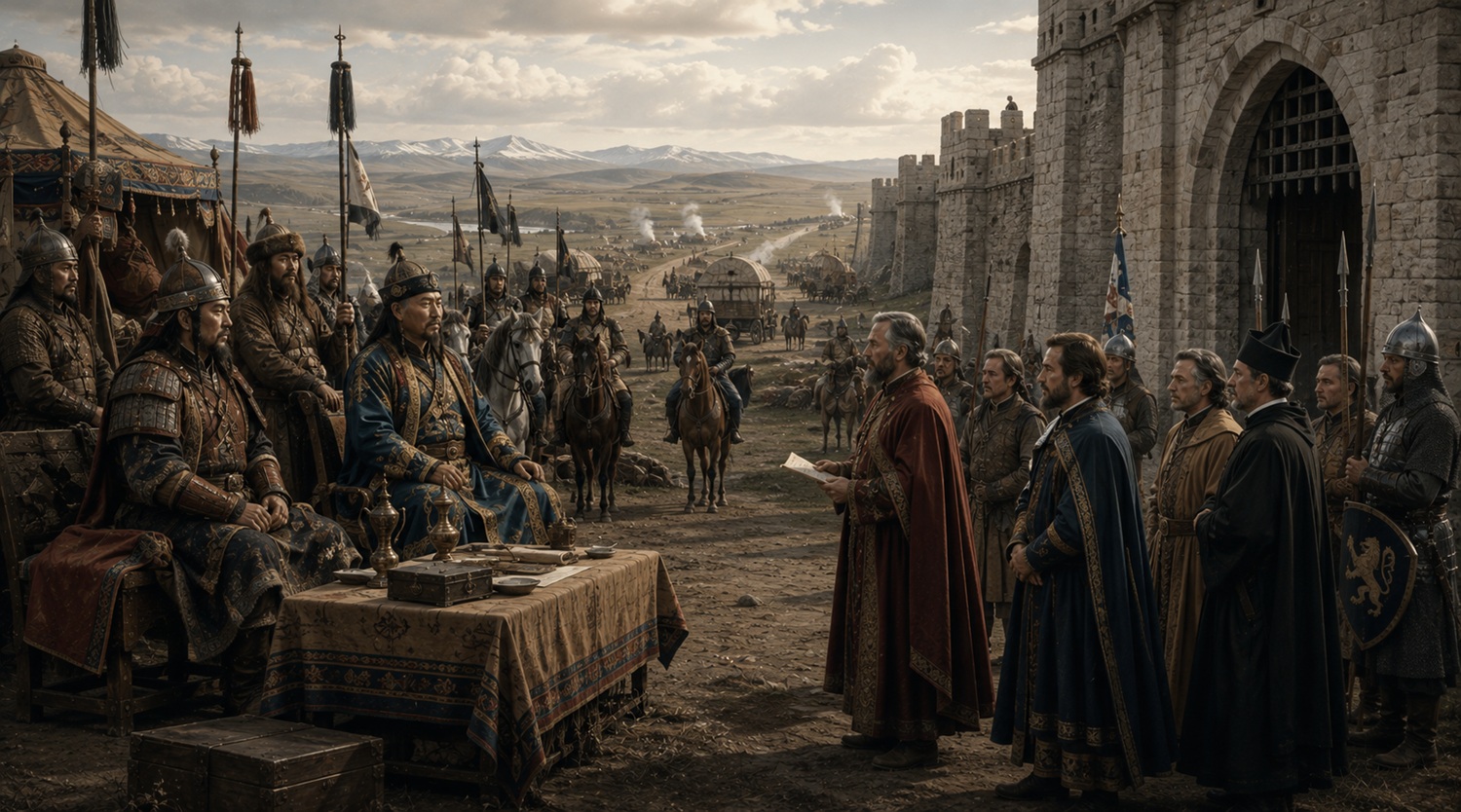
In the spring of 1241, armies of the Mongol Empire struck deep into Christian Europe.
One Mongol force moved through Poland and defeated a Polish-German army at Legnica on April 9. Two days later, the main Mongol army under Batu and other commanders destroyed the Hungarian royal army at the Battle of Mohi. King Béla IV escaped, but Hungary was left militarily exposed. Mongol forces subsequently operated across much of the kingdom and in early 1242 crossed the frozen Danube into western Hungary. (Cambridge University Press)
For contemporaries, the implications were terrifying.
The Mongols had already conquered or shattered powers across Inner Asia, Central Asia, the Caucasus, the Volga region, and the principalities of Rus'. Now they had demonstrated that armies from Poland and Hungary could also be defeated.
Then the western campaign stopped.
During 1242 the Mongol armies withdrew from Hungary.
That withdrawal has generated one of medieval history's most persistent counterfactual questions:
What if the Mongols had continued west?
Popular versions sometimes imagine Mongol cavalry sweeping unstoppably across Vienna, Germany, France, and Italy until virtually all Europe becomes part of a single Asian empire.
That is not a useful historical model.
The Mongols were extraordinarily effective conquerors, but their commanders thought strategically about resources, communications, political submission, pasture, siege warfare, and the dangers of overextension. Recent work on Mongol strategy emphasizes that the empire tried to coordinate simultaneous campaigns without simply exhausting its military resources. (Cambridge University Press)
More importantly, “conquest” did not always mean direct occupation.
In Rus', Mongol supremacy could involve tribute, censuses, political supervision, recognition of local princes, and selective military intervention while existing dynasties continued governing. The Rus' church could even receive exemption from tribute. (Cambridge University Press)
So the strongest alternate-history question is not:
What if Mongol governors directly ruled every village from Hungary to France?
It is:
What if the Mongols established lasting supremacy in Hungary and Poland, pushed farther into Central Europe, and forced additional European rulers into tributary or subordinate relationships?
That could create a Mongol-dominated Central Europe.
It might extend the political and commercial world of the Golden Horde much farther west.
It could profoundly alter Hungary, Poland, Rus', Germany, the Balkans, European trade, and relations between Latin Christianity and Eurasia.
But even after further victories, forests, mountains, stone fortifications, maritime regions, political resistance, logistical demands, and eventually conflicts within the Mongol ruling house would impose serious limits.
The result would probably not be a Mongolian Europe.
It would be a European frontier incorporated unevenly into a wider Mongol imperial system.
---
The Mongol Road to Europe
The European invasion was not an isolated raid.
It grew out of the western expansion of the Mongol Empire after the conquests initiated under Chinggis Khan.
The lands assigned to the descendants of Chinggis Khan's eldest son Jochi included the western steppe world. Mongol campaigns progressively broke resistance among peoples of the Volga-Ural region and then turned toward Rus'. (Cambridge Resolve)
The Rus' principalities were politically divided.
Mongol armies attacked major centers during the campaigns of 1237–1240. The destruction was severe, and by the time the Mongol armies turned toward Central Europe, much of Rus' had been placed within a new system of political subordination that would eventually become associated with the Golden Horde. (Cambridge University Press)
Western expansion therefore began with a secure strategic base far east of Hungary.
The Mongols did not suddenly appear from nowhere on the Hungarian frontier.
They had spent years defeating rivals, gathering intelligence, absorbing troops, and establishing lines of political authority across Eurasia.
---
Poland in 1241
The Mongol thrust into Poland served both military and strategic purposes.
Poland itself was politically fragmented among competing Piast rulers.
Mongol forces devastated areas of southern Poland and eventually confronted an army associated with Duke Henry II of Silesia and other regional forces near Legnica.
The Mongols won.
Henry was killed.
But the Polish campaign was not followed by the permanent occupation of all Poland. Instead, the force operating there moved in connection with the larger campaign against Hungary. The coordinated victories at Legnica and Mohi demonstrated the Mongols' ability to divide European armies and prevent effective concentration against the main invasion. (Cambridge University Press)
That distinction matters.
The Mongols were not simply moving west in a straight line toward the Atlantic.
Hungary was the central strategic objective of the 1241 phase.
---
Hungary Was the Critical Prize
The Hungarian plain offered both opportunity and difficulty.
King Béla IV had allowed Cumans fleeing Mongol expansion to enter Hungary, creating an additional source of Mongol-Hungarian tension. Hungary also lay directly west of the conquered or subordinated lands of Rus' and the steppe.
The royal Hungarian army was destroyed at Mohi in April 1241.
Mongol forces then devastated wide areas and sought to capture Béla, who fled westward and eventually toward the Adriatic region. The Mongols remained in Hungary through much of 1241 and, after the Danube froze, crossed into western portions of the kingdom in early 1242. (Cambridge University Press)
This was more than a brief cavalry raid.
For a time the Mongols were operating as though Hungary might become another conquered territory.
That makes the withdrawal especially important.
---
Why Did the Mongols Leave?
The traditional answer is famous:
Ögödei, the Great Khan, died in December 1241, so the Mongol princes had to return east to choose his successor.
The death certainly mattered to imperial politics.
But historians increasingly resist treating it as a complete explanation that automatically ended the invasion.
The withdrawal remains debated, and modern scholarship has examined strategic objectives, Mongol politics, the costs of occupation, resistance, pasture availability, terrain, weather, and the difficulty of reducing fortified positions. Aleksandr Maiorov's reassessment of the first European invasion explicitly notes that the reason for the 1242 withdrawal remains a disputed problem. (Cambridge University Press)
Environmental evidence has added another possibility.
Tree-ring and documentary evidence indicates relatively warm, dry conditions before the invasion but unusually wet and cold conditions in early 1242. Researchers have argued that waterlogged conditions on the Hungarian plain could have reduced usable pasture and impaired the mobility of an army dependent upon large numbers of horses. (PubMed Central (PMC))
That hypothesis is itself debated.
Climate should not be turned into another single-cause explanation.
The better conclusion is that Mongol commanders faced several overlapping strategic considerations.
Political uncertainty at the top of the empire mattered.
Maintaining enough pasture mattered.
Fortified positions mattered.
Supply mattered.
Whether Hungary was worth permanently occupying mattered.
And Mongol commanders were capable of abandoning a theater if continuing it no longer served the empire's larger objectives.
---
Fortifications Were Becoming a Problem
The Mongols could conduct sophisticated siege warfare.
They were not merely horse archers incapable of attacking walls.
Across Eurasia they incorporated engineers and siege specialists from conquered societies and demonstrated repeatedly that major fortified cities could be destroyed.
But fortifications still imposed costs.
Hungary before 1241 contained comparatively few strong stone castles in some regions, particularly compared with the defensive landscape that emerged after the invasion. Contemporary and later evidence highlights the relative scarcity of stone fortification in areas such as Transylvania before the Mongol attack. (Cambridge Resolve)
That vulnerability helped the first invasion.
European rulers learned from it.
Historically, Béla IV became strongly associated with rebuilding Hungary's defenses around stronger stone castles after the Mongol catastrophe. Later Mongol campaigns against Hungary encountered a very different defensive environment. (Cambridge University Press)
The farther west the Mongols moved, the more frequently they would encounter politically fragmented but heavily fortified territories.
Winning battles in the open would not automatically deliver every castle, cathedral city, and mountain stronghold.
---
The Point of Divergence: Hungary Submits in 1242
Our alternate timeline combines several modest changes rather than one miracle.
First, the winter and spring of 1242 are somewhat drier.
The Hungarian plain remains capable of supporting larger horse herds.
Second, the death of Ögödei still creates political uncertainty, but Batu does not treat immediate withdrawal from Hungary as necessary.
Third—and most importantly—Béla IV fails to escape Mongol pressure.
He is either captured or forced into negotiations.
The precise mechanism matters less than the political result.
Rather than continuing to rally resistance from outside the conquered zone, the Hungarian king accepts Mongol supremacy.
A treaty establishes that:
Béla remains king;
Hungary pays substantial annual tribute;
Mongol representatives supervise the settlement;
hostages are provided as guarantees;
Hungarian forces cannot join anti-Mongol coalitions;
strategic routes remain open to Mongol armies;
and Cumans or other steppe populations are integrated according to agreements acceptable to Batu.
This is the turning point.
The Mongols do not need to replace every Hungarian official.
They need Hungary to stop resisting.
---
Why Indirect Rule Is More Plausible Than Annexation
Rus' provides the model.
Mongol power there had profound fiscal and political consequences, but local princes continued ruling. Tribute was assessed and collected, Mongol representatives supervised aspects of the system, and princes could depend on the khan's recognition and support. (Cambridge University Press)
A similar system in Hungary has enormous advantages.
It costs fewer Mongol soldiers.
It preserves an existing tax structure.
It keeps local Christian elites responsible for maintaining order.
It turns the Hungarian king from an enemy into a tribute-paying subordinate.
And it gives Batu access to the Hungarian plain without forcing Mongol administrators to govern every village.
So “Mongol Hungary” in this scenario still has:
a Hungarian king;
Hungarian nobles;
Catholic bishops;
Hungarian-speaking and Slavic-speaking communities;
existing towns;
local courts;
and Christian institutions.
The political order above them has changed.
---
Hungary Becomes the Western Base of the Jochid World
The Hungarian plain could provide a western strategic base much closer to Central Europe.
That does not mean it is identical to the Eurasian steppe.
Pasture conditions, settled agriculture, river systems, mountains, and existing landholding all constrain nomadic use.
But a tributary Hungary offers food, taxes, horses, manpower, roads, intelligence, and political access.
The Jochid rulers who later presided over the Golden Horde historically governed the northwestern Eurasian steppe and dominated the Rus' principalities. A durable Hungarian dependency would extend that political system directly into Central Europe. (Cambridge University Press)
From this point westward expansion becomes possible.
It does not become effortless.
---
Poland: Tribute Rather Than Full Occupation
Poland is the next logical target.
Its political fragmentation would make unified resistance difficult.
A Mongol campaign could devastate southern and eastern principalities, force individual dukes to negotiate separately, and demand tribute.
The strongest scenario does not place the entirety of Poland under one Mongol provincial governor.
Instead, Piast rulers survive as tributary princes.
Some submit.
Others resist.
Those closest to Hungary and Rus' face the greatest pressure.
Western Polish territories have more opportunity to seek support from German princes and Bohemia.
This could produce a political geography similar to Rus' in broad principle but less complete:
a Mongol tributary zone in eastern and southern Poland surrounded by contested western frontier states.
Polish fragmentation might initially deepen.
Over the longer term, the need to coordinate resistance could create the opposite pressure and encourage political consolidation.
---
A Mongol Victory Could Accelerate Polish Centralization
This is one of the counterfactual's paradoxes.
External domination sometimes fragments political systems.
It can also encourage rulers to centralize.
A Polish duke who controls tribute collection on behalf of the khan could gain leverage over rivals, just as Mongol political relationships affected the competition among Rus' princes. Mongol backing could become a resource in domestic political struggles. (Cambridge University Press)
Alternatively, anti-Mongol resistance could make reunification attractive.
Either route might eventually produce a stronger Polish monarchy—
but one very different from the monarchy that emerged historically.
---
Bohemia and Moravia Become the Western Shield
Beyond Poland and Hungary, terrain and political organization become increasingly important.
Bohemia possesses mountainous approaches and a stronger fortification environment than much of the Hungarian plain.
A Mongol army can raid Moravia.
It can defeat armies sent against it.
It can burn undefended settlements.
It can threaten Prague.
But turning Bohemia into a stable tribute-paying possession is harder.
The Mongols would face precisely the strategic problem that repeats throughout this alternate history:
battlefield superiority does not automatically translate into inexpensive permanent control.
A ruler who submits and pays tribute could solve that problem for the Mongols.
A ruler who retreats behind fortifications forces them into extended siege operations.
---
Austria and Vienna
Austria would be an obvious next theater once Hungary became secure.
The route toward Vienna is geographically attractive compared with pushing immediately into the Alpine interior.
A large Mongol army operating from Hungary could threaten the Austrian duchy and defeat forces assembled on the plains east of the city.
Could Vienna itself fall?
Possibly.
But it should not be treated as inevitable.
A siege requires time, engineers, supplies, and protection of the surrounding operational area.
The strongest counterfactual is therefore that Austria is compelled to pay tribute after a campaign demonstrating that its ruler cannot safely defend the countryside, whether or not Vienna is permanently occupied.
That would be enough to produce a major political shock inside the Holy Roman Empire.
---
The Holy Roman Empire Is Not One Target
The phrase “Mongols conquer Germany” hides a major problem.
The Holy Roman Empire was politically complex.
It contained princes, bishops, dukes, counts, cities, ecclesiastical territories, and royal domains.
Defeating one emperor's army would not automatically make every German ruler surrender.
This decentralization could initially help the Mongols.
Local rulers might negotiate separately.
One duke could submit while another resists.
Rivals might even request Mongol support against each other.
But decentralization would also make permanent conquest exhausting.
There is no single political switch that causes all Germany to obey.
---
The Mongols Would Prefer Tribute
Suppose the Mongols defeat a major imperial army somewhere in Austria or Bavaria.
What comes next?
The most useful settlement would probably not involve dismantling every German principality.
Instead:
major princes acknowledge Mongol supremacy;
tribute is assessed;
hostages are exchanged;
military contingents may be demanded;
merchants receive protected access;
and rulers who rebel face punitive campaigns.
That fits much better with the diversity of Mongol imperial governance than trying to transplant steppe administration wholesale into the Rhine valley.
The Mongols were capable of adapting tax and tribute arrangements to local political traditions, as their relationship with the Rus' demonstrates. (Cambridge University Press)
---
Would the Holy Roman Emperor Become a Mongol Vassal?
It is possible in a limited sense.
A defeated emperor might send tribute and ambassadors while describing the agreement differently to his Christian subjects.
Medieval diplomatic language allowed considerable ambiguity.
The Mongol ruler might understand the emperor as a subject.
The emperor might tell Europe he had agreed to a temporary truce.
Such mismatched interpretations were common features of Mongol diplomacy with outside states, in which demands for submission could collide with foreign assumptions about negotiation among sovereign rulers. Scholarship on Mongol-Western relations emphasizes the gap between Mongol universal claims and Latin diplomatic expectations. (Cambridge University Press)
The political struggle over what the agreement meant could last for generations.
---
The Papacy Faces an Unprecedented Crisis
A Mongol-dominated Hungary and tributary Austria would place Mongol power alarmingly close to northern Italy and the center of Latin Christianity.
The papacy historically responded to the Mongol threat not only through fear but also through diplomacy and missionary contact. Franciscan and Dominican envoys traveled to Mongol courts, and surviving evidence records sustained papal attempts to understand Mongol intentions. (Cambridge University Press)
In the alternate timeline, those missions become even more urgent.
The pope would likely attempt several strategies simultaneously:
organize military resistance;
encourage rulers to stop fighting one another;
send envoys to Batu and the Great Khan;
seek information about Mongol religion and politics;
and explore whether certain Mongol factions might become Christian allies.
That last idea would not be absurd to medieval Europeans.
Mongol religious diversity and the presence of Christians within the empire contributed historically to European speculation about possible cooperation. (Cambridge University Press)
---
Would the Pope Call a Crusade Against the Mongols?
Almost certainly in some form if Italy were directly threatened.
But declaring a crusade would be easier than organizing one.
European rulers had conflicting interests.
The papacy and Holy Roman emperors themselves were often political rivals.
French, German, Italian, English, Scandinavian, and Iberian rulers did not form a standing European command structure.
Mongol success could force greater cooperation.
It could also encourage rulers to preserve their armies and let someone else bear the immediate burden.
European unity should therefore not be assumed simply because the threat is severe.
---
Northern Italy Is a Different Battlefield
Crossing from Hungary and Austria into northern Italy would expose Mongol armies to a much denser urban and fortified environment.
Northern Italy contained wealthy cities capable of raising troops, building defenses, hiring soldiers, and participating in powerful political leagues.
Open terrain in the Po Valley would offer opportunities for cavalry.
But conquering Italy means dealing with city after city.
A defeated field army does not make Milan, Verona, Padua, Bologna, or the other major centers automatically surrender.
This is where the cost curve of Mongol expansion becomes much steeper.
The Mongols could devastate the countryside.
They could destroy cities that resisted unsuccessfully.
They could compel some communes to pay tribute.
But directly ruling northern Italy would require repeated sieges and a permanent military presence far from the primary Jochid steppe base.
---
Venice Creates Another Problem Entirely
Even a victorious Mongol land army cannot simply ride into the Venetian lagoon.
Venice's maritime position demands ships and naval capability.
The Mongols were capable in other theaters of employing naval resources and adapting specialist technologies, but building a permanent naval system in the Adriatic would require local allies, ports, sailors, and substantial time. Mongol strategy across Eurasia was flexible, yet strategic overextension remained an explicit concern during the period of united imperial expansion. (Cambridge University Press)
Venice might therefore respond pragmatically.
Instead of fighting to the death, it could negotiate trade.
A Mongol empire extending into Central Europe would give Venetian merchants powerful reasons to seek commercial access.
That kind of accommodation would fit both Venetian interests and the Mongols' historically strong interest in long-distance merchants.
---
France Is Much Harder
France represents the point where the popular “Mongols conquer Europe” scenario becomes especially difficult.
A campaign from Hungary into France would require the Mongols to operate far from the grassland and steppe regions that best supported large cavalry forces.
They would cross or bypass heavily fortified German territories.
Their communication lines would lengthen.
The density of castles and cities would increase.
Pasture would become a greater operational concern.
France could potentially concentrate greater resources than politically fragmented frontier states.
None of this means Mongol armies could not enter France or win battles there.
They could.
The question is whether the strategic return would justify the enormous cost of making France a permanent tributary state.
That is far less certain.
---
Paris Is Not the Logical Goal
Alternate histories often imagine the conquest as a race toward capital cities.
But Mongol commanders did not need to occupy Paris to obtain favorable political results.
If a French king chose to pay tribute after a major defeat, the Mongols could claim submission without marching to the Atlantic.
If he refused and withdrew behind increasingly strong defenses, the Mongols would have to decide whether France was important enough to justify a long campaign.
A pragmatic commander could simply stop.
The empire's strategic objective would already have been extraordinary:
Rus', Hungary, much of Poland, and parts of the German world incorporated into a western Mongol sphere.
---
The Balkans Could Be More Vulnerable Than France
The Balkans offer a much more plausible direction for durable influence.
Mongol forces historically operated in southeastern Europe, and later Jochid power became deeply involved in the politics of the Black Sea and neighboring regions. The Golden Horde's geopolitical world stretched to the eastern frontier of Hungary and interacted with Balkan, Byzantine, and Black Sea states. (Cambridge University Press)
A permanently Mongol Hungary would increase that involvement.
Bulgaria could become tributary.
Serbian rulers could face pressure from both Hungary and Mongol forces.
Croatia and the Adriatic hinterland could become contested.
Byzantine diplomacy would have to incorporate a powerful Mongol presence north of the Balkans much earlier and more directly.
The Balkans might become a political meeting ground among Latin Christians, Orthodox rulers, Mongol elites, and later Muslim powers.
---
Rus' Becomes Even More Important
A westward Mongol advance would not make Rus' less important.
It would make it more central to the imperial system.
Rus' supplied tribute and formed the political hinterland between the Volga steppe and Central Europe. Mongol taxation adapted itself to existing princely institutions, and over time local rulers could gain authority by serving as intermediaries between the khan and other princes. (Cambridge University Press)
With Hungary and Poland added to the same political sphere, routes through Rus' become part of a transcontinental system stretching from Central Europe into the Black Sea, Volga region, Central Asia, and ultimately farther east.
That could enhance the wealth of some Rus' principalities.
It could also make Mongol control harder to escape.
---
Does Moscow Still Rise?
Possibly, but not necessarily on the same schedule.
The eventual rise of Moscow was affected by many factors, including geography, dynastic politics, church relationships, and interactions with the Golden Horde.
If Mongol power extends farther west and remains stronger for longer, the competition among Rus' princes changes.
A prince who becomes an especially effective collector of tribute might gain even more influence.
Or the center of Mongol attention could move toward western Rus', Poland, or Hungary, reducing the relative importance of northeastern princes.
The strong conclusion is not that Moscow disappears.
It is that the political environment from which Moscow later emerged would be altered substantially.
---
What Mongol Rule Actually Looked Like
A conquered Europe would not be covered by Mongolian-speaking administrators forcing every local population to adopt steppe customs.
The Mongol Empire was highly diverse.
It incorporated Chinese administrators, Persian officials, Turkic populations, Muslim merchants, Christian communities, artisans from many regions, and local ruling elites.
Governance varied by region.
The empire could conduct censuses.
Demand tribute.
Move skilled workers.
Provide merchants with privileges.
Create military obligations.
Use local political structures.
And maintain strategic representatives without abolishing every existing institution. (Cambridge University Press)
In Europe, this means Mongol rule would probably be layered.
---
A Possible European Hierarchy
At the top stands the Jochid khan, eventually associated with the Golden Horde.
Below him could be:
Tributary kings
Hungary might retain a king recognized by the khan.
Tributary dukes
Polish and German rulers could govern locally while paying annual sums.
Direct Mongol officials
Strategic cities, tax centers, roads, and military zones might contain Mongol representatives.
Local tax collectors
Existing elites could be responsible for delivering tribute.
Exempt religious institutions
Some church properties might receive privileges in return for political neutrality, following precedents found in Rus'. (Cambridge University Press)
This would still represent foreign domination.
But it would look nothing like the cultural replacement implied by the phrase “Mongol Europe.”
---
Religious Policy Would Surprise Many Europeans
The Mongols were not originally crusaders for one universal missionary faith.
The empire contained followers of traditional Mongol religious practices, Buddhists, Muslims, and Christians, among others. Modern scholarship emphasizes the degree of religious exchange and pragmatic tolerance possible under Mongol rule. (Cambridge University Press)
A conquered Catholic Hungary would therefore not automatically be forced to convert.
Bishops could remain.
Monasteries could remain.
Parish churches could remain.
The papacy might still function outside the directly controlled zone.
The khan's priority would be political obedience and revenue.
---
Christianity Would Not Disappear
This conclusion is strong.
The Golden Horde historically ruled large Christian populations in Rus' without eliminating Orthodox Christianity. The Rus' church could receive fiscal privileges under Mongol rule. (Cambridge University Press)
There is therefore little reason to predict forced mass conversion of Hungary or Poland.
Catholic institutions might instead adjust to Mongol sovereignty.
A bishop could pray for a Christian king who himself pays tribute to a non-Christian khan.
That arrangement would be politically uncomfortable but not administratively impossible.
---
What Happens When the Golden Horde Becomes More Islamic?
This makes the longer-term story more complicated.
The western Mongol world eventually developed powerful Islamic political and cultural connections. Golden Horde society nevertheless remained religiously diverse, and archaeological scholarship emphasizes both its later Islamization and the persistence of varied religious communities. (Cambridge University Press)
If Hungary and Poland remain tributary into that period, Catholic Europe could find itself paying tribute to a Muslim Mongol dynasty.
That still would not automatically produce forced Islamization.
But religious diplomacy changes dramatically.
The papacy might increasingly portray tribute as unacceptable submission to a Muslim ruler.
Christian princes could use religion to organize rebellion.
Conversely, the khan could treat Christian bishops as useful intermediaries.
Religion becomes a political resource on both sides.
---
Islam in Central Europe Would Be More Visible
Merchants, diplomats, soldiers, and officials from Islamic parts of the Mongol world could appear in Hungarian and Polish cities.
Mosques might develop in major trade centers serving immigrant communities or military groups.
Muslim merchants could participate more directly in Central European trade.
But this is very different from predicting that Hungarians or Poles become majority Muslim.
Local religious identity was deeply rooted, and Mongol government did not require mass cultural assimilation.
The most plausible result is greater religious diversity at major commercial and administrative centers.
---
Silk Road Commerce Could Reach Farther West
One of the most consequential effects could be economic.
Mongol rule created unprecedented opportunities for long-distance exchange across much of Eurasia.
The empire fostered merchant mobility, moved silver across enormous distances, and supported networks linking regions that had previously interacted less directly. Scholarship on Mongol economic exchange emphasizes the scale of monetary and commercial integration achieved across the empire. (Cambridge University Press)
A tributary Budapest, Kraków, Vienna, or another Central European center could become connected more directly to Black Sea and Eurasian merchant routes.
European goods move east.
Asian and Middle Eastern goods move west.
Merchants gain reasons to learn Mongol political procedures and languages.
Central Europe becomes less peripheral to the commercial world of the Golden Horde.
---
The Black Sea Becomes Even More Important
Historically, Italian merchants—especially Genoese and Venetian networks—developed major interests around the Black Sea during the Mongol period. Scholarship on Mongol-Europe relations pays considerable attention to the convergence between Mongol power and Mediterranean commercial expansion. (Cambridge University Press)
A Mongol Central Europe magnifies this.
Goods reaching Black Sea ports could continue overland into Hungary and Germany through territories protected by Mongol authority.
Italian merchants might therefore have more, not less, incentive to negotiate with the khans.
The frontier between “Europe” and the “Mongol world” becomes commercially porous even while politically hostile.
---
The Yam and Faster Communications
The Mongols developed and used extensive relay systems for official communications.
The yam system provided stations where authorized travelers and messengers could obtain fresh mounts and supplies, allowing information to move efficiently across enormous imperial spaces. Later scholarship on Mongol governance and communications identifies these networks as important to both political administration and wider mobility. (Cambridge University Press)
Extend that infrastructure into Central Europe and the consequences are striking.
A message from Hungary could move east through a system connected with the Black Sea and steppe.
Diplomats could travel more predictably.
Merchants could benefit indirectly.
European courts would obtain more regular information about Central Asia and beyond.
The psychological distance between Europe and eastern Eurasia could shrink.
---
Would Technology Reach Europe Faster?
Possibly in some areas.
But this requires caution.
The Mongol Empire clearly facilitated movement of people, artisans, information, goods, and technical knowledge across Eurasia. Historians have studied the empire's role in inter-civilizational exchange as one of its major global consequences. (Cambridge University Press)
That does not mean a conquered Europe suddenly receives a package labeled:
gunpowder, printing, compass, advanced mathematics.
Technologies move through complicated channels.
Knowledge can arrive without widespread adoption.
Some technologies already traveled independently through Islamic, Mediterranean, and commercial networks.
The strongest conclusion is modest:
more intensive Mongol-European integration increases opportunities for transmission.
---
Gunpowder Is a Good Example
Gunpowder technology was developing across Eurasia during the Mongol age, and historians have investigated Mongol connections to its diffusion. But the exact paths by which specific gunpowder weapons and knowledge reached different societies remain complicated. The Cambridge history of Mongol-European relations itself points readers to substantial scholarship on this issue rather than presenting one simple Mongol-to-Europe transmission event. (Cambridge University Press)
A Mongol Central Europe could accelerate European exposure to certain forms of siege technology.
It might also accelerate European defensive experimentation.
But claiming cannons appear a century early everywhere would exceed the evidence.
---
Military Change Would Accelerate
The direct military effects are easier to defend.
European rulers confronted by repeated Mongol campaigns would invest heavily in:
stone fortifications;
crossbows;
disciplined infantry;
better reconnaissance;
coordinated regional defense;
stronger logistics;
and methods for denying cavalry access to pasture.
Hungary historically strengthened fortifications after the first invasion precisely because the weaknesses exposed in 1241 had been devastating. (Cambridge Resolve)
A Mongol conquest lasting decades would make that learning process much more intense across Central Europe.
---
Castles Could Become the Foundation of Resistance
This could transform the political map.
A heavily fortified noble who can resist a Mongol raid has greater bargaining power.
Cities capable of maintaining strong walls become strategic islands.
Mountain fortresses gain importance.
Kings might grant new privileges to towns willing to fund defenses.
The need for fortification could strengthen royal taxation in some states.
In others, it could strengthen regional nobles.
Mongol pressure does not produce one universal European response.
It creates incentives that different societies answer differently.
---
City Destruction Could Be Severe
A sanitized Mongol conquest would be as misleading as a cartoonishly apocalyptic one.
Mongol campaigns could be extraordinarily destructive.
Cities that resisted might be stormed and their populations subjected to killing, enslavement, deportation, or dispersal. The wider conquests of the united Mongol Empire generated large numbers of captives and forced population movements across Eurasia. (Cambridge University Press)
If Vienna, Kraków, Prague, or northern Italian cities resisted unsuccessfully, some could experience devastating destruction.
Agricultural regions crossed repeatedly by large armies could suffer famine and depopulation.
Tribute could burden surviving populations.
Artisans could be relocated.
The demographic effects could be substantial.
---
But Not Every City Would Be Destroyed
Mongol conquest depended partly on making submission preferable to resistance.
A ruler or city that surrendered could receive much better treatment than one that fought until capture.
That creates incentives for negotiated submission.
One city resists and is destroyed.
The next opens its gates.
Tribute begins.
Local government continues.
This combination of extreme coercion and pragmatic accommodation was part of Mongol imperial politics.
The alternate European map would therefore contain both devastated zones and surprisingly intact tributary cities.
---
Could the Mongols Depopulate Europe?
Not plausibly as a whole.
Central and Eastern Europe could suffer enormous local losses.
Hungary had already experienced severe destruction during the historical invasion.
Additional campaigns would magnify that damage.
But the farther west the Mongols move, the larger the population, the denser the settlement pattern, and the more numerous the fortified centers they encounter.
There is no realistic scenario in which a finite Mongol army systematically exterminates the population from Hungary to the Atlantic.
Mongol rulers also need taxpayers, farmers, artisans, and merchants.
A permanently empty Europe would have little imperial value.
---
Would European States Become More Centralized?
Some probably would.
The threat could strengthen kings capable of organizing defense.
A ruler who can collect taxes nationally, build fortresses, coordinate troops, and negotiate with the khan has an advantage over fragmented rivals.
France could become more centralized precisely because it fears what happened to Hungary.
Polish princes could pursue reunification.
Hungarian kings operating under tribute might strengthen administrative control so they can meet Mongol demands.
German rulers could move in either direction: imperial authority might strengthen under crisis, or regional princes might become more independent as they organize their own defenses.
So Mongol conquest could paradoxically accelerate some forms of European state-building.
---
Hungary Could Become More Centralized Under Mongol Supremacy
A tributary king has to deliver tribute reliably.
That gives the crown an argument for stronger taxation.
A census becomes politically useful.
Local nobles who evade royal demands now threaten the entire kingdom with Mongol punishment.
Béla or a successor could therefore use the khan's demands to strengthen royal administration.
The result could resemble a pattern seen elsewhere under imperial overlordship:
foreign domination increases the power of the local intermediary who can manage it successfully.
Alternatively, nobles could rebel against both king and khan.
Both outcomes are plausible.
---
Poland Could Follow a Similar Path
A Polish ruler recognized as principal tax collector for the Mongols could gain power over rival dukes.
That resembles mechanisms later visible in the political evolution of Rus', where Mongol recognition and the right to collect tribute could become important resources in competition among princes. (Cambridge University Press)
A Mongol-dominated Poland might therefore eventually reunify under a dynasty whose strength partly comes from cooperation with the Horde.
Later nationalist memory would judge such rulers very differently.
Their contemporaries might simply see them as effective survivors.
---
The Holy Roman Empire Could Move the Opposite Direction
Germany's decentralized structure makes a unified response harder.
If the emperor cannot protect eastern princes, they may negotiate separately with the Mongols.
Bavaria pays one arrangement.
Austria another.
Bohemia another.
Saxony refuses.
A bishop bargains for church exemptions.
An imperial city buys peace.
The emperor's theoretical authority could therefore weaken.
The Mongols might prefer this.
A divided frontier is easier to manage diplomatically than a powerful unified monarchy.
---
What Happens to France?
France could benefit politically even without being conquered.
A Capetian king could present himself as defender of western Christendom.
Refugees and clerics fleeing Mongol-controlled territories could move west.
French rulers could use the threat to justify taxation and military reform.
A crusading army organized under French leadership could increase royal prestige.
If the Mongols never establish permanent control beyond Austria or Bavaria, France might emerge as one of the greatest indirect winners.
It avoids direct conquest while its eastern rivals are weakened.
---
England Becomes More Distant From the Main War
England would still care deeply about the Mongol threat through church diplomacy and continental alliances.
But geography insulates it.
For Mongol armies to reach England they would first need to dominate France or the Low Countries and then obtain large-scale naval capability.
That lies well beyond the strongest counterfactual.
England could therefore contribute money, crusaders, diplomacy, or troops while remaining outside Mongol direct rule.
This gives English kings the luxury of choosing how deeply to become involved.
---
Scandinavia Is Also Hard to Occupy
Northern forests, long coastlines, lower-density settlement, and maritime geography reduce the advantages of enormous cavalry forces.
Mongol diplomacy and raids could reach Scandinavian politics.
Permanent occupation would be much less attractive.
Again, this demonstrates why “conquering Europe” must be defined politically rather than colored as one block on a map.
The Mongol system would have a core, tributary belt, contested frontier, and independent outer powers.
---
A Plausible Mongol Europe Around 1250
The map might look roughly like this:
Direct Jochid-Mongol military zone
Southern Rus', steppe corridors, major routes, selected Hungarian strategic sites.
Strong tributary states
Hungary and several Rus' principalities.
Partial tributary zone
Polish principalities, perhaps Bulgaria, Serbia, and parts of Austria or Moravia.
Contested frontier
Bohemia, Bavaria, other eastern German principalities, northern Italy.
Independent but threatened powers
France, papal territories, Venice, much of western Germany.
Diplomatic outer zone
England, Scandinavia, Iberian kingdoms.
This would qualify as a dramatic Mongol conquest of Europe.
It would not require Mongol riders reaching Lisbon.
---
The Mongol Empire Itself Begins to Change
The greatest limitation on the scenario may eventually come from inside the empire.
The united Mongol Empire did not remain politically unified indefinitely.
After the death of Great Khan Möngke in 1259, disputes among Chinggisid rulers contributed to the emergence of increasingly independent Mongol states. Modern strategic history treats this fragmentation as a fundamental turning point because successor khanates no longer had access to the full coordinated resources of the united empire. (Cambridge University Press)
That matters enormously for Europe.
A western European conquest created under a united empire would eventually become primarily the responsibility of Batu's Jochid successors.
China, Iran, Central Asia, and Europe would no longer be parts of one smoothly coordinated military machine.
---
Europe Falls Into the Golden Horde's Sphere
By the later thirteenth century, the most plausible Mongol ruler of conquered Central Europe would be the Golden Horde rather than a great khan directly managing European affairs from Mongolia.
Historically, the Golden Horde governed the northwestern Eurasian steppe and exercised supremacy over Rus'. (Cambridge University Press)
In this alternate timeline, its western frontier lies perhaps along the Alps, Bohemian mountains, or eastern German territories instead of near the Carpathians.
That creates a very different Golden Horde.
It is wealthier.
More European.
More deeply involved in Catholic politics.
And more dependent on settled agricultural tributaries.
---
The Golden Horde Might Become Less Nomadic Politically
A khan receiving major revenues from Hungary, Poland, Rus', and Balkan territories has strong incentives to protect those sources.
Permanent tax offices become more important.
Urban commercial centers matter more.
Diplomatic relationships with Catholic clergy become routine.
European scribes and administrators may enter khanate service.
Latin documents could join Persian, Turkic, Mongolian, Rus', and other bureaucratic traditions.
The khanate's ruling elite might remain culturally steppe-based while the machinery underneath it becomes increasingly heterogeneous.
That type of adaptation is consistent with the wider Mongol record of incorporating diverse political and administrative traditions.
---
Trade Could Become the Great Long-Term Legacy
Once conquest slows, commerce becomes more valuable than continued destruction.
Mongol Eurasia historically supported extensive movement of merchants, goods, silver, religious travelers, artisans, and information. (Cambridge University Press)
A Central Europe firmly connected to that world might see:
Italian merchants traveling through Hungary toward the Black Sea;
German silver moving east;
Central Asian goods reaching European courts more directly;
more Europeans traveling to Mongol capitals;
more Asian merchants appearing in European cities;
and geographical knowledge circulating more quickly.
The psychological idea of an isolated “Europe” separated from “Asia” could become less convincing to people living along the frontier.
---
Marco Polo Would Not Be Unique in the Same Way
Marco Polo's later fame came partly from the extraordinary distance and novelty of his reported travels.
In a Europe with stable Mongol roads reaching to Hungary or Austria, long-distance travel eastward becomes less extraordinary for merchants and churchmen.
That does not make a journey to China easy.
It does mean the starting point of that journey is politically closer.
There could be many more European accounts of Central Asia, Iran, or Mongol courts.
European geographical knowledge might deepen earlier.
---
The Papacy Could Become a Permanent Diplomatic Partner
Historically, papal envoys already traveled to the Mongols and European rulers sometimes entertained hopes of alliances with particular Mongol rulers against Muslim powers. (Cambridge University Press)
With Mongol power permanently established in Central Europe, papal diplomacy becomes continuous rather than exceptional.
The pope might seek:
protection for Catholic communities;
exemptions from taxation;
release of captives;
permission for missionaries;
alliances against rival Muslim states;
or simply guarantees that Rome itself will not be attacked.
The relationship would alternate between confrontation and negotiation.
---
Mongol-Christian Alliances Become More Plausible
The religious complexity of the Mongol world makes this especially interesting.
Some Mongol elites and subject peoples were Christians.
Others became Muslims.
Others followed Buddhist or traditional religious systems.
European observers knew enough of this diversity to imagine conversion or alliance possibilities. (Cambridge University Press)
A Catholic Hungary under Mongol overlordship could serve as a diplomatic bridge.
A Hungarian king might tell the pope:
the khan is dangerous, but he can be negotiated with.
The pope might tell the king:
submission is unacceptable.
Both could be right from their respective political perspectives.
---
European Crusading Changes
Crusading ideology would not disappear.
It could redirect.
Instead of concentrating primarily on the eastern Mediterranean, some crusading resources might be devoted to Central Europe.
Military orders could build fortresses along the Mongol frontier.
German nobles might view service against the Mongols as a prestigious religious obligation.
Papal taxation could support defenses in Austria or Bohemia.
The geography of Latin Christian holy war shifts northward and eastward.
That could reduce resources available for other crusading theaters.
---
What Happens to the Crusader States?
This becomes increasingly uncertain because Mongol politics in the Middle East also change after the empire fragments.
Historically, later Mongol rulers in Iran fought Muslim powers in the Middle East, and Latin Christian states explored alliance possibilities with them. Mongol political involvement in the region was highly complex. (Cambridge University Press)
If the Jochid world is more heavily committed in Europe, its relationship with other Mongol khanates could change.
A richer and more powerful Golden Horde might compete even more intensely with the Ilkhanate.
European rulers could become entangled in inter-Mongol rivalries stretching from Hungary to the Caucasus.
At that point, “Europe versus the Mongols” becomes inaccurate.
Europeans would be dealing with different Mongol states.
---
Could Mongol Fragmentation Save Western Europe?
Very possibly.
Suppose Batu's successors control Hungary and receive tribute from parts of Poland and Austria by 1260.
They might want to continue into Germany or Italy.
But now they must also consider:
rival Chinggisid factions;
the politics of the Golden Horde;
relations with the Ilkhanate;
Black Sea trade;
rebellions in Rus';
succession disputes;
and the danger of stretching western military resources too far.
The logic of endless conquest weakens.
Tribute from already conquered territories becomes more attractive than risky new wars.
This is the point where a Mongol frontier could stabilize.
---
Geography Sets a Hard Limit
The horse-centered Mongol military system worked best where mobility and pasture could be maintained.
That does not mean Mongols could fight only on grasslands.
They fought successfully across an extraordinary variety of environments.
But operational costs rise when armies enter mountain ranges, dense forests, wet environments, heavily cultivated zones lacking adequate grazing, or landscapes covered with strong fortifications.
The environmental hypothesis for the historical Hungarian withdrawal illustrates how significant horse-supporting terrain could become even in a region otherwise favorable to cavalry. (PubMed Central (PMC))
From Hungary westward, those constraints become more frequent.
---
The Alps Are a Strategic Boundary
A Mongol army can cross Alpine routes.
A large occupation system operating repeatedly across them is another matter.
Italy's wealthy plains are attractive once crossed.
But the Alps complicate supply and reinforcement.
Holding northern Italy would also require more siege warfare and perhaps naval cooperation.
The Mongols might therefore prefer tributary arrangements with Italian rulers to direct occupation.
This could make the Alps one of the natural boundaries of permanent western Mongol power.
---
The Rhine Is Another Possible Frontier
A Mongol sphere stretching to the Danube and eastern German territories is strategically plausible within a sufficiently successful campaign.
Reaching and permanently dominating the Rhine is harder.
By then the Mongols would be operating through regions of dense settlement, fortified towns, forests, river systems, and competing German princes.
The empire could raid farther.
It could force temporary submission farther.
But the distinction between military reach and administrative frontier grows steadily wider.
---
How Much Destruction Would Central Europe Suffer?
Potentially enormous destruction in the first generation.
Hungary already suffered severely in the historical invasion.
A second phase of conquest through Poland, Austria, and German frontier territories would bring additional burned settlements, ruined agricultural districts, refugees, captives, and abandoned land.
Captivity and forced migration were major consequences of Mongol conquest elsewhere. (Cambridge University Press)
But permanent Mongol rulers would eventually have an interest in reconstruction.
A tribute system cannot function if the taxable population disappears.
Once rulers submit, Mongol policy would likely shift from destruction toward extraction.
The first decade could therefore be devastating.
The second could increasingly focus on restoring revenue.
---
Europe Could Recover Under Mongol Rule
This is important.
Conquest does not mean permanent economic collapse.
Cities connected to Eurasian trade might prosper.
Merchants could benefit from political protection across long routes.
Rulers serving as tax intermediaries could become wealthy.
Some devastated rural regions could be resettled.
Artisans relocated from elsewhere could arrive.
European economies could adapt to a new political system.
The Mongol Empire's historical record contains both extraordinary destruction and powerful facilitation of long-distance exchange; either half by itself produces a distorted picture. (Cambridge University Press)
---
Could the Black Death Arrive Differently?
A deeper Central European integration into Eurasian trade would alter movement networks through which diseases could travel.
But predicting a specific medieval epidemic schedule would be hazardous.
The historical Black Death of the fourteenth century emerged from ecological and transmission processes far more complex than simply “Silk Road trade caused plague.”
A larger Golden Horde presence in Europe could alter routes and timing.
It could just as easily create different bottlenecks.
This is an area where precise counterfactual claims should stop.
---
Would Europe Become Culturally Mongolian?
No.
That is among the weakest popular assumptions.
The Mongol Empire ruled enormous populations without making them ethnically Mongol.
Chinese society remained Chinese.
Persian society remained Persian.
Rus' society remained overwhelmingly Slavic and Orthodox.
Mongol rulers adapted to local administrative systems and over time themselves underwent substantial cultural transformations in different regions. (Cambridge University Press)
Hungarians would remain Hungarians.
Poles would remain Poles.
German communities would remain linguistically and culturally German.
Catholicism could remain dominant.
What changes is the political environment surrounding those identities.
---
Mongol Elites Would Change Too
This influence goes both ways.
A Jochid ruling class receiving revenue from Christian European kingdoms would interact constantly with European nobles, bishops, merchants, and soldiers.
European luxury goods enter Mongol courts.
Hungarian aristocrats could marry into steppe-connected elite families.
Multilingual administrators become valuable.
Some Mongol nobles might become patrons of Christian communities.
Others could adopt Islamic identities while preserving tolerant arrangements for Catholic subjects.
The conqueror changes the conquered.
The conquered also change the conqueror.
---
A Mongol-Dominated Central Europe in 1300
A plausible medium-strength scenario might look like this:
Golden Horde core
The Volga steppe, Pontic steppe, Crimea, and directly controlled strategic territories.
Rus'
Tributary principalities whose princes compete for the khan's recognition.
Hungary
A Christian tributary kingdom with strong Mongol political oversight but substantial domestic autonomy.
Poland
Partly reunified under a ruler responsible for tribute, though western regions may have moved in and out of Mongol influence.
Balkans
Several rulers pay tribute or maintain alliances with the Horde.
Austria and Bohemia
Border kingdoms periodically tributary but increasingly fortified and capable of resistance.
Germany
Mostly independent, with eastern princes shaped by generations of Mongol warfare.
Italy
Independent and commercially engaged with the Mongol world; some northern cities may have paid temporary tribute.
France and England
Outside Mongol rule and increasingly important centers of western military and papal resistance.
This is not a Mongol Europe from Atlantic to Urals.
It is still an extraordinary transformation.
---
Would Later European Nation-States Still Appear?
Some would.
But not through the same sequence.
France might centralize earlier under the pressure of external threat.
Poland might reunify through collaboration with or resistance to the Horde.
Hungarian kingship could become more bureaucratic because tribute demands require stronger taxation.
Bohemia might become the central fortress of western Slavic resistance.
The Holy Roman Empire could weaken if eastern princes negotiate separately with the khans.
Or it could strengthen if emperors successfully organize collective defense.
There is no single institutional consequence.
The common factor is that Mongol power becomes one of the central forces shaping European state formation.
---
Could There Still Be a Habsburg Austria?
Not in the same predictable form.
The rise of the Habsburgs depended on specific dynastic opportunities, marriages, territorial acquisitions, and imperial politics.
A tributary or devastated Austria in the thirteenth century changes those conditions dramatically.
The Habsburg dynasty could still rise.
Another dynasty could replace it.
Austria might become more tightly integrated with Hungary.
Bohemia could become more powerful.
Predicting the Holy Roman Empire's later dynastic structure after a Mongol conquest quickly becomes unreliable.
---
Could Poland-Lithuania Still Form?
Also impossible to assume.
Lithuania historically expanded across large areas of former Rus' during the centuries in which Mongol power influenced Eastern Europe.
A stronger Golden Horde extending into Poland would transform that opportunity.
Lithuania might become an even more important anti-Mongol refuge.
It could be conquered.
It could ally with western Christian powers.
It could expand north and west instead.
A later Polish-Lithuanian union might still arise for entirely different reasons, but the historical path would be broken.
---
What About the Teutonic Order?
Military orders could become far more important.
A long Mongol frontier in Poland and the Baltic world would give crusading military institutions a new enemy and new justification for fortification.
The Teutonic Order might present itself not merely as a force in Baltic Christianization and conquest but as a defensive barrier against Mongol expansion.
That could increase papal support.
It could also change its relations with Poland and neighboring peoples.
Former rivals might temporarily become allies against a larger threat.
---
Could the Mongols Eventually Conquer the Baltic?
They could campaign there.
Permanent occupation is harder.
Forests, marshlands, climatic conditions, dispersed settlement, and limited grazing would reduce cavalry advantages.
The Baltic could therefore become another natural boundary where Mongol political influence exceeds direct military occupation.
Tribute extracted through local rulers would again be more efficient than trying to garrison every region.
---
Would Mongol Rule Make Europe More “Eastern”?
That framing is too vague to be useful.
European states would remain geographically European.
What would change is the density of their Eurasian relationships.
More diplomats travel east.
More merchants use Black Sea routes.
More European rulers understand Mongol politics.
More eastern goods circulate.
More Asian and Middle Eastern visitors appear in Central Europe.
Intellectual geography becomes broader.
The effect could be substantial without erasing local cultures.
---
Europe Might Learn More About Asia Earlier
Papal missions historically generated some of medieval Europe's most important firsthand descriptions of the Mongols and Inner Asia. (Cambridge University Press)
In the alternate world, such travel is routine.
A bishop in Kraków might know people who have visited the khan's court.
A merchant in Vienna might have partners in the Black Sea.
A royal adviser could possess reports about Persia, Central Asia, and China.
European cosmography develops from a denser stream of information.
That could affect later exploration.
But it should not be turned into a claim that Columbus or the Renaissance automatically occurs earlier.
---
Could the Renaissance Be Accelerated?
Only cautiously.
Greater access to Eurasian commerce and knowledge might enrich Italian and Central European intellectual networks.
Movement of artisans and texts could create new opportunities.
But the Renaissance had many political, economic, institutional, artistic, and intellectual causes.
Mongol conquest could stimulate some exchanges while devastating some of the cities that might otherwise support them.
The direction is therefore ambiguous.
A more connected Europe is not automatically a more rapidly “modern” Europe.
---
Three Broad Alternate Outcomes
| Scenario | Mongol Reach | Political Structure | Long-Term Result |
| ------------------------------------- | --------------------------------------------------------------------------------------------- | ---------------------------------------------------------------- | ----------------------------------------------------- |
| Central European tributary empire | Rus', Hungary, much of Poland, Balkan states, intermittent Austrian/Bohemian tribute | Local kings and princes govern under Golden Horde supremacy | Strongest scenario |
| Maximum western expansion | Tributary influence reaches eastern Germany and northern Italy after major Mongol victories | Mixed direct rule, tribute, client princes and autonomous cities | Possible but difficult |
| Rapid western overextension | Mongols push deep into Germany or Italy but cannot sustain pasture, sieges and communications | Revolts spread after imperial succession disputes | Very plausible if expansion becomes too ambitious |
The key distinction is that the Mongols could penetrate farther than they could cheaply hold.
---
How Far Could the Mongols Realistically Go?
Militarily, very far.
Politically, less far.
A Mongol army continuing after 1242 could plausibly devastate Austria, Moravia, Bohemia, additional parts of Poland, and the Balkans.
It could conceivably defeat major German armies.
It could reach northern Italy.
It could raid still farther west.
But permanent rule becomes progressively less attractive beyond the Hungarian and Polish zones.
Several factors combine:
pasture and logistics — enormous cavalry forces require immense resources;
fortifications — western expansion means more expensive sieges;
mountains and forests — they reduce mobility and complicate supply;
political fragmentation — initially exploitable, but difficult to administer comprehensively;
distance — Central Europe is far from the Volga and even farther from the imperial heartlands;
succession disputes — Chinggisid politics can redirect armies abruptly;
inter-Mongol conflict — after the united empire fragments, western rulers no longer command all Mongol resources. (PubMed Central (PMC))
The strongest geographical answer is therefore:
Hungary could plausibly become a durable part of the Mongol political world. Poland and the Balkans could become substantial tributary zones. Austria, Bohemia, and eastern Germany could become contested frontier regions. Permanent domination of France is much less likely.
That is already enough to transform European history.
---
Conquest vs. Permanent Rule
This distinction is the heart of the scenario.
The Mongols could defeat armies well beyond the territory they could efficiently administer.
They could raid western Germany without ruling it.
They could burn an Italian city without annexing Lombardy.
They could force a king to pay tribute without stationing Mongol officials in every county.
They could claim universal sovereignty while accepting surprisingly autonomous local government.
Rus' provides the clearest European historical example: princes continued ruling, while Mongol supremacy reshaped tribute, political competition, and the relationship between local rulers and the khan. (Cambridge University Press)
A Mongol conquest of Central Europe would likely follow that logic.
The map might still show Hungary.
It might still show Poland.
It might still show Bohemia.
Their kings might still wear crowns.
Their churches might still ring bells.
Their nobles might still hold estates.
But above all of them stands another political fact:
the khan can demand tribute, confirm rulers, call for troops, and punish disobedience.
That is conquest.
It simply is not cultural erasure.
---
The AltHistAI Verdict
What if the Mongol Empire conquered Europe?
The first thing to change is the meaning of the word Europe in the question.
A Mongol army did not need to occupy London, Paris, Rome, and every German city for the invasion to become one of the greatest political transformations in European history.
The decisive opportunity existed much farther east.
Hungary.
Historically, the Mongols destroyed the Hungarian royal army at Mohi, pursued King Béla IV, occupied wide areas of the kingdom, and crossed the Danube during the winter of 1241–1242. (Cambridge University Press)
Then they left.
The withdrawal should not be reduced confidently to a single cause.
Ögödei's death altered imperial politics, but historians continue debating the withdrawal. Environmental evidence indicates that unusually wet conditions in early 1242 may have reduced pasture and hindered cavalry mobility. Strategic overextension, fortifications, supply, and the political value of continued occupation also matter. (Cambridge University Press)
Change several of those variables modestly and continued conquest becomes plausible.
A drier season.
A political decision by Batu to remain in the west.
A captured or diplomatically broken Béla IV.
A Hungarian elite willing to preserve its property in return for submission.
The Mongols do not need to colonize Hungary with hundreds of thousands of settlers.
They need the kingdom to pay.
That is the key divergence.
Béla keeps his crown.
Hungarian nobles keep their estates.
The Catholic church remains.
But annual tribute goes east.
Hostages guarantee obedience.
Strategic roads remain open.
Mongol envoys and officials monitor compliance.
The Hungarian monarchy has survived.
Hungarian independence has not.
From there, Poland becomes vulnerable.
Not necessarily to direct annexation, but to the same political method.
A Piast duke who submits survives.
One who resists risks destruction.
A ruler who collects tribute efficiently gains Mongol support against domestic rivals.
Over time, the Mongols may accidentally help create stronger local monarchies by elevating the princes best able to manage imperial demands, much as Mongol political relationships profoundly shaped the competition among Rus' rulers. (Cambridge University Press)
Austria and Bohemia become the next frontier.
Here the challenge grows.
Castles matter more.
Mountains matter more.
Dense settlement matters more.
A Mongol army can still win major battles.
But every victory creates another problem.
How many castles must be taken?
How many troops must remain behind?
How much pasture supports the horses?
How many local rulers can simply be made to pay instead?
The rational Mongol answer would often be:
take the tribute and move on.
That logic could push Mongol political supremacy well into the Holy Roman Empire without producing direct Mongol government over Germany.
The emperor might pay.
Austria might pay.
A Bohemian king might resist.
Bavarian rulers might bargain.
German princes could make separate arrangements.
The Mongols could claim that all had submitted while those same rulers insisted they had merely bought temporary peace.
The political ambiguity itself would become part of medieval European diplomacy.
Northern Italy presents still greater difficulties.
The Po Valley offers attractive cavalry country, but the region's wealthy fortified cities turn conquest into a chain of sieges.
Venice presents a maritime problem.
The Alps complicate reinforcement.
The papacy can organize religious resistance.
Italy might be raided.
Individual cities might pay tribute.
A major northern Italian army might be defeated.
Permanent Mongol provincial rule over the peninsula is much harder to sustain.
France is harder still.
The farther Mongol forces travel from Hungary, the less the campaign resembles the conquest of a steppe frontier and the more it becomes a war against castles, cities, rivers, forests, and increasingly long communications.
The Mongols could reach France militarily.
That does not make Paris the inevitable destination of history.
By then Batu or his successors would possess something far more valuable than one additional campaign:
a functioning western empire.
Rus'.
The steppe.
Hungary.
Tributary Polish states.
Influence in the Balkans.
Perhaps Austria.
Perhaps Bohemia.
Perhaps eastern German rulers acknowledging Mongol supremacy.
At that point the logic of empire changes from conquest to extraction.
And this is where the alternate Europe becomes most interesting.
It would not become Mongolian.
Catholic Christianity remains powerful.
Polish remains spoken.
Hungarian remains spoken.
German princes remain German princes.
Churches continue functioning.
Local law continues.
Existing aristocrats continue governing.
The historical precedent of Rus' shows that Mongol supremacy could coexist with local dynastic rule and even fiscal privileges for Christian religious institutions. (Cambridge University Press)
The khan wants submission.
He does not need every peasant to speak Mongolian.
That produces a political hierarchy very different from a modern centralized nation-state.
A Hungarian king collects taxes partly because tribute must be paid to the Horde.
A Polish prince seeks confirmation from the khan.
A bishop negotiates tax privileges.
A German duke sends hostages.
Italian merchants obtain commercial protections.
Mongol envoys travel through Central European capitals.
The frontier between Europe and the Mongol world becomes difficult to locate because parts of Europe are politically inside the Mongol world.
Commerce could be one of the largest consequences.
The Mongol Empire facilitated extraordinary Eurasian exchange. Merchants, silver, luxury goods, diplomatic missions, religious travelers, artisans, and information moved across territories tied together by Mongol power. (Cambridge University Press)
Extend those systems to Hungary and Poland and Central Europe becomes a western terminus of Eurasian networks.
Italian merchants need not fear Mongol expansion only as destruction.
They can also profit from it.
Black Sea commerce becomes even more important.
Overland routes through Hungary develop.
European churchmen travel east.
Mongol diplomats travel west.
A merchant in Vienna might understand Golden Horde politics as carefully as a Venetian merchant historically understood Byzantine or Egyptian politics.
That deeper contact could accelerate transfers of information and technologies.
But there is no reason to imagine an instant European technological revolution.
The Mongol age historically supported inter-civilizational exchange, but technological adoption remained dependent upon local institutions, skills, resources, and needs. (Cambridge University Press)
What would unquestionably change is military architecture.
European rulers had already learned from the real Mongol invasion.
A longer Mongol presence makes the lesson impossible to ignore.
Stone castles multiply.
Towns strengthen walls.
Mountain strongholds become strategic.
Kings develop more reliable tax systems because national defense is expensive.
Crossbows, disciplined infantry, scouting, and anti-cavalry tactics become urgent priorities.
The Mongols might therefore produce a Europe better organized to resist Mongols.
That is another paradox.
The first conquests are easiest.
Every decade afterward makes the frontier harder.
Then the Mongol Empire itself changes.
The united empire did not endure indefinitely. After Möngke's death in 1259, Chinggisid rivalries contributed to the emergence of increasingly independent Mongol states, each with fewer resources than the united empire could deploy. (Cambridge University Press)
This places a natural limit on the European conquest.
A western empire built by Batu would increasingly become part of the Golden Horde's sphere.
Its rulers would have to choose.
Fight Germans?
Manage Poland?
Collect Hungarian tribute?
Compete with rival Mongol khanates?
Control Rus'?
Protect Black Sea commerce?
Deal with rebellions?
Fight over succession?
Every army sent farther toward France is an army unavailable somewhere else.
By 1270 or 1300, the conquest could therefore stabilize somewhere in Central Europe.
And once it stabilizes, the conquerors themselves begin changing.
Golden Horde rulers become increasingly connected to settled taxation.
European merchants become useful.
Christian bishops become political intermediaries.
Muslim merchants establish communities farther west.
Administrative languages multiply.
A Mongol political elite may rule people who are Catholic, Orthodox, Muslim, and followers of other traditions simultaneously.
Later Islamization of Golden Horde elites would add another layer but need not produce mass conversion of Christian tributary populations. Mongol rule historically accommodated substantial religious diversity. (Cambridge University Press)
By 1300, therefore, the strangest result may be how ordinary some of this begins to seem.
A Hungarian king paying tribute to a Muslim Mongol khan sounds astonishing from a modern national perspective.
For people born into that political system, it might simply be the order of the world.
And then the order would begin changing again.
European states strengthen.
Mongol succession disputes grow.
The Golden Horde faces internal divisions.
Local rulers discover that tribute can be delayed.
Then reduced.
Then refused.
Some seek alliances with neighboring Christian states.
Others remain loyal because Mongol backing protects their own dynasties.
The end of Mongol supremacy would therefore probably not come in one great battle that “liberates Europe.”
It would come unevenly.
Hungary stops paying.
A Polish king defeats a punitive expedition.
A German prince tears up a treaty.
A Rus' ruler redirects taxes.
The western frontier contracts.
What remains is influence.
Military lessons.
Trade connections.
Dynastic memories.
Administrative practices.
Cities rebuilt after destruction.
Religious communities established during the period of Mongol rule.
A much deeper European awareness of Eurasia.
And political states whose histories had been shaped for generations by the khans.
So how far could the Mongols realistically conquer?
Farther than they historically did—but not without limit.
A lasting Mongol Hungary is plausible within a modest divergence.
A tributary Poland is plausible.
Greater Mongol influence in the Balkans is plausible.
Austria and Bohemia could be devastated or temporarily subordinated.
Eastern parts of the Holy Roman Empire could conceivably enter tributary relationships after major defeats.
Northern Italy could experience raids, sieges, and temporary submission.
France could be threatened and perhaps invaded.
Permanent Mongol rule across France, England, Iberia, Scandinavia, and all Italy is much harder to defend.
The most credible alternate “Mongol Europe” is therefore Central European rather than continental.
And that is enough.
If the Golden Horde's political frontier had reached the Danube, Vistula, Alps, and perhaps parts of Germany for several generations, European history would not merely have suffered another invasion.
Europe itself would have become one of the western regions of the Mongol Eurasian system.
Not culturally Mongolian.
Not permanently conquered.
Not isolated from Christianity.
But politically, economically, and diplomatically tied to the greatest land empire of the medieval world in a way that the Europe of our timeline never was.
That is the AltHistAI verdict:
The Mongols could plausibly have conquered substantially more of Europe after 1241, especially through tribute and indirect rule. Their greater challenge would not have been winning the next battle. It would have been transforming battlefield victories into a durable political system across landscapes increasingly hostile to the military advantages that had carried them there.
The Mongols might have reached much farther west.
The more important question is how long the west would have remained theirs.
Key Takeaways
Mongol armies defeated major forces in both Poland and Hungary in April 1241, including the victories at Legnica and Mohi. (Cambridge University Press)
The Mongols remained in Hungary into 1242 and crossed the frozen Danube before withdrawing. (Cambridge University Press)
The withdrawal should not be explained solely by the death of Ögödei; modern historians continue debating its combination of political, strategic, environmental, and logistical causes. (Cambridge University Press)
Wet conditions in early 1242 may have reduced pasture and cavalry mobility on the Hungarian plain, although environmental causation remains only one part of the debate. (PubMed Central (PMC))
The Mongols were sophisticated strategists who sought conquest without unnecessarily overextending imperial resources. (Cambridge University Press)
A plausible divergence has Béla IV captured or forced into a tributary settlement rather than escaping and rebuilding resistance.
Hungary could then become the principal western base for continued Mongol campaigns.
Permanent Mongol rule would more likely rely on a Hungarian king and existing institutions than on wholesale replacement of the kingdom's government.
The Rus' experience shows that Mongol supremacy could operate through tribute, taxation, local princes, political supervision, and selective exemptions for religious institutions. (Cambridge University Press)
Southern and eastern Polish principalities could plausibly become tributaries without the Mongols directly governing every part of Poland.
Austria, Moravia, and Bohemia would be plausible targets for continued campaigning.
Stronger fortifications farther west would increase the cost of occupation.
The Holy Roman Empire's fragmentation could initially help Mongol diplomacy by allowing separate agreements with individual princes, but it would also make comprehensive conquest difficult.
Northern Italy could be raided or partially subordinated, but its fortified and densely urban landscape would require repeated siege warfare.
Venice's maritime position would make direct conquest especially difficult and could encourage commercial accommodation instead.
France might be invaded or threatened, but permanent French submission is substantially less plausible than Mongol supremacy in Hungary or Poland.
The Balkans could fall more naturally within an expanded Golden Horde political sphere than western France.
Christianity would almost certainly remain dominant among conquered European populations; Mongol rule did not normally require cultural or religious homogenization. (Cambridge University Press)
The later Islamization of Golden Horde elites could increase Muslim political and commercial presence in Central Europe without automatically converting Christian populations. (Cambridge University Press)
Mongol-controlled Central Europe could become more deeply connected with Black Sea and Eurasian trade.
Mongol economic systems facilitated long-distance exchange of goods and silver across Eurasia. (Cambridge University Press)
Relay communications and merchant networks could bring Central Europe into closer informational contact with Asia. (Cambridge University Press)
Technology transfer might increase, but claims of immediate revolutionary advances in gunpowder, printing, or other technologies would be too strong.
Mongol pressure would almost certainly accelerate castle building and other military adaptation.
Repeated invasions could cause severe local demographic losses, forced migrations, enslavement, and destruction. (Cambridge University Press)
Permanent rulers would nevertheless need surviving taxpayers, farmers, merchants, and artisans, making endless destruction economically self-defeating.
Foreign tribute demands could strengthen some European monarchies by giving kings incentives to centralize taxation and administration.
Poland or Hungary could conceivably become stronger centralized states under—or eventually in resistance to—Mongol political pressure.
The Holy Roman Empire could alternatively fragment further if individual princes negotiated separately with the khans.
The Mongol Empire's fragmentation after the late 1250s would place a major structural limit on continued westward conquest. (Cambridge University Press)
A conquered Central Europe would ultimately fall primarily within the sphere of the Golden Horde rather than remain directly controlled by a unified world empire.
The strongest plausible frontier of durable Mongol supremacy lies somewhere across Hungary, Poland, the Balkans, and perhaps portions of Austria, Bohemia, and eastern Germany, not at the Atlantic coast.
Military penetration could extend farther west than permanent political control.
The most realistic Mongol Europe is therefore a network of tributary Christian kingdoms and contested frontier states connected to the Golden Horde—not a culturally Mongolian continent.
Sources and Further Reading
Aleksandr V. Maiorov, “The First Mongol Invasion of Europe: Goals and Results,” Journal of the Royal Asiatic Society.
A major modern reassessment of Mongol objectives in Eastern and Central Europe and the continuing historical debate over the 1242 withdrawal. (Cambridge University Press)
Timothy May, “Chinggis Khan and the Mongol Empire, AD 1206 to 1368,” in The Cambridge History of Strategy.
Especially valuable for understanding Mongol grand strategy, the effort to avoid overextension, and the strategic consequences of the empire's later fragmentation. (Cambridge University Press)
The Cambridge History of the Mongol Empire, “The Mongols and Europe.”
Broad modern synthesis of military, diplomatic, commercial, religious, and intellectual interaction between Mongol states and Latin Europe. (Cambridge University Press)
The Cambridge History of the Mongol Empire, “The Rus' Principalities.”
Essential for understanding how Mongol indirect rule operated through taxation, tribute, local princes, basqaqs, and privileges for the Orthodox church. (Cambridge University Press)
The Cambridge History of the Mongol Empire, “The Golden Horde, c. 1260–1502.”
Provides the institutional and political context for the Jochid state that would most plausibly govern an expanded Mongol sphere in Central Europe. (Cambridge University Press)
Ulf Büntgen and Nicola Di Cosmo, “Climatic and Environmental Aspects of the Mongol Withdrawal from Hungary in 1242 CE,” Scientific Reports 6 (2016).
Important environmental analysis showing unusually cold and wet conditions in early 1242 and proposing reduced pasture and mobility as contributors to the withdrawal. (PubMed Central (PMC))
The Cambridge History of War, material on Mongol warfare and the 1241–1242 Hungarian campaign.
Useful for the invasion's chronology, the crossing of the frozen Danube, Central European defenses, and the military environment encountered by the Mongols. (Cambridge University Press)
The Cambridge History of the Mongol Empire, “Economic Exchange.”
Documents the extraordinary monetary, commercial, and long-distance exchange networks fostered under Mongol rule. (Cambridge University Press)
Michal Biran, scholarship on the Mongol Empire and inter-civilizational exchange.
Important for understanding the Mongol period as both an age of destructive conquest and an era of intensified movement of goods, people, technologies, beliefs, and information across Eurasia. (Cambridge University Press)
The Cambridge History of the Mongol Empire, “Religious Exchange.”
Provides the broader context for Mongol religious pluralism and the unusually extensive contact among Christian, Muslim, Buddhist, and other religious communities under Mongol rule. (Cambridge University Press)
The Cambridge History of the Mongol Empire, archaeological scholarship on the Golden Horde.
Useful for understanding the religious diversity, urban development, material culture, and extensive commercial connections of the later Golden Horde. (Cambridge University Press)
The Cambridge World History of Slavery, “Forced Migrations and Slavery in the Mongol Empire.”
Provides important context for war captives, enslavement, and forced population movements produced by Mongol expansion—essential for avoiding an overly sanitized interpretation of conquest. (Cambridge University Press)