 Alternate History AI
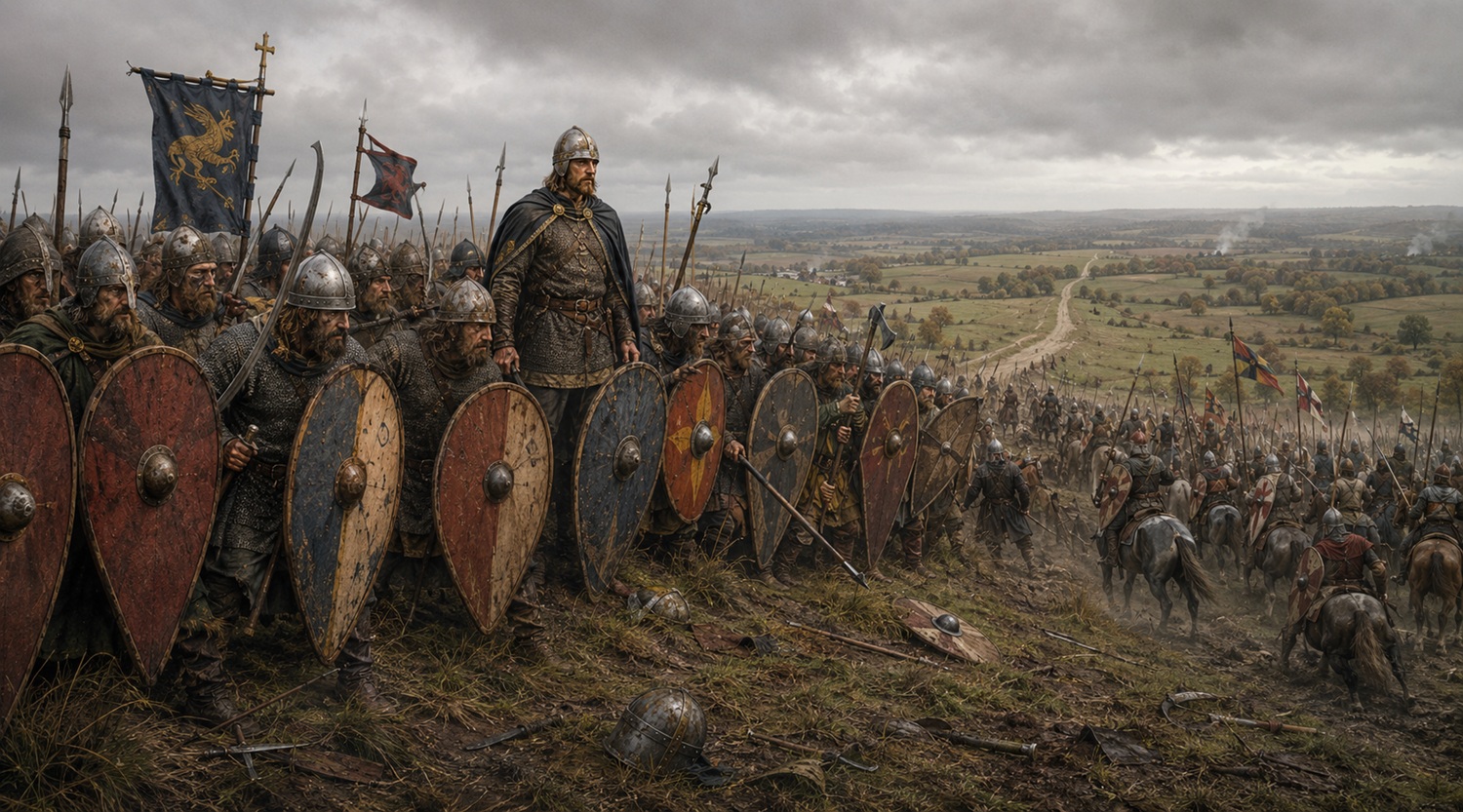
On October 14, 1066, two armies fought for the English crown on a ridge in Sussex.
King Harold II—Harold Godwinson—had been king for only nine months. His army had recently fought and defeated a Norwegian invasion in Yorkshire. Duke William of Normandy had crossed the English Channel with a multinational invasion force and claimed that the English throne rightfully belonged to him. The battle lasted most of the day, an unusually long engagement by medieval standards, and contemporary evidence does not support treating William's victory as inevitable. (English Heritage)
Historically, Harold died during the fighting. His army eventually broke, William survived a dangerous moment in which some Norman troops believed he had been killed, and the duke went on to become William I of England. Over the next generation, the conquest transformed England's aristocracy, patterns of land ownership, military architecture, church leadership, language, and political relationship with continental Europe. (English Heritage)
But none of that had to happen on October 14.
A plausible alternate outcome does not require Harold to possess a secret army or William to make an absurd tactical mistake.
The historical battle itself provides a divergence.
During the fighting, part of William's army retreated after a rumor spread that the duke had been killed. William personally rode among his men, showed his face, rallied them, and restored the Norman position. Some English warriors who pursued the retreating Normans were then surrounded and killed. (English Heritage)
In the alternate timeline, the rumor is true.
William is killed while trying to rally his collapsing left wing.
Harold prevents a large-scale English pursuit down the hill.
The shield wall remains intact.
Without William's personal authority, Norman command begins to fragment.
By evening, the invasion army is retreating toward its ships.
Harold Godwinson has survived the most dangerous year an English king had faced in generations.
England remains unconquered.
But that does not mean English history simply freezes on October 13, 1066.
The England Harold saves would continue changing.
The important question is how it changes without a Norman conquest.
---
Why There Was a Succession Crisis in 1066
The crisis began when Edward the Confessor died on January 5, 1066 without a surviving child.
Harold Godwinson, Earl of Wessex and the most powerful English nobleman of the late Edwardian period, was selected as king and crowned almost immediately. But his accession did not go uncontested. William of Normandy maintained that Edward had promised him the throne and that Harold had later sworn to uphold William's claim. The precise circumstances and credibility of those claims remain historically contested, but William successfully presented his invasion as a legitimate succession struggle and secured papal backing for his expedition. (English Heritage)
William was not the only foreign claimant.
Harald Sigurdsson—Harald Hardrada—king of Norway, asserted a Scandinavian claim to England. He was joined by Harold Godwinson's estranged brother Tostig, the former Earl of Northumbria. In September 1066, their invasion force entered northern England and defeated the forces of Earls Edwin and Morcar at Fulford near York. (Historic UK)
Harold reacted with extraordinary speed.
He brought an English army north and defeated the invaders at Stamford Bridge on September 25. Hardrada and Tostig were both killed. Only days later, William's fleet landed at Pevensey in Sussex, forcing Harold to turn south again to meet another invasion. (Historic UK)
The popular story sometimes reduces Hastings to rested Normans defeating exhausted Saxons.
The reality is more complicated.
Harold's northern campaign unquestionably affected his strategic situation, but English Heritage emphasizes that the two armies at Hastings were sufficiently well matched for the battle to continue throughout the day. William did not simply sweep aside a physically ruined opponent. (English Heritage)
That matters.
A Harold victory is not among the most far-fetched alternate outcomes in medieval history.
---
The Point of Divergence: William Dies During the Norman Crisis
The English army took up a strong defensive position on the ridge later associated with Battle Abbey.
Harold's housecarls and other troops formed a dense shield wall. The Norman army combined infantry, archers, and mounted warriors. Early Norman attacks failed to break the English line. English Heritage records that the first attacks were repulsed and that the Norman left wing later fled after troops believed William had been killed. (English Heritage)
Historically, William turned that moment around.
In this scenario, he does not.
A spear, axe, or missile kills the duke as he attempts to rally the retreat.
The news spreads rapidly.
There is no single commander with equivalent legitimacy.
Norman, Breton, French, and Flemish contingents have fought together because William organized the expedition and because success promised English land and wealth. With William dead and the English king visibly alive on the ridge, the incentives change.
Harold, meanwhile, avoids the greatest danger produced by the initial Norman retreat.
Instead of allowing large portions of the shield wall to chase fleeing enemies, English commanders keep most of the formation on the high ground.
By late afternoon the Normans have suffered heavy casualties without breaking the English center.
Their retreat becomes genuine.
Harold wins.
---
What Happens to William?
In this alternate scenario, William dies at Hastings.
That creates immediate consequences on both sides of the Channel.
William's eldest son, Robert Curthose, was already regarded as heir to Normandy and historically succeeded his father as duke in 1087. But in 1066 Robert was still young, and the political authority that William had painfully rebuilt in Normandy would suddenly have to be maintained without the ruler who created it. (Cambridge Resolve)
Normandy therefore does not disappear.
It remains one of the strongest principalities in northern France.
But William's death could create serious instability among Norman magnates, neighboring powers, and members of the ducal family.
The invasion itself has also removed or killed numerous Norman nobles and knights.
Men who expected English estates return home empty-handed—if they return at all.
The defeat becomes a political shock comparable to what Hastings historically became for the English aristocracy.
Only the direction has reversed.
---
Could the Normans Try Again?
Yes.
Harold's victory in one battle does not permanently immunize England from Norman invasion.
A surviving Norman government could claim that William died pursuing a lawful right and organize a second expedition.
The pope might continue supporting the Norman claim.
English opponents of Harold might invite foreign intervention.
But another invasion would face severe obstacles.
The first expedition had required enormous organization, shipping, money, diplomatic preparation, military recruitment, and William's personal authority. Normandy would now be dealing with a succession of its own. (Cambridge University Press)
England would also be better prepared.
Harold now knows exactly where a Norman invasion is likely to land.
Southern defenses can be strengthened.
The fleet can be maintained longer.
Coastal lookouts can be improved.
And the political prestige of the Godwinson monarchy has changed completely.
Harold is no longer the recently selected king whose legitimacy can be challenged easily.
He is the king who defeated two foreign invasions in three weeks.
That would be an extraordinarily powerful source of legitimacy.
---
Harold's Monarchy After Hastings
Harold's first task would be political consolidation.
The victory removes Hardrada, Tostig, and William as immediate rivals.
But England remains a kingdom in which great aristocratic families possess substantial regional power.
Earls Edwin and Morcar, who had been defeated by Hardrada before Harold rescued the north, remain particularly important.
Harold would need their cooperation rather than merely attempting to turn England into a Godwin family state.
The surviving late Anglo-Saxon monarchy already possessed relatively sophisticated royal institutions. Modern constitutional scholarship rejects the idea that William arrived in a politically primitive country and invented centralized government from scratch. The Norman rulers inherited and adapted English shires, courts, taxation systems, royal writs, coinage, military obligations, and other institutions. (Cambridge University Press)
A victorious Harold would therefore govern through institutions that were already capable of supporting a strong monarchy.
There is no need to invent a radically new English state.
---
Harold Would Need an Heir Problem Solved
Military victory solves the succession crisis of 1066.
It does not solve succession forever.
Harold had children, but later medieval hereditary succession was not yet the automatic constitutional mechanism it would become. English kingship involved heredity, elite recognition, political strength, and practical ability to secure the throne.
A successful reign would give Harold time to establish one of his sons as an obvious successor.
That could shift England toward a durable Godwinson dynasty.
But another disputed succession remains possible.
This matters because the Norman Conquest historically imposed a new ruling house and created a chain of succession eventually involving William II, Henry I, Stephen, Empress Matilda, Henry II, and the Plantagenets.
Remove William I from England and that entire dynastic sequence becomes contingent.
---
The English Aristocracy Survives
One of the clearest consequences of Harold's victory concerns the landholding elite.
After the real Norman Conquest, the old English aristocracy was largely replaced by Norman and other continental landholders. English Heritage notes that Domesday Book reveals the dramatic destruction of the pre-Conquest English landed elite between 1066 and 1086. Cambridge scholarship similarly characterizes the conquest as a rapid substitution of a new aristocracy of foreign settlers. (English Heritage)
That does not happen if Harold wins.
Families that historically lost their estates after resisting William retain them.
English earls and thegns remain the dominant landholding class.
Norman military adventurers do not receive vast English estates as rewards for conquest.
The political elite therefore remains much more culturally English and Scandinavian in background.
That may be one of the most durable immediate changes.
---
Land Ownership Changes More Gradually
The conquest did not merely replace individual landlords.
It created a new political relationship between the crown and a foreign aristocracy whose wealth derived heavily from William's distribution of conquered land.
Norman landholding became closely connected to military obligation and royal power. English Heritage summarizes this post-Conquest system as one in which wealthy barons received estates while owing military service and knights to the king. (English Heritage)
Without conquest, England still has lords.
It still has hierarchy.
It still has military obligations.
It still has large estates.
The idea that Harold's England would be an egalitarian peasant democracy is unsupported.
What disappears is the mass confiscation produced by foreign conquest.
Change would occur through marriage, forfeiture, royal grants, inheritance, rebellion, and normal aristocratic politics rather than wholesale redistribution to an invading elite.
---
There Is Probably No Domesday Book in 1086
William ordered the great Domesday survey in 1085–86 partly because his government needed extraordinarily detailed information about landholding, taxation, resources, and obligations in the conquered kingdom.
A Harold government might conduct its own surveys.
Late Anglo-Saxon kings were perfectly capable of sophisticated taxation and administrative record keeping.
But there is no reason to assume the exact Domesday inquiry occurs in 1086 or takes the same form.
This creates an ironic consequence for modern historians:
Harold's victory might leave us knowing less about eleventh-century England.
Domesday Book is one of the richest administrative sources surviving from medieval Europe precisely because the Norman monarchy wanted to understand and control its conquest.
A less disruptive English succession might produce fewer extraordinary records.
---
What Happens to Castles?
England would still eventually build castles.
But probably fewer, later, and under different political circumstances.
English Heritage describes castles as one of the most visible tools of Norman control after 1066. They were constructed across England to administer territory and dominate local populations, and Norman aristocrats established fortifications at strategically important sites soon after the conquest. (English Heritage)
Pre-Conquest England already possessed fortified towns, defended residences, burhs, and other forms of fortification.
The important difference is the rapid spread of the private or aristocratic castle as an instrument of conquest and lordship. Cambridge archaeological work notes that castles became the dominant form of aristocratic power center after the Norman Conquest. (Cambridge University Press)
Without William's victory, the Norman castle-building explosion does not occur.
England probably adopts continental castle technology gradually through military competition and aristocratic imitation.
A powerful king such as Harold might actually restrict private fortification because castles could strengthen rebellious earls.
Royal fortresses may develop more quickly than private baronial castles.
---
England Would Not Remain Architecturally “Anglo-Saxon” Forever
Avoiding conquest would not seal England off from continental architecture.
Religious and aristocratic networks already connected England with Normandy, Flanders, Scandinavia, Rome, and other parts of Europe before 1066.
Romanesque architecture would still influence English church building.
Stone fortifications would still spread.
Cathedrals would still be rebuilt.
Monasteries would still participate in continental religious movements.
The difference would be pace, patronage, and political context.
Architecture would arrive through exchange rather than conquest.
---
What Happens to Church Reform?
William's invasion had papal support partly because Norman propaganda presented him as a reformer of the English church. After the conquest, Norman bishops and abbots replaced much of the existing English ecclesiastical leadership, and figures such as Lanfranc helped connect the English church more closely with contemporary continental reform movements. (Cambridge Resolve)
A Harold victory prevents this Norman takeover of the English church.
It does not prevent church reform.
Reform currents were already moving throughout Latin Christendom, and pre-Conquest England itself had a long history of monastic and ecclesiastical reform. Cambridge scholarship warns against assuming that the English church was simply corrupt and waiting for Normans to rescue it. (Cambridge University Press)
Harold would also need to repair relations with the papacy after defeating a papally sanctioned invasion.
That gives him a powerful incentive to support credible ecclesiastical reform.
The likely result is an English-led reform movement involving fewer mass replacements of bishops and abbots.
---
Canterbury Could Remain More English
Historically, Lanfranc of Bec became Archbishop of Canterbury after the deposition of the English archbishop Stigand.
Without William's victory, that appointment does not happen.
English ecclesiastical families and churchmen retain more influence over senior appointments.
Continental scholars still arrive.
Latin remains the international language of the western church.
But English monasteries and cathedrals preserve more personnel continuity across 1066.
That could also preserve more late Anglo-Saxon manuscript culture.
Again, continuity does not mean isolation.
---
Relations With Scandinavia
Harold's victory over Hardrada at Stamford Bridge would remain one of the defining events of his reign.
It would demonstrate that England could resist Scandinavian conquest while also reminding everyone how closely England remained connected to the North Sea world.
Only a generation earlier, Cnut had ruled England as part of a larger Scandinavian monarchy.
Northern England retained extensive Scandinavian cultural and political connections.
Harold would therefore have strong reasons to maintain diplomacy with Denmark and Norway.
The question is whether Scandinavia becomes England's principal external orientation after Normandy is defeated.
That is plausible—but not guaranteed.
---
Denmark Could Become England's Most Important Royal Ally
A victorious Harold needs allies capable of deterring another Norman invasion.
Denmark is an obvious candidate.
An English-Danish naval relationship could threaten Normandy and protect the Channel approaches.
Dynastic marriages could reinforce the arrangement.
Trade across the North Sea would continue.
The English monarchy might therefore retain a stronger Scandinavian orientation than it did under the Anglo-Norman kings.
This would not make England a Viking kingdom.
By 1066, England and the Scandinavian monarchies were Christian states participating in wider European politics.
The difference would be where English rulers concentrated their diplomatic attention.
---
Normandy Becomes a Rival Across the Channel, Not Part of the English Crown
Historically, William's victory united the English crown with the Norman duchy, creating a political problem that influenced English and French history for generations.
Kings of England became landholders in France.
English aristocrats possessed estates on both sides of the Channel.
Dynastic politics became inseparable from disputes with the French monarchy.
Cambridge scholarship describes the post-1066 relationship as an Anglo-Norman realm created when William united Normandy and England. (Cambridge University Press)
Harold's victory prevents this.
England and Normandy remain separate states.
They may trade.
They may fight.
They may intermarry.
But there is no Anglo-Norman ruling aristocracy tying the two together.
This single difference eventually affects the Plantagenets, Magna Carta, and centuries of Anglo-French warfare.
---
What Happens to Normandy?
William's death would be a major crisis, not necessarily a terminal one.
Robert Curthose could become duke under a regency or coalition of powerful Norman nobles. Normandy might face challenges from Maine, Anjou, Brittany, or the French crown while its leadership adjusts. William's historical successors themselves experienced repeated struggles over the duchy, demonstrating that Norman politics were far from automatically stable even after the successful conquest. (Cambridge Resolve)
A weakened Normandy could lose territory.
Or Robert could mature into a viable duke and preserve most of his father's principality.
Either way, Normandy lacks the enormous English revenues that historically altered the balance of power.
English wealth no longer finances Norman continental politics.
That makes the French monarchy's long-term rise somewhat easier.
---
Wales Changes Substantially
The Norman Conquest became a major turning point for Wales because powerful Norman and marcher lords expanded aggressively across the English-Welsh frontier.
Cambridge scholarship stresses that England and Welsh kingdoms already had centuries of conflict and interaction before 1066, so English involvement in Wales would not simply disappear without the Normans. (Cambridge University Press)
Harold himself was no stranger to Welsh warfare.
Therefore an alternate Anglo-Saxon England should not be imagined as permanently respecting every Welsh border.
English kings would still intervene.
Welsh rulers would still fight one another and seek English alliances.
But there would be no identical class of Norman Marcher Lords carving out semi-independent principalities using castles and mounted forces on the historical timetable.
---
Welsh Independence Probably Lasts Longer
This is one of the stronger medium-term conclusions.
Without the explosion of Norman private lordship after 1066, English expansion westward is likely more directly controlled by the king and probably more gradual.
Welsh kingdoms receive more time to consolidate.
Different Welsh dynasties may emerge stronger.
Large-scale castle construction on the frontier proceeds differently.
A later English king could still conquer substantial Welsh territory.
But the path to Edward I's eventual conquest of Wales in the thirteenth century becomes much less direct.
That event lies more than two centuries beyond Hastings and cannot simply be transplanted into the alternate timeline.
---
Scotland Also Develops Differently
England and Scotland already possessed complicated political and dynastic relationships before 1066.
The Norman kings later strengthened English royal authority in the north and developed relationships with Scottish rulers that became deeply entangled with Anglo-Norman aristocracy. Cambridge research notes that Norman rule also helped integrate northern England more firmly with the southern kingdom while interacting with the changing Anglo-Scottish frontier. (Cambridge University Press)
Without conquest, Norman nobles do not enter Britain through England in the same numbers.
That does not mean Scotland remains untouched by Norman and continental influence.
Scottish rulers themselves historically welcomed continental knights, churchmen, institutions, and military practices.
Those incentives still exist.
But England no longer acts as the same Anglo-Norman transmission belt.
The Scottish state could therefore develop along a somewhat more Scandinavian and native aristocratic path for longer.
---
Could Scotland Become Stronger Relative to England?
Possibly.
Harold's England remains richer and more populous, so a sudden reversal of power is unlikely.
But a less militarized castle-building frontier could give Scottish rulers greater freedom in Northumbria and Cumbria.
English attention might also remain divided between Scandinavian threats and renewed Norman claims.
The border could remain fluid longer.
What later becomes the familiar Anglo-Scottish struggle might emerge from a very different political landscape.
---
The Biggest Cultural Question: What Happens to English?
This is where popular alternate histories often go wrong.
One version says:
Without the Norman Conquest, modern English would basically be Old English.
That is not plausible.
Languages do not stop changing because one invasion fails.
Old English was already changing before 1066.
Contact with Old Norse had already influenced English vocabulary and probably interacted with changes in grammar. Dialects differed across England. Sound changes, simplification of inflections, trade, migration, literacy, and social change would all continue. Oxford scholarship on the contact history of English emphasizes that medieval English change involved both contact and internal processes rather than one simple Norman cause. (OUP Academic)
So an alternate English in 1500 would not sound like Beowulf.
It would still be a descendant of Old English transformed by several more centuries of change.
What it would lack is the extraordinary depth of sustained Anglo-Norman French influence created after the conquest.
---
What Norman French Actually Did to English
After 1066, French became closely associated with the ruling elite, aristocratic culture, law, administration, and court life, while Latin remained extremely important in church, scholarship, and official writing. English continued to be spoken by most of the population and never disappeared. Cambridge and Oxford scholarship emphasize that England became a multilingual society rather than one in which French simply replaced English. (Cambridge University Press)
Over time, thousands of French-derived words entered English.
French influence was particularly strong in areas including government, administration, law, warfare, religion, fashion, elite culture, and cookery, while also reaching ordinary vocabulary. (Cambridge University Press)
Modern English consequently contains layers of Germanic and French-derived vocabulary that frequently express similar ideas with different shades of meaning.
The conquest was not the only source of French vocabulary—trade and continental contact would have introduced some French words anyway—but it magnified contact enormously.
---
An Alternate English Vocabulary
Without conquest, the everyday grammatical core remains strongly Germanic just as it does historically.
Words descended from Old English for family, body parts, basic actions, numbers, nature, common objects, and ordinary speech remain central.
But many later French-derived terms associated with royal government, aristocracy, law, war, culture, and food either never enter or arrive later through normal international contact.
A modern alternate English might therefore rely more heavily on native compounds and inherited Germanic roots.
For example, political and legal vocabulary could develop from English words that historically lost ground after French-speaking elites took control.
But it would be a mistake to replace every modern French-derived term with an invented “pure English” equivalent.
England would still trade with France.
The church would still connect England to Latin Europe.
Merchants and aristocrats would still travel.
Later Renaissance scholarship would still introduce enormous quantities of Latin and Greek vocabulary.
French borrowing would occur.
There would simply be less of it, and under different social conditions.
---
English Writing Probably Retains Higher Status
Before the Conquest, English had an unusually developed written tradition for a European vernacular.
After 1066, English continued in use, but its position as a language of elite writing and administration weakened while Latin and French gained prominence. Cambridge scholarship distinguishes the continued survival of Old English after the conquest from the reduced status English experienced in written and elite contexts. (Cambridge University Press)
A Harold victory could preserve that institutional prestige.
Royal laws could continue being issued in English.
Chronicles could continue more directly in the pre-Conquest vernacular tradition.
Administrative documents might use English alongside Latin more frequently.
The transition from Old English to Middle English would still happen linguistically.
What changes is that historians might see a much more continuous written bridge between them.
---
Would Modern English Be Easier for German or Dutch Speakers?
Perhaps somewhat.
A vocabulary with fewer French-derived words would preserve a more visibly Germanic character.
But this should not be exaggerated.
Modern German, Dutch, Scandinavian languages, and English all underwent centuries of independent development.
English would still experience sound change, grammatical simplification, dialect mixing, and later borrowing.
The alternate language could be recognizably more Germanic while remaining very different from any modern continental Germanic language.
---
England and France Separate Much Earlier
The political consequences of the linguistic divergence reinforce each other.
Historically, the ruling class of England became deeply connected to France because many nobles owned lands on both sides of the Channel.
For generations, the king of England was simultaneously a major French territorial prince.
That shaped diplomacy, marriage, warfare, inheritance, and identity. (Cambridge University Press)
Harold's victory prevents the creation of that cross-Channel aristocracy.
English nobles are less likely to possess Norman estates.
Norman nobles do not own enormous English estates.
France remains a foreign kingdom rather than the geographic setting of half the English ruling class's property.
Relations may actually be less continuously hostile as a result.
There are fewer inherited territorial disputes.
---
Could Harold Ally With the King of France Against Normandy?
Very plausibly.
The French monarchy had its own complicated relationship with the powerful Norman duchy.
A surviving Harold might find that Capetian France is a useful partner against a resentful Normandy.
England could support the French king's efforts to contain Robert Curthose.
France could recognize Harold's legitimacy in exchange for English diplomatic support.
This would create an almost complete reversal of later medieval assumptions.
Instead of England repeatedly fighting France because English kings claim French lands, England and France could spend much of the late eleventh century cooperating against Normandy.
That alignment would not necessarily last.
But it illustrates how profoundly Hastings affected continental politics.
---
There Is No Anglo-Norman Realm
This has consequences beyond one generation.
Historically, the union of England and Normandy later fractured and reunited repeatedly under William's sons.
Eventually the dynastic crisis after Henry I produced the conflict between King Stephen and Empress Matilda.
Matilda's marriage to Geoffrey of Anjou created the dynastic route through which their son Henry II inherited England and established the enormous collection of territories commonly called the Angevin Empire. Cambridge's account explicitly describes Henry as reuniting England and Normandy within a much larger Angevin dominion. (Cambridge University Press)
Without William ruling England, that entire chain is gone.
No William II as king of England.
No Henry I in the historical role.
No White Ship succession crisis in the same political context.
No Empress Matilda claiming the English crown as William I's granddaughter.
No Stephen-Matilda civil war as history knows it.
And no Henry II inheriting England through that chain.
---
Does That Mean No Plantagenets?
No Plantagenet dynasty in its historical English form.
Geoffrey of Anjou and his descendants can still exist.
Anjou still exists.
Normandy still exists.
Dynastic marriages still occur.
But Henry II's path to the English throne depended upon his mother Matilda being Henry I's daughter and designated heir.
Remove Norman England, and there is no reason for the Count of Anjou's son to become king of England in 1154. (Cambridge University Press)
A later marriage could conceivably connect an Angevin ruler to the English crown.
But that would be a new event, not the historical Plantagenet succession.
Therefore the reigns of Henry II, Richard I, and John cannot simply be moved into the alternate timeline.
---
No Angevin Empire
Historically, Henry II eventually controlled England, Normandy, Anjou, substantial additional French territories, and through marriage to Eleanor of Aquitaine acquired influence over a huge part of western France.
That cross-Channel empire became one of the defining political structures of the twelfth century. (Cambridge University Press)
Without Norman England, there is almost certainly no such political combination.
Aquitaine develops according to French dynastic politics.
Normandy remains Norman or is eventually absorbed into France.
Anjou follows its own trajectory.
England remains primarily an island kingdom with interests in Britain, the North Sea, and trade across the Channel.
That may fundamentally change how English kings think about power.
---
English Kings Spend Less Money Fighting for French Land
This has important constitutional implications.
The historical kings of England frequently needed money for continental wars and defense of overseas territories.
John's loss of Normandy and Anjou in 1204 became especially important because he then taxed England heavily while trying to recover those lands. UK Parliament identifies the loss of Normandy, John's expensive recovery efforts, heavy taxation, and his defeat at Bouvines as central elements in the crisis that produced Magna Carta in 1215. (Parliament UK News)
Without the Anglo-Norman and Angevin territorial system, that sequence never occurs.
John is not king—at least not the historical John.
There is no loss of Normandy in 1204 by an English Plantagenet ruler.
There is no Bouvines campaign driven by John's attempt to restore those possessions.
Therefore there is no Magna Carta of 1215 produced by the same chain of events.
---
Does That Mean No Magna Carta?
No.
It means no historical Magna Carta.
Conflict between kings and powerful aristocrats existed before the Plantagenets and would continue under a Godwinson or successor dynasty.
English political traditions already included assemblies, royal councils, shire institutions, law codes, aristocratic rights, and expectations concerning legitimate kingship.
A powerful king could still abuse taxation.
A succession crisis could still produce rebellion.
Great lords could still demand written guarantees.
A charter limiting royal power could therefore emerge.
But its language, clauses, date, and political circumstances would differ.
The historical Magna Carta was not an inevitable document waiting to be signed by whichever king happened to rule England in 1215.
It was the product of a specific crisis. (Parliament UK News)
---
English Constitutional Development Does Not Stop
This point is important because counterfactual histories sometimes credit the Norman Conquest with creating everything later considered distinctive about English government.
England already had sophisticated royal administration before 1066.
The Normans then changed, adapted, centralized, and expanded parts of that system rather than replacing political nothingness with government. (Cambridge University Press)
A surviving English monarchy could still develop stronger taxation.
Royal courts could evolve.
Common legal procedures could expand.
Assemblies of nobles and churchmen could develop into new political institutions.
The precise road to Parliament changes enormously.
But political institutional development does not vanish.
---
Could an Anglo-Saxon Parliament Appear?
Calling it a “Parliament” too early would be misleading.
The late Anglo-Saxon witan was not simply a modern parliament in embryo.
It was an assembly of leading political and ecclesiastical figures involved in royal governance, succession, witness to royal acts, and consultation.
Under a continuing English dynasty, such councils could evolve in several directions.
Royal administration might become more bureaucratic.
County representation could eventually emerge through fiscal or judicial needs.
Urban wealth could generate demands for political participation.
But there is no basis for saying Harold's victory automatically creates a more democratic England.
It could just as easily produce a powerful hereditary monarchy.
---
Would England Still Have Knights?
Yes.
Mounted armored warriors were becoming increasingly important throughout western Europe.
Norman knights were especially prominent in 1066, and English Heritage emphasizes mounted armored warfare as one of the important military advantages associated with Norman conquest. (English Heritage)
But military technology spreads.
Harold's successors would study the army they had just defeated.
English nobles could hire continental horsemen.
Native aristocrats could adopt cavalry equipment and tactics.
English warfare would evolve toward greater use of mounted elites without requiring their estates to be distributed by William.
The same applies to castles, siege warfare, armor, and military organization.
Victory at Hastings would not create a museum of pre-Conquest warfare.
---
Harold's Government Might Reform the Fyrd
The year 1066 exposed both the strengths and limitations of England's military system.
Harold had successfully mobilized forces against two invasions at opposite ends of the kingdom.
But maintaining troops for prolonged coastal defense was difficult.
A surviving Harold therefore has powerful incentives to improve military readiness.
He could strengthen the royal fleet.
Increase permanent household troops.
Modify local military obligations.
Create strategically placed armories.
Encourage mounted service among wealthy landholders.
The army that fights a later Norman invasion might already look different from the army at Hastings.
---
Would England Turn Toward the Sea?
Possibly more than under the historical Anglo-Norman kings.
A monarchy without large continental estates has less reason to pour resources into holding Normandy or Anjou.
Protecting England requires preventing invasions across the Channel and North Sea.
Trade increasingly rewards maritime power.
A Harold dynasty could therefore invest more consistently in fleets.
This is only a medium-strength counterfactual, but it fits England's geography and the lessons of 1066.
A stronger maritime orientation could eventually become one of the great unintended consequences of avoiding Norman conquest.
---
The English Church Still Becomes More European
Harold's victory would preserve more English ecclesiastical personnel, but the church would not become nationally isolated.
Latin Christianity was experiencing major institutional changes in the eleventh century.
Papal authority was expanding.
Monastic reform networks crossed borders.
Clerics moved among England, France, Germany, Italy, and Scandinavia.
Harold would need papal reconciliation after defeating William.
A king seeking recognition could offer church reform, new monasteries, stricter clerical discipline, or changes in episcopal appointments.
So England may become deeply integrated with continental reform while remaining politically independent of Normandy.
---
What Happens to English Saints and Royal Memory?
The absence of Norman conquest changes which historical figures become politically useful.
Norman rulers historically appropriated aspects of pre-Conquest royal legitimacy and promoted Edward the Confessor as an important saintly predecessor. Cambridge scholarship notes that Edward became increasingly useful as a foundational figure for Norman, Angevin, and Plantagenet rulers seeking English legitimacy. (Cambridge Assets)
A Godwinson dynasty has different needs.
Harold himself could become the celebrated defender of England.
Stamford Bridge and Hastings might become foundational national victories.
Royal chronicles could present 1066 not as the end of an era but as the moment a native dynasty proved its right to rule by defeating foreign claimants.
That would reshape English historical memory.
---
Would Harold Be Remembered Like Alfred the Great?
Potentially.
A king who defeated a Norwegian invasion and a Norman invasion in the same month would possess an extraordinary military reputation.
If he then ruled successfully for another decade or two, later English writers might portray Harold as one of the kingdom's greatest rulers.
His actual historical reputation became inseparable from defeat and the question of whether his coronation was legitimate.
Victory would change the evidence that later political culture chose to emphasize.
Success has a powerful effect on medieval legitimacy.
---
The Bayeux Tapestry Would Tell a Different Story—or Never Exist
The Bayeux Tapestry as we know it is a product of the victorious Norman world.
Without William's conquest, the famous embroidery would not tell the same story and might never be commissioned.
An English royal or ecclesiastical patron could instead sponsor an artwork celebrating Harold's victories.
Imagine a long embroidered narrative moving from Edward's death through Hardrada's invasion, Stamford Bridge, William's landing, and the final Norman collapse at Hastings.
The visual memory of 1066 could become England's great national victory cycle.
This is speculative, but the underlying point is strong:
historical sources themselves are products of who wins.
---
England Around 1100
By roughly 1100, the alternate kingdom might plausibly look like this.
Harold himself may have died naturally or in another conflict by then.
A son or another English successor rules.
The old aristocracy has evolved but not been replaced wholesale.
English remains a language of ordinary life and retains stronger status in royal and legal writing.
Latin dominates much church scholarship.
French vocabulary enters through trade and diplomacy but not through a French-speaking ruling class.
The castle landscape is less dense.
Church reform has occurred, but through a more gradual English and papal process.
England maintains close relations with Denmark and other North Sea powers.
Normandy remains a separate principality and may be increasingly pressured by France and Anjou.
Wales remains more independent than in the historical Anglo-Norman world.
Scotland's relationship with England is less shaped by Norman aristocratic networks.
The kingdom is recognizably medieval European.
It is simply not Anglo-Norman.
---
The Real-vs-Alternate Timeline Through 1200
| Date | Real History | Harold-Victory Scenario |
| ------------------ | ------------------------------------------------------------------------------------------------------------------------------ | ---------------------------------------------------------------------------------------------------------------------------------------------------- |
| Jan. 1066 | Edward the Confessor dies; Harold becomes king. | Same. |
| Sept. 25, 1066 | Harold defeats and kills Harald Hardrada and Tostig at Stamford Bridge. | Same. (Historic UK) |
| Sept. 28 | William lands at Pevensey. | Same. (English Heritage) |
| Oct. 14 | Harold dies at Hastings; William wins. | William is killed during a Norman battlefield crisis; Harold's shield wall holds and the invasion collapses. |
| 1066–70 | William conquers England and suppresses resistance. | Harold consolidates his rule, negotiates with northern earls, reinforces the south coast, and seeks papal reconciliation. |
| 1070s–80s | Norman land redistribution and castle construction transform England; Norman churchmen replace much of the English episcopate. | English aristocracy remains dominant; continental military and church reforms arrive gradually rather than through conquest. (English Heritage) |
| 1086 | Domesday Book records the post-Conquest kingdom. | No reason for the exact Domesday survey to occur; English fiscal administration continues by other means. |
| 1087 | William dies; Robert receives Normandy and William Rufus becomes king of England. | William has been dead since 1066; Robert or another Norman settlement governs a separate duchy. (Cambridge Resolve) |
| 1100 | Henry I becomes king of England. | England is ruled by the Godwinson dynasty or another succession emerging from English politics. |
| 1106 | Henry I defeats Robert and reunites England and Normandy. | No Anglo-Norman reunification because England was never conquered. |
| 1135–54 | Stephen and Matilda fight the civil war known as the Anarchy. | No historical Stephen-Matilda succession crisis. England may have other dynastic struggles. |
| 1154 | Henry II begins Plantagenet rule and later controls an enormous collection of French territories. | No historical Henry II accession and no Angevin Empire in its familiar form. (Cambridge University Press) |
| 1160s–80s | Plantagenet rule reshapes England, Wales, Ireland, and Anglo-French relations. | England remains primarily an insular and North Sea monarchy; Welsh and Scottish politics develop along different trajectories. |
| 1189 | Richard I succeeds Henry II. | No historical Richard I as king of England. |
| 1199 | John becomes king and inherits England and extensive French territories. | No historical King John. |
| 1200 | England remains deeply tied to continental Plantagenet possessions. | England is likely a substantial independent European kingdom with no inherited Norman-Angevin territorial empire in France. |
After about 1100, confidence necessarily declines.
By 1200, specific names of kings, marriages, wars, and alliances become increasingly speculative.
---
No Richard the Lionheart as King of England
Richard I's historical career depended upon the Plantagenet dynasty.
Without Henry II becoming king, Richard's route to the English crown disappears.
Richard might still be born into the aristocratic world of Aquitaine or Anjou if enough personal circumstances remained similar—which itself becomes increasingly doubtful.
But the famous English king who spends much of his reign campaigning outside England is not part of the strong counterfactual.
That has obvious implications for the Third Crusade and English cultural memory.
Yet the Crusades themselves still occur.
English knights and kings could still participate.
Only the personnel change.
---
No Historical King John
The same is even clearer for John.
His position as king depended on being Henry II's son and Richard's brother.
No Plantagenet England means no historical reign of John.
Therefore the political crisis that produced Magna Carta does not happen as we know it.
This is not an argument that English liberty disappears.
It is an argument that constitutional development becomes genuinely contingent.
---
No Historical Magna Carta
Magna Carta arose from the relationship between John and his barons, his methods of raising revenue, his continental territorial ambitions, the loss of Normandy and Anjou, and the military disaster at Bouvines. (Parliament UK News)
Every one of those factors is transformed if Harold wins Hastings.
An alternate charter could appear earlier.
Or later.
It might focus on royal succession, taxation, church appointments, regional aristocratic privileges, or limits on the military obligations of the fyrd.
It might never become a single famous document.
By 1215, England could possess its own body of royal promises and legal customs that perform some of Magna Carta's functions without bearing that name.
---
What About the Hundred Years' War?
It almost certainly does not occur in its historical form.
The Hundred Years' War lay far in the future, but its dynastic and territorial context developed out of centuries of intimate Anglo-French aristocratic politics.
An England never ruled by Norman and Plantagenet kings begins with a different relationship to France.
There is no inherited Duchy of Normandy.
No Angevin empire.
No historical loss of continental Plantagenet territories.
No identical English claims to Gascony.
No identical Plantagenet family tree producing Edward III's later claim to the French crown.
A later Anglo-French war remains entirely plausible.
The two states face each other across a narrow sea.
Trade creates friction.
Flanders, Brittany, naval power, alliances, and dynastic marriages could produce conflict.
But a conflict called the Hundred Years' War beginning in 1337 for the same reasons is extraordinarily unlikely.
---
England Could Actually Fight France Less Often
This is counterintuitive because later history makes Anglo-French rivalry seem inevitable.
Geography creates competition.
It does not dictate the exact frequency or causes of warfare.
For centuries after 1066, English rulers were often fighting in France because they were French territorial princes as well as kings of England.
Remove those possessions and many disputes disappear.
England may devote more attention to:
Scotland;
Wales;
Ireland;
Denmark;
Norway;
North Sea trade;
Flanders;
and naval security.
France could become an important commercial partner or occasional ally rather than the inherited center of English royal ambitions.
---
Or England and France Could Still Become Rivals
The opposite path is also possible.
A stronger French monarchy could absorb Normandy earlier.
That would place Capetian power directly across the Channel.
English kings might worry about a consolidated French coast.
Flanders and the wool trade could become flashpoints.
Naval rivalry could intensify.
So Harold's victory does not create permanent Anglo-French friendship.
It simply removes the most important historical mechanism that made conflict so persistent.
---
Could Normandy Eventually Become Part of France?
Very plausibly.
Without England's wealth supporting the Norman dukes, the duchy is strategically weaker.
William's young successor must handle internal magnates and powerful neighbors without access to the resources of an English kingdom.
The French monarchy was still relatively limited in 1066, but Capetian power grew substantially over later generations.
A weakened Normandy might therefore be absorbed by France decades before Philip II historically conquered it from King John in 1204. (Parliament UK News)
If that happens, the Channel develops a simpler political geography:
England on one side.
France on the other.
No English king simultaneously ruling Normandy.
---
What Happens to Ireland?
The prompt does not require Ireland, but the implications are too large to ignore.
The Anglo-Norman intervention in Ireland began in the late 1160s and became closely tied to Henry II's Plantagenet monarchy. Cambridge's history of medieval Ireland emphasizes the profound effects of Anglo-Norman conquest, colonization, and land redistribution. (Cambridge University Press)
Without Henry II as king of England, that exact intervention does not happen.
English involvement in Ireland remains possible through trade, church politics, dynastic alliances, or later invasion.
Welsh, Scandinavian-Gaelic, and Irish political networks continue evolving.
But the creation of an English lordship of Ireland in the twelfth century becomes far less likely on the historical timetable.
This could be one of the largest consequences of Harold's victory for the British Isles.
---
Would England Be More Scandinavian?
Somewhat, perhaps.
But not enough to call it culturally Scandinavian.
English language, institutions, Christianity, law, and political identity were already distinct by 1066.
The Danelaw and the reign of Cnut had left important Scandinavian influences.
A victorious Harold could renew North Sea ties because the continental alternative created by William never dominates the monarchy.
Royal marriages with Denmark or Norway could reinforce those links.
Norse vocabulary already embedded in English continues influencing the language.
But England remains England.
---
Would England Be Less “European”?
No.
This is another misconception.
Norman conquest dramatically increased certain kinds of continental integration, particularly with Normandy and French-speaking aristocratic culture.
But pre-Conquest England was already connected to western Christendom.
The church was Latin.
Royal marriages crossed borders.
English exiles traveled abroad.
Merchants traded with the Continent.
Scandinavian and Flemish relationships were extensive.
A Harold kingdom would still be a European Christian monarchy.
It would simply be connected through a different network.
---
Would Feudalism Exist in England?
The answer depends heavily on what one means by “feudalism,” a term historians themselves use cautiously because it can flatten many different medieval institutions into one supposed system.
England already had lordship, military service, dependent landholding, aristocratic hierarchy, and royal obligations before 1066.
The conquest did, however, redistribute land on a huge scale and embed England in a specifically Anglo-Norman aristocratic world. (English Heritage)
Without conquest, English land and military relationships would continue evolving.
Knights could acquire estates.
Hereditary lordships could strengthen.
Royal grants could connect landholding with military service.
The result might eventually resemble aspects of continental lordship without following the precise Norman settlement.
---
Could Harold Build a Stronger Monarchy Than William?
Possibly, although this is not obvious.
William historically had one enormous advantage: conquest allowed him to redistribute estates and create a new elite dependent upon his success.
Harold would govern men whose families already had regional power.
Edwin, Morcar, and other magnates would not owe their entire fortunes to him.
That could make the monarchy more politically constrained.
On the other hand, Harold would inherit intact administrative institutions without needing years of conquest, rebellion suppression, and land redistribution.
A prestigious military victory could also make his personal authority formidable.
Whether the long-term monarchy becomes stronger or weaker therefore depends more on Harold's political skill and succession than on Hastings alone.
---
A More Continuous English Aristocracy Could Mean a Stronger Nobility
This may matter centuries later.
The Norman Conquest produced a new aristocracy whose wealth was intimately connected with royal grants.
A victorious Harold preserves established regional families.
Those families might become hereditary territorial powers capable of challenging the crown.
England could consequently experience major baronial conflicts earlier than it did historically.
An alternate constitutional crisis might arise not because the monarchy is weak but because old aristocratic houses remain too strong to ignore.
That is one possible route toward a charter limiting royal authority.
---
Could England Fragment?
Yes.
Victory at Hastings is not a guarantee of national stability.
The late Anglo-Saxon kingdom had been unified relatively recently by medieval standards.
Northern political loyalties could be difficult.
A weak successor to Harold could face rebellions by major earls.
Scandinavian kings could return.
Wales and Scotland could intervene.
The England William historically conquered was a strong kingdom, but not indestructible.
A disastrous Godwinson succession around 1080 could still fracture the realm.
The counterfactual should therefore avoid assuming a smooth thousand-year continuation of Anglo-Saxon monarchy.
---
Three Main Paths After Harold's Victory
| Scenario | Political Development | Continental Relationship | Long-Term Outlook |
| ---------------------------------- | ------------------------------------------------------------------------------------------------------------------------ | ----------------------------------------------------------------------------------------- | -------------------------------------- |
| Godwinson consolidation | Harold rules successfully and establishes a stable hereditary dynasty. | England balances Normandy, France, and Scandinavia without continental possessions. | Strongest near-term scenario |
| Aristocratic succession crisis | Harold dies without an uncontested successor; Edwin, Morcar, Godwinsons, or foreign-backed claimants struggle for power. | Normandy or Scandinavia may attempt another intervention. | Plausible |
| Later continental dynasty | A later English marriage brings a French, Flemish, Breton, or Scandinavian prince into the succession. | England becomes more continental—but through a different dynasty and at a different date. | Highly plausible over the long run |
The third possibility is important.
Preventing William from conquering England in 1066 does not guarantee that every English monarch for the next five centuries has an English name and English-speaking parents.
Medieval dynastic politics makes later foreign marriages almost inevitable.
---
What Would Alternate English Sound Like?
No one can reconstruct it precisely.
But several features are plausible.
Its basic grammar and much of its everyday vocabulary remain descended from Old English.
Norse influence stays important because it already existed.
French still contributes words through commerce, diplomacy, aristocratic marriage, literature, and the church—but substantially fewer than under centuries of elite Anglo-Norman bilingualism.
Latin continues contributing learned, ecclesiastical, and later scholarly vocabulary.
The transition toward Middle English still occurs.
Regional dialects still interact.
Inflectional endings continue weakening.
Sound changes continue.
By 1400, alternate English might be no easier for an eleventh-century English speaker to understand than historical Middle English would be.
The difference would be most obvious in the lexicon and social history, not in some miraculous preservation of Old English grammar. (OUP Academic)
---
Words That Might Be Different
Modern English contains enormous numbers of words that entered through French influence associated with the post-Conquest multilingual world, particularly in law, government, warfare, culture, religion, fashion, and cookery. (Cambridge University Press)
An alternate English might therefore develop different native terms in domains such as:
royal administration;
courts;
property law;
military ranks;
elite titles;
cuisine;
fashion;
literature.
But the distinction would never be perfect.
Latin and French were culturally prestigious throughout Europe.
Borrowing would continue.
Some familiar modern words might enter two centuries later rather than disappear forever.
---
Would There Still Be “Beef” and “Cow”?
Popular explanations often use pairs like cow and beef to illustrate English-speaking peasants raising animals eaten by French-speaking aristocrats.
The broader point—that French became associated with elite domains and heavily affected vocabulary—is sound, though individual word histories can be more complicated than the famous classroom anecdotes imply.
Without conquest, English would likely preserve more native vocabulary around elite dining and administration.
Yet international trade and later French cultural influence could still produce culinary loans.
So even some highly recognizable French-derived English words might eventually appear.
The difference is density, timing, and social context.
---
A More Germanic English Does Not Mean a More Germanic Political Culture Forever
Language and politics should not be confused.
England could speak a more Germanic-derived English while adopting French fashions.
It could borrow Italian financial practices.
Its church could follow Roman reforms.
Its scholars could write Latin.
Its knights could imitate continental chivalry.
Its kings could marry French princesses.
Cultural exchange would continue.
What Hastings changes is the dominance of one elite linguistic community at a particularly important moment.
---
Would England Still Become a Major European Power?
Very possibly.
The Norman Conquest was enormously consequential.
It was not the sole source of England's later power.
England in 1066 was already a wealthy, centralized kingdom capable of raising significant taxes and armies. Its rulers possessed sophisticated administrative mechanisms, a valuable agricultural economy, important towns, a unified coinage tradition, and strong royal institutions. The Normans were able to build such a formidable kingdom partly because they conquered an unusually well-organized one. (Cambridge University Press)
Geography would still matter.
England remained protected by water but close enough to continental Europe for trade.
Its population could continue growing.
London could continue developing.
Wool could remain economically valuable.
Royal government could continue centralizing.
Naval power could expand.
Nothing about Harold's victory condemns England to permanent second-rate status.
But the kind of power England becomes could be different.
---
England May Become More Insular Earlier
Historical English kings often treated England as one component of a larger cross-Channel inheritance.
An alternate dynasty without Normandy or Anjou has fewer reasons to spend years governing or fighting in France.
That could lead rulers to define the kingdom more clearly around England itself.
The political energy historically directed toward Normandy, Maine, Anjou, Aquitaine, and Gascony could instead go toward:
Wales;
Scotland;
Ireland;
North Sea commerce;
naval defense;
or domestic consolidation.
Such an England might become more recognizably insular centuries earlier.
---
Or England Could Become a North Sea Power
A second possibility is even more interesting.
England could build a political and commercial network oriented around Denmark, Norway, Flanders, the Baltic, and the North Sea.
The memory of Cnut's empire was still recent.
Harold's great military victory over Hardrada would not erase commercial and cultural ties to Scandinavia.
An England focused on shipping rather than French land wars could develop powerful maritime institutions.
This path is speculative but structurally plausible.
It could ultimately produce a major European power whose rise comes through trade and naval strength rather than possession of French duchies.
---
England Still Has Significant Advantages
Harold inherits a monarchy capable of nationwide action.
He demonstrated that capacity in 1066 by moving forces rapidly enough to confront invasions in both Yorkshire and Sussex within weeks.
English kings can tax.
They can summon military forces.
They can issue law.
They can use shire and local institutions.
They can mint currency.
Those capacities do not disappear because William's army retreats.
A competent dynasty could build upon them. (Cambridge University Press)
The state might actually avoid some of the destruction associated with conquest and rebellion.
That provides its own advantages.
---
What Becomes Less Likely?
Several features of later history become much less likely in recognizable form.
The Anglo-Norman aristocracy.
Mass Norman land redistribution.
The castle-building explosion of the late eleventh century.
Norman domination of English bishoprics.
The Anglo-Norman realm.
The Anarchy between Stephen and Matilda.
The Plantagenet succession of 1154.
The Angevin Empire.
Richard I's English kingship.
John's reign.
The loss of Normandy in 1204 as an English royal possession.
The political crisis leading specifically to Magna Carta in 1215.
Later Plantagenet claims to French territory developing from the same dynastic background.
And, much farther in the future, the Hundred Years' War as it actually occurred.
Each event depended on earlier conditions that Harold's victory would remove. (Cambridge University Press)
---
What Still Happens Anyway?
England remains part of Latin Christendom.
Church reform continues.
Continental military technologies spread.
Castles eventually appear.
Mounted knights become more important.
English changes from Old English into later forms.
French and Latin words still enter the language.
Trade across the Channel continues.
English rulers intervene in Wales.
England and Scotland compete.
Scandinavian relations remain important.
Aristocrats challenge kings.
Kings seek more revenue.
Succession disputes occur.
Cities grow.
Medieval European population, commercial, religious, and technological changes continue affecting England.
Harold's victory changes one extraordinarily important political event.
It does not remove England from medieval history.
---
Strong, Moderate, and Weak Counterfactual Claims
| Claim | Assessment | Reason |
| ----------------------------------------------------------------------- | ---------------------- | ----------------------------------------------------------------------------------------------------------------------------------------- |
| Harold could conceivably have won Hastings | Strongly plausible | The battle lasted most of the day and Norman forces experienced a genuine crisis when they believed William dead. (English Heritage) |
| William actually dying during that crisis could cause Norman defeat | Plausible | His personal rally historically restored cohesion at a dangerous moment. (English Heritage) |
| Harold immediately establishes an uncontested dynasty lasting centuries | Weak | Medieval succession remained politically contingent. |
| English aristocracy avoids the wholesale post-1066 replacement | Very strong | That replacement directly resulted from William's conquest and land distribution. (English Heritage) |
| England never builds castles | Very weak | Castle and cavalry technology would continue spreading through Europe. |
| The Norman castle-building explosion after 1066 disappears | Very strong | Castles were central instruments of Norman conquest and control. (English Heritage) |
| The English church avoids all reform | Very weak | Reform movements already extended across Latin Europe. |
| Norman replacement of English bishops is prevented | Strong | That ecclesiastical takeover followed the conquest. (Cambridge University Press) |
| English remains Old English indefinitely | False | Language change was already underway and would continue. (OUP Academic) |
| English receives substantially less French vocabulary | Strong | Centuries of elite French-English contact followed directly from the conquest. (oed.com) |
| Modern English can be reconstructed exactly | Impossible | Centuries of later linguistic developments remain contingent. |
| Anglo-Norman England never forms | Very strong | It depended directly on William becoming king. (Cambridge University Press) |
| The historical Plantagenet dynasty never rules England | Very strong | Henry II's claim came through the Norman royal succession. (Cambridge University Press) |
| No document limiting royal power ever appears | Weak | King-aristocrat conflict would continue even without John. |
| The historical Magna Carta of 1215 does not occur | Very strong | Its immediate political circumstances depended heavily on John's reign and continental wars. (Parliament UK News) |
| Wales remains independent forever | Weak | English-Welsh rivalry existed before the Normans. (Cambridge University Press) |
| Welsh independence probably lasts longer | Moderately strong | The Norman marcher expansion no longer begins in the same form after 1066. |
| England becomes Scandinavian | Weak | North Sea ties could strengthen, but English institutions and identity were already distinct. |
| England remains a significant European kingdom | Strongly plausible | Pre-Conquest England already possessed considerable wealth and administrative capacity. (Cambridge University Press) |
| The Hundred Years' War occurs exactly as historical | Extremely weak | The Plantagenet territorial and dynastic background disappears. |
| England and France never fight | Weak | Geography and later political competition could still produce wars. |
---
The Most Plausible England by 1200
The farther the counterfactual moves from 1066, the less useful exact prediction becomes.
Still, a coherent medium scenario can be constructed.
Harold survives Hastings and rules long enough to consolidate his monarchy.
One of his sons succeeds him.
The Godwinson dynasty eventually faces its own succession dispute, but the kingdom remains intact.
The old English aristocracy gradually evolves rather than being replaced.
Continental knights, churchmen, merchants, and craftsmen still enter England, but as immigrants and specialists rather than conquerors.
Castles spread slowly.
The monarchy maintains a stronger royal military infrastructure to prevent great earls from creating independent fortress networks.
Church reform proceeds under papal pressure while more English clerics remain in high office.
Written English retains higher prestige.
French is known among merchants, diplomats, and some aristocrats but never becomes the dominant language of England's ruling class.
Latin remains central to the church and scholarship.
England develops close links with Flanders and Scandinavia.
France gradually absorbs or dominates Normandy.
The English crown possesses no permanent French territorial empire.
Welsh rulers remain independent longer.
Scotland develops without the identical flood of Anglo-Norman aristocratic influence.
Ireland does not experience the Plantagenet intervention of the 1160s and 1170s.
By 1200, England is still one of northwestern Europe's wealthier and better-organized monarchies.
It simply occupies a very different political world.
---
What Is Impossible to Predict?
Almost everything after several generations becomes conditional.
We cannot know the names of England's kings in 1200.
We cannot know whether Harold's sons survive.
We cannot know whether a Godwinson princess marries a Danish king, a Flemish count, a French prince, or a Scottish dynasty.
We cannot know whether Normandy remains independent.
We cannot know whether a later English monarch conquers Wales.
We cannot know whether England develops an overseas empire centuries later.
We cannot know whether anything resembling the Wars of the Roses, Tudor monarchy, Reformation, English Civil War, British Empire, or modern United Kingdom occurs.
Each of those developments depends on thousands of later events.
The value of the Hastings counterfactual lies in the first few consequences where the causal chain is strongest.
And those consequences are already enormous.
---
Would England Still Become a Major European Power?
Probably.
But it might become one through a different route.
William's conquest gave England a new aristocracy, new continental entanglements, and new military institutions.
It did not create England's wealth, geographic position, administrative sophistication, or capacity for centralized monarchy from nothing. Late Anglo-Saxon England was already a powerful and comparatively well-organized kingdom. (Cambridge University Press)
A successful Harold could build on that foundation.
His England might avoid generations of expensive fighting over Normandy and other French territories.
It might invest more attention in naval defense and North Sea trade.
Its rulers might concentrate more consistently on governing England itself.
Welsh and Scottish expansion could still occur, though more slowly and through different mechanisms.
London could still become an increasingly important commercial center.
The monarchy could still develop stronger taxation, courts, and central administration.
The language could still become one of Europe's major vernaculars.
Nothing about a Harold victory requires England to become weak.
What disappears is the specific Anglo-Norman route to power.
---
The AltHistAI Verdict
Harold Godwinson could have won the Battle of Hastings.
That conclusion requires less imagination than many famous historical counterfactuals.
The battle was long.
The armies were competitive.
The English defense initially held.
At one point the Norman left wing retreated after believing William had been killed, and William personally restored the situation by showing himself to his men and rallying them. (English Heritage)
If William had actually died during that crisis, the battle could have taken a very different course.
His invasion was built around his personal claim.
His army was composed of different contingents assembled under his leadership.
His death would not automatically cause every soldier to flee, but it would remove the one commander with the political authority to hold the expedition together.
Harold's challenge would be simpler.
Keep the shield wall intact.
Avoid a reckless pursuit.
Survive until Norman cohesion fails.
In this scenario, he does.
By nightfall, William is dead and the remnants of his army are attempting to reach the coast.
The immediate effect is enormous.
Harold's kingship becomes dramatically more secure.
Within weeks he has defeated Harald Hardrada, Tostig, and William—the three most dangerous opponents of his throne.
No English aristocrat could easily argue that God had obviously rejected him.
The opposite argument would be far easier to make.
Harold is the king who saved England.
But the greatest consequences come from what does not happen next.
There is no successful Norman conquest.
There is no enormous distribution of English estates to Norman and continental warriors.
The pre-Conquest English aristocracy therefore survives instead of being almost completely replaced. (English Heritage)
There is no immediate castle-building program designed to secure a conquered population.
Castles still reach England because military technology crosses borders, but their spread is slower and their political role different. (English Heritage)
There is no Norman takeover of the English episcopate.
Church reform still comes because England remains part of Latin Christendom, but English churchmen retain more institutional continuity. (Cambridge University Press)
There is no ruling French-speaking aristocracy transforming the linguistic ecology of England.
English still changes.
Old English does not remain frozen.
Norse influence already exists, grammatical simplification continues, dialects mix, sounds change, and Latin remains a major source of learned vocabulary. (OUP Academic)
But French influence becomes much smaller.
The enormous influx of French vocabulary associated with centuries of Anglo-Norman elite contact is reduced. Law, government, warfare, religion, fashion, cuisine, and aristocratic culture retain more native English terminology or adopt foreign vocabulary through later, ordinary contact. (oed.com)
Modern English would not be Old English.
It would probably be a recognizably more Germanic cousin of the English we know.
Politically, the consequences become even larger.
England and Normandy remain separate.
That means the English crown never becomes tied to the Duchy of Normandy through William.
The cross-Channel aristocracy created after the conquest does not emerge in the same way.
English kings do not spend generations treating French estates as part of their ordinary inheritance. (Cambridge University Press)
From that one change, an entire dynastic chain begins disappearing.
No William Rufus as historical king.
No Henry I in the same role.
No historical succession crisis between Stephen and Empress Matilda.
No Matilda marrying Geoffrey of Anjou as the mother of a future English king by the same route.
No Henry II succeeding in 1154.
No Plantagenet England in its familiar form.
No Angevin Empire stretching from Scotland's frontier deep into western France. (Cambridge University Press)
And once the Plantagenet chain disappears, many famous later events become contingent.
Richard the Lionheart is not the historical king of England.
John does not inherit England and enormous French possessions.
John does not lose Normandy in 1204 and tax England while attempting to recover it.
The baronial crisis produced by those circumstances does not culminate in the historical Magna Carta at Runnymede in 1215. (Parliament UK News)
That does not mean England never develops limitations on royal power.
Kings and aristocrats would still clash.
Taxes would still cause resentment.
Succession disputes would still produce political bargains.
The English monarchy might eventually issue its own great charter.
But it would be written by different people for different reasons.
The same caution applies to Anglo-French warfare.
England and France can still become rivals.
They face one another across the Channel.
They compete commercially.
Flanders, Brittany, naval strategy, and dynastic marriages can still produce wars.
But the centuries-long inherited territorial struggle created by Anglo-Norman and Plantagenet possessions disappears.
There is therefore no good reason to assume the Hundred Years' War occurs in anything resembling its historical form.
Relations elsewhere in Britain also change.
Welsh independence probably lasts longer because Norman marcher expansion does not begin in the same way.
Scotland experiences less immediate Anglo-Norman aristocratic influence through England.
The Plantagenet intervention in Ireland does not occur on its historical timetable.
A victorious Harold's England remains more strongly oriented toward the North Sea, Scandinavia, and perhaps Flanders.
Yet none of this makes England isolated.
England was already European.
Its church was Latin Christian.
Its kings interacted with foreign rulers.
Its merchants traded abroad.
Continental military and architectural innovations would still cross the Channel.
The most plausible alternate England is therefore neither an untouched Anglo-Saxon time capsule nor a radically alien civilization.
It is a medieval European England whose political continuity was never broken by conquest in 1066.
That distinction matters.
By 1200 the kingdom could still be rich.
Still centralized.
Still militarily powerful.
Still culturally connected to Europe.
Still expanding its bureaucracy.
Still developing its language.
Still fighting neighbors.
Still experiencing dynastic crises.
And quite possibly still on a path toward becoming one of Europe's major powers.
But it would be a power whose aristocracy, language, territorial ambitions, and constitutional history had evolved from late Anglo-Saxon foundations rather than from Norman conquest.
The biggest consequence of Harold's victory therefore would not be that England stays “Saxon.”
It would be that England gets the opportunity to change on its own terms.
William's death at Hastings would preserve the English monarchy of 1066.
It would also erase the political bridge that later connected England to Normandy, the Angevins, the Plantagenets, King John, and the specific crisis of Magna Carta.
For the first several decades, the alternate history is reasonably clear.
After that, possibility multiplies.
Perhaps the Godwinsons establish a dynasty.
Perhaps England eventually receives another foreign ruling family through marriage.
Perhaps Normandy becomes part of France.
Perhaps England develops into a North Sea commercial monarchy.
Perhaps an English king eventually conquers Wales.
Perhaps a later French war creates an entirely different continental empire.
Those paths cannot be predicted reliably.
But one conclusion is strong:
If Harold Godwinson had won at Hastings, 1066 would still be remembered as one of the decisive years in English history.
It would simply be remembered for the opposite reason.
Not as the year Anglo-Saxon rule ended—
but as the year it survived.
Sources and Further Reading
English Heritage, “1066 and the Norman Conquest.”
A concise authoritative overview of Edward the Confessor's death, Hastings, the balance between the armies, and the transformation that followed William's victory. (English Heritage)
English Heritage, “What Happened at the Battle of Hastings?”
Particularly important for this counterfactual because it describes the Norman retreat and the moment when William personally demonstrated that he was alive and rallied his army. (English Heritage)
English Heritage, “What Was the Legacy of William the Conqueror?”
Useful for the transformation of English aristocratic landholding after 1066 and the relationship between royal power, new barons, and military service. (English Heritage)
Simon Keynes, “The Kingdoms of Anglo-Saxon England (450–1066),” in The Cambridge Constitutional History of the United Kingdom.
Important modern context for the political and administrative sophistication of England before William's invasion. (Cambridge University Press)
Benjamin Pohl, ed., The Cambridge Companion to the Age of William the Conqueror.
Especially useful chapters cover aristocracy, church and society, language and literacy, warfare, and the larger Anglo-Norman transformation. (Cambridge University Press)
Chris Jones, “Old English after 1066,” in The Cambridge Companion to Old English Literature.
An important corrective to the idea that Old English vanished immediately following the conquest; it helps distinguish language change from political conquest. (Cambridge University Press)
Oxford English Dictionary, “Middle English—an Overview.”
Useful summary of the multilingual environment created after 1066 and the central role of French-speaking elites in the subsequent history of English. (oed.com)
Oxford Academic, “The Contact History of English.”
Important for understanding that English linguistic change resulted from both language contact and internal developments and that French influence was only one part of a longer process. (OUP Academic)
Richard Ingham, “The Diffusion of Higher-Status Lexis in Medieval England.”
Provides scholarly context for French-derived vocabulary associated especially with government, warfare, law, religion, fashion, and other high-status domains. (Cambridge University Press)
The New Cambridge Medieval History, “England and Normandy 1042–1137.”
Explains how William's conquest created the Anglo-Norman political relationship whose absence is central to the alternate scenario. (Cambridge University Press)
The New Cambridge Medieval History, “England and the Angevin Dominions, 1137–1204.”
Essential for tracing how the Norman succession crisis eventually produced Henry II and the wider Angevin political complex. (Cambridge University Press)
The New Cambridge Medieval History, “Scotland, Wales and Ireland in the Twelfth Century.”
Useful corrective against imagining that English involvement in Wales began with the Normans, while also showing how the conquest changed the political framework of Britain's borderlands. (Cambridge University Press)
UK Parliament, “How Did Magna Carta Come About?”
Authoritative summary of the connection among King John, the loss of Normandy and Anjou, taxation, Bouvines, baronial rebellion, and Magna Carta. It demonstrates why removing the Plantagenet territorial sequence also removes the historical path to Runnymede in 1215. (Parliament UK News)
William M. Aird, Robert Curthose, Duke of Normandy c.1050–1134.
Useful for understanding William's Norman succession and why a William death in 1066 would create a separate crisis in Normandy rather than simply causing the duchy to disappear. (Cambridge Resolve)