 Alternate History AI
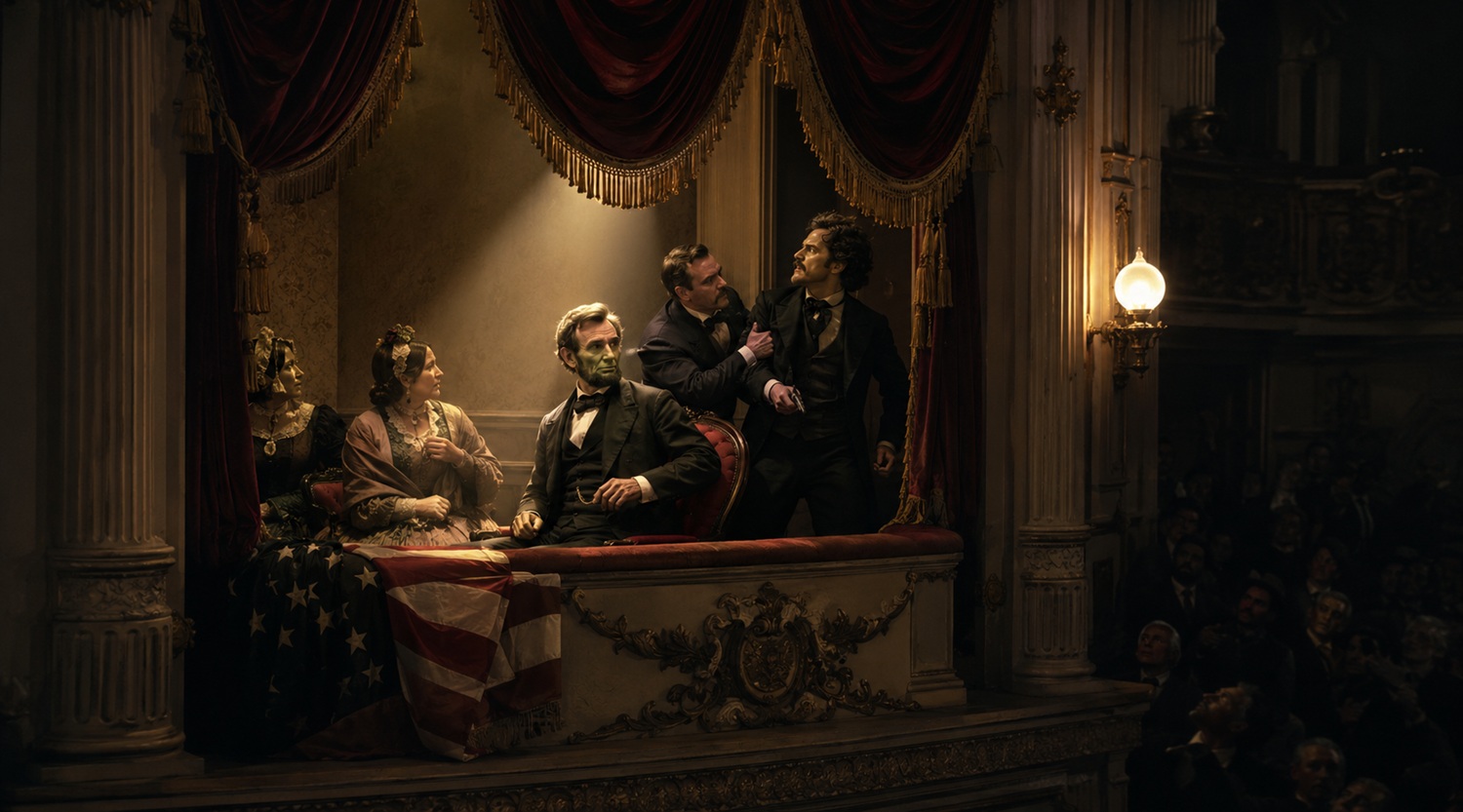
On the night of April 14, 1865, President Abraham Lincoln attended Our American Cousin at Ford's Theatre in Washington.
Five days earlier, Robert E. Lee had surrendered the Army of Northern Virginia at Appomattox Court House. Other Confederate armies remained in the field, but organized Confederate resistance was collapsing. Four years of civil war were approaching their end.
Lincoln therefore faced a problem almost as difficult as winning the war:
What kind of country would emerge from it?
Slavery was dying. Congress had passed the Thirteenth Amendment and sent it to the states for ratification. Millions of formerly enslaved Americans were attempting to turn legal emancipation into meaningful freedom. Confederate state governments had collapsed. Southern farms, towns, railroads, and families had been devastated. Former Confederates wanted political restoration. Black Americans demanded citizenship, family autonomy, education, land, legal protection, and increasingly the vote.
Congress and the president had not agreed on how Reconstruction should work. Lincoln had proposed relatively generous terms for restoring loyal state governments, but some congressional Republicans believed his approach moved too quickly and provided inadequate protection for freedpeople. Lincoln had pocket-vetoed the more demanding Wade-Davis Bill in 1864 while emphasizing that he did not want to be permanently bound to one method of reconstruction.
Then John Wilkes Booth entered the presidential box at Ford's Theatre.
In real history, Booth fired a single-shot pistol into the back of Lincoln's head. Lincoln died the following morning, April 15. Vice President Andrew Johnson became president.
What followed was one of the most consequential political confrontations in American history.
Johnson moved rapidly to restore Southern governments controlled largely by white voters. Former Confederates regained political influence. Southern legislatures enacted Black Codes restricting the lives and economic freedom of African Americans. Johnson opposed Black suffrage and vetoed both an extension of the Freedmen's Bureau and the Civil Rights Act of 1866. Congress increasingly took control of Reconstruction, overrode Johnson's vetoes, proposed the Fourteenth Amendment, imposed military Reconstruction, and eventually impeached the president.
But suppose Booth never gets the chance to change presidents.
Suppose the weapon misfires.
Major Henry Rathbone reacts to the sudden movement beside the presidential box. Booth attempts to draw his knife, but Rathbone and others restrain him before he can reach Lincoln.
The president survives.
The Civil War still ends.
Slavery still ends.
But Reconstruction belongs to Abraham Lincoln rather than Andrew Johnson.
Would Lincoln create a more successful interracial democracy?
Would Black men receive the vote sooner?
Would there still be a Fourteenth Amendment?
Would the Ku Klux Klan still emerge?
Could Lincoln prevent Jim Crow?
The evidence suggests Lincoln probably would have handled Reconstruction very differently from Johnson.
It does not justify the comforting conclusion that Lincoln would have solved America's racial conflicts.
The struggle after slavery ran far deeper than one president.
What Lincoln Actually Believed in April 1865
Counterfactual Lincoln is unusually difficult because his views were still evolving.
There is no completed “Lincoln Reconstruction Plan of 1865” telling historians exactly what he intended to do after Confederate surrender.
Instead, there is a record of experiments, public statements, private correspondence, executive decisions, and disagreements with Congress.
Those sources reveal both continuity and change.
Lincoln favored relatively rapid restoration of loyal Southern governments.
He favored abolition.
He had accepted a significant federal role in assisting freedpeople.
By the end of his life, he had also moved publicly toward at least limited Black male suffrage.
But he had not endorsed universal Black male voting rights, large-scale confiscation of former Confederate property, or the full congressional Reconstruction program later adopted after his death.
That uncertainty should remain at the center of the counterfactual.
Lincoln's Ten Percent Plan
Lincoln's first comprehensive Reconstruction program appeared in his Proclamation of Amnesty and Reconstruction, issued December 8, 1863.
Under the plan, most Confederates could receive pardons after taking an oath of allegiance to the United States and accepting federal measures concerning emancipation. When the number of loyal voters in a Confederate state reached at least 10 percent of the number who had voted in the 1860 election, they could establish a new state government.
The proposal was deliberately lenient.
Lincoln wanted to encourage Southern Unionists, weaken Confederate resistance, and create functioning loyal governments while the war was still underway. Historian Eric Foner describes the Ten Percent Plan as being as much a wartime strategy for undermining the Confederacy as a completed blueprint for the postwar South.
That distinction matters.
Lincoln was experimenting while the outcome of the war was still uncertain.
By 1865, military victory and emancipation had created a different political environment.
Congress Wanted More
Some Republicans believed Lincoln was moving far too quickly.
The Wade-Davis Bill of 1864 required a much larger proportion of white Southerners to demonstrate loyalty before a reconstructed state government could be recognized. Congress and Lincoln also disagreed about whether Reconstruction should be controlled principally by the executive or legislative branch.
Lincoln pocket-vetoed Wade-Davis.
But his explanation is important.
He did not declare that his Ten Percent approach was the only constitutional solution. Instead, he resisted being locked into a single reconstruction formula while the war continued. The Senate's historical account notes Lincoln's objection to being “inflexibly committed” to one restoration plan.
This suggests a Lincoln who was pragmatic rather than doctrinaire.
He had a preferred approach.
But he was still willing to adjust it.
That becomes crucial after April 1865.
Louisiana: Lincoln's Reconstruction Experiment
Louisiana became one of Lincoln's most important test cases.
Union forces controlled New Orleans and significant portions of the state. Lincoln encouraged the creation of a loyal state government there, hoping Louisiana might become a model for restoring other Confederate states. The state's 1864 constitution abolished slavery and made important educational changes, but it did not grant Black men voting rights.
Lincoln was dissatisfied with that omission.
In March 1864, he wrote privately to Louisiana governor Michael Hahn suggesting that the state consider enfranchising some African American men, particularly educated men and Black soldiers who had fought for the Union.
That was a limited proposal.
Lincoln was not yet endorsing universal Black male suffrage.
But it represented a significant movement from his earlier politics.
Then, three days before Booth shot him, Lincoln went further by discussing the question publicly.
Lincoln's Last Public Address
On April 11, 1865, Lincoln spoke from the White House about Reconstruction.
His subject was Louisiana.
He defended the reconstructed state government despite its imperfections and argued that destroying an existing loyal government because it did not meet every desired condition might be counterproductive.
But he also returned to Black suffrage.
Lincoln stated that he personally preferred that voting rights be extended to at least some Black men—particularly those who were educated and those who had served as Union soldiers. The Library of Congress identifies this as the first time he publicly advocated even limited Black suffrage.
John Wilkes Booth was reportedly among those who heard the speech.
Booth was enraged by Lincoln's support for Black voting rights.
Three days later, he went to Ford's Theatre.
That makes the final speech one of the most important pieces of evidence for imagining a surviving Lincoln.
Lincoln had not reached the position congressional Radicals would later adopt.
But he was still moving.
The Point of Divergence: Booth's Gun Fails
The divergence requires no change to the war, the election of 1864, emancipation, Lee's surrender, or Lincoln's political development.
Only the assassination changes.
On April 14, Booth enters the presidential box exactly as he did historically.
He raises his pistol.
The percussion cap fails, the weapon does not discharge, or the shot otherwise fails to strike Lincoln.
Major Henry Rathbone reacts.
Booth attempts to escape, perhaps injuring Rathbone with his knife as he did historically, but he is stopped before killing the president.
Within minutes, the capital learns that an assassination attempt has failed.
Lincoln is alive.
And everything surrounding Reconstruction immediately changes.
The First Political Effect: Lincoln Gains Enormous Authority
Lincoln had just won reelection.
The Confederacy was collapsing.
Richmond had fallen.
Lee had surrendered.
The president had survived four years of civil war and now survived an assassination attempt tied to Confederate sympathies.
His political authority would probably be extraordinary.
This does not mean Congress suddenly obeys him.
Congressional Republicans had already demonstrated their willingness to challenge Lincoln over Reconstruction.
But a surviving Lincoln enters the postwar struggle from a far stronger position than Andrew Johnson ever possessed.
Lincoln is:
- the victorious wartime president;
- the leader who issued the Emancipation Proclamation;
- the president who pushed for constitutional abolition;
- the reelected leader of the Republican coalition;
- and now the survivor of an assassination plot.
Johnson inherited Lincoln's office.
He did not inherit Lincoln's political legitimacy.
That difference would matter constantly.
Lincoln Versus Andrew Johnson
The easiest mistake is to assume that Lincoln's relatively lenient Reconstruction meant that he would simply have followed Johnson's policies.
There were similarities.
Both wanted Southern states restored relatively quickly.
Both opposed treating secession as permanently destroying statehood.
Both initially favored presidential leadership in restoration.
But there were also profound differences.
Lincoln had embraced emancipation
By 1865, Lincoln had made abolition a Union war aim and strongly supported the Thirteenth Amendment. The amendment passed Congress before his assassination and was ratified by the states in December 1865.
Lincoln had signed the Freedmen's Bureau into law
On March 3, 1865, Lincoln signed legislation creating the Bureau of Refugees, Freedmen, and Abandoned Lands. It provided federal assistance in the transition from slavery, including aid involving schools, labor arrangements, families, food, hospitals, and land.
Johnson later vetoed legislation extending and strengthening the Bureau.
Lincoln was moving toward Black suffrage
Johnson explicitly opposed Black suffrage. Lincoln, by contrast, had privately suggested limited Black voting rights in Louisiana in 1864 and publicly endorsed such a position in his final speech.
Lincoln could work with Republicans
Lincoln had fierce disagreements with congressional Republicans, but he remained the leader of their wartime political coalition.
Johnson's confrontational vetoes and public attacks helped produce a complete rupture with Congress.
These differences make an identical Reconstruction extremely unlikely.
Presidential Reconstruction Under Lincoln
Lincoln's first instinct probably remains reconciliation.
He is unlikely to demand mass punishment of ordinary Confederate soldiers.
Grant's generous surrender terms at Appomattox were compatible with Lincoln's desire to end resistance without unnecessary humiliation, and Lincoln had long used presidential pardon authority as an instrument of restoration.
Former Confederate states would likely be encouraged to form loyal governments quickly.
They would be required to accept the end of slavery.
They would probably be required to repudiate secession and Confederate political authority.
Lincoln would continue using loyal Southern Unionists where possible.
That much could resemble Johnson's Presidential Reconstruction.
The difference would emerge when reconstructed governments attempted to define freedom so narrowly that former slaves remained politically powerless and economically dependent.
That is exactly what happened historically under Johnson.
The Black Codes Become Lincoln's First Great Test
Under Johnson's Reconstruction, Southern state governments enacted Black Codes designed to control Black labor, restrict mobility, regulate employment, and preserve as much of the former racial hierarchy as possible after formal slavery had ended. The resulting reaction was one of the principal reasons Northern support moved away from Johnson's policies.
A surviving Lincoln would almost certainly encounter similar attempts.
The white Southern political class does not become racially egalitarian merely because Lincoln lives.
Former slaveholders still want agricultural labor.
Many reject Black political equality.
State and local officials still seek to preserve white supremacy.
So Black Codes—or laws resembling them—remain highly plausible.
The question becomes:
How does Lincoln respond?
Here the contrast with Johnson could be decisive.
Lincoln Probably Does Not Defend the Black Codes
Johnson viewed reconstructed Southern governments as essentially restored and resisted strong federal intervention in their domestic policies. His conflict with Congress escalated when he vetoed the Civil Rights Act of 1866 and Freedmen's Bureau legislation.
Lincoln's record points in another direction.
He had already:
- made emancipation an essential war policy;
- supported permanent constitutional abolition;
- signed the Freedmen's Bureau into law;
- encouraged public education in reconstructed Louisiana;
- and begun advocating limited Black suffrage.
It is therefore difficult to imagine Lincoln simply accepting laws designed to restore freedpeople to quasi-servile conditions.
That does not tell us exactly what legislation he would support.
But it strongly suggests that the executive-congressional confrontation would begin from a different place.
The Freedmen's Bureau Is Probably Stronger
The original Freedmen's Bureau was created before Lincoln's death, and Lincoln signed it.
The agency assisted formerly enslaved people and poor white refugees, helped establish schools, legalized marriages, helped reconnect families, provided food and medical services, oversaw labor contracts, and became one of the federal government's primary institutions in the transition from slavery to freedom.
Historically, Congress tried to extend the Bureau in 1866.
Johnson vetoed the first extension bill. Congress ultimately passed another extension over his veto in July.
Would Lincoln sign an extension?
Probably.
That is an inference, not a certainty.
But he had signed the original Bureau only six weeks before the assassination attempt. Nothing in his final weeks suggests he had concluded that the federal transition effort should immediately end.
A Lincoln administration could therefore give the Bureau stronger presidential backing during the critical first postwar years.
That could improve:
- protection of Black schools;
- oversight of labor contracts;
- legal assistance;
- family reunification;
- relief operations;
- and coordination with the Army.
It would not eliminate local racism or the Bureau's limited resources. The National Archives notes that funding constraints and pervasive racist opposition remained serious problems even during its historical operation.
A president can support an institution.
He cannot make it omnipotent.
Land: Lincoln Is Much Harder to Predict
One of the deepest weaknesses of Reconstruction was the failure to provide most formerly enslaved families with independent land.
Freedom without land left many Black Southerners economically dependent on white landowners. Sharecropping and tenant farming became widespread.
Johnson's policy made the problem worse by restoring much federally controlled property to former owners. Eric Foner's National Park Service overview emphasizes that Johnson's return of land in 1865 undermined freedpeople's hopes for independent landownership.
Would Lincoln behave differently?
Possibly.
But this is one area where evidence does not justify a confident heroic prediction.
Lincoln had never committed himself to a nationwide redistribution of plantations to former slaves.
The original Freedmen's Bureau legislation contained mechanisms dealing with abandoned and confiscated lands, but that was not the same thing as a presidential promise to divide the Southern plantation system permanently among freedpeople.
A surviving Lincoln might protect some wartime land settlements longer.
He might resist immediate blanket restoration to pardoned Confederates.
He might support opportunities for freedpeople to purchase federal land.
But a massive “40 acres and a mule” program imposed across the South should be classified as highly uncertain.
This matters because even a politically stronger Reconstruction without significant land redistribution would leave Black economic independence incomplete.
Former Confederate Leaders
Lincoln's reputation for clemency sometimes produces another oversimplification:
Lincoln would have forgiven everybody immediately.
His actual 1863 amnesty proclamation excluded important categories of Confederate officials and military personnel from automatic pardons, even though he was broadly willing to pardon many participants in the rebellion.
His overriding goal was reunion rather than mass vengeance.
That suggests a middle course.
Ordinary Confederate soldiers probably receive generous treatment.
Many civilian participants receive pardons after loyalty oaths.
High-ranking political and military leaders may face temporary disqualification or case-by-case review.
Jefferson Davis is unlikely to return immediately to national political life.
Lincoln would probably resist large-scale executions.
But that does not require allowing former Confederate leadership to regain control of Southern politics before new political arrangements are secured.
Johnson's extensive pardoning helped former Confederates return rapidly to positions of influence.
Lincoln had political incentives to proceed more carefully.
Black Voting Rights Become the Central Question
No issue better illustrates both the promise and limits of a surviving Lincoln.
Lincoln had moved farther than Johnson.
But not yet as far as universal suffrage.
His April 11 speech favored voting rights for some African American men, especially educated men and Union veterans.
That creates several plausible paths.
Path One: Limited suffrage expands gradually
Lincoln begins by demanding voting rights for Black Union veterans and perhaps literate or property-owning Black men in reconstructed states.
Once Black voters participate successfully, political pressure grows to remove the remaining qualifications.
Universal Black male suffrage emerges by the late 1860s.
Path Two: Congress moves faster than Lincoln
Radical and moderate Republicans conclude that selective suffrage is inadequate.
Congress pushes for broader voting rights as a condition of state readmission.
Lincoln compromises and eventually accepts universal Black male suffrage.
Path Three: Lincoln remains cautious
He supports citizenship and civil rights but leaves most voting qualifications to individual states.
Universal suffrage is delayed until a later political crisis.
All three fit parts of the available evidence.
What does not fit well is the assumption that Lincoln was already committed in April 1865 to the Fifteenth Amendment exactly as adopted in 1870.
He was not.
The Thirteenth Amendment Almost Certainly Survives Unchanged
This is the easiest constitutional question.
Congress had already approved the Thirteenth Amendment before Lincoln was assassinated.
Lincoln strongly supported its passage.
Ratification by the states completed the abolition of slavery in December 1865.
Lincoln's survival therefore probably changes very little here.
His administration would continue urging ratification.
The amendment becomes part of the Constitution.
Slavery remains abolished.
Confidence: Very high
Would There Still Be a Fourteenth Amendment?
Probably some constitutional guarantee of citizenship and federal protection emerges—but whether it is the exact Fourteenth Amendment of 1866 is less certain.
Historically, the amendment grew from the confrontation among:
- Southern Black Codes;
- Johnson's lenient Reconstruction;
- congressional concerns about citizenship;
- Johnson's veto of the Civil Rights Act;
- and the question of representation and political power in reconstructed states.
The Civil Rights Act of 1866 declared U.S.-born people citizens and guaranteed fundamental civil rights. Johnson vetoed it; Congress overrode him. The Fourteenth Amendment then constitutionalized birthright citizenship and equal protection principles while addressing representation and former Confederate officeholders.
With Lincoln alive, the political process changes.
He might sign a Civil Rights Act rather than veto it.
If so, Congress and the president could collaborate rather than clash.
But Republicans could still want constitutional protection so a later Congress or president could not easily undo those rights.
That makes a citizenship and equal-protection amendment highly plausible.
Its wording might differ.
Its political path almost certainly would.
Confidence that some constitutional civil-rights amendment emerges: Moderate to strong
Confidence that the exact historical Fourteenth Amendment emerges on the exact schedule: Moderate at best
Lincoln and the Civil Rights Act of 1866
Would Lincoln sign it?
No surviving statement gives a definitive answer.
But there is a reasonable case that he would.
The law declared people born in the United States citizens and guaranteed important civil rights involving contracts, property, courts, and legal protection. Johnson objected to both its substance and what he regarded as excessive federal intervention. Congress enacted it over his veto.
Lincoln had already accepted growing federal responsibility for emancipation and had signed the Freedmen's Bureau. His public movement toward Black suffrage suggests he was not moving toward Johnson's restrictive conception of Black citizenship.
So Lincoln signing either the historical Civil Rights Act or a negotiated version is reasonably plausible.
If that happens, one of the most destructive elements of historical Reconstruction disappears:
the open institutional warfare between the White House and the Republican Congress.
Would There Still Be a Fifteenth Amendment?
This is more uncertain.
The Fifteenth Amendment, ratified in 1870, prohibited governments from denying voting rights because of race, color, or previous condition of servitude.
Lincoln had not reached that position when he died.
He supported limited Black male suffrage.
Yet politics after 1865 could push him farther.
White Southern resistance might convince Lincoln that civil rights could not survive without Black political power.
Black veterans and activists would demand the vote.
Republicans would recognize the importance of Black voters in protecting loyal Southern governments.
Violence against freedpeople could make federal voting guarantees increasingly necessary.
The historical 1868 election demonstrated the emerging political importance of Black Republican voters; official presidential-history material notes that hundreds of thousands of Black votes contributed to Grant's victory.
A surviving Lincoln might therefore reach universal Black male suffrage through experience rather than arrive there immediately in April 1865.
A Fifteenth Amendment or equivalent by the early 1870s: Plausible
Lincoln personally proposing it in 1865: Weak
Congressional Republicans Would Still Matter
Lincoln could not reconstruct the South alone.
Congress had constitutional authority over the admission and qualifications of its members and was already asserting a major role in Reconstruction. Congressional leaders disagreed with Lincoln before his death, and the conflict over Wade-Davis demonstrated that disputes did not begin with Andrew Johnson.
Radical Republicans such as Thaddeus Stevens and Charles Sumner wanted a more thorough reconstruction of Southern society and stronger guarantees for African Americans.
Moderates occupied a crucial middle ground.
Lincoln's political talent would be tested by keeping these groups together while preventing Southern governments from restoring the prewar racial hierarchy.
The likely Reconstruction settlement would therefore be Lincolnian-congressional, not simply presidential.
That alone distinguishes it from Johnson's attempted approach.
The 1866 Elections Would Be Completely Different
Historically, 1866 became a national referendum on Andrew Johnson.
Johnson openly attacked congressional Republicans and undertook his disastrous “Swing Around the Circle” speaking tour. Northern voters overwhelmingly rejected his approach. Republicans won commanding congressional majorities, effectively ending Presidential Reconstruction and giving Congress the numbers needed to override Johnson repeatedly.
With Lincoln alive, there is no equivalent rupture.
Lincoln remains the Republican president.
He can campaign for Republican candidates rather than against them.
Moderates do not need to choose between their president and their party.
Radicals still criticize him, but the political coalition is less fractured.
The result could be surprising:
Republicans may win fewer seats than they did historically in 1866 precisely because Lincoln's Reconstruction produces less confrontation.
Johnson's extremism helped radicalize Northern opinion.
Without him, some voters may see less need for an overwhelming congressional check on the White House.
That could leave Lincoln with a more moderate Republican Congress in 1867.
But Southern Violence Could Radicalize the North Anyway
This is the counterweight.
Even if Lincoln manages Congress better, events in the South could push Northern voters toward stronger federal action.
Violence against African Americans and white Unionists did not exist because Andrew Johnson invented it.
White resistance to emancipation and Black citizenship had deeper roots.
The historical Memphis violence of May 1866 and the New Orleans massacre of July 1866 demonstrated how rapidly political conflict could turn into organized racial violence. In New Orleans, former Confederates had regained important local authority, and police and white mobs attacked Black citizens and political activists.
Similar violence remains highly plausible under Lincoln.
If reconstructed governments tolerate such attacks, Lincoln would face the question Johnson repeatedly avoided:
Will the federal government use military and legal power to protect freedpeople?
How he answers could determine the entire course of Reconstruction.
Would the Ku Klux Klan Still Exist?
Probably some form of white supremacist terrorist organization would emerge.
The historical Ku Klux Klan arose from a broader white Southern counterrevolution against Black political participation, Republican government, emancipation, and federal Reconstruction. Violence targeted Black voters, officeholders, teachers, ministers, Republican organizers, and white Southern Unionists.
Those motivations do not vanish with Lincoln's survival.
Indeed, if Lincoln succeeds in expanding Black suffrage sooner, white supremacist terrorism could appear just as quickly.
The name “Ku Klux Klan” might still emerge.
Or a different organization could fill the same role.
The more important conclusion is structural:
organized racial terrorism remains very likely because the political revolution of emancipation remains.
Would Lincoln Use Federal Force Against White Supremacist Violence?
Probably more readily than Johnson.
But this conclusion requires caution.
Lincoln had spent four years exercising extraordinary federal power during civil war. He had used the Army to preserve the Union and ultimately destroy slavery.
He had also signed the Freedmen's Bureau, placing an important institution for protecting freedpeople within the War Department.
That makes it plausible that Lincoln would support military intervention when state and local governments openly failed to protect freedpeople.
But Reconstruction enforcement differs from battlefield war.
How long should troops remain?
Can military authorities supersede civil governments?
How far can federal courts reach?
How much violence will Northern voters tolerate before demanding withdrawal rather than intervention?
These same questions eventually constrained Ulysses S. Grant.
Under Grant, Congress enacted Enforcement Acts permitting federal action against voter intimidation and Klan terrorism. Federal intervention temporarily suppressed the Klan in important areas, demonstrating that determined national enforcement could work—but also that such enforcement required sustained political commitment.
Lincoln could plausibly begin that policy earlier.
He could not guarantee that later presidents or Congresses would continue it.
Would Military Reconstruction Still Happen?
Historically, Congress's Reconstruction Acts of 1867 divided most former Confederate states into military districts and required new constitutions, ratification of the Fourteenth Amendment, and Black male suffrage as conditions for restoration. Johnson vetoed the measures; Congress overrode him.
With Lincoln alive, the exact Reconstruction Acts become less likely.
Why?
Because they were partly a response to the failure of Johnson's Presidential Reconstruction and his resistance to Congress.
Lincoln might reach negotiated requirements before the crisis becomes that severe.
A plausible compromise might include:
- continued federal military presence;
- recognized loyal state governments;
- ratification of the Thirteenth Amendment;
- federal protection of basic civil rights;
- limited or expanding Black suffrage;
- restrictions on leading Confederate officeholders;
- congressional approval before full representation resumes.
That could achieve some of the purposes of the Reconstruction Acts without formally declaring Southern governments provisional and placing every state under a military district system.
Exact historical Reconstruction Acts: Less likely
Continued federal military supervision: Highly plausible
Black Political Participation Could Begin Earlier—but Perhaps More Narrowly
Lincoln's support for Black veterans voting provides an obvious first step.
Nearly 180,000 Black soldiers served in the Union Army during the Civil War, along with additional Black sailors. The existence of a large body of African American veterans gave voting-rights advocates a powerful argument: men who had fought to preserve the Union should not be denied participation in its government. Lincoln himself highlighted military service when suggesting Black suffrage.
A surviving Lincoln could push reconstructed Louisiana and other states to enfranchise Black veterans first.
That creates Black political constituencies earlier.
Once those voters participate, drawing a stable line between a Black veteran who may vote and his equally educated or property-owning neighbor who may not becomes politically difficult.
Limited suffrage could therefore become a bridge toward broader suffrage.
But it could also become a ceiling.
That is why universal enfranchisement should not be assumed.
Reconstruction Governments Might Look More Moderate
Historical Congressional Reconstruction produced interracial Republican coalitions across the South. African Americans constituted the majority of Republican voters in many areas, while Black officeholders served in state governments, local offices, and Congress. Reconstruction governments established public school systems, expanded governmental responsibilities, and enacted new civil-rights measures.
Under Lincoln, these governments might emerge differently.
If suffrage expands gradually rather than universally in 1867, Black representation could initially be smaller.
More former Confederate whites might retain voting rights.
Moderate Southern Unionists could hold greater power.
That could make the governments appear more politically acceptable to Northern moderates.
But it might also weaken freedpeople's ability to defend their interests.
This tradeoff is fundamental.
A Reconstruction that is easier for white Southerners to accept might also accomplish less racial transformation.
The Great Question: Could Lincoln Reconcile White Southerners and Protect Black Rights?
Perhaps better than Johnson.
But not completely.
Lincoln possessed something Johnson lacked: enormous credibility among Northern Republicans and considerable capacity to present reconciliation as the policy of a victorious Union rather than capitulation to former Confederates.
He could tell Southern whites:
the war is over;
slavery is permanently over;
loyalty will bring political restoration;
ordinary soldiers will not face mass punishment;
but freedpeople are citizens whose basic liberty must be protected.
That might persuade more white Southerners to accept the settlement.
But there is little evidence that white Southern society in 1865 was ready broadly to accept Black political equality.
The Black Codes and violent resistance that followed emancipation were not accidents of presidential personality.
Lincoln might manage the confrontation better.
He could not make the confrontation disappear.
Could Lincoln Prevent Jim Crow?
This is where the counterfactual must become especially cautious.
The answer is:
Not by himself.
Jim Crow emerged through decades of political change after Reconstruction.
Black voting rights were attacked through violence, fraud, legal restrictions, poll taxes, literacy tests, and other mechanisms. Federal commitment to enforcing Reconstruction weakened. Supreme Court decisions narrowed federal protections. Southern Democratic governments consolidated control. By the end of the nineteenth century, racial segregation and Black disfranchisement had become entrenched across much of the South.
Lincoln could improve the starting conditions.
He might secure civil rights earlier.
He might preserve the Republican coalition.
He might support longer federal enforcement.
He might reduce the number of former Confederate elites immediately returning to office.
He might help create stronger Black political institutions.
All of that could make Jim Crow more difficult to establish.
But Lincoln's second term ends in 1869.
Jim Crow's consolidation extends far beyond 1869.
The question ultimately depends on successors, Congress, courts, Northern voters, Southern politics, economic structures, and sustained federal enforcement.
A living Lincoln cannot guarantee decisions made in 1877, 1883, 1890, or 1896.
The 1868 Election
Historically, Ulysses S. Grant defeated Democrat Horatio Seymour in 1868.
Black voters participated in significant numbers where Reconstruction governments had established voting rights. Official presidential-history material notes the importance of hundreds of thousands of Black Republican votes in the election.
With Lincoln alive, the election becomes less predictable.
Lincoln's second elected term expires in March 1869.
There was no constitutional two-term limit at the time, so a third run was legally possible.
But the precedent established by George Washington made retirement after two elected terms politically powerful.
Lincoln had also endured four exhausting years of civil war.
The strongest scenario
Lincoln does not seek a third term.
Instead, he backs a Republican successor committed to preserving emancipation and his Reconstruction settlement.
Grant remains an obvious candidate because of his military prestige.
But other Republicans could compete in a political environment less shaped by the Johnson impeachment crisis.
Grant may still win the nomination.
He may face a different opponent.
The 1868 election still revolves around Reconstruction, Black rights, Confederate restoration, taxation, and postwar economic policy.
But it does not take place after three years of presidential warfare against Congress.
Could Lincoln Run for a Third Term?
Yes, legally.
The Twenty-Second Amendment limiting presidents to two elected terms did not exist.
But legal possibility is not the same as likelihood.
Lincoln would be sixty years old in 1869.
He had served through the most destructive conflict in American history.
A third term would risk accusations of personal ambition and would break an important presidential tradition.
More importantly, a successful Lincoln might see peaceful succession as part of restoring constitutional normality after wartime emergency.
Third-term candidacy: Possible, but weak as the primary scenario
Retirement as senior Republican statesman: More plausible
Lincoln After March 1869
If Lincoln retires, his political career need not end.
He could return to Illinois.
He could write.
He could campaign for Republican candidates.
He could advise Grant or another successor.
He could speak on Reconstruction and national reconciliation.
He might participate in Republican conventions.
He could theoretically seek a Senate seat, though there is little basis for assuming he would want one after eight years as president.
The more likely role is informal:
the most influential elder statesman in the Republican Party.
That alone could matter.
A living Lincoln could criticize premature abandonment of Reconstruction.
Or, alternatively, he could become one of the voices urging reconciliation and reduced federal intervention.
His later views cannot be known.
The historical Lincoln died before he had to choose.
Lincoln's Legacy Would Become More Complicated
Assassination froze Lincoln in public memory.
He became the martyred president who saved the Union and destroyed slavery.
A surviving Lincoln would have to govern the aftermath.
That means making compromises.
Some would disappoint Radical Republicans.
Some would anger white Southerners.
Some would disappoint Black leaders.
Some policies would fail.
Violence would continue.
Corruption would exist.
Economic recovery would be uneven.
Former slaves would remain overwhelmingly poor.
Land reform might fail.
Political opponents would accuse Lincoln of either military dictatorship or excessive leniency.
By 1868, his reputation could be substantially more controversial than it was after martyrdom.
Paradoxically, surviving might make Lincoln less universally revered even if it makes Reconstruction more successful.
A Plausible Alternate Reconstruction Timeline
| Year | Real History | Plausible Lincoln-Survives Timeline |
|---|---|---|
| April 1865 | Lincoln is assassinated; Andrew Johnson becomes president. | Booth's attack fails; Lincoln remains president and directs postwar policy. |
| Spring 1865 | Johnson begins Presidential Reconstruction. | Lincoln continues a relatively lenient restoration policy but links recognition more closely to emancipation and loyalty. |
| Summer 1865 | Johnson issues pardons; Southern white governments rapidly reorganize. | Lincoln grants broad amnesty but more cautiously limits return of high Confederate leaders to political power. |
| Late 1865 | Southern governments enact Black Codes. | Similar restrictions appear; Lincoln challenges the harshest measures and uses the Army and Freedmen's Bureau more actively. |
| December 1865 | Thirteenth Amendment ratified. | Thirteenth Amendment ratified with strong Lincoln administration support. |
| Early 1866 | Johnson vetoes Freedmen's Bureau extension and Civil Rights Act. | Lincoln probably supports a Bureau extension and negotiates or signs federal civil-rights legislation. |
| 1866 | Johnson and Congress rupture completely; Republicans sweep midterms. | Lincoln and congressional Republicans disagree but remain within one political coalition; midterm Republican gains may be less overwhelming. |
| 1866–1867 | Fourteenth Amendment proposed; most Southern states initially reject it. | A citizenship/equal-protection amendment remains likely, possibly with different wording or negotiated readmission terms. |
| 1867 | Congress imposes military Reconstruction over Johnson's veto. | Federal military supervision continues, but exact Reconstruction Acts may be avoided through presidential-congressional compromise. |
| 1867–1868 | Black male suffrage expands under Reconstruction Acts. | Lincoln pushes at minimum for Black veteran and selected Black suffrage; pressure grows for universal male suffrage. |
| 1868 | Johnson is impeached and narrowly acquitted; Grant wins presidency. | No Johnson impeachment. Lincoln retires or, less likely, seeks another term; Grant remains a strong Republican successor. |
| 1869–1870 | Congress proposes and states ratify Fifteenth Amendment. | An equivalent voting-rights amendment remains plausible, especially if Southern resistance demonstrates that state-level guarantees are inadequate. |
| Early 1870s | Grant uses Enforcement Acts against Klan terrorism. | Similar federal enforcement may begin earlier or continue under Lincoln's Republican successor. |
This is not a prediction.
It is one plausible pathway consistent with Lincoln's documented positions in 1865.
Lincoln Versus Johnson: The Most Important Differences
| Issue | Andrew Johnson in Real History | Plausible Lincoln Position |
|---|---|---|
| Speed of reunion | Rapid | Also relatively rapid |
| Abolition | Accepted Thirteenth Amendment as required reality | Strong political advocate of permanent abolition |
| Former Confederates | Extensive pardons and rapid restoration of political influence | Broad clemency likely, but stronger political controls on senior Confederate leadership are plausible |
| Black suffrage | Opposed | Publicly favored limited Black male suffrage by April 1865 |
| Freedmen's Bureau | Vetoed extension | Had signed original Bureau; extension likely |
| Federal civil-rights law | Vetoed Civil Rights Act of 1866 | Likely more receptive, but exact position unknowable |
| Relationship with Congress | Open rupture | Serious disagreements but much greater capacity for compromise |
| Southern Black Codes | Effectively tolerated within his restoration policy | Likely to resist severe restrictions on freedom |
| Federal enforcement | Resistant to congressional Reconstruction | More willing federal role is plausible |
| Universal Black male suffrage | Opposed | Not yet endorsed in April 1865; could evolve toward it |
The largest error would therefore be equating Lincoln's leniency toward former Confederates with Johnson's hostility to Black political rights.
They were not the same policy.
Strong, Moderate, and Weak Counterfactual Claims
| Counterfactual Claim | Assessment | Reason |
|---|---|---|
| Lincoln would continue supporting the Thirteenth Amendment | Very strong | He had already made abolition central to his policy and strongly supported the amendment. |
| Lincoln would pursue relatively lenient reunion terms | Strong | His Ten Percent Plan and wartime amnesty policies consistently favored restoration rather than mass punishment. |
| Lincoln would treat Reconstruction exactly like Andrew Johnson | Very weak | Lincoln supported the Freedmen's Bureau and had moved toward limited Black suffrage, while Johnson opposed Black suffrage and vetoed key federal protections. |
| Lincoln would support continuation of the Freedmen's Bureau | Strong but inferential | He signed the original Bureau law in March 1865. |
| Lincoln would oppose severe Black Codes | Strong but inferential | Such laws conflicted with the increasingly substantive freedom policy reflected in his final years. |
| Lincoln would sign the exact Civil Rights Act of 1866 | Moderate | His trajectory makes approval plausible, but no direct evidence addresses that later bill. |
| Some constitutional protection of Black citizenship still emerges | Moderate to strong | The citizenship problem and Southern resistance would remain even without Johnson. |
| The exact Fourteenth Amendment passes unchanged | Moderate to weak | Its language and coalition were shaped partly by the Johnson-Congress conflict. |
| Lincoln immediately demands universal Black male suffrage | Weak | His documented April 1865 position supported only selected Black voters. |
| Lincoln eventually supports universal Black male suffrage | Moderate | His views were moving, and postwar resistance could push him further. |
| A Fifteenth Amendment or equivalent still emerges | Moderate | Black voting rights would remain central to Reconstruction politics. |
| The Ku Klux Klan never exists | Weak | White supremacist resistance had causes deeper than Johnson's presidency. |
| Lincoln responds more forcefully to racial terrorism than Johnson | Moderate to strong | Lincoln had accepted federal emancipation enforcement and the War Department-based Freedmen's Bureau. |
| Lincoln redistributes plantations to freedpeople | Weak | He left no clear commitment to broad permanent land redistribution. |
| Reconstruction is more coherent under Lincoln | Strongly plausible | The catastrophic executive-congressional rupture under Johnson would almost certainly be reduced. |
| Lincoln prevents Jim Crow | Weak | Jim Crow developed over decades and depended on national commitment long after Lincoln's second term. |
| Black political rights survive longer under Lincoln's settlement | Plausible but uncertain | Better early institutions and federal enforcement could strengthen Reconstruction, but later political retreat remains possible. |
Why Lincoln Could Produce a More Effective Reconstruction
There is a credible case for optimism.
He had political legitimacy Johnson lacked
Lincoln had just won reelection and led the Union to military victory.
He could unite Republican factions more effectively
Even when Republicans disagreed with Lincoln, he remained their president rather than an accidental successor increasingly aligned against them.
He was still changing
His movement from cautious wartime emancipation to constitutional abolition and then limited Black suffrage demonstrates political evolution rather than a fixed Reconstruction ideology.
He had already accepted federal responsibility for freedpeople
Signing the Freedmen's Bureau is tangible evidence, not speculation.
He could combine reconciliation with enforcement
This might allow him to isolate hard-line former Confederates instead of driving moderate Republicans and white Southerners into opposing camps.
There is no presidential veto war
Without Johnson vetoing civil-rights measures, Reconstruction policy could emerge through negotiation rather than constitutional combat.
These advantages are real.
They make a more successful Reconstruction plausible.
Why Lincoln Still Might Fail
The case against an overly optimistic scenario is equally important.
White supremacy was deeply rooted
Millions of white Americans—North and South—did not support racial equality.
Former slaveholders retained economic power
Even without slavery, ownership of land gave planters enormous influence over the Southern economy.
Freedpeople lacked property
Without large-scale land reform, political freedom rested on a fragile economic foundation.
Terrorism could undermine elections
White supremacist organizations could murder local leaders, intimidate voters, and destroy Republican organizations, as they did historically.
Federal enforcement required time
Protecting rights for a few years would not be enough.
Northern commitment could fade
By the 1870s, many Northern Republicans historically became less willing to use federal power indefinitely in the South.
Courts would still matter
Later judicial interpretations weakened Reconstruction protections. A surviving Lincoln does not control Supreme Court doctrine for decades.
Lincoln himself was cautious on suffrage
His final position was progressive relative to Johnson but considerably narrower than universal Black male enfranchisement.
A Lincoln Reconstruction could therefore be better coordinated while still falling short of full racial democracy.
The Most Plausible 1866
The year 1866 would probably become the decisive year.
Southern governments attempt to restrict freedpeople.
Black leaders petition for protection and voting rights.
The Freedmen's Bureau reports abuses.
Congress drafts civil-rights legislation.
Unlike Johnson, Lincoln does not automatically frame congressional measures as unconstitutional attacks on white Southern self-government.
Instead, months of negotiation occur.
Lincoln probably insists on keeping restoration moving.
Radicals insist that representation cannot precede meaningful civil rights.
Moderates search for compromise.
A likely settlement might contain:
- ratification of the Thirteenth Amendment;
- recognition of Black citizenship and basic civil rights;
- continued operation of the Freedmen's Bureau;
- continued federal troops where local governments cannot maintain order;
- temporary political restrictions on leading Confederates;
- initial Black suffrage for Union veterans and perhaps other qualified Black men;
- a pathway for broader suffrage;
- congressional approval before full Southern representation is restored.
No faction gets everything.
That is precisely why Lincoln might make it work.
The Most Plausible 1868
By 1868, two possibilities compete.
Reconstruction is stabilizing
Black voters participate in several Southern states.
Loyal governments operate with federal military backing.
Civil-rights protections exist.
Former Confederates who accept the settlement gradually regain political rights.
Lincoln can claim reunion has succeeded without surrendering emancipation.
Grant or another Republican runs as the candidate of continuity.
Violence forces Reconstruction to become more radical
White supremacist attacks increase.
Southern governments refuse meaningful Black suffrage.
Black Codes reappear in new forms.
Republicans conclude that selective voting rights cannot protect freedom.
Lincoln moves toward universal Black male suffrage and stronger federal enforcement.
In this scenario, Lincoln himself becomes more radical because circumstances force the issue.
That kind of political evolution would be consistent with important changes in his views during the Civil War.
But it cannot be assumed.
What About the Fourteenth and Fifteenth Amendments?
The safest way to frame the constitutional outcome is:
The Thirteenth is almost certain.
The principles of the Fourteenth are likely.
The Fifteenth is plausible but less certain on the same timetable.
That ranking follows the historical evidence.
Lincoln had already helped secure abolition.
He was moving toward meaningful Black citizenship.
He was only beginning to endorse Black voting rights.
The constitutional order could therefore emerge more gradually than it did during the Johnson-Congress confrontation.
Ironically, Johnson's obstruction helped make congressional Republicans more determined to write protections directly into the Constitution.
A cooperative Lincoln might make some reforms easier politically while making the demand for immediate constitutional solutions feel less urgent.
Could Reconstruction Last Longer?
Possibly.
This may be the most consequential long-term possibility.
Historical Reconstruction suffered from a legitimacy problem in white Southern politics and eventually from declining commitment in the North.
A settlement associated personally with Lincoln—the victorious Union president—could enjoy greater national legitimacy than one imposed during a bitter struggle against Andrew Johnson.
Lincoln could also establish a precedent that reconciliation and Black rights were not opposing policies.
That might make it harder for later politicians to argue that protecting freedpeople was simply vindictive punishment of the South.
But longevity still depends on the administrations after Lincoln.
If his successor vigorously enforces voting and civil rights, Reconstruction could become more deeply institutionalized.
If the successor retreats, many gains remain vulnerable.
Lincoln can build the foundation.
He cannot govern forever.
Would Jim Crow Still Emerge?
Some system of racial discrimination is still very likely.
The degree is the question.
A stronger Reconstruction might prevent or delay the near-total political disfranchisement that occurred historically.
Suppose Black voting becomes normalized for twenty or thirty years rather than increasingly suppressed after Reconstruction.
Suppose Southern Black political institutions become stronger.
Suppose federal courts and prosecutors develop a deeper tradition of protecting voting rights.
Suppose the Republican Party remains competitive in more Southern states.
Then constructing the full Jim Crow political order becomes much harder.
Segregation and discrimination could still exist.
Violence could still exist.
But a biracial electorate with durable federal protection changes the balance of power.
This is perhaps the largest plausible long-term gain from Lincoln's survival:
not the elimination of racism, but the possibility that Black citizenship becomes harder to reverse.
What Lincoln Probably Cannot Prevent
Even a successful Lincoln Reconstruction does not erase:
- racism in Northern states;
- white resistance to interracial government;
- economic inequality between former slaves and former slaveholders;
- landlessness among freedpeople;
- racist violence;
- disputes over federal versus state authority;
- voter intimidation;
- factional politics within the Republican Party;
- corruption;
- postwar economic downturns;
- Supreme Court decisions limiting federal power;
- declining Northern attention to Southern civil rights.
The historical failure of Reconstruction was not caused by the death of one man.
Lincoln's assassination removed an unusually capable political leader at an unusually dangerous moment.
That is different from saying his survival guarantees success.
The AltHistAI Verdict
If Abraham Lincoln had survived the assassination attempt at Ford's Theatre, Reconstruction would probably have been more coherent, less confrontational at the federal level, and more protective of freedpeople than it was under Andrew Johnson.
That conclusion rests on documented differences between the two men.
Lincoln wanted rapid reunion, but so did Johnson.
The crucial difference is what each believed should accompany reunion.
Lincoln had supported permanent abolition.
He signed the Freedmen's Bureau into law on March 3, 1865.
He encouraged Louisiana to create a free-state government and public education.
He privately suggested Black suffrage in 1864.
And in his final public address on April 11, 1865, he openly favored voting rights for at least some African American men.
Johnson went the other way.
He opposed Black suffrage, facilitated rapid restoration of white Southern governments, resisted congressional Reconstruction, vetoed the Freedmen's Bureau extension, and vetoed the Civil Rights Act of 1866. Congress ultimately overrode him.
That makes one outcome particularly unlikely:
Lincoln simply reproducing Johnson's Reconstruction.
A surviving Lincoln would still seek reconciliation.
Ordinary Confederate soldiers would probably receive generous treatment.
Many former Confederates would eventually regain political rights.
Southern state governments would probably be restored relatively quickly.
But Lincoln would likely insist that emancipation meant more than removing the word slave from state law.
When Southern legislatures attempted to impose Black Codes, he would face enormous pressure—from freedpeople, the Army, congressional Republicans, Northern voters, and his own evolving position—to intervene.
The Freedmen's Bureau would probably receive stronger executive support.
Some form of federal civil-rights legislation is likely.
The Thirteenth Amendment would almost certainly be ratified exactly as it was historically.
A constitutional amendment protecting national citizenship and equal legal protection remains probable, although there is no reason to assume it would contain precisely the same language as the historical Fourteenth Amendment.
Black suffrage is more difficult.
Lincoln had not endorsed universal Black male voting rights by April 1865.
His position was limited.
But it was moving.
The most plausible path is gradual expansion: Black Union veterans and selected Black men gain voting rights first; violent Southern resistance demonstrates the inadequacy of partial enfranchisement; Lincoln and congressional Republicans move toward universal male suffrage.
A Fifteenth Amendment or equivalent could still emerge.
Perhaps sooner.
Perhaps later.
Perhaps in different language.
None of this creates harmonious Reconstruction.
Former slaveholders still seek economic dominance.
White supremacists still organize.
Black communities still face violence.
A Ku Klux Klan—or an organization serving the same purpose—remains likely.
Federal troops are still needed.
Formerly enslaved families still need land, schools, courts, employment, and protection.
Lincoln himself had no clearly documented program for large-scale permanent redistribution of plantation land, so the economic foundations of racial inequality could remain largely intact.
That is a major limitation.
A freed family that can vote but owns no land remains economically vulnerable.
And Lincoln's presidency still ends.
The best estimate is that he leaves office in March 1869 rather than seeking a third term.
By then he could have created a substantially stronger starting point for interracial democracy.
But he cannot control what happens under later presidents.
He cannot guarantee that Congress remains committed.
He cannot prevent the Supreme Court from narrowing federal protections.
He cannot guarantee Northern voters will support military enforcement indefinitely.
And he cannot personally prevent the later emergence of Jim Crow.
What he might prevent is something more specific:
the disastrous lost year of 1865–1866 in which Andrew Johnson allowed former Confederate political power to reconstitute rapidly while fighting the congressional effort to define meaningful freedom.
That year mattered.
It allowed Black Codes to appear.
It strengthened former Confederate leadership.
It drove the president and Congress into open institutional warfare.
It forced Reconstruction policy to develop through vetoes, overrides, military confrontation, and impeachment rather than cooperation.
Lincoln's survival could change that.
Perhaps the most plausible alternate Reconstruction is neither Lincoln's original Ten Percent Plan nor the Radical Republican program.
It is a negotiated settlement that evolves as events unfold.
Lenient toward ordinary Confederates.
Firm on abolition.
Supportive of the Freedmen's Bureau.
Increasingly protective of Black civil rights.
Initially cautious but progressively broader on Black suffrage.
Willing to keep federal troops where violence makes civil government impossible.
And constructed jointly by a Republican president and a Republican Congress rather than through a war between them.
Would that be enough?
Maybe.
It might allow Black political participation to become more deeply rooted before the national retreat from Reconstruction begins.
It might make Southern Republican governments more durable.
It might give federal civil-rights enforcement a stronger institutional foundation.
It could make the complete disfranchisement of Black citizens at the end of the nineteenth century more difficult.
But it would not erase the forces trying to make that disfranchisement happen.
The most historically defensible conclusion is therefore not:
Lincoln survives, Reconstruction succeeds, and Jim Crow never exists.
It is:
Lincoln survives, and the United States gets a better chance to make emancipation politically meaningful before white supremacist resistance hardens into a new racial order.
Whether the country would use that chance remains uncertain.
That is what makes April 14, 1865 such a powerful turning point.
Booth did not merely kill a president.
He removed the politician who would have had to answer the hardest question left by the Civil War:
After destroying slavery, how far would the United States go to protect the freedom that replaced it?
A surviving Abraham Lincoln would have been forced to answer that question in policy rather than rhetoric.
The answer might have transformed Reconstruction.
It would not have made Reconstruction easy.
Key Takeaways
- Lincoln's Reconstruction policy was still evolving when he was assassinated; there was no completed postwar blueprint that allows historians to know exactly what he would have done.
- His 1863 Ten Percent Plan favored relatively rapid restoration of loyal state governments and broad amnesty, but Lincoln resisted being permanently bound to one reconstruction formula.
- Lincoln and congressional Republicans already disagreed about Reconstruction before his assassination.
- Lincoln strongly supported the permanent abolition of slavery, and the Thirteenth Amendment had already passed Congress before his death.
- Lincoln signed the original Freedmen's Bureau Act on March 3, 1865.
- In 1864 he privately encouraged Louisiana to consider voting rights for some Black men, particularly educated men and Union veterans.
- In his final public speech on April 11, 1865, Lincoln publicly supported limited Black male suffrage.
- Andrew Johnson, by contrast, opposed Black suffrage and vetoed both Freedmen's Bureau extension legislation and the Civil Rights Act of 1866.
- It is therefore unlikely that Lincoln would simply have reproduced Johnson's Reconstruction.
- Southern Black Codes and white resistance would probably still emerge because their causes extended beyond presidential policy.
- Lincoln would likely give the Freedmen's Bureau stronger presidential support, although the agency would still face funding, staffing, and racist opposition.
- Large-scale redistribution of former Confederate plantations to freedpeople cannot confidently be attributed to Lincoln; evidence for such a program is weak.
- The Thirteenth Amendment is almost certain to remain unchanged.
- A Fourteenth Amendment or similar constitutional guarantee of citizenship and equal protection remains plausible, but its exact wording and timing could differ.
- Universal Black male suffrage is less certain because Lincoln had endorsed only limited suffrage by April 1865.
- Lincoln could plausibly move toward broader voting rights as Southern resistance and violence demonstrated the weakness of partial protections.
- Some form of Fifteenth Amendment remains plausible but should not be treated as inevitable on the historical timetable.
- The Republican landslide of 1866 could be smaller because Lincoln would not wage Johnson's public war against congressional Republicans.
- White supremacist political terrorism would probably still emerge.
- Determined federal enforcement could suppress such organizations temporarily, as Grant's administration later demonstrated against the Ku Klux Klan.
- Lincoln could create stronger starting conditions for Reconstruction but could not personally guarantee Black rights after leaving office.
- Jim Crow therefore remains possible even in a Lincoln-survives timeline.
- The strongest counterfactual is a more cooperative and potentially more durable Reconstruction—not a painless or complete racial transformation.
Sources and Further Reading
Lincoln's Own Reconstruction Policy
Abraham Lincoln, Proclamation of Amnesty and Reconstruction, December 8, 1863 — Abraham Lincoln Papers, Library of Congress.
Primary source for Lincoln's early restoration policy, loyalty oath, presidential pardons, and framework for reconstructed state governments.
Library of Congress, “Abraham Lincoln and Emancipation: Timeline.”
Documents Lincoln's Reconstruction and emancipation policies, including his December 1863 proclamation and his final 1865 support for limited Black suffrage.
Abraham Lincoln to Michael Hahn, March 13, 1864 — Abraham Lincoln Papers, Library of Congress.
Crucial primary evidence showing Lincoln privately urging consideration of voting rights for some Black Louisianans, particularly educated men and Union soldiers.
National Park Service, Abraham Lincoln timeline.
Provides the chronology of Lincoln's final days, including his April 11 address on Reconstruction and the April 14 assassination.
Reconstruction and Lincoln's Final Position
Eric Foner, “Reconstruction,” National Park Service.
A major scholarly overview by one of the leading historians of Reconstruction. It distinguishes Lincoln's wartime Ten Percent Plan from Johnson's Presidential Reconstruction and follows the evolution of citizenship, Black political participation, federal enforcement, and the eventual retreat from Reconstruction.
National Park Service, “The New Orleans Slaughter of July 30, 1866.”
Useful both for Lincoln's final public position on Louisiana and Black suffrage and for understanding the violent white resistance that developed after emancipation.
Congress and Presidential Reconstruction
U.S. Senate Historical Office, “Victory, Tragedy, and Reconstruction.”
Authoritative congressional history covering Lincoln's conflict with Wade-Davis, Johnson's Reconstruction policies, Black suffrage, congressional resistance, the Civil Rights Act, Reconstruction Acts, and impeachment.
U.S. Senate Historical Office, “Freedmen's Bureau Acts of 1865 and 1866.”
Documents Lincoln's signing of the original Freedmen's Bureau legislation on March 3, 1865, and Johnson's later vetoes of extension legislation.
U.S. House of Representatives, “The Civil Rights Bill of 1866.”
Official congressional history of the legislation defining national citizenship and guaranteeing basic civil rights, Johnson's veto, and Congress's landmark override.
U.S. House of Representatives, “40th Congress Profile.”
Documents the overwhelming Republican victory in the 1866 elections and its consequences for Congressional Reconstruction.
Freedpeople and Federal Assistance
National Archives, “The Freedmen's Bureau.”
Overview of the Bureau's work involving education, families, legal marriage, labor contracts, food, hospitals, land, and the transition from slavery to freedom, as well as the institution's limitations.
Reconstruction Amendments and Civil Rights
National Archives, Thirteenth Amendment.
Official history and text of the constitutional abolition of slavery.
National Archives, Fourteenth Amendment.
Official history of constitutional citizenship, due process, and equal-protection guarantees adopted during Reconstruction.
National Archives, Fifteenth Amendment and Voting Rights records.
Documents the constitutional prohibition on racial discrimination in voting and later federal enforcement efforts.
U.S. House of Representatives, “Constitutional Amendments and Major Civil Rights Acts of Congress.”
Detailed official chronology of the Reconstruction Amendments, Reconstruction Acts, and Enforcement Acts.
Black Political Participation
U.S. House of Representatives, “Reconstruction and Black Political Activism.”
Explains Black voting, political organization, officeholding, and the transformation of Southern political life under Reconstruction.
U.S. House of Representatives, “Early Black Congressmen and Civil Rights.”
Provides primary and congressional material on the Fourteenth Amendment, Reconstruction governments, and African American political participation.
White Supremacist Violence and Federal Enforcement
National Park Service, “President Grant Takes on the Ku Klux Klan.”
Documents the scale of Klan violence and the Grant administration's use of federal authority to suppress organized political terrorism.
National Archives, “Laws and Court Cases: Voting Rights.”
Summarizes the Fifteenth Amendment and Enforcement Acts, including federal measures against violence and intimidation intended to prevent Black citizens from voting.
Library of Congress, “Reconstruction: A Resource Guide.”
Broad documentary resource on Reconstruction, the constitutional amendments, interracial democracy, political violence, the end of federal Reconstruction, and the rise of Jim Crow.