What if Hitler succeeded in art school?
An analysis grounded in Holocaust scholarship: why the Weimar structural crisis, institutional anti-Semitism, and mass participation in atrocity were not dependent on one man’s biography — and why that conclusion is more important than the counterfactual itself.
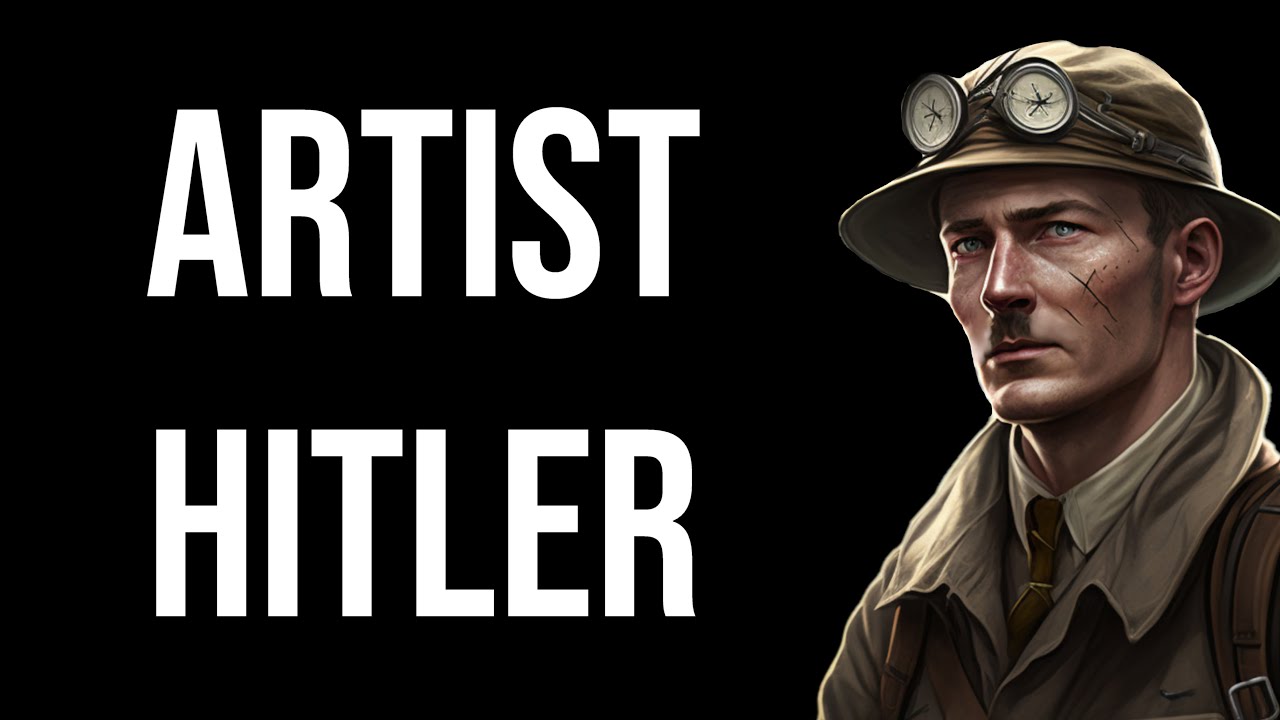
The Question Behind the Question
Adolf Hitler applied twice to the Academy of Fine Arts Vienna, in 1907 and 1908, and was rejected both times. The examiners found his portfolio competent in architectural subjects but deficient in figure drawing — the lack of human presence in his paintings was a consistent weakness they noted explicitly. He was advised to consider studying architecture, but he lacked the secondary school qualifications required for the architecture program. This biographical fact is among the most studied in modern history, because of the obvious question it raises: had those rejections gone differently, would the 20th century's worst catastrophes have been averted?
The popular answer is yes — a career as an artist deflects Hitler from politics, no Nazi Germany, no Holocaust, a century of unthinkable suffering prevented by an admissions officer's different judgment. This is the scenario's appeal, and it is not entirely without foundation. But serious historical analysis produces a more complicated and ultimately more disturbing answer: the structural conditions that made Nazism possible transcended any single individual's biography, and those conditions would have demanded a political response regardless of what one Austrian painter was doing in 1930.
This article examines what we actually know about Hitler's radicalization, what the Weimar Republic's crisis was really about, and whether the art school counterfactual meaningfully changes the 20th century or merely relocates its catastrophes.
What the Rejections Actually Caused — and What They Didn't
The conventional narrative of Hitler's radicalization runs as follows: art school rejections humiliate and impoverish him, he descends into destitution in Vienna's homeless shelters, he absorbs anti-Semitic ideology from the gutter press and populist politicians, and he emerges embittered and radicalized. The art school rejections are the hinge — change them, and the radicalization doesn't happen.
The historical record is more nuanced. Hitler's exposure to anti-Semitic politics in Vienna came through a specific intellectual and cultural environment that was pervasive in Habsburg Austria, not from personal destitution alone. Karl Lueger, the Mayor of Vienna from 1897 to 1910, was a popular anti-Semitic politician whom Hitler later explicitly praised in Mein Kampf as an influence. Georg Ritter von Schönerer's pan-German nationalism was widely discussed in Viennese political culture. The anti-Semitic broadsheets and pamphlets that Hitler consumed in Vienna were not the reading material of the desperately poor; they were mainstream political publications.
Moreover, Hitler's financial situation in Vienna was not the complete destitution that later Nazi hagiography suggested. He received an orphan's pension, income from selling his paintings as postcards and from selling illustrated advertising posters, and occasionally from an aunt. He lived in a men's hostel from 1909 onward, but this was a reasonably comfortable institution by the standards of working-class Vienna. His radicalization was ideological, not simply economic. Art school acceptance might have given him a more comfortable social milieu, but it would not have placed him in a different intellectual environment — Vienna's art world in 1907-1914 was itself saturated with nationalist and racial politics.
The Specific Divergence: What 1907 Actually Offered
The most historically precise divergence is worth examining carefully. Hitler's first rejection in autumn 1907 came with a specific recommendation: his drawings showed promise for architectural study. His mother Klara was diagnosed with breast cancer in January 1907 and died in December of that year, leaving him without his primary source of emotional and modest financial support. The second rejection came in 1908, as he was coping with grief and financial instability simultaneously.
In our alternate history, acceptance in 1907 — before his mother's death — provides a fundamentally different context. He is enrolled in a structured institution, socially engaged with peers, working toward a professional identity, and experiencing his mother's illness as a family tragedy rather than also as the onset of social collapse. This is the most plausible version of the divergence, and it is genuinely significant. The combination of rejection, grief, and financial precarity that characterized Hitler's Vienna years from 1907 to 1913 was unusually destabilizing for a personality already disposed toward grandiosity and resentment. Removing the institutional rejection while the grief still occurs changes the psychological equation.
But it does not change the intellectual environment. The Viennese art world that Hitler would have entered in 1907 was dominated by the Secession movement — Gustav Klimt's ornate symbolism, Egon Schiele's expressionism, Oskar Kokoschka's psychological intensity. These styles were antithetical to everything Hitler's actual paintings revealed about his aesthetic sensibilities: he preferred neoclassical architecture, empty spaces, technically competent but emotionally detached renderings with conspicuously absent human figures. Art school might have forced him to develop the figure drawing the examiners found lacking, but it could not have transformed his fundamental aesthetic vision. An art school Hitler is probably a moderately successful, technically proficient academic painter working in a romantic-nationalist style that the Vienna Secession had already rendered unfashionable by 1900.
WWI Would Still Have Happened — and Would Still Have Radicalized Germany
Even accepting the most optimistic version of the art school divergence — Hitler becomes a painter, avoids political radicalization, never joins the NSDAP — the structural forces that created the conditions for Nazism remain intact. World War I erupts in 1914 regardless. Germany fights, suffers catastrophic casualties, and loses. The armistice of November 1918 is followed by the humiliating terms of the Treaty of Versailles: the war guilt clause, reparations of 132 billion gold marks, territorial losses including Alsace-Lorraine and the Polish Corridor, military restrictions. The Weimar Republic inherits these conditions.
The Weimar Republic's structural problems were severe even before the Great Depression. Hyperinflation in 1922-1923 wiped out middle-class savings. The brief period of relative stabilization in 1924-1929 was built on American loans (the Dawes Plan) that evaporated when Wall Street crashed. By 1932, unemployment in Germany had reached roughly 30 percent of the workforce — the highest in any major industrial country. The political consequence was the collapse of mainstream parties and the rise of anti-system parties from both the extreme left (Communist Party) and extreme right (NSDAP). This was not primarily a product of Hitler's personal charisma; it was a product of mass economic desperation combined with a political culture that associated parliamentary democracy with national humiliation.
Without Hitler, who fills that space? The question is not whether extreme nationalism fills the vacuum — it almost certainly does — but which specific individual or movement succeeds. The candidates were numerous. Ernst Röhm commanded the Sturmabteilung (SA) and had genuine mass support. Alfred Hugenberg controlled a media empire and the German National People's Party. The Strasser brothers (Gregor and Otto) led a socialist-nationalist wing of the early Nazi movement that could have developed independently. Franz von Papen and the conservative establishment that in actual history enabled Hitler's rise in January 1933 would have enabled someone else's rise instead.
The Holocaust Was Not a One-Man Project
Perhaps the most historically important insight for this counterfactual concerns the Holocaust itself. The conventional framing treats the Holocaust as primarily a product of Hitler's personal ideology — his specific obsessive anti-Semitism, his Messianic conviction that he was Germany's appointed savior, his willingness to order industrialized murder. If Hitler never enters politics, this reasoning goes, the Holocaust doesn't happen.
A generation of Holocaust scholarship has complicated this picture substantially. Christopher Browning's Ordinary Men (1992) studied Reserve Police Battalion 101, a unit of middle-aged German policemen from Hamburg who killed roughly 38,000 Jews in occupied Poland in 1942 — men who were given explicit opportunities to opt out and largely chose not to. Raul Hilberg's monumental The Destruction of the European Jews documented the bureaucratic machinery of the Holocaust — the railway administrators, the statisticians, the regional officials who coordinated mass murder through normal administrative channels without Hitler's direct personal involvement in most operational decisions.
Daniel Jonah Goldhagen's controversial Hitler's Willing Executioners argued that eliminationist anti-Semitism was a widespread cultural phenomenon in German society, not a top-down directive from one man. Whether or not one accepts Goldhagen's strongest claims, the scholarship makes clear that the Holocaust required the active participation of hundreds of thousands of ordinary Germans and the passive complicity of millions more. This does not distribute moral responsibility evenly or excuse any individual perpetrator. It does mean that the ideological preconditions for genocide — the dehumanization of Jewish people embedded in European anti-Semitism across centuries — were not Hitler's personal invention.
A German extreme-nationalist government of the 1930s, led by someone other than Hitler, would not necessarily have pursued the Holocaust in exactly the same form, on the same scale, at the same speed. The specific decision-making process that led to the Final Solution in 1941-1942 was Hitler-dependent in important ways. But the conditions for severe persecution of Jewish people and other minorities in a fascist German state were structural, cultural, and institutional — they would not simply vanish because one man became a painter instead of a politician.
What an Artist Hitler's Life Might Have Actually Looked Like
Setting aside the macro-historical question of whether Nazism happens without Hitler, the biographical counterfactual of an artist Hitler has its own interest. What can we infer from his actual paintings?
Hitler's surviving works — roughly 2,000 paintings and drawings — are technically competent but artistically unremarkable. They show accurate perspective and clean line work in architectural subjects. They avoid figures almost entirely: his cityscapes are empty of people, his architectural studies feel like technical exercises rather than emotional expressions. Art historians who have assessed them professionally describe them as the work of a capable draughtsman without artistic vision or emotional depth.
The Vienna Secession of 1907-1914 demanded precisely the qualities Hitler's work lacked: emotional intensity, the human figure as the primary subject, psychological depth. Art school would have pushed him to develop figure drawing (which the Academy examiners specifically demanded), but it is unlikely to have fundamentally changed his aesthetic sensibility. The most plausible outcome is an artist Hitler who achieves modest commercial success in architectural illustration, poster design, or postcards, and who graduates into a career in architectural rendering or commercial art rather than into the fine arts world of galleries and exhibitions.
He might, in this career, have eventually found his way to the Nazi aesthetic that he later promoted as Führer — the neoclassical monumental architecture of Albert Speer, the heroic realist painting promoted by the Reich, the bombastic public art that characterized Nazi cultural production. There is something ironic in the possibility that Artist Hitler might have been a minor contributor to the cultural apparatus of a Nazi Germany run by someone else.
The Honest Verdict: Necessary but Not Sufficient
Hitler was necessary to Nazism as it actually occurred — the specific timing, scale, and character of the Nazi movement depended on his particular combination of skills: the demagogic oratory, the tactical political intelligence, the willingness to authorize and celebrate violence, the Messianic self-image that attracted followers who wanted a prophet rather than a politician. Without him, German fascism almost certainly takes a different form. The Holocaust, as the specific event it was — industrial, total, continent-wide — probably does not happen in exactly that way.
But Hitler was not sufficient to explain Nazism. He was the catalyst for a reaction whose chemical components — anti-Semitism, post-war resentment, economic desperation, failure of democratic institutions — were already present in German and European society. A world where Hitler becomes a painter is a world where something recognizably terrible still finds a way to happen in the 1930s and 1940s, because the structural conditions for political extremism are not solved by one young man's art school portfolio.
This is the most important and most uncomfortable insight of this counterfactual. The Holocaust was not an accident produced by one man's peculiar biography. It emerged from centuries of European anti-Semitism, from specific political failures of the Weimar period, from the willingness of ordinary people to participate in or ignore extraordinary evil. Understanding this is not a counsel of despair — it is a call to address structural conditions rather than waiting for the appearance of individual monsters who can be stopped by early rejection letters. The lesson of the art school counterfactual is not that small biographical events can prevent great atrocities. It is that great atrocities require great structural failures, and those failures demand structural solutions.
Explore This Scenario Interactively
The analysis above is our editorial interpretation. On Alternate History AI, you can trace your own 20th-century timeline from this divergence — deciding how Weimar Germany's political crisis plays out without Hitler, whether another figure fills the nationalist vacuum, and what shape the 1930s and 1940s take in a different Europe. Each decision produces a different simulated outcome.
Select an interactive scenario and start exploring →
References and Further Reading
- Wikipedia: Adolf Hitler — comprehensive biography with extensive sourcing
- Britannica: Adolf Hitler — scholarly overview of his life and rise to power
- World History Encyclopedia: Adolf Hitler — articles on his Vienna years, the Nazi rise, and the war
- Wikipedia: Weimar Republic — the structural crises of German democracy in the 1920s and 1930s
- Wikipedia: The Holocaust — the history, perpetrators, and scholarly understanding of the genocide
- Wikipedia: Ordinary Men by Christopher Browning — the landmark study of Holocaust perpetrators as ordinary individuals
- AlternateHistory.com: If Hitler Was Accepted into Art School — community analysis and timelines
What if the Soviet Union survived? · What if the Confederates won the Civil War? · What if Napoleon won at Waterloo?