 Alternate History AI
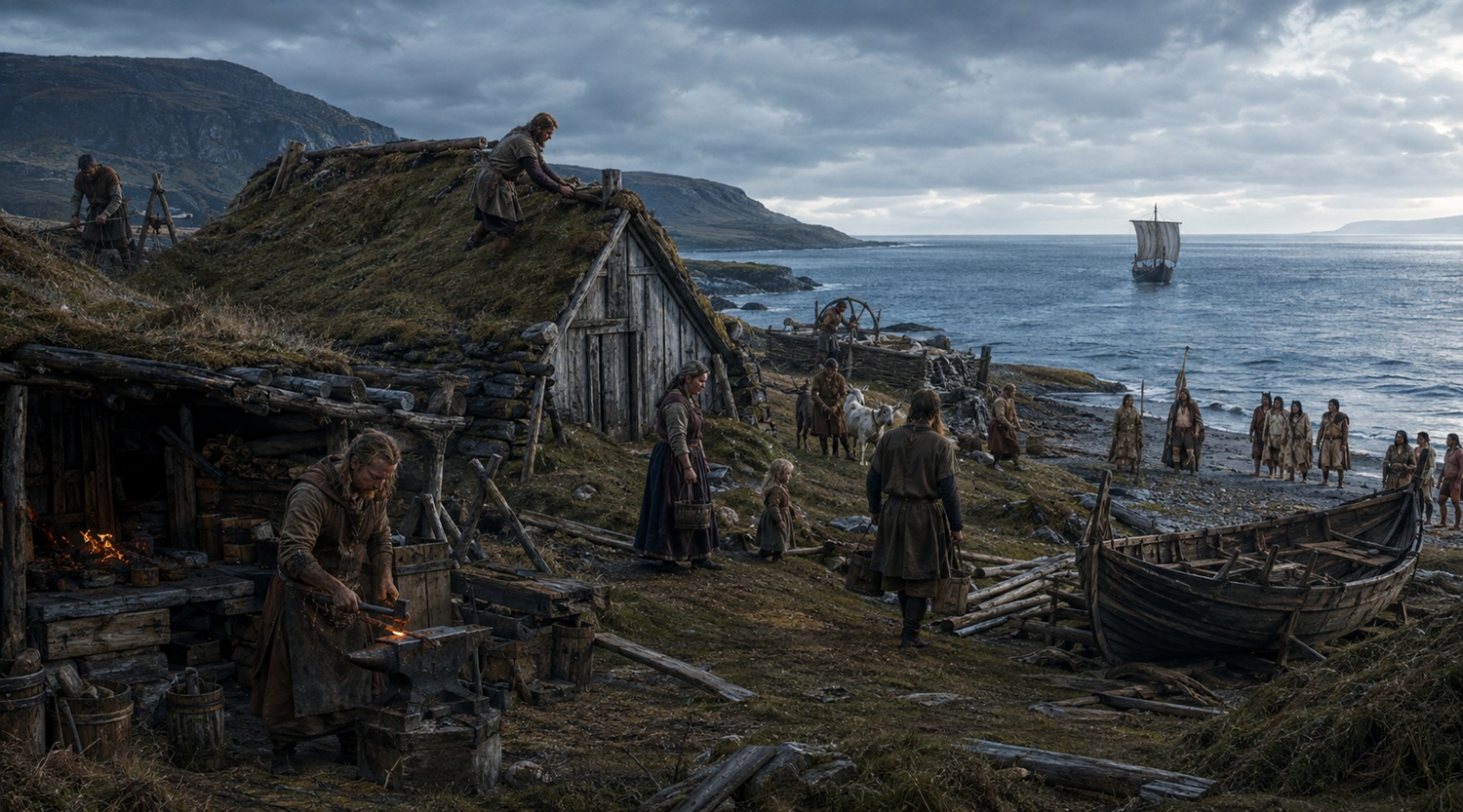
Nearly five centuries before Christopher Columbus crossed the Atlantic, Norse sailors reached North America.
This is no longer a conclusion based only on medieval stories.
At L'Anse aux Meadows, on the northern tip of Newfoundland, archaeologists uncovered unmistakably Norse turf buildings, ironworking remains, boat rivets, and other artifacts. More recently, analysis of wood cut with metal tools established that Norse activity occurred there in AD 1021, providing the first precise calendar year for a European presence in the Americas before Columbus. (Nature)
The discovery is extraordinary.
But it is also frequently exaggerated.
L'Anse aux Meadows was not a medieval European city. It was not the capital of a vast Viking colony. Archaeology does not demonstrate that Norse settlers occupied large areas of North America or established political control over Indigenous peoples.
The evidence instead points to a small Norse base or encampment occupied for a relatively short period. Parks Canada identifies eight Norse buildings at the site, including dwellings and workshops. Iron was smelted and worked there, boats were repaired, and the settlement was substantial enough to support organized expeditions. (Parks Canada)
Even more intriguing, butternuts recovered at L'Anse aux Meadows do not grow naturally that far north. Their presence indicates that people using the site traveled or obtained materials from regions farther south, strengthening the interpretation of L'Anse aux Meadows as a base for wider exploration rather than necessarily being all of “Vinland.” (Parks Canada)
The strongest counterfactual is therefore not:
What if Vikings conquered North America around the year 1000?
Nothing in the archaeological evidence suggests that a few ships of Norse settlers possessed the population, logistics, or political capacity to do that.
The better question is:
What if a small Norse settlement in northeastern North America survived, reproduced, maintained regular contact with Greenland and Iceland, and gradually became a permanent part of the North Atlantic world?
That scenario requires far less magic.
It also produces more interesting consequences.
A permanent Norse settlement could create centuries of intermittent contact between Europe and North America before Columbus. It could generate trade and conflict with Indigenous communities. It might produce mixed families and multilingual frontier societies. It could make European knowledge of western lands more concrete and durable.
But it might also remain tiny.
It might survive for two centuries and disappear.
And even if it endured until 1492, it would not make the continent an empty stage waiting for Europeans.
The Norse newcomers would be entering lands already inhabited by Indigenous societies with their own political systems, economies, technologies, territories, alliances, and histories. Archaeological scholarship increasingly emphasizes the diversity and dynamism of North American societies in the centuries before sustained European colonization. (Cambridge University Press)
The most plausible Norse America is therefore not a Viking empire.
It is a small Atlantic frontier community whose survival depends as much on Indigenous relationships and shipping networks as on Norse weapons or ships.
---
What We Actually Know About L'Anse aux Meadows
The archaeological evidence is much firmer than it was a generation ago.
Helge and Anne Stine Ingstad identified the site in 1960, and excavations revealed structures whose construction closely resembles Norse buildings in Iceland and Greenland. Parks Canada records eight buildings built with sod over timber framing. Finds included a bronze ring-headed pin, a spindle whorl, a stone lamp, a bone needle fragment, iron rivets, and extensive evidence of ironworking. (Parks Canada)
UNESCO describes L'Anse aux Meadows as the earliest authenticated European settlement in North America and notes both the iron production and hundreds of recovered wooden, bronze, bone, and stone objects associated with its Norse occupants. (UNESCO World Heritage Centre)
The iron evidence is especially important.
The people at the site smelted local bog iron and forged iron objects. Parks Canada has connected the operation with boat repair, including production or replacement of iron fasteners. (Parks Canada)
That tells us something about the settlement's purpose.
These were not merely shipwrecked sailors surviving temporarily.
They had brought the knowledge and tools required to create an operational base.
Scientific dating has strengthened that interpretation. Wood at the site was cut with metal blades in AD 1021, showing unequivocally that Norse people were working there at that time. The researchers also describe L'Anse aux Meadows as a base from which expeditions reached other locations farther south. (Nature)
What archaeology does not establish is equally important.
There is only one securely authenticated Norse settlement site in North America outside Greenland.
We do not know the exact number of voyages.
We do not know exactly how long L'Anse aux Meadows remained occupied.
We cannot identify every place described in the later Vinland stories.
And we cannot automatically treat every detail of those stories as eyewitness history. (OUP Academic)
---
What Was Vinland?
The name Vinland appears in Norse textual traditions describing lands west of Greenland.
But “Vinland” should not simply be equated with the archaeological site at L'Anse aux Meadows.
The written traditions describe multiple landscapes and journeys. L'Anse aux Meadows may have been one base within a much larger region explored by Norse sailors. The presence of butternuts, whose natural range lies south of northern Newfoundland, supports the idea that expeditions traveled considerably beyond the settlement itself. (Parks Canada)
The most famous written accounts are The Saga of the Greenlanders and The Saga of Erik the Red.
They contain stories of Leif Erikson, Thorfinn Karlsefni, Gudrid Thorbjarnardottir, encounters with Indigenous inhabitants, exploration, trade, fighting, and attempted settlement.
They are valuable.
They are not transcripts.
The sagas emerged from long oral traditions and were written down generations after the events they describe. Oxford scholarship notes that the two principal Vinland sagas disagree over important details, including how many settlements were established. The archaeology confirms the fundamental claim that Norse voyagers reached North America, but not every narrative detail. (OUP Academic)
That distinction matters for alternate history.
We can use the sagas to identify possibilities.
We should not convert every saga episode into a documented fact.
---
Greenland Was the Essential Link
A permanent Vinland could not initially survive as an isolated colony.
Its lifeline would be Norse Greenland.
Greenland had been settled from Iceland in the late tenth century. Norse communities persisted there for nearly five centuries, combining pastoral agriculture, hunting, marine resources, and long-distance trade. (Cambridge University Press)
This is crucial because it demonstrates that medieval Norse communities could maintain remarkably distant settlements for centuries.
Greenland was already on the far edge of European maritime networks.
From Greenland, North America was the next stage westward.
Norse Greenland also had a compelling reason to continue visiting North America:
wood.
Suitable large timber was limited in Greenland. Recent archaeological analysis shows that Norse Greenlanders imported wood from both Europe and North American sources. Medieval references and archaeological evidence therefore suggest that western voyages may have continued beyond the brief occupation of L'Anse aux Meadows itself. (Cambridge University Press)
A permanent North American base could consequently function as something very different from a conventional farming colony.
It could begin as a resource station.
Timber is cut.
Ships are repaired.
Furs and other products are acquired.
Explorers travel south.
The settlement supplies Greenland.
Greenland provides immigrants, metal goods, livestock, church connections, and shipping access to Iceland and Norway.
That is the network our alternate history must preserve.
---
Why the Historical Settlement Failed
There is no single documented explanation.
The later sagas emphasize conflict with Indigenous people, but archaeology cannot verify those particular encounters at L'Anse aux Meadows in the way it verifies the Norse occupation itself. Parks Canada notes that the Norse did encounter Indigenous peoples elsewhere in the regions their traditions called Vinland, while the exact identities, places, and circumstances remain difficult to reconstruct. (Parks Canada)
Several structural problems made permanent settlement difficult.
The Norse Population Was Tiny
A settlement requires more than warriors.
It requires families.
Children.
Food production.
Craft specialists.
Replacement labor.
Women and men of reproductive age.
The artifacts at L'Anse aux Meadows indicate that women were among the Norse occupants, but the settlement was still very small compared with the populations already living across North America. (Parks Canada)
A settlement of dozens of people can establish a base.
It cannot afford repeated violent losses.
A ship sinking with twenty settlers aboard could be a demographic catastrophe.
---
The Atlantic Supply Line Was Enormous
The North American route was not a direct Norway-to-Newfoundland commuter service.
Ships traveled through a chain of North Atlantic communities.
Norway.
The Faroes.
Iceland.
Greenland.
Then farther west.
That network had functioned because each successive settlement was linked to the others through ships, kinship, commerce, and knowledge. Oxford research on the North Atlantic diaspora emphasizes that these settlements remained connected to mainland markets despite their great distances. (OUP Academic)
Every additional stage increased risk.
Ships could be lost.
Bad weather could delay departures.
Greenland could face shortages.
Political priorities in Norway or Iceland could change.
A permanent Vinland therefore requires not one successful expedition but repeated successful voyages across generations.
That is a much higher threshold.
---
There Was No Empty Frontier
Indigenous people had lived at and around L'Anse aux Meadows for thousands of years before the Norse appeared. Parks Canada records Indigenous occupation of the area reaching back roughly four millennia before the Norse camp. (Parks Canada)
The Norse were therefore the newcomers.
That changes how the settlement problem should be understood.
A Norse community could not simply identify fertile territory, declare it unowned, and expand indefinitely.
Hunting grounds were used.
Fishing locations mattered.
Travel corridors mattered.
Seasonal landscapes mattered.
Communities possessed their own political and economic relationships.
The success of a permanent Norse settlement would depend substantially on how nearby Indigenous peoples viewed it.
Trade could make the newcomers useful.
Violence could make them intolerable.
---
The Point of Divergence: Karlsefni's Settlement Chooses Trade Over Expansion
The most useful divergence occurs around the early eleventh century.
A larger settlement expedition arrives from Greenland after the initial exploratory voyages.
Rather than treating L'Anse aux Meadows only as a seasonal base, perhaps 60 to 100 people establish a permanent community.
That number is speculative, but it is deliberately modest.
They include:
several extended families;
farmers;
sailors;
carpenters;
smiths;
hunters;
people capable of textile production;
enough women and children for a self-reproducing settlement.
They bring cattle, sheep, goats, and perhaps pigs—but in limited numbers.
The critical change is political.
When contact occurs with nearby Indigenous communities, the Norse leaders conclude that territorial expansion is impossible without creating permanent warfare.
They establish trading relationships instead.
Iron tools.
Worked metal.
Woolen textiles.
Woodworking.
Boat repair.
Furs.
Animal products.
Food.
Geographical knowledge.
Different communities value different things.
The Norse settlement survives because it becomes more useful alive than destroyed.
---
This Does Not Require Perfect Peace
No frontier involving different societies remains permanently peaceful.
Disputes occur.
People are killed.
Livestock damage hunting or gathering areas.
Trade disagreements develop.
Norse sailors trespass.
Indigenous groups have conflicts among themselves into which the settlers may become entangled.
Norse factions may disagree over diplomacy.
But the alternate settlement avoids the fatal mistake of transforming every dispute into a war for territory.
A community numbering fewer than a few hundred cannot sustain that kind of conflict.
The Norse settlers eventually learn an obvious lesson:
survival requires accommodation.
---
What Would Make Permanent Settlement Possible?
Four conditions matter above all others.
1. Regular Greenland Shipping
At least one or two successful ship connections must occur often enough to prevent the community from being forgotten.
The ships need not arrive every year.
But contact must be frequent enough to move immigrants, iron tools, church personnel, news, specialized goods, and people seeking marriage partners.
A decade of isolation could become dangerous.
---
2. A Reproducing Population
Temporary crews cannot establish a society.
Families can.
The settlement needs enough unrelated adults to avoid becoming demographically fragile within a few generations.
Repeated immigration from Greenland and Iceland would be especially important during the first century.
---
3. Indigenous Trade and Political Accommodation
This is probably the decisive factor.
The Norse can provide some goods Indigenous communities may find valuable.
Indigenous communities possess something even more important to the settlers:
knowledge of North America.
Seasonal movement.
Animal populations.
Fishing grounds.
Edible plants.
Travel routes.
Winter conditions.
Neighboring peoples.
River systems.
A Norse colony that refuses to learn from Indigenous expertise remains vulnerable.
One that participates selectively in Indigenous exchange networks has much better prospects.
---
4. Less Dependence on European Farming Assumptions
The settlement cannot simply reproduce southern Scandinavian agriculture.
Even Greenlandic Norse communities adapted over time, increasingly using marine foods alongside pastoral farming. Evidence from Greenland shows changing subsistence strategies rather than a society rigidly dependent upon cattle alone. (Nature)
Newfoundland offers different resources again.
Fishing becomes central.
Hunting matters.
Local plants matter.
Small livestock herds may be useful.
Large-scale cattle pastoralism may be impractical.
The successful Norse settlement is therefore not a Scandinavian farm transported intact across the Atlantic.
It becomes something new.
---
How Large Could the Colony Become?
Slowly.
Suppose the initial settlement contains 80 people.
With births, deaths, occasional immigration, shipwrecks, and marriages, perhaps the settlement reaches 150–200 people after several generations.
A second community might then appear farther south.
By 1100, perhaps several hundred people of Norse or partly Norse ancestry live in northeastern North America.
That would be historically significant.
It would still be minuscule relative to the Indigenous population of the continent.
This distinction prevents the counterfactual from turning into fantasy.
The Norse do not have the population necessary to conquer Newfoundland, much less eastern North America.
Their power depends on ships, metalworking, trade connections, and their ability to negotiate.
---
Livestock: Advantage and Problem
Domestic animals would distinguish Norse settlements from surrounding communities.
Cattle provide milk, hides, and meat.
Sheep and goats provide wool, milk, and food.
Pigs reproduce quickly.
But imported livestock creates costs.
Animals require fodder.
Winter feed requires labor and suitable land.
Grazing alters vegetation.
Escaped livestock can damage areas used by neighboring communities.
Greenlandic archaeology demonstrates that Norse pastoral economies were closely tied to the availability and management of fodder resources. (Cambridge University Press)
A successful North American colony would probably reduce cattle numbers and favor smaller, more flexible herds.
Fishing and hunting would supply a larger share of food.
This would make the settlement increasingly unlike Norway and increasingly adapted to its local environment.
---
Iron Technology
Iron gives the Norse an obvious technological advantage in particular tasks.
They can make and repair:
axes;
knives;
nails;
rivets;
woodworking tools;
weapons.
L'Anse aux Meadows contains the first authenticated evidence of European-style iron production in North America, with bog iron being smelted locally. (UNESCO World Heritage Centre)
But iron does not turn a tiny colony into a conquering empire.
Metal production requires labor and fuel.
Ore quality varies.
Tools wear out.
Specialist knowledge matters.
A settlement of a hundred people cannot equip an army capable of occupying huge territories.
More interesting is the effect of trade.
Could small iron knives, awls, axes, nails, or pieces of workable metal enter Indigenous exchange systems?
Yes, in principle.
If they did, European metal could travel considerably farther than Norse people themselves.
The resulting archaeological footprint might therefore extend well beyond the settlement.
---
Would Indigenous Peoples Adopt Norse Technology?
Some items might be desirable.
That does not mean Indigenous societies abandon their own technologies.
Technological adoption is selective.
A metal cutting edge can be useful without requiring adoption of Norse agriculture, language, religion, housing, or government.
Indigenous communities would decide what to acquire based on their own needs and cultural systems.
The Norse could similarly adopt Indigenous technologies.
Snow travel.
Clothing adapted to local environments.
Hunting techniques.
Food preservation.
Watercraft appropriate to rivers and coastal conditions.
Knowledge transfer would not move in only one direction.
A tiny immigrant society may actually have more to learn from established local communities than the reverse.
---
Mixed Norse-Indigenous Communities
If contact continues for generations, intermarriage or other forms of family formation become increasingly plausible.
The original Norse population is too small to remain socially isolated indefinitely.
Sailors arrive without spouses.
Individuals leave one community and join another.
Children grow up speaking more than one language.
Some Norse settlers depend on Indigenous relatives for trade and diplomacy.
Some people of Indigenous ancestry enter the Atlantic world through Greenland.
The result might eventually be communities that are difficult to classify simply as “Viking” or “Indigenous.”
They could be both.
This is a more plausible long-term outcome than an ethnically sealed Norse colony persisting unchanged for five hundred years.
---
What Happens to Language?
Old Norse would initially dominate within the settlement.
Christian religious services would introduce Latin.
But sustained local contact would create multilingual households.
Loanwords could move both ways.
Terms for animals, landscapes, food, boats, tools, weather, and social relationships are especially likely to cross linguistic boundaries.
After several centuries, the colony might speak a distinctive North Atlantic Norse dialect containing substantial Indigenous vocabulary.
If mixed communities dominate, a more complicated contact language could emerge.
Predicting its exact grammar would be impossible.
The strong conclusion is simply that five centuries of isolation and intercultural contact would not preserve eleventh-century Old Norse unchanged.
---
Indigenous People Are Not One Political Bloc
Another common alternate-history mistake is referring to “the Native Americans” as though all Indigenous societies shared one government and one reaction to the Norse.
They did not.
North America contained enormous cultural, linguistic, political, and economic diversity. Archaeological research shows complex systems of production, exchange, settlement, and political organization across the continent during the period from roughly AD 1000 to 1500. (Cambridge University Press)
Even within northeastern North America, different communities could react differently.
One group might trade with the Norse.
Another might regard them as trespassers.
A third might form an alliance with them against a rival.
A fourth might have almost no direct contact but acquire iron objects through trade networks.
Norse survival could therefore become part of Indigenous diplomacy, rather than existing outside it.
That would fundamentally shape the settlement's political history.
---
Disease: A Major Uncertainty
Any discussion of sustained medieval contact must address disease carefully.
It is tempting to assume that Norse contact around 1000 would automatically trigger the massive epidemics later associated with European colonization.
The evidence does not support such a simple conclusion.
Archaeological scholarship on later European-Indigenous encounters increasingly rejects the idea that catastrophic population loss resulted automatically from a single moment of pathogen exposure. The devastating effects of disease after sustained colonial expansion interacted with warfare, displacement, food insecurity, exploitation, and other forms of social disruption. (Cambridge University Press)
A Norse settlement of perhaps one or two hundred people would also have very different epidemiological characteristics from sixteenth- and seventeenth-century Atlantic traffic involving large populations, cities, armies, enslaved populations, and continuous movement among Europe, Africa, and the Americas.
Diseases could cross.
Some outbreaks might be deadly.
Transmission could occur in either direction.
But a continent-wide eleventh-century epidemic comparable to later colonial catastrophes should not simply be assumed.
The scale and frequency of contact matter. (Cambridge University Press)
---
Could the Norse Introduce Smallpox?
Possibly in some later contact episode, but certainty would be irresponsible.
A pathogen needs an infected traveler to remain contagious during the voyage and then encounter a susceptible population.
Long sea journeys could interrupt transmission chains for some acute infections.
Small medieval settlements also could not continuously sustain every epidemic disease circulating in densely populated European regions.
If regular travel eventually connects North America more directly with Iceland, Norway, and continental Europe, the risk increases.
But we cannot write a responsible alternate timeline in which “the Vikings arrive, therefore all later epidemics happen in 1000.”
Biology does not work that mechanically.
---
What About Norse Diseases Going the Other Direction?
This is often overlooked.
Sustained contact creates two-way biological exchange.
Norse sailors could encounter pathogens or parasites unfamiliar to North Atlantic Europeans.
Plants could travel east.
Animals or animal products could move through Greenland.
The epidemiological consequences would depend on what organisms were actually transmitted and whether they could establish themselves in new ecological environments.
Again, the strongest conclusion is not a specific epidemic.
It is that five centuries of recurrent contact would begin biological exchange before 1492.
---
Trade Could Become the Colony's Reason to Exist
A small Vinland settlement would need economic justification.
Timber provides the most obvious commodity.
Greenland needed wood, and recent archaeological research supports North American timber reaching Norse Greenland. (Cambridge University Press)
Other possible resources include:
furs;
hides;
oil;
fish;
specialty animal products;
perhaps walrus products from northern regions;
and locally obtained goods entering Indigenous exchange networks.
European imports could include:
iron;
woven cloth;
weapons;
ornaments;
religious objects;
specialized tools.
The settlement could become the westernmost node in a chain:
Norway → Iceland → Greenland → Vinland → Indigenous North American networks.
That network would not need enormous trade volumes to remain historically important.
---
Greenland Could Become More Important Because Vinland Exists
Historically, Norse Greenland ultimately disappeared in the fifteenth century after almost five centuries of settlement. Scholars no longer accept a single simplistic explanation. Environmental change, trade, social organization, changing demand for walrus ivory, sea-level change, and other pressures have all been investigated. (Cambridge University Press)
A successful Vinland settlement could alter that story.
Greenland gains a closer source of timber.
Its western connections become economically valuable.
Greenland can serve as Europe's gateway to North America.
Ships have more reason to continue visiting.
A community important to transatlantic trade may be less easily forgotten by Norway and Iceland.
That could prolong Norse Greenlandic settlement.
But it does not guarantee survival.
Greenland's challenges remain real.
---
The Colony Could Outlive Greenland
There is also a fascinating reverse possibility.
Suppose environmental and economic pressures still cause Norse Greenland to decline in the fourteenth and fifteenth centuries.
Vinland, however, has adapted more successfully.
It has better timber.
More extensive fisheries.
Mixed communities.
Local trading partners.
A more diversified subsistence system.
In that case, the Atlantic chain breaks in the middle.
A few Greenlanders may migrate west rather than disappear from the historical record.
The North American Norse community survives while regular voyages from Europe decline.
By 1450, it might know Iceland primarily through ancestral stories and occasional ships.
This would create a genuinely distinctive North American society before the age of Columbus.
---
Christianity in Vinland
The Norse Atlantic world was becoming Christian around the time of the Vinland voyages.
A permanent settlement would probably develop a church.
At first it might be a tiny timber chapel.
Later, clergy could arrive from Greenland.
If the community grows, a parish might be formally incorporated into the North Atlantic church structure.
Religious objects and literacy would become additional ties to Europe.
But geographic distance again matters.
A priest may die without replacement.
Local practices could diverge.
Intermarriage could produce religious blending or conversion in both directions.
A fifteenth-century Vinland Christianity isolated for generations from formal church institutions might look quite different from Christianity in Norway.
---
Would the Pope Know About North America?
Eventually, probably.
Church officials in Europe already knew Greenland existed.
If a stable Christian community west of Greenland maintained communications, knowledge of another inhabited land would become difficult to keep confined to sagas.
A priest traveling to Iceland could report it.
A bishop could mention it.
A Norwegian merchant could describe western timber.
Maps or geographical works might include increasingly concrete references to lands beyond Greenland.
The crucial question is not whether someone in medieval Europe knew.
The sagas already demonstrate that western voyages remained part of Norse cultural memory. (OUP Academic)
The alternate difference is whether the knowledge becomes sufficiently continuous, practical, and economically valuable that it survives outside a relatively limited North Atlantic tradition.
---
Would Europe Realize It Had Found a New Continent?
Not necessarily.
Medieval Europeans did not possess the modern continental framework necessary to classify the discovery immediately as “North America.”
Western lands could be understood through existing geographical ideas.
They might be thought of as islands.
Extensions of Asia.
Remote Atlantic territories.
The conceptual revolution associated with realizing that European voyages had reached continents previously unknown to their geographical tradition required much more exploration.
A permanent Vinland makes the western lands known.
It does not immediately make their global geography understood.
---
Scenario One: The Small Trading Enclave
This is the most plausible long-term success.
L'Anse aux Meadows or a nearby settlement survives.
Its population fluctuates between perhaps 100 and 300 people.
It relies heavily on fishing, hunting, local trade, and timber.
Ships arrive from Greenland intermittently.
Intermarriage occurs.
The community does not expand far inland.
By 1200
It is a recognized but remote part of the Norse Atlantic world.
By 1350
It may contain several mixed communities along a limited coastal zone.
By 1450
Its population may be only a few hundred or perhaps several thousand across scattered settlements.
Historical importance
Large.
Territorial power
Small.
This is probably the strongest alternate path.
---
Scenario Two: A Norse-Indigenous Coastal Society
Trade becomes more important than migration from Europe.
Mixed families become common.
The settlement adopts significant local subsistence practices.
Old Norse evolves alongside Indigenous languages.
Political authority becomes less recognizable as a transplanted Scandinavian farm society.
Perhaps a Norse-descended chieftain's legitimacy depends on Indigenous kinship networks.
Perhaps leadership alternates among prominent mixed families.
The society remains connected symbolically to Greenland and Iceland but becomes increasingly North American.
By 1300, asking whether it is “Norse” or “Indigenous” may already impose categories that its inhabitants themselves would not recognize in the same way.
This outcome is particularly plausible if European immigration remains low.
---
Scenario Three: The Colony Survives for Centuries and Then Fails
Permanence need not mean forever.
Suppose the settlement succeeds from 1020 until about 1300.
Then Greenlandic shipping declines.
A series of poor harvests occurs.
Conflict disrupts trade.
A disease outbreak kills key families.
Ships stop arriving.
The settlement fragments.
Some inhabitants join neighboring Indigenous communities.
Others attempt a voyage back to Greenland.
By 1400, no separate Norse settlement remains.
Yet the three centuries of contact still matter.
Norse ancestry persists.
Some metalworking knowledge may persist locally.
Oral traditions remain.
European objects have moved through trade systems.
European geographic traditions preserve much firmer knowledge of western lands.
This scenario could be both a “successful permanent settlement” by medieval standards and a colony that does not survive to Columbus.
---
Scenario Four: A Genuine North Atlantic Colony
This is the more dramatic possibility.
Regular migration continues from Iceland and Greenland.
Several settlements develop farther south where agriculture is easier.
Population reaches several thousand.
A bishopric or formal colonial government appears.
Timber and other resources justify regular voyages from Europe.
This creates something resembling a medieval transatlantic colony.
Possible?
Yes.
But considerably less likely.
The colony would require a sustained stream of ships and settlers far greater than the archaeological evidence suggests occurred historically.
It would also require durable political arrangements with Indigenous neighbors.
Any scenario in which thousands of Norse settlers simply seize vast territories should be treated skeptically.
---
Four Possible Outcomes
| Outcome | Settlement | Indigenous Relations | European Contact | Plausibility |
| ------------------------------------ | ----------------------------------------------------------------- | -------------------------------------------- | -------------------------------- | -------------------------- |
| Small trading enclave | Hundreds at most | Trade mixed with occasional conflict | Intermittent but persistent | Strongest |
| Mixed coastal communities | Gradual growth through local families and limited immigration | Deep economic and family relationships | Declines in importance over time | Strong |
| Later collapse | Survives several centuries, then disappears as separate community | Survivors may join nearby societies | Knowledge remains in Europe | Very plausible |
| Large medieval colony | Thousands in multiple settlements | Requires stable alliances and access to land | Regular shipping to Europe | Possible but demanding |
| Viking conquest of North America | Vast territorial state | Indigenous peoples somehow overwhelmed | Large European migration | Extremely weak |
---
How Could Indigenous Politics Change?
The effects could extend beyond communities that directly meet Norse settlers.
Suppose one local group obtains iron tools through trade.
A neighboring community wants access.
That creates incentives for trade alliances.
Norse objects can become prestige goods.
A leader able to control access to a foreign trading settlement may gain political influence.
Another community might deliberately block access.
Others may obtain goods indirectly through existing networks.
The Norse settlement therefore could become one new factor inside Indigenous politics.
It would not replace those politics.
This is a more realistic mechanism for broad influence than direct Norse conquest.
---
Could Horses Arrive Five Centuries Early?
Extremely unlikely through the initial settlement.
Norse Atlantic settlements relied heavily on livestock, but transporting large animals across multiple ocean stages would be difficult and expensive.
Small numbers could conceivably arrive in a larger colonization attempt.
Whether they survive, reproduce, escape, and spread would be separate questions.
There is no basis for assuming that a few imported animals automatically create mounted cultures across North America centuries early.
The same caution applies to cattle, sheep, goats, and pigs.
Introduced animals can have ecological effects.
But every species requires an actual viable breeding population.
---
Could Ironworking Spread Widely?
More plausibly than horses.
A working smithy already existed at L'Anse aux Meadows. (Parks Canada)
If Norse smiths produce small iron goods for trade, those objects could travel.
But widespread iron production is harder.
Knowledge alone is insufficient.
Communities need suitable ore.
Charcoal.
Furnace construction.
Experienced smiths.
Time and incentives.
Local technologies may already accomplish the required tasks efficiently.
The most plausible result is centuries of imported and recycled iron objects, followed perhaps by localized experimentation with production.
---
What Happens When Greenland Declines?
This may be the decisive medieval crisis.
Norse Greenland remained inhabited for centuries but eventually disappeared as a separate European settlement. Its end is now understood as a complex process rather than the result of one climate event or one conflict. (Cambridge University Press)
If Vinland depends completely on Greenland, it may disappear with it.
If Vinland has become economically and demographically independent, the opposite can happen.
Greenlanders move west.
Ships sail from Vinland directly to Iceland when possible.
Indigenous trade replaces lost European supplies.
The colony transforms from a European outpost into a locally rooted society with distant European ancestry.
That distinction determines whether the alternate colony survives into the fifteenth century.
---
What Would Europeans Know by 1400?
In the strongest persistent-contact scenario, educated Norse and at least some northern European maritime circles would know several things:
there is substantial land west of Greenland;
it contains forests;
people already live there;
voyages are possible;
some settlements or trading stations exist;
valuable resources can be obtained.
Those claims would be based not on one old saga but on repeated practical experience.
This could eventually appear in chronicles, ecclesiastical correspondence, merchant traditions, and maps.
But knowledge could still remain geographically restricted.
A Portuguese navigator does not automatically know everything a Greenlander knows.
Information networks in medieval Europe were uneven.
---
Would the Vikings Tell the Rest of Europe?
Over generations, probably.
But “Europe” was not one information system.
Knowledge could circulate among Iceland, Norway, church authorities, merchants, and particular royal courts without becoming common knowledge in Genoa, Venice, Portugal, or Castile.
The permanent settlement matters because it gives the information economic value.
A story can be forgotten.
A timber route generating profit tends to leave records and interested participants.
That makes wider diffusion much more likely.
---
Does Columbus Still Sail?
Possibly.
But the context changes.
Christopher Columbus's project was to reach Asia by sailing west across the Atlantic.
If European geographers already possess credible reports of inhabited lands west of Greenland, they would have to decide what those lands represent.
Are they islands?
Part of Asia?
A separate landmass?
Could they provide stopping points?
Do they block a westward route?
The existence of known western territory might make Atlantic exploration more attractive, not less.
A permanent Vinland therefore need not prevent Columbus.
It could change his route, expectations, or backers.
---
Portugal May Become Interested Earlier
Portugal's Atlantic expansion was already underway long before 1492.
Portuguese sailors explored Atlantic islands and progressively navigated the African coast during the fifteenth century.
If reliable reports about western lands circulate through northern Europe, Portuguese or other Atlantic states could become interested in verifying them.
But this does not automatically mean Portugal sends an expedition in 1200.
The motivations, ship technology, capital, political institutions, and accumulated navigation experience of fifteenth-century expansion developed over centuries.
The more defensible claim is that by the fifteenth century, Vinland becomes an additional piece of evidence encouraging Atlantic exploration.
---
England Could Also Become Interested
English and especially Bristol merchants later participated actively in North Atlantic exploration.
A documented western land known through Scandinavian networks could attract commercial interest.
Fish and timber alone could be sufficient motivation.
An English ship might follow established northern routes rather than attempt a Columbus-style voyage through the mid-Atlantic.
That creates a striking possibility:
the great European expansion into North America could begin not with Caribbean islands but through the North Atlantic fisheries and established Vinland contacts.
But the exact country and date cannot be predicted confidently.
---
Would 1492 Still Be a Great Historical Divide?
Perhaps less so.
If Norse-Indigenous contact has persisted for centuries, then 1492 is no longer the first enduring transatlantic connection between Europe and the Americas.
But the scale of late-fifteenth- and sixteenth-century expansion could still dwarf everything before it.
Large sailing fleets.
Imperial governments.
Commercial finance.
Gunpowder weapons.
Dense European population.
African Atlantic connections.
Plantation systems.
Missionary institutions.
Large-scale migration.
These create a fundamentally different type of interaction.
A tiny Vinland settlement does not prevent the later Atlantic colonial system.
It changes the world that system encounters.
---
The Europeans Arriving in 1500 Would Find a Known Frontier
Suppose a Portuguese, English, French, or Castilian ship reaches northeastern North America around 1500.
Instead of encountering an area unknown to European geography, its crew may encounter:
a settlement whose inhabitants speak a distant descendant of Norse;
Christians using unusual local practices;
mixed families;
Indigenous traders familiar with iron objects;
people who already understand something about Europeans;
local political communities with centuries of experience dealing with Atlantic outsiders.
That could profoundly alter diplomacy.
Europeans would not possess a monopoly on information about the other side.
Indigenous societies connected to Vinland might already know that foreigners arrive by sea, what they trade, how they fight, and how limited their numbers can be.
That prior experience could matter enormously.
---
Could Earlier Contact Make Later Colonization Harder?
Possibly.
Local societies with centuries of experience negotiating with a small European enclave may be better positioned politically when larger expeditions arrive.
Trade relationships already exist.
Translation traditions may exist.
Foreign intentions are less mysterious.
Some groups may possess iron tools.
Some may know European military methods.
Others may have developed alliances specifically designed to manage the Norse settlement.
None guarantees resistance to later imperial expansion.
But “first contact” would no longer involve two worlds with no sustained diplomatic experience of one another.
---
Or Could Vinland Make Colonization Easier?
Also possible.
Later European explorers could use the settlement as:
a harbor;
a source of interpreters;
a repair station;
a source of geographical information;
a place to buy food;
a diplomatic intermediary.
A tiny colony that survived through accommodation could unintentionally provide the infrastructure for a much larger wave of European expansion.
This is another reason the consequences cannot simply be labeled beneficial or harmful.
The same settlement can reduce uncertainty for everyone—and thereby enable more ambitious outsiders.
---
Could Vinland Become a European Colony Before Columbus?
Only under the strongest scenario.
To become a recognizable medieval colonial territory, the settlement needs thousands of people and a direct economic relationship with Europe.
That requires regular ships.
Regular immigration.
Reliable trade.
Political protection.
Perhaps church institutions.
Perhaps royal interest from Norway.
Historically, the archaeology shows nothing on that scale. Only L'Anse aux Meadows has been securely confirmed as a Norse settlement. (OUP Academic)
So the larger the imagined colony becomes, the more counterfactual assumptions must be added.
A settlement surviving?
Reasonable.
A network of mixed trading communities?
Quite plausible within the divergence.
A Scandinavian kingdom stretching from Newfoundland to New England?
Not supported.
---
Why the Historical Settlement Failed
The evidence does not permit one definitive answer, but several weaknesses stand out.
The Norse presence was very small.
The Atlantic supply route was long.
Greenland itself had limited population and resources.
North American land was already inhabited.
Conflict could therefore become disproportionately costly.
The settlement's economic value may not have justified the dangers of maintaining it.
And Norse Greenland had other priorities.
The saga tradition preserves memories of voyages and conflict, but archaeological scholarship cautions against treating those narratives as simple factual chronicles. (OUP Academic)
The most useful conclusion is therefore that permanent settlement required a combination that history did not provide:
more people, more dependable shipping, economic value, and sustainable relationships with Indigenous neighbors.
---
What Would Make Permanent Settlement Possible?
The answer is less dramatic than conquering armies.
A settlement of families rather than expeditionary crews.
Annual or near-annual planning for western voyages.
Timber trade that makes Vinland economically valuable to Greenland.
A second settlement site with better access to food and agriculture.
Smaller livestock herds adapted to local conditions.
Political agreements with nearby Indigenous communities.
Intermarriage.
Learning local survival techniques.
Enough immigration to prevent demographic collapse.
And perhaps most importantly:
a willingness to remain small.
A colony seeking to control large territories would probably fail.
A settlement content to occupy a limited coastal enclave and participate in existing economic networks has a far better chance.
---
What Changes Most?
North America Enters the North Atlantic Information Network Earlier
European knowledge of western lands becomes practical and recurrent rather than primarily preserved through later literary traditions.
Greenland Becomes More Economically Important
It becomes the bridge between Europe and a North American resource zone.
Indigenous-European Diplomacy Begins Centuries Earlier
This could include trade, conflict, intermarriage, negotiation, and cultural exchange.
Some European Goods Enter Indigenous Exchange Networks
Iron is the most obvious candidate.
Norse Culture Changes
The North American settlers become increasingly locally adapted and potentially culturally mixed.
Exploration After 1400 Starts With More Information
Later Atlantic explorers may know western lands exist before setting sail.
---
What Probably Does Not Happen?
Vikings Do Not Conquer North America
Their demographic base is far too small.
Indigenous Societies Do Not Disappear
They remain the overwhelmingly larger political and demographic presence.
The Entire Continent Does Not Convert to Christianity
A tiny settlement cannot accomplish that.
Iron Does Not Instantly Replace Indigenous Technologies
Adoption would be selective and locally determined.
Horses Do Not Automatically Transform the Continent
Large breeding populations would have to be imported and survive.
Europe Does Not Industrialize Early
Vinland offers resources and geographic knowledge, not the institutional and technological conditions of industrialization.
Columbus Does Not Necessarily Disappear
His particular project could still emerge even in a Europe aware of western Atlantic lands.
Later Colonization Does Not Necessarily Become Peaceful
Centuries of contact could provide diplomatic experience, but larger imperial expansion would introduce entirely different political and demographic pressures.
---
A Plausible Alternate Timeline
| Date | Real History | Permanent-Vinland Scenario |
| ---------------- | ----------------------------------------------------------------------------------------------- | ------------------------------------------------------------------------------------------------------------------------------------------ |
| c. 985 | Norse settlement of Greenland begins. | Same. (Cambridge University Press) |
| c. 1000–1021 | Norse voyages reach North America; L'Anse aux Meadows operates as a base. | Same initial exploration; Norse presence is securely established by AD 1021. (Nature) |
| 1020s | L'Anse aux Meadows is eventually abandoned. | A settlement of several dozen families remains; regular shipping with Greenland is organized. |
| 1050 | No confirmed permanent Norse colony remains. | Small fishing, timber, and trading enclave survives. |
| 1100 | North American voyages remain part of Norse memory and possibly intermittent activity. | Population reaches several hundred through births, limited immigration, and mixed families. |
| 1200 | Greenland remains connected with Europe; Vinland stories circulate orally and later in writing. | Vinland is an acknowledged western dependency or trading region within the Norse Atlantic network. |
| 1300 | Norse Greenland continues but faces changing environmental and economic pressures. | North American settlements are increasingly self-sufficient and culturally distinct. |
| 1400 | Greenlandic Norse settlements are declining. | Greenland decline redirects some population westward; Vinland either survives independently or loses European contact. |
| 1450 | Norse Greenland approaches disappearance. | Mixed North American Norse-descended communities may persist even if direct European shipping becomes irregular. |
| 1490s | Columbus and other European voyages begin a new phase of Atlantic expansion. | European navigators possess stronger prior knowledge of western lands and may encounter an established Norse-Indigenous Atlantic frontier. |
The first century of this alternate timeline is much easier to defend than the fifteenth.
Every later generation creates new possibilities.
---
How Plausible Are the Major Outcomes?
| Claim | Assessment |
| ---------------------------------------------------------------------- | ----------------------------------------------------------- |
| Norse reached North America around AD 1000 | Certain from archaeology |
| Norse were active at L'Anse aux Meadows in AD 1021 | Very strong scientific evidence (Nature) |
| L'Anse aux Meadows supported wider exploration | Strong (Nature) |
| A somewhat larger expedition could have attempted permanent settlement | Plausible |
| A settlement could survive with regular Greenlandic support | Plausible but demanding |
| Indigenous trade would substantially improve survival prospects | Strong inference |
| The colony could expand by conquest across Newfoundland | Weak |
| Mixed Norse-Indigenous families develop after centuries of contact | Strongly plausible in a long-lived enclave |
| Iron objects enter wider exchange networks | Plausible |
| Ironworking immediately spreads throughout eastern North America | Weak |
| Norse diseases immediately cause continent-wide depopulation | Unsupported (Cambridge University Press) |
| Repeated contact increases opportunities for disease exchange | Plausible |
| Vinland could strengthen the economic value of Norse Greenland | Plausible |
| The colony survives after Greenland disappears | Possible |
| Medieval Europeans gain more reliable knowledge of western lands | Very likely if shipping continues |
| Portugal or England explores North America earlier | Plausible but increasingly speculative |
| Columbus never sails | Weak |
| Later European colonization occurs differently | Very strong in general, impossible to specify precisely |
| Vikings create a continental North American empire | Not a serious counterfactual |
---
The Most Interesting Possibility: A Society That Stops Being Simply Viking
A permanent Norse settlement poses a conceptual problem after several centuries.
Who exactly are its inhabitants?
The first generation knows Greenland.
The second has parents from Greenland but was born in North America.
The third may have Indigenous grandparents.
The fourth speaks a local dialect.
The fifth has never seen Iceland.
By 1300, an individual might have:
a Norse personal name;
an Indigenous grandmother;
a Christian baptism;
local hunting knowledge;
an iron knife;
clothing adapted from Indigenous designs;
a house containing both Norse and local technologies;
and relatives living in more than one cultural community.
Calling this person simply a “Viking” would tell us remarkably little.
The success of permanent settlement may therefore depend precisely on the disappearance of a rigid boundary between settlers and the societies around them.
Vinland survives because it becomes North American.
---
The AltHistAI Verdict
What if the Vikings had permanently settled North America?
The strongest counterfactual is much smaller than a Viking conquest.
And because it is smaller, it is much more plausible.
The archaeological evidence establishes that Norse sailors reached North America and maintained a substantial working base at L'Anse aux Meadows. The site contained Norse turf buildings, textile tools, boat fasteners, and local iron production. Scientific evidence now places Norse activity there in AD 1021. (Nature)
The site was also not necessarily the southern limit of Norse exploration. Butternuts recovered there came from regions farther south, and researchers interpret the settlement as a base supporting additional voyages. (Parks Canada)
So the basic geographical challenge had already been solved.
The Norse knew how to reach North America.
They knew how to construct buildings there.
They knew how to repair ships.
They could smelt iron.
They could explore farther south.
What they did not establish historically was a self-sustaining colonial population.
That is the real point of divergence.
A few additional ships carrying families rather than primarily expeditionary crews could matter enormously.
The colony does not need 10,000 people.
It needs enough adults and children to survive the loss of one ship, one harsh winter, or one violent encounter.
It needs continued connections with Greenland.
It needs an economic purpose.
Timber provides an obvious one. Evidence indicates that Norse Greenlanders obtained North American wood, showing that western resources could fit naturally into the Greenlandic economy. (Cambridge University Press)
Most importantly, the settlers need workable relationships with Indigenous communities.
The Norse would be extraordinarily vulnerable if they attempted unrestricted territorial expansion.
They were newcomers numbering dozens or hundreds in lands where Indigenous peoples already possessed generations of environmental knowledge and established political relationships. The broader archaeology of pre-1492 North America shows dynamic societies with extensive systems of production and exchange rather than a sparsely inhabited continent awaiting colonization. (Cambridge University Press)
Trade therefore offers a better strategy than conquest.
Iron tools and textiles might move outward.
Food, furs, geographical knowledge, and local technologies move inward.
Norse settlers learn which places can support them.
Indigenous traders learn what the newcomers possess and how their ships operate.
Some relationships remain hostile.
Others become valuable.
Over time, intermarriage becomes increasingly likely.
This is where the alternate history moves furthest from the popular image of Vikings planting a Scandinavian colony unchanged on the edge of America.
A successful Vinland would probably become less Scandinavian with every generation.
Its inhabitants would adapt their diet.
Reduce livestock dependence.
Use local materials.
Learn Indigenous travel and hunting techniques.
Speak more than one language.
Develop families crossing cultural boundaries.
A settlement surviving to 1200 could therefore be recognizably descended from Greenlandic Norse culture without being a replica of Greenland.
By 1400, the distinction might be even harder to draw.
That adaptation could become especially important when Norse Greenland begins its historical decline. Greenland persisted for nearly five centuries but eventually vanished as a separate Norse settlement, probably through a combination of economic, environmental, demographic, and social pressures rather than one simple cause. (Cambridge University Press)
A dependent Vinland would probably fall with it.
An adapted Vinland might not.
If timber, fishing, local trade, mixed families, and Indigenous alliances have made the North American communities self-sufficient, Greenland's decline could actually send additional migrants west.
The astonishing alternate result would be a North American Norse-descended community surviving after Norse Greenland had disappeared.
Its relationship with Europe might then weaken.
Ships from Iceland become rare.
Christian clergy become difficult to replace.
Old Norse changes.
Local religious and political customs develop.
By 1450, this community might be more accurately understood as a North American Atlantic culture with Norse ancestry than as an overseas Scandinavian colony.
Yet Europe would remember it.
This may be the largest global consequence.
Historically, the Vinland voyages were preserved in Norse textual traditions, while only one settlement has been archaeologically confirmed. The sagas themselves are later literary works containing memories of Viking-Age voyages rather than straightforward contemporary records. (OUP Academic)
Regular settlement changes the information problem.
Merchants have reasons to remember routes.
Churchmen have reasons to record communities.
Greenlanders have reasons to request timber voyages.
Sailors have relatives living across the Atlantic.
Kings might receive tribute or exotic goods.
The existence of western lands becomes less like an inherited story and more like practical geographical knowledge.
That does not mean every person in Europe knows America exists.
Information was unevenly distributed.
But by the fifteenth century, northern European mariners might possess a very different map of the Atlantic.
That could affect the later Age of Exploration.
Portuguese Atlantic expansion would still develop for its own reasons.
Iberian states would still seek maritime trade routes.
Columbus could still believe westward sailing offered access to Asia.
But explorers would now have credible reports that substantial inhabited lands existed west of Greenland.
Some expeditions might travel north deliberately.
English or Portuguese sailors could attempt to reach known western communities.
The great European encounter with North America might therefore grow from existing North Atlantic knowledge rather than appearing as an apparent discovery.
And when larger European expeditions arrive, they encounter Indigenous societies with centuries of previous experience dealing with at least one European-derived community.
That could matter.
Some communities might already possess metal goods obtained through trade.
Some might have interpreters.
Some might know what Atlantic ships can and cannot do.
Some might have political alliances with Vinland settlements.
Others might regard the Norse-descended communities as enemies.
There would be no single Indigenous response, just as there was never one historically.
Disease would remain one of the greatest uncertainties.
Sustained contact creates opportunities for pathogens to move between continents earlier.
But modern archaeological scholarship warns against the simplistic assumption that initial European exposure automatically creates immediate, continent-wide depopulation. Later epidemic disasters interacted with colonization, warfare, displacement, malnutrition, and sustained traffic on a vastly larger scale. (Cambridge University Press)
A small eleventh-century trading enclave is not sixteenth-century Atlantic colonialism.
Disease exchange could occur.
Some outbreaks might be severe.
But predicting an eleventh-century equivalent of the post-Columbian demographic catastrophe would go beyond the evidence.
The same restraint applies to technology.
The Norse had iron.
That does not mean all of North America enters an Iron Age immediately.
They might transport a few livestock animals.
That does not produce mounted continental societies.
They have ocean-going ships.
That does not enable them to conquer millions of people.
Their greatest strength is connection.
Their greatest weakness is numbers.
That is why the most likely successful Vinland is a small trading society rather than an empire.
Perhaps 200 people.
Perhaps eventually 1,000.
Perhaps several scattered coastal communities.
Enough to maintain a church.
Enough to build boats.
Enough to operate a forge.
Enough to send timber east.
Enough to preserve a transatlantic route.
Enough to change history.
But never enough to make Indigenous North America merely the background to a Viking story.
The most dramatic plausible consequence would therefore not be Viking conquest.
It would be the destruction of the historical idea of 1492 as the beginning of sustained contact between the European and American worlds.
Instead, the Atlantic would have possessed a thin human bridge for nearly five centuries beforehand.
At first that bridge would be extraordinarily fragile.
One settlement.
A few ships.
A handful of families.
A forge beside a bog.
Then perhaps marriages.
Trade partners.
Second settlements.
New languages.
New stories.
A priest from Greenland.
An Indigenous traveler crossing east.
A piece of North American timber incorporated into a Greenlandic church.
A Norse iron blade moving far inland through Indigenous exchange.
A European manuscript describing inhabited lands west of Greenland.
None by itself produces conquest.
Together they create continuity.
And continuity is what the historical Norse presence in North America apparently lacked.
The AltHistAI verdict is therefore:
A permanent Norse settlement in North America was possible, but only on a small scale and only if it became embedded in the North American world around it.
The most plausible colony would not conquer a continent.
It would trade with it.
Marry into it.
Learn from it.
Sometimes fight with it.
And gradually become part of it.
By the time later European explorers arrived, they might not find a Viking North America.
They might find something far more interesting:
a centuries-old North Atlantic society descended from both sides of the ocean, living proof that sustained contact between Europe and North America had begun around the year 1000 rather than 1492.
Key Takeaways
Archaeology confirms an authentic Norse settlement at L'Anse aux Meadows in Newfoundland, including turf buildings, iron production, and Norse artifacts. (UNESCO World Heritage Centre)
Scientific dating establishes Norse activity there in AD 1021. (Nature)
The settlement appears to have functioned partly as a base for wider exploration rather than representing the full extent of the region Norse sources called Vinland. (Nature)
Butternuts found at L'Anse aux Meadows came from farther south and provide evidence of travel or resource acquisition beyond northern Newfoundland. (Parks Canada)
The Vinland sagas preserve important memories of western voyages but were transmitted orally before being written and disagree on important details; archaeology rather than saga narrative must anchor the reconstruction. (OUP Academic)
A permanent colony would require families and sustained migration, not merely additional warriors.
Greenland would initially be the settlement's indispensable connection to Iceland and Europe.
Timber could provide a strong economic reason for continued western voyages; archaeological research indicates North American wood reached Norse Greenland. (Cambridge University Press)
A settlement numbering only hundreds could not plausibly conquer large North American territories.
Indigenous peoples had occupied the L'Anse aux Meadows region for thousands of years before the Norse arrived. (Parks Canada)
Indigenous societies must therefore be treated as political actors whose decisions about trade, alliance, conflict, and access to territory would substantially determine whether the Norse settlement survived.
Trade offers a much more plausible survival strategy than territorial conquest.
Iron objects could become useful trade goods, although widespread adoption of iron production would require far more than exposure to Norse tools.
A permanent colony would probably adapt away from an exclusively Scandinavian pastoral economy toward fishing, hunting, local plants, smaller livestock herds, and Indigenous environmental knowledge.
Intermarriage and mixed communities become increasingly plausible if contact persists for generations.
A long-lived community would probably develop a distinctive language and culture rather than preserve eleventh-century Norse society unchanged.
Repeated contact could introduce diseases in both directions, but an immediate continent-wide epidemic should not be assumed; later colonial epidemics were shaped by sustained colonization, violence, dislocation, and other social conditions as well as pathogens. (Cambridge University Press)
Norse Greenland itself survived almost five centuries and adapted its subsistence economy considerably over time, demonstrating that remote North Atlantic settlement could endure for long periods. (Cambridge University Press)
A successful Vinland could make Greenland more economically valuable by supplying timber and connecting it to additional trade.
Alternatively, Vinland might eventually survive Greenland if it became sufficiently integrated into North American economic and family networks.
A settlement lasting two or three centuries but later disappearing would still have major historical consequences.
Regular Vinland contact would probably make European knowledge of western lands more detailed and durable.
That does not automatically mean medieval Europeans would understand those lands as a separate continent.
Fifteenth-century Portuguese, English, or other explorers could potentially benefit from established northern Atlantic knowledge.
Columbus might still sail; knowledge of western lands could alter rather than eliminate the search for maritime routes to Asia.
Later European expansion could be facilitated by Vinland as a harbor and source of information—or complicated because Indigenous societies already had generations of experience dealing with transatlantic newcomers.
The strongest counterfactual is therefore a small, culturally mixed Norse-Indigenous trading frontier—not a Viking conquest of North America.
Sources and Further Reading
Margot Kuitems et al., “Evidence for European Presence in the Americas in AD 1021,” Nature 601 (2022).
The key scientific study establishing a precise AD 1021 date for Norse activity at L'Anse aux Meadows and describing the site as a base from which other locations were explored. (Nature)
Parks Canada, L'Anse aux Meadows National Historic Site — Culture and History.
Provides the official archaeological overview of the eight Norse buildings, artifacts, textile evidence, ironworking, and history of excavation. (Parks Canada)
UNESCO World Heritage Centre, L'Anse aux Meadows National Historic Site.
Authoritative summary of the archaeological site's international significance, Norse buildings, iron production, and artifact assemblage. (UNESCO World Heritage Centre)
Parks Canada, “A Saga of Discovery.”
Useful overview distinguishing the later Vinland stories from the archaeological site while explaining the traditions of Leif Erikson, Karlsefni, western exploration, and Indigenous encounters. (Parks Canada)
Davide Zori, “Stories of Vínland: The End of the Viking Horizon,” in Age of Wolf and Wind, Oxford University Press.
A recent archaeological and historical reassessment emphasizing both the importance of the saga traditions and their contradictions, and the fact that L'Anse aux Meadows remains the only archaeologically verified Norse settlement in North America. (OUP Academic)
Lísabet Guðmundsdóttir, “Timber Imports to Norse Greenland: Lifeline or Luxury?”, Antiquity 97 (2023).
Important archaeological study of wood acquisition in Norse Greenland, including evidence and medieval references connecting Greenlandic timber supply to northeastern North America. (Cambridge University Press)
The Cambridge History of the Polar Regions, “The Norse Settlement of Greenland.”
Modern synthesis of the nearly five-century history of Norse Greenland, emphasizing agriculture, hunting, long-distance trade, adaptation, and the continuing uncertainty surrounding the settlement's disappearance. (Cambridge University Press)
Robert W. Park, “Contact between the Norse Vikings and the Dorset Culture in Arctic Canada,” Antiquity.
A valuable caution against casually attributing every archaeological similarity in the Arctic to Norse-Indigenous interaction and against treating Indigenous peoples as a single undifferentiated population. (Cambridge University Press)
Parks Canada, “Indigenous Sites — L'Anse aux Meadows.”
Important official context emphasizing Indigenous occupation of the region and the broader issue of encounters between Norse travelers and Indigenous peoples. (Parks Canada)
Lynn H. Gamble, “Finding Archaeological Relevance during a Pandemic and What Comes After,” American Antiquity 86 (2021).
Especially useful for its discussion of disease transmission and its warning against simplistic models in which first exposure alone explains later Indigenous demographic catastrophe. (Cambridge University Press)
Ann M. Carlos, “The Country They Built: Dynamic and Complex Indigenous Economies in North America before 1492,” Journal of Economic History 83 (2023).
Useful corrective to portrayals of pre-Columbian North America as empty or economically static, emphasizing diverse Indigenous production, exchange networks, political organization, and economic adaptation. (Cambridge University Press)
Oxford Handbook scholarship on the North Atlantic diaspora and environmental archaeology.
Places Newfoundland within the longer Norse expansion through the Faroes, Iceland, and Greenland and emphasizes both long-distance economic connections and the environmental adaptations required for settlement at the edge of the medieval European world. (OUP Academic)
Cambridge archaeological research on Norse Greenland and walrus economies.
Useful for understanding why the disappearance of Norse Greenland cannot be explained by climate alone and why shifts in commerce, environmental conditions, social systems, and resource exploitation must all be considered. (Cambridge University Press)