 Alternate History AI
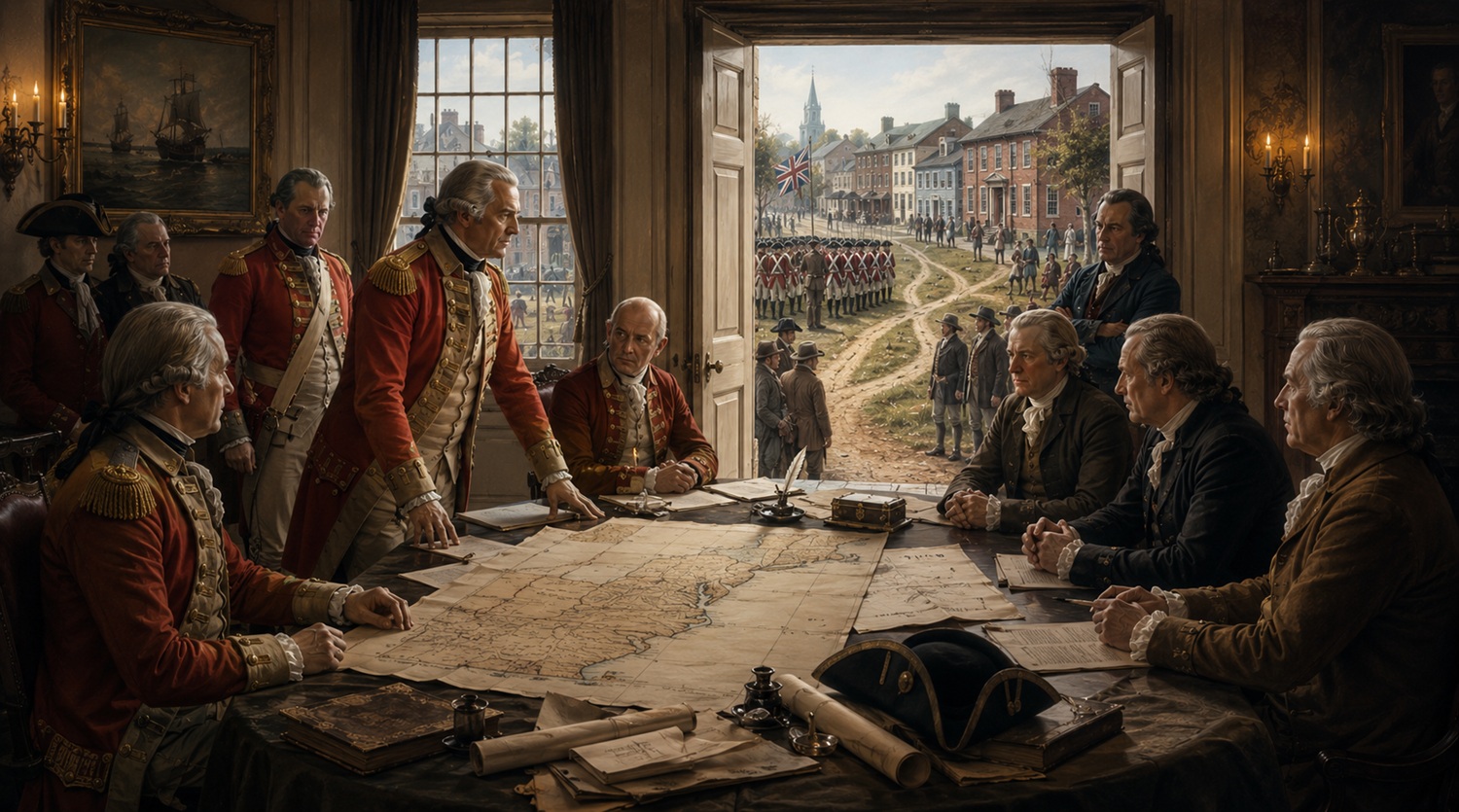
In October 1777, more than 5,000 British and allied troops under General John Burgoyne surrendered near Saratoga, New York.
The military defeat was serious. Its diplomatic consequences were even larger.
France had already been secretly assisting the American rebellion, but the American victory at Saratoga convinced French Foreign Minister Charles Gravier, comte de Vergennes, that the new United States had demonstrated enough military viability to justify an open alliance. France formally signed treaties of alliance and commerce with the Americans on February 6, 1778. The colonial rebellion was no longer simply a war between Britain and thirteen rebellious colonies. Britain now faced a global conflict involving its greatest European rival.
That makes Saratoga one of the strongest divergence points for asking:
What if Britain won the American Revolution?
But first, “Britain wins” needs to be defined carefully.
A realistic British victory does not mean red-coated soldiers permanently occupying every American town while angry colonists submit indefinitely to direct rule from London.
Britain had already discovered how difficult it was to govern a large, politically mobilized population across the Atlantic. Patriot armies could be defeated without eliminating political resistance. Loyalist support was significant but insufficient to govern the colonies by itself. The Revolutionary War functioned in important respects as a civil war, with perhaps 20 to 30 percent of the population remaining loyal to the Crown while many others actively supported independence or tried to avoid choosing sides.
A sustainable British victory therefore requires more than winning battles.
It requires a political settlement.
The most plausible outcome is a compromise in which Britain defeats or marginalizes the Continental military effort, prevents the decisive French alliance, and then gives the colonies far more control over their own taxation and domestic government while keeping them inside the British Empire.
In other words:
Britain wins militarily by conceding much of what the colonists had originally demanded politically.
That might prevent the United States of America from being created in 1776–1783.
It would not prevent North Americans from eventually governing themselves.
The Revolution Britain Was Trying to Defeat
The conflict that became the American Revolution had developed from disputes over the structure of the British Empire after the Seven Years' War.
Britain's victory in 1763 had produced enormous territorial gains in North America, but also enormous debt. London attempted to enforce imperial trade rules more effectively, maintain troops in North America, and make the colonies contribute more toward imperial expenses. Colonial resistance intensified as Americans argued that Parliament was violating traditions of self-government and imposing taxes without their political consent.
The conflict became progressively more difficult to reverse.
The Coercive Acts adopted after the Boston Tea Party restricted Massachusetts self-government and helped convince many colonists that the dispute concerned constitutional liberty rather than a handful of taxes.
Fighting began at Lexington and Concord in April 1775.
The Second Continental Congress organized a Continental Army and selected George Washington as commander in chief.
By July 1776, Congress had declared the colonies independent.
From that point onward, a British political settlement had to overcome an enormous new obstacle:
Britain was no longer asking angry colonists to accept revised imperial government.
It was asking people who had declared themselves citizens of independent states to become British subjects again.
Britain Was Powerful—but Occupation Was Not the Same as Victory
Britain possessed one of the world's most powerful navies and a professional military capable of capturing major American cities.
British forces occupied New York City for most of the war.
They captured Philadelphia.
Later they captured Charleston.
They won numerous conventional battles.
Yet capturing territory did not automatically eliminate the rebellion.
The British southern strategy illustrates the problem. British planners hoped that substantial Loyalist support would allow royal authority to be reconstructed after British armies secured key areas. Instead, Patriot forces under commanders such as Nathanael Greene and Daniel Morgan continued fighting through maneuver, raids, local militia warfare, and attacks on British supply and political networks.
Britain therefore faced an unpleasant equation.
To reconquer every colony permanently by force would require large military commitments across enormous distances.
To leave immediately after defeating the Continental Army could allow rebellion to restart.
A British victory had to create enough American acceptance that colonial governments could operate without permanent military occupation.
That makes political reconciliation central to this counterfactual.
The Most Plausible Divergence: Britain Wins the Saratoga Campaign
The historical British strategy of 1777 sought to isolate New England by gaining control of the Hudson River corridor.
General Burgoyne advanced south from Canada toward Albany.
But British operations were poorly coordinated. General William Howe instead concentrated his main campaign on Philadelphia. Burgoyne's army became increasingly isolated, was defeated in the Saratoga campaign, and surrendered in October.
The Library of Congress notes that Britain remained in a strong position in 1777 and that mistakes contributed significantly to the failure of the campaign.
Our alternate history changes that coordination.
Spring 1777
London gives Howe unambiguous instructions that the Hudson campaign is the year's primary strategic objective.
Howe sends a substantial force north from New York City rather than committing the main British effort to Philadelphia.
Burgoyne advances more cautiously from Canada.
British forces establish firmer control over the Hudson corridor.
American forces attempt to prevent the junction but cannot isolate Burgoyne as they did historically.
Autumn 1777
There is no British surrender at Saratoga.
Perhaps Britain captures Albany.
Perhaps the British merely establish enough control of the Hudson to force the Americans back while Burgoyne's army remains intact.
Either outcome removes the dramatic American victory that transformed French calculations.
That distinction matters enormously.
France had already provided covert aid, but official alliance carried far greater risks because it meant open war with Britain. Historically, news of Saratoga persuaded Vergennes to move toward formal recognition and alliance.
Without Saratoga, France hesitates.
Benjamin Franklin remains enormously effective in Paris.
French weapons and money may continue reaching the Americans secretly.
But Versailles delays the formal alliance while asking whether the rebellion can actually survive.
Britain has gained something almost as valuable as battlefield victory:
time.
Britain Offers Peace Before France Enters the War
This is where military success becomes political strategy.
Historically, Britain eventually offered remarkably substantial concessions.
After Saratoga and amid the growing danger of French intervention, Parliament abandoned attempts to impose colonial taxation and Britain sent the Carlisle Peace Commission to America in 1778. The commission represented Britain's last major attempt to reconcile the colonies without recognizing their complete independence.
By then it was too late.
France had entered the war.
Congress had declared independence nearly two years earlier.
The revolutionaries had survived long enough to believe independence was achievable.
In the alternate timeline, London reaches essentially the same political conclusion while Britain is winning rather than losing.
The British government announces that:
- Parliament will no longer levy taxes on the colonies for revenue;
- colonial assemblies will control internal taxation;
- objectionable punitive legislation will be repealed;
- colonial legislatures will retain extensive domestic authority;
- a continental congress or intercolonial body may continue for common American affairs;
- Britain retains responsibility for foreign affairs, imperial defense, and imperial trade policy;
- property and political rights of Loyalists will be restored;
- Patriot leaders will receive broad amnesty if armed resistance ends;
- British troops will withdraw from most civilian areas after political order is restored.
These concessions would have been revolutionary by the standards of the British Empire of 1765.
Yet Britain's actual peace initiatives of 1778 demonstrate that London eventually became willing to retreat substantially from its earlier taxation policies in an effort to preserve imperial union.
The fundamental bargain becomes:
No independence, but no return to the prewar imperial system either.
Would Congress Accept?
This is the greatest uncertainty in the early counterfactual.
By 1777, many Patriot leaders had committed themselves personally and ideologically to independence.
John Adams was unlikely to welcome renewed British sovereignty.
Thomas Jefferson had written the Declaration of Independence.
Benjamin Franklin had invested enormous effort securing European recognition.
George Washington had commanded an army fighting the Crown for more than two years.
The revolutionary movement could not simply forget 1776.
But political movements are not monolithic.
The American population included Patriots, Loyalists, neutrals, war-weary civilians, merchants worried about commerce, families divided by politics, and local communities primarily concerned with security.
Loyalist support was substantial enough to demonstrate that independence had never represented a unanimous continental position.
Military conditions would matter enormously.
If the Continental Army remains intact and France appears ready to enter the war, Congress probably rejects compromise.
If British success in the Hudson Valley is followed by another major American defeat, French recognition appears uncertain, Continental finances worsen, enlistment falters, and several colonies begin considering separate negotiations, unity could weaken.
A British victory therefore does not require every Patriot to change his beliefs.
It requires enough Americans to decide that:
near-total domestic self-government inside the empire is preferable to continuing an increasingly uncertain war.
George Washington
Washington presents Britain with both a military and political problem.
Defeating his army would be useful.
Making him a martyr could be disastrous.
If Britain captures Washington and executes him for treason, resistance could harden.
If Britain negotiates a continental settlement, broad amnesty is far more practical.
A plausible outcome is therefore that Washington refuses personal negotiations while Congress is still fighting but accepts civilian authority if Congress ultimately approves a settlement.
He then resigns his command.
Instead of becoming the first president of the United States, Washington returns to Mount Vernon as the most famous former revolutionary in British North America.
Whether he later participates in colonial politics is impossible to know.
His reputation could resemble that of a defeated but respected constitutional nationalist—or he could remain a symbol for a future independence movement.
Britain would have every reason to let him retire quietly.
A living Washington on his plantation is less dangerous than a Washington executed in London.
What Happens to the Continental Leadership?
Different leaders would make different decisions.
Some might accept amnesty.
Some might leave for France.
Some might continue underground resistance.
Some could eventually return to colonial legislatures.
The political careers of Washington, Jefferson, Adams, Franklin, Hamilton, Madison, and others become radically different.
There is no Constitutional Convention of 1787 as we know it.
No first U.S. Congress.
No Washington presidency.
No Jeffersonian Republican Party.
No Hamiltonian federal financial system in its historical form.
But the political ideas these men represented do not disappear.
The argument over representation, taxation, sovereignty, written constitutions, natural rights, and republican government has already occurred.
Britain can defeat an army.
It cannot make North Americans forget the political arguments of the 1760s and 1770s.
Patriots and Loyalists After a British Victory
Reconciliation would be difficult because the Revolution was also a civil conflict.
Patriot governments had confiscated Loyalist property.
Loyalists had served in British military units.
Neighbors had fought neighbors.
Families had divided.
Retaliation had occurred on both sides.
In real history, large numbers of Loyalists left the new United States after independence, with many resettling in British North America. Canada records that tens of thousands went to Nova Scotia and Quebec after the war, profoundly influencing the later development of British Canada.
In the alternate timeline, that mass Loyalist migration does not occur.
Loyalists remain in New York, Pennsylvania, the Carolinas, Georgia, and other colonies.
Their political influence may actually increase because they can claim that loyalty to Britain has been vindicated.
But Britain cannot simply restore Loyalists to every confiscated property without provoking a new rebellion.
The settlement would therefore require compensation, negotiated restoration, or legal arbitration.
A British North America born from reconciliation would spend years dealing with the human aftermath of civil war.
Colonial Self-Government Becomes the Price of Imperial Survival
This may be the most important long-term consequence.
The Revolution had demonstrated that Parliament could not easily tax and restructure politically mature settler colonies from London without resistance.
If Britain wins by compromise, Westminster has learned the lesson decades earlier than it did through later colonial experience:
large settler colonies require extensive control of their own domestic affairs.
The political model could gradually evolve toward something resembling the responsible-government arrangements Britain eventually accepted in Canada.
Historically, British North American colonies gained responsible government during the nineteenth century. Nova Scotia did so in 1847–1848, and the Province of Canada followed in 1848–1849, meaning governments increasingly depended on the confidence of elected colonial assemblies rather than simply the governor's preference.
An alternate British America could reach that destination sooner.
By 1800 or 1820, the former thirteen colonies might possess:
- elected lower houses;
- locally responsible ministries;
- control over taxation;
- extensive control over domestic law;
- an intercolonial congress;
- shared defense arrangements;
- continued allegiance to the Crown.
That would not be the United States.
But neither would it resemble the dependent colonies Parliament tried to govern in 1765.
Does the United States Ever Exist?
Possibly not.
At least not under that name, with those borders, or in 1783.
Instead, the colonies could gradually become a federation such as:
British American Confederation
or
Federation of North American Colonies
or simply a collection of self-governing colonies increasingly treated as one political unit.
The Crown remains sovereign.
Foreign policy remains tied to London.
But internal political life becomes overwhelmingly North American.
Over time, this arrangement could resemble the relationship Canada later developed with Britain much more than eighteenth-century colonial rule.
The great irony would be that Britain “wins” the American Revolution and eventually gives the colonists most of the practical autonomy for which many had originally fought.
The primary difference is symbolic and geopolitical:
there is no sudden creation of an independent American republic.
Canada Becomes a Very Different Idea
The historical existence of Canada as a political community distinct from the United States was heavily shaped by the Revolution and its aftermath.
Loyalist migration transformed Nova Scotia and the remaining British territories to the north. Tens of thousands of people displaced by the Revolution entered British North America.
If Britain wins, that migration largely disappears.
New York Loyalists stay in New York.
New England Loyalists stay in New England.
Southern Loyalists stay in the South.
Upper Canada is therefore not populated through the same post-Revolutionary Loyalist movement.
There is also no hostile United States south of British Canada.
That means one of the main strategic reasons for treating the northern colonies as a separate defensive political bloc is weakened.
Quebec remains distinctive because of its French-speaking population, civil law traditions, Catholic institutions, and historical experience.
But the eventual border between “Canada” and the “United States” may never become the defining line across North America.
Instead, Quebec, Nova Scotia, the thirteen colonies, Newfoundland, and later western territories could gradually become components of a much larger British North American federation.
Canada as we know it might never exist.
Or the name Canada might eventually be applied to that entire federation.
Westward Expansion Slows
This is one of the stronger consequences.
After the Seven Years' War, Britain attempted to reduce conflict with Native nations by restricting colonial settlement west of the Appalachian Mountains.
The Royal Proclamation of 1763 established a boundary intended to limit settlement farther west. One purpose was to reduce warfare and stabilize relations with Indigenous nations.
American colonists strongly resented these restrictions.
Land speculators and settlers wanted access to western territory.
Independent U.S. governments later pushed rapidly into the Ohio Valley and beyond.
With Britain victorious, the Crown retains control over western policy.
That likely means slower settlement beyond the Appalachians, at least initially.
But it does not mean the West becomes permanently protected Indigenous territory.
Britain had already modified frontier boundaries through later treaties such as the Treaty of Fort Stanwix in 1768. British policy tried to manage colonial expansion, not halt it forever.
The population of the Atlantic colonies would continue growing.
Land hunger would continue.
Speculators would continue lobbying.
Settlers would continue moving illegally across boundaries.
British officials would still seek treaties opening additional territory.
The difference is therefore primarily one of pace and political control.
Native Nations Could Retain More Power for Longer
Many Native nations faced an impossible strategic situation during the Revolution.
Different nations—and factions within nations—made different choices, while both British and American forces sought Indigenous allies. British military planners considered Native power in the Great Lakes region strategically important.
A British victory could strengthen Indigenous bargaining power in the short term.
London has practical reasons to preserve a western buffer between densely settled Atlantic colonies and the interior.
A strong Haudenosaunee presence, western confederacies, and other Native political formations could therefore remain significant diplomatic actors longer than they did under rapid U.S. expansion.
Britain might attempt to create protected Indigenous territories in parts of the Great Lakes and Ohio country.
But this should not be romanticized.
British imperial officials had their own interests.
Colonial settlers would still seek land.
Treaties could still be coercive or unequal.
Native peoples could still suffer displacement, warfare, disease, and demographic pressure.
So the defensible conclusion is:
British victory probably slows the massive westward expansion of the new United States because there is no new United States. It does not guarantee permanent Native sovereignty over the interior.
Slavery: Britain Winning Does Not Mean Immediate Emancipation
This is perhaps the most important myth to avoid.
Britain in 1777 was deeply involved in Atlantic slavery.
British merchants participated extensively in the transatlantic slave trade.
British Caribbean colonies depended heavily on enslaved labor.
Slaveholding was fundamental to the economies and political structures of several rebellious mainland colonies.
A British victory in the Revolution would therefore not lead London to abolish slavery throughout North America in 1778.
Historical abolition came much later.
Parliament abolished Britain's participation in the transatlantic slave trade in 1807. Slavery itself continued in much of the British Empire until the Slavery Abolition Act of 1833, with emancipation beginning in 1834 and full freedom after the controversial apprenticeship system ended in 1838 in the British West Indies.
Any alternate history that announces “Britain wins, so American slavery ends immediately” compresses more than half a century of British history into an outcome that did not yet exist politically.
But the Revolution Had Already Opened an Escape Route From Slavery
The relationship between Britain and slavery during the war was contradictory.
British authorities offered freedom to some enslaved people belonging to rebels who escaped and joined or assisted British forces.
Lord Dunmore's 1775 proclamation in Virginia famously promised freedom to enslaved people owned by rebels who escaped and served the Crown. Thousands of enslaved people sought freedom through British lines during the war.
These proclamations were wartime measures, not declarations of universal abolition.
They did not free every enslaved person.
They did not abolish slavery in Loyalist households.
And the British Empire continued to contain large slave societies afterward.
Nevertheless, Britain could not easily win the war and then return people it had explicitly promised to protect to rebellious former enslavers without creating a major political and moral crisis.
A British victory therefore likely produces a substantial free Black population associated with wartime service and escape.
That could strengthen antislavery politics.
But it still does not automatically abolish plantation slavery in Virginia, the Carolinas, or Georgia.
What Happens When Britain Abolishes the Slave Trade?
Now the counterfactual becomes more consequential.
Assume British antislavery politics develop broadly enough that Parliament still passes legislation similar to the 1807 Slave Trade Act.
The transatlantic importation of enslaved Africans into the American colonies would then become illegal under imperial law.
Southern planters would resist.
But ending the overseas trade is different from ending slavery itself.
Slave populations in colonies such as Virginia were already capable of natural increase.
Plantation slavery could continue for decades even without legal overseas importation.
The deeper constitutional crisis arrives when Britain moves toward emancipation.
The 1830s Could Produce a Second American Revolution—Over Slavery
Suppose the former thirteen colonies remain within the British Empire when abolition becomes a dominant British political cause.
Historically Parliament passed the Slavery Abolition Act in 1833.
Would Parliament pass exactly the same act if Virginia, Maryland, North Carolina, South Carolina, and Georgia were still major British colonies represented indirectly or directly within a huge North American imperial structure?
Not necessarily.
Their slaveholding political influence would be much greater than that of any one historical British Caribbean colony.
Three broad outcomes become plausible.
Outcome One: Imperial emancipation still occurs
Britain compensates slaveholders and orders gradual emancipation across British North America during the 1830s or 1840s.
If enforced, slavery could disappear from much of mainland North America roughly three decades before the historical U.S. Thirteenth Amendment.
Outcome Two: Emancipation is delayed
Southern colonial governments use their influence to postpone implementation or obtain a much longer transition.
Britain's abolition timetable changes because the political cost is dramatically larger.
Outcome Three: Slaveholding colonies rebel
South Carolina, Georgia, and perhaps other slaveholding colonies reject parliamentary emancipation and declare that Britain has exceeded its imperial authority.
The alternate North America could experience its great nineteenth-century secession crisis not because northern and southern U.S. states disagree over slavery, but because southern British colonies rebel against abolition imposed from London.
That is one of the most plausible ways a British victory in 1777 could still eventually produce an independent American state.
It would simply be a very different American revolution, fought generations later and centered partly on slavery.
There Is Probably No American Civil War as We Know It
Without an independent United States, there is no U.S. Constitution with its historical compromises over slavery.
There is no Missouri Compromise.
No Kansas-Nebraska Act.
No Republican Party founded in the same political system.
No Lincoln presidency.
No Confederate States of America in 1861 under the historical circumstances.
But slavery remains such a powerful institution that some other major constitutional confrontation is likely.
The key question becomes whether Britain can reconcile two incompatible developments:
increasing metropolitan commitment to abolition
and
powerful slaveholding colonial societies in mainland North America.
So British victory might prevent the American Civil War while creating a different emancipation crisis.
What Happens to Louisiana?
The Louisiana Purchase almost certainly does not occur as we know it.
Historically, Spain had controlled Louisiana since the eighteenth century. France regained the territory from Spain under Napoleon, and the United States purchased approximately 530 million acres from France in 1803 for $15 million. Napoleon's decision to sell was shaped partly by the failure of French efforts in Saint-Domingue and the renewed likelihood of war with Britain.
In our alternate timeline, there is no United States available to buy it.
What happens instead depends heavily on France.
If France still experiences revolution and Napoleon still comes to power, France might still regain Louisiana from Spain.
But then Napoleon faces an uncomfortable strategic reality:
a huge British North America lies immediately to the east.
Britain's navy could threaten French Louisiana whenever European war resumes.
France might retain Louisiana.
It might attempt a larger colonial restoration.
It might return territory to Spain.
It might eventually lose it to Britain.
The one outcome we can reject with confidence is the historical transaction of 1803:
there is no Louisiana Purchase by the United States because there is no United States to make the purchase.
Spain Becomes Much More Important in North America
At the end of the Revolutionary era, Spain controlled enormous territories in North America, including Florida and Louisiana west of the Mississippi.
An independent United States rapidly became Spain's expanding neighbor.
Without the United States, British-Spanish rivalry becomes a central question.
British settlers will still want access to the Mississippi.
Spanish authorities will still worry about migration into their territory.
British merchants will want access to western markets.
The Gulf Coast becomes a long-term imperial frontier.
If Spanish American independence movements later occur, Mexico and other successor governments could inherit far stronger territorial positions because there is no United States expanding through Louisiana, Texas, and the Southwest in the historical manner.
There is no obvious U.S.-Mexican War of 1846–1848.
There is no American annexation of California under those circumstances.
There is no historical Texas Republic arising from relations between Mexico and settlers who identify themselves as citizens of the United States.
North America's eventual borders could therefore be dramatically different.
Would the French Revolution Still Happen?
Probably—but perhaps differently.
France's intervention in the American Revolution imposed substantial additional costs on a monarchy already experiencing serious fiscal problems. Research on eighteenth-century French public finance identifies short-term borrowing associated with the American War as part of the debt burden confronting the monarchy in the 1780s.
But it would be simplistic to argue:
No French intervention in America = no French Revolution.
France's fiscal crisis had deeper structural causes.
Its tax system was politically difficult to reform.
State borrowing had long posed problems.
Social privilege, political conflict, Enlightenment criticism, disputes over representation, food crises, and struggles over royal authority all contributed to the revolutionary environment. Historians continue to debate how precisely the fiscal crisis became the political revolution of 1789.
Removing the expensive American intervention improves French finances.
It may postpone the immediate fiscal emergency.
It also removes some of the direct political interchange created when French officers and soldiers participated in the American war.
But revolutionary pressures remain.
Three possibilities are reasonable:
- The French Revolution still begins around 1789, because the monarchy's deeper fiscal and political problems remain.
- Reform postpones revolution, perhaps into the 1790s.
- France undergoes a constitutional crisis rather than the same radical revolution, because the timing and state finances differ.
What should not be claimed is that Britain winning at Saratoga automatically saves Louis XVI.
Republican Ideas Do Not Vanish With an American Defeat
The Declaration of Independence already exists.
Thomas Paine's arguments already exist.
Colonial assemblies already possess long traditions of representative politics.
Enlightenment arguments about rights, representation, sovereignty, and political authority already circulate across the Atlantic world.
A British victory can prevent the immediate consolidation of a successful American republic.
It cannot erase republican political thought.
Indeed, a negotiated British settlement might produce an ironic hybrid.
The colonies remain under a king while exercising increasingly republican domestic politics through elected assemblies.
Over time, the distinction between “monarchical” and “republican” government could become blurred in practice.
A North American colonist might remain a subject of George III while electing representatives who control nearly every domestic issue.
That is not full republican independence.
But neither is it the imperial system against which the Patriots first rebelled.
Britain Learns a Different Imperial Lesson
Historically, losing the thirteen colonies did not end the British Empire.
Britain continued expanding elsewhere, particularly in Asia, Africa, the Pacific, and the Caribbean.
In our alternate timeline, Britain's most important imperial lesson could instead be:
settler colonies are easier to retain through autonomy than coercion.
That could accelerate the political evolution that later produced responsible government in Canada and other settler colonies. Historically, London eventually accepted colonial ministries responsible to elected assemblies in British North America during the nineteenth century.
If Britain develops that model first in the American colonies, later imperial history might look different.
Australia, Canada, New Zealand, and other settler societies could receive self-government within a more explicitly federal imperial structure.
Britain might even experiment earlier with some form of imperial parliament or intercolonial council.
But another possibility exists.
Keeping a huge North American population inside the empire might consume enormous British political attention and military resources.
Britain could become more Atlantic-oriented and somewhat less focused on other imperial expansion.
That is much harder to predict.
A North American Federation Becomes Increasingly Likely
As the eighteenth century gives way to the nineteenth, administering Massachusetts, Virginia, Pennsylvania, Quebec, Nova Scotia, Georgia, and other colonies separately becomes increasingly impractical.
Intercolonial commerce expands.
Roads and canals connect regions.
Western settlement creates new territories.
Defense requires coordination.
Political leaders demand greater autonomy.
Some kind of federation becomes increasingly attractive.
The Continental Congress itself provides a precedent for intercolonial cooperation.
A British victory does not require London to abolish that idea.
Indeed, Britain could eventually decide that a continental assembly is the best way to transfer routine North American governance away from Westminster.
By the mid-nineteenth century, a plausible British North American federation could include many of the former thirteen colonies plus Quebec, Nova Scotia, New Brunswick, and expanding western provinces.
It could possess its own prime minister and parliament.
The monarch remains head of state.
Britain controls little more than foreign policy and certain constitutional matters.
In practical terms, it becomes a nation.
It simply reaches nationhood inside the British Empire rather than through successful revolution.
Alternate Snapshot: 1783
Real History
The Treaty of Paris recognizes the independence of the United States.
Britain retains Canada.
The new United States stretches westward to the Mississippi under the peace settlement.
Loyalists migrate northward and elsewhere in the British Empire.
Alternate History
There is no international recognition of an independent United States.
The Continental military effort has ended after a negotiated settlement.
Washington has resigned his military command.
Most colonial legislatures have resumed operation.
Parliament has formally abandoned revenue taxation of the mainland colonies.
A continental political body meets to coordinate colonial affairs.
British regular troops remain at major strategic locations but are withdrawing from ordinary civil government.
Loyalists remain in the colonies rather than migrating north in enormous numbers.
The Appalachian frontier is still formally controlled by imperial authorities.
France is angry and strategically disappointed but has avoided open war with Britain.
North America remains British along most of the Atlantic seaboard.
The American Revolution has ended in a strange compromise:
the Patriots lose independence but win much of the constitutional argument.
Alternate Snapshot: 1800
By 1800, the imperial settlement has existed for roughly two decades.
A generation has grown up remembering the Revolution but not living under wartime occupation.
The former thirteen colonies possess extensive domestic autonomy.
Their assemblies control taxation.
An intercolonial congress handles trade disputes, western settlement, infrastructure, and common petitions to London.
Britain controls foreign policy and imperial defense.
George Washington, if still following his historical lifespan, has become an elderly symbol of the failed independence movement rather than a former president.
Political factions still invoke Jeffersonian or Adams-style ideas, but there are no Federalists and Democratic-Republicans in their historical forms.
Slavery remains legal in southern colonies.
The British slave trade continues because Parliament has not yet enacted the historical 1807 abolition.
Western settlement is increasing but proceeds through imperial treaties and regulated territories more slowly than the rapid expansion of the historical United States.
Spain still dominates substantial territory beyond the Mississippi and in Florida.
Louisiana's future is uncertain.
The North American political map still looks recognizably imperial.
But the colonies themselves are becoming increasingly difficult to describe as subordinate.
Alternate Snapshot: 1850
By 1850, the original imperial settlement could no longer survive unchanged.
Population growth alone would guarantee that.
The strongest scenario is now an autonomous British North American federation.
It possesses:
- a parliament;
- a prime minister;
- provincial governments;
- courts;
- extensive fiscal autonomy;
- substantial control over settlement and transportation;
- perhaps responsibility for most internal military affairs.
The Crown remains head of state.
Foreign policy is still coordinated with London, although North American leaders demand a voice in imperial diplomacy.
Quebec's French-speaking population forms a major component of the federation rather than belonging to a separate Canadian political trajectory.
There has been no War of 1812 between Britain and the United States because no independent United States existed to fight it. The historical war involved disputes over maritime rights, impressment, western expansion, British territory in North America, and relations with Native nations—all of which would take different institutional forms inside one empire.
The largest political crisis is slavery.
Britain's historical abolition movement has created intense conflict with mainland slaveholding colonies.
Perhaps emancipation has already been imposed.
Perhaps it has been delayed.
Perhaps several southern colonies are threatening secession.
This could be the moment when the British American federation either survives as a united political system—
or finally breaks apart.
Alternate Snapshot: 1900
Any precise prediction by 1900 would be false confidence.
More than a century of alternate wars, elections, migration, industrialization, territorial disputes, imperial crises, technological change, and demographic growth separates 1900 from Saratoga.
Still, several broad configurations are plausible.
Scenario A: A continental dominion
Most of the former thirteen colonies and historical Canada belong to a vast self-governing federation within the British imperial system.
It is independent in virtually every practical domestic sense.
London and the federation share the monarch and perhaps coordinated foreign policy.
The political relationship resembles an enlarged and earlier version of dominion status.
Scenario B: Peaceful independence
The federation negotiated full sovereignty during the nineteenth century.
The separation resembles constitutional decolonization rather than 1776-style revolution.
Britain and the new American federation remain close commercial and strategic partners.
Scenario C: Southern independence
A nineteenth-century crisis over slavery or imperial authority caused several southern colonies to leave the federation.
North America contains at least two major English-speaking states.
Scenario D: Multiple North American countries
Regional differences prevent continental federation.
New England, the mid-Atlantic colonies, southern colonies, Quebec, and western territories develop into separate federations or states.
There is nothing inevitable about the emergence of one continental superpower.
Competing Long-Term Scenarios
| Scenario | Core Idea | Plausibility | Major Consequence |
|---|---|---|---|
| Autonomous British America | Colonies remain under Crown but acquire responsible government and continental federation. | High | No independent United States in 1783, but a powerful self-governing North American nation eventually emerges. |
| Delayed peaceful independence | Britain wins the war but later accepts independence after autonomy becomes nearly complete. | Moderately high | An American nation still appears, but without the same founding war, Constitution, or political mythology. |
| Second revolution in the early 1800s | Imperial disputes reappear and another independence movement succeeds. | Moderate | 1776 is remembered as a failed first attempt rather than the founding moment. |
| Slavery-driven break in the 1830s–1850s | Imperial abolition provokes rebellion among slaveholding colonies. | Moderate | American independence becomes tied to defense of slavery in some regions rather than universal republican rhetoric. |
| Permanent regional fragmentation | No single federation can reconcile New England, Quebec, southern colonies, and western territories. | Possible | North America develops several major states instead of one United States. |
| Permanent direct British colonial rule | London continues governing the colonies substantially as before 1775. | Low | Political resistance and population growth make this increasingly unworkable. |
The least plausible outcome is the simplest one:
Britain wins one battle and nothing important changes for the next century.
A British victory would force the empire itself to evolve.
North American Borders Could Be Unrecognizable
The familiar map of the United States emerged from a sequence of events that depends upon American independence.
Those include:
- the 1783 boundaries of the United States;
- the Louisiana Purchase;
- U.S. settlement beyond the Appalachians;
- acquisition of Florida;
- Texas independence and annexation;
- the U.S.-Mexican War;
- the Oregon settlement;
- treaties and wars displacing Native nations;
- continental railroad development under U.S. sovereignty.
Break the chain in 1777 and none of those events can simply be assumed.
A British federation might eventually expand west to the Pacific.
But it might do so more slowly.
Spain or Mexico might retain considerably more territory.
Indigenous confederacies might remain politically powerful longer.
Louisiana might become French, Spanish, British, independent, or divided.
The Pacific Northwest might become the center of a longer British-Spanish or British-Russian rivalry.
The result could be a North America containing several large political systems rather than one nation stretching from the Atlantic to the Pacific.
What Probably Still Happens
A rigorous counterfactual should also identify developments that do not depend completely on American independence.
Population continues growing
The Atlantic colonies remain economically attractive and demographically dynamic.
Settlers continue moving west
Britain can regulate migration more effectively than the early United States, but it cannot permanently eliminate demand for western land.
Native nations continue resisting encroachment
British victory changes the balance of power but does not remove colonial pressure on Indigenous territory.
Slavery remains a major issue
Britain in the 1770s is not an abolitionist empire.
Antislavery politics continue developing
The late eighteenth- and nineteenth-century British abolition movements have causes larger than American independence alone.
France continues facing political and fiscal problems
Avoiding the American war improves French finances but does not cure the monarchy's structural crisis.
Industrialization continues
Britain's Industrial Revolution does not depend upon losing the thirteen colonies.
North American industrial development would also continue under imperial or autonomous government.
Representative politics grows
The colonies already possess deep traditions of elected assemblies.
A military victory cannot permanently erase them.
What Almost Certainly Does Not Happen
Other developments depend so closely upon American independence that their historical forms disappear.
There is no Washington presidency in 1789
There is no U.S. presidency to occupy.
There is no U.S. Constitution of 1787
A different continental constitution could emerge later, but not through the historical Philadelphia Convention.
There is no Louisiana Purchase by the United States
The purchaser does not exist.
There is no War of 1812 between Britain and the United States
The political relationship that produced that war is absent.
There is no Monroe Doctrine in 1823
The United States does not exist as an independent republic asserting a special geopolitical position in the Western Hemisphere.
There is no American Civil War in its historical form
The political structure containing free and slave states is different.
There is no U.S.-Mexican War under the historical circumstances
The United States is not expanding toward Mexican territory in the same way.
Canada does not develop in the same demographic and strategic environment
The massive historical Loyalist migration and the permanent border with an independent United States are absent.
Would Britain Really Be Able to Govern Millions of Americans?
Not indefinitely through direct rule.
That is precisely why the political part of this scenario is essential.
Britain could probably defeat more Continental armies.
It could occupy coastal cities.
It could blockade ports.
It could use Loyalist forces.
But if a large percentage of the population remained permanently committed to armed resistance, the empire would face recurring insurgency across thousands of miles of territory.
The sustainable victory therefore comes from splitting independence from self-government.
Britain must convince enough Americans that they can enjoy extensive political liberty without complete international sovereignty.
The historical Carlisle Peace Commission shows that British politicians eventually became willing to offer substantial concessions when the alternative was losing the colonies altogether.
Our alternate Britain learns that lesson early enough for it to matter.
How Plausible Is the Divergence?
Better British coordination prevents the Saratoga disaster
Plausible.
The 1777 British campaign suffered from significant strategic and coordination problems, and the Library of Congress explicitly notes the strong British position during that year.
France delays its formal alliance
Strongly plausible if there is no Saratoga victory.
The historical American victory was an important reason Vergennes moved toward formal alliance.
Britain offers major political concessions
Very plausible.
Britain actually offered important concessions and sent the Carlisle Commission in 1778.
Congress accepts
Uncertain.
By 1777–1778, commitment to independence among Patriot leadership was already substantial. Acceptance would probably require additional military reverses and signs that France would not intervene.
The colonies remain permanently subordinate
Unlikely.
Population growth, political experience, distance, and established assemblies favor increasing autonomy.
The colonies remain voluntarily inside the empire for generations
Plausible if Britain accepts meaningful self-government.
Canada's later development demonstrates that British North American colonies could evolve toward responsible government without immediately severing ties to the Crown.
Native nations permanently retain the entire trans-Appalachian West
Unlikely.
British authorities were already modifying settlement boundaries before the Revolution.
Slavery is abolished immediately after British victory
Very unlikely.
British abolition of the slave trade came in 1807 and emancipation across much of the colonial empire decades later.
Slavery ends earlier than in the historical United States
Plausible, but far from certain.
If British abolition develops on a similar timetable and Parliament can enforce it over the mainland colonies, emancipation might precede U.S. abolition in 1865 by decades. But the presence of powerful mainland slave societies inside the empire could also delay British policy.
The French Revolution never happens
Too strong.
French fiscal and political problems were deeper than the costs of intervention in America.
There is never an independent American nation
Possible, but not the strongest long-term conclusion.
More likely, North America eventually becomes nearly or completely self-governing through federation, dominion status, peaceful separation, or a later independence crisis.
The Great Paradox of British Victory
The political paradox at the center of this scenario is that Britain could win the war only to lose the old imperial system.
The government that tried to tax the colonies without their consent would eventually have to accept colonial control of taxation.
The Parliament that attempted to discipline Massachusetts would have to tolerate powerful colonial legislatures.
The empire that rejected the Continental Congress might eventually discover that a continental parliament was the easiest way to govern British America.
Britain would preserve the Crown's sovereignty while surrendering much of the practical authority that caused the Revolution.
So what has Britain actually won?
It retains:
- imperial prestige;
- strategic control of the Atlantic seaboard;
- commercial ties;
- foreign-policy authority;
- military alliances;
- allegiance to the Crown;
- and perhaps a continent-sized partner inside the British world.
What have the colonists won?
They retain:
- representative assemblies;
- control of taxation;
- substantial domestic autonomy;
- political institutions;
- and eventually responsible government.
The loser is the idea that Britain can treat politically mature North American colonies like dependencies governed primarily from Westminster.
That system probably cannot survive even a British military victory.
The AltHistAI Verdict
A British victory in the American Revolution was possible.
The best divergence is not Yorktown.
By 1781, France was already deeply involved and Britain faced a much broader international war.
The more consequential turning point comes in 1777.
Britain entered that year in a strong military position. Better coordination of the Hudson campaign could plausibly prevent Burgoyne's surrender at Saratoga. Without the dramatic American victory, France has less reason to conclude in late 1777 that an open military alliance with the United States is worth the risk of war with Britain. Historically, Saratoga was central to Vergennes's decision to formalize the French alliance.
That gives Britain an opportunity it squandered historically:
combine military strength with political compromise before French intervention transforms the war.
A viable British settlement would have to abandon parliamentary revenue taxation, restore extensive colonial self-government, preserve elected assemblies, offer amnesty, and eventually recognize some continental American political institution.
Those concessions are not purely imaginary. Britain's own 1778 peace initiatives demonstrate how far the government eventually became willing to move in an attempt to preserve imperial union.
If enough war-weary Americans accept, there is no independent United States in 1783.
But Britain has not frozen North America in the eighteenth century.
Quite the opposite.
The colonies would probably evolve rapidly toward a self-governing federation.
Canada develops differently because there is no enormous Loyalist exodus from the thirteen colonies and no permanent U.S.-Canadian frontier created by American independence.
Westward expansion slows because London retains control over frontier policy, giving Native nations greater bargaining power for at least some additional period. But settler pressure remains too strong to assume permanent Indigenous security.
The familiar continental United States does not emerge.
There is no Louisiana Purchase in 1803.
Spain and perhaps France remain more important North American powers.
Mexico could retain much more northern territory.
The political map of the continent becomes profoundly uncertain.
Slavery provides the darkest and perhaps most consequential long-term crisis.
Britain winning in 1777 would not immediately emancipate enslaved Americans. Britain's own slave trade continued until Parliament abolished it in 1807, and colonial slavery persisted into the 1830s.
If British abolition later follows a similar path, however, the presence of Virginia, the Carolinas, Georgia, and other slave societies within the empire creates an enormous constitutional confrontation.
Britain might abolish slavery in mainland North America decades before the historical United States did.
Southern colonies might force a delay.
Or abolition could produce a second American rebellion.
Ironically, the independence movement that succeeds might then be fought partly to preserve slavery from British abolition, producing a national founding narrative profoundly different from 1776.
France also changes, but not predictably enough to say that the French Revolution disappears. Avoiding the American war would reduce an important source of French expenditure, but France's fiscal and constitutional problems were much deeper than one conflict.
Republican ideas survive regardless.
Britain can defeat Washington.
It cannot erase the Declaration of Independence, decades of colonial self-government, Enlightenment political thought, or the experience of representative assemblies.
By 1850, the most plausible successful British America would therefore barely look colonial.
It would have its own parliament.
Its own government.
Its own political parties.
Its own economic interests.
Perhaps its own prime minister.
It might stretch from the Atlantic deep into the continental interior.
It might encompass both the historical United States and Canada.
Its people could still consider themselves British subjects while increasingly thinking of themselves as members of a distinct North American nation.
And eventually, perhaps peacefully, that nation might become completely sovereign.
So the strongest answer to “What if Britain won the American Revolution?” is not:
America remains a collection of British colonies forever.
It is:
The United States as founded in 1776 probably never exists—but a different, increasingly autonomous British American nation eventually takes its place.
Britain wins the Revolution.
The Crown keeps America.
But in order to keep America, Britain ultimately has to let Americans govern themselves.
Key Takeaways
- Britain remained in a strong military position in 1777, and strategic mistakes contributed to the Saratoga disaster.
- Saratoga was a crucial diplomatic turning point because it helped convince France to form an official alliance with the United States in 1778.
- A plausible British victory therefore begins by preventing Burgoyne's surrender and delaying or preventing formal French intervention.
- Britain could not realistically govern the colonies indefinitely through military occupation alone.
- Loyalists made up a substantial minority of the population, but British estimates of Loyalist strength often exceeded what could actually be mobilized politically and militarily.
- Britain's historical peace initiatives in 1778 show that London eventually became willing to retreat substantially on taxation and colonial government in an effort to restore peace.
- A successful settlement would probably require extensive colonial self-government inside the British Empire.
- The United States would not be created in its historical form, and the Constitution and presidency of 1787–1789 would not exist as we know them.
- Canada would develop very differently because the large historical Loyalist migration and permanent U.S.-Canadian border would not arise in the same way.
- British victory would probably slow western settlement but would not permanently prevent colonial encroachment on Native lands.
- Native nations could retain greater diplomatic and military leverage for longer in the Great Lakes and Ohio regions.
- British victory would not immediately abolish slavery. Britain did not abolish its slave trade until 1807 or colonial slavery until decades later.
- British wartime proclamations nevertheless enabled many enslaved people to seek freedom by escaping Patriot owners and reaching British forces.
- If British abolitionism later develops on a similar timetable, the mainland slaveholding colonies could face an emancipation crisis decades before 1865.
- There would be no Louisiana Purchase by the United States in 1803.
- Spain, France, Britain, Native nations, and later Mexico could all retain stronger positions in continental North America.
- The French Revolution might still occur because France's fiscal and political problems had causes deeper than the cost of intervention in America.
- Republican political ideas would remain influential even after a Patriot military defeat.
- The most plausible long-term outcome is not permanent colonial dependency but an autonomous British North American federation, later independence, or both.
Sources and Further Reading
American Revolution and British Strategy
Library of Congress, “The American Revolution, 1763–1783.”
Primary-source-based overview of the Revolution, colonial resistance, Loyalism, British strategy, and the military turning points of 1776–1777. The Library's account notes that Britain remained in a strong position in 1777 before the failures culminating at Saratoga.
Library of Congress, “Revolutionary War: The Home Front.”
Useful for understanding the Revolution as a civil conflict and the substantial Loyalist population within the colonies.
Library of Congress, “Revolutionary War: Southern Phase, 1778–1781.”
Examines Britain's attempt to reconstruct political control through presumed Loyalist strength and why military victories did not automatically restore royal government.
France and the International War
U.S. Department of State, Office of the Historian, “French Alliance, French Assistance, and European Diplomacy during the American Revolution.”
Authoritative overview of French assistance and the decisive importance of Saratoga in Vergennes's decision to conclude the 1778 alliance.
U.S. Department of State, Office of the Historian, “Benjamin Franklin: First American Diplomat.”
Provides additional context for Franklin's diplomacy in France and the combination of his efforts with the American victory at Saratoga.
British Reconciliation
Library of Congress, George Washington Papers timeline, “The American Revolution.”
Documents Britain's dispatch of the Carlisle Commission in 1778 as part of the attempt to restore peace.
American Revolution Institute, “The Carlisle Commission.”
Overview of Britain's 1778 diplomatic attempt to end the rebellion after the strategic situation had deteriorated and French intervention threatened to expand the conflict.
“The Reception of the British Peace Offer of 1778,” Pennsylvania History.
Historical scholarship on the substantial legislative and political concessions associated with Britain's 1778 reconciliation effort, including retreat from controversial taxation and legislation.
Native Nations and Western Expansion
National Park Service, “Breaking Rugged Boundaries: American Expansion onto Indigenous Lands.”
Explains British efforts before the Revolution to restrict settlement beyond the Appalachian boundary and reduce conflict with Native peoples.
National Park Service, “1768 Boundary Line Treaty of Fort Stanwix.”
Important evidence that the Proclamation Line of 1763 was not intended as an unchangeable permanent frontier; British officials continued negotiating new boundaries as settler pressure expanded.
Government of Canada, Department of National Defence, “In Defence of Their Homelands.”
Discusses the strategic importance of Indigenous nations during the Revolutionary War and efforts by both sides to obtain Native alliances.
Loyalists and Canada
Government of Canada, “Canada: A History of Refuge.”
Provides figures and context for the large-scale Loyalist migration into Nova Scotia and Quebec after the successful American Revolution.
Government of Canada, “Discover Canada: Canada's History.”
Provides official historical context for the later development of responsible government in British North America, useful when assessing how a victorious Britain might eventually accommodate self-governing American colonies.
Slavery and Emancipation
UK Parliament, “1807 Abolition of the Slave Trade.”
Documents Parliament's abolition of Britain's transatlantic slave trade in 1807 and the much later emancipation of enslaved people in British colonies.
UK Parliament, “Parliament and the British Slave Trade: Key Dates.”
Provides the legislative chronology from abolition of the slave trade in 1807 through the Slavery Abolition Act of 1833.
UK Parliament, “The West Indian Colonies and Emancipation.”
Discusses the implementation of emancipation beginning in 1834 and the end of the apprenticeship system in 1838.
National Park Service, “Freedom Denied? Enslaved Soldiers During the Revolution.”
Explains Lord Dunmore's wartime proclamation offering freedom to enslaved people belonging to rebels who escaped and joined British forces.
National Park Service, “Patriots of Color at Valley Forge.”
Provides further context for enslaved people seeking freedom through British lines and the complicated relationship between military allegiance and emancipation.
France and the French Revolution
David R. Weir, “Tontines, Public Finance, and Revolution in France and England, 1688–1789,” The Journal of Economic History.
Examines French public finance before the Revolution, including substantial short-term debt associated with the American War.
Andrew Jainchill, “Political Economy, the State, and Revolution in Eighteenth-Century France,” Modern Intellectual History.
Useful for understanding why France's fiscal crisis cannot be reduced to the costs of the American Revolution alone.
Louisiana and the Later North American Map
U.S. Department of State, Office of the Historian, “Louisiana Purchase, 1803.”
Documents Spanish possession of Louisiana, French reacquisition, and the historical American purchase—an event that could not occur in the same form without an independent United States.
U.S. Department of State, Office of the Historian, “Napoleonic Wars and the United States, 1803–1815.”
Explains Napoleon's reacquisition of Louisiana, the strategic consequences of the failure in Saint-Domingue, and the renewed threat of war with Britain that contributed to the decision to sell.