 Alternate History AI
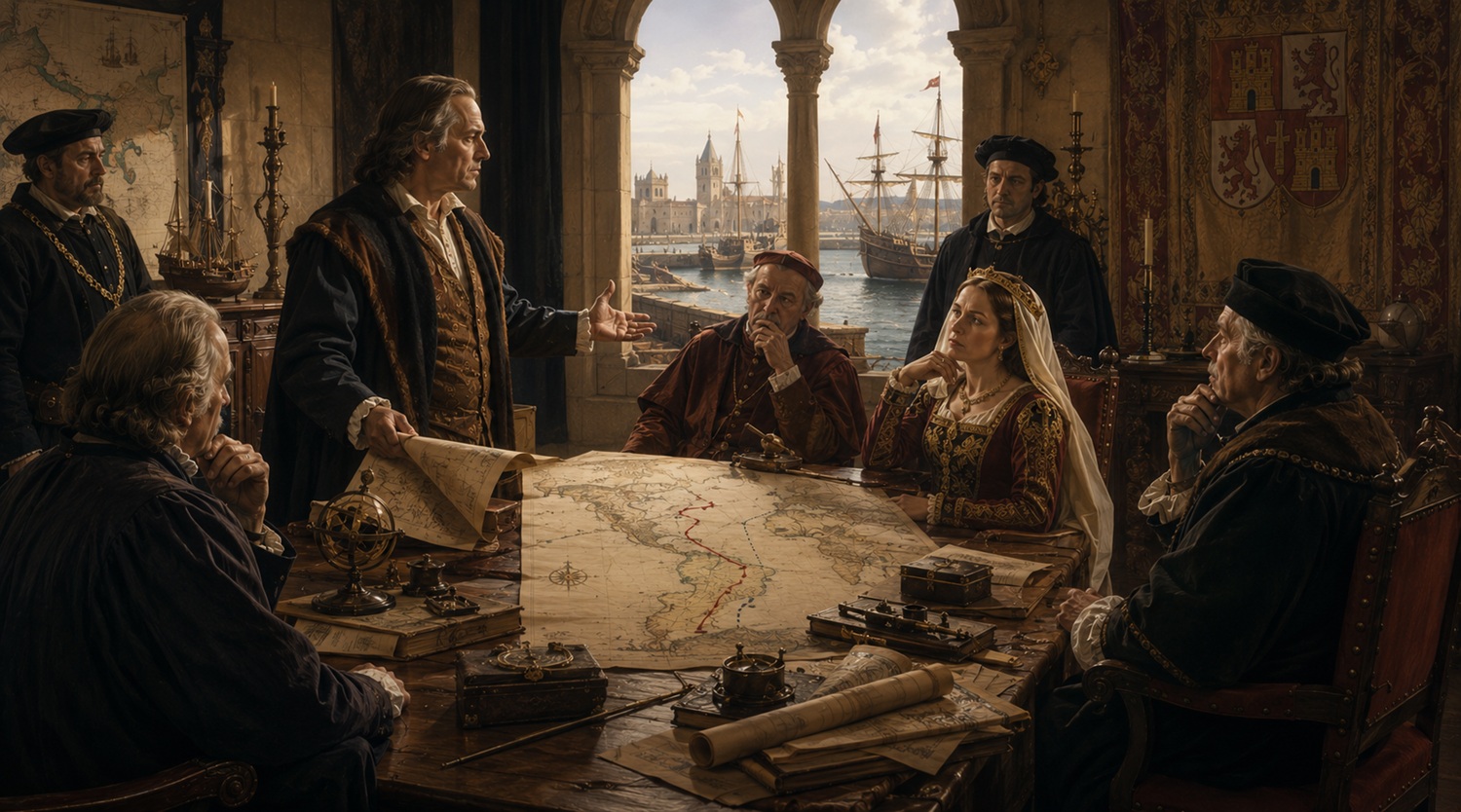
Christopher Columbus was not the first person to discover the Americas.
Millions of Indigenous people were already living throughout North America, South America, the Caribbean, and the Arctic when Columbus crossed the Atlantic in 1492. Their societies ranged from mobile communities to agricultural villages, trading networks, city-states, kingdoms, and expanding empires.
Nor was Columbus even the first known European to reach the Americas.
Archaeological evidence from L'Anse aux Meadows in Newfoundland demonstrates a Norse presence in North America centuries before Columbus. Researchers have now securely dated Norse activity there to 1021 CE, making it the earliest precisely dated European presence in the Americas currently confirmed by archaeology.
What made 1492 historically distinctive was something else.
Columbus's voyage helped establish a sustained political, commercial, biological, and imperial connection between the Americas and the interconnected societies of Europe, Africa, and Asia. His return to Spain was followed by additional voyages, Spanish settlement in the Caribbean, military conquest, missionary activity, forced labor, migration, disease transmission, the movement of plants and animals, African slavery, and eventually immense flows of American silver into European and Asian markets. Cambridge's global history of the period describes the voyages as firmly connecting Africa and Eurasia with the Americas in a way that earlier Norse contact had not.
So the useful counterfactual is not:
What if nobody ever discovered America?
It is:
What if Columbus never made his 1492 voyage, delaying and redirecting the sustained European connection with the Americas?
That distinction produces a much more historically plausible—and much more interesting—alternate history.
The Point of Divergence: Spain Says No
Columbus spent years seeking support for a westward voyage toward Asia.
Portuguese mariners were already building a different route to Asian markets by sailing south along Africa. Bartolomeu Dias rounded the Cape of Good Hope in 1488, demonstrating that the Indian Ocean could be reached by sea from the Atlantic. Vasco da Gama would complete the route to India in 1498.
Columbus proposed instead that Asia could be reached by sailing west.
His calculation dramatically underestimated the distance between Europe and Asia because Europeans did not know that the American continents stood between them.
In real history, Isabella of Castile ultimately supported Columbus's expedition.
Our divergence is simple.
Early 1492
Granada has just fallen, ending the final Muslim-ruled kingdom in Iberia.
Ferdinand and Isabella face military expenses, political consolidation, religious policy, Mediterranean commitments, relations with Portugal, and numerous other demands.
After another royal review of Columbus's proposal, Isabella declines to finance it.
Perhaps the court judges his geographical assumptions too doubtful.
Perhaps Columbus's demands for titles and privileges appear excessive.
Perhaps financial priorities simply lie elsewhere.
Whatever the immediate reason, Columbus leaves court without royal sponsorship.
No Niña.
No Pinta.
No Santa María.
No October 1492 landfall in the Bahamas.
No Columbus-led return expedition to Hispaniola in 1493.
The Atlantic world enters 1493 without anyone in the Spanish court knowing that enormous continents stand between Europe and Asia.
But that does not mean the Atlantic remains uncrossed for another century.
Why Another European Voyage Is Almost Certain
By 1492, European Atlantic exploration was already accelerating.
Columbus did not create the maritime technology that made his voyage possible.
Fifteenth-century Portuguese and Castilian sailors had spent decades improving Atlantic navigation, ship design, astronomical navigation, cartography, and understanding of currents and winds. Historian P. E. H. Hair describes Columbus as appearing at precisely the moment when generations of Portuguese and Castilian maritime development were producing increasingly effective high-seas navigation.
Portuguese sailors had settled Madeira and the Azores and explored progressively farther down the African coast. By 1488 they had rounded southern Africa.
English merchants in Bristol were also looking west.
Only five years after Columbus's historical voyage, John Cabot reached the Newfoundland region in 1497 under English sponsorship. Cambridge histories identify Bristol-based Atlantic ventures and Cabot's 1497 voyage as part of a wider late-fifteenth-century search for western routes.
Then, in 1500, the Portuguese expedition commanded by Pedro Álvares Cabral reached the coast of Brazil while sailing in connection with Portugal's growing route toward India.
These events make one conclusion particularly strong:
Removing Columbus probably delays sustained European contact. It does not prevent it.
The real uncertainty is who establishes the connection first and where.
Who Reaches the Americas Instead?
Several possibilities are credible.
England: John Cabot
Cabot is the most obvious candidate for the first major post-Norse European contact in our alternate timeline.
His historical 1497 voyage does not depend directly on Columbus commanding Spanish ships. Bristol merchants already possessed Atlantic interests, and England sponsored Cabot's westward expedition.
If his voyage still occurs, Europeans again reach North America only five years later than Columbus historically reached the Caribbean.
But Cabot's landfall is very different.
He reaches the colder North Atlantic rather than the populous Caribbean.
There is no immediate English equivalent of Columbus's second voyage carrying settlers, livestock, officials, and an imperial colonization program.
England historically did not establish durable large-scale colonization immediately after Cabot. Its American colonial projects developed much later.
So Cabot might create European knowledge of American lands without immediately producing the biological and imperial transformation that followed Hispaniola.
Portugal: Perhaps the Strongest Alternative
Portugal is an even more interesting possibility.
By 1492, Portuguese maritime strategy was focused primarily on Africa and the route to India.
That focus would probably continue.
Vasco da Gama's arrival in India in 1498 represented the culmination of decades of Portuguese Atlantic and African exploration.
Yet Portugal's oceanic routes also carried ships deep into the South Atlantic.
Cabral historically reached Brazil in 1500.
Without Columbus, there is no 1494 Treaty of Tordesillas in its historical form because the diplomatic dispute that produced the particular Spanish-Portuguese division of newly contacted lands would be different. Historically, the treaty created an agreed line dividing spheres of Spanish and Portuguese expansion and later gave Portugal a basis for its claims in Brazil.
In the alternate timeline, Cabral or another Portuguese navigator could reach South America before Spain establishes any American claim.
That could produce an extraordinary reversal.
Instead of Spain becoming the first major Iberian empire in the Americas, Portugal might establish the first sustained European-American imperial connection.
Spain could then find itself rushing to catch up.
Spain Probably Returns to the Atlantic
Spanish withdrawal from Columbus's proposal would not mean permanent Spanish disinterest.
Once England or Portugal returns with credible reports of large western lands, maps, timber, fisheries, unfamiliar peoples, valuable commodities, or rumors of gold, the strategic calculation changes.
The same Spanish monarchy that rejected a speculative voyage toward Asia would now confront evidence that rival European powers had reached territories across the Atlantic.
Spain would probably sponsor its own expeditions quickly.
The question would no longer be:
Does land exist to the west?
It would be:
How much can England or Portugal claim before Spain arrives?
Thus even in a Cabot- or Cabral-first scenario, Spanish involvement could begin within years.
France Would Eventually Join
France also had maritime communities capable of entering Atlantic competition.
French involvement would become increasingly likely once Portuguese, English, or Spanish reports demonstrated that transatlantic voyages could produce valuable fisheries, trade, land claims, or strategic advantages.
The historical development of French activity in Atlantic Canada and later colonial expansion demonstrates that Iberia did not possess a permanent monopoly over European interest in the Americas. European overseas competition eventually involved French, English, Dutch, Portuguese, and Spanish powers.
Without Columbus, that competition probably starts from a different geographical map.
The northern Atlantic—Newfoundland fisheries and northeastern North America—could initially attract greater European attention than the Caribbean.
Contact Is Not the Same as Colonization
This distinction is essential.
The Norse reached North America around five centuries before Columbus.
Yet Norse contact did not produce a sustained integration of the American continents into European imperial systems. L'Anse aux Meadows remains the only confirmed Norse site in the Americas, and the settlement did not develop into a lasting European colony.
Cabot could similarly reach Newfoundland without producing immediate conquest.
Portuguese sailors could make landfall in Brazil without immediately occupying the continent.
French fishermen could interact repeatedly with coastal communities without founding a territorial empire.
The transformative threshold comes when contact becomes:
regular, repeatable, state-supported, commercially valuable, and demographically sustained.
Once ships begin crossing the Atlantic every year, carrying settlers, soldiers, missionaries, merchants, livestock, enslaved people, and cargo in both directions, the biological and political histories of the continents begin merging.
That process might begin in 1493.
Or 1500.
Or 1520.
The difference matters enormously.
The Americas in 1492 Were Politically Dynamic
Another common mistake is to imagine Indigenous societies frozen in place until Europeans appeared.
They were not.
Political systems were expanding, contracting, competing, trading, migrating, fighting, reforming, and collapsing long before European contact.
A delayed European arrival therefore does not produce the same Aztec and Inca empires simply waiting patiently for conquistadors in a later year.
The Americas have their own history.
And additional decades could transform it.
The Mexica Empire Without Cortés
What is commonly called the Aztec Empire was more accurately an imperial system based on the Triple Alliance centered on Mexico-Tenochtitlan, Texcoco, and Tlacopan.
It had expanded across much of central Mexico through conquest, tribute, military pressure, and political alliances. Cambridge scholarship describes the empire as a loose patchwork of conquered territories whose communities supplied tribute, troops, and other resources.
By the time Hernán Cortés arrived in 1519, Tenochtitlan was one of the world's great cities and the center of an empire containing millions of subjects.
But the empire was not politically uncontested.
Tlaxcala remained independent and had resisted Mexica pressure for years. Other tributary communities resented imperial demands. Those divisions became crucial because Cortés did not conquer central Mexico with a few hundred Spaniards acting alone. Indigenous allies provided thousands of warriors and were essential to the defeat of Tenochtitlan.
Remove European intervention in 1519 and those conflicts continue.
The Mexica might conquer additional territory.
Tlaxcala could continue resisting.
Tributary provinces could revolt.
A succession crisis could weaken Tenochtitlan.
A competing Mesoamerican coalition could emerge.
Or the empire could remain the region's dominant power for decades.
There is no reason to assume that the political map of 1519 survives unchanged until 1550 or 1600.
A Fifty-Year Delay Changes the Mexican Conquest Completely
Suppose sustained European contact does not reach central Mexico until approximately 1542.
Moctezuma II would almost certainly no longer face the newcomers under precisely the same circumstances.
Cortés might never command the expedition.
The political alliances exploited by the Spaniards in 1519 could be different.
Tlaxcala might be stronger.
It might be weaker.
It might have been conquered.
The Triple Alliance itself might have fractured.
The dominant city in central Mexico might no longer be Tenochtitlan.
This illustrates an important rule of alternate history:
delaying contact does not merely move the conquest date forward while leaving all participants unchanged.
It creates a different encounter between different political coalitions.
The Inca Empire Could Change Even More
The Inca case is even more dramatic because disease and political succession were closely connected to the Spanish conquest.
The Inca Empire was still expanding in the early sixteenth century.
Then an epidemic—probably smallpox moving southward through Indigenous networks after European contact elsewhere in the Americas—reached the Andes before Francisco Pizarro's direct confrontation with the empire. Huayna Capac died during the epidemic. A dynastic conflict subsequently developed between his sons Huascar and Atahualpa, splitting the empire in a civil war.
Pizarro arrived in 1532 as that civil war was reaching its conclusion.
This does not mean smallpox single-handedly “caused” the Spanish conquest of the Inca Empire.
But epidemic mortality and civil war clearly altered the political environment the Spaniards encountered.
If sustained European contact is delayed enough that the epidemic does not reach the Andes in the 1520s, Huayna Capac's succession could unfold differently.
Perhaps he lives longer.
Perhaps he designates a successor more effectively.
Perhaps Huascar and Atahualpa never fight the same civil war.
Perhaps a different succession conflict occurs later.
Perhaps the empire continues expanding.
A Spanish or Portuguese force arriving in 1550 could therefore encounter a more unified Inca state—
or an entirely different Andean political order.
Disease Is Still the Great Constraint
This is where overly optimistic alternate histories often fail.
Delaying Columbus does not automatically protect Indigenous populations from Old World disease forever.
The Columbian Exchange ultimately connected disease environments that had developed separately for thousands of years. Cambridge scholarship identifies the introduction of Old World infectious diseases as a primary cause of the enormous demographic collapse experienced in many regions of the Americas after sustained European contact.
The first well-documented smallpox epidemic in the Caribbean occurred in 1518. It then reached central Mexico and contributed to the catastrophic conditions surrounding the conquest.
Epidemic disease also penetrated South America before Pizarro's direct encounter with the Inca political center.
Demographic estimates remain debated, especially because reconstructing pre-contact populations is difficult. But scholarship consistently identifies the post-contact population decline as extraordinarily severe, produced by disease interacting with warfare, coercive labor, famine, displacement, ecological disruption, and colonial institutions.
Would a Later First Contact Be Less Deadly?
Not automatically.
A Native American population living in 1542 instead of 1492 does not simply acquire immunity to smallpox by waiting fifty years.
Immunity to a disease generally requires exposure to that disease or related biological conditions.
If smallpox, measles, influenza, and other Old World pathogens have still not reached the Americas, populations remain vulnerable when sustained contact begins.
So a fifty-year delay does not eliminate the epidemiological danger.
What it changes is the environment into which disease arrives.
An empire may be larger or smaller.
Cities may be different.
Trade routes may have expanded.
Political alliances may have changed.
Population distributions may differ.
Some societies may be better able to organize relief or political resistance.
Others might be more vulnerable because dense networks allow infection to spread rapidly.
The pathogen remains dangerous.
The history surrounding it changes.
Sporadic Contact Might Not Produce Immediate Continental Epidemics
Another distinction matters.
One ship reaching Newfoundland does not automatically infect two continents.
Disease transmission requires the right combination of infected people, susceptible populations, timing, infectious period, local contact, and onward transmission.
A brief expedition could arrive without carrying a disease capable of establishing a major epidemic.
But as voyages become regular, the probability of successful pathogen introduction rises dramatically.
Once Europeans establish permanent settlements containing continuous traffic across the Atlantic, epidemic exchange becomes extremely difficult to avoid.
Thus the main epidemiological variable is not simply first European landfall.
It is sustained transatlantic connectivity.
Ten Years Later: A Different Beginning, Similar Biological Collision
A delay of roughly ten years is the most historically plausible scenario.
Columbus does not sail in 1492.
Cabot still reaches Newfoundland in 1497.
Cabral or another Portuguese voyage reaches Brazil around 1500.
Spain then sends its own expeditions.
By approximately 1502–1510, sustained contact begins.
In this scenario, the biological consequences could resemble real history surprisingly closely, although the first major centers of colonization might differ.
Old World animals still cross the Atlantic.
European pathogens still arrive.
European states still seek wealth and strategic advantage.
But Portugal or England may establish priority in regions Spain historically dominated.
The political map begins differently even if the ecological collision is delayed only briefly.
Fifty Years Later: Indigenous Political History Has Time to Diverge
A fifty-year delay requires more unusual circumstances.
Cabot's voyages must fail to produce sustained follow-up.
Portuguese South Atlantic contact must remain limited.
Spain must remain uninterested or distracted.
French expeditions must not create permanent connections.
Given late-fifteenth- and early-sixteenth-century maritime competition, this is much less probable.
But as a counterfactual, it is still useful.
If sustained connection does not begin until around 1542:
The Mexica political system has had another half-century to expand, reform, fragment, or collapse.
The Inca Empire has had another half-century of internal development without the historical smallpox-driven succession crisis.
Caribbean societies have another two generations without Spanish colonization.
North American political networks continue developing independently.
European states also change.
The Reformation has begun.
The Habsburg-Valois rivalry has transformed European politics.
Portuguese power in the Indian Ocean has grown substantially.
Spanish priorities are different.
The Europeans who first establish an American empire in 1542 would not think exactly like the Europeans of 1492.
The encounter itself becomes fundamentally different.
A Hundred-Year Delay Is Much Harder to Defend
A century without sustained European-American contact would mean reaching approximately 1592.
By then, historically, European ships were crossing the Atlantic routinely.
Spain possessed enormous American territories.
Portugal controlled Brazil.
English and French maritime powers were increasingly active.
European fisheries had long operated around Newfoundland.
Atlantic shipping technology and navigational knowledge were far more developed than they had been in Columbus's youth.
Preventing sustained contact until 1592 therefore requires not one divergence but many independent failures.
Cabot must fail.
Portuguese expeditions must fail to follow up South American contact.
Spanish exploration must fail.
French voyages must fail.
European fishermen must somehow avoid creating durable connections.
Maritime competition must repeatedly turn elsewhere.
That is possible as speculative fiction.
It is much weaker as a historically grounded counterfactual.
How Much Does the Length of the Delay Matter?
| Sustained contact begins | Plausibility | Indigenous political consequences | Disease consequences | European imperial consequences |
|---|---|---|---|---|
| c. 1500–1510 | High | Most major late-fifteenth-century political systems still recognizable, though important local changes occur. | Major epidemics probably still develop relatively early in the sixteenth century. | Portugal or England may gain first-mover advantages; Spanish monopoly is weaker. |
| c. 1540s | Moderate to low | Mexica, Inca, Caribbean, North American and other societies have undergone generations of independent political change. | Populations remain epidemiologically vulnerable when sustained contact begins; timing and routes of epidemics change. | Reformation-era European rivalries make colonization more multipolar from the beginning. |
| c. 1590s | Low | Entire Indigenous political landscapes could differ from those known to sixteenth-century conquistadors. | Disease remains a major threat, although its demographic effects unfold in different political and settlement networks. | England, France, Portugal, Spain and perhaps the Dutch enter competition with much more mature oceanic capabilities. |
| No sustained contact for centuries | Extremely low | Independent American political development continues much longer. | Epidemic collision is postponed rather than biologically abolished. | Requires repeated failure by many independent Atlantic maritime powers. |
The longer the delay, the greater the divergence—
and the weaker the historical plausibility.
Horses Arrive Later
Horses had evolved in North America deep in prehistory but became extinct there thousands of years before European colonization.
The horses that transformed many later American societies were reintroduced from Eurasian domestic stock.
Columbus's second voyage in 1493 historically carried livestock to the Caribbean, part of a much larger transfer of domesticated animals that included horses, cattle, pigs, sheep, goats, chickens, and other species.
Without the Columbus voyages, that ecological transfer begins later and perhaps somewhere else.
If Portuguese colonizers establish the first sustained settlement in Brazil, livestock introduction may initially be concentrated in eastern South America.
If Spanish settlement begins later in the Caribbean, horses enter there later.
If northern European contact dominates first, the pattern could differ substantially.
Once established, however, horses can reproduce, escape, trade between communities, and spread far beyond the territory directly controlled by Europeans. Modern scholarship emphasizes that Indigenous peoples rapidly adapted horses to their own military, economic, and political purposes rather than remaining passive recipients of a “European technology.”
So delayed contact likely means a delayed equestrian transformation of the Americas.
It does not mean that transformation never occurs.
Other Animals and Plants Also Arrive Later
The Columbian Exchange involved far more than horses.
Old World livestock transformed landscapes through grazing, rooting, reproduction, and competition.
European crops entered American agriculture.
American crops—including maize, potatoes, cassava, tomatoes, cacao, and many others—entered agricultural systems elsewhere.
These transfers altered diets, population growth, land use, labor systems, and global commerce. The Columbian Exchange was fundamentally a reciprocal movement of organisms between previously separated ecological worlds.
Without Columbus, those changes begin later.
A ten-year delay produces a measurable shift.
A fifty-year delay means generations of Europeans, Africans, Asians, and Americans live without biological transfers that historically were already reshaping diets and economies.
A hundred-year delay could substantially alter Old World demographic and agricultural history as well as American history.
The Atlantic Slave Trade Does Not Begin With Columbus
This point requires particular care.
European Atlantic slavery existed before 1492.
Portuguese and Castilian expansion into Atlantic islands had already helped create plantation systems combining commercial crops with enslaved labor. Madeira became particularly important in the development of plantation sugar production, while Iberian traders were increasingly connected to West African slave markets.
So if Columbus never sails:
slavery does not disappear.
Nor does African enslavement.
Portuguese expansion along the African coast continues because it was driven by commercial, strategic, and maritime forces independent of Columbus.
What changes is the enormous American demand that later helped expand the transatlantic system.
American Colonization Greatly Enlarged Atlantic Slavery
Beginning in the sixteenth century, Iberian colonization transferred Atlantic plantation and slave systems into American territories.
The Cambridge World History of Slavery describes the movement of an existing Eastern Hemisphere and Atlantic-island slave system into Caribbean and mainland American colonies, followed later by British, French, Dutch, and other colonial powers.
Hispaniola's colonial economy moved through gold extraction and eventually sugar production supported increasingly by African slavery after catastrophic Indigenous demographic decline and coercive labor exploitation.
Thus the absence of Columbus could reduce or delay one of the largest forces expanding the Atlantic slave trade.
If sustained American colonization begins ten years later, the difference may be limited.
If it begins fifty years later, Atlantic plantation expansion and forced African migration could be delayed substantially.
If Portugal rather than Spain dominates the first American connection, slavery may develop first around a Portuguese Brazilian model rather than a Spanish Caribbean one.
But there is no sound reason to conclude that African slavery disappears altogether.
European plantation systems and Portuguese African trading networks already existed.
Indigenous Slavery and Forced Labor Still Matter
European conquest also produced systems of Indigenous enslavement and coerced labor.
It would be misleading to describe colonial labor history solely as the replacement of Indigenous workers by enslaved Africans.
Spanish colonial systems exploited Indigenous labor extensively, and Indigenous slavery persisted despite legal attempts to limit or abolish it. Research on Spanish America demonstrates that Indigenous enslavement continued even after the New Laws of 1542 formally restricted the practice.
A delayed or differently organized conquest therefore changes not only the African slave trade but also the institutions imposed upon Indigenous populations.
A Portuguese-first America, English-first America, or later multipolar colonization could produce different labor systems—
not necessarily less coercive ones.
Spain Loses the Greatest Opportunity of the Sixteenth Century
The largest European loser in the scenario is probably Spain.
Columbus's voyages opened the political route by which Castile claimed immense American territories.
Over the sixteenth century, the Spanish monarchy acquired dominion over the Caribbean, Mexico, Central America, much of South America, and major Pacific connections. American mining and taxation became important to the imperial state and to European geopolitics. Iberian trade linked Seville, Mexico, Peru, Manila, Africa, Europe, and Asia.
Without the 1492 voyage, Spain risks losing its first-mover advantage.
Portugal may arrive first in South America.
England may claim northern territories.
France may enter before Spain has consolidated the Caribbean.
The diplomatic division of the Atlantic between Spain and Portugal established in the Treaty of Tordesillas would not occur in precisely the same form because its historical context depends on the discoveries and claims following Columbus's voyage.
Spain might still build an American empire.
But it would enter a more competitive environment.
That could mean a smaller, later, or differently located Spanish America.
Portugal Could Become Even More Powerful
Portugal might gain the most.
Its strategic program does not depend on Columbus.
Portuguese expeditions continue around Africa.
Vasco da Gama still has strong reasons to seek India.
Portuguese commercial expansion in the Indian Ocean can still develop.
If Portuguese ships also establish the first sustained connection with eastern South America, Lisbon could find itself operating simultaneously in:
Africa;
Brazil;
the Indian Ocean;
and eventually East Asia.
Historically Portugal already constructed an extraordinary maritime network linking these regions.
Without an early Spanish American empire competing beside it, Portugal's Atlantic position could initially be stronger.
Yet Portugal faces an important limitation:
population.
A relatively small European kingdom cannot easily settle and administer enormous territories everywhere at once.
Its American presence could therefore emphasize coastal ports, plantations, trade, and alliances rather than immediate deep continental conquest.
The Spanish Conquest of Mexico Is Not Inevitable
Suppose Spain reaches the Caribbean ten or twenty years late and eventually launches an expedition toward Mexico.
It should not be assumed that a later Cortés simply repeats the events of 1519–1521.
Spanish success depended on a specific combination of factors:
political rivalries among Indigenous states;
large numbers of Indigenous allies;
European military technologies;
horses;
disease;
leadership decisions;
communications failures;
and contingency.
Cambridge's history of Mexico emphasizes the critical role of Indigenous opponents of the Mexica who allied with the Spanish.
Change the date and those alliances may no longer exist.
A stronger Tenochtitlan could defeat a European expedition.
A weaker empire could collapse before Europeans arrive.
Tlaxcala could become the dominant central Mexican power.
European forces could establish coastal trading enclaves rather than immediately conquer the interior.
The conquest of Mexico was a historical event.
It was not a law of nature.
Nor Is the Spanish Conquest of the Inca Empire Inevitable
The same caution applies even more strongly in the Andes.
Pizarro confronted an empire recently devastated by epidemic disease and civil war.
Remove the disease chronology and the civil war may change.
Remove Pizarro and a later expedition may face different rulers.
A unified Inca Empire might be much harder to destabilize.
On the other hand, fifty additional years could produce new succession struggles or rebellions unrelated to Europeans.
The correct counterfactual conclusion is not:
The Inca Empire survives forever.
It is:
The specific conditions that enabled Pizarro's 1532 seizure of Atahualpa and the subsequent Spanish conquest no longer occur in the same way.
That alone could transform South American history.
Silver Changes the World—But Later
One of the largest consequences eventually stretches far beyond the Atlantic.
Spanish American mines became major sources of global silver.
Silver from Mexico and Peru traveled across the Atlantic to Europe and across the Pacific through Manila into Asian trade networks.
Chinese demand for silver became one of the central forces connecting the early modern global economy. Economic historians have described China as a powerful “suction pump” for global silver and emphasized the importance of Latin American silver to international trade.
American silver eventually became particularly important to Chinese markets; scholarship estimates enormous flows from Spanish American mines into China over the early modern centuries.
Without Columbus, the mines themselves do not disappear.
The silver remains underground.
What disappears—or is delayed—is European access to it.
What If Potosí Is Not Exploited by Spain in 1545?
Historically, the great silver deposits at Potosí became one of the most important mining centers of the Spanish Empire.
A delayed conquest could mean Europeans do not obtain that silver on the historical timetable.
This affects more than Spain.
Less American silver reaches European markets.
Less reaches the Ottoman and Indian Ocean worlds.
Less reaches China.
Spanish monarchs possess fewer American resources for European wars.
Merchants must rely more heavily on other sources of bullion, including European and Japanese silver.
The first truly integrated global trading system could therefore develop more slowly or along different routes.
This does not mean there is no globalization before American silver.
Long-distance trade across Eurasia and the Indian Ocean was already enormous.
But American bullion gave the developing global system a powerful new monetary link.
China Still Wants Silver
Another mistake would be to assume that China becomes isolated simply because Spanish America is delayed.
Chinese commercial and monetary developments had their own history.
Demand for silver was not created by Columbus.
Japanese mines and existing Asian trade networks could continue supplying important quantities.
What changes is the later surge of American bullion.
A delay could therefore strengthen Japanese and other Asian silver suppliers for longer while reducing the relative importance of Spanish merchants in Pacific trade.
The famous Manila galleon connection between Spanish America and Asia might never develop in its historical form.
Perhaps Portugal becomes the main European intermediary.
Perhaps Dutch merchants later dominate more of the trade.
Perhaps Spain establishes a Pacific connection decades later.
Again, the global system still develops.
Its center of gravity changes.
The Columbian Exchange Becomes the Cabral Exchange—or Something Else
The phrase Columbian Exchange is convenient because Columbus's voyages marked the beginning of sustained interchange in real history.
But the biological process did not depend upon Columbus personally.
If Cabral's Portuguese expedition becomes the first durable bridge, historians might eventually speak of a Portuguese Atlantic exchange.
If northern European fishing communities create the earliest sustained bridge, the first biological transfers could enter through northeastern North America.
If several European powers enter almost simultaneously, there may be no single iconic founder at all.
The exchange would still include disease, crops, animals, people, and ecological change.
What changes are the routes, sequence, timing, and political institutions carrying it.
Would Indigenous Societies Benefit From a Delay?
In one obvious sense, yes.
Every year without conquest, forced labor, colonial warfare, or imported epidemics is a year in which communities avoid those specific catastrophes.
A fifty-year delay gives several generations additional time before sustained colonial intrusion.
But “benefit” should not be turned into another deterministic claim.
Indigenous societies would continue experiencing their own wars, political struggles, famines, migrations, environmental pressures, and inequalities.
The Mexica Empire would continue demanding tribute.
Inca expansion could continue absorbing new peoples.
North American nations would continue competing and forming alliances.
The Americas before European colonization were not an untouched utopia.
They were inhabited by human societies with all the complexity that implies.
What the delay provides is not permanent peace.
It provides more time for American history to develop on its own terms before becoming entangled with European imperial expansion.
What Changes Most?
The identity of the first major colonial power
Spain loses its guaranteed early advantage.
Portugal or England could establish the first major post-Norse claims.
Indigenous political conditions at conquest
A delay of decades means Europeans encounter different rulers, alliances, wars, and perhaps different empires.
Spanish power in Europe
A smaller or later Spanish American empire means reduced or delayed access to American wealth.
That could affect Habsburg warfare and European diplomacy.
Atlantic slavery
The slave trade already exists, but the massive American plantation market develops later or along different routes.
Global silver flows
American bullion reaches European and Asian markets later, potentially changing the pace and geography of early globalization.
Horses and livestock
The transformation of American landscapes and Indigenous societies through Eurasian animals occurs later.
North American language and political geography
Portuguese, French, English, Spanish, and Indigenous languages could occupy very different regions depending on the order of colonial expansion.
What Changes Less Than People Assume?
Europeans eventually reach the Americas
This is the strongest constraint on the scenario.
Cabot reached Newfoundland in 1497 and Cabral reached Brazil in 1500 historically. Multiple maritime powers possessed strong incentives to explore the Atlantic.
Portuguese expansion toward India continues
It did not depend on Columbus and was already well advanced by 1492.
Indigenous politics continue changing
The Mexica and Inca empires are not permanently frozen in their 1492 form.
Old World diseases remain dangerous
Simply postponing exposure does not generate immunity. Once sustained biological contact occurs, major epidemics remain a serious danger.
Atlantic slavery still exists
Portuguese and Iberian slave systems predate Columbus. What changes substantially is their later American scale.
European competition continues
Portugal, Spain, France, and England would still seek maritime wealth and strategic advantage.
Global trade continues expanding
Indian Ocean, Mediterranean, African, European, and Asian commercial systems already existed. American integration accelerates and reshapes globalization rather than creating long-distance trade from nothing.
A Plausible Alternate Timeline
| Date | Real History | Columbus-Never-Sails Scenario |
|---|---|---|
| 1492 | Columbus crosses Atlantic under Castilian sponsorship and reaches Caribbean. | Isabella declines the proposal. Columbus never undertakes the voyage. |
| 1493 | Second Columbus voyage begins Spanish settlement and carries livestock to Caribbean. | No Spanish Caribbean settlement; no equivalent large-scale biological transfer yet. |
| 1494 | Spain and Portugal sign Treaty of Tordesillas dividing overseas claims. | No identical Tordesillas settlement because Columbus's discoveries have not created the same territorial dispute. |
| 1497 | John Cabot reaches Newfoundland for England. | Cabot may become the best-known European Atlantic explorer of his generation and first major post-Norse western voyager. |
| 1498 | Vasco da Gama reaches India. | Portuguese Indian Ocean strategy continues largely unchanged. |
| 1500 | Cabral reaches Brazil under Portuguese command. | Portuguese landfall could become the first major Iberian contact with continental America. |
| 1500s | Spain rapidly consolidates Caribbean bases. | Portugal, England and Spain compete to determine what the western lands actually are and who can exploit them. |
| 1518 | Major documented smallpox epidemic strikes Caribbean. | Epidemic chronology is delayed if no permanent colony has yet created sustained transmission. |
| 1519 | Cortés enters Mexico; Indigenous alliances help challenge Mexica power. | No historical Cortés expedition; Mexica-Tlaxcalan and other Mesoamerican conflicts continue independently. |
| 1521 | Tenochtitlan falls. | Central Mexican political future remains Indigenous and uncertain. |
| 1520s | Epidemic disease reaches Andes and Huayna Capac dies; Inca succession crisis develops. | If sustained contact remains delayed, Huayna Capac's succession and Inca politics unfold differently. |
| 1532 | Pizarro captures Atahualpa during aftermath of Inca civil war. | No equivalent event under the same political circumstances. |
| 1540s | Spanish imperial structures entrenched across large American regions; major silver expansion begins. | Depending on contact date, European territorial control could still be limited or divided among several powers. |
| Late 1500s | American silver moves through Atlantic and Pacific networks toward Europe and Asia. | Global silver flows are smaller, delayed, or controlled by a different combination of empires. |
The Ten-Year Scenario
The ten-year delay is the strongest.
Columbus never sails.
Cabot reaches Newfoundland.
Cabral reaches Brazil.
Portugal recognizes that it has encountered a major western landmass.
Spain quickly responds.
By roughly 1505, permanent European bases begin emerging.
The main consequences are geopolitical rather than civilizational.
Spain begins later.
Portugal gains leverage.
England gains prestige in the northern Atlantic.
The Caribbean may remain outside sustained European control for several extra years.
Tordesillas never divides the American world in exactly the same manner.
Disease arrives a little later.
The Atlantic slave system expands into the Americas a little later.
The Aztec and Inca conquests occur differently and perhaps later, but large-scale European-American interaction still defines the sixteenth century.
Plausibility: High
The Fifty-Year Scenario
The fifty-year delay produces a much more transformed world.
For this to happen, early Portuguese and English contacts must remain exploratory rather than colonial.
European governments remain focused on Africa, Asia, Mediterranean wars, the Reformation, and conflicts at home.
By 1542, Europeans know western lands exist but have not established sustained imperial penetration.
Now the first large colonial push enters an Americas with another half-century of independent development.
The Mexica Empire could have expanded or fragmented.
The Inca succession could be entirely different.
The political geography of the Caribbean could have changed.
European newcomers arrive during the Reformation era rather than the age immediately following the conquest of Granada.
Portugal already possesses Indian Ocean experience.
France is a major competitor.
England is politically and religiously changing.
Spain no longer confronts a nearly empty European field.
Colonization becomes multipolar immediately.
Disease still produces devastating consequences once regular contact is established.
But there may be no single Spanish century dominating the early American encounter.
Plausibility: Moderate to low
The Hundred-Year Scenario
The hundred-year delay is the most fascinating and least defensible historically.
By 1592, Europe has changed profoundly.
Protestant and Catholic powers compete across the continent.
England has become a significant maritime state.
The Dutch revolt against Habsburg Spain has transformed northwestern Europe.
Portugal possesses extensive experience from Africa to Asia.
European shipbuilding, gunnery, navigation, and commerce are more sophisticated.
Meanwhile, the Americas have experienced another century of political development without sustained European conquest.
No historian could confidently predict what states dominate Mexico, the Andes, the Caribbean, or North America.
When sustained contact finally occurs, it may involve five or six competing European maritime powers rather than one dominant Spanish monarchy.
The resulting colonial world might become much more fragmented.
But keeping all those sailors and merchants from establishing permanent connections for a century requires a chain of additional counterfactual events.
Plausibility: Low
Could the Americas Remain Independent Into the Modern Era?
Possibly in some regions.
But permanent continental isolation is extremely difficult to defend.
Once Atlantic navigation is routine, the ocean becomes a highway rather than an absolute barrier.
The more interesting question is whether stronger or differently organized Indigenous states could resist European territorial conquest even after contact begins.
A later encounter might produce relationships resembling:
trade;
treaty ports;
military alliances;
missionary enclaves;
coastal colonies;
diplomatic recognition;
and gradual territorial encroachment
rather than immediate conquest.
European technology alone did not make conquest automatic.
Europeans repeatedly depended upon Indigenous allies, local knowledge, political divisions, food supplies, labor, and favorable circumstances.
A delayed encounter changes all of those variables.
Some Indigenous states might therefore remain sovereign much longer.
Others could still collapse rapidly under the combined effects of disease, internal rivalries, and foreign intervention.
There is no single continental answer.
Would There Still Be a United States?
Almost certainly not in its historical form.
That question lies centuries beyond the divergence, so precision would be false confidence.
But the eventual British colonies that produced the thirteen colonies arose within a European imperial competition already profoundly shaped by Spain's early American empire.
Change the location and strength of Spanish, Portuguese, and French possessions, and English colonization changes too.
A Portuguese-dominated eastern South America might expand farther north.
A weaker Spain might control less of the Gulf and Florida.
France might establish stronger Atlantic settlements earlier.
English settlement could begin in Newfoundland and the northeast rather than Virginia.
Indigenous confederacies could retain larger territories for longer.
There is no reason for exactly thirteen English colonies to develop, revolt in 1776, and create the same United States.
North America's eventual political map could be dramatically more fragmented.
A Different Atlantic World
Perhaps the most important consequence is not that “Spain loses America.”
It is that no single European power receives the exact opportunity Spain received after 1492.
Portugal is busy building an Indian Ocean network.
England's state resources are more limited in the late fifteenth century.
France faces its own continental priorities.
Spain might enter late.
The Americas could therefore become contested earlier among several European states.
That could produce more colonial wars.
It could also create more opportunities for Indigenous states to manipulate European rivalries.
A powerful Indigenous government might trade with Portugal against Spain.
Another might ally with France against Portugal.
European guns, horses, metals, and ships could enter Indigenous political systems without immediate European sovereignty over them.
The seventeenth-century North American pattern of shifting Indigenous-European alliances could emerge much earlier and on a broader scale.
The Deepest Change Is Sequence
Historical developments often depend not merely upon what occurs, but in what order.
In real history:
Spain established Caribbean bases.
Then Spanish expeditions reached mainland America.
Then the Mexica Empire fell.
Then the Inca Empire was conquered.
Then enormous silver mines entered Spanish imperial networks.
Then American bullion crossed the Atlantic and Pacific.
Portuguese Brazil developed alongside this Spanish system.
English, French, and Dutch imperial expansion accelerated later.
Change the sequence and everything interacts differently.
Imagine instead:
Portugal reaches Brazil before Spain has any American empire.
England publicizes Newfoundland discoveries before Europeans know much about the Caribbean.
France enters Atlantic competition early.
Spain responds after its rivals already possess claims.
European powers encounter Mesoamerican states after another generation of Indigenous warfare.
Disease reaches the Andes later.
Spanish access to silver begins later.
Portugal's Indian Ocean network matures before American bullion transforms trade.
That is not a world without European expansion.
It is a world in which the first global age is assembled in a different order.
The AltHistAI Verdict
If Ferdinand and Isabella had refused to finance Columbus in 1492, the Americas would almost certainly not have remained isolated from Europe for centuries.
The maritime conditions that made transatlantic contact possible already existed.
Portuguese sailors had rounded the Cape of Good Hope before Columbus sailed. John Cabot reached Newfoundland in 1497. Pedro Álvares Cabral reached Brazil in 1500.
That makes a short delay of roughly five to fifteen years the strongest alternate scenario.
But even a short delay could matter enormously.
The first sustained European connection might be Portuguese rather than Spanish.
The first major focus might be Brazil or Newfoundland rather than Hispaniola.
There would be no Treaty of Tordesillas in precisely its historical form.
Spain could enter the Atlantic race after Portugal or England had already established claims.
The early American imperial system could therefore become more competitive and less overwhelmingly Spanish.
The consequences grow rapidly if contact is delayed longer.
A fifty-year delay would mean Europeans no longer encounter the Indigenous political world of 1492 or 1519.
The Mexica Triple Alliance would have another half-century in which to expand, reform, fragment, or fall through Indigenous political conflict.
The Inca Empire would avoid the exact epidemic and succession sequence that helped produce the civil war encountered by Pizarro.
No Spanish conquistador could simply arrive in 1542 and replay Cortés or Pizarro.
The political world would be different.
Yet disease remains the most sobering constraint on the scenario.
A delay does not automatically give populations immunity to Old World pathogens. Once sustained transatlantic traffic begins, diseases such as smallpox remain capable of producing enormous mortality, particularly when combined with warfare, displacement, forced labor, hunger, and colonial disruption.
What changes is where the epidemics begin, when they spread, which political systems encounter them, and how societies respond.
The Columbian Exchange also still occurs—but later and perhaps under another name.
Horses, cattle, pigs, crops, weeds, and pathogens eventually cross westward.
Maize, potatoes, tomatoes, cassava, cacao, and other American organisms eventually cross eastward.
The biological worlds still merge.
The date changes.
The routes change.
The political consequences change.
Atlantic slavery follows the same pattern.
Columbus did not invent European participation in African slavery. Portuguese and Iberian plantation-slave systems already existed in the Atlantic before 1492.
But American colonization enormously expanded the demand that helped transform Atlantic slavery into one of history's largest systems of forced migration.
Delay American plantation economies and the scale, geography, and timing of the slave trade change as well.
Perhaps the greatest global economic effect involves silver.
Without rapid Spanish conquest of Mexico and the Andes, the enormous flows of American bullion that eventually connected European, American, and Asian markets begin later. China still demands silver. Portugal still reaches India. Asian trade continues. But American silver does not enter the system on the historical timetable.
Spain would probably be weaker.
Portugal could be stronger.
England and France might enter American competition sooner relative to Spain.
The political borders, languages, religions, and identities of the modern Americas could therefore be radically different.
But the most important correction is conceptual.
The alternate history is not a world in which Columbus fails and history stops.
Indigenous Americans continue making history.
Portuguese sailors continue making history.
English and French merchants continue making history.
African societies continue interacting with expanding Atlantic commerce.
Asian markets continue shaping European exploration.
Another ship eventually crosses the ocean.
Another court eventually recognizes what has been found.
Another empire eventually tries to profit from it.
The true significance of Columbus was therefore not that he made contact between two worlds physically possible.
The Norse had already proven that centuries earlier.
His historical importance lies in the fact that his voyages occurred at exactly the moment when expanding European maritime states possessed the ships, capital, political ambitions, commercial networks, military institutions, and appetite for repeated overseas expansion necessary to turn one voyage into a permanent connection.
Remove Columbus and that historical process probably still begins.
But it begins somewhere else.
Under another flag.
Against a different Indigenous political landscape.
Through different trade routes.
At a different moment.
And once the order changes, the Americas—and eventually the world—no longer develop along the path we know.
Key Takeaways
- Indigenous peoples had inhabited and transformed the Americas for thousands of years before Columbus, and complex states and political systems already existed throughout the hemisphere.
- Norse voyagers reached North America centuries before 1492; archaeological evidence securely dates Norse activity at L'Anse aux Meadows to 1021 CE.
- Columbus's historical significance lies primarily in helping initiate a sustained transatlantic imperial connection, not in being the first human or first European to reach the Americas.
- A plausible divergence is simply Ferdinand and Isabella declining to finance his voyage.
- Permanent European isolation of the Americas afterward is unlikely because Atlantic maritime exploration was already accelerating.
- John Cabot reached Newfoundland in 1497 and Pedro Álvares Cabral reached Brazil in 1500, making a short delay substantially more plausible than a century-long delay.
- Portugal could become the first major Iberian power to establish sustained contact with South America.
- Spain would probably enter the Atlantic competition later rather than abandon it permanently.
- A later European arrival would encounter changing Indigenous states rather than the exact political landscape known to Cortés and Pizarro.
- The Mexica Empire contained important internal and external rivals, and Indigenous allies were crucial to the historical Spanish conquest.
- In the Andes, epidemic disease and the civil war between Atahualpa and Huascar helped create the political circumstances encountered by Pizarro; delaying contact could disrupt that entire sequence.
- Delaying contact does not automatically protect Indigenous populations from Old World disease once sustained transatlantic exchange begins.
- Horses and other Eurasian livestock would arrive later and through different routes.
- Atlantic slavery existed before Columbus, but American plantation colonization greatly expanded the transatlantic slave system.
- A delayed Spanish conquest would postpone or redirect the enormous American silver flows that later linked the Americas, Europe, and China.
- A ten-year delay is historically plausible; a fifty-year delay requires considerably more changes; a hundred-year delay requires multiple European maritime ventures to fail or remain temporary.
- The strongest alternate-history conclusion is not that Europeans never reach the Americas. It is that changing who establishes sustained contact first could dramatically reorder the development of the Atlantic and global worlds.
Sources and Further Reading
- Kuitems, Margot et al., “Evidence for European presence in the Americas in AD 1021,” Nature. Archaeological and dendrochronological evidence establishing a precise date for Norse activity at L'Anse aux Meadows.
- The Cambridge History of America and the World, “The Atlantic and the Americas.” Useful context for fifteenth-century Atlantic exploration, Bristol voyages, Cabot, and the broader maritime environment surrounding Columbus.
- The Portuguese in India, “The Portuguese Arrival in India.” Documents the long Portuguese maritime expansion culminating in Vasco da Gama's arrival in India in 1498.
- P. E. H. Hair, “Columbus from Guinea to America,” History in Africa. Examines the maritime and navigational developments preceding Columbus and the importance of Portuguese and Castilian Atlantic experience.
- The Cambridge World History, “The Americas in the Age of Indigenous Empires.” Broad treatment of Indigenous American political systems, epidemic disease, the Mexica and Inca empires, and the conditions surrounding European conquest.
- A Concise History of Mexico, “The European Incursion, 1519–1620.” Emphasizes the crucial role of Indigenous opponents of the Mexica Empire in the conquest of Tenochtitlan.
- The Cambridge World History, “The Columbian Exchange.” Scholarly overview of biological exchange, including disease transmission and the ecological consequences of sustained Old World–American contact.
- The Cambridge Economic History of Latin America, “The Demographic Impact of Colonization.” Reviews the severe post-contact demographic collapse and the combined effects of disease and colonial transformation.
- William D. Phillips Jr., “Slavery in the Atlantic Islands and the Early Modern Spanish Atlantic World,” in The Cambridge World History of Slavery. Explains how Iberian Atlantic-island plantation and slave systems preceded and then expanded into the Americas.
- David Eltis, Atlantic Cataclysm: Rethinking the Atlantic Slave Trades. Modern synthesis of European participation in Atlantic slavery, including the central early roles of Portuguese and Spanish networks.
- The Cambridge History of America and the World, “The Early Iberian American World.” Examines Spanish and Portuguese American empires and the Atlantic-Pacific trading networks connecting Europe, Africa, America, and Asia.
- Dennis O. Flynn and Arturo Giráldez / The Cambridge World History, “Silver in a Global Context, 1400–1800.” Important scholarship on American silver, Chinese demand, and the emergence of an increasingly integrated global trading system.
- Richard von Glahn, “The Changing Significance of Latin American Silver in the Chinese Economy, 16th–19th Centuries.” Examines the large role American silver came to play in Chinese monetary and commercial development.