What if the Ming Dynasty sailed to America?
A counterfactual analysis that takes seriously the unavoidable tragedy at its center: any Old World contact with the Americas meant catastrophic disease mortality for indigenous populations — regardless of the contact power’s intentions. This article examines what would have been different about Ming contact, and what would not have been.
The Most Tantalizing Near-Miss in Exploration History
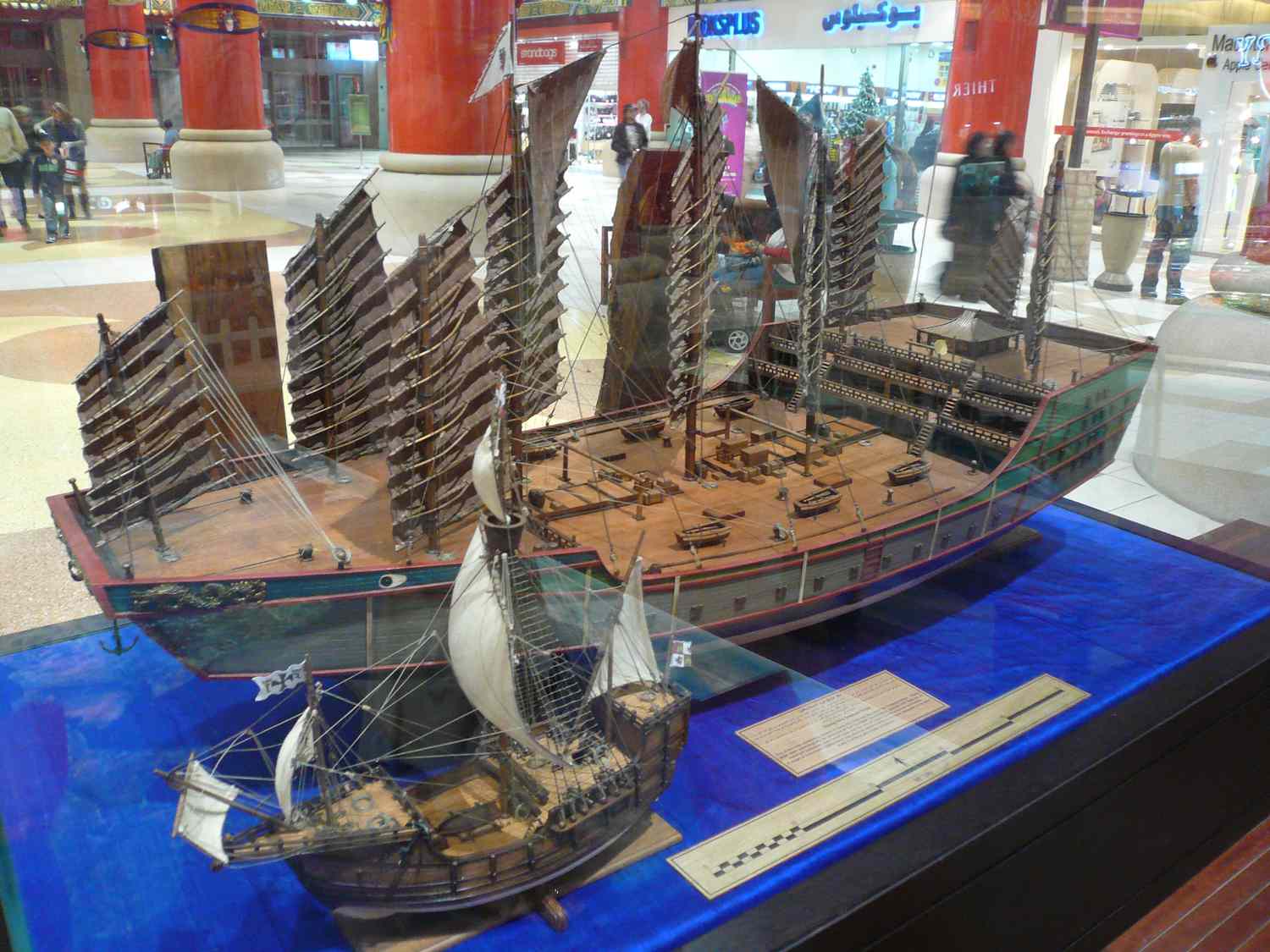
Between 1405 and 1433, Ming China dispatched seven massive naval expeditions across the Indian Ocean under the command of Admiral Zheng He. The largest of these fleets comprised more than 300 vessels, including "treasure ships" that may have been 400 feet in length — dwarfing anything contemporary European navies could field. They reached the coasts of Southeast Asia, India, the Persian Gulf, and East Africa. They brought back giraffes to the imperial zoo in Beijing, established tributary relationships with dozens of polities, and demonstrated a Chinese naval capability that was, in the early 15th century, the most sophisticated in the world.
Then they stopped. The voyages ended in 1433. The shipyards fell into disuse. The great ocean-going vessels rotted or were dismantled. Within decades, China had retreated behind its land borders, and the maritime dominance that had been so strikingly demonstrated passed, by default, to Portugal, Spain, and the other European powers whose much smaller ships would go on to reshape the world.
The question of what might have been is almost irresistible. What if, instead of turning back at East Africa, those fleets had pushed eastward across the Pacific? What if Chinese sailors had been the first Old World people to establish sustained contact with the Americas? The scenario has fascinated historians, novelists, and counterfactual thinkers for generations. A rigorous answer requires confronting several uncomfortable realities that the romantic vision typically glosses over.
The Pacific Crossing Problem
The first practical constraint is geographic. The Pacific Ocean is not merely a larger version of the Indian Ocean routes Zheng He's fleets navigated. The distance from China's southeastern coast to the American continent — depending on the route taken — is roughly 8,000 to 12,000 kilometers of open ocean with no intermediate landfall for most of the journey. Columbus's Atlantic crossing, by comparison, was approximately 6,500 kilometers, and even that took five weeks with significant crew anxiety.
A Pacific crossing was not impossible. Polynesian navigators had been making trans-Pacific voyages for centuries using outrigger canoes, navigating by stars, ocean swells, and bird behavior with extraordinary precision. Archaeological evidence confirms Polynesian contact with South America: sweet potatoes (an American crop) appear in Pacific island sites dated to before European contact, and chicken bones with American-specific DNA have been found in pre-Columbian Chilean middens. The Pacific was crossable — just not easily, and not by the same kind of large, deep-hulled treasure ships that Zheng He used in the Indian Ocean.
The North Pacific route, using the Kuroshio Current (the Pacific equivalent of the Gulf Stream) from Japan eastward to California, offers a more plausible pathway. Ships caught in this current could have been carried to the North American coast in roughly 50 to 70 days. Japanese and Chinese fishing vessels are known to have occasionally drifted to the American coast in historical times. A deliberate expedition following this current, with the navigational knowledge available to Ming China, is plausible. But it requires a different ship design than the treasure fleets — smaller, more maneuverable, ocean-capable rather than coastal — and it requires an institutional decision to explore eastward that Ming China never made.
The Institutional Problem: Why the Voyages Really Ended
Most accounts of the treasure voyages' end focus on a single emperor's decision or on vague references to "isolationism." The reality is more structurally interesting. The voyages were politically contested throughout their entire existence, and their ending reflects a fundamental conflict within Ming governance that no single divergence point easily resolves.
The expeditions were championed primarily by the eunuch faction at court — officials associated with Emperor Yongle and his successors who controlled the imperial household and certain state functions. Their opponents were the Confucian scholar-bureaucrats who dominated the civil service and viewed the voyages as extravagant, wasteful, and contrary to proper governance priorities. The Confucian argument was not simply conservative resistance; it had genuine intellectual content. The voyages were enormously expensive (modern estimates suggest each expedition cost the equivalent of several years of provincial revenue), and they produced prestige and tribute but not, by Confucian standards, the kind of agricultural and administrative development that constituted proper statecraft.
When Yongle died in 1424 and the political balance shifted, the bureaucratic faction gained ground. The voyages continued for another decade largely through bureaucratic momentum and the personal influence of Zheng He himself, but they faced constant institutional opposition. The 1433 termination was the culmination of a long political struggle, not a sudden reversal.
In our counterfactual, reaching America requires not just a favorable emperor's order but a sustained shift in Ming institutional politics that keeps the maritime faction dominant across multiple reigns. This is a more demanding divergence than the scenario usually acknowledges. The forces that ended the voyages in actual history were rooted in the structural values of the imperial bureaucracy. Sustained Chinese engagement with the Americas would have required something close to a revolution in how the Ming state understood its own priorities.
The Tribute Model Was Not Colonialism
A crucial distinction, often lost in this counterfactual, is the fundamental difference between what the Ming treasure voyages were designed to accomplish and what European colonization actually accomplished. The treasure voyages were tribute missions. Their purpose was to extend the Ming tributary system — the hierarchical network of relationships in which foreign rulers acknowledged Chinese imperial supremacy through symbolic tribute payments and received in return Chinese goods, diplomatic recognition, and protection. They were not designed to establish permanent settlements, extract resources by force, or displace local populations.
This matters enormously for the counterfactual. A Ming expedition reaching California or Peru in the 1420s would, on the model of every previous Zheng He voyage, have sought to establish tributary relations with local rulers: offering Chinese goods (silk, porcelain, copper cash), demanding nominal acknowledgment of the Chinese emperor's supremacy, and perhaps leaving behind a small diplomatic mission. It would not, in the first instance, have sought to conquer the Aztec Empire or enslave the indigenous population of the Pacific coast.
The optimistic version of this counterfactual imagines a benign Chinese presence that avoids the horrors of European colonization. There is something to this: the Ming tributary system was genuinely less immediately destructive than Spanish conquest. But the optimism needs to be tempered by two considerations. First, Chinese contact with less powerful societies was not always gentle — tribute extraction could involve coercion, and Ming naval power was used forcefully when tribute was refused. Second, and more importantly, the disease problem was not a product of European malevolence. It was a product of Old World biology meeting New World immunology.
Disease: The Unavoidable Catastrophe
The demographic catastrophe that followed European contact with the Americas — estimated to have killed 50 to 90 percent of the indigenous American population within a century of sustained contact — is often discussed as if it were a specifically European phenomenon. It was not. It was an Old World phenomenon. The diseases that devastated American populations — smallpox, measles, typhus, influenza, plague — were endemic in Eurasia and had been cycling through Eurasian populations for centuries, selecting for partial immunity in surviving lineages. American populations had no such exposure and no such immunity.
Chinese populations in the 15th century carried the same Old World disease burden as European populations. Smallpox was endemic in China; measles had been circulating since antiquity; bubonic plague had devastated China in the 14th century. A Ming expedition arriving in the Americas would have introduced these pathogens to a population with no prior exposure, with exactly the same catastrophic results as European contact produced. The demographic catastrophe would have happened regardless of the cultural or political character of the contact. It was biological, not intentional.
What might have been different is the pace and the response. A Chinese tributary-model contact, with smaller initial settlements and less intensive resource extraction, might have introduced diseases more gradually, giving American populations slightly more time to adapt. The initial death toll of Chinese-introduced contact would likely still have been on the same catastrophic order of magnitude as European-introduced contact, but the political and social structures that survived might have had more time to develop responses.
Silver and the Chinese Economy: The Most Transformative Consequence
If we accept, despite these constraints, a scenario in which Ming China establishes sustained contact with the Americas by the mid-15th century, the most consequential and underappreciated consequence concerns silver.
The Americas, particularly the mines at Potosí in modern Bolivia and Zacatecas in Mexico, were the world's primary source of silver from the mid-16th century onward. In actual history, roughly 80 percent of this silver ultimately flowed into China, via Spain and Portugal's Manila Galleon trade. China's monetized economy ran on silver — the Ming and later Qing governments collected taxes in silver, merchants priced goods in silver, and the expansion of the Chinese economy from the 16th through the 18th century was fueled by the infusion of American silver into the Chinese monetary system. When the silver supply disrupted in the early 17th century, China experienced severe deflation and fiscal crisis that contributed to the conditions that brought down the Ming Dynasty in 1644.
In a world where Ming China has direct access to American silver mines — bypassing the Spanish intermediary entirely — the quantity and reliability of silver supply to China is transformed. The chronic silver famines that periodically disrupted Chinese commerce are reduced or eliminated. The Ming fiscal system, which struggled perpetually with insufficient tax revenue, has a more stable foundation. The crisis of the 1620s–1640s that ended the dynasty in actual history may be mitigated enough to allow the Ming to survive, or at minimum to fall on a different schedule and for different reasons.
The reverse flow is equally significant. American crops — maize, sweet potatoes, and peanuts — were introduced to China via the Portuguese and Spanish in the 16th century and contributed massively to Chinese population growth: China's population roughly doubled between 1500 and 1700, fueled in part by the agricultural productivity of American crops adaptable to China's varied terrain. Earlier introduction of these crops, through direct Chinese contact in the 15th century, could have shifted this demographic surge a century earlier, with profound implications for Chinese society, labor markets, and the political pressures that the Ming government faced.
The Geopolitical Consequence: A Contested Pacific
The long-term geopolitical shape of a Ming-contact Americas depends critically on whether the institutional changes needed to sustain engagement actually take hold. In the most plausible scenario — where the maritime faction prevails and sustained trans-Pacific trade routes are established — the Americas become a zone of competition between an established Chinese tributary presence and the later-arriving European powers, particularly Spain.
Spain's Pacific ambitions, which produced the Manila Galleons and the colonization of the Philippines in 1565, would have encountered Chinese influence directly. The Philippines were already within the Ming tributary sphere; a China that had extended that sphere across the Pacific would have confronted Spanish expansion at multiple points. The specific form of this confrontation — whether diplomatic negotiation, trade competition, or military conflict — is uncertain. What is certain is that Spanish colonization of the Americas would have been substantially more contested, and the specific Americas that emerged in the 16th and 17th centuries would have been fundamentally different.
The indigenous empires of the Americas — the Aztecs, the Inca, the Mississippian cultures of North America — still face Old World disease, which is devastating regardless. But they face it in a geopolitical context where no single colonial power has a free hand, and where some may find Chinese tributary relationships a useful counterweight to Spanish conquest. Whether this produces better outcomes for indigenous populations is genuinely uncertain; it produces different ones.
Historical Verdict: A Different China More Than a Different Americas
The Ming-reaches-America counterfactual, taken seriously, does not produce the benign multicultural alternative to European colonialism that popular imagination sometimes envisions. It produces a world where the Americas are contacted by Old World pathogens regardless of who carries them, where the specific form of exploitation differs but exploitation itself is not absent, and where geopolitical competition is more genuinely multipolar.
What it does produce, distinctively and consequentially, is a different Chinese history. A Ming dynasty with direct access to American silver and American crops may survive longer, grow more populous, and enter the 17th and 18th centuries with greater economic and demographic strength than the one that actually collapsed in 1644. The specific form of the "Great Divergence" — the process by which Europe pulled ahead of China economically from roughly 1700 onward — is substantially altered. The 19th-century story of European imperialism forcing unequal treaties on a weakened China may not happen, or happens very differently.
That, ultimately, is the most historically profound consequence of this scenario. Not a transformed Americas — though the Americas are certainly different — but a transformed China. A Ming dynasty that finds the Pacific rather than turning away from it is a dynasty whose entire subsequent trajectory shifts. And because China's trajectory is so central to modern world history, everything that follows shifts with it.
Explore This Scenario Interactively
The analysis above is our editorial interpretation. On Alternate History AI, you can shape your own Ming exploration timeline — deciding how the institutional battles at court play out, how contact with indigenous American civilizations unfolds, and how Chinese and Spanish ambitions collide in the Pacific. Each decision produces a different simulated outcome.
Select an interactive scenario and start exploring →
References and Further Reading
- Wikipedia: Zheng He — biography and voyages of the Ming admiral
- Britannica: Zheng He — scholarly overview of the treasure fleet expeditions
- World History Encyclopedia: Zheng He — detailed articles on the voyages and political context
- Wikipedia: Ming Dynasty — political structure, economics, and the end of the treasure voyages
- Wikipedia: Columbian Exchange — the biological and agricultural consequences of Old World–New World contact
- AlternateHistory.com: Ming Settles in the Americas — extensive community analysis and timelines
What if Alexander the Great lived longer? · What if Queen Elizabeth I was never born? · What if the Soviet Union survived?