What if Queen Elizabeth I was never born?
A counterfactual analysis of the Tudor succession crisis that shaped the English-speaking world — and what happens when the Virgin Queen never takes the throne.
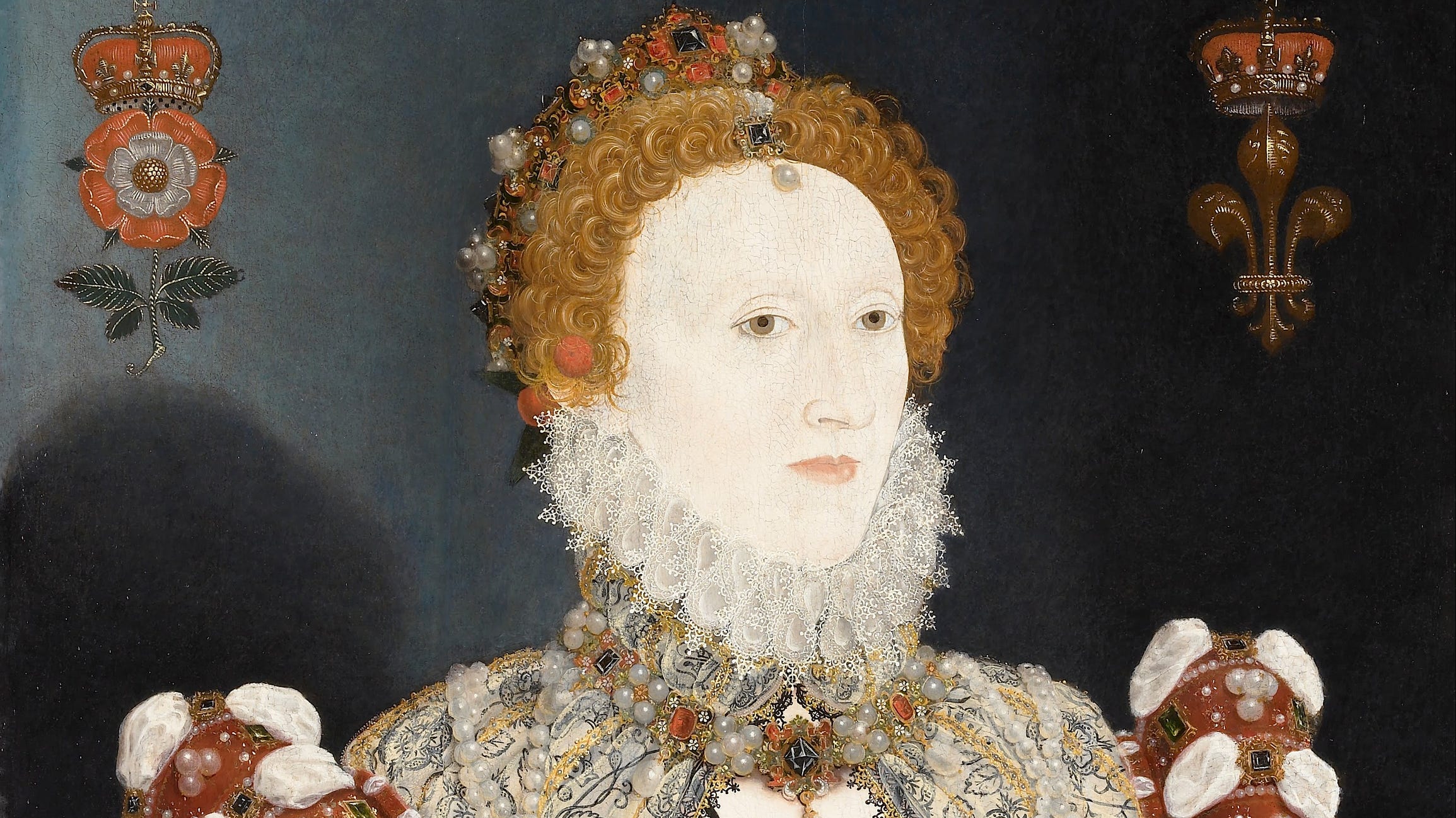
Why Elizabeth I Is the Hinge Point of the English-Speaking World
Elizabeth I reigned for 45 years, from 1558 to 1603. That single statistic understates her significance. She took the throne of a country that had endured four monarchs in eleven years, that was religiously fractured between radical Protestants and resurgent Catholics, financially weakened by war with France, and widely expected by European powers to collapse or be absorbed into a Habsburg sphere of influence. When she died, England had defeated the greatest naval force of the age, established its first permanent overseas settlement, produced a literary culture that still defines the English language, and laid the institutional foundations for what would become the most expansive empire in history.
None of this was preordained. It depended, in ways that are unusual even in monarchical history, on the specific character and decisions of one person. Elizabeth was not a figurehead. She controlled foreign policy, she resisted enormous pressure to marry and subordinate her authority to a husband, and she made the decisive strategic choices — the support for Dutch Protestant rebels, the commission of the fleet that faced the Armada, the authorization of privateering voyages by Drake and Hawkins — that determined England's trajectory. Remove her, and the entire edifice falls.
The Point of Divergence: Anne Boleyn's Pregnancy Fails
The simplest and most historically plausible divergence is a miscarriage in 1533. Anne Boleyn's actual pregnancy history was troubled — she suffered at least two, possibly three, miscarriages after Elizabeth's birth, including a stillborn boy in January 1536 who may have been deformed. In our alternate timeline, this medical misfortune occurs earlier. Anne fails to carry the 1533 pregnancy to term, delivers a stillborn child, or delivers a daughter who dies in infancy before the name Elizabeth is assigned to her.
The consequences cascade immediately. Henry VIII, having broken with Rome and dissolved his marriage to Catherine of Aragon specifically to produce a male heir, finds himself in 1534 or 1535 with only Mary (whom he has declared illegitimate) and no surviving child by Anne. Anne Boleyn is executed in May 1536 in the real timeline; in this alternate, she is executed perhaps a year earlier, having produced nothing. Henry proceeds to Jane Seymour, and Edward VI is still born in 1537. The succession structure that remains is: Edward, then Mary, then a void — because Elizabeth does not exist.
That void is the engine of everything that follows.
The Protestant Succession Crisis: England Without a Safe Harbor
In actual history, Elizabeth served a crucial function even before she became queen: she was the Protestant alternative. During Mary I's Catholic reign from 1553 to 1558, Elizabeth was imprisoned in the Tower of London, placed under house arrest at Woodstock, and survived multiple plots against her life. But she survived. Every Protestant in England knew that if Mary died — and Mary was chronically ill — Elizabeth would inherit, the burnings would stop, and the Reformation would resume. This knowledge tempered Protestant resistance to Mary's regime; it gave moderates a reason to wait rather than rebel.
Without Elizabeth, that safety valve does not exist. When Mary I dies in November 1558, there is no obvious Protestant heir. The legitimate claim passes, under strict hereditary logic, to Mary Queen of Scots — great-granddaughter of Henry VII, Catholic, currently queen of both Scotland and, since her marriage to Francis II in 1558, effectively co-ruler of France. England faces the prospect of being absorbed into a Franco-Scottish Catholic bloc at the precise moment when the Wars of Religion are beginning to tear France apart.
The English Protestant faction — led by figures like William Cecil, Robert Dudley, and the broader network of Edwardian reformers — would not accept this quietly. The result is almost certainly an immediate succession crisis: either a Protestant candidate is put forward with armed backing, or Mary Queen of Scots is accepted but faces an insurgency from the outset of her English reign. Either scenario produces a civil war far more severe than anything England actually experienced in the 1550s.
Mary Queen of Scots as Queen of England: A Franco-Catholic Britain
Suppose the civil war is avoided — perhaps because Protestant resistance is poorly organized, or because Mary Queen of Scots makes credible concessions to Protestant nobles. She is crowned Mary II of England in 1559, ruling Scotland and England simultaneously from Edinburgh or London. What does this England look like?
The picture is not simply "Catholic England" as a mirror of Protestant England. It is something more complicated and, for English national development, more damaging. Mary Queen of Scots was not a ruthless ideological Catholic like her great-aunt Mary I. She was politically pragmatic. But she was also deeply embedded in French court culture, married to a French king (who dies in December 1560, leaving her a widow), and committed to a dynastic vision that was Franco-Scottish-English rather than English-first. The English political identity — the sense of England as a sovereign, self-sufficient nation with its own culture, language, and church — that Elizabeth spent 45 years consciously constructing does not develop.
Instead, England becomes a satellite. Its foreign policy is shaped by French interests. Its religious settlement is negotiated between Rome and Edinburgh rather than defined by an English monarch and an English Parliament. The English language itself, which Elizabeth patronized as a prestige language through court culture, legal proceedings, and literary sponsorship, remains secondary to Latin and French in elite culture. The specific conditions that produced Shakespeare — a vernacular literary culture with royal backing, an urban theatre audience, and a monarch who used English rhetoric as an instrument of national identity — do not exist in this form.
The Spanish Armada: A Different Outcome Without Elizabeth's Navy
The 1588 defeat of the Spanish Armada is one of the most studied military events of the 16th century, and its outcome is frequently misunderstood. The Armada did not fail primarily because of English naval superiority. It failed because of storms, poor coordination between the fleet and Parma's land forces in the Netherlands, and the tactical effectiveness of English fireships at Gravelines. The English fleet under Howard and Drake fought well — but the margin was narrow.
What is less often appreciated is the thirty years of preparation behind that margin. Elizabeth had been investing in English naval capacity since the early 1560s. The ship designs that faced the Armada — lower, faster, capable of longer-range gunnery — were the product of deliberate policy development over decades. The privateering network that produced experienced captains like Drake and Hawkins was something Elizabeth tolerated and sometimes encouraged precisely because it developed naval expertise at no direct cost to the crown. The financial base to sustain a fleet came from the same careful fiscal management that kept England solvent while France and Spain were repeatedly driven to bankruptcy by their continental wars.
Without Elizabeth, none of this preparation happens. A succession-crisis England of the 1560s and 1570s — whether under a contested Protestant regime or an unpopular Catholic one — does not have the political stability or the fiscal discipline to build a blue-water navy. When Philip II of Spain eventually dispatches his fleet (and he would, regardless, given the threat that Protestant England posed to his Netherlands), he faces a different England. One that has not spent thirty years preparing for exactly this confrontation. The Armada succeeds, or at minimum forces a negotiated outcome that leaves England under strong Spanish influence.
The downstream consequences are profound. A Spain that controls or heavily influences England in the late 16th century does not face a significant rival in the Atlantic. French Huguenot settlements and Dutch Protestant resistance lose their most important backer. The Americas remain overwhelmingly Spanish. English colonization of Virginia and New England — which begins only in 1584 (Roanoke) and 1607 (Jamestown) under Elizabethan-era charters — never happens on this timeline. The trajectory toward what becomes the United States is severed at its root.
The Elizabethan Literary Explosion: A Cultural Accident
It is tempting to think of the Elizabethan literary flowering — Shakespeare, Marlowe, Spenser, Sidney, Donne — as an inevitable product of its time, a Renaissance wave that would have broken on English shores regardless of who sat on the throne. This is not true. The specific conditions that produced this culture were contingent on Elizabeth's reign in ways that go beyond mere background context.
Elizabeth made English prestigious. She wrote poetry in English, conducted diplomatic correspondence in English, and performed her most important speeches — at Tilbury before the Armada, at her accession, at the end of her reign — in an English prose style that was itself a political statement. She created the cultural demand for English-language literature at court by being the kind of monarch who read and appreciated it. The court became a market for vernacular writing, which created the audience and the patronage system that sustained professional writers.
The public theatre — the Globe, the Rose, the Curtain — was an urban phenomenon that depended on a stable, prosperous London with a large middle-class audience. That stability and prosperity were themselves products of Elizabethan peace and trade expansion. A civil war England, or a Spain-dominated England, or an England whose energies were consumed by religious persecution does not produce this environment. Shakespeare might exist as a provincial grammar school teacher. Marlowe might find patronage writing Latin verses for a Catholic nobleman. The English language does not become, in the 16th century, the medium for the greatest literary output since ancient Athens.
The long-term consequence — that English, rather than French or Spanish or Latin, becomes the world's dominant language of science, commerce, and diplomacy — is not inevitable. It is the product of English imperial and commercial expansion in the 17th and 18th centuries, which itself depends on the Elizabethan foundation. Break that foundation in 1533 by preventing Elizabeth's birth, and the linguistic map of the modern world looks fundamentally different.
What Elizabeth Could Not Have Prevented: The Limits of the Counterfactual
Honest alternate history requires acknowledging what Elizabeth did not control and what might have happened similarly regardless of her reign. The Protestant Reformation was a structural force in European history that no single ruler could permanently reverse. Even without Elizabeth, England's Protestant majority — built up through decades of Henrician and Edwardian reform — would eventually have produced a Protestant state. The question is the timeline and the cost.
England without Elizabeth likely still becomes Protestant, but through violence rather than through the careful constitutional settlement that Elizabeth constructed. The English Civil War, which in actual history occurs in the 1640s over issues of royal prerogative that Elizabeth managed through personal authority, might occur in the 1580s or 1590s instead — earlier, more destructive, and without the institutional structures needed to manage its aftermath.
Additionally, Elizabeth's record has genuine failures. Her handling of Ireland was brutal and produced a century of conflict. Her fiscal conservatism, while stabilizing, also constrained English investment in infrastructure and administration. Her refusal to name a successor until the very end of her life created a court culture of faction and anxiety that weakened the later years of her reign. A different monarch might have managed some of these problems better. The Elizabeth counterfactual is not an argument that she was uniquely virtuous — it is an argument that her specific combination of abilities and circumstances was uniquely well-matched to the challenges England faced in the second half of the 16th century.
Historical Verdict: The Contingency of the English-Speaking World
The world you are reading this in is, in a very direct sense, an Elizabethan artifact. The language you are reading it in — English — is dominant partly because of decisions and cultural investments made during a 45-year reign that ended in 1603. The United States, Australia, Canada, India's institutional inheritance, the global legal tradition rooted in English common law: all of these trace a line back through the British Empire to the conditions that made that empire possible, and those conditions were shaped in critical ways by Elizabeth I.
None of this means she was the sole cause of everything that followed. History is not monocausal. But she was, more than almost any other figure in the millennium between Charlemagne and Napoleon, a genuine hinge. Remove her, and the door of the Anglophone world swings in a fundamentally different direction.
That is what makes this particular "what if" so historically rich. It is not a question about a battle or a treaty or a technological invention. It is a question about whether a woman who was declared illegitimate at age three, nearly executed in her twenties, and consistently underestimated by every foreign court in Europe could, through intelligence, patience, and sheer political endurance, shape the world that came after her. She did. And the counterfactual of her absence shows just how much she did it.
Explore This Scenario Interactively
The analysis above is our editorial interpretation. On Alternate History AI, you can shape your own Tudor timeline — choosing how the Protestant succession crisis unfolds, whether Mary Queen of Scots consolidates power or is deposed, and how England's naval posture develops without Elizabethan investment. Each decision produces a different simulated outcome.
Select an interactive scenario and start exploring →
References and Further Reading
- Britannica: Elizabeth I — authoritative biography covering her reign and legacy
- Wikipedia: Elizabeth I — comprehensive overview with primary source citations
- World History Encyclopedia: Elizabeth I — detailed articles on the Elizabethan Settlement and foreign policy
- Britannica: Spanish Armada — the 1588 campaign and its causes
- Wikipedia: Mary Queen of Scots — her claim to the English throne and its implications
- AlternateHistory.com: Elizabeth I threads — community-generated counterfactual timelines
- Royal.uk: Elizabeth I — official Royal Family historical summary
What if Alexander the Great lived longer? · What if Napoleon won at Waterloo? · What if the Confederates won the Civil War?