 Alternate History AI
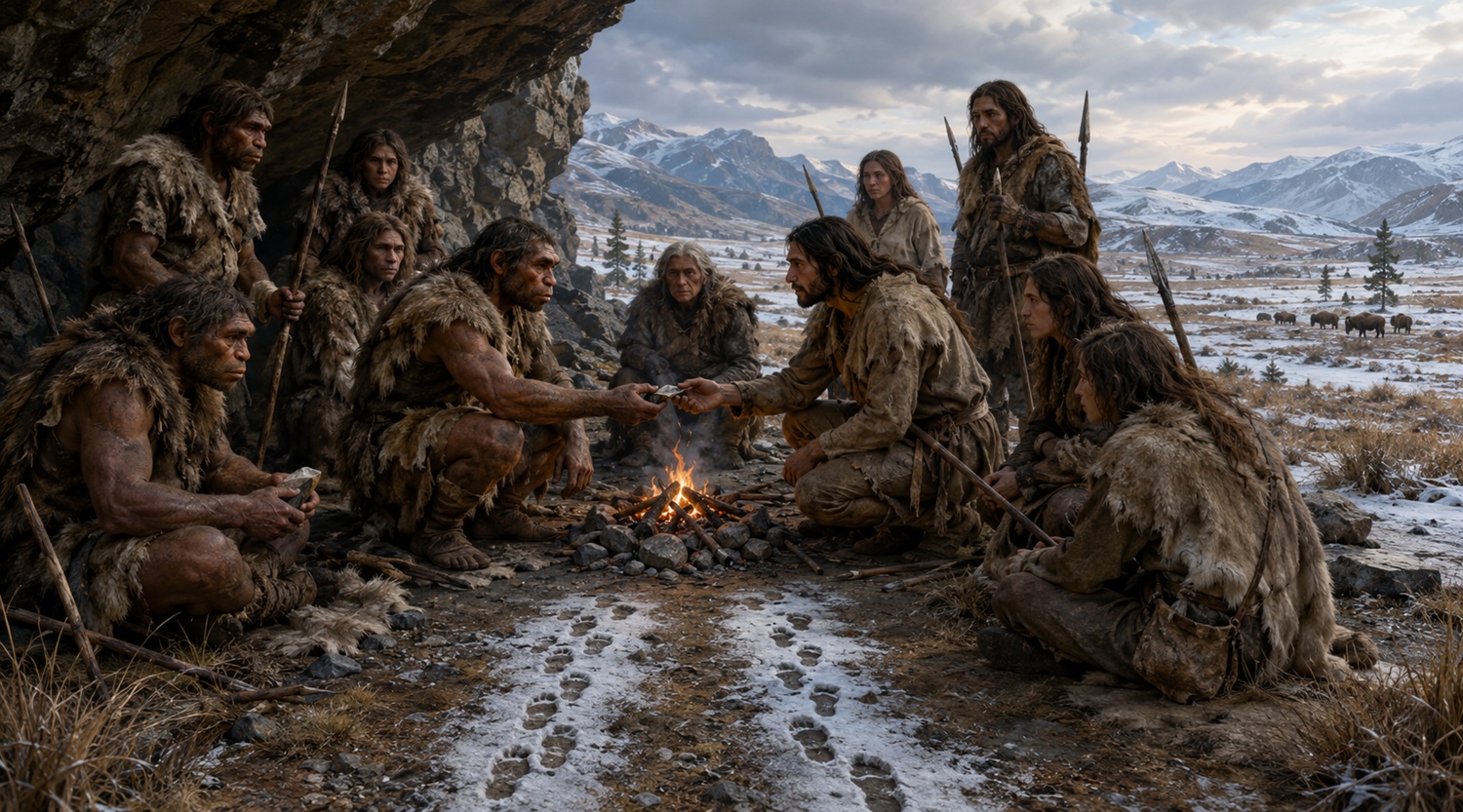
For much of the twentieth century, popular culture treated Neanderthals as an evolutionary failure: stooped, dim-witted, brutish people waiting to be replaced by smarter modern humans.
Modern archaeology and genetics have dismantled that picture.
Neanderthals were a distinct human lineage that occupied Europe and western Asia for hundreds of thousands of years. They made sophisticated stone tools, hafted tools with adhesives, controlled and used fire, hunted large animals, ate plant foods as well as meat, exploited coastal resources in some regions, cared for members of their communities, and adapted repeatedly to severe environmental change. Research on their hearing anatomy even suggests auditory capacities compatible with an efficient speech-based communication system, although no fossil can tell us exactly what a Neanderthal language sounded like or how complex its grammar was. (Science)
They also had children with Homo sapiens.
Ancient and modern genomes demonstrate multiple episodes of interbreeding. Present-day people outside Africa commonly derive roughly 2–3% of their ancestry from Neanderthals, while some early Homo sapiens individuals in Eurasia possessed much more recent Neanderthal ancestors. A roughly 40,000-year-old person from Peștera cu Oase in Romania, for example, had a Neanderthal ancestor only several generations earlier, while individuals from Bacho Kiro Cave also carried evidence of comparatively recent mixing. (Nature)
Neanderthals therefore did not vanish genetically.
Part of their population history survives inside Homo sapiens.
What disappeared around 40,000 years ago was the existence of recognizably distinct Neanderthal populations.
Even that disappearance was not one clean event. Improved dating indicates that Neanderthals disappeared at different times in different regions and that Homo sapiens and Neanderthals overlapped in Europe for thousands of years. (Nature)
And scientists still do not have one universally accepted explanation for why Neanderthals disappeared.
Climate instability may have mattered.
Demography may have mattered.
Competition may have mattered.
Interbreeding and gradual absorption may have mattered.
Repeated Homo sapiens migration into Eurasia may have mattered.
Disease has been proposed.
Differences in social networks or technology may have mattered.
Several mechanisms could have acted simultaneously. Demographic models even show that replacement could occur without assuming a dramatic intellectual or biological superiority of Homo sapiens. (Nature)
That uncertainty creates a scientifically meaningful counterfactual.
What if Neanderthals did not disappear?
Not because they suddenly became technologically superior.
Not because Homo sapiens never entered Europe.
And not because the two lineages lived on opposite sides of an imaginary boundary without interacting.
Instead, suppose several substantial Neanderthal populations survived the demographic crisis around 45,000–40,000 years ago, remained sufficiently connected to avoid being completely absorbed, and continued living beside Homo sapiens.
For tens of thousands of years afterward, Earth would contain at least two surviving human lineages.
The consequences would begin in ecology and demography.
Eventually, however, they would reach one of the deepest questions imaginable:
What would human civilization look like if Homo sapiens had never been the only kind of human left?
---
What Science Actually Tells Us
Any responsible alternate history has to begin by removing several myths.
Neanderthals were not failed apes halfway toward becoming human.
They were humans in an evolutionary sense: members of the genus Homo, extremely close relatives of Homo sapiens, with a long independent evolutionary history.
Whether scientists call them Homo neanderthalensis or classify them as a subspecies of Homo sapiens reflects a larger problem with the concept of species in closely related populations that exchanged genes.
The genetics makes one fact unavoidable:
the boundary between Neanderthals and Homo sapiens was permeable.
They could interbreed successfully enough that Neanderthal-derived DNA remains widespread tens of thousands of years later. (Nature)
That does not mean they were identical populations.
Their genomes were distinguishable.
Their skeletal anatomy was distinguishable.
They had evolved separately for a very long period.
But they were not completely reproductively isolated.
That biological ambiguity becomes extremely important in a world where both populations survive.
---
Neanderthals Were Not Unintelligent Primitives
Archaeological evidence increasingly makes simple cognitive hierarchies difficult to defend.
Neanderthals produced sophisticated stone industries and composite tools. Evidence from Middle Paleolithic contexts includes adhesives used with stone implements, requiring knowledge of materials and multi-stage manufacturing. (Science)
They were capable hunters.
Sites preserve evidence for systematic exploitation of large animals, including extraordinarily large prey. Research at Neumark-Nord in Germany has documented extensive processing of straight-tusked elephants by Neanderthals, illustrating the scale of cooperative planning and food processing that some groups could undertake. (Science)
Their diet was not simply “meat.”
Dental calculus has produced direct evidence for plant consumption, including starchy foods, and some remains indicate cooking or processing of plant resources. Coastal Neanderthals in Iberia also exploited shellfish, fish, and other marine foods. (PNAS)
They altered landscapes as well. Archaeological work at Neumark-Nord has suggested sustained Neanderthal occupation and fire use contributed to maintaining more open vegetation around the site. (Science)
There is therefore little basis for building this scenario around the idea that Neanderthals would be incapable of learning from Homo sapiens.
The more interesting question is what happens when two technologically capable human populations exchange ideas while maintaining partly separate identities.
---
What About Language?
We cannot recover a Neanderthal sentence.
We do not know their vocabulary.
We cannot prove that Neanderthal language possessed every grammatical property found in modern spoken languages.
But anatomical research provides no good reason to portray them as incapable of sophisticated vocal communication.
A 2021 study modeling the Neanderthal auditory system concluded that their hearing bandwidth was similar to that of living Homo sapiens and compatible with a highly efficient vocal communication system. (Nature)
That is not proof of Shakespearean syntax.
It is evidence against the cartoon of grunting creatures unable to communicate complex information.
In this counterfactual, the safest assumption is therefore that Neanderthals possess rich learned communication, probably language in some meaningful sense.
If they survive alongside Homo sapiens, bilingual communication becomes one of the most important mechanisms in their history.
---
Neanderthal Social Life
Genetics is also beginning to illuminate Neanderthal communities.
DNA recovered from Chagyrskaya Cave in Siberia identified close relatives, including a father and daughter. The same population showed substantial homozygosity, consistent with a small community, while patterns of mitochondrial and Y-chromosome diversity suggested movement of women between groups. (Nature)
That result has sometimes been generalized too far.
A major 2026 genomic study of late Neanderthals from Belgium and France found a more complicated picture. Those populations showed greater connectivity than the isolated Altai group and did not exhibit evidence of progressive genetic deterioration leading toward extinction. The authors specifically argued against treating accumulating genetic load as a general explanation for Neanderthal disappearance. (Nature)
So the emerging picture is not:
all Neanderthals lived in hopelessly inbred bands doomed to extinction.
It is:
Neanderthal communities were often small, but their degree of regional connectivity varied substantially.
That variation gives our counterfactual its opening.
---
The Point of Divergence: Neanderthal Networks Hold Together
Between roughly 45,000 and 40,000 years ago, Homo sapiens populations are spreading into areas long occupied by Neanderthals.
Historically, Neanderthal archaeological signatures disappear during this transition.
In the alternate timeline, that still nearly happens.
But not everywhere.
Several things differ modestly.
First, population movements of Homo sapiens into western Eurasia remain somewhat more intermittent. Climate fluctuations disrupt some migration corridors and reduce the rate at which new groups continually enter already occupied territories.
Second, several Neanderthal populations in southwestern Europe, the Balkans, and the Caucasus maintain stronger connections with neighboring communities.
This does not require inventing a continent-wide Neanderthal nation. Recent genetics already demonstrates that some late Neanderthal populations were better connected than the extremely isolated groups once used as the standard model. (Nature)
Third, sustained contact leads to technological exchange.
Neanderthals adopt useful techniques from neighboring Homo sapiens.
Homo sapiens adopt useful Neanderthal techniques.
The boundary between their archaeological tool traditions becomes increasingly difficult for future archaeologists to identify.
Fourth, interbreeding continues—
but not so frequently that every Neanderthal population disappears into a much larger Homo sapiens population.
The result around 38,000 years ago is a demographic map containing three kinds of regions:
predominantly Homo sapiens territories;
predominantly Neanderthal territories;
and broad zones where both lineages live, trade, intermarry, and compete.
Neanderthals have survived their most dangerous demographic bottleneck.
That changes everything.
---
The Greatest Threat Is Still Population Size
Survival for another thousand years is much easier than survival for another forty thousand.
Neanderthal populations would remain vulnerable because Homo sapiens populations could repeatedly expand into their territories.
One demographic model has shown that recurring migration alone could drive replacement even without assuming that Homo sapiens had any competitive superiority. (Nature)
Another possibility is genetic absorption.
If members of two populations regularly have fertile children, and one population is much larger, the smaller lineage can gradually disappear as a distinct genetic population even if no one is deliberately exterminated.
A 2025 model explored precisely this type of process, showing how repeated small-scale gene flow could theoretically produce extensive genetic replacement over long periods. (Nature)
So a surviving Neanderthal lineage requires more than avoiding battlefield defeat.
It requires enough people—and enough population continuity—to remain statistically distinct.
---
Geographic Refuges Become Crucial
Geography could help.
Several regions offer possibilities.
Iberia
Mountain systems and varied environments could support populations somewhat separated from continuing migration routes through central Europe.
The Balkans
Mountainous landscapes and complicated ecological zones could preserve locally distinct communities while still allowing contact with Homo sapiens.
The Caucasus
The region had already supported Neanderthal populations and provides numerous ecological refuges separated by difficult terrain.
Parts of Central Asia
Neanderthals reached as far east as the Altai region. Small surviving populations in continental Eurasia could remain geographically distant from the main demographic centers of Homo sapiens expansion. (Nature)
No refuge would be sealed.
The purpose of geography is not to prevent contact.
It is to slow demographic absorption.
---
The Alternate Neanderthals Would Keep Changing
A Neanderthal population surviving until 20,000 years ago would no longer be culturally identical to one living 50,000 years ago.
That is fundamental.
Homo sapiens culture changed enormously over the same interval.
Neanderthal culture would too.
Their stone tools change.
Hunting strategies change.
Clothing changes.
Language changes.
Social networks change.
Religious ideas may change.
Population structure changes.
Their bodies also continue evolving.
Natural selection does not stop simply because a population has acquired a familiar scientific name.
A Neanderthal born 10,000 years after the divergence might be genetically and culturally different from the Neanderthals whose fossils we have actually recovered.
By the time agriculture appears, calling these people “Ice Age Neanderthals” would make as little sense as expecting a modern Homo sapiens farmer to live like someone from 40,000 years ago.
---
Competition Would Not Always Mean Warfare
Homo sapiens and Neanderthals would compete for some of the same resources.
Both hunted.
Both used caves and shelters.
Both required water.
Both exploited animal and plant foods.
Research modeling their ecological overlap finds substantial similarities in resource use, which helps explain why demographic interaction could be important. (Science)
But ecological competition can occur without armies.
One group settles a valley.
Another hunts farther north.
A larger Homo sapiens population consumes more prey.
Neanderthal families migrate.
A mixed settlement develops.
A marriage creates access to another territory.
Technology makes previously marginal land usable.
Conflict is one possible outcome.
Partition, migration, trade, and assimilation are others.
---
Homo Sapiens Would Not Always Win
The phrase “competition with modern humans” can misleadingly imply a universal contest in which every encounter has a predetermined winner.
Real ecological competition is local.
A Neanderthal population could know a particular mountain environment better.
It could possess stronger alliances.
Its hunters could outperform newcomers in certain conditions.
A Homo sapiens community could fail after a severe winter while neighboring Neanderthals survive.
Elsewhere, the reverse could happen.
Over thousands of years the balance could shift repeatedly.
The reason Homo sapiens ultimately dominates the globe in the alternate timeline may be population scale and migration rather than an inherent superiority visible in every encounter.
---
Interbreeding Becomes the Central Biological Problem
The genetics makes complete reproductive separation difficult to justify.
Homo sapiens and Neanderthals had offspring repeatedly. (Nature)
If two populations coexist for another 20,000 years, they will almost certainly continue mixing.
The resulting landscape could become complicated.
Some Neanderthal groups might remain relatively endogamous.
Some Homo sapiens communities might intermarry frequently with them.
Some frontier populations could become genetically intermediate.
People might change cultural identity without changing ancestry.
Children could have grandparents from both populations.
After enough generations, anatomical categories that seem obvious to paleoanthropologists studying isolated fossils might become much less clear.
This leads to a surprising possibility.
The greatest long-term threat to Neanderthal survival might not be extinction.
It might be successfully having children with their neighbors.
---
Could Two Human Lineages Coexist?
Yes—but remaining distinct for tens of thousands of years would be harder than simply coexisting.
We already know that Homo sapiens and Neanderthals overlapped in Eurasia for thousands of years. Dating work suggests a European overlap measured in several millennia, while ancient genomes directly document repeated interbreeding during that period. (Nature)
So short-term coexistence requires no extraordinary assumption.
Long-term coexistence requires additional stabilizing mechanisms.
Geography could provide one.
Cultural identity could provide another.
Marriage customs could reduce gene flow.
Different ecological preferences could reduce competition.
Political boundaries could eventually reinforce group identity.
And once the populations become larger, isolated demographic accidents matter less.
The surviving Neanderthals therefore need to become something they never had time to become historically:
a large, self-conscious population capable of reproducing its social identity across generations.
---
What Would “Neanderthal Identity” Mean?
At first, probably nothing resembling our scientific category.
A Neanderthal group 30,000 years ago would not introduce itself as Homo neanderthalensis.
Its people would identify themselves through their own family, community, territory, language, stories, and relationships.
Homo sapiens neighbors would do the same.
Physical differences would be visible.
But prehistoric people would not possess nineteenth-century evolutionary taxonomy.
They might categorize one another in terms analogous to:
our people;
their people;
people from the mountains;
people from beyond the river;
allies;
marriage partners;
strangers;
enemies.
The scientific concept of separate human evolutionary lineages would arrive vastly later.
---
Would the Two Groups Speak Different Languages?
Almost certainly.
But the difference would not remain neatly aligned with ancestry.
Even within Homo sapiens, languages diversify rapidly over historical timescales.
Neanderthal populations living in Iberia and the Caucasus would probably not retain one common language for tens of thousands of years.
Different Neanderthal languages would emerge.
Mixed communities would become bilingual.
Homo sapiens children raised in Neanderthal communities could speak Neanderthal languages.
Neanderthal children raised among Homo sapiens could speak Homo sapiens languages.
A language is culturally transmitted.
It does not come encoded as “Neanderthal” or “modern human” in the genome.
This could eventually weaken biological identity.
A person may be mostly Neanderthal by ancestry but speak the language and follow the customs of a neighboring Homo sapiens community.
The reverse could also occur.
---
Technology Would Cross the Boundary
This may be one of the safest long-term predictions.
Useful technologies spread.
The archaeological record already shows that the last period of Neanderthal-Homo sapiens coexistence was culturally complicated rather than containing two perfectly isolated technological traditions. (Nature)
In the alternate timeline, exchange continues.
Projectile technology.
Adhesives.
Fishing techniques.
Needles.
Clothing.
Pigments.
Food storage.
Shelter construction.
Boats.
Grinding technology.
Later ceramics.
Eventually metallurgy.
Once social contact exists, there is no scientific reason to imagine Neanderthals permanently trapped with Middle Paleolithic tools while Homo sapiens advances toward agriculture.
Technology belongs to cultures, not species.
---
Would Neanderthals Invent New Technologies?
Almost certainly.
Any population surviving for thousands of additional years would continue innovating.
The exact inventions cannot be predicted.
But it would be unreasonable to assume Neanderthals could only copy Homo sapiens.
They had already maintained complex technological traditions for enormous spans of time and produced composite tools before their disappearance. (Science)
An innovation invented in a Neanderthal-speaking community could spread into Homo sapiens populations.
Later historians might therefore know technologies, farming practices, weapons, or artistic traditions associated originally with Neanderthal societies.
At that point, the simple story of one lineage teaching the other becomes impossible.
---
Climate Still Matters
Neanderthals survived repeated glacial and interglacial changes long before Homo sapiens became widespread in Europe.
So they were clearly capable of adapting to major climate variation.
Nevertheless, the climatic instability of Late Pleistocene Eurasia repeatedly changed vegetation, prey distributions, river systems, and habitable territory.
Small populations are especially vulnerable when environmental shocks fragment them.
In the alternate timeline, Neanderthal survival depends partly upon maintaining enough contact among regional populations during those changes.
A valley that becomes uninhabitable is not fatal if people can move into neighboring territory.
It is fatal if every neighboring territory is occupied by a hostile population.
Politics and climate therefore interact.
---
The Last Ice Age Could Strengthen Some Neanderthal Populations
Neanderthal anatomy included cold-adapted characteristics, though their environmental range was not restricted simply to frozen tundra.
A surviving population might do well in some cold continental environments.
But that should not be exaggerated into biological destiny.
Homo sapiens also became extraordinarily effective at living in cold environments.
Clothing, shelters, fire, stored food, and social cooperation can reduce anatomical differences dramatically.
By the Last Glacial Maximum, cultural technology may matter more than body shape alone.
The key advantage for either lineage becomes its ability to maintain networks across harsh landscapes.
---
Population Growth Changes the Balance
The long-term future depends less on who is stronger physically than on who has more surviving children.
Suppose Homo sapiens populations grow faster.
Neanderthal territories shrink even without war.
Suppose mixed communities consistently identify with Homo sapiens.
Neanderthal identity declines.
Suppose agricultural Homo sapiens later experience major population expansion.
Hunter-gatherer Neanderthal populations could be overwhelmed demographically.
For Neanderthals to survive as a distinct lineage into historical time, they eventually need either:
a substantial population base;
geographically protected territories;
continued cultural endogamy;
or adoption of economic systems capable of supporting larger populations.
That brings us into the Neolithic.
And at this point the counterfactual becomes much more speculative.
---
From Here Forward: Social Speculation
Everything up to this point can be built from archaeology, genetics, ecology, and demographic reasoning.
The next stage cannot.
No evidence tells us how a Neanderthal kingdom would govern itself.
No fossil tells us how a Bronze Age Homo sapiens state would classify Neanderthal neighbors.
There is no archaeological basis for predicting Neanderthal religious doctrine, legal systems, writing, monarchy, or citizenship.
The following sections therefore ask plausible social questions, not make scientific predictions.
That distinction is essential.
---
Neanderthals Meet Agriculture
Agriculture begins developing independently in several regions of the world long after historical Neanderthals disappeared.
In western Eurasia, farming communities eventually expand from Southwest Asia into Europe.
If Neanderthals still occupy portions of Europe, they would encounter farming populations.
Three broad responses become possible.
Adoption
Some Neanderthal communities begin cultivating crops and keeping domesticated animals.
Rejection
Others remain hunters, fishers, and gatherers because farming offers little advantage in their environment.
Mixed economy
Many combine domesticated resources with hunting and gathering.
There is no reason to assume one response for the entire lineage.
Homo sapiens communities themselves reacted differently to farming across regions.
Neanderthals would probably do the same.
---
Agriculture Could Threaten Neanderthal Survival More Than the Paleolithic Did
Farming supports much denser populations.
That demographic fact could prove devastating to small Neanderthal hunter-gatherer populations.
A valley supporting a few hundred mobile foragers may eventually support thousands of farmers.
Even without deliberate warfare, agricultural expansion could transform forests, grasslands, animal populations, and migration routes.
Neanderthals could therefore face another period of demographic replacement.
Surviving it probably requires adoption of agriculture by at least some communities.
If they do adopt it, one of the central assumptions behind many fictional scenarios disappears:
there is no longer a permanent “Neanderthal hunter-gatherer civilization” facing a “modern human agricultural civilization.”
There are simply different farming and non-farming societies containing people of different ancestry.
---
A Neanderthal Farming Village
Imagine central Europe around 5000 BCE.
One settlement speaks a language descended primarily from Neanderthal communities.
Its people farm wheat and barley introduced through neighboring societies.
They keep cattle or sheep.
Their houses follow architectural traditions that have changed repeatedly over millennia.
Metal is still unknown.
A neighboring settlement is predominantly Homo sapiens.
The two communities trade.
Some families have relatives in both.
Their skeletal anatomy differs enough that an archaeologist could distinguish many individuals.
Their daily economic lives may be more similar than different.
That is probably a better model for later coexistence than two civilizations separated by an evolutionary wall.
---
Would Neanderthals Remain Genetically Distinct?
Perhaps only partially.
By the agricultural era, surviving communities may contain considerable Homo sapiens ancestry.
Homo sapiens communities near them may contain substantial Neanderthal ancestry.
The meaningful distinction could become statistical rather than absolute.
A community might average much more Neanderthal ancestry than neighboring populations while no individual is “pure.”
That would resemble the messy population histories genetics already reveals for Homo sapiens.
The idea of two untouched bloodlines enduring beside one another for forty millennia is much less plausible than two ancestry gradients maintained by geography and social identity.
---
What Does “Species” Mean in This World?
This could become one of the most important scientific controversies in the alternate modern era.
Today, Neanderthals are commonly classified as Homo neanderthalensis, while some taxonomic traditions have treated them as Homo sapiens neanderthalensis.
The disagreement reflects a larger reality:
species definitions become difficult when closely related populations can exchange genes.
The surviving-world problem would be even more obvious.
Suppose Neanderthals and Homo sapiens:
look anatomically different;
have distinguishable population histories;
have lived separately for hundreds of thousands of years;
but can produce fertile children.
Are they different species?
Subspecies?
Human populations belonging to one broad species complex?
Taxonomists might disagree for centuries.
And the terminology could have enormous political implications that biological taxonomy was never designed to resolve.
---
Biology Would Not Determine Moral Status
A scientific label such as Homo neanderthalensis tells us something about evolutionary history.
It would tell us nothing by itself about political rights.
That distinction would become crucial.
If living Neanderthals spoke languages, raised children, formed communities, negotiated treaties, practiced religions, created art, remembered ancestors, and participated in political life, then arguments about whether taxonomists called them a species or subspecies would be biologically interesting but morally inadequate.
History, unfortunately, gives no reason to assume societies would always recognize that distinction.
---
Social Classification Could Be Brutal
From this point onward, the discussion is necessarily speculative.
Human societies have repeatedly created hierarchies among neighboring populations.
A visibly distinct human lineage could become the subject of:
enslavement;
forced migration;
segregation;
marriage restrictions;
religious conversion;
tribute;
stereotyping;
legal exclusion;
or conquest.
Other societies could take different approaches.
Neanderthal communities might be incorporated into kingdoms.
Neanderthal elites might rule Homo sapiens subjects.
Mixed dynasties might emerge.
Military alliances could cross ancestry lines.
Cities could contain both populations.
There is no basis for assuming that Homo sapiens would always dominate socially merely because Homo sapiens dominate demographically.
Political power is historical, not anatomical.
---
Do Not Map Modern Racial Categories Onto This Scenario
This point requires special emphasis.
Modern racial classifications are not an appropriate analogy for Neanderthal-Homo sapiens evolutionary divergence.
Present-day human populations belong to one deeply interconnected species and share overwhelmingly recent common ancestry.
Neanderthals represented a lineage that had experienced a long period of separate evolutionary history before later gene flow with Homo sapiens. Genomic studies clearly recover that deep divergence as well as subsequent interbreeding. (Nature)
Therefore statements such as:
“Neanderthals would simply be another race”
or
“modern racial conflict tells us exactly how Neanderthals would be treated”
are biologically and historically misleading.
A surviving Neanderthal population would create a social situation humanity has no direct modern equivalent for.
Historical prejudice could certainly arise.
But the categories would develop through their own history.
---
Mixed Populations Make Rigid Classification Even Harder
Imagine a medieval kingdom in which:
one person's grandparents include three Neanderthals and one Homo sapiens;
another has the reverse;
a third comes from a community that has intermarried for five thousand years;
and a fourth belongs to an isolated population with comparatively little mixing.
Where does the state draw a legal line?
Skull shape?
Parentage?
Language?
Community membership?
Religion?
Self-identification?
Residence?
Some states might attempt rigid ancestry rules.
Others might not care.
A person's political identity could depend more on kingdom, religion, clan, or language than evolutionary ancestry.
That is historically plausible precisely because most premodern states did not possess genomic science.
---
Ancient People Would Not Know About DNA
A Roman, Persian, Greek, Celtic, Egyptian, or Chinese scholar encountering Neanderthals would not understand the separation in terms of hundreds of thousands of years of evolutionary divergence.
They would create explanations using the intellectual frameworks available to them.
Different appearance.
Different ancestry legends.
Different languages.
Different gods.
Different origins.
Some traditions might regard Neanderthals as another people.
Others as a special branch of humanity.
Others might mythologize their ancestry.
A scientific evolutionary explanation does not emerge until much later.
This makes ancient identity impossible to predict precisely.
---
Could Neanderthals Build States?
If they survive into agricultural societies, there is no scientific reason to rule it out.
States depend upon population density, food surplus, political organization, warfare, trade, administration, and cultural institutions.
None can be inferred directly from Neanderthal skull anatomy.
The evidence we possess shows that Neanderthals were capable of complex social cooperation and sophisticated technology. It does not tell us whether they would independently invent kingship or bureaucracy.
But if Neanderthal communities participate in farming networks with Homo sapiens neighbors, institutional ideas can diffuse just like agricultural technology.
A Neanderthal-speaking polity could therefore emerge.
So could mixed polities.
---
A Neanderthal Kingdom Is Possible—but Not Predictable
Suppose a mountain refuge in southeastern Europe retains a large Neanderthal-majority population into the Bronze Age.
Agriculture supports population growth.
Metallurgy arrives through trade.
Several valleys unify under one ruler.
A kingdom develops.
That is possible.
But almost every detail beyond that point is invention.
Its religion cannot be reconstructed.
Its laws cannot be predicted.
Its political system could be monarchy, aristocratic federation, city-state network, tribal confederation, or something else.
The responsible counterfactual stops at structural possibilities rather than inventing an entire deterministic civilization from biology.
---
Religion Would Cross Lineage Boundaries
If Neanderthals survive into historical times, religious traditions would probably spread across ancestry lines.
A Neanderthal community could adopt the religion of neighboring Homo sapiens.
Homo sapiens living inside a Neanderthal-majority state could adopt its religious traditions.
Later universal religions would face profound theological questions.
Are both lineages descendants of the same sacred ancestors?
Do the same salvation doctrines apply?
Can they enter the same priesthood?
Can they marry?
These would become historical debates.
But their answers cannot be derived from paleoanthropology.
---
The Ancient Mediterranean Becomes More Complicated
If surviving Neanderthal populations lived in Iberia, the Balkans, or the Caucasus, expanding states eventually encounter them.
Roman expansion offers an obvious example.
Rome historically incorporated enormous numbers of linguistically and culturally distinct peoples.
Would a Neanderthal-majority community become another Roman provincial population?
Possibly.
Roman citizenship was a political status, not a genetic test.
A Neanderthal provincial elite could theoretically acquire citizenship, serve in auxiliary forces, participate in trade, and later enter administrative life.
But Roman prejudice could also construct Neanderthals as fundamentally alien.
Which tendency dominates cannot be predicted.
---
Interbreeding Would Undermine Every Simple Legal Boundary
If Homo sapiens and Neanderthals remained capable of producing fertile descendants, conquest would immediately complicate classification.
Soldiers form families.
Merchants migrate.
Slaves are transported.
Cities mix populations.
Political borders change.
After centuries of imperial movement, ancestry becomes increasingly continuous.
Some regions might remain heavily Neanderthal.
Others become mixed.
Still others retain little Neanderthal ancestry.
The biological map becomes similar to a spectrum rather than two blocks.
Ironically, large empires could therefore accelerate the gradual genetic disappearance of Neanderthals even while protecting Neanderthal communities politically.
---
A Second Route to Extinction: Assimilation in Civilization
This is perhaps the most plausible long-term outcome.
The divergence succeeds.
Neanderthals survive the Paleolithic.
They survive the Last Glacial Maximum.
They survive the spread of agriculture.
They enter historical societies.
And then they gradually disappear as a distinct genetic population because intermarriage becomes too extensive.
By 1000 CE, people with high Neanderthal ancestry may still exist.
By 2000 CE, almost everyone across parts of western Eurasia may carry far more Neanderthal ancestry than people do in our world—
but no population remains clearly separable as Homo neanderthalensis.
The lineage survived much longer.
It was ultimately absorbed rather than destroyed.
This may be more biologically plausible than perfect separation into the modern era.
---
Scenario One: Neanderthal Refuges Survive but Remain Small
This is the most conservative alternate path.
Several Neanderthal populations survive after 40,000 years ago.
They occupy mountainous or climatically marginal refuges.
Interbreeding occurs around their boundaries.
Their numbers fluctuate.
Technology is exchanged.
Over millennia they become increasingly mixed with Homo sapiens.
By around 10,000 years ago, perhaps only a few highly distinctive populations remain.
Agricultural expansion finally absorbs them.
Result
Neanderthals survive thousands or tens of thousands of years longer than historically but never reach recorded history as a clearly separate population.
Plausibility
High within the initial divergence.
---
Scenario Two: Two Lineages Reach the Agricultural World
Some Neanderthal populations grow enough to survive the Neolithic transition.
They adopt farming selectively.
Several large regional populations remain genetically distinctive.
Homo sapiens and Neanderthal-majority villages coexist.
Mixed communities are common along frontiers.
Result
By 3000 BCE, western Eurasia contains both predominantly Homo sapiens and predominantly Neanderthal-speaking societies.
Plausibility
Possible, but it requires stronger demographic separation.
---
Scenario Three: Neanderthals Reach Recorded History
A few substantial Neanderthal-majority regions survive into the Bronze or Iron Age.
They participate in trade.
They use metals.
They build settlements.
They develop political institutions.
Neighboring civilizations know them as another human population rather than as fossils.
Result
Ancient texts contain direct descriptions of Neanderthal peoples.
Plausibility
Speculative.
At this point social history matters far more than Pleistocene biology.
---
Scenario Four: Neanderthals Survive Into the Modern Era
To remain visibly and genetically distinct for forty thousand additional years would require sustained demographic boundaries.
Perhaps an isolated mountain or northern population preserves strong endogamy.
Perhaps political institutions maintain identity.
Perhaps later states protect a territorial homeland.
Result
Modern genetics develops while two recognizably distinct human lineages are alive.
Plausibility
Highly speculative, but logically possible once long-term survival is granted.
Its social consequences would be impossible to forecast reliably.
---
Comparing the Outcomes
| Scenario | Neanderthal Survival | Interbreeding | Technology | Distinct Population by Historical Era? | Plausibility |
| --------------------------------------------- | ------------------------ | -------------------------------------------------- | ------------------------------------------------ | -------------------------------------- | ------------------------------- |
| Extended Paleolithic survival | Thousands of extra years | Frequent frontier mixing | Shared Paleolithic innovations | No | Strongest |
| Neolithic coexistence | Into agricultural era | Moderate | Farming and craft technologies exchanged | Yes, regionally | Plausible within divergence |
| Bronze/Iron Age populations | Into recorded history | Variable | Metallurgy, farming and state systems available | Yes | Speculative |
| Modern surviving lineage | To present | Must remain limited enough to preserve distinction | Full participation in modern technology possible | Yes | Highly speculative |
| Permanent isolated “caveman civilization” | To present | None | Technology mysteriously unchanged | Yes | Scientifically implausible |
---
What Would Happen to Human Genetics?
The genetic consequences could be enormous.
Present-day populations already retain Neanderthal-derived variants because of ancient interbreeding. (Nature)
With another thirty or forty thousand years of contact, Neanderthal ancestry could become much more extensive.
Some regions might average only modestly more than present-day populations.
Others could contain 20%, 40%, or more ancestry from Neanderthal populations.
Mixed communities could generate new combinations of genes subject to natural selection.
Some Neanderthal-derived variants might spread because they are useful.
Others could disappear.
The outcome would not simply be “modern humans with more Neanderthal DNA.”
The Neanderthal populations themselves would also acquire Homo sapiens ancestry.
Gene flow goes both ways.
---
Natural Selection Would Continue on Both Lineages
Some introgressed Neanderthal DNA surviving in people today has been affected by natural selection. Ancient admixture did not simply mix two genomes evenly and preserve every inherited segment forever. (MPG)
In the alternate timeline, selection continues for tens of thousands of years.
Genes influencing immunity could move between populations.
Adaptations to climate might spread.
Some reproductive incompatibilities might reduce particular combinations.
Other combinations could flourish.
By the historical era, the genomes of both lineages might contain so much reciprocal ancestry that evolutionary biologists would argue intensely about whether maintaining two species names still made sense.
---
Disease Exchange
Long-term coexistence also means exposure to many of the same pathogens.
When populations first contact one another after long separation, disease could create temporary asymmetries.
Disease-transmission models have been proposed as one factor potentially affecting the original Neanderthal-Homo sapiens encounter, though evidence remains indirect and the hypothesis is not a settled explanation of Neanderthal disappearance. (Nature)
In a survival timeline, repeated contact would eventually reduce some of that novelty.
Shared pathogens circulate.
Immune adaptations cross through gene flow.
By the agricultural era, disease differences may depend more on settlement patterns, livestock, crowding, and trade than on deep ancestry alone.
Again, culture can overwhelm biological starting conditions.
---
Would Neanderthals Be Physically Stronger?
Neanderthals were generally robustly built compared with recent Homo sapiens.
But turning that average anatomical difference into a universal personality or occupational stereotype would be misleading.
Individuals vary.
Nutrition matters.
Sex and age matter.
Later evolution matters.
A Neanderthal population surviving another forty thousand years would not necessarily preserve identical body proportions.
Agriculture itself changes bodies.
Climate changes.
Mixed ancestry changes populations.
So historical societies might notice average anatomical differences while still encountering enormous overlap among individuals.
---
Would They Think Differently?
Science cannot answer this in the way fiction often wants it to.
Neanderthal brains differed in shape from those of Homo sapiens, but gross anatomy does not provide a reliable map from which to reconstruct a lost person's thoughts, emotions, imagination, or worldview.
Their archaeological record demonstrates substantial behavioral complexity.
Their hearing anatomy was compatible with efficient vocal communication. (Nature)
Beyond that, claims such as:
“Neanderthals would be less creative,”
“Neanderthals would be more logical,”
or
“Neanderthals would lack religion”
would be speculation presented as neuroscience.
A living Neanderthal population would be required to test such hypotheses.
In this alternate world, scientists could actually do so—
which itself would transform psychology and anthropology.
---
Modern Science Would Develop Differently
Imagine nineteenth-century evolutionary science discovering not only fossils but living populations representing another deeply diverged human lineage.
Darwin's age would face direct evidence that human evolution was branching rather than a simple ladder.
Comparative anatomy would become politically explosive.
Genetics would later demonstrate interbreeding.
The species question would move from museums to legislatures.
Every theory of humanity would have to confront the fact that Homo sapiens was not the sole surviving human lineage.
Biology, anthropology, philosophy, theology, law, and politics would all be changed.
But predicting the direction of those changes requires extreme caution.
---
Political Rights in a Modern Two-Lineage World
This is firmly social speculation.
There are many possible histories.
A Neanderthal-majority population could enter modernity as:
an independent state;
a colonized population;
a minority inside a Homo sapiens state;
several different ethnic and linguistic communities;
or populations so intermixed that legal ancestry categories have little practical meaning.
Political rights could therefore vary just as dramatically as they have among Homo sapiens societies.
The existence of a different taxonomic label would not determine whether equality emerged early, late, or at all.
The most defensible prediction is simply that biology would become politically dangerous whenever rulers tried to turn evolutionary classification into a hierarchy of persons.
---
The Discovery of Genetics Could Destroy Old Myths—or Create New Ones
Once scientists sequence living Neanderthal genomes, several facts become clear.
The populations diverged deeply in the past.
They nevertheless interbred.
Every group contains internal variation.
Many people possess mixed ancestry.
No simple anatomical trait maps cleanly onto moral or political worth.
This could undermine rigid ideologies of biological separation.
Or states could misuse the same genetic information to construct new categories.
Science itself cannot determine which political outcome occurs.
---
A Modern Mixed Family Would Make the Species Question Personal
Imagine a family in the alternate twenty-first century.
One parent comes from a predominantly Neanderthal-descended population.
The other comes from a predominantly Homo sapiens population.
Their children are healthy.
Their grandparents speak different languages.
Their genome contains ancestry from both lineages.
A taxonomist may still find the distinction evolutionarily useful.
For the family, the claim that one parent belongs to a different “species” could seem bizarre.
This demonstrates why biological categories designed to describe evolutionary history do not automatically translate into meaningful social categories.
---
Would There Be Separate Neanderthal Nations?
Possibly.
But ancestry alone does not create nations.
Nationhood requires historical institutions, territories, political movements, shared cultural narratives, and usually language or political identity.
A large surviving Neanderthal population in a geographically coherent region could develop a national movement.
Another Neanderthal population elsewhere might belong fully to a mixed state and reject the idea.
Some people of substantial Neanderthal ancestry might not identify with Neanderthal political movements at all.
Modern identity would therefore be culturally constructed around biological history, not mechanically determined by it.
---
What Could Change About Philosophy?
The question “What makes us human?” would have an entirely different history.
Our world has repeatedly treated humanity as equivalent to living Homo sapiens because no other human lineage survived visibly into recorded history.
In the alternate world, that shortcut would never be available.
Philosophers would have to distinguish:
human ancestry;
biological species;
rational agency;
language;
culture;
personhood;
citizenship;
and moral status.
The existence of Neanderthals might therefore force societies to confront questions our own philosophy mostly encounters through fossils, animals, artificial intelligence, or hypothetical extraterrestrial life.
For them, the other human would be standing across the table.
---
What Would Change Least?
Some consequences would be surprisingly limited.
Physics does not change because Neanderthals survive.
Agricultural plants still undergo domestication somewhere.
Metals remain useful.
Writing can still be invented.
States can still form.
Cities can still grow.
The basic ecological pressures driving technological and political organization remain.
There is no reason to assume two human lineages automatically produce:
earlier industrialization;
different laws of science;
faster spaceflight;
or a radically different technological ceiling.
The largest consequences are likely to be demographic, cultural, political, and philosophical rather than magical technological acceleration.
---
What Would Change Most?
Human identity
Humanity would never be synonymous with one surviving lineage.
Genetics
Much greater two-way admixture would reshape western Eurasian populations.
Anthropology
Scientists could study another living human evolutionary lineage rather than reconstructing one entirely from bones and DNA.
Language
Neanderthal-descended languages could become part of recorded linguistic history.
Politics
States would have to decide whether ancestry mattered for membership and rights.
Religion and philosophy
Traditions would confront multiple living human lineages.
Archaeology
The transition around 40,000 years ago would be understood as a period of coexistence rather than replacement.
---
What Probably Would Not Happen?
Neanderthals do not remain frozen in the Stone Age
Culture and technology continue changing.
Homo sapiens does not automatically enslave every Neanderthal
Possible histories range from conflict to integration to Neanderthal political dominance in particular regions.
Neanderthals do not become a direct analogue for any modern racial group
The biological histories are fundamentally different.
Every mixed child does not create a new “species”
Interbreeding creates population gradients, not neat new taxonomic boxes.
Neanderthal kingdoms are not scientifically predictable
Their existence is conceivable; their political institutions are speculative.
A second human lineage does not automatically prevent warfare
Shared species membership has never prevented Homo sapiens groups from fighting one another.
Nor does biological difference make conflict inevitable
Trade, marriage, alliance, coexistence, and assimilation are equally possible.
---
A Plausible Alternate Timeline
| Period | Real History | Neanderthal-Survival Scenario |
| --------------------------- | ------------------------------------------------------------------------------------------------------- | ------------------------------------------------------------------------------------------------------------------------------------------------------ |
| 50,000–45,000 years ago | Homo sapiens populations expand farther into Eurasia and interact with Neanderthals. | Same broad expansion and repeated contact; interbreeding occurs. (Nature) |
| 45,000–40,000 years ago | Neanderthals disappear region by region; archaeological evidence suggests several millennia of overlap. | Most Neanderthal populations decline, but interconnected refuges in parts of southwestern Europe, the Balkans and Caucasus persist. (Nature) |
| 35,000 years ago | Only Homo sapiens remains as a distinct human lineage in Europe. | Several Neanderthal-majority populations remain; technological exchange blurs archaeological boundaries. |
| 25,000 years ago | Homo sapiens populations face severe Ice Age conditions. | Both lineages adapt; mixed frontier populations become common. |
| 20,000 years ago | Last Glacial Maximum. | Some Neanderthal refuges expand or contract with changing habitat; population connectivity remains essential. |
| 12,000 years ago | Major climatic warming accompanies transition toward Holocene conditions. | Neanderthal and Homo sapiens hunter-gatherer societies both adjust to changing environments. |
| 10,000–7,000 years ago | Agriculture expands through parts of western Eurasia. | Some Neanderthal communities adopt farming, some resist it, and others develop mixed economies. |
| 5,000 years ago | Complex agricultural states and Bronze Age societies develop in several regions. | Highly speculative: some Neanderthal-majority populations may participate in state and trade systems, while others have been genetically absorbed. |
| 2,000 years ago | Large historic empires dominate much of Eurasia. | Highly speculative: Neanderthals could survive as distinct peoples, mixed populations, or already be mostly assimilated. |
| Modern era | Neanderthals are known from fossils, archaeology and ancient DNA. | Extremely speculative: if distinct populations remain, evolutionary biology studies two living human lineages. |
---
Strong, Moderate, and Speculative Claims
| Claim | Assessment |
| --------------------------------------------------------------------------------------------- | ---------------------------------------------------------------------------------------- |
| Neanderthals were behaviorally sophisticated humans, not unintelligent primitives | Very strong |
| They made sophisticated tools and adhesives | Very strong (Science) |
| They consumed plants as well as animal foods | Very strong (PNAS) |
| Some exploited marine foods | Very strong (Science) |
| They possessed auditory capacities compatible with efficient speech communication | Strong (Nature) |
| We can reconstruct their exact language | Unsupported |
| Homo sapiens and Neanderthals interbred repeatedly | Certain from genetics (Nature) |
| Present-day non-African populations carry substantial Neanderthal-derived ancestry | Certain from genetics (Nature) |
| Neanderthals disappeared at exactly the same moment everywhere | False (Nature) |
| One single cause explains their disappearance | Unsupported |
| Every Neanderthal population was extremely isolated and inbred | Too strong; 2026 genomic evidence shows important regional variation. (Nature) |
| Small population size and demographic pressure could have mattered greatly | Strongly plausible (Nature) |
| Interbreeding could eventually absorb a surviving Neanderthal minority | Strongly plausible |
| Neanderthals could survive several thousand additional years in refuges | Plausible counterfactual |
| They could adopt Homo sapiens technologies | Very plausible |
| Homo sapiens could adopt Neanderthal technologies | Very plausible |
| Distinct Neanderthal populations could reach the Neolithic | Possible but increasingly speculative |
| Neanderthals could farm | No biological reason rules it out; historical outcome speculative |
| Neanderthal-majority states could eventually exist | Social speculation |
| They would inevitably be politically subordinate to Homo sapiens | Unsupported |
| Neanderthals correspond to a modern racial category | Scientifically misleading |
| A living Neanderthal population would force major debates about taxonomy, identity and rights | Highly plausible social inference |
| Neanderthals survive as a genetically distinct population to the present | Highly speculative |
---
Could Two Human Lineages Coexist?
For several thousand years, clearly yes.
They already did.
Homo sapiens and Neanderthals occupied overlapping parts of Eurasia, exchanged genes, and apparently shared landscapes for a significant period before recognizable Neanderthal populations disappeared. (Nature)
The harder question is whether they could coexist for forty thousand additional years while remaining distinct.
That requires more.
A surviving Neanderthal population cannot remain permanently tiny.
It cannot continuously lose members to a much larger neighboring population through intermarriage.
It needs territories or social institutions that preserve enough demographic continuity.
Some communities would probably disappear.
Others would merge.
Some mixed populations might remain culturally Neanderthal while becoming genetically intermediate.
Others could retain substantial genetic distinctiveness.
The boundary would move.
That makes the alternate world more complicated than one containing two cleanly separated species.
Instead of two human civilizations, it might contain a continuum of human populations whose ancestry, language, culture, and identity overlap imperfectly.
And that may actually be the most scientifically credible outcome.
---
What Science Cannot Tell Us
Science can help estimate whether a population could survive.
It can tell us about gene flow.
Climate.
Anatomy.
Population structure.
Diet.
Technology.
Mobility.
It cannot tell us whether a Neanderthal-majority kingdom would be democratic.
It cannot tell us which religions it would create.
It cannot tell us whether Homo sapiens societies would persecute Neanderthals.
It cannot tell us whether mixed marriage would be celebrated or banned.
It cannot tell us whether a twenty-first-century Neanderthal would identify first by lineage, country, language, profession, faith, or family.
Once the scenario reaches complex historical societies, contingency overwhelms paleoanthropology.
That uncertainty is not a weakness.
It is the scientifically responsible boundary of the exercise.
---
The Most Plausible Long-Term Outcome
If Neanderthals survive the crisis around 40,000 years ago, the strongest scenario is probably not two completely separate human species reaching the present.
It is prolonged coexistence followed by varying degrees of integration.
Some regions retain distinctive Neanderthal populations for thousands of years.
Some develop mixed communities almost immediately.
Technology circulates.
Languages circulate.
Genes circulate.
Climate repeatedly rearranges territories.
Agriculture creates another major demographic shock.
Some Neanderthal societies adopt it.
Others disappear.
By the Bronze Age, perhaps a few regions still contain populations with unusually high Neanderthal ancestry and distinctive cultural identities.
Whether those communities remain biologically recognizable into modernity depends less on intelligence or technological ability than on marriage, migration, population size, and political history.
That is far more plausible than imagining an eternal enclave of Stone Age Neanderthals hiding in European mountains.
---
The AltHistAI Verdict
What if Neanderthals never went extinct?
The first answer is that they were never as completely erased as the word extinct implies.
Neanderthals interbred with Homo sapiens, and genetic evidence demonstrates that part of their evolutionary history survives in living people. Early modern humans in Eurasia sometimes had Neanderthal ancestors only a handful of generations earlier, while present-day non-African populations retain roughly a few percent Neanderthal ancestry. (Nature)
What disappeared around 40,000 years ago was something more specific:
distinct Neanderthal populations.
And even that disappearance was gradual.
Dating shows a regionally uneven transition and several millennia during which Neanderthals and Homo sapiens overlapped in Europe. (Nature)
Nothing in modern science supports the old picture in which intellectually superior Homo sapiens simply encountered dim-witted Neanderthals and immediately swept them aside.
Neanderthals made complex tools.
Used compound adhesives.
Hunted large animals.
Consumed plants.
Exploited marine resources in some regions.
Manipulated fire and landscapes.
Lived in socially organized groups.
And possessed auditory anatomy compatible with highly efficient vocal communication. (Science)
Their disappearance is therefore better understood as a demographic and evolutionary problem than a simple intelligence contest.
Small populations are vulnerable.
Repeated migration matters.
Fragmentation matters.
Climate matters.
Competition may matter.
Interbreeding matters.
And recent genetic evidence makes the story more complicated still. The isolated Neanderthals of Chagyrskaya Cave clearly lived in small communities with close kinship, yet 2026 genomic research from northwestern Europe found larger or better-connected late Neanderthal populations and no evidence that steadily accumulating genetic deterioration drove the lineage toward extinction. (Nature)
That creates the most plausible divergence.
Not a smarter Neanderthal.
Not a weaker Homo sapiens.
A demographically luckier Neanderthal.
Several regional populations remain sufficiently large and connected during the critical transition around 45,000–40,000 years ago.
Homo sapiens still enters Europe.
The two populations still compete.
They still have children together.
But migration never becomes overwhelming enough to erase every Neanderthal population.
For the next ten thousand years, both survive.
At first, their worlds might remain somewhat distinct.
A Neanderthal community hunts one mountain system.
A Homo sapiens group occupies a neighboring river valley.
Mixed settlements emerge between them.
People trade stone, food, pigments, hides, and eventually new technologies.
Individuals cross social boundaries.
Children acquire ancestry from both sides.
The archaeological record becomes increasingly difficult to divide by lineage because technology is cultural rather than genetic.
That is probably the first major lesson of the alternate history:
Neanderthals would not remain technologically Neanderthal merely because their bodies remained Neanderthal.
A useful innovation spreads.
A better hunting strategy spreads.
Clothing spreads.
Boats spread.
Later pottery spreads.
Agriculture spreads.
Metallurgy spreads.
Writing could spread.
Nothing about a Neanderthal genome would require a Neanderthal society to remain trapped in the Middle Paleolithic.
The second lesson is almost the opposite.
Interbreeding makes long-term distinctness difficult.
The same the opposite.
Interbreeding makes long-term distinctness difficult.
The same biological compatibility that allowed Neanderthal DNA to enter Homo sapiens hi(Nature)nue operating for tens of thousands of additional years. citeturn415349view2
A small Neanderthal population surrounded by larger Homo sapiens populations could disappear simply because its descendants increasingly belong to mixed communities.
No genocide is necessary.
No decisive war is necessary.
No mysterious inferiority is necessary.
Demography alone can be powerful enough to transform populations. Models of Neanderthal replacement demonstrate how migration and population processes can produce extinction or r(Nature)t assigning one lineage a universal selective advantage. citeturn415349view8
For Neanderthals to reach agriculture as a distinct population, some communities therefore need stronger boundaries.
Mountains.
Distance.
Marriage customs.
Political alliances.
Cultural identity.
Perhaps all of them.
Once agriculture arrives, the pressure intensifies.
Farmers can sustain far denser populations than mobile hunter-gatherers.
A Neanderthal community that refuses agriculture permanently while farming populations expand around it would face shrinking territory.
Some communities might continue hunting in environments poorly suited to farming.
Others would adopt crops and livestock.
After several generations, a Neanderthal farming settlement could be economically almost indistinguishable from a Homo sapiens farming settlement next door.
Its inhabitants would simply descend predominantly from another ancient human lineage.
From that point forward, scientific confidence falls rapidly.
Bronze Age Neanderthal cities are possible.
Neanderthal-speaking kingdoms are possible.
Mixed Homo sapiens-Neanderthal states are possible.
Neanderthal soldiers in ancient empires are possible.
None can be predicted from the archaeological record.
Biology provides capacities and constraints.
It does not write constitutions.
If distinct populations somehow survived into recorded history, societies would then have to answer questions that our own history never confronted directly.
Are Neanderthals another people?
Another species?
Another branch of humanity?
Can Homo sapiens and Neanderthals marry?
Can they inherit from one another?
Can they hold the same offices?
Can one rule the other?
Ancient societies would answer those questions without knowing anything about evolution.
Modern societies would eventually reinterpret them through genetics.
And genetics would complicate every clean category because the populations had been interbreeding all along.
That is why modern race provides such a poor analogy.
Neanderthals represented a genuinely deep evolutionary lineage that separated from the ancestors of Homo sapiens long before the recent population differences among living humans developed. At the same time, Neanderthals and Homo sapiens w(Nature)ons. Their genomes crossed the boundary. citeturn415349view2turn408581view0
A modern world containing living Neanderthals would therefore confront something for which our existing racial categories provide no biological equivalent.
It might also force a profound distinction between taxonomy and personhood.
Calling a population Homo neanderthalensis would describe evolutionary history.
It would not answer whether an individual could speak, love, vote, own property, write a novel, practice medicine, raise children, serve in government, or demand equality.
If Neanderthals had survived into the modern world, those would not be hypothetical questions.
They would be ordinary political life.
But the strongest scientifically grounded scenario probably does not get that far.
The more likely long-term result is partial assimilation.
Neanderthals survive another 5,000 years.
Then 10,000.
Perhaps some enter the agricultural era.
Their descendants increasingly intermarry.
By recorded history, western Eurasia contains populations with dramatically more Neanderthal ancestry than people possess today, but only a few regions remain recognizably Neanderthal.
Eventually even those boundaries blur.
The lineage disappears as a separate population—
but not because it lost.
It disappears because its descendants become part of a larger, mixed humanity.
That outcome would radically change how we use the word extinction.
And if a few distinct populations did remain?
Then civilization would develop under a fact our species has never had to confront in recorded history:
Homo sapiens would know that being human and being Homo sapiens were not necessarily the same thing.
That is the AltHistAI verdict.
A surviving Neanderthal population is scientifically plausible only if demographic conditions change enough to prevent complete replacement or assimilation around 40,000 years ago.
Continued coexistence for thousands of years is much easier to imagine than survival unchanged into modernity.
Technology would cross population boundaries.
Language and culture would change.
Interbreeding would continue.
Agriculture would create another major demographic test.
And the farther the timeline proceeds, the less biology determines the outcome.
The most defensible counterfactual is therefore not a world divided permanently between “modern humans” and “cavemen.”
It is a much stranger and more realistic world—
one in which several kinds of human ancestry persist, combine, separate, and recombine across thousands of years.
Neanderthal survival would not show that there were two ways to be almost human.
It would show that humanity had more than one surviving evolutionary history.
Key Takeaways
Neanderthals survived in Europe and western Asia for hundreds of thous(Nature)istinct populations disappeared around 40,000 years ago. citeturn408581view0
Their disappearance occurred at different time(Nature) rather than through one instantaneous extinction event. citeturn4(Nature)iens and Neanderthals overlapped for thousands of years. citeturn41(Nature)two populations interbred repeatedly. citeturn415349view2turn417777search12
Present-day no(Nature)derive roughly 2–3% of their ancestry from Neanderthals. citeturn415349view2
Some early Homo s(Nature) Neanderthal ancestors only several generations earlier.(Science)- Neanderthals used sophisticated tools and adhesives. citeturn417777search2
They ate div(PNAS)ulations exploited marine resources. citeturn668320search0turn668320search1
Evidence from their auditory anatomy is compatible with efficient speech-li(Nature), though their actual languages cannot be reconstructed. citet(Nature) Neanderthal communities were small and closely related. citeturn415349view0
But new 2026 genetic evidence shows that late Neanderthal populations were not uniformly isolated or severely inbred, and it argues (Nature)netic deterioration as a universal extinction mechanism. citeturn408581view0
No single explanation for Neanderthal disappearance has been conclusively established.
Demographic processes alone can theoretically produce replacemen(Nature)g Homo sapiens possessed a universal adaptive advantage. citeturn415349view8
A plausible survival divergence therefore involves larger, better-connected regional Neanderthal populations rather than miraculous cognitive or technological changes.
Interbreeding would remain one of the greatest threats to long-term Neanderthal distinctness.
Neanderthal societies surviving thousands of years would continue changing culturally and technologically.
There is no scientific reason they would remain permanently restricted to Middle Paleolithic technology.
If Neanderthals encountered agriculture, different populations could adopt, reject, or partially adopt it.
Agricultural population growth could produce a second major demographic crisis for Neanderthal hunter-gatherers.
Distinct Neanderthal populations reaching the Bronze Age or later are scientifically possible but increasingly speculative.
Neanderthal kingdoms, religions, laws, and political ideologies cannot be predicted from fossils or genes.
Modern racial classifications should not be mapped onto Neanderthal-Homo sapiens differences.
If living Neanderthals existed today, the distinction between species classification, ancestry, cultural identity, citizenship, and personhood would become enormously important.
The strongest long-term scenario may be prolonged Neanderthal survival followed eventually by extensive assimilation into mixed populations rather than permanent biological separation.
The most scientifically defensible conclusion is that Neanderthals could plausibly survive longer without remaining culturally or genetically frozen—and a world with living Neanderthals would eventually become a story about mixing as much as coexistence.
Sources and Further Reading
Tom Higham et al., “The Timing and Spatiotemporal Patterning of Neanderthal Disappearance,” Nature (2014).
A major chronological study showing that Neanderthal disappearance was regionally uneven and estimati(Nature)f overlap with early Homo sapiens populations in Europe. citeturn415349view1
Arev P. Sümer et al., “Earliest Modern Human Genomes Constrain Timing of Neanderthal Admixture,” Nature (2025).
Provides recent genomic estimates of major Neanderthal-Homo sapiens admixture and summarizes evidence that app(Nature)sent-day non-African ancestry derives from Neanderthals. citeturn415349view2
Mateja Hajdinjak et al., “Initial Upper Palaeolithic Humans in Europe Had Recent Neanderthal Ancestry,” Nature (2021).
Ancient genomes from Bacho Kiro demonstrate recent Neanderthal(Nature) earliest Homo sapiens populations known from Europe. citeturn417777search12
Laurits Skov et al., “Genetic Insights into the Social Organization of Neanderthals,” Nature (2022).
The first genomic identification of close Neanderthal family relationships, including a father and daughter, and (Nature)ll community structure and female movement among groups. citeturn415349view0
A. Bossoms Mesa et al., “Genetic Diversity of Late Neanderthals in Northwestern Europe,” Nature (2026).
An important new study showing greater regional connectivity among some late Neanderthals, absence of the severe close-relative mating signatures seen in some Altai populations, and no eviden(Nature)netic deterioration drove the lineage toward extinction. citeturn408581view0
Oren Kolodny and Marcus Feldman, “A Parsimonious Neutral Model Suggests Neanderthal Replacement Was Determined by Migration and Random Species Drift,” Nature Communications (2017).
Demonstrates that demographic replacement can theoretica(Nature)ming an inherent competitive advantage for Homo sapiens. citeturn415349view8
Mercedes Conde-Valverde et al., “Neanderthals and Homo sapiens Had Similar Auditory and Speech Capacities,” Nature Ecology & Evolution (2021).
Uses CT reconstruction and auditory modeling to investigate Neanderthal hearin(Nature)compatible with an efficient vocal communication system. citeturn415349view7
Amanda Henry, Alison Brooks and Dolores Piperno, “Microfossils in Calculus Demonstrate Consumption of Plants and Cooked Foods in Neanderthal Diets,” Proceedings of the National Academy of Sciences (2011).
Direct evidence against t(PNAS)hat Neanderthals lived exclusively on large-game meat. citeturn668320search0
João Zilhão et al., “Last Interglacial Iberian Neandertals as Fisher-Hunter-Gatherers,” Science (2020).
Documents subst(Science)arine and coastal resources by Neanderthals in Iberia. citeturn668320search1
Patrick Schmidt et al., “Ochre-Based Compound Adhesives at the Mousterian Type-Site Document Complex Cognition and High Investment,” Science Advances (2024).
Important evidence for sophistica(Science)ology and deliberate processing of adhesive materials. citeturn417777search2
Wil Roebroeks et al., “Landscape Modification by Last Interglacial Neanderthals,” Science Advances (2021).
Investigates sustained Neandertha(Science)andscape modification around Neumark-Nord in Germany. citeturn668320search10
Sabine Gaudzinski-Windheuser et al., “Hunting and Processing of Straight-Tusked Elephants 125,000 Years Ago,” Science Advances (2023).
Provides remarkable evidence for systematic exploitation of enormo(Science)ional implications of large-scale carcass processing. citeturn417777search18
Leah N. M. Iasi et al., “Neanderthal Ancestry Through Time: Insights from Genomes of Ancient and Present-Day Humans,” Science (2024).
A major recent genomic analysis of how Neand(Science)nd changed within Homo sapiens populations over time. citeturn116867search2