 Alternate History AI
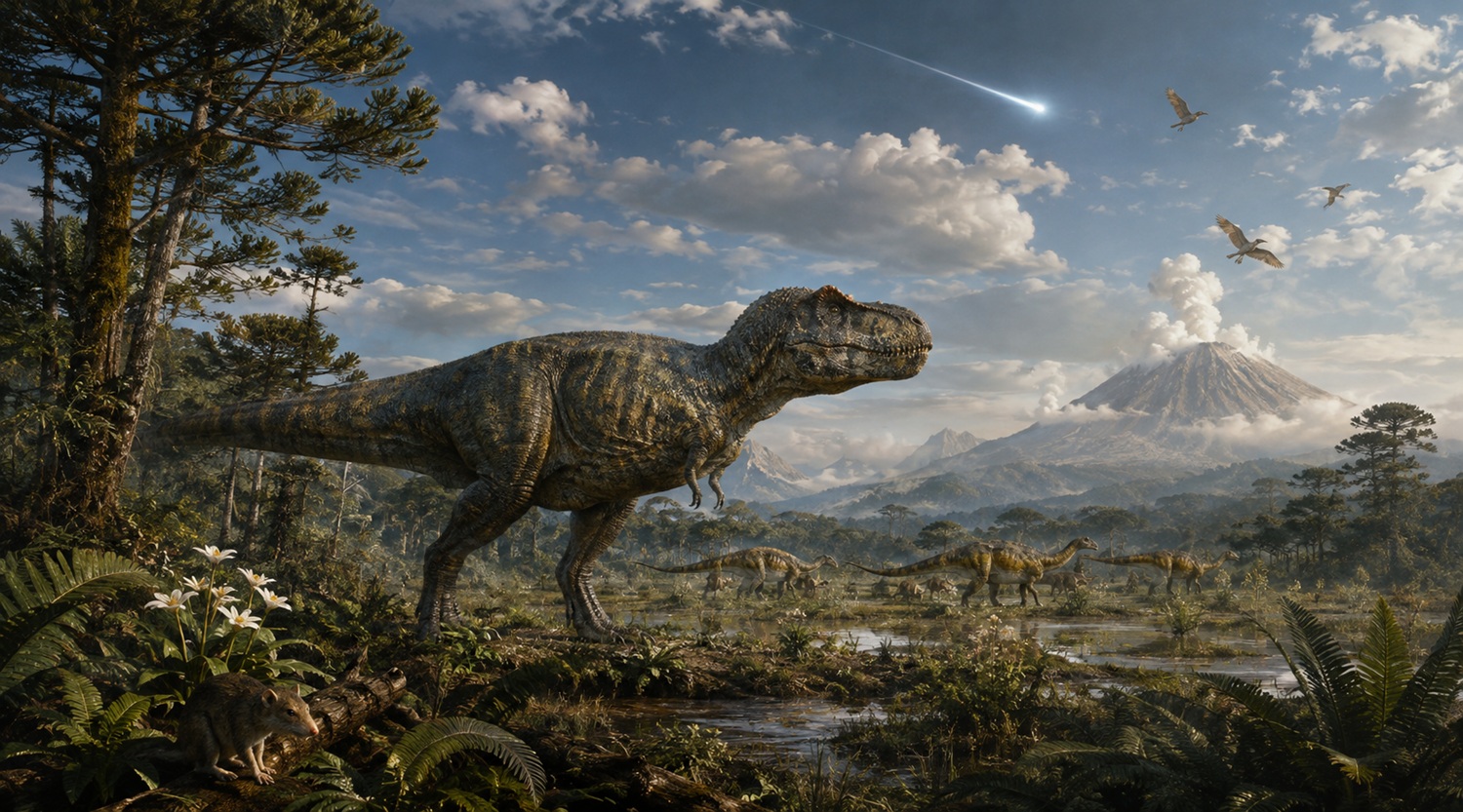
Sixty-six million years ago, Earth experienced one of the most consequential accidents in the history of life.
An asteroid roughly 10 kilometers across struck near what is now Mexico's Yucatán Peninsula, excavating the Chicxulub crater and triggering the Cretaceous–Paleogene, or K–Pg, mass extinction. Roughly three-quarters of species disappeared. All known non-avian dinosaurs died out, along with ammonites, pterosaurs, mosasaurs, plesiosaurs, and many other organisms. Birds survived. Mammals survived. From the ecological wreckage emerged the world that would eventually contain whales, elephants, horses, apes—and humans.
But the asteroid did not have to hit Earth.
Its orbit could have differed slightly. Earth could have been somewhere else along its orbit when the asteroid crossed it. The object might even have struck another part of the planet and produced less catastrophic environmental effects. One modeling study concluded that Chicxulub was unusually destructive partly because it struck rocks rich in hydrocarbons and sulfur-bearing material capable of generating severe atmospheric effects.
So consider the simplest counterfactual:
The Chicxulub asteroid misses Earth entirely.
There is no impact winter. There is no sudden global K–Pg ecological collapse. Tyrannosaurs, hadrosaurs, ceratopsians, sauropods, smaller feathered dinosaurs, pterosaurs, ammonites, mammals, birds, flowering plants, insects, and countless other organisms enter the Paleogene together.
What happens next?
The scientifically defensible answer is not that dinosaurs inevitably rule Earth forever. Evolution does not operate toward predetermined outcomes.
But there is also little justification for assuming that dinosaurs conveniently disappear anyway, allowing history to return to something resembling our own.
Without Chicxulub, Earth's biological history would almost certainly take a profoundly different path.
First: What Actually Happened?
The Chicxulub impact occurred approximately 66 million years ago at the boundary between the Cretaceous and Paleogene periods. The crater lies beneath the Yucatán Peninsula and adjacent Gulf of Mexico.
Evidence connecting the impact with the extinction includes the worldwide K–Pg boundary layer, impact-derived materials, shocked minerals, the crater itself, and extremely precise geological dating. Modern geochemical research continues to reinforce the extraterrestrial origin of the impactor.
The collision produced devastation far beyond the impact site.
Immediate regional effects included extreme heat, seismic disturbance, ejecta, and enormous waves. Material thrown into the atmosphere altered global conditions. Dust, soot, sulfur-bearing aerosols, and other particles reduced the sunlight reaching Earth's surface and produced rapid cooling and disruption of precipitation. The resulting interruption of photosynthesis destabilized food webs on land and in the oceans.
The extinction was highly selective rather than total. Around 76 percent of species are estimated to have disappeared, but many groups survived.
Among dinosaurs, the distinction was dramatic.
Every known non-avian dinosaur lineage disappeared.
One branch of dinosaurs survived: birds.
Birds had already evolved millions of years earlier, meaning that birds are not merely descendants of something dinosaur-like. They are dinosaurs—the surviving avian branch of Dinosauria.
Many mammals also survived, although mammals as a group were hit severely. Survival did not mean that mammalian life passed through the catastrophe unharmed. Numerous mammalian lineages vanished.
What mattered enormously was what happened next.
Once large non-avian dinosaurs were gone, enormous portions of terrestrial ecological space were suddenly vacant.
The Ecological Opportunity That Mammals Inherited
Mammals were not invented by the asteroid.
They had existed alongside dinosaurs for more than 100 million years.
Nor were all Mesozoic mammals tiny, identical shrew-like animals. Late Cretaceous mammals occupied multiple ecological roles, and recent fossil discoveries continue to reveal more diversity in body size and lifestyle than older textbook stereotypes suggested. A 2024 study, for example, described a Late Cretaceous therian mammal from Patagonia estimated at roughly 14 kilograms—large by Mesozoic mammal standards.
What changed after the extinction was ecological opportunity.
Research on placental mammals indicates that the K–Pg extinction was closely associated with major subsequent diversification within surviving mammalian lineages. Genomic studies have detected a significant post-extinction diversification pulse, while fossil evidence shows mammals rapidly expanding into new ecological roles and increasing dramatically in body size.
For the first several million years after the impact, mammals did not simply become smarter. One study found that early placentals initially emphasized increased body size rather than larger brains relative to body size as they exploited newly available ecological opportunities.
This matters enormously for our alternate Earth.
If the asteroid never strikes, those vacancies do not suddenly appear.
Were Dinosaurs Already Dying Out Anyway?
This is one of the most important questions in the entire scenario.
If dinosaurs were already collapsing before Chicxulub, perhaps the asteroid merely accelerated an inevitable transition.
Scientists disagree about how strong that decline actually was.
Evidence for a pre-impact decline
A major 2021 analysis of six important dinosaur families concluded that dinosaur diversity had begun declining approximately 10 million years before the K–Pg boundary. The researchers estimated that extinction rates had risen above speciation rates in several groups, possibly influenced by long-term cooling and ecological changes among herbivorous dinosaurs.
Under this interpretation, Chicxulub struck ecosystems that were already experiencing evolutionary stress.
That does not, however, demonstrate that dinosaurs were inevitably headed for complete extinction.
Declining diversity is not the same thing as terminal extinction.
Evidence against a broad terminal decline
Other researchers have reached a substantially different conclusion.
A 2019 ecological modeling study argued that apparent declines in North American dinosaur diversity may partly reflect the uneven fossil record. When researchers modeled available habitat rather than relying only on known fossil-bearing rocks, suitable dinosaur habitat remained stable or even expanded during the latest Cretaceous. They concluded that there was little evidence for a long-term climatic deterioration severe enough to doom dinosaurs before the impact.
The authors went further: their models suggested that suitable dinosaur habitat would have remained available across the K–Pg boundary in the absence of the catastrophic post-impact conditions.
The most defensible conclusion
The safest interpretation is therefore:
Some dinosaur groups may have been declining, restructuring, or experiencing elevated extinction before Chicxulub, but there is no scientific basis for saying that all non-avian dinosaurs were destined to disappear at approximately 66 million years ago anyway.
The asteroid remains the critical divergence.
Remove it, and at least some non-avian dinosaur lineages probably cross into the Paleogene.
The Alternate Timeline Begins
66 Million Years Ago: The Asteroid Misses
There is no Chicxulub crater.
There is no global ejecta layer associated with the collision.
There is no abrupt asteroid-generated collapse of sunlight, temperature, rainfall, and primary productivity.
The massive Deccan Traps eruptions in India continue because those eruptions were already occurring around this time. Volcanic gases could still create periods of environmental stress and short-lived climatic change. Research continues to debate the precise contribution of Deccan volcanism to events around the K–Pg boundary, although substantial evidence identifies the Chicxulub impact as the primary trigger of the mass extinction itself.
In our alternate timeline, therefore, Earth is not necessarily environmentally tranquil.
But the single catastrophic ecological reset associated with Chicxulub never happens.
Large dinosaurs survive the year.
And then the next.
And then the next generation.
Which Dinosaurs Might Survive?
It is impossible to list the exact species that would still exist millions of years later.
Species normally appear and disappear through evolution even without mass extinctions.
A Tyrannosaurus rex population surviving 66 million years ago would not imply that T. rex itself remains unchanged for another 20 or 50 million years.
Instead, surviving dinosaur lineages would continue evolving.
Latest Cretaceous ecosystems contained large herbivores and predators belonging to groups such as hadrosaurs, ceratopsians, ankylosaurs, tyrannosaurs, dromaeosaurs, and other dinosaur clades. Different continents supported different communities.
On an asteroid-free Earth, some of these lineages would likely disappear through ordinary extinction.
Others would generate new species.
Climate change would favor some forms and disadvantage others. Continents would continue moving. Mountains would rise. Seas would retreat or expand. Vegetation would change.
The dinosaurs of 40 million years ago in this alternate timeline would probably look no more identical to Cretaceous dinosaurs than modern horses look identical to their early Cenozoic ancestors.
The correct counterfactual is therefore not:
T. rex lives forever.
It is:
Non-avian dinosaur evolution continues beyond the Cretaceous.
That is a much stronger scientific proposition.
Would Dinosaurs Still Dominate the Large-Animal Niches?
Reasonable inference: probably for some substantial period.
Large dinosaurs already occupied many of Earth's dominant terrestrial herbivore and predator roles.
If those animals survive, mammals do not inherit an empty landscape.
A mammalian lineage attempting to evolve toward elephant-sized herbivory would potentially face established dinosaur herbivores.
A lineage moving toward large terrestrial predation would encounter dinosaur predators.
That does not make mammalian expansion impossible. Ecological competition is far more complicated than one group simply preventing another from evolving.
But the extraordinary ecological release produced by the actual K–Pg extinction would be absent.
Because post-impact mammalian diversification and body-size expansion are strongly associated with the ecological opportunities created after the extinction, it is reasonable to infer that mammal evolution would be substantially different without that event.
Mammals would not disappear
This point is equally important.
Dinosaurs had coexisted with mammals for tens of millions of years before Chicxulub.
There is no reason to expect mammals suddenly to vanish simply because dinosaurs survive.
Small mammals could continue occupying:
- burrowing niches;
- nocturnal niches;
- arboreal habitats;
- insect-eating roles;
- small-herbivore niches;
- omnivorous lifestyles;
- perhaps increasingly aquatic or specialized environments.
Some mammalian groups could become larger as local opportunities arose.
What becomes less certain is whether mammals achieve anything resembling their actual Cenozoic dominance.
Would Primates Still Evolve?
This question takes us deeper into uncertainty.
Humans are primates, and primate evolution is ultimately part of the mammalian diversification that unfolded across the Cenozoic.
An early relative of the lineage leading toward primates survived the K–Pg extinction, and the common ancestry of living primates reaches back roughly 60 million years.
Without Chicxulub, arboreal mammals would still exist. Forests would still provide powerful evolutionary opportunities for animals capable of climbing, grasping, judging distances, and exploiting fruit and insects.
Something with some primate-like characteristics is therefore conceivable.
But there is a large difference between saying:
Arboreal mammals could evolve specialized climbing adaptations
and saying:
primates as we know them would definitely evolve.
The second claim is much weaker.
Evolution depends on ancestry, competition, geography, climate, chance mutations, population isolation, extinction, and countless historical contingencies.
Change one event as enormous as the K–Pg extinction and the exact sequence leading to lemurs, monkeys, apes, and humans becomes increasingly unlikely to repeat.
Would Humans Still Evolve?
This is where the counterfactual becomes especially dramatic.
There is no scientific basis for expecting Homo sapiens specifically to evolve on an asteroid-free Earth.
Our existence depends on a long chain of evolutionary events:
mammalian survival;
placental diversification;
primate evolution;
ape evolution;
African environmental changes;
hominin diversification;
the evolution of the genus Homo;
and eventually Homo sapiens.
Removing the K–Pg extinction alters conditions near the beginning of that chain.
This does not prove that no large-brained mammal could ever evolve.
It does not prove that no primate-like organism could appear.
It does not even prove that no technologically capable species could eventually evolve.
But expecting the same human lineage after 66 million years of dramatically altered ecology would require an extraordinary degree of evolutionary repetition for which there is no evidence.
Confidence assessment
Strong inference: The precise evolutionary pathway that produced modern humans would be radically disrupted.
Reasonable but less certain inference: Apes and hominins as we recognize them might never appear.
Unsupported claim: Mammals could never become intelligent because dinosaurs would prevent it.
What Happens to Birds?
Birds present one of the most interesting twists in this scenario because birds are themselves dinosaurs.
In the real world, only a small portion of Late Cretaceous avian diversity survived the mass extinction. Entire groups of ancient birds disappeared. Modern-type beaked birds were among the survivors. Traits such as the ability to exploit persistent foods including seeds may have helped some lineages endure the post-impact collapse.
Without Chicxulub, that selective filter disappears.
Bird evolution could therefore become radically different.
Lineages of toothed birds that vanished at the K–Pg boundary could continue.
Other avian groups might compete with them.
Modern bird groups might still evolve—but they would do so inside a much more crowded evolutionary landscape.
And birds would continue sharing terrestrial and aerial ecosystems with their non-avian dinosaur relatives.
The result might be a world with greater diversity of dinosaur body plans, not merely a world in which familiar Cretaceous dinosaurs survive unchanged.
What About Pterosaurs?
Pterosaurs were flying reptiles, not dinosaurs.
They also disappeared at the K–Pg extinction.
If Chicxulub never occurs, at least some pterosaur lineages could plausibly continue into the Paleogene.
That creates another enormous evolutionary variable.
Modern birds became extraordinarily diverse after the extinction, but in our alternate timeline they might continue sharing aerial ecosystems with pterosaurs.
Would pterosaurs eventually decline as birds diversified?
Would the two groups partition aerial niches?
Would new pterosaurs evolve into forms unlike anything known from the Cretaceous?
There is no confident answer.
What can be said is that the sudden extinction removing pterosaurs from the evolutionary contest would never occur.
The Oceans Would Also Be Different
The K–Pg extinction was not merely a dinosaur event.
Marine ecosystems suffered extensive losses.
Ammonites disappeared.
Large marine reptiles including mosasaurs and plesiosaurs disappeared.
Planktonic communities were heavily disrupted.
The reduction of sunlight and collapse in marine primary productivity created cascading effects through ocean food webs.
Without the impact, these organisms do not face that specific catastrophe.
Ammonites are an especially interesting case
For years, paleontologists debated whether ammonites were already doomed before the K–Pg boundary.
Recent research emphasizes substantial regional variation and challenges simple narratives of inevitable global decline. A 2024 analysis concluded that late Cretaceous ammonoid diversification patterns were regionally heterogeneous rather than showing one simple worldwide trajectory toward extinction.
The Natural History Museum has similarly highlighted research suggesting that ammonite extinction was not inevitable before the impact.
So an asteroid-free Paleogene could contain ammonites.
It could also contain surviving marine reptile lineages.
Exactly how long they persist remains unknowable.
But the early Cenozoic oceans would begin from a completely different biological starting point.
Plants: No Global K–Pg Reset
Plants experienced profound disruption at the boundary.
Research from tropical South America indicates that the K–Pg extinction reduced plant diversity substantially and reorganized forest structure. Paleocene rainforests that developed afterward differed from Late Cretaceous forests, including changes in canopy structure and plant–insect relationships.
Without Chicxulub, there is no equivalent sudden global ecological reset.
Flowering plants had already become enormously important during the Cretaceous and would continue evolving.
But forest evolution would proceed from existing Late Cretaceous communities rather than from a devastated post-impact landscape.
That matters for every organism dependent on those plants.
Insects Would Follow the Plants
Insects were already diverse before the K–Pg boundary, including rich Late Cretaceous assemblages documented in the fossil record.
Many insects depend closely on particular plants for:
- food;
- reproduction;
- pollination relationships;
- shelter;
- larval development.
Because the actual K–Pg event changed plant communities, it also changed the ecological environment in which insect evolution proceeded.
On an alternate Earth with no Chicxulub catastrophe, some plant–insect relationships that disappeared could persist.
Others would emerge gradually through ordinary evolutionary change.
Trying to predict modern butterfly, beetle, bee, ant, or moth diversity would be impossible.
But the general conclusion is straightforward:
changing plant history changes insect history too.
Could Dinosaurs Become Intelligent?
This is where popular alternate history often leaves science behind.
The image is familiar:
Dinosaurs survive.
Some theropod evolves a larger brain.
Millions of years later, intelligent dinosaurs build cities, develop technology, and perhaps launch spacecraft.
This is imaginative.
It is not a conclusion supported by paleontology.
Evolution has no obligation to produce technological intelligence.
Dinosaurs survived and diversified for well over 100 million years before Chicxulub without developing anything resembling a technological civilization.
That does not mean such evolution was impossible.
Some dinosaur lineages possessed relatively large brains, sophisticated sensory systems, complex behavior, parental care, social interactions, and other adaptations that could continue evolving.
Birds—the surviving dinosaurs—demonstrate that dinosaurian brains are capable of supporting highly complex behavior.
But moving from behavioral complexity to cumulative technological civilization requires a vast number of evolutionary and ecological steps.
There is no fossil evidence from which scientists could calculate whether those steps would occur.
Therefore:
Dinosaurs continuing to evolve: highly plausible.
Some dinosaurs becoming behaviorally more sophisticated: plausible.
A lineage evolving substantially greater intelligence: possible but unquantifiable.
Human-level technological dinosaur civilization: highly speculative.
Specific predictions about dinosaur cities, governments, machines, or spaceflight: science fiction.
That does not make such ideas uninteresting.
It simply means they belong on the speculative side of the boundary.
Could Technological Intelligence Evolve Somewhere Else?
Perhaps.
Removing humans from the likely evolutionary future does not mean removing intelligence from evolution.
Over tens of millions of years, multiple lineages could potentially evolve greater cognitive abilities.
Candidates could conceivably emerge among:
- mammals;
- birds;
- non-avian dinosaurs;
- marine animals;
- descendants of groups that do not exist in our timeline.
But technological intelligence is not known to be an inevitable ecological destination.
Earth has supported complex multicellular life for hundreds of millions of years.
Only one known species has developed global industrial technology.
The most scientifically responsible answer is therefore:
An asteroid-free Earth might eventually produce another technologically capable species, but we have no reliable method for predicting whether it would, what lineage it would belong to, or when it would appear.
What Would Probably Still Happen?
Removing Chicxulub does not freeze the Cretaceous world.
Several enormous processes continue regardless.
Continents keep moving
Plate tectonics does not depend on dinosaur extinction.
The Atlantic continues widening.
India continues its northward motion and eventually collides with Asia.
Mountain systems rise and erode.
Ocean gateways change.
Continental isolation creates new opportunities for evolution.
Climate continues changing
Earth would still experience warming and cooling episodes driven by tectonics, atmospheric composition, ocean circulation, orbital cycles, and volcanism.
Some dinosaur groups adapted to Late Cretaceous conditions could struggle under later climates.
Others could thrive.
Species still become extinct
Ordinary extinction continues constantly.
A dinosaur group that survives Chicxulub is not immortal.
Predators disappear.
Herbivores disappear.
New species replace old ones.
Flowering plants keep evolving
Angiosperms were already transforming terrestrial ecosystems before the K–Pg boundary. Their evolutionary story would continue even without the asteroid, although the exact trajectory would differ because the K–Pg extinction significantly reorganized vegetation.
Mammals continue evolving
They simply evolve under different competitive conditions.
Birds continue evolving
And, unlike in our history, they may evolve alongside a much broader surviving dinosaur fauna.
Another Mass Extinction Could Eventually Change Everything
Dinosaurs had already survived earlier mass extinctions.
Earth's geological history repeatedly demonstrates that dominant groups can be disrupted by events no organism anticipates.
An asteroid-free post-Cretaceous world would still face:
- major volcanic episodes;
- long-term climate transitions;
- changes in sea level;
- continental collisions;
- ocean circulation shifts;
- later asteroid or comet impacts;
- evolutionary competition;
- disease;
- ecological collapse.
Mass extinctions have repeatedly reorganized life on Earth.
So “the dinosaurs survive Chicxulub” does not mean “the dinosaurs rule forever.”
Perhaps another extinction eliminates many large dinosaurs 20 million years later.
Perhaps prolonged cooling favors smaller feathered forms.
Perhaps some dinosaur lineages independently become increasingly bird-like.
Perhaps mammals eventually expand anyway.
Perhaps another impact reshuffles the ecosystem.
Counterfactual history becomes less reliable the farther it travels from the divergence point.
After a few years, we can reason fairly confidently.
After a few million years, we can discuss ecological possibilities.
After 66 million years, detailed predictions become overwhelmingly speculative.
Real History vs. an Asteroid-Free Earth
| Time | Real Earth | Asteroid-Free Counterfactual |
|---|---|---|
| 66 million years ago | Chicxulub strikes near the Yucatán Peninsula. | Asteroid misses Earth. |
| Immediate aftermath | Global environmental disruption, severe food-web collapse and mass extinction. | Existing Cretaceous ecosystems continue under normal climatic and volcanic pressures. |
| Non-avian dinosaurs | All known lineages become extinct. | Multiple lineages probably survive into the Paleogene. |
| Birds | Only a fraction of Cretaceous bird diversity survives. | Extinct-in-our-world avian lineages may persist and compete with later birds. |
| Pterosaurs | Become extinct. | Some lineages could survive beyond the Cretaceous. |
| Mammals | Survivors expand rapidly into newly vacant ecological niches. | Mammals survive but face continued competition from established dinosaur communities. |
| Marine life | Ammonites, mosasaurs, plesiosaurs and many plankton groups disappear or suffer severe losses. | Many of these groups likely persist beyond 66 million years ago. |
| Plants | Major regional and global ecological disruption reshapes vegetation. | Cretaceous plant communities transition more gradually. |
| Early Cenozoic | Mammalian and avian radiations transform terrestrial ecosystems. | Dinosaur-dominated ecosystems probably continue evolving alongside mammals and birds. |
| Primate evolution | Primates emerge and diversify. | Primate-like evolution remains possible but the actual primate trajectory is uncertain. |
| Hominins | Eventually evolve in Africa. | No reliable reason to expect the same lineage to emerge. |
| Today | Homo sapiens dominates a mammal-centered terrestrial world. | Biosphere is unknowable; surviving dinosaur descendants could remain major animals, while technological intelligence may or may not exist. |
The certainty of the alternate column declines dramatically as the timeline moves farther from 66 million years ago.
How Different Might the Modern Earth Look?
This is the question people naturally want answered.
Unfortunately, it is also the question science can answer least precisely.
A modern asteroid-free Earth would not simply be today's continents populated by T. rex, Triceratops, elephants, lions, and humans.
That would combine organisms from evolutionary histories that depended on mutually incompatible events.
Instead, imagine an entirely different evolutionary tree.
There might be large feathered predators descended from Cretaceous theropods.
There might be herbivorous dinosaurs adapted to grasslands—or perhaps dinosaur lineages for which no modern ecological equivalent exists.
There might be mammals with body plans evolution never produced in our world.
There might be surviving pterosaurs.
There might be strange descendants of ancient birds.
There might be ammonite-filled oceans.
Or none of those particular possibilities might survive later environmental changes.
The most realistic modern alternate Earth is not a Cretaceous theme park.
It is an alien version of our own planet created by 66 million years of uninterrupted evolutionary divergence.
What Are the Strongest Counterfactual Claims?
| Claim | Assessment | Why |
|---|---|---|
| Non-avian dinosaurs survive immediately beyond 66 million years ago | Very strong | Their extinction is tightly associated with the Chicxulub catastrophe. |
| Multiple dinosaur lineages continue evolving into the Paleogene | Strong | Suitable habitat existed, and there is no evidence every dinosaur lineage was inevitably approaching extinction. |
| Mammalian evolution changes dramatically | Strong | The real post-K–Pg mammalian radiation was closely associated with ecological opportunities created by the extinction. |
| Large dinosaurs continue occupying major ecological roles for some time | Reasonably strong | Surviving established large-animal communities would not instantly disappear. |
| Bird evolution changes significantly | Strong | The K–Pg event selectively removed most Cretaceous bird groups. |
| Ammonites survive longer | Reasonable to strong | Evidence does not support their extinction as inevitable immediately before the impact. |
| Modern primates still evolve | Uncertain | Some precursor conditions remain, but the evolutionary pathway changes profoundly. |
| Humans eventually evolve anyway | Highly uncertain | Human evolution depends on a long sequence of contingent mammalian events. |
| Dinosaurs eventually evolve human-level intelligence | Highly speculative | No evidence establishes technological intelligence as an expected outcome of dinosaur evolution. |
| Dinosaurs build a technological civilization | Science fiction | Possible as imagination, but not a scientific inference from the fossil record. |
What Would Probably Not Happen?
Several popular versions of this counterfactual are much less plausible than the basic scenario itself.
Dinosaurs would not remain unchanged
Evolution over tens of millions of years guarantees change.
Mammals would not necessarily remain tiny
They had already diversified before Chicxulub and would continue evolving afterward.
Dinosaurs would not necessarily prevent all primate-like evolution
Competition influences evolution but does not dictate one simple outcome.
The world would not stay permanently tropical
Cenozoic geology and long-term climate forces would continue operating.
Technological dinosaurs are not inevitable
Nothing in evolution guarantees that large brains, hands, language, agriculture, cities, or machines eventually emerge.
Humans probably would not simply appear on schedule
The events linking a Cretaceous mammal to Homo sapiens are far too contingent for that assumption.
The Most Important Consequence May Be Us
The most dramatic result of preventing Chicxulub might not be the survival of Tyrannosaurus.
It might be the disappearance of our own evolutionary future.
The asteroid was catastrophic for countless forms of life.
But mass extinctions create winners as well as losers.
Mammals were among the survivors. The enormous ecological restructuring that followed allowed mammalian lineages to expand into roles previously occupied by other organisms. Placental mammals underwent major diversification, body sizes increased, and over tens of millions of years one branch eventually produced primates.
Remove the catastrophe and that sequence changes from near its beginning.
This leads to one of the strange lessons of counterfactual natural history:
An event can be a planetary disaster and still be a prerequisite for the existence of species that appear much later.
Chicxulub was not “good” for life.
It destroyed an enormous amount of it.
But our species exists on the branch of history that grew from the world left behind.
The AltHistAI Verdict
If the Chicxulub asteroid had missed Earth 66 million years ago, the strongest scientific conclusion is that at least some non-avian dinosaur lineages would probably have survived into the Paleogene and continued evolving.
They were not necessarily a doomed evolutionary remnant waiting to disappear. Although some research finds declining dinosaur diversity before the impact, other analyses indicate that fossil-record bias exaggerates the decline and that suitable dinosaur habitats remained widespread.
Mammals would survive too.
But the extraordinary ecological opportunity created by the extinction of large terrestrial dinosaurs would vanish. Mammalian diversification would therefore occur in a different ecological world, making the later emergence of recognizable primates, apes, hominins, and Homo sapiens increasingly uncertain.
Birds would probably follow a different evolutionary trajectory because many Cretaceous bird lineages eliminated by the impact would remain in competition.
Pterosaurs could survive longer.
Ammonites could persist.
Marine reptiles might cross into the Paleogene.
Plant and insect evolution would proceed without the same catastrophic K–Pg restructuring.
What happens tens of millions of years later cannot be reconstructed with confidence.
Dinosaurs might remain prominent.
Mammals might eventually challenge them.
Another extinction might transform the planet again.
A highly intelligent species might evolve—or might never evolve at all.
The famous image of intelligent dinosaurs replacing humans is therefore among the least defensible parts of the scenario.
The scientifically interesting possibility is much larger:
Without Chicxulub, almost the entire modern biosphere could be different.
The asteroid did not merely end the Age of Dinosaurs.
It changed which evolutionary experiments Earth would be able to run next.
Key Takeaways
- The Chicxulub asteroid struck Earth approximately 66 million years ago and was the primary trigger of the K–Pg mass extinction.
- Approximately three-quarters of species disappeared, including every known non-avian dinosaur lineage.
- Scientists disagree over whether dinosaur diversity was declining beforehand, but there is no consensus that dinosaurs were inevitably approaching total extinction.
- Without Chicxulub, multiple non-avian dinosaur lineages would probably have crossed into the Paleogene.
- Mammals would continue evolving but would not receive the same sudden ecological opportunities that followed the real extinction.
- The mammalian radiation following the K–Pg event was a major component of the development of modern terrestrial ecosystems.
- Birds would probably evolve differently because many ancient bird groups eliminated at the boundary might survive.
- Pterosaurs, ammonites, and marine reptile lineages could also survive beyond their historical extinction boundary.
- There is no reliable reason to expect Homo sapiens to evolve after such a large early change to Cenozoic evolutionary history.
- Intelligent dinosaurs are possible as speculation but cannot be inferred from the fossil record.
- The farther the scenario moves from 66 million years ago, the less confidently specific outcomes can be predicted.
Sources and Further Reading
Fischer-Gödde, M. et al. (2024). “Ruthenium isotopes show the Chicxulub impactor was a carbonaceous-type asteroid.” Science. DOI: 10.1126/science.adk4868.
Recent geochemical research on the origin of the Chicxulub impactor.
Hull, P. M. et al. (2020). “On impact and volcanism across the Cretaceous-Paleogene boundary.” Science. DOI: 10.1126/science.aay5055.
Examines the relative roles of Chicxulub and Deccan volcanism in the extinction and subsequent climate history.
During, M. A. D. et al. (2022). “The Mesozoic terminated in boreal spring.” Nature. DOI: 10.1038/s41586-022-04446-1.
Provides evidence about the timing and biological severity of the K–Pg extinction.
Condamine, F. L., Guinot, G. & Currie, P. J. (2021). “Dinosaur biodiversity declined well before the asteroid impact, influenced by ecological and environmental pressures.” Nature Communications. DOI: 10.1038/s41467-021-23754-0.
One of the major analyses supporting a pre-impact decline in several dinosaur families.
Chiarenza, A. A. et al. (2019). “Ecological niche modelling does not support climatically-driven dinosaur diversity decline before the Cretaceous/Paleogene mass extinction.” Nature Communications. DOI: 10.1038/s41467-019-08997-2.
Provides an important counterargument emphasizing fossil sampling bias and continued suitable dinosaur habitat.
Foley, N. M. et al. (2023). “A genomic timescale for placental mammal evolution.” Science. DOI: 10.1126/science.abl8189.
Uses genomic evidence to examine placental mammal diversification surrounding the K–Pg event.
Bertrand, O. C. et al. (2022). “Brawn before brains in placental mammals after the end-Cretaceous extinction.” Science. DOI: 10.1126/science.abl5584.
Examines the rapid body-size expansion of mammals following the extinction.
Lyson, T. R. et al. (2019). “Exceptional continental record of biotic recovery after the Cretaceous–Paleogene mass extinction.” Science. DOI: 10.1126/science.aay2268.
Documents ecosystem and mammal recovery in the aftermath of the extinction.
Carvalho, M. R. et al. (2021). “Extinction at the end-Cretaceous and the origin of modern Neotropical rainforests.” Science. DOI: 10.1126/science.abf1969.
Examines how the extinction reshaped tropical plants, forests, and plant–insect interactions.
Flannery-Sutherland, J. T. et al. (2024). “Late Cretaceous ammonoids show that drivers of diversification are regionally heterogeneous.” Nature Communications. DOI: 10.1038/s41467-024-49462-z.
Challenges overly simple narratives that ammonites were undergoing one inevitable worldwide decline before Chicxulub.
Natural History Museum, London. “How an asteroid ended the age of the dinosaurs.”
Accessible overview of the Chicxulub impact and extinction mechanism.
Natural History Museum, London. “Dinosaurs were not in decline before the asteroid wiped them out.”
Overview of research questioning whether non-avian dinosaurs were already headed toward extinction.
American Museum of Natural History. “Birds = Dinosaurs, and Other Survivors of K-T Extinction.”
Overview of major vertebrate groups that survived the K–Pg event and the subsequent rise of mammals.
Smithsonian Magazine. “Why Birds Survived, and Dinosaurs Went Extinct, After an Asteroid Hit Earth.”
Accessible discussion of hypotheses surrounding avian survival, including the possible importance of beaks and seed-based diets.