 Alternate History AI
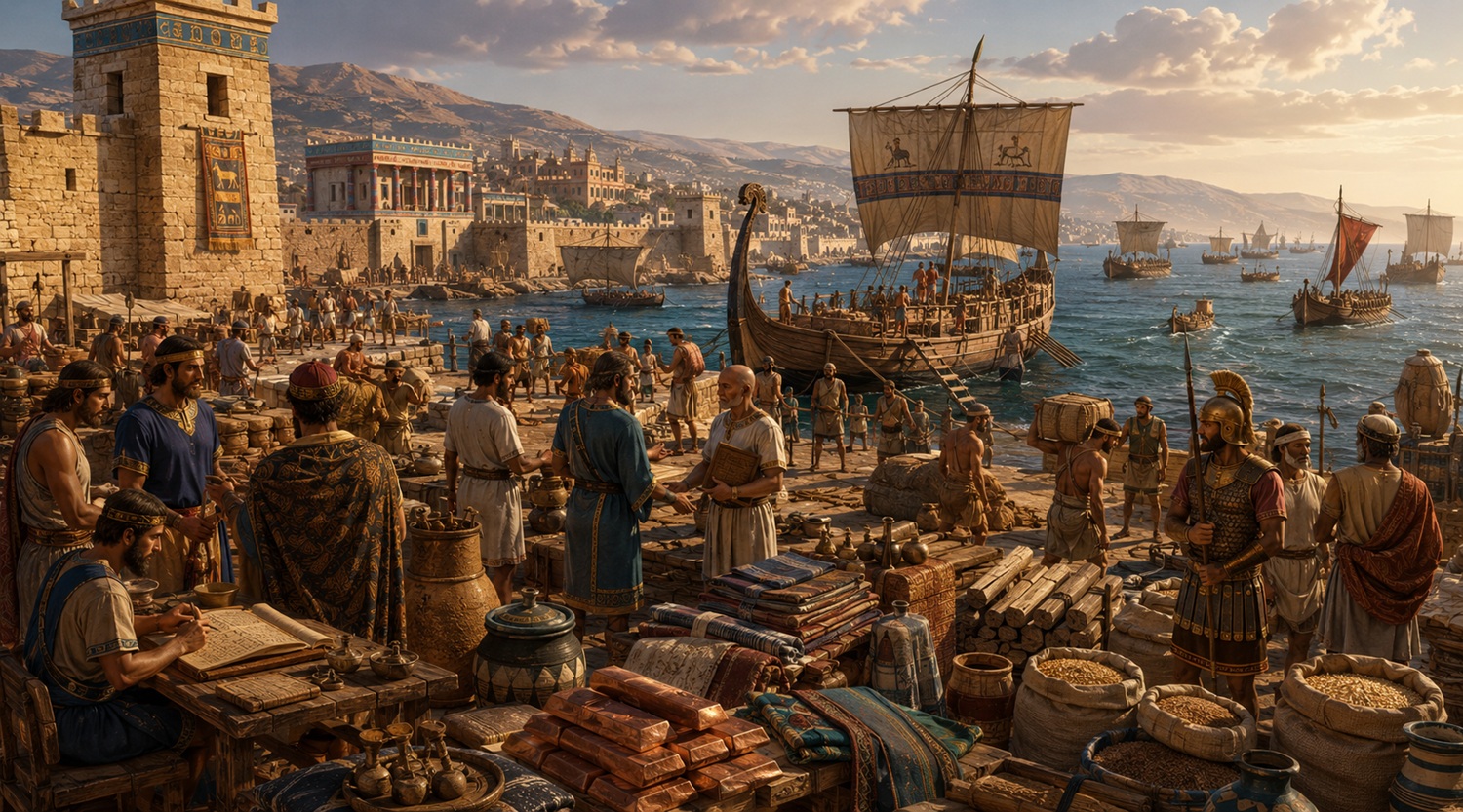
Around 1200 BCE, the eastern Mediterranean was not a collection of isolated kingdoms separated by empty seas. It was a densely connected political and commercial world.
Mycenaean palace states in Greece maintained bureaucracies that recorded goods, land, labor, livestock, military obligations, and religious offerings in Linear B. The Hittite Empire dominated much of Anatolia and exercised power through a network of vassals and subordinate kingdoms extending into Syria. New Kingdom Egypt remained one of the great powers of the eastern Mediterranean. Coastal cities such as Ugarit linked inland states to maritime trade. Cyprus was a major producer of copper and a central hub in the exchange networks that made large-scale bronze production possible. Ships moved metals, pottery, luxury goods, foodstuffs, textiles, diplomatic gifts, and people among the Aegean, Anatolia, Egypt, the Levant, and Cyprus. The cargo of the Uluburun shipwreck provides an especially vivid archaeological snapshot of just how geographically wide those connections could be. (The Metropolitan Museum of Art)
Then, across the decades around 1200 BCE, much of that political order changed dramatically.
The Mycenaean palaces were destroyed or abandoned and their administrative system disappeared. Linear B vanished with the palace bureaucracies that had used it. The Hittite imperial center dissolved. Ugarit was destroyed and never returned as the same Late Bronze Age kingdom. Cyprus experienced destructions, relocations, and major changes in settlement and material culture. Egypt survived, but its power declined and its control of territories in the Levant weakened. Long-distance exchange continued in some forms, yet the international palace-centered network of the thirteenth century BCE did not survive intact. (Cambridge University Press)
This transformation is commonly called the Bronze Age Collapse.
The phrase is useful, but it can also mislead.
There was no single night when “Bronze Age civilization” disappeared. Different regions experienced different sequences of destruction, migration, political reorganization, survival, and recovery. Some institutions vanished. Others adapted. Some cities were destroyed. Others remained inhabited. Carchemish, for example, preserved Hittite dynastic and cultural traditions after the central Hittite imperial structure disappeared. Cyprus retained maritime and copper-trade connections at reduced levels even after the wider international system contracted. Modern scholarship therefore increasingly treats the period as one of both collapse and transformation, with substantial regional variation. (Cambridge University Press)
That makes the strongest alternate-history question more subtle than:
What if nothing bad happened around 1200 BCE?
Drought does not disappear.
Political rivalry does not disappear.
Ships are still wrecked.
Harvests fail.
Populations move.
Kings make mistakes.
Cities fight.
Earthquakes still occur.
The stronger counterfactual is this:
What if the major eastern Mediterranean states proved resilient enough that several key political and commercial systems bent under the crisis instead of breaking together?
In that world, the Bronze Age does not remain frozen forever.
It changes.
It reforms.
And precisely because the old system survives, many institutions associated with the later Iron Age and Classical Mediterranean develop along very different paths.
---
The Eastern Mediterranean Before the Crisis
The Late Bronze Age political order was hierarchical, bureaucratic, and highly interconnected.
At its highest level stood a small group of rulers who communicated through diplomacy, marriages, gift exchange, treaties, and formal claims of status. Trade was not separate from politics in the modern sense. Maritime exchange, elite consumption, state diplomacy, palace administration, and control of strategic resources often overlapped. Scholarship on Late Bronze Age maritime trade emphasizes that exchange among Egypt and western Asian states was embedded within high-level diplomatic systems, while archaeological evidence shows objects and raw materials moving across enormous distances. (Cambridge Resolve)
This created wealth.
It also created dependency.
A Mycenaean palace did not merely govern farmers living immediately outside its walls. It collected and redistributed goods, supported specialists, organized labor, recorded obligations, managed elite production, and connected its territory to larger exchange networks. The Linear B tablets preserved at palatial centers such as Pylos are administrative records produced within that system. (Cambridge University Press)
The Hittite Empire similarly depended on a combination of royal authority, provincial administration, vassal relationships, military obligations, and strategic routes. Ugarit illustrates the system well: it was a wealthy coastal kingdom tied politically to the Hittites while remaining deeply involved in international commerce. Surviving treaties show that Ugarit operated within Hittite imperial politics rather than as an isolated port. (The Metropolitan Museum of Art)
Cyprus held a particularly important place because copper was fundamental to bronze production. Archaeological research describes the island as a major copper producer at the center of eastern Mediterranean exchange networks, while Cypriot ceramics and metal moved widely through surrounding regions. (Cambridge University Press)
This was a sophisticated system.
It was also a system in which failure could travel.
A political crisis in Anatolia could affect Syrian ports.
A disruption in maritime trade could affect access to metals.
Agricultural shortages could weaken a palace's ability to support dependents and soldiers.
Warfare could damage the ports that carried international exchange.
A ruler facing several problems at once could discover that systems designed for efficient centralized control were not necessarily designed for flexible crisis response.
That is where the counterfactual begins.
---
What Caused the Bronze Age Collapse?
There is no scholarly consensus around one universal cause.
That point is essential.
Modern discussions have proposed and debated warfare, migration, internal political conflict, economic disruption, failures in palace systems, climate stress, drought, earthquakes, changing military practices, disease, and broader systemic vulnerability. A major review by A. Bernard Knapp and Sturt Manning emphasizes the large number of competing explanations and argues for examining regional evidence and multiple interacting processes rather than assuming one master cause. (RCNi Company Limited)
Warfare and political instability
War clearly mattered in some places.
Cities were destroyed.
Palaces prepared defenses.
Kings struggled with rivals, vassals, and external enemies.
But archaeological destruction does not automatically identify who attacked, why they attacked, or whether an external invasion caused the larger political failure.
Civil conflict, rebellion, dynastic competition, raids, and regional warfare could all produce similar archaeological traces.
Migration and the “Sea Peoples”
The label Sea Peoples is especially easy to misuse.
Egyptian sources from the reign of Ramesses III depict and describe groups involved in conflict with Egypt, and population movements clearly formed part of the eastern Mediterranean transition. But “Sea Peoples” should not become a convenient single invading nation blamed for every destruction between Greece and Egypt.
Modern archaeological work treats migration, cultural interaction, local transformation, and identity as much more complicated than a simple invasion narrative. (Cambridge University Press)
Some mobile groups may have been raiders.
Others migrants.
Others mercenaries.
Others displaced communities seeking new land.
The same population might play several roles over a generation.
Climate stress and drought
Climate probably mattered in some regions too.
A 2023 Nature study using tree-ring evidence identified an unusually severe multi-year drought in central Anatolia around 1198–1196 BCE, coinciding closely with the end of the Hittite imperial system. That does not prove that drought single-handedly destroyed the Hittites. It does show that a state already facing political and military pressures may have encountered a serious agricultural shock at a particularly dangerous time. (Nature)
Earthquakes and natural disasters
Earthquakes have also been proposed as contributors to destruction at particular sites.
The eastern Mediterranean is seismically active.
But even where earthquake damage occurred, the important question is whether societies rebuilt.
An earthquake can destroy buildings.
It does not automatically destroy a political system.
A resilient state rebuilds.
A state already facing famine, rebellion, invasion, or commercial breakdown may not.
Trade disruption
Bronze itself illustrates the vulnerability of the system.
Copper was comparatively abundant in places such as Cyprus.
Tin was much rarer and had to travel through long-distance exchange systems.
If maritime trade contracted sharply, access to essential raw materials could become less reliable.
The international elite economy was therefore powerful partly because it was connected—and vulnerable for the same reason. (Cambridge University Press)
Systemic vulnerability
The safest conclusion is therefore systemic:
around 1200 BCE, several societies faced multiple overlapping stresses, and some highly centralized institutions proved unable to absorb them.
Preventing the collapse does not require eliminating every stressor.
It requires preventing those stressors from cascading.
---
The Point of Divergence: The Palaces Learn to Bend
Our divergence begins during the final decades of the thirteenth century BCE.
The major powers have already received warnings.
Harvests have been inconsistent in some regions.
Ports have reported insecurity.
Population movement is increasing.
Western Anatolia remains politically difficult.
Long-distance shipments are less predictable.
Some palace administrators recognize the danger of concentrating too much food, political authority, craft production, and military organization in a few central institutions.
In this alternate timeline, several rulers respond more successfully.
The changes are not modern economic reforms. They are practical Bronze Age adaptations:
more grain is stored in dispersed regional centers rather than overwhelmingly at royal capitals;
vassal rulers receive greater autonomy to organize local defense and food supply;
important ports maintain larger emergency reserves;
palace workshops rely somewhat more on local and regional exchange when international shipments fail;
states preserve redundant land and sea routes rather than depending on a few critical corridors;
rulers make greater use of diplomacy and resettlement to absorb mobile groups into military and agricultural communities rather than treating every movement as an invasion;
regional elites are incorporated into crisis government instead of being forced into rebellion by ever-greater palace extraction.
None of these reforms guarantees peace.
Some cities still burn.
Some dynasties still fail.
Some harvests are still disastrous.
But the crisis no longer destroys several major nodes of the system at nearly the same time.
The Hittite world contracts but survives.
Several Mycenaean palace states remain functional.
Egypt retains more of its Levantine position.
Cypriot copper trade continues at reduced but reliable levels.
Ugarit suffers warfare and commercial disruption but is not permanently destroyed.
The eastern Mediterranean enters a difficult century of reform instead of a broad institutional rupture.
---
The Hittite Empire Survives by Becoming Less Imperial
The historical Hittite Empire is one of the clearest examples of why resilience is a better divergence than simple preservation.
The empire around 1200 BCE was not merely a city called Hattusa. It was a political network spanning central Anatolia and extending through subordinate rulers into northern Syria. When the central imperial system disappeared, Hittite political traditions did not vanish everywhere. Carchemish and other successor states preserved important elements of Hittite dynastic culture into the Iron Age. (Cambridge University Press)
Our alternate Hittite survival builds on that real continuity.
Hattusa remains symbolically important, but the Great King accepts that the old degree of centralized control is unsustainable.
Carchemish receives greater authority in Syria.
Regional Anatolian rulers gain more control over taxation, defense, and grain management.
The imperial court demands loyalty, tribute, and military support but interferes less in daily regional administration.
In effect, the Hittite Empire evolves toward a federated imperial system.
This makes it weaker in one sense.
The Great King cannot command every region as easily.
But it makes the system harder to decapitate.
A crop failure in central Anatolia does not automatically paralyze Syria.
A rebellion in western Anatolia does not require every imperial resource to pass through Hattusa.
A royal succession crisis can be mediated among several strong dynastic centers.
The Hittite state survives because it stops insisting on the political structure that made it vulnerable.
---
Hattusa Might Still Decline
Preventing imperial collapse does not mean Hattusa remains forever at its thirteenth-century peak.
The central Anatolian capital was dependent on a demanding political and economic system.
If drought remains severe, the court might temporarily reduce population or shift some administrative functions southward.
The alternate empire could eventually develop multiple capitals or seasonal royal centers.
Carchemish could become increasingly powerful.
Southern Anatolian routes could matter more.
The Hittite political name might survive while its institutional geography changes almost beyond recognition.
That is a more plausible long-term survival than imagining the old palace at Hattusa functioning unchanged for seven additional centuries.
---
Mycenaean Greece Is the Harder Case
Mycenaean Greece was not a single centralized empire under one universally acknowledged king.
It consisted of multiple palatial states, including major centers such as Mycenae, Pylos, Tiryns, and others whose exact political relationships remain debated. Their bureaucracies used Linear B to administer goods, labor, land, offerings, and other palace concerns. Around the transition to the twelfth century BCE, the palaces disappeared and the writing system disappeared with them. (Cambridge University Press)
The alternate survival therefore cannot be “the Mycenaean Empire continues.”
There was no simple unified Mycenaean Empire to preserve.
Instead, several palace kingdoms respond differently.
Pylos may still be destroyed.
A coastal palace facing attack is difficult to save merely through administrative reform.
But Mycenae, Tiryns, or Thebes could survive or be rebuilt rapidly enough that palatial government remains a living institution rather than a memory.
The key change is decentralization.
Local elites gain greater authority.
Regional storage replaces complete dependence on central palace redistribution.
Craft specialists increasingly work for mixed palace and private markets.
Military leaders receive land and political standing in exchange for defending local districts.
The palace remains powerful without controlling every important economic transaction.
---
Linear B Does Not Disappear
This could be one of the most consequential changes.
Historically, Linear B was closely tied to palace administration. When the Mycenaean palatial institutions disappeared, the script vanished from the surviving record. Greek alphabetic writing later emerged in a completely different context, with the Greek alphabet adapted from a Phoenician model around the eighth century BCE. (Cambridge University Press)
If even several palace bureaucracies survive, Linear B continues.
At first, its purpose remains administrative.
Lists.
Taxes.
Offerings.
Personnel.
Military supplies.
Land.
But scripts change when institutions change.
A palace system that increasingly deals with regional elites, merchants, treaties, and private workshops may need writing for more than internal accounting.
Scribes begin recording longer legal agreements.
Diplomatic correspondence becomes more common.
Religious texts may eventually be written.
Genealogies and royal proclamations may appear.
This does not mean Linear B automatically becomes an alphabetic literary script. Its syllabic structure has limitations.
It does mean Greek speakers never experience the same centuries-long disappearance of writing.
---
Would the Greek Alphabet Still Be Invented?
Very possibly.
The alphabetic traditions that eventually produced Phoenician, Hebrew, and Aramaic scripts had Bronze Age roots in the Levant. Alphabetic writing therefore did not depend on the Bronze Age Collapse for its invention. (Cambridge University Press)
A literate Mycenaean world might encounter alphabetic systems through trade and diplomacy and decide that they are more flexible than Linear B for some purposes.
The result could be two scripts in Greek society:
Linear B for palace and religious tradition;
an alphabetic script for trade, private correspondence, public inscriptions, or literature.
Over time, the alphabet might replace Linear B.
Or Linear B could evolve under alphabetic influence.
The important point is that the historical eighth-century “return” of Greek writing no longer happens.
Writing never left.
---
The Greek Polis Is No Longer Inevitable
This is where the alternate history begins moving far from classical Greece.
The Greek city-state, or polis, developed through the social and political transformations of the Early Iron Age. The collapse of the palaces removed the old political order and created space for new forms of settlement, elite competition, community identity, self-government, and eventually the polis structures associated with Archaic and Classical Greece. Cambridge scholarship on Early Iron Age Greece connects post-palatial political development with the emergence of independent communities and new forms of self-government. (Cambridge University Press)
If palatial kingdoms survive, that path changes.
Athens might still become important.
Sparta might still exist as a settlement.
Corinth may still prosper because of geography.
But there is no reason for those communities to develop the same political institutions.
A surviving Mycenaean political world might contain:
hereditary kings;
palace bureaucracies;
regional noble councils;
merchant assemblies;
temple estates;
semi-autonomous port communities;
and dependent towns.
Some may eventually become republic-like city-states.
Others could remain monarchies.
Classical Greece would probably be politically more continuous with Bronze Age kingship and less dominated by the independent polis model.
---
No Collapse Does Not Mean No Political Change in Greece
The Mycenaean palace system cannot simply continue unchanged to 500 BCE.
Its centralized economic structure would face the same long-term pressures that caused trouble around 1200 BCE:
regional elites want autonomy;
trade creates wealthy people outside the palace;
military commanders accumulate local power;
population grows and moves;
iron becomes more available;
new ports gain commercial importance;
administrative needs expand.
The palace states either adapt or collapse later.
A successful kingdom might evolve into a territorial monarchy with a professional scribal bureaucracy rather than a redistributive Bronze Age palace.
Another might fragment into aristocratic cities.
A third might experience revolution and expel its dynasty.
The result by 700 BCE could be politically diverse without reproducing the historical polis world.
---
Homer Would Not Be the Same Homer
The historical Greek epic tradition developed across the centuries following the palace collapse and was eventually written using alphabetic Greek.
If Mycenaean institutions survive, stories of heroic kings, war at Troy, palace feasting, chariots, and divine ancestry would exist within societies that still possess palace traditions rather than remembering them through a transformed post-palatial world.
Oral epic could certainly continue.
But the Iliad and Odyssey as we know them should not be assumed.
A scribal palace culture might record heroic poetry earlier.
Different stories might become canonical.
Royal courts could sponsor written epic celebrating dynastic ancestors.
By 500 BCE, alternate Greeks might possess extensive Bronze Age historical chronicles alongside poetry.
The loss of Linear B literacy historically created a sharp gap between the Mycenaean bureaucratic record and later Greek literary memory.
That gap disappears.
---
Egypt Survives More Comfortably—but Still Changes
Egypt historically survived the upheavals around 1200 BCE.
Ramesses III's monuments depict victories over groups traditionally associated with the Sea Peoples, and Egypt remained a functioning state. But the New Kingdom nevertheless moved into a period of declining imperial reach, economic difficulty, and political fragmentation. (Cambridge University Press)
In the alternate timeline, a more resilient eastern Mediterranean helps Egypt.
Ugarit remains a functioning commercial partner.
Hittite Syria remains organized.
Cypriot copper routes continue.
The Levant experiences less widespread political fragmentation.
Egypt therefore faces fewer simultaneous external disruptions.
Ramesses III or his successors may retain more influence in Canaan.
Egyptian access to Mediterranean trade remains stronger.
But internal Egyptian problems do not disappear.
Royal succession, temple wealth, administrative corruption, labor disputes, fiscal strain, and regional political power remain Egyptian issues.
The New Kingdom may last longer as a coherent imperial system.
It does not become immortal.
---
Egypt and the Hittites Could Become Long-Term Rivals Again
The famous Egypt-Hittite rivalry of the thirteenth century had already evolved into diplomacy after earlier warfare.
If both powers survive, the Levant remains a zone of negotiation between major states instead of becoming a political vacuum.
This could produce a surprisingly stable balance:
Egypt dominates the southern Levant.
The Hittite sphere remains powerful in northern Syria.
Ugarit and other coastal cities mediate trade.
Cyprus deals with both.
Neither great power can easily destroy the other.
Late Bronze Age international diplomacy therefore continues into the first millennium BCE in modified form.
That alone would radically change the political environment from which the kingdoms of Israel, Judah, Aram, Phoenicia, and other Iron Age states historically emerged.
---
The Levant Remains More Imperial
The historical transition created opportunities for new local states and identities.
As Egyptian and Hittite control weakened, smaller polities gained political room.
In the alternate timeline, that room is reduced.
Some highland communities still consolidate.
Coastal cities still develop.
Aramaic-speaking populations still move and form states.
But larger imperial frameworks remain present.
The political map of the southern and northern Levant therefore develops through negotiated autonomy inside surviving great-power spheres rather than through the same sequence of post-collapse state formation.
This makes exact biblical-era political history impossible to carry over unchanged.
The later kingdoms of Israel and Judah might still arise.
They might arise later.
They might form as Egyptian client states.
They might develop under different borders.
After a divergence this deep, treating their historical trajectories as fixed would be unjustified.
---
Ugarit Could Become One of the Great Survivors
Ugarit is one of the most striking losses of the historical collapse.
It was a literate, wealthy port linked to the Hittite system and the wider Mediterranean. Its archives preserve diplomatic, administrative, literary, and economic texts. Historically the city was destroyed around the transition and did not return as the same major kingdom. (The Metropolitan Museum of Art)
In the alternate timeline, Ugarit is damaged but survives.
That could make it one of the most important cultural bridges of the first millennium BCE.
A Ugaritic scribal tradition continues.
Cuneiform remains useful.
Alphabetic writing continues developing beside it.
Merchants connect Hittite Syria, Cyprus, Egypt, and the Aegean.
Religious and literary traditions preserved at Ugarit continue to be copied rather than buried until modern archaeological discovery.
The survival of one literate Levantine city could therefore have disproportionate effects on writing and cultural transmission.
---
Phoenician Development Becomes Very Different
The societies later called Phoenician did not suddenly appear from nowhere after 1200 BCE.
The coastal cities of the Levant had deep Bronze Age histories, and alphabetic writing had Bronze Age antecedents. What changed after the collapse was the political and commercial environment in which coastal city-states such as Tyre, Sidon, and Byblos operated. (Cambridge University Press)
If Ugarit survives and Hittite and Egyptian imperial systems remain stronger, the coastal commercial vacuum is smaller.
Tyre and Sidon still trade.
They may still become powerful.
But their westward expansion could be delayed or less dominant.
Instead of a distinct “Phoenician” commercial era emerging from the post-collapse world, the eastern Mediterranean could preserve a broader network of Levantine merchant cities operating under competing imperial umbrellas.
The consequences could reach the western Mediterranean.
Carthage might not be founded on the same schedule or by the same political process.
Phoenician settlements in Sicily, Sardinia, Iberia, and North Africa could develop later, differently, or through multi-city coalitions rather than primarily Tyrian expansion.
By 500 BCE, the western Mediterranean map could be radically altered.
---
Cyprus Becomes Even More Valuable
Cyprus already stood at the center of Late Bronze Age commerce because of its copper resources and geographic location. Even after the historical disruption, its copper trade and maritime links continued at reduced levels. (Cambridge University Press)
That makes Cyprus one of the easiest places to imagine thriving in the resilience scenario.
If the major powers remain intact enough to keep buying metal, Cypriot exporters retain powerful markets.
Ports damaged in local conflict are rebuilt.
Political centers compete for access to copper production.
Aegean, Anatolian, Levantine, and Egyptian merchants continue appearing on the island.
Cyprus could become the commercial mediator of the reformed Bronze Age system.
Its rulers might gain political independence precisely because every major power needs continued access to its trade.
---
Bronze Does Not Remain Supreme Forever
Preventing the Bronze Age Collapse does not prevent the Iron Age.
Iron objects were known before 1200 BCE, and iron technology spread more widely during the centuries that followed. The transition was technological and economic, not a magical switch triggered by the destruction of Bronze Age palaces. (Cambridge University Press)
A functioning copper-and-tin trade might reduce some of the pressure to replace bronze quickly.
Elite weapons and prestige objects could remain bronze longer.
Palace workshops accustomed to bronze would have institutional inertia.
But iron has an enormous long-term advantage:
iron ores are far more widely distributed than tin.
Once smiths master reliable iron production and increasingly effective forging, states are no longer as dependent on distant tin supply for many tools and weapons.
So iron still spreads.
The alternate transition is more gradual.
The “Bronze Age system” survives politically while becoming technologically iron-using.
By 800 BCE, a Hittite-descended state could be culturally continuous with the Late Bronze Age while equipping much of its army with iron weapons.
Historical labels would become awkward.
---
Iron Could Actually Strengthen Surviving Palaces
A palace that controls bronze depends heavily on international trade.
A palace that learns to organize iron production can draw on more local resources.
That could reduce systemic vulnerability.
Military equipment becomes less tightly connected to the copper-tin network.
Agricultural tools may become more available over time.
Regional smiths gain importance.
This may weaken central palace monopolies over prestige metalworking while strengthening the territorial state overall.
Again, survival requires institutional change.
A palace that tries to monopolize every new iron workshop may provoke local resistance.
A monarchy that taxes iron production while allowing regional specialists to prosper could become stronger.
---
Population Movement Still Happens
No-collapse scenario should imagine populations remaining neatly where they were in 1200 BCE.
People move because of drought, warfare, trade, marriage, pastoralism, political opportunity, and local demographic pressure.
The end of the Bronze Age clearly involved mobility, but modern scholarship warns against turning changes in material culture into simplistic stories of one ethnic group replacing another everywhere. (Cambridge University Press)
In the alternate world, major states respond to mobility differently.
Some migrants are settled on frontier land.
Some become mercenaries.
Some form autonomous military communities.
Some enter existing ports.
Some are expelled.
Some raid.
Some conquer local districts.
The crucial difference is that the states receiving them remain strong enough to negotiate, recruit, divide, and incorporate many of these groups.
Migration becomes a source of social transformation inside surviving states rather than one component of generalized state collapse.
---
The “Sea Peoples” Become Subjects, Soldiers, and Neighbors
The groups represented in Egyptian records need not disappear from the alternate timeline.
Some still fight Egypt.
Some still move into the Levant.
But if Egypt retains firmer control and Ugarit and Hittite Syria survive, newcomers encounter stronger institutions.
They may receive land in exchange for military service.
Coastal groups may become specialized maritime communities.
Aegean-derived populations could still settle in parts of the southern Levant, but the political environment surrounding those settlements changes.
The historical Philistine cities, identities, and relations with neighboring communities therefore cannot simply be copied into the alternate map.
What survives is population movement.
What changes is the state system absorbing it.
---
Long-Distance Trade Becomes Less Fragile
The greatest economic consequence of avoiding collapse may not be higher total trade.
It may be more diversified trade.
Late Bronze Age exchange was deeply impressive but partly tied to palaces, courts, elite gifts, and major ports. A crisis that destroyed several political centers could therefore break multiple connections at once. (Cambridge Resolve)
The alternate rulers learn from that experience.
More trade passes through private or semi-private merchants.
Ports become less dependent on one palace sponsor.
Smaller ships operate regional routes alongside large elite cargoes.
Market exchange grows beside diplomatic gift exchange.
The economy becomes less spectacularly centralized but more resilient.
That shift could be one of the main mechanisms by which the Bronze Age world evolves into something genuinely new without first collapsing.
---
A Merchant Class Gains Political Weight
If palaces increasingly rely on merchants to maintain trade during periods of crisis, merchants gain bargaining power.
They finance ships.
They maintain foreign contacts.
They move metals and grain.
They know which ports remain safe.
They can supply rulers whose own bureaucracies are struggling.
By 1000 BCE, major port cities could possess councils of wealthy commercial families capable of negotiating with kings.
Some cities might become semi-republican merchant polities even while inland regions remain monarchies.
This could generate political forms resembling later Mediterranean city-states—but arising within a continuous Bronze Age-derived system.
The old palace order survives by creating institutions that eventually dilute palace power.
---
Writing Could Expand Earlier
One of the historical collapse's largest informational consequences was the disappearance of several scribal systems and institutions.
In Greece, Linear B vanished.
At Ugarit, a distinctive literate culture ended with the city.
Elsewhere, writing traditions survived and changed.
In the alternate world, several of those traditions continue simultaneously.
Cuneiform remains the diplomatic language of older institutions.
Ugaritic alphabetic writing persists.
Levantine alphabetic systems continue evolving.
Linear B remains in Greek palaces.
Egyptian scripts remain powerful.
This produces intense scribal competition.
Merchants and soldiers need simpler writing.
Multilingual border zones require flexible scripts.
Alphabetic systems may therefore spread even without collapse, perhaps because they are easier to adapt to commercial and vernacular uses than complex palace scripts.
---
The Alphabet Might Spread Earlier—But Differently
It is tempting to say that preserving Bronze Age bureaucracy would delay alphabetic writing.
That is possible.
It is not inevitable.
Alphabetic writing had roots in the Bronze Age Levant already. (Cambridge University Press)
A continuous international commercial system could actually speed its diffusion.
A Cypriot merchant trading with Ugarit, Crete, and Greece has practical reasons to use a flexible script.
A Mycenaean ruler might retain Linear B for palace records while permitting an alphabet for diplomacy and commerce.
A Hittite successor administration could use several scripts at once.
The resulting Mediterranean around 900 BCE might be more continuously literate but more graphically diverse than the historical one.
Greek alphabetic writing could appear earlier than the eighth century—or later if Linear B remains adequate.
There is no single inevitable direction.
---
Does Classical Greece Still Happen?
Not in the form we know.
That answer should be firm.
The Classical Greek world of the fifth century BCE was the product of a long sequence of post-Mycenaean transformations.
The development of the polis.
The political evolution of Athens.
The distinctive Spartan system.
Colonization across the Mediterranean and Black Sea.
The reintroduction of writing in alphabetic form.
Archaic aristocratic competition.
Hoplite warfare.
Law codes.
Tyrannies.
Civic religion.
Panhellenic institutions.
All emerged within a world that had already lost the Mycenaean palace states centuries earlier. (Cambridge University Press)
Preserve those palace states and the ingredients are rearranged.
Greek speakers still trade.
They still fight.
They still colonize when population and commercial pressures encourage it.
They still form communities.
But Athens does not automatically become a democracy.
Sparta does not automatically become the Sparta of historical memory.
There is no reason for the Persian Wars to occur in the same form because Anatolian politics are completely different.
There is no reason for a Delian League to exist.
There may be no Peloponnesian War.
By 500 BCE, alternate Greek civilization could be highly literate, urban, commercially dynamic, and technologically sophisticated while remaining politically unfamiliar.
---
A Palace-to-Kingdom Transition Is More Plausible Than Eternal Palaces
The strongest Greek survival scenario looks something like this:
1200–1100 BCE
Several palaces survive by devolving economic authority to regional elites.
1100–950 BCE
The palace monarchies become territorial kingdoms. Linear B continues but is used alongside newer commercial writing.
950–800 BCE
Ports and aristocratic councils gain power. Some kingdoms become constitutional monarchies in a very broad ancient sense: kings remain, but elite councils and assemblies constrain them.
800–650 BCE
Commercial cities establish overseas colonies or trading settlements. Alphabetic writing spreads. Iron dominates ordinary tools and weapons.
650–500 BCE
Some old dynasties survive. Others are overthrown. Several former palace centers become oligarchic or civic states.
Greek political experimentation exists, but it develops from continuous monarchy rather than from centuries of post-palatial reconstruction.
This is not modern progress arriving early.
It is another route to complex Mediterranean states.
---
Colonization Could Be Smaller—or Larger
Historical Greek colonization from the eighth century BCE onward involved population pressure, trade, elite competition, local politics, and opportunities throughout the Mediterranean and Black Sea.
A surviving palace system could suppress independent colonization by controlling shipping.
Or it could sponsor colonies deliberately.
A king at Mycenae might establish a protected trading settlement in southern Italy.
A Cypriot-Hittite commercial consortium might settle strategic ports.
Levantine merchants may compete farther west.
The western Mediterranean could therefore become a field of state-sponsored Bronze Age-descended colonial competition centuries before the great imperial struggles of Classical antiquity.
But this depends heavily on later political choices.
It should not be treated as inevitable.
---
The Hittites Meet Assyria
One major power cannot be ignored.
Assyria survived the Bronze Age transition historically and later became the dominant empire of much of the Near East.
In the alternate timeline, a surviving Hittite sphere occupies territory and political influence that historical Neo-Assyrian rulers would later seek.
That creates a major first-millennium rivalry.
The Hittite world has several advantages:
Anatolian manpower;
Syrian vassals;
access to Mediterranean trade;
long diplomatic traditions;
and perhaps stronger commercial ties with Greece and Cyprus.
Assyria has its own formidable military and administrative development.
By the ninth or eighth century BCE, the central geopolitical struggle of the Near East might be Assyria versus a reformed Hittite federation, with Egypt and Mediterranean states maneuvering around them.
This is far more plausible than assuming the Hittites survive for seven centuries without facing another major imperial challenger.
---
The Hittite Empire Might Still Fall—Just Later
This is one of the most important competing scenarios.
Resilience buys time.
It does not abolish history.
A decentralized Hittite system may survive 1200 BCE only to face a succession crisis around 1100.
Or an Assyrian expansion in the tenth century.
Or regional separatism.
Or another climate episode.
Or a coalition of western Anatolian powers.
The result could be collapse in 1050 or 900 BCE instead.
That later collapse would be different because the surrounding world has changed.
Iron technology is more mature.
Trade is more diversified.
Regional states are stronger.
Writing is more widespread.
The failure of one empire would no longer cause the same system-wide cascade.
Thus the Bronze Age Collapse can be prevented even if the Hittite Empire eventually disappears.
---
The Same Is True for Mycenaean Kingdoms
Some may last only another century.
Others may transform.
The important divergence is not eternal survival.
It is continuous institutional evolution.
A kingdom that survives from 1200 to 950 BCE has preserved writing, royal traditions, archives, land systems, religious institutions, and political memory across the period that historically separated Mycenaean Greece from Archaic Greece.
Even if that dynasty then falls, its successors inherit written records and functioning institutions.
There is no equivalent “Dark Age” in the same sense.
The cultural consequences persist long after the original palace is gone.
---
Three Competing Alternate Outcomes
| Scenario | What Survives | What Changes | Long-Term Result |
| ------------------------------------- | ------------------------------------------------------------------------------------------------------------------------------ | ----------------------------------------------------------------------------------------- | ----------------------------------------- |
| Reformed Bronze Age system | Hittite federation, several Mycenaean kingdoms, major Levantine ports, stronger Egyptian sphere, Cypriot trade | Palaces decentralize; merchants and regional elites gain power; iron and alphabets spread | Strongest sustained-survival scenario |
| Delayed collapse | Most major states survive the crisis for 100–200 years | Old vulnerabilities reappear; later wars or succession crises break empires separately | Very plausible |
| Selective survival | Some regions endure while others still collapse—for example Hittite Syria and Cyprus survive while most Mycenaean palaces fall | Trade remains stronger than historically but political continuity varies widely | Easiest counterfactual to defend |
| Unchanged palace world to 500 BCE | Almost everything survives in thirteenth-century form | Very little | Extremely implausible |
The useful alternate history lies in the first three rows.
---
Real History vs. Alternate Chronology, 1200–500 BCE
| Approximate Date | Real Historical Trajectory | Plausible Resilience Timeline |
| ---------------- | --------------------------------------------------------------------------------------------------------------------------------------------------------- | ----------------------------------------------------------------------------------------------------------------------------------------------------------------------------------------------------------------------------- |
| c. 1200 BCE | Major disruptions across the eastern Mediterranean; Mycenaean palaces fall; Hittite imperial system collapses; several cities are destroyed or abandoned. | Severe crisis still occurs, but emergency grain systems, decentralized administration, and stronger regional defense prevent synchronized breakdown. |
| 1190s BCE | Hittite imperial center disappears; recent climate evidence points to severe multi-year drought in central Anatolia around 1198–1196 BCE. (Nature) | Central Anatolia suffers badly, but Carchemish and other regional centers maintain dynastic legitimacy and keep a reduced imperial network functioning. |
| c. 1175 BCE | Egypt under Ramesses III fights groups represented in the Medinet Habu records; Egyptian power survives but later contracts. | Egypt still fights major migrant and raiding coalitions but benefits from functioning allies and ports; it retains somewhat stronger Levantine influence. |
| 1150 BCE | Greek palace administration and Linear B are gone; post-palatial societies reorganize. | Some Mycenaean kingdoms remain. Linear B scribal schools continue, though regional elites and merchants gain autonomy. |
| 1100 BCE | Eastern Mediterranean political landscape is substantially transformed; Cyprus and the Levant show new settlement and cultural patterns. | The old great-power system has become looser. Cyprus thrives as a copper and shipping hub; Ugarit remains a major Syrian port. |
| 1000 BCE | New Iron Age polities expand; Phoenician coastal cities rise; Greek communities develop outside palatial structures. | Iron spreads inside surviving kingdoms. Levantine merchant cities compete within Hittite and Egyptian spheres. Greek palace states evolve toward territorial monarchies. |
| 900 BCE | Regional kingdoms and city-states increasingly define the eastern Mediterranean; Greek recovery and connectivity accelerate. | Some Bronze Age dynasties have fallen, but without loss of literacy. Merchant councils, monarchies, and regional federations coexist. |
| 800 BCE | Greek alphabetic literacy expands; polis development and Mediterranean colonization accelerate. (Cambridge University Press) | Greek speakers may already use both Linear-derived and alphabetic scripts. Colonization is more often state-sponsored or commercial than polis-driven. |
| 700 BCE | Archaic Greek city-states develop; Assyria dominates much of the Near East; Phoenician networks extend far west. | Assyria confronts a surviving or successor Hittite federation in Syria and Anatolia. Phoenician expansion is less monopolized by Tyre and Sidon because older ports remain important. |
| 600 BCE | Greek poleis, Neo-Babylonian power, Egypt, Lydia, Phoenician cities, and other states compete across the region. | The political map is highly divergent: old palace-descended kingdoms, merchant cities, Assyria or its successors, Egyptian power, and Anatolian federations compete. |
| 500 BCE | Classical Greek political development is underway; the Achaemenid Persian Empire dominates much of the Near East. | No exact equivalent is predictable. Greece is likely literate and urban but may contain monarchies and federations rather than the historical polis system. The Persian imperial trajectory itself may be profoundly altered. |
After about 900 BCE, exact prediction becomes increasingly uncertain.
By 500 BCE, the alternate map should not be presented as a recolored version of our own.
Seven centuries of different institutions, wars, migrations, marriages, technologies, and trade would have accumulated.
---
Would Persia Still Rise?
The peoples and regions that later formed the Achaemenid Persian Empire do not disappear.
But Persian expansion depended upon the political landscape of the Near East in the sixth century BCE.
If Anatolia contains a strong Hittite-descended federation rather than the same sequence of Phrygian and Lydian powers, western Persian expansion faces different enemies.
If Assyria has fought a powerful Hittite rival for centuries, its own trajectory may differ.
If Egypt retains greater Levantine influence, imperial coalitions change.
Cyrus the Great or an equivalent Persian ruler could still create an enormous empire.
But there is no basis for assuming precisely the same Achaemenid borders, conquest dates, or Greek-Persian conflicts.
This is one of the places where responsible counterfactual analysis must stop short of false precision.
---
Does Democracy Still Appear?
Political participation is not genetically encoded in post-collapse Greece.
Athens' historical democracy developed through a specific sequence of aristocratic competition, social conflict, institutional reform, tyranny, military organization, and civic identity.
A surviving Mycenaean monarchy could eventually develop assemblies.
Merchant cities might develop oligarchies.
Military communities could demand political rights.
A royal council could evolve into a broader representative institution.
So participatory government remains possible.
What disappears is the assumption that Athenian democracy emerges in the same place, at the same time, through the same reforms.
The alternate Mediterranean might produce republican or participatory political systems in Cyprus, a Greek port, a Levantine merchant city, or an Anatolian federation instead.
Political experimentation still happens.
Its geography changes.
---
Would Philosophy and Science Be Delayed?
Not necessarily.
Continuous literacy could preserve more technical knowledge.
Long-lived scribal institutions could transmit astronomy, accounting, medicine, engineering, mathematics, and diplomatic knowledge without a centuries-long Greek break in writing.
Contact among Egypt, Anatolia, Mesopotamia, the Levant, Cyprus, and Greece remains intense.
That could create fertile conditions for intellectual exchange.
But centralized palace institutions can also restrict knowledge.
A scribal class serving kings may not encourage open public debate.
The historical polis created distinctive settings for political argument, public competition, patronage, and intellectual life.
So continuous literacy does not automatically produce “Greek science earlier.”
It could produce more accumulated technical knowledge but less of the same public intellectual culture associated with later Classical Greece.
Different institutions encourage different forms of thought.
---
Would the World Become Technologically More Advanced Earlier?
This is one of the weakest tempting claims.
No collapse means more continuity.
More archives survive.
Trade remains stronger.
Craft specialists retain institutional support.
That could preserve and spread technologies that were historically disrupted.
But technological development is not a simple meter that rises whenever civilization avoids collapse.
Large palace systems can be conservative.
Elites can monopolize skilled labor.
Cheap iron can undermine older bronze industries.
Political stability can encourage investment, but instability can also generate innovation.
There is no defensible route from “Hittites survive” to “industrial revolution in antiquity.”
The strongest claim is narrower:
some technological and administrative traditions would experience less interruption, while entirely new innovations would still depend on later social and economic conditions.
---
What Happens to Bronze?
It becomes a prestigious and specialized material rather than disappearing.
That is broadly what happened historically anyway.
Iron did not eliminate bronze.
Bronze remained useful for armor, vessels, art, fittings, instruments, and many other objects.
In the alternate system, strong Cypriot copper commerce and established tin routes may keep bronze somewhat more economically central for longer.
But iron eventually becomes dominant for many tools and weapons.
By 500 BCE, calling this alternate civilization a “Bronze Age society” would be misleading technologically.
The continuity is institutional, not metallurgical.
---
The Most Important Change May Be Memory
The historical collapse created cultural discontinuities.
In Greece, later societies remembered a heroic past but did not preserve the Mycenaean palace archives as a continuous readable historical tradition.
In the alternate world, archives survive.
Kings know the names of rulers from 300 years earlier.
Treaties are recopied.
Boundary decisions remain documented.
Religious institutions preserve foundation records.
Merchants maintain family archives.
Historical writing could therefore develop in societies with documentary memories extending back into the second millennium BCE.
Imagine a Greek historian in 500 BCE who can consult copies of palace records from 1100 BCE.
Imagine a Hittite court preserving diplomatic treaties with Egypt for seven centuries.
Imagine Ugaritic scholars copying Late Bronze Age literature continuously rather than modern archaeologists rediscovering it after thousands of years.
The survival of institutions would change not only political history.
It would change what ancient people themselves knew about their past.
---
Sources and Further Reading
A. Bernard Knapp and Sturt W. Manning, “Crisis in Context: The End of the Late Bronze Age in the Eastern Mediterranean,” American Journal of Archaeology 120 (2016). A major review of competing explanations for the Late Bronze Age transition and an essential corrective to simple single-cause collapse stories. (RCNi Company Limited)
Sturt W. Manning et al., “Severe Multi-Year Drought Coincident with Hittite Collapse around 1198–1196 BC,” Nature (2023). Tree-ring evidence for an unusually severe multi-year drought in central Anatolia at approximately the time the Hittite imperial system disappeared. (Nature)
Guy D. Middleton, “A Tale of Three Cities: Urban and Cultural Resilience and Heritage between the Late Bronze Age and Early Iron Age in the Eastern Mediterranean,” Urban History (2021). Particularly useful for balancing the language of collapse with evidence for survival, rebuilding, continuity, and regional resilience. (Cambridge University Press)
Antonis Kotsonas, Social Change across the End of the Aegean Bronze Age (Cambridge University Press, 2025). A recent synthesis of political, demographic, economic, and social transformation after the Mycenaean palatial period. (Cambridge University Press)
*The Metropolitan Museum of Art, Beyond Babylon: Art, Trade, and Diplomacy in the Second Millennium B.C..* A broad archaeological overview of the international connections among Egypt, western Asia, the Aegean, and other parts of the Late Bronze Age world, including the Uluburun shipwreck. (The Metropolitan Museum of Art)
The Metropolitan Museum of Art, “Ugarit.” A concise introduction to Ugarit's relationship with the Hittite Empire and its place in Late Bronze Age politics and commerce. (The Metropolitan Museum of Art)
“Cyprus in the Twelfth and Eleventh Centuries BCE,” in The Cambridge Companion to the Greek Iron Age. Important for both the severe transformations on Cyprus and the island's continuing copper trade and maritime connections after the wider crisis. (Cambridge University Press)
Guy D. Middleton, Migration Myths and the End of the Bronze Age in the Eastern Mediterranean (Cambridge University Press, 2021). A critical treatment of migration, ethnicity, climate claims, and the archaeological evidence surrounding population movements. (Cambridge University Press)
John K. Papadopoulos, “The Early History of the Greek Alphabet: New Evidence from Eretria and Methone,” Antiquity (2016). Useful for understanding the historical adoption of alphabetic Greek and how continued Linear B literacy could alter that trajectory. (Cambridge University Press)
Philippe Beaujard, “The Late Bronze Age (c. 1600–1100 BCE), an Area Unified around the Eastern Mediterranean,” in The Worlds of the Indian Ocean. A synthesis of Late Bronze Age connectivity, Cyprus's commercial role, metals, and Mediterranean exchange. (Cambridge University Press)
Could the Bronze Age System Really Survive?
Yes—but not in its thirteenth-century form.
That distinction is the foundation of the counterfactual.
A system built around powerful palaces, concentrated storage, elite-controlled craft production, distant metal supplies, royal diplomacy, and a limited number of major political nodes was highly effective when those connections functioned.
It could also become fragile when several connections failed together.
A multi-year drought does not have to destroy an empire.
A migration does not have to destroy an empire.
A lost battle does not have to destroy an empire.
A failed shipment does not have to destroy an empire.
The danger comes when agricultural stress weakens the tax base, political conflict reduces legitimacy, maritime disruption reduces strategic imports, military pressure increases expenditure, and centralized institutions have few alternative mechanisms for distributing resources.
That is why the alternate system must reform.
The Hittite Empire survives by giving Carchemish and other regional centers greater authority.
The Mycenaean kingdoms survive by letting local elites, ports, and merchants operate outside complete palace control.
Cyprus survives by trading through multiple routes.
Ugarit survives because it can obtain supplies and security through more than one imperial connection.
Egypt survives more strongly because its northern trading partners have not all failed together.
In systems language, the alternate Bronze Age gains redundancy.
That is historically plausible because real post-collapse societies demonstrate that regional networks could continue after larger structures failed. Cyprus retained trade at reduced scale, and Hittite dynastic traditions survived in successor centers even after the Great King's empire disappeared. (Cambridge University Press)
The larger problem is political.
Centralized palace systems existed partly because centralization benefited rulers.
A king may understand that regional autonomy makes his state more resilient while still fearing that an autonomous governor will become a rival.
A palace may know that merchants are useful while resenting their independent wealth.
A bureaucracy may recognize that local storage protects against famine while wanting grain under royal control.
So survival requires rulers to accept less immediate control in exchange for greater long-term stability.
Some would.
Others would not.
That is why selective survival is ultimately more plausible than every Late Bronze Age state successfully reforming.
Perhaps the Hittite federation and Cyprus survive while most Mycenaean palaces still fail.
Perhaps several Greek kingdoms survive while Ugarit is still destroyed.
Perhaps Egypt remains dominant but Anatolia fragments.
There is no need for the entire eastern Mediterranean to pass one resilience test together.
Preventing the historical “collapse” only requires enough important nodes to survive that the international network itself remains functional.
And even then, the Bronze Age system does not survive forever.
By 900 or 800 BCE, the states still standing would be using more iron, broader markets, different scripts, altered armies, more powerful regional elites, and new political institutions.
The civilization survives by becoming something its thirteenth-century rulers would only partly recognize.
What Still Changes?
Almost everything—just not through the same rupture.
Iron still spreads. Bronze remains important, but no political decision can permanently prevent the diffusion of increasingly useful iron technologies. (Cambridge University Press)
Population still moves. Drought, trade, war, pastoral mobility, and political opportunity continue producing migration. Stronger states can redirect and absorb movement; they cannot stop it.
Kings still fall. A Hittite dynasty saved in 1190 BCE can face rebellion in 1050. A Mycenaean palace preserved at Mycenae can be overthrown two centuries later.
Trade changes. Merchant networks become more independent as rulers discover that privately organized exchange gives the system flexibility.
Writing changes. Linear B may survive, but alphabetic systems remain attractive. The Mediterranean could become more continuously literate without preserving one script forever.
Egypt still faces internal strains. The survival of Hittite Syria does not solve every fiscal, dynastic, or administrative problem along the Nile.
Assyria still expands. A surviving Hittite sphere does not eliminate the rise of ambitious Mesopotamian states. It changes whom they have to fight.
Greek politics still evolves. Palace monarchy cannot remain unchanged while merchants, soldiers, aristocrats, and cities accumulate power.
New political forms still emerge. Oligarchies, councils, federations, merchant cities, and perhaps forms of popular government can develop even without the historical polis sequence.
Religious traditions change. Gods, cults, sanctuaries, and myths adapt to new political communities and to centuries of continued contact.
The western Mediterranean still becomes important. But Phoenician and Greek expansion may occur through different cities and political institutions.
Old empires may still collapse later. Resilience postpones or localizes failure. It does not abolish it.
This is what makes the scenario more interesting than imagining an eternal Bronze Age.
The Bronze Age Collapse was not the only path from 1200 BCE to complex first-millennium societies.
Without it, history still produces innovation, conflict, state formation, trade, migration, and political experimentation.
It simply does so with more institutional memory.
There is no lost age of writing in Greece.
No complete disappearance of the Hittite imperial tradition.
No identical rise of independent Phoenician commercial power.
No same route toward the Greek polis.
No same division between a mysterious heroic Bronze Age and a later literate Greek present.
The Mediterranean changes continuously rather than through one of antiquity's most dramatic systemic breaks.
The AltHistAI Verdict
What if the Bronze Age Collapse never happened?
The strongest answer is not that Mycenaean kings, Hittite emperors, Egyptian pharaohs, and Levantine merchant princes preserve the world of 1200 BCE unchanged for another seven centuries.
That would merely replace collapse with stagnation.
The more plausible alternate history is a successful crisis of adaptation.
The stresses still arrive.
Central Anatolia still experiences severe drought. The 1198–1196 BCE tree-ring evidence is a reminder that any surviving Hittite state must deal with a genuine agricultural shock rather than having climate edited out of the scenario. (Nature)
People still move.
Armies still raid.
Dynasties still quarrel.
Trade routes still become dangerous.
Some cities are still destroyed.
What changes is the response.
Instead of several major political and commercial centers failing in a narrow historical window, enough of them remain functional to keep the eastern Mediterranean network alive.
The Hittite Empire contracts into a looser federation.
Carchemish and other regional centers carry more authority.
A few Mycenaean palaces fall, but others adapt and preserve Greek literacy.
Egypt remains a major power with stronger northern connections.
Ugarit survives as a commercial and scribal bridge.
Cyprus remains the indispensable copper crossroads of the eastern Mediterranean.
That survival changes the meaning of the following centuries.
The first great consequence is continuity of writing.
Historically, the destruction of the Mycenaean palaces took Linear B with them. Greek speakers later adopted alphabetic writing in a new social world. (Cambridge University Press)
In the alternate timeline, Greek scribes never disappear.
Linear B evolves.
An alphabet may still arrive through Levantine contact, perhaps even earlier because trade remains intense.
But Greek civilization never has to reconstruct literacy after centuries without palatial writing.
That means archives survive.
Treaties survive.
Genealogies survive.
Religious records survive.
Perhaps literature begins being written earlier.
Later Greek societies possess documentary knowledge of their Mycenaean ancestors rather than primarily heroic memory.
The second great consequence is political.
Classical Greece no longer emerges from the same post-palatial landscape.
The palace collapse historically opened space for new political communities that eventually helped produce the polis. (Cambridge University Press)
Preserve the kingdoms and Greek political experimentation begins from monarchy rather than from its disappearance.
Some kingdoms may become federations.
Others become oligarchies.
Ports may win privileges from kings.
Merchant councils may acquire power.
Assemblies may develop around military obligations.
A few dynasties may be overthrown.
But Athens is not destined to become the historical democracy, and Sparta is not destined to become the historical Sparta.
“Classical Greece” would still be Greek.
It would not be classical in the form familiar to us.
The third major difference is the Levant.
Ugarit survives.
The Hittite sphere remains active in Syria.
Egypt retains more influence to the south.
Coastal cities such as Tyre and Sidon therefore rise inside a more crowded political system.
Phoenician maritime expansion could still occur, but its timetable, leadership, and scale change.
Carthage is no longer inevitable on its historical date.
The alphabet still develops because its roots predate the collapse, but its routes across the Mediterranean may be different. (Cambridge University Press)
The fourth difference is economic.
Bronze remains easier to obtain because Cyprus and the eastern Mediterranean trade network continue functioning.
But iron does not disappear from the story.
Its ores are widespread.
Technical knowledge improves.
Smiths experiment.
States discover that iron can reduce dependence on imported tin.
By the first millennium BCE, surviving Bronze Age kingdoms increasingly equip themselves with Iron Age technologies.
This is the central paradox of the scenario:
the Bronze Age survives by ceasing to be purely Bronze Age.
The same is true politically.
Palaces survive by giving up some palace control.
Empires survive by accepting regional autonomy.
Royal economies survive by making room for merchants.
Scribal traditions survive by adopting new forms of writing.
The great powers preserve themselves only by loosening the systems that once made them great.
That means the alternate eastern Mediterranean of 800 BCE would not look like the world of Ramesses II or the kings of Pylos preserved in amber.
It would be a hybrid civilization.
Old dynasties beside new merchant elites.
Cuneiform beside alphabets.
Linear B descendants beside new Greek scripts.
Bronze prestige goods beside iron agricultural tools and weapons.
Royal diplomacy beside commercial contracts.
Territorial monarchies beside autonomous ports.
A Hittite political tradition that may still exist even if Hattusa itself has declined.
A Greek world that remembers Mycenaean kings through archives rather than archaeological ruins.
And that continuity would change what later civilizations believe about themselves.
There would be no mysterious “age of heroes” separated from later Greece by a long institutional break.
There would be royal lists.
Tax records.
Temple archives.
Treaties.
Perhaps chronicles describing old wars centuries after they occurred.
The Bronze Age would become history rather than legend.
Yet the biggest lesson of the counterfactual is that survival is not the same as permanence.
A reformed Hittite federation may still lose a war to Assyria.
A Mycenaean kingdom may still face aristocratic revolution.
Egypt may still fragment.
Ugarit may eventually lose commercial primacy.
Cyprus may face new competitors.
Iron may shift military power toward states with resources previously considered peripheral.
Every institution continues facing history.
So could the Bronze Age system really survive?
For a time, yes.
Could it survive unchanged?
Almost certainly not.
And that is the AltHistAI verdict:
Preventing the Bronze Age Collapse would not preserve an eternal palace civilization. It would replace a sharp systemic rupture with centuries of continuous institutional evolution. The Hittites, Mycenaean kingdoms, Egypt, Cyprus, and Levantine cities might carry more of the second millennium directly into the first—but iron, migration, trade, political competition, and new writing systems would still transform them. The deepest consequence would not be that the ancient world becomes “more advanced” sooner. It would be that later Mediterranean civilizations inherit far more living institutions, written memory, and political continuity from the Bronze Age than they did in our history.
The old world would survive.
But only by learning how to become a new one.