What if Alexander the Great lived longer?
A counterfactual analysis of the ancient world's most consequential early death — and what 20 more years might have changed.
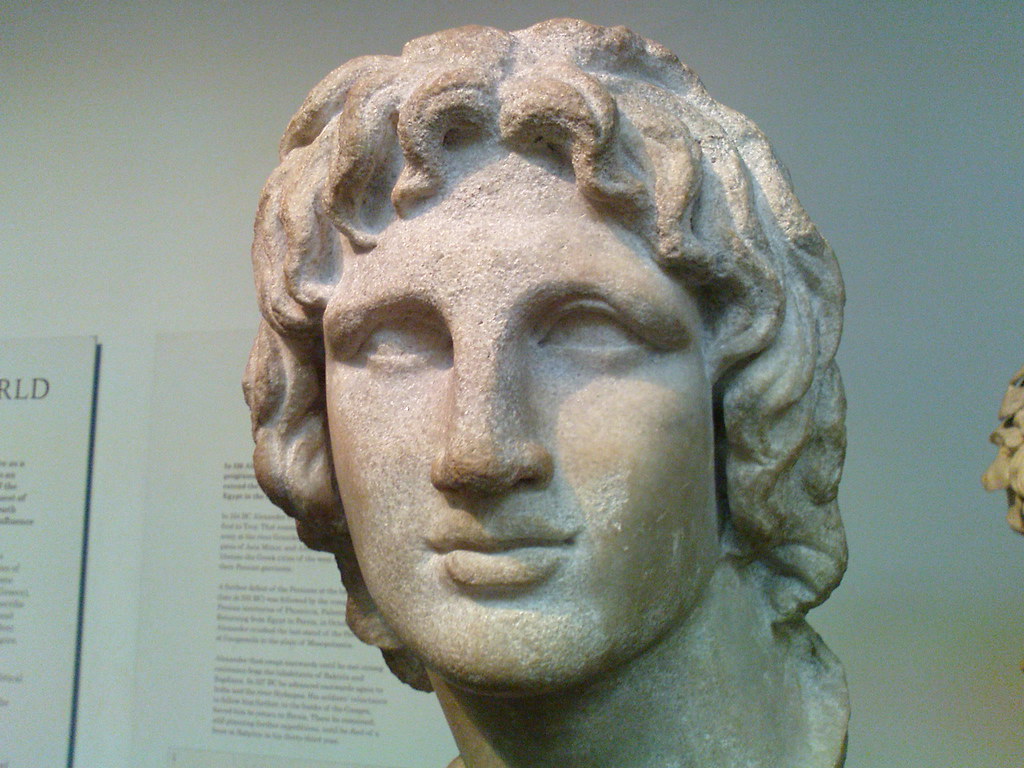
Why Alexander's Death Was the Ancient World's Greatest Accident
In June 323 BCE, Alexander III of Macedon died in the palace of Nebuchadnezzar II in Babylon. He was 32 years old. The cause remains disputed — typhoid fever complicated by alcohol, West Nile virus, poisoning, or a combination — but the consequence was immediate and catastrophic. The man who had spent twelve years building the largest contiguous empire the world had ever seen died without a clear successor, without a functioning central administration, and without finishing any of his announced next campaigns.
The Wars of the Diadochi — the "Successors" — began almost immediately. By 281 BCE, forty years after Alexander's death, his empire had been carved into at least three major successor kingdoms: the Ptolemaic in Egypt, the Seleucid across Persia and the Near East, and the Antigonid in Macedonia and Greece. The unified Macedonian world Alexander had created existed for less than two years after his death. Every consequence historians associate with "the Hellenistic period" — its cultural diffusion, its scientific flowering, its eventual absorption by Rome — flows from that single political fact: Alexander died before he could consolidate what he had conquered.
This raises one of history's most productive counterfactual questions. What happens if he doesn't die in 323 BCE? What if he lives another twenty or even thirty years, into the 290s BCE? The answer is not simply "a bigger empire." It is a fundamentally different ancient world — one in which Rome may never dominate, in which Greek science achieves something closer to an industrial revolution, and in which the religious landscape of the entire Mediterranean basin takes a different shape.
The Point of Divergence: What Alexander Actually Planned
The most important detail for any alternate history of Alexander is that historians have clear records of what he intended to do next. He was not resting. Ancient sources, including Diodorus Siculus and Arrian, describe detailed plans at the time of his death: a massive naval expedition to circumnavigate Arabia and establish ports along its coast, campaigns into Carthaginian North Africa, and possibly further operations into the western Mediterranean. He had ordered the construction of a vast fleet at Babylon. He had dispatched exploratory missions. He was, by all accounts, less than a year from launching the Arabian campaign when he fell ill.
In our alternate history, the divergence is simple: the fever breaks. Alexander recovers in late 323 BCE, weakened but alive. His court remains intact, his generals still subordinate, and his plans already in motion. The Diadochi wars never happen — because there is no power vacuum to fight over.
The Arabian Campaign and What It Would Have Meant
The Arabian expedition is the most concrete near-term consequence. In the real timeline, no ancient power ever fully controlled Arabia's coasts — it remained a corridor of independent trade intermediaries connecting the Mediterranean to India and East Africa. Alexander had recognized, correctly, that whoever controlled those ports could tax the entire luxury trade of the ancient world.
Had he succeeded, the economic implications are enormous. The Nabataean Arabs, who built Petra and grew wealthy managing incense and spice routes, would likely have been absorbed or made tributary. The direct sea routes from India to Egypt that the Ptolemies later developed — routes that eventually funneled wealth into Rome — would instead have flowed into a unified Alexandrian empire. The financial base of such a state would have dwarfed anything the later Hellenistic successor kingdoms managed individually.
More importantly, a successful Arabian campaign would have consolidated Alexander's legitimacy in ways that no further conquest could. His troops were exhausted and had famously refused to march further east at the Hyphasis River in 326 BCE. Arabia was a different proposition — a maritime campaign with clear economic logic, manageable in scale, and winnable. Victory there would have given Alexander a decade of administrative work rather than military expansion, which is exactly what his empire needed.
The Succession Problem: The Real Reason the Empire Collapsed
Historians sometimes treat the collapse of Alexander's empire as inevitable — the result of overextension, cultural incompatibility between Greek rulers and Persian subjects, or the sheer logistics of governing territory from the Aegean to the Indus. But this misdiagnoses the problem. The empire's collapse was not structural; it was dynastic. Alexander died without a functioning heir. His son, Alexander IV, was born posthumously and was murdered as a child by 309 BCE. His half-brother Philip III Arrhidaeus, who was mentally incapacitated, was used as a figurehead and then killed. The Diadochi fought not because the empire was impossible to hold, but because no legitimate ruler existed to hold it.
A living Alexander solves this problem directly. He was not yet 33 when he died. A man who lived to 55 or 60 — roughly the lifespan of his father Philip II — would have had twenty to twenty-five years to do three things no one else could: name and groom a successor, purge disloyal generals before they became independent warlords, and create the institutional infrastructure (tax systems, provincial administrations, a professional civil service) that empires need to outlast their founders.
There is no guarantee he would have done this well. Alexander showed little interest in administrative detail during his lifetime. But the pressure of governing a settled empire rather than conquering new territory tends to produce exactly this kind of institutional investment — or, as with Augustus Caesar in a different century, it produces men around the ruler who do it on his behalf. Either way, the outcome is almost certainly more durable than what actually happened.
The Rome Question: Would the Republic Have Risen to Dominance?
Perhaps the most profound long-term consequence of a longer-lived Alexander concerns Rome. In 323 BCE, Rome was a mid-sized Italian city-state that had not yet completed its conquest of the Italian peninsula. It would not control all of Italy until 272 BCE, and would not defeat Carthage in the First Punic War until 241 BCE. The Roman Republic that became the Mediterranean superpower was still a half-century away from its decisive expansion phase when Alexander died.
Alexander had already received an embassy from Rome, according to some ancient sources. He was aware of it. And his planned western campaigns — against Carthage and potentially into Italy — would have brought Macedonian military power directly into contact with Rome during precisely the period when Roman institutions were still fragile and the Italian confederation still forming.
This does not necessarily mean Alexander conquers Rome. His army was the finest in the world, but Rome's legionary system and political resilience were already distinguishing features by this era. More plausibly, Macedonian intervention in the western Mediterranean restructures the balance of power in ways that prevent any single Italian city-state from achieving the dominance Rome actually achieved. The Carthaginians, Etruscans, Samnites, and early Romans exist in a multipolar western Mediterranean overshadowed by a Macedonian superpower to the east. Rome might still become important, but it does not become inevitable.
The downstream implications are staggering. Roman law, the Latin language, the Roman road system, early Christianity's institutional spread through Roman infrastructure, and the political inheritance that eventually shaped medieval Europe — all of these depend on Rome winning its wars in the third and second centuries BCE. In an Alexander-survives timeline, that sequence is broken or at minimum severely disrupted.
Hellenistic Science and the Road Not Taken
One of the most tantalizing aspects of this counterfactual is what it might mean for the history of science. The Hellenistic period produced an extraordinary cluster of scientific achievement: Eratosthenes measuring the circumference of the Earth, Aristarchus proposing a heliocentric solar system, Archimedes developing the foundations of calculus, Hero of Alexandria building primitive steam-powered devices. All of this happened in a fragmented, politically unstable world of competing successor kingdoms.
A unified Alexandrian empire with stable funding, a single administrative language, and strong patronage of the Library of Alexandria model — which Alexander himself initiated in Egypt — creates different conditions for this scientific work. The resources available to scholars, the communication between research centers in Alexandria, Babylon, and Taxila, and the practical application of scientific knowledge to imperial engineering projects (roads, irrigation, naval architecture) all scale upward significantly in a unified state.
It is not fanciful to suggest that ancient science, under these conditions, might have made the leap from theoretical insight to systematic technological application one to two centuries earlier than it did. Hero's steam engine, a curiosity in the fragmented ancient world, becomes a practical investment in a state that needs to pump water from mines and move grain across a continent. The historical conditions for an ancient industrial revolution — energy surplus, institutional support, practical incentive — come closer to alignment.
This is the most speculative part of any Alexander counterfactual, but it is also the most historically important. The reason the steam engine was developed in 18th-century Britain and not in 1st-century Alexandria is not primarily one of intelligence or knowledge — ancient scientists understood the relevant principles. It is a question of institutional context and economic incentive. A surviving Alexandrian empire changes that context fundamentally.
Tensions and Limits: What Alexander Could Not Have Fixed
Honest counterfactual history requires acknowledging the constraints on any alternate timeline. Several features of Alexander's situation would have remained genuinely difficult regardless of his survival.
The cultural integration problem was real and deep. Greek Macedonians resented Alexander's adoption of Persian customs — the proskynesis (prostration before the king), the Persian dress, the integration of Persian nobles into the officer corps. These tensions nearly produced multiple mutinies during his lifetime. A longer reign extends the duration of this friction. It is possible Alexander would have managed it through a generation of hybrid elites who grew up in the blended culture; it is equally possible that the resentment would have produced a coup or civil war from within his own court.
The logistical reality of governing a territory stretching 5,000 kilometers from west to east was also genuinely without precedent. The Achaemenid Persian Empire had managed it through a sophisticated system of satraps, royal roads, and local intermediaries — a system Alexander had largely inherited but not yet fully reformed. Building robust provincial institutions takes decades, and Alexander's record suggests impatience with administrative work. He would have needed capable, loyal deputies willing to govern permanently rather than campaign, and finding such men while retaining their loyalty was a chronic problem in ancient autocracies.
Finally, there is the question of personality. Alexander was a conqueror by temperament and upbringing. The evidence suggests he was constitutionally unsuited to the sedentary work of administration. The same qualities that made him extraordinary as a general — impulsiveness, personal charisma, willingness to take enormous risks — are liabilities in a peacetime ruler. A longer-lived Alexander might simply have launched more campaigns rather than building the institutions his empire needed, ultimately producing the same fragmentation on a delayed schedule.
Historical Verdict: A Contingent World
The most important lesson of the Alexander counterfactual is not about Alexander specifically. It is about contingency in history. The ancient world as it actually developed — Roman dominance, the particular spread of Christianity, the specific shape of the Byzantine and Islamic civilizations that followed — was not inevitable. It was the product of a specific sequence of events that included, as one of its most significant inputs, the untimely death of a 32-year-old king in Babylon in June of 323 BCE.
Had Alexander lived, the world we inhabit would be unrecognizably different. Not better or worse in any simple sense — his empire would have had its own oppressions, its own wars, its own suppressed peoples — but structured around entirely different political and cultural foundations. The languages we speak, the religions practiced by billions, the political institutions that shape modern life: all of these trace ancestry to a world that might have been profoundly otherwise.
That is what makes this scenario the most consequential "what if" in ancient history. No other single death, in the ancient world or perhaps in all of history, changed more by its timing.
Explore This Scenario Interactively
The analysis above is our editorial take. On Alternate History AI, you can shape your own version of events — choosing how Alexander responds to his generals' resistance, which campaigns to prioritize, and how to manage succession. Each decision produces a different simulated timeline.
Select an interactive scenario and start exploring →
References and Further Reading
- Wikipedia: Alexander the Great — comprehensive overview with primary source citations
- Britannica: Alexander the Great — scholarly summary of his campaigns and legacy
- Britannica: Wars of the Diadochi — the succession conflicts that followed his death
- World History Encyclopedia: Alexander the Great — detailed articles on his campaigns, court, and cultural policies
- AlternateHistory.com community discussion — reader-generated timelines and debate
- YouTube: What if Alexander Lived Longer? — video explainer
What if Queen Elizabeth I was never born? · What if Napoleon won at Waterloo? · What if the Ming Dynasty sailed to America?